• About
  • Best Baby Names
  • Celebrity Baby Names
  • Celebrity Baby Names – Current
  • Celebrity Baby Names – Past
  • Featured Boys Names
  • Featured Girls Names
  • Featured Unisex Names
  • Links to Name Data
  • Waltzing on the Web

Waltzing More Than Matilda

~ Names with an Australian Bias of Democratic Temper

Waltzing More Than Matilda

Tag Archives: Spanish names

Melbourne Suburbs That Could Be Used as Girl’s Names

08 Sunday Jul 2012

Posted by A.O. in Name Themes and Lists

≈ 12 Comments

Tags

astronomical names, Australian Aboriginal names, bird names, Brazilian names, Bunurong names, created names, english names, famous namesakes, Gaelic names, gemstone names, germanic names, Greek names, Irish names, Latin names, literary namesakes, locational names, mythological names, name history, name meaning, name popularity, nature names, Old Norse names, Palawa names, plant names flower names, popular culture, Portuguese names, Scottish names, Spanish names, tree names, unisex names, Visigothic names, vocabulary names

Cardinia

Cardinia is an outer suburb of Melbourne, in the shire of the same name. The name Cardinia is taken from the local Bunurong phrase Kar Din Yarr, meaning “to look towards the rising sun”. I’ve always thought this would make a great girl’s name, with an interesting sound and an inspiring meaning. To me it sounds like a cross between Caroline and Gardenia, and is a native alternative to Dawn and Aurora.

Clematis

Clematis is another outer suburb in the Shire of Cardinia, leading into the Dandenong Ranges. It’s a tiny village dating to the turn of the century, with a few basic amenities. Its fire brigade formed in 1936, takes about 100 emergency calls per year, and has fought many major blazes in Victoria and New South Wales. The suburb is named after the climbing plant, which looks wonderful in the garden and has large, beautiful flowers. The plant’s name is Ancient Greek, and probably referred originally to the periwinkle (the plant we call clematis is from Asia, and related to the buttercup). Clematis is an elegant name filled with Edwardian charm; it’s more unexpected and alluring than Clementine.

Doreen

The name Doreen looks like an elaboration of the name Dora, perhaps influenced by Kathleen, and is said to have been invented by English author Edna Lyall, who published a novel called Doreen in 1894. The Doreen in her story was an Irish singer, and possibly Lyall had heard of the Irish name Dáiríne, which is pronounced daw-REEN-uh, and means “fertile”. Although this outer suburb of Melbourne had been settled since 1844, it was renamed Doreen in 1895, just a year after Lyall’s novel. Perhaps someone was a big fan of the book? Doreen plays a role in Australian literature too, for poet C.J. Dennis wrote a famous verse-novel called Songs of a Sentimental Bloke (1915), in which larrikin Bill meets, courts and marries his sweetheart. This is a girl who works in a pickle factory called Doreen, and she turns Bill from a Melbourne gang-member into a contented husband and father. It’s been made into two movies, a musical, a TV show and a ballet. Doreen was #83 in the 1900s, and peaked in the 1920s at #21, no doubt influenced by the rhymes of C.J. Dennis. It hasn’t charted since the 1970s.

Emerald

Emerald is a town and semi-rural area in the Shire of Cardinia, and its post office first opened in 1899. It’s a popular tourist destination, because it has the Puffing Billy steam train railway which opened in 1900, and enjoyed its heyday in the 1920s. The town also holds a number of festivals through the year. Emeralds have been mined on a small scale in New South Wales and Western Australia; there is a town in Queensland named Emerald; and David Williamson’s play Emerald City is a classic of modern theatre – the title a reference to The Wizard of Oz. Emerald is a name that I’ve seen in occasional use, and the popularity of Ruby is almost certainly making other gemstone names for girls seem more usable. It also has a connection to Ireland, because this country is known as The Emerald Isle. The name is ultimately from the Greek, meaning “green gem”. Perhaps the town got its name because it is set in the forest like a green jewel – although Gembrook is just up the road.

Iona

Iona is a rural area in the Shire of Cardinia; its post office opened in 1898, and it received its current name in 1905. It is named after an island in the Hebrides, off the coast of Scotland. According to tradition, Saint Columba founded a monastery there in the 6th century, and it played a vital role in converting the Picts of Scotland and the Anglo-Saxons of northern England to Celtic Christianity. A renowned centre of learning for four hundred years, Viking raiders plundered it, and the monastery was abandoned. Today it has an ecumenical Christian community, active since the 1930s; they worship in the restored medieval Iona Abbey. The island’s name is thought to come from the Gaelic for “place of yew trees”, but may also be from the Old Norse for “island of the bear cave, island of the animal den”. It is still a popular name in Scotland, and seems like a good alternative to the popular Isla with the fashionable OH sound in it (it’s said ie-OH-na).

Jacana

The suburb of Jacana was originally farmland owned by Duncan Kennedy in the 1840s, and its streets were laid out in 1923 after the land was sold. During the 1950s to 1970s, the land was developed by the government Housing Commission, who built most of the houses. They also re-named some of the early streets, which had been given jocular names such as Emu Parade and Sunset Boulevard. Being developed as a Housing Commission suburb, it is a lower-middle and working-class area with good amenities. The suburb is apparently named after Jacana Avenue, which is in the next suburb of Broadmeadows; other streets nearby also have bird names, such as Ortolan and Dacelo. Jacanas are tropical birds that live on lily lakes in wetlands and found world-wide; in Australia we have the Comb-Crested Jacana. Its name is Brazilian-Portuguese, and pronunciation is very diverse around the globe. The Australian way to pronounce it is juh-KAH-nuh, although the original is more like ZHAH-suh-NUH. I think this is a pretty and unusual bird name that sounds similar to Jacqueline, Jana and Jacinta, but with its own “feel”.

Kallista

Kallista is in the outer suburbs, and the first European inhabitants were loggers in the 1850s; gradually farmers began settling in the area as the forest was cleared. From early on, the government preserved a section of it as state forest, and once the roads were completed, Melburnians began using it for weekenders and holiday homes. During the Depression, many people could not afford the luxury of a second home for holidays, and they were bought up cheaply by those hoping to support themselves by living off the land. The suburb gained its name in 1925, from the Ancient Greek Kalliste, meaning “most beautiful”. In Greek mythology, Callisto or Kallisto was one of the nymphs of Artemis, although Kalliste was one of the epithets of the goddess herself, and the stories of the nymph were probably originally about Artemis. Callisto was seduced by Zeus, and gave birth to a son named Arcas, who became the king of Arcadia. Jealous Hera turned Callisto into a bear, and when a teenaged Arcas was hunting in the woods, he almost shot his own bear-mother. Zeus placed them in the sky as the constellations Ursa Major and Ursa Minor to protect them. A very pretty “star” name.

Olinda

The outer suburb of Olinda began as a logging settlement, but began growing in the early 1900s as land became available for market gardening. It is famous as the home of artist Sir Arthur Streeton, and today is an artsy-craftsy sort of suburb, studded with antique shops and galleries. Olinda is named after Olinda Creek, which has its source in the suburb, and the creek was named after Alice Olinda Hodgkinson, the daughter of Victoria’s acting surveyor-general in 1859. Her unusual middle name is something of a mystery to me – I have seen it defined as a German name meaning “defender of the land”, which became used in Spain thanks to the Visigoths. However in English, this name is said to be derived from the place Olynthus in Greece, meaning “fruit of the wild fig tree”. Olinda’s Adventures was the first novel of a precocious teenage writer in the 17th century called Catherine Trotter. It fits in with other literary names of that period, such as Orinda and Belinda. It sounds like retro Linda, dressed up with the fashionable OH sound, and still seems exotic and poetic.

Sassafras

Sassafras is in the outer suburbs, and lies between Olinda and Kallista. It was opened to farming in the 1890s, and a small township developed. Around the turn of the 20th century, it began to attract tourists, and still caters for them, with boutique stores, cafes serving Devonshire teas, and garden nurseries. Sassafras has very fertile volcanic soil, which makes it ideal for growing plants. Aptly enough, it is named after the sassafras tree, found growing there in profusion. These are not true sassafras, which are native to North America and Asia, but Southern Sassafras, an ancient tree from the southern hemisphere, with several species native to Australia. The one in Victoria is Atherosperma moschatum, and it grows in cool temperate rainforest. An evergreen, it flowers in winter with white petals, and its springy timber is in demand for speciality woodwork. The word sassafras is thought to be a corruption of saxifrage, an unrelated genus of tough alpine plants; their name is from the Latin for “stone breaker”. I have seen this once in a birth notice for a baby girl; it’s an unusual plant name which gives the nicknames Sass and Sassy.

Sunshine

This inner-city suburb has been a township since the late 19th century, and is an important part of our industrial history, because the Sunshine Harvester Works were moved here in 1906 by H.V. McKay, and became the largest manufacturing plant in Australia. It was after this that the suburb was given its present name; it is believed that McKay chose Sunshine for the name of his business after hearing a sermon by visiting American evangelist Rev. Thomas de Witt Talmage. The word sunshine seems to have been frequently used in Talmage’s writings, as a symbol of happiness and God’s blessings. McKay planned Sunshine on Garden City principles, and workers flocked there to live. The manufacturing plant was demolished in the early 1990s, but there is still plenty of industry, and it has attracted many migrants, especially from Malta and Vietnam. Skier Lydia Lassila grew up here, as did singer Bon Scott; Prince Philip lived here briefly. This cheerful, friendly name isn’t just from nature – it’s one connected to our manufacturing history, and also has idealistic Christian roots. Although unisex, the film Little Miss Sunshine helps give it a feminine edge. Sunny makes a cute nickname.

Truganina

This suburb is named after Truganini, considered to be the last “full blood” Palawa (Tasmanian Aborigine). Truganini was a chieftain’s daughter born in 1812 on Bruny Island, described as a vivacious and intelligent woman by contemporary sources. Her mother was killed by whalers, her two sisters were abducted and taken as slaves, her fiance died saving her from being abducted herself. Efforts at conciliation meant that Truganini and the last surviving Palawa people were moved around, including a short time in Melbourne, which is how the suburb received its name. By 1873, Truganini was the last Palawa left, and she died three years later. Her final request, that her ashes be scattered in the D’Entrecasteaux Channel near her island home, was ignored; she was buried in a convict workhouse in Hobart. Two years later, her skeleton was exhumed, and put on display by the Royal Society of Tasmania. In 1976, a century after her death, her last wish was finally fulfilled. Her name is the Palawa word for the tough plant we call grey saltbush (Atriplex cinerea), and can be spelled a number of ways. This could make an interesting heritage choice, although its namesake is a tragic symbol of Indigenous genocide. The correct pronunciation is not known, but Truganina could be said to give the nicknames True and Nina.

(Picture shows the Puffing Billy steam railway in Emerald)
MYTH: Australian Baby Names are Becoming Increasingly Influenced by American Trends

01 Sunday Jul 2012

Posted by A.O. in Baby Name Mythbusters

≈ 20 Comments

Tags

Australian names, Biblical names, classic names, created names, famous namesakes, fictional namesakes, flower names, French names, germanic names, Greek names, Irish names, Italian names, Mer de Noms, name data, name popularity, name trends, nicknames, Old English names, popular names, saints names, Scottish names, Spanish names, surname names, unisex names, US name trends, US popularity, Welsh names

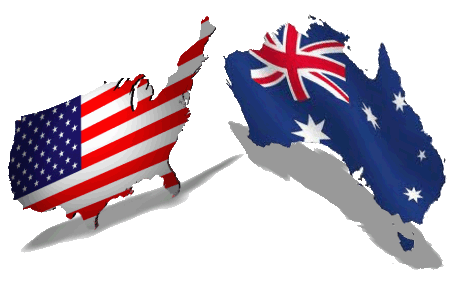
Since I last went mythbusting, the 2011 name data from the United States has been released, and this week it’s American Independence Day. To celebrate both events, I decided to compare Australian and US name data. (Lou at Mer de Noms brought out her own comparison of the data for the United States and England/Wales in May, and did something pretty interesting with it.)

That Australians are becoming increasingly Americanised, including their choice of baby names, is something not debated, but accepted as a truism. It is often mourned by older generations that Australians used to call their children good solid Aussie names like Barry and Sheila, and now give them sleek American-style names like Logan and Scarlett.

It’s a myth which sounds very plausible – I certainly know far more children named Logan and Scarlett than I do Barry and Sheila (actually I don’t know any children called Barry or Sheila). But I thought we should try to get some numbers to back the myth up.

So I decided to look at the Top 100 names from both countries, in the years 1930, 1950, 1970, 1990 and 2011. If the number of names shared by both countries went steadily up, that could help support the theory that Australian names were becoming increasingly “American”. By no means conclusive proof, but it would be a start, and frankly I couldn’t think of any other way of doing it.

As I went through calculating the number of shared names, I also took note of those trends at work in Australia and the United States, where they were the same and where they differed. This gave me a picture of changing trends through the years. (The data is from Victoria, because theirs go back to 1929).

1930

MALE – 65% shared with US Top 100

1930 marked the highest percentage of shared names between the countries. This wasn’t because Australians were more “American” in 1930, but because in every year, the common denominator for both countries were classic names like John, Thomas and William, and these sort of names took up more space of both countries’ Top 100.

Trends noticeable on the Australian Top 100 were names from Ireland, Scotland and Wales, such as Kevin, Malcolm and Trevor, and aristocratic English surnames, such as Neville. Americans preferred prominent surnames of their own citizens, such as Elmer and Lee. Popular names from America we didn’t share were “cowboy” names – Wayne, Earl and Jesse. In America, nicknames for boys were all the rage, including Billy, Bob and Jimmie.

FEMALE – 51% shared with US Top 100

Popular girls names in both countries were homespun names such as Margaret and Dorothy, as well as plant names like Hazel and Rose.

Australian trends for girls included names from Ireland and Wales, such as Sheila and Gweneth, saints names such as Carmel and Veronica, and literary inventions like Doreen and Mavis. American trends were for Germanic names such as Emma and Clara, and the clunky Old English Mildred and Bertha. America’s Hispanic population meant that Delores and Juanita were Top 100 there.

1950

MALE – 59% shared with US Top 100 (down 6%)

American trends for boys we had picked up by 1950 include Gary, after Hollywood star Gary Cooper, and that supposed Australian favourite, Bruce, also popular in the US.

America continued its love of nicknames, with Bobby, Joe and Fred all Top 100. Several of the Irish boys names such as Kevin and Barry were now on the US Top 100 as well, but new Irish-style names such as Shane were still to gain American acceptance. Already in the US you can see a reluctance to use “feminine sounding” or unisex names such as Lindsay and Noel, which were Top 100 in Australia. In Australia, that same 1950s gender-anxiety produced the opposite result, with some unisex names like Leslie becoming male-only.

FEMALE – 47% shared with US Top 100 (down 4%)

The most noticeable shared trends for girls were those glamorous Hollywood names such as Marilyn (Monroe) and Rita (Hayworth). Even when Australians did take a name from America, such as Jennifer from Hollywood star Jennifer Jones, it didn’t always follow that Americans would embrace it as rapidly themselves. Jennifer was a 1950s name in Australia, but didn’t peak in the US until the 1970s.

Australian girls were being given French names like Annette and Jeanette, while Americans girls had Jacqueline. Another popular Australian “French” name was Lorraine, given in honour of St Joan of Arc, sometimes called The Maid of Lorraine. The American love of the nickname meant that names such as Judy and Peggy were Top 100 for girls.

1970

MALE – 56% shared with US Top 100 (down 3%)

Popular 1970 names which we think of as “American style” were in evidence on both charts, such as Bradley, Jason, Glenn, Darren and Craig.

Australian boys names not picked up in the US included Scottish-style names such as Ross, Graham, Stuart and Gavin, and the “feminine sounding” Ashley and Jamie. Differing ethnicities also made their mark, with Spanish Carlos in the US Top 100, and Italian and Greek names like Giovanni and Giorgio in the Australian Top 100. American nicknames powered on, with Larry, Terry and Jerry amongst them.

FEMALE – 51% shared with US Top 100 (up 4%, return to 1930 level)

It was the decade of those 1970s names Sharon and Tracey, although Sharon in particular had been popular in America for some time and we’d only just caught up.

Names such as Samantha and Amanda were already popular in Australia in 1970, but would have to wait until the 1980s to make it big in the US. Conversely, Amy was popular in the US, but wouldn’t be here until the 1980s. French Nicole was in vogue in both countries, and we’d caught up with Jacqueline; however Australia also had Danielle, Louise, Justine, Natalie, Simone and Josephine – typical 1970s girls names that were underused in the US. Scottish and Welsh names like Fiona, Megan and Bronwyn were popular here but didn’t get a look-in in the US. We were proudly using names of Australian origin, like Kylie and Narelle; naturally these were unknown in the US.

1990

MALE – 56% shared with US Top 100 (no change)

Trends from the US we were embracing were Old Testament names, such as Jacob and Zachary; and the new surname names, such as Ryan and Mitchell.

A new generation of “too feminine” boys names that were popular in Australia were ignored in the US, such as Shannon, Tristan and Leigh, as were more Scottish, Welsh and Irish-ish names, such as Lachlan, Rhys and Kane. Hayden and Jayden were already Top 100 in Australia, but not in the US. America had finally gone off nickname names, while Australia now had Jack, Jake and Ricky. American names Beau, Jackson and Tyson were popular then, as now, in Australia; of the three, only Jackson has hit the US Top 100 so far.

FEMALE – 56% the same as the US Top 100 (up 5%)

Names that both countries had in common were those typical 1990s names, like Tiffany, Brittany, Kayla and Caitlin.

Americana we were still to discover included unisex names for girls like Ariel, Shelby and Paige. Although the US had Danielle and Natalie by now, French names such as Monique, Elise, Renee and Madeleine which were popular here had apparently failed to make an impression. Although Welsh Caitlin was all the rage, the US were not on board with Tegan and Rhiannon, as we were. Most notably, Emma, Amelia, Charlotte, Sophie, Chloe and Zoe were missing from the US Top 100 – while American parents who chose these names in 1990 were ahead of the trends, in Australia, parents choosing these names in 1990 were just following the trends.

2011

MALE – 59% shared with US Top 100 (up 3%, return to 1950 level)

Congruence in popularity between the two nations has risen to 1950 levels, with many name trends in common, mostly a fresh crop of Biblical names, such as Elijah, and surname names, such as Mason.

American parents are now avoiding a new generation of Scottish names, such as Angus and Hamish, while Irish names like Declan and Flynn are also neglected in the US. Oddly enough, Kevin is still Top 100 in the US, while it’s considered a bit dated here. The scunner against nicknames continues as Americans shun Australian populars Charlie, Harry, Archie, Sam and Nate. No longer merely  shying away from “feminine sounding” names for boys like Bailey and Riley, parents in the US have actually given these names to their daughters in such numbers that they are now Top 100 for girls, while Top 100 for boys here. Several names we have taken from the US, such as Jett, Hudson and Jasper, are still not popular in America.

FEMALE – 47% shared with US Top 100 (down 9%, return to 1950 level)

Girls names have also returned to 1950s levels. Many names are shared because America has caught up with our popular names from 1990, but Australian parents have also begun to use unisex names for girls like Madison and Addison.

America has abandoned many names as “outdated” such as Amy, Jessica, Holly and Amber that have taken on “modern classic” status here. While America has accepted Lily, it is less keen on our popular plant names Daisy, Ivy, Violet, Willow, Olive and Rose. British-style names such as Isla and Imogen cut no mustard in the States. Meanwhile, popular American virtue names like Genesis, Serenity, Trinity, Nevaeh and Destiny do not resonate here. Perhaps they will in the future.

CONCLUSIONS

I did not manage to bust this myth, but neither did I find much evidence to support it, so I will give its status as MYTH UNCONFIRMED.

As I compared popularity charts from the two countries, I realised more and more that it was a case of apples and oranges. Names took longer to gain popularity in the US, and it was harder for them to stay in the Top 100; name popularity was a competitive environment there. Australia has a much smaller population size, which means that name trends show up faster here. We’re also more likely to hold onto our favourite names once we’ve found them, sometimes for generations.

I don’t think it’s an exaggeration to say that American parents are absolutely obsessed with getting ahead of the current trends, and can watch the slowly rising popularity of their chosen names with almost comical anxiety. This makes some sense, because trending names can take so long to reach the Top 100 that they have a good chance of having ten to twenty years before that happens. In Australia, this behaviour makes no sense at all, because as soon as a name begins to show up in the data, it’s basically already quite popular. As we keep names around for longer, there’s no real rush to “catch” a name on the way up either; we can always wait until it’s a cosy, familiar “classic”.

In any given year, Australia and the US will share around half the names on their respective Tops 100s, and this has not changed across time. We share many name trends, and since at least 1950, Australia has been drawn to names from America. Sometimes it took us a long time to get onto a particular trend from America, and other times we took to it with greater enthusiasm than Americans did themselves.

Both countries also have their own styles of naming. Australia has always been fond of Irish-inspired names, and although Barry and Sheila have fallen by the wayside, we now have Finn and Molly. Scottish names continue to be a growth area, with Angus, Hamish, Callum and Isla seeming rather stylish to us. Through the years, there were many names unique to the Australian popularity charts. Names that I thought of as typical of their period, such as Dulcie in 1930, Glenys in 1950, and Jacinta in 1970 seemed to be unknown in the US.

Americans are slow to adopt Irish names, but often touchingly faithful to them, and are wary of Scottish and Welsh names. They have a deep suspicion of unisex names for boys or anything that even sounds remotely feminine, while comfortable with briskly masculine names for girls. Flower names are not popular there; perhaps they seem too girlish even for girls.

Due to going overboard on nicknames in the past, America has developed almost a horror of them, much in the same way I can no longer stomach gingerbread after overindulging on it a few Christmases ago. As nicknames are currently internationally popular, this has seen them unfairly branded as a bit stuffy on the issue, when they’re really just over the whole thing.

We don’t have to try to follow American trends, and in fact a couple of them would be downright foolish for us to imitate. But the United States has proved a rich source of name inspiration for many decades, and I know it will continue to be so for many decades to come.

Can You Suggest an Australian-Themed Name for the Third Triplet?

18 Friday May 2012

Posted by A.O. in Naming Assistance

≈ 28 Comments

Tags

angel names, constellation names, famous namesakes, fictional namesakes, Greek names, holiday names, mythological names, name history, name meaning, name popularity, name trends, nature names, nicknames, patriotic names, plant names, Spanish names, surname names, themes for triplets, tree names, triplet sets, unisex names, US name popularity, vocabulary names

Gabbi is an ex-pat Aussie originally from Perth, in Western Australia; she lives in the United States with her husband and six children. The family will be welcoming children 7, 8 and 9 in a few months, because they are expecting fraternal triplets – two boys and a girl.

Now if Gabbi had been having boy-girl twins, there would be no naming problem, because they have already chosen gorgeous names for the girl and one boy baby: Clover and Jasper.

The names fit together perfectly, because both reference the number three (Jasper was one of the three wise men, and clovers usually have three leaves), and both are associated with luck or gifts. They both bring to mind particular colours as well, because jasper stones are red, and clover is of course green; furthermore, they are both connected to special days of the year (Epiphany on January 6, and St Patrick’s Day on March 17).

Gabbi is now very concerned that the third triplet receives a name which has a special meaning of its own: even if it doesn’t fit in exactly with Clover and Jasper, it needs to be meaningful and have its own significance, rather than just being an afterthought. She would love it if the third triplet receive a name which is connected to Australian culture and celebrates Gabbi’s heritage, without being anything too obvious, like Sydney or Jack.

Other name preferences

  • Nothing too popular – one of Gabbi’s sons has a name which became very popular, and she doesn’t want that to happen again. (Gabbi actually stipulated that the name had to be outside the 300s, but I thought that was too strict, especially considering Jasper is in the 200s, so I restricted myself to names outside the Top 250).
  • Nothing too unusual that will really stick out in America – no Bluegum or Gallipoli
  • Nothing too obviously political, he’s not a bumper sticker
  • The family has a long, complicated surname, so the name needs to be simple to spell and pronounce

Names that have already been considered and rejected

  • Alister (dislikes nn Al)
  • Archer (too trendy, dislikes nn Archie)
  • Asher (too popular)
  • Finn (too popular)
  • Flynn (too connected to its namesake, Erroll Flynn)
  • Jonah (too popular)
  • Micah (too popular)
  • Miller (loves the name, but not the beer connection in the US)
  • Sawyer (too popular, too often used as a girl’s name)
  • Sayer (worries it looks “made up”)
  • Zephyr (Gabbi’s husband has vetoed as “too weird”)

The other children in the family tend to have names which are fairly popular in Australia, but underused in the United States. They are quite “cute” sounding, and even if unisex, used far more by one gender than the other.

Although Gabbi is interested to see what names I come up with, she would also love blog-readers to contribute any thoughts or ideas they have.

MY SUGGESTIONS

Felix

I think this goes with Jasper and Clover rather nicely, and is by far my top choice for Triplet Number Three. Felix means “lucky”, and Australia Felix is the name given to lush pastureland; there’s also a Great Australian Novel called Australia Felix, by Henry Handel Richardson (like George Eliot, Henry was a woman). It also reminds me of Felix the Cat, which was an Australian-American creation, and in LA, Felix the Cat is used on a three-sided sign. Although Top 100 in Australia, Felix is only #311 in the US.

Phoenix

A similar sound to Felix, but it references the colour red, which fits with Jasper. In China, the phoenix is a symbol of luck, and has great significance in terms of immortality and resurrection. The Phoenix is one of the constellations of the Southern Hemisphere, and is most visible around Christmas time – I thought this fitted in rather nicely with Jasper’s Christmassy meaning. Although quite popular in Australia, it is only #388 in the United States. However, you may be bothered by the fact that it also charts for girls in America, and possibly Phoenix the city in Arizona is also an issue for you.

Orion

This is another constellation name, one which references the number 3, because Orion is famous for having three stars in his belt, and even the absolute beginner (or a small child) can locate them easily in the night sky. Like the Phoenix, Orion is another constellation which is most visible around Christmas time. The RAAF have a plane called the Orion, while in the USA, it is the name of a ship, and a rocket. Orion seemed like a name from Greek mythology which might be less “weird” than Zephyr. It is #471 in the US.

Finlay

This seemed like an obvious alternative to Flynn and Finn, with a similar sound and origin, yet not even on the Top 1000 in the US. Because Finlay is connected to the colour white, it also seems a nice match with Jasper and Clover. There’s a rather nice connection to Gabbi’s home state as well, because Garfield Finlay was a World War I flying ace who lived in Perth, Western Australia, before the war.

Rafael

Names starting with Raf- are very much on trend in Australia, yet not over-used in the United States. This is the Spanish form of Raphael, the name of a healing archangel, and seems just as special as Jasper and Clover to me. An Australian connection is that Raphael Aimbari was an Ori man who helped Australian soldiers on the Kokoda Campaign during World War II; there is a statue of him in Brisbane. I think Rafe makes a very dashing nickname. Rafael is #274 in the US, but has been stable for some time and isn’t climbing up the way Jasper is. Raphael is #668, but seems harder to spell than Rafael.

Lawson

There are said to be three great Australian poets – Banjo Paterson, C.J. Dennis, and Henry Lawson. Banjo seems too out-there for you, and Dennis is a bit old-fashioned, but Lawson seems like a nice Australian replacement for Sawyer (both surnames, similar vowel-sounds). The surname means “son of Laurence”, and the name Laurence is connected by meaning to the bay tree, a symbol of success. It’s a subtle nature-themed name which again makes me think of a colour. It’s #580 in the US.

Shepherd

Another surname; this one reminds me of the conservation organisation, Sea Shepherd, which operates in Australia and the US. Interestingly, Sea Shepherd has three ships in its main fleet. It is a subtle environmental name, reminding us that we are all guardians of life on earth. At the same time, it’s another “Christmas-themed” name to go with Jasper. This name hasn’t been on the US Top 1000 since the 19th century.

Franklin

Another environmental namesake, because the successful fight against the proposal to dam the Franklin River in the Tasmanian wilderness was a landmark in Australian environmental activism. Aptly, the surname Franklin means “free man”, and the call of the activists was to let the Franklin River run free. This has a wonderful American connection too, because of Benjamin Franklin. It also reminds me of the word frankincense, as brought by the Three Wise Men. The name is #504 in the US, but I somehow feel the nickname Frank isn’t going to appeal to you.

Ash

This is another nature name which references a colour, and seems like a replacement for Asher. In Australia, it reminds me of the Ash Wednesday bushfires, which like the Phoenix, became another symbol of resurrection, of rising from the ashes. It also reminds me of the mountain ash, the tallest of all eucalypt trees, and one of the tallest trees in the world. Ash isn’t on the US Top 1000, but may be too unisex for you. You might consider it for a middle name though.

Talon

This is another nature name which is on trend in Australia, but underused in the United States. The main reason it occurred to me is because an eagle’s claw has three talons which are used to hold prey (the fourth is used for balance). The Wedgetail Eagle is very important in Aboriginal mythology, as Bunjil the Wedgetail Eagle is a creator deity. Of course, the Bald Eagle is the national bird of the United States, making it an important symbol for both countries. Talon is #516 in the US.

Which of these names do you think is the best match with Jasper and Clover? Or maybe you have your own suggestion for Jasper and Clover’s brother. If so, let’s hear it! All ideas are welcome.

NOTE: The triplets’ names are Clover, Jasper and Ash!

Global Girls – More Names from Around the World from the Bonds Baby Search

04 Wednesday Apr 2012

Posted by A.O. in Baby Contests

≈ 1 Comment

Tags

African names, Arabic names, Australian Aboriginal names, Chinese names, Dutch names, Ethiopian names, Fijian names, Finnish names, French names, German names, Greek names, hebrew names, Igbo Names, Indian names, Iranian names, Italian names, Japanese names, Maori names, Persian names, Polish names, polynesian names, Russian names, scandinavian names, Slavic names, Slovak names, Spanish names, Sri Lankan names, Swahili names, Swedish names, Turkish names, Xhosa names

Akira (Japanese et al)

Amara (Igbo et al)

Amaya (Spanish et al)

Anamaya (Indian)

Annalisa (Italian)

Annika (Swedish)

Anushka (Russian)

Anya (Russian)

Aranya (Indian)

Arya (Indian)

Astrid (Scandinavian)

Ayana (Swahili)

Belen (Spanish)

Catalina (Spanish)

Chalah (Hebrew)

Chava (Hebrew)

Diamalaini (Fijian)

Dika (Scandinavian)

Diya (Arabic)

Eleni (Greek)

Elisa (Spanish etc)

Eliska (Slovak)

Elke (German et al)

Emel (Turkish)

Evanthia (Greek)

Giuliana (Italian)

Grazia (Italian)

Hadassah (Hebrew)

Hanneke (Dutch)

Hawaiki (Maori)

Ilaria (Italian)

Indra (Indian)

Ivona (Slovak etc)

Jamilla (Arabic)

Jana (Slavic et al)

Jara (Slavic et al)

Jaya (Indian)

Jazarah (Ethiopian)

Jedda (Australian Aboriginal)

Jiaya (Chinese?)

Kaisa (Finnish)

Kamilah (Arabic)

Katia (Russian)

Lalita (Indian)

Latika (Indian)

Layal (Arabic)

Leilani (Polynesian)

Lidija (Slovak etc)

Liv (Scandinavian)

Magali (French)

Mannat (Indian)

Manarra (Arabic)

Mariam (Arabic et al)

Marta (Slovak etc)

Matarii (Polynesian)

Mathilda (German et al)

Meila (Dutch etc)

Mereana (Polynesian)

Mija (Finnish)

Mika (Japanese)

Milena (Slavic)

Naava (Hebrew)

Naeema (Arabic)

Nahla (Arabic)

Nalani (Polynesian)

Nataya (Indian)

Ngareta (Maori)

Nicolina (Italian)

Nikisha (Indian)

Nithara (Indian)

Oviya (Indian)

Porjai (Indian)

Raffaella (Italian)

Ru (Chinese)

Safia (Arabic)

Sakura (Japanese)

Samala (Hebrew)

Samara (Arabic et al)

Sana (Arabic et al)

Soraya (Persian)

Stefania (Italian etc)

Tamika (Indian)

Tarla (Indian)

Tatiana (Russian)

Thandiwe (Xhosa)

Thinuki (Sri Lankan)

Vanya (Russian – usually male)

Yianna (Greek)

Zaneta (Spanish)

Zari (Persian et al)

Zofia (Polish)

Multicultural Men – Boys Names from Around the World from the Bonds Baby Search

04 Wednesday Apr 2012

Posted by A.O. in Baby Contests

≈ 4 Comments

Tags

Afghan names, African names, Albanian names, Arabic names, Armenian names, Chinese names, Dutch names, Ethiopian names, Filipino names, Finnish names, French names, German names, Greek names, hebrew names, Igbo Names, Iranian names, Italian names, Japanese names, Lithuanian names, Macedonian names, Maori names, Persian names, polynesian names, Portuguese names, Russian names, scandinavian names, Spanish names, Swahili names, Swedish names, Turkish names

Aasil (Arabic)

Adnan (Arabic)

Adriano (Italian)

Akil (Arabic)

Alakai (Polynesian)

Aleksandr (Russian)

Amon (Hebrew)

Andre (French etc)

Andrei (Russian)

Anuj (Indian)

Aras (Lithuanian)

Ardem (Armenian)

Bavneet (Indian)

Benito (Italian)

Cihan (Turkish)

Chinedu (Igbo)

Dardan (Albanian)

Didyme (Greek)

Diego (Spanish)

Dimitri (Russian)

Djaali (Arabic)

Domenico (Italian)

El’Amein (Arabic)

Emil (German etc)

Emir (Arabic)

Eshaan (Arabic)

Eyob (Ethiopian)

Fuakava (Polynesian)

Gian (Italian)

Giorgio (Italian)

Giovanni (Italian)

Giuseppe (Italian)

Hamza (Arabic)

Hang (Chinese)

Heemi (Maori)

Henri (French)

Horomona (Maori)

Hussein (Arabic)

Ioannis (Greek)

Ishan (Indian)

Jabari (Swahili)

Jad (Arabic)

Jalal (Arabic)

Jin (Chinese)

Josef (German etc)

Kaan (Turkish)

Kalani (Polynesian)

Kareem (Arabic)

Kelepi (Polynesian)

Keoni (Polynesian)

Khamesa (Arabic)

Khan (Arabic)

Kheez (Arabic)

Khrishwin (Indian)

Kingi (Maori)

Kiva (Hebrew)

Koa (Polynesian)

Koray (Turkish)

Leonardo (Italian)

Levent (Turkish)

Lorenzo (Italian)

Lui (Polynesian)

Malik (Arabic)

Marcello (Italian)

Markell (German)

Massimo (Italian)

Mateo (Polynesian)

Matheos (Greek)

Matias (Finnish et al)

Michelangelo (Italian)

Mikail (Russian)

Mirza (Persian et al)

Nakoa (Polynesian)

Namish (Indian)

Naseem (Arabic)

Navrin (Indian)

Ngarani (Maori)

Niketas (Russian)

Nikita (Russian etc)

Nikolai (Russian etc)

Omar (Arabic)

Panagiotis (Greek)

Panayioti (Greek)

Paolo (Italian)

Pieter (Dutch etc)

Qiyamah (Arabic)

Rastin (Afghan)

Rauna (Polynesian?)

Ren (Japanese)

Riwai (Maori)

Rocco (Italian)

Ronin (Japanese)

Saalih (Arabic)

Sahar (Arabic)

Sahib (Indian)

Sahil (Indian)

Sanchay (Indian)

Sebatian (Filipino)

Shaunak (Indian)

Sobhi (Arabic)

Soltan (Persian)

Souvik (Indian)

Stefan (German etc)

Sulo (Swedish)

Taavi (Finnish)

Tariq (Arabic)

Tirso (Spanish)

Tommaso (Italian)

Toren (Dutch et al)

Trifun (Macedonian)

Vasco (Portuguese)

Vincenzo (Italian)

Walid (Arabic)

Yianni (Greek)

Zamzam (Arabic)

Zaya (Arabic)

Zayd (Arabic)

Zidane (Arabic)

Zied (Arabic)

Boys Names of Australian Aboriginal Origin

26 Sunday Feb 2012

Posted by A.O. in Name Themes and Lists

≈ 18 Comments

Tags

Australian Aboriginal names, Buddhist names, famous namesakes, fictional namesakes, Indian names, Indonesian names, Japanese names, Korean names, locational names, Maori names, name history, name meanings, Native American names, New Zealand names, nicknames, Quechuan names, Samoan names, scandinavian names, scientific names, seasonal names, Slavic names, South American names, Spanish names, surname names, unisex names

This follows on from last week’s list, Girls Names of Aboriginal Origin. It was more challenging to find boys’ names, because many, if not most, Aboriginal words end in a vowel, and easily conform to we think of a “feminine sounding” name. They are similar to names in Hebrew, Arabic, and in the Indian languages in that regard, and even now you will find people who insist that Ezra must be a female name, because it ends in -a.

These are not traditional or tribal Aboriginal names for men, but rather words from Aboriginal languages that I thought could be used as names by people from any culture. Some of them coincide with words or names from other languages, as I thought people may be interested to know that a word from their own heritage has a distinct Australian meaning as well.

Dural

Dural is a pleasant semi-rural suburb of Sydney, and its meaning has been in some dispute. It is said that dural was a word from the Dharug language, meaning “gully, valley”, and this information came from a traditional owner of the land in the 19th century. It was also said to mean “burning logs”, from the word dooral dooral, but this belief only dates from the 1940s, and is taken from the Wiradjuri language. As the Wiradjuri people are from central New South Wales, the local meaning is claimed to be the correct one. Translations of this name as “hollow tree” or “burned out tree” in baby name books can be safely discarded as invention. I think Dural seems very usable as a personal name, and I considered it for Sydney Suburbs That Could Be Used as Boy’s Names. It sounds like familiar names such as Darrell, and sturdily similar to the word endure.

Jarli

This word means “barn owl” in the Jiwarli language of northern Western Australia. As in many other societies, several Australian Aboriginal cultures saw owls as symbols of wisdom, mystery, secrets and sacred knowledge; messengers from one world to another, and companions of the medicine men. The owl features in several myths and legends, and is sometimes depicted in Aboriginal art. This name seems familiar to us, because Jarli is also a Scandinavian boy’s name based on the word for “earl”, and I have seen one or two boys with this name. I like the sound and the meaning of this name, and it is similar to another Jiwarli word: jali, meaning “friend”.

Kaiya

This word from a Queensland language refers to a spear with two barbs, and is pronounced KY-uh. It has been used in the Latin name for a species of caddisfly – Chimarra kaiya – who is so called because of its distinctive barb-like projections. In the Kaurna language of South Australia, the similar sounding kaya means “spear”, although in Nyungar it means “hello; yes”. This is always listed as a girl’s name in baby name books, but the name Kai makes this name look masculine to me. I don’t see how the sound of it is any more “girly” than, say, Hezekiah. The meaning does not seem feminine either. I would say it is a unisex name, and suitable for a boy.

Kuparr

This means “red earth, burnt earth” in the Ngiyampaa language of New South Wales. It refers to the ochre used for making body paint for the Coroborees; the sacred ceremonies of Indigenous Australians involving ritual, dance and music. Red ochre is also used in other Aboriginal forms. Kuparr was the basis for the name of the mining town Cobar, and because copper was mined there, it has also been suggested that it may have been the local way of translating the word copper. Most likely the similarity between the words is a coincidence though. The attraction of this name is that it sounds a bit like Cooper. If you like the sound of Cooper but think it seems a bit boring or surnamey, Kuparr might be for you.

Miro

Miro (MEE-roh) is a Nyungar word for a type of spear thrower which propels the aim of the gidgee; a fearsome qaurtz-tipped spear about 8 feet long. Miro exists as a name or word in several other languages. It’s a Slavic name which is short for Miroslav, meaning “glorious peace”. In Japanese, it’s short for Miroku, a Japanese form of Maitreya, the fifth (future) incarnation of the Buddha. In New Zealand, it’s the name for a species of conifer tree. In Korea, it means “maze”. It’s also the surname of Spanish artist, Joan Miró i Ferrà (Joan was a man) – his surname was short for Ramiro, the Spanish form of a Germanic name meaning “famous counsel”. It’s very multicultural, and none of the meanings that I’ve seen are negative. I think it’s attractive. We had a baby boy in a recent birth announcement named Finn Joseph Miro, so it’s considered usable in Australia.

Monti

This is one of the Aboriginal names for the Black-necked Stork, which is found across the tropical north of Australia, and is the only stork species native to Australia. I have not been able to track down which language it is from, except that it’s not from the Northern Territory, where this bird is called a jabiru. It’s therefore either from Queensland or northern New South Wales, as the only other places where this bird exists. It’s listed as one of the Indigenous names by museums, so I feel fairly confident it’s authentic. The stork is mentioned in several Aboriginal legends, one of them an extremely touching love story. The attraction of this name is that it sounds exactly like the fashionable name Monty, but has its own significance.

Tarka

This means “eggshell” in the Kaurna language of South Australia. I thought of it because I have seen the name Tarka used in the birth announcements from the London Telegraph. It has a number of meanings in other contexts. There is a well-loved English children’s book called Tarka the Otter, so famous that it has given its name to a railway line and a bike path in the West Country. It was made into a film in the 1970s. In the book, Tarka’s name was meant to suggest the barking sound that an otter makes. In India, tarka is a word for seasoning added to a meal, and in Quechuan, a tarka is a type of flute played by the Indigenous people of the Andes. Tarka Cordell was a British musician who died in tragic circumstances a few years ago; I’m not sure where his name was taken from, or whether he is the inspiration for British children having Tarka as one of their names. This is the second name with the meaning of “eggshells” I have suggested; the other was Keid. Because eggshells appear so fragile, and yet are surprisingly strong under compression, I find this meaning very evocative.

Tau

Means “evening, dusk, twilight” in the Kaurna language of South Australia, and is said to rhyme with the word cow. In Maori, it can mean a number of different things, including “sweetheart”, “song, chant”, “string”, or “ridge”. In one of the Indigenous languages of Indonesia, it means “man”. In Samoan, it can mean “anchor” or “war”. It’s known to many people in the context of the Tau Cross, a symbol of life which was used by the Egyptians, and became important in a number of different religions and spiritual paths, including Christianity. I have met men named Tau, but I’m not sure which meaning was associated with their names. I think Tau fits in very well with other popular names for boys, such as Ty, Tai and Taj, and would be readily accepted.

Warragul

Warragul, pronounced WOHR-uh-guhl, is a town in the West Gippsland region of rural Victoria, the birthplace of legendary Aboriginal boxer Lionel Rose. Its name is said to come from a local word, warrigal, meaning either “wild” or “wild dog”, referring to the dingo. The dingo is Australia’s largest predator on land, and its ancestor is thought to have been introduced to Australia by seafarers from south east Asia thousands of years ago, when dogs were less domesticated and more closely related to wolves. Dingoes play a major role in Aboriginal myths and legends; in stories they are often guardians of humans who can warn them of the supernatural or evil spirits. There are also myths of dingo-people shapeshifters, or “were-dingoes”, and often the dingo in legends is a rebel or trickster figure. In everyday life, dingoes were tamed and kept in Aboriginal camps as guard dogs. They were treated with great affection, given names, slept with their human companions, and were even breastfed. At least sometimes they were buried alongside humans. I saw someone in a parenting forum say they had already used Warragul as a baby name.

Warrin

Warrin meant “winter, cold and frosty season” in one the language spoken around the Sydney region when Europeans first arrived. However, there are a number of similar words used throughout Indigenous languages. Warran or Warrung was the original name for the place we call Sydney Cove, and by extension, Sydney itself; it is said to mean “the other side [of the harbour]”. In the Brisbane area, Warun was a place name in the suburb now called Redcliffe; it may have meant “neck”. There are historical records of a man from south-west Queensland named Warun, so it was used as a personal name. In the Melbourne area, warun meant “eel” in the local language, a fish prized as a valuable food source; there is a suburb of Geelong named Warun Ponds. I have also seen the word warun translated to mean “diving ducks” in the Northern Territory. Baby name books translate Warun as meaning “sky”, but I don’t know which language they are deriving it from. From this I deduce that the English name Warren is the most “indigenous sounding” of our names, and perhaps it deserves a closer look.

(The photo is of young actor Brandon Walters, who starred in Baz Luhrman’s film, Australia).

Names of Convicts on the First Fleet

15 Sunday Jan 2012

Posted by A.O. in Name Themes and Lists

≈ 31 Comments

Tags

Aramaic names, Biblical names, english names, famous namesakes, fictional namesakes, germanic names, Greek names, hebrew names, Latin names, locational names, mythological names, name history, name meaning, name popularity, popular names, royal names, saints names, Shakespearean names, Spanish names, surname names

It is Australia Day next week, and so my name lists for January are names of convicts from the First and Second Fleets.

Convicts were the prisoners who filled overcrowded British prisons in the 18th and early 19th centuries. Because the death penalty was applied even to what we would consider minor offences, people were sent to prison for what we would consider to be misdemeanours, such as petty theft, or not crimes at all, such as being in debt.

Many convicts were disposed of by sending them to the colonies as cheap labour – nearly always North America – until the term is now understood as those prisoners sent to the colonies. The American War of Independence putting an end to America as a colony, another place had to be thought up to send convicts, and the east coast of Australia seemed a likely spot.

The First Fleet sailed from Portsmouth, Hampshire on May 13 1787, and consisted of eleven ships, led by Captain Arthur Phillips. Aboard were around 1487 people, including 778 convicts (192 women, 586 men). They travelled 24 000 km (15 000 miles) across the sea for 252 days.

On January 26 1788, the ships sailed into Port Jackson, which Phillips called “the finest harbour in the world” – an opinion many have shared since. They anchored in a sheltered place they called Sydney Cove, after British Home Secretary, Lord Sydney.

Life was very difficult in the new colony, and punishments could be extremely harsh. Convicts were basically slaves, mostly used on public works, but also assigned to individuals as a personal labour force.

The names of the convicts were those common in Britain in the 18th century, with names from the Bible being often used. Rather than cover historically famous convicts, I chose people for their names, giving a rather random selection of ordinary people and their unremarkable fates.

[All convicts’ names can be found here. Information on convicts from the First Fleet Database].

WOMEN

Deborah (Elam/Ellam/Elias)

At the age of 20, Deborah was found guilty of stealing 36 shillings worth of clothing, and sentenced by the court in Chester to seven years transportation. She sailed to Australia on the Prince of Wales. She married a fellow convict and brought a complaint against him; it was judged to be “trivial” and she received 25 lashes in punishment. The couple had seven children and have many descendants. Deborah died in 1819, “universally respected by her numerous friends and acquaintances”. The name Deborah means “bee” in Hebrew, and in the Old Testament Deborah was a prophetess, judge, advisor and warrior. The Song of Deborah, which she is said to have composed, may be the earliest Hebrew poetry we know of. Deborah didn’t rank in Australia until the 1940s, and peaked in the 1960s at #12. It left the Top 100 in the 1980s and hasn’t ranked since the 1990s.

Dorothy (Handland aka Dorothy Gray)

Dorothy made her living as a dealer in old clothes. In her early 60s, she was found guilty of perjury at the Old Bailey and sentenced to 7 years transportation. She sailed to Australia on the Lady Penrhyn. Dorothy is believed to be the oldest convict, and despite her age, she survived the voyage and returned to England when she had completed her sentence. Dorothy is the English form of Dorothea, from the Greek meaning “gift of God”. There are three saints named Dorothea, one of whom we call Saint Dorothy. A legendary virgin martyr of the 4th century, said to be of surpassing beauty, her cult spread across Europe in the Middle Ages. The name Dorothy was #2 in the 1900s and 1910s, and remained Top 100 until the 1950s. It has been unranked since the 1980s.

Flora (Lara/Larah, aka Laura Zarah)

Flora is thought to have been Jewish. She was found guilty of stealing a mahogany tea chest and money to the value of 5 shillings, and sentenced by the court in Westminster to seven years transportation. She sailed to Australia on the Prince of Wales. She was described in the court records as being of an evil disposition; she married in Australia and left the colony in 1801. Flora was the Roman goddess of spring, married to the west wind, Zephyr; her name is from the Latin for “flower”. Flora is the scientific term for all plant life. Flora was first used as a personal name in France, and it’s especially famous in Scotland, because of Jacobite heroine Flora MacDonald. Flora has never been Top 100 in Australia – it peaked at #112 in the 1900s, and left the charts in the 1950s.

Lydia (Munro, aka Letitia Munro)

At the age of 17 Lydia was found guilty of stealing material to the value of 20 shillings. She was sentenced to death by the court in Kingston-upon-Thames, which was later commuted to 14 years transportation. She sailed to Australia on the Prince of Wales. The convict records show that she was the victim of a sexual assault and attempted rape by another convict. She married, and she and her husband went to Tasmania where they raised a family of eleven children; they have numerous descendants. She died in 1856. Lydia of Thyatira is a character in the New Testament, regarded as the first convert to Christianity in Europe. She was a successful merchant who was baptised by St Paul and became a deacon in the early church; she is considered a saint by several denominations. Her Greek name is after the place name Lydia, an area of the ancient world now part of modern Turkey. Lydia has charted almost continually without ever hitting the Top 100. It peaked in the 1900s at #137, disappeared from the rankings in the 1930s and ’40s, and is currently #322.

Rachel (Earley/Early/HurleyHarley/Arrly)

At the age of 25 Rachel was found guilty of stealing tea and silk worth 3 shillings, and sentenced by the court in Reading to seven years transportation. She sailed to Australia on The Friendship, and spent time in irons onboard, for the twin crimes of “theft and dirtyness”. As a convict, she once received 10 lashes for not obeying orders. She married twice, and had a daughter, but was left by both husbands; she has living descendants. She died in Tasmania in 1842. In the Old Testament, Rachel was one of the wives of Jacob. Her name is Hebrew for “ewe”, perhaps with connotations of purity and submissiveness, although in the Bible Rachel did literally take care of her father’s sheep. Rachel is said to have been of overwhelming beauty, and Jacob loved her best of his wives. She was plagued by infertility issues, but managed to give birth to Joseph and Benjamin, her husband’s favourite children. Unfortunately, she died in childbirth, and her tomb is still a place of pilgrimage. The name Rachel has charted almost continually since 1900, dropping from the rankings during the 1940s. It peaked in the 1970s at #19, and is currently #118.

MEN

Barnaby (Denison/Dennison/Deneson)

At the age of 28 Barnaby was found guilty of “intent to rob”, and sentenced by the court in Bristol to seven years transportation. He sailed to Australia on the Alexander. According to the convict records, he was once sentenced to 50 lashes for “singing loudly at an improper time”, and became a night watchman. He died in 1811. The name Barnaby is a medieval English form of Barnabas. In the New Testament, Barnabas was a companion of St Paul and fellow missionary. His name was Joseph, but when he converted from Judaism to Christianity he was given the name Barnabas, which is a Greek form of Aramaic, and can be translated as “son of prophecy” or “son of encouragement”. There are many literary characters named Barnaby, most notably Dickens’ eponymous Barnaby Rudge.

Cooper (Handy/Handley/Henley)

Cooper made his living as a weaver. At the age of 33 he was found guilty of assault and highway robbery to the value of 20 shillings and sentenced to death by the court in Salisbury. This was commuted to seven years transportation, and he sailed to Australia on the Friendship. Cooper was held in a hulk at Dunkirk before he left, and at one point managed to escape during an uprising, but was recaptured. His report says that he behaved “remarkably well” otherwise. Not long after his arrival in Australia, Cooper was killed by Aborigines while gathering greens. Cooper is an English surname referring to someone who makes barrels as their occupation. Apart from being a popular name, Cooper is well known in Australia as the surname of the family who owns Cooper’s Brewery in South Australia. The name Cooper first joined the charts in the 1990s and peaked in 2009 at #4. It’s currently #7.

Ferdinand (Dowland/Dowlan/Doolan)

Ferdinand was a dustman. At the age of 32 he was found guilty of stealing a horse worth 30 shillings. He was sentenced to death at the Old Bailey, commuted to seven year’s transportation, and sailed to Australia on the Scarborough. He died in 1827. The name Ferdinand is from the Spanish form of a Germanic name meaning “daring journey”. Brought to Spain by the Visigoths, it was used amongst the royal houses of Spain and Portugal, and through them became common in the Hapsburg family, rulers of the Holy Roman Empire. One of its most famous namesakes is Ferdinand Magellan, a Portuguese explorer whose expedition was the first to circumnavigate the globe (although Ferdinand himself did not survive the voyage). Ferdinand is also a character in Shakespeare’s play The Tempest; a prince who is shipwrecked on Propsero’s island, and falls in love with his daughter Miranda.

Ishmael (Colman)

At the age of 32 Ishmael was found guilty of stealing woollen blankets worth 14 shillings, and sentenced to seven years transportation by the court in Dorchester. Ishmael was held in a hulk at Dunkirk before sailing, where he was described as “decent and orderly”. He died after only 16 days at sea on the Charlotte; the report from the ship’s doctor says that his death was brought about through his long confinement before the trip, which had brought about “low spirits and debility”. Ishmael is a name from the Bible which is translated as “God has heard”. In the Old Testament, Ishmael was the son of Abraham and his wife’s handmaiden, Hagar; Ishmael and his mother are two Biblical characters who get a raw deal, being cast into the wilderness to fend for themselves and not receiving any inheritance from Abraham. According to tradition, he is the father of the Arabic people, and is considered such in Islam, Judaism and Christianity, although this isn’t historically accurate. The prophet Muhammad traced his bloodline from Ishmael, and he is one of the prophets of Islam. In literature, Ishmael is the brooding narrator of Herman Melville’s famous novel, Moby Dick.

Job (Hollister)

At the age of 21 Job was found guilty of stealing tobacco and sentenced to seven years transportation by the court in Gloucester. He sailed to Australia on the Alexander. When he completed his sentence, Job left the colony and migrated to Vancouver Island in Canada. Job is another Old Testament character who has a miserable time. A righteous man, God allows Satan to take away his wealth, his children and his health in an effort to tempt him to curse his Creator. He never does so, although he is aggrieved by the process, and spends a lot of time wondering why all these dreadful things keep happening to him. The story ends happily, with God rewarding him many times over, but with no reasonable explanation for his treatment. Although the tale bears all the hallmarks of an allegory on the human condition, Job is regarded as a prophet in Judaism and Islam, and is given a saint’s day in several Christian denominations. In line with the narrative, Job’s name is translated as “hated, persecuted”.

Image is of The First Fleet in Sydney Cove, January 27, 1788 by John Allcott (1938). Painting held by the National Library of Australia.

Girls Names From Stars and Constellations

11 Sunday Dec 2011

Posted by A.O. in Name Themes and Lists

≈ 32 Comments

Tags

Arabic names, Aramaic names, astronomical names, Biblical names, British Baby Names, celebrity baby names, famous namesakes, flower names, Greek names, Latin names, literary namesakes, locational names, mythological names, name history, name meaning, nature names, popular culture, popular names, Sanskrit names, Slavic names, Spanish names, surname names

Christmas is a time for stars – we put stars on our Christmas trees, sing about stars in carols, send cards with glittering stars on them, and cut gingerbread in the shape of stars. Elea at British Baby Names has a post on starry names up on her lovely Advent calendar; she also had a post on astronomical names back in October, which contains many star names. If you name your child after a star, you will want to show them “their” star when they get older, so I’ve given a few hints as to the best time to view the star from Australia; to learn more, two great resources are the Skynotes newsletter from the Melbourne Planetarium (includes video), and the Beginner’s Guide to the Night Sky at ABC Science. I normally do ten names per list, but because it’s the last set for the year I’ve done twelve – besides, stars naturally seem to go in groups of twelve, don’t they?

Alya

Alya is a common name for the yellow binary star Theta Serpentis in the constellation Serpens (“The Serpent”). Its name comes from the Arabic word alyah, meaning “fat tail of the sheep”. Arab astronomers saw this part of the sky as a pasture, with Alya representing a sheep’s tail. The Arabs have cooked with the rich fat from a sheep’s tail for centuries, and it is still considered a delicious comfort food. It might seem like calling your daughter Lard, but it fits in with the popular Aaliyah variants, while being simpler to pronounce and spell. You can always tell people the baby is named after a star that represents a sheep gambolling in a field; however vegetarians may not be able to get past the fact that the Arabs were looking up at the star and thinking, “Yum yum yum”. Serpens is visible in Australia in the middle of winter, and its stars are not easy to see.

Andromeda

Andromeda is a constellation named after a character from Greek mythology. This princess was chained naked to a rock for a sea monster to gobble, thanks to her rather stupid mother’s boasting of her beauty. The hero Perseus, on his way home from other heroic deeds, saw her in distress, and did the traditional hero’s rescue-and-marry-damsel manoeuvre. An awkward detail was that Andromeda was already engaged to her uncle, but Perseus turned him into stone, which got rid of him nicely. The name is pronounced an-DROHM-eh-da, and is said to mean “to think as a man” in Greek, interpreted as meaning to be as intelligent or brave as a man – which sounds a bit sexist, but the story isn’t exactly a feminist fairytale, and it’s clearly meant to be complimentary. Andromeda is a stunning name which can easily be shortened to Andie, Annie, Meda, Mia or Romy; it will remind people of the Andromeda Galaxy, which you can see best in November from Australia, along with the constellation.

Capella

Capella is a common name for the yellow star Alpha Aurigae, the brightest in the constellation Auriga (“The Charioteer”). It means “little she-goat” in Latin, and represents the divine goat Amalthea from Roman mythology. Amalthea was the foster-mother of the god Jupiter, and provided him with milk. When Jupiter broke off one of her horns, it became the ‘”horn of plenty”, which provided its owner with whatever food they desired. For the Boorong people of Victoria, this star was Purra, a kangaroo who is chased and killed by the twins in the constellation of Gemini; the tracks of Purra form the bed of the Wimmera River. Capella is a small town in central Queensland named after the star, so it’s a surprisingly Australian choice as a star name. It’s a fresh twist on Capri or Caprice, with the popular -ella ending. You can see Capella on the northern horizon during summer in Australia, and it’s bright enough to be clearly visible.

Carina

Carina is a constellation of the southern hemisphere; its name is Latin for “keel”, and it represents part of the ship, the Argo, sailed by Jason and the Argonauts in Greek legend. The most prominent star in the constellation is Canopus, the brightest star of southern skies, clearly visible and high in the sky. If you live in the far south of Australia, Canopus will never set. The Bibbulum people of south-western Australia saw Canopus as their ancestor Waa Wahn, the trickster crow. The Maoris called it Atutahi, or “Stand Alone”, because of its brightness. Carina also has meteor showers which peak around Australia Day, and contains the Diamond Cross, sister to the Southern Cross. Considering that the winged keel on Australia II is said to have won us the America’s Cup in 1983, Carina adds up to being a patriotic star name (and suitable for boaties). As Carina is also a name related to either Cara or Katherine, it has the added advantage of sounding like a “regular name”.

Gemma

Gemma is a common name for the binary star Alpha Coronae Borealis, the brightest in the constellation Corona Borealis (“The Northern Crown”). In Greek mythology, Corona Borealis represents a crown worn by Ariadne when she married the wine god Dionysus; Gemma is Latin for “jewel”, so it’s “the jewel in the crown”. Australian Aborigines called this constellation The Boomerang, because of its shape (being in the southern hemisphere, we see the constellation upside-down). Gemma is a popular name in Australia, and the star association helps give it another layer of meaning, while also showing that you don’t need to have a strange or rare name to be named after a star. The constellation is best viewed in winter from Australia, and its difficult to see without practice.

Lucy

In the constellation Centaurus (“The Centaur”) is a tiny white dwarf star, smaller than the Earth, with the boring name of BPM 37093. Its carbon atoms are believed to have formed a crystalline structure, and because diamonds are also carbon arranged in crystalline formation, astronomers have nicknamed this star Lucy – as in Lucy in the Sky with Diamonds. It’s a fun star and song reference for a very popular name, and as you probably know, Lucy means “light”, which seems apt for a star. Because of its size, you can only see Lucy with a telescope; however the constellation Centaurus is the most magnificent in the southern hemisphere, with two of the brightest stars, Alpha and Beta Centauri. You can see a great portion of the Milky Way in Centaurus, and on a moonless autumn night, it will be easy enough to point at Lucy’s general location. Does it matter if it cannot be seen? The Little Prince told us that what is essential is invisible to the eye …

Lyra

Lyra is a small constellation whose name is Greek for “lyre”. It is associated with the myth of Orpheus, a legendary musician, poet and prophet who is best known for his descent into the Underworld in search of his wife, Eurydice. According to some accounts, he died being ripped apart by savage Bacchantes, the female worshippers of the god Dionysus; the Muses gave him a proper burial, and he was finally reunited with his beloved. The Muses took his lyre to heaven and placed it amongst the stars in his honour. In Australia, you can see Lyra low in the northern sky during winter. The name has become well known since Lyra Belacqua is the young heroine of Philip Pullman’s His Dark Materials Trilogy. English model Sophie Dahl named her daughter Lyra in May this year.

Maia

Maia is the common name for 20 Tauri, a blue giant in the constellation Taurus, and the fourth-brightest star in the Pleiades cluster. In Greek mythology, the Pleiades were seven beautiful nymphs who were sisters. They were pursued by the hunter Orion, and Zeus changed them first into doves, and then into stars – where they are still chased by the constellation Orion. The Pleiades are often called the Seven Sisters, and you can see them clearly in summer from Australia. The Aborigines have several legends about the Pleiades, and one involves seven sisters being pursued by a man, just like the Greek myth. Maia was the eldest of the Pleiades, and the mother of the god Hermes. The meaning of the name is uncertain; it may be a respectful title for a mature lady. Maia the star appears as a character in Mary Poppins by P.L. Travers – an Australian writer who clearly loved stars, because the Mary Poppins books are filled with them. Maia is said like the popular Maya (MY-ah), but seems more elegant and literary.

Mimosa

Mimosa is a common name for the yellow binary star Beta Crucis, the second-brightest in the constellation Crux (“Cross”). Crux is the smallest of the constellations, but very significant in Australia, as it is our dear Southern Cross, represented on the national flag as well as the Eureka flag (Mimosa is the left-hand arm of the Cross). Various Aboriginal peoples saw the Cross as an eagle’s footprint, a stingray, a possum in a tree, or two brothers cooking a fish on their campfire. The Aborigines of Eastern Australia called it Mirrabooka; Mirrabooka was a kind and clever man who was placed in the sky by the creator Biami so he could watch over the earth. Because the Southern Cross is always visible here, Mirrabooka never leaves us. The Maoris call it The Anchor; it anchors the Milky Way. The star Mimosa received its name because of its colour; the mimosa is another name for the silver wattle. The name is from the Greek for “mimic”. It’s an extravagant name that’s very patriotic; you could use Mim, Mimi, Mia or Mo as nicknames.

Mira

Mira is the common name for Omicron Ceti, the most notable star in the constellation Cetus. It’s a binary star consisting of a red giant and a white dwarf; the closest symbiotic pair of stars to the Sun. Mira is a variable star; like other red giants, its surface oscillates so that its brightness increases and decreases. Mira was the first variable star ever observed in modern times, and so it gained its name, for Mira means “wonderful, astonishing” in Latin, and is said MEE-rah. The constellation Cetus depicts the sea monster that was going to eat Andromeda: for some reason it has also been immortalised in the stars, and placed worrying close to its intended victim. It’s a large constellation, but not very bright or easy to see; it’s best viewed in Australia in November. At its brightest, you can see Mira with the naked eye; at its dimmest, you will need powerful binoculars to view it. Mira is also a Sanskrit name meaning “ocean”, and a Slavic name possibly meaning “peace”.

Talitha

Talitha is one of the common names for Iota Ursae Majoris, a yellow and purple star system in the constellation Ursa Major consisting of two binary stars orbiting around each other. The name is Arabic, and means “the third leap”, referring to a gazelle jumping about, which is how Arab astronomers saw this portion of the sky. Talitha is also the Aramaic for “little girl”, and is taken from the New Testament when Jesus raises a child from the dead by saying Talitha cumi (“Little girl, get up”). Talitha is pretty, and fits in with popular names like Talia and Taia; it’s pronounced TAH-lith-ah. Ursa Major, or the Great Bear, is one of the best known and loved constellations of the northern hemisphere, but in Australia it can only be viewed in April/May, and is so low on the northern horizon we see only part of it; we cannot see Talitha at all.

Vega

Vega is the common name for Alpha Lyrae, the brightest star in the constellation Lyra, and fifth-brightest star in the sky. The name is from Arabic, and means “falling” or “landing”, referring to the constellation Arab astronomers called The Alighting Vulture. Lyra was seen as a descending vulture; an idea dating back to ancient Egypt and ancient India. Even when the Greeks said it was a lyre, it was still often pictured as a vulture or eagle holding the instrument in its talons. The Boorong people saw Vega as a Mallee Fowl, and knew that once the star disappeared in October, it was time to collect that bird’s eggs. Vega is also a Spanish surname meaning “meadow-dweller”; it’s familiar from the Spanish playwright Lope de Vega, and folk singer Suzanne Vega. Vega is a glamorous-sounding name that’s strongly associated with its star. Once you learn to find Lyra, it will be easy to spot Vega because of its luminosity.

Waltzing With … Cruz

11 Sunday Sep 2011

Posted by A.O. in Waltzing with ...

≈ 8 Comments

Tags

car names, celebrity baby names, name combinations, name history, name meaning, name popularity, Spanish names, surname names, UK name popularity, unisex names, US name popularity

This blog post was first published on September 11 2011, and substantially revised and updated on September 18 2015.

On Saturday September 17, Australia celebrates Australian Citizenship Day. The date was chosen because September 17 was the day that the Nationality and Citizenship Act 1948 was renamed, in 1973, The Australian Citizenship Act 1948. We have been celebrating Australian Citizenship Day since 2001, and it is organised by the Department of Immigration and Citizenship.

Australian Citizenship Day is one to think about what unites as Australians, to take pride in our national citizenship, and to celebrate our democratic values and commitment to a fair go, equality, and respect for each other. Local councils are encouraged to hold citizenship ceremonies and affirmation ceremonies, where you affirm your loyalty to Australia, just it case it had started waning in the interim.

Citizenship Day is one to remember that we are all Australian citizens, whether you were born here 80 years ago, or just took out citizenship. It seems like a great opportunity to look at a name that has only recently come to Australia from another land, and although many names have been welcomed to our shores, this one stood out as a success.

Name Information
Cruz is a common Spanish surname which means “cross”, coming from the Latin word crucis; it originated in Castile. Many places throughout Europe got their name from a prominent cross used as a marker; perhaps for a public meeting place or a market. This is the origin of the surname, and as there are people called Cruz in Spain, there are Crosses in Britain, Groses in France, Kreuzes in Germany, and so on. In the Christian era, the name took on religious significance, and in some cases the surname Cruz might have been bestowed on someone who carried a crucifix at festivals.

Cruz has been used as a personal name in Spain since the Middle Ages. You can often find it in name combinations such as Santa Cruz (“holy cross”) or Vera Cruz (“true cross”), to underline its Christian significance. In early records, it seems to have been commonly given to babies born during the Lenten and Easter seasons. The other key date for the name is around mid-September – The Feast of the Holy Cross is on September 14.

The name was originally given mostly, but not exclusively, to girls. However overall the name has been given fairly evenly to both sexes in Spain, but with females still ahead. In Latin America, records show it as unisex, but with males slightly ahead of females. The name isn’t popular in Spanish-speaking countries, and is often seen as rather dated for either gender.

The United States is the only English-speaking country where Cruz has much of a history, thanks to its significant Hispanic population. It has been on and off the US Top 1000 since records began in 1880, and has been continually on the charts for boys since 1980. It charted as a girl’s name a few times in the years leading up to World War II. Currently Cruz is #290 in the US, and fairly stable.

In the UK, the name Cruz gained publicity after English football star David Beckham chose it for his third son. Although it is presumed the Beckhams chose a Spanish name to honour David Beckham’s football team at the time, Real Madrid, and perhaps as a nod toward the tattoo of a cross David got in 2004, (apparently for vaguely religious reasons), Cruz seems much more of an “American-style” name, like his siblings Brooklyn and Harper, than one used in Spain. The name began charting in the UK after Cruz Beckham’s birth in 2005, and it is currently #381 and rising.

In Australia, Cruz is a celebrity baby name as well, as tennis champion Lleyton Hewitt, and his wife, actress Bec Cartwright, called their son Cruz in 2008. It seems to be a name which appeals to male sportsmen, because there are several other Australian athletes with sons named Cruz. Cruz shows up a few times in Australian historical records, always on people of Hispanic heritage, and often from countries such as the Philippines or islands such as Guam. In 2012, the name Cruz was #115 in Victoria, and would have been in the Top 100 if combined with the spelling Cruze.

Apart from the obvious star-factor of the name Cruz, I think it’s doing well in Australia because it’s short, simple, sounds very boyish to our ears, and the z-ending seems to give it a little pizzazz. It’s almost a “car” name in Australia, as we have the Holden Cruze, so this connection with sports and cars probably makes it seem blokey.

Perhaps it also reminds parents of the slang words cruise and cruisey, which seem to sum up our relaxed attitude and way of life. If anyone looks up the meaning and sees that it means “cross”, it will of remind them of our own Southern Cross, twinkling down at us from the night sky, and appearing on our national flag. In other words, it seems like a name well suited to Australian conditions, and is almost verging on the patriotic.

Cruz had been inducted as a citizen of Australia, affirmed his loyalties to our way of life, and proudly hung his certificate on the wall. Welcome to Australia, mate.

POLL RESULTS
Cruz received an approval rating of 58%. 29% of people disliked it, while only 9% loved it.

The Winning Baby With a Famous Dad

04 Thursday Aug 2011

Posted by A.O. in Babies in the News

≈ 4 Comments

Tags

celebrity baby names, famous namesakes, Spanish names, surname names, unisex names

Universal Royalty is a Texas-based company which runs glitz-style beauty pageants for children, and is familar from the reality TV series, Toddlers and Tiaras. When it was announced that Universal Royalty were bringing their glitzy pageantry to Australia, it caused an enormous controversy here, and prompted the Pull the Pin campaign on social media as a bid to stop them.

Those against child beauty pageants say they are exploitative and potentially psychologically damaging. Those in favour say that they are harmless fun, and promote self-esteem. Ironically, the huge media furore ensured that the pageants received many more contestants than they otherwise would have.

The pageant in Melbourne was held at the end of July, and people must have brought their tots far and wide to compete. The winner for the 13-23 months division was Diaz Bowen, the daughter of Queensland NRL star Matt Bowen.

Matt was brought up on an Aboriginal mission on Cape York in the far north of Queensland, played rugby league for his school, and was signed by the North Queensland Cowboys while still a teenager. He plays fullback, and this year broke the record for most games played with the Cowboys.

Matt’s partner, Rudie Doyle, says she entered Diaz in the beauty pageant because she loves playing dress up, and Rudie was looking for something relaxing they could do together in order to bond as mother and daughter. She says that there were no pushy mothers at the pageant, and that Diaz had a lot of fun being on stage.

Diaz is a common Spanish surname that means “son of Diego”. Diego is thought to be a short form of Santiago, meaning “St James”; Saint James the Greater is said to have preached in Iberia, and is the patron saint of Spain. In the Middle Ages, Diego was Latinised as Didacus to make it look as though it was derived from the Greek for “wise, learned”.

Diaz is probably best known to us as the surname of Hollywood actress Cameron Diaz, and I imagine that this was the inspiration behind Matt and Rudie picking this unusual name for their daughter.

(Story and picture from The Townsville Bulletin, August 2 2011).

← Older posts
Newer posts →

Enter your email address to follow this blog

Categories

Archives

Recent Comments

A.O.'s avatarwaltzingmorethanmati… on Zarah Zaynab and Wolfgang…
Madelyn's avatarMadelyn on Zarah Zaynab and Wolfgang…
JD's avatardrperegrine on Can Phoebe Complete This …
A.O.'s avatarwaltzingmorethanmati… on Rua and Rhoa
redrover23's avatarredrover23 on Rua and Rhoa

Blogroll

  • Appellation Mountain
  • Baby Name Pondering
  • Babynamelover's Blog
  • British Baby Names
  • Clare's Name News
  • For Real Baby Names
  • Geek Baby Names
  • Name Candy
  • Nameberry
  • Nancy's Baby Names
  • Ren's Baby Name Blog
  • Sancta Nomina
  • Swistle: Baby Names
  • The Art of Naming
  • The Baby Name Wizard
  • The Beauty of Names
  • Tulip By Any Name

RSS Feed

  • RSS - Posts

RSS Posts

  • Celebrity Baby News: Melanie Vallejo and Matt Kingston
  • Names from the TV Show “Cleverman”
  • Can Phoebe Complete This Sibset?
  • Zarah Zaynab and Wolfgang Winter
  • Baby, How Did You Get That Name?
  • Celebrity Baby News: Media Babies
  • Celebrity Baby News: Adelaide Crows Babies
  • Celebrity Baby News: Chris and Rebecca Judd
  • Names at Work: Name News From the World of Business and Employment
  • Celebrity Baby News: Sporting Round Up

Currently Popular

  • Rare Boys Names From the 1950s
  • Celebrity Baby News: Ross Stevenson and Sarah Fallshaw
  • The Top 100 Names of the 1920s in New South Wales
  • Arlo Robert Galafassi: A Son for Toni Collette and Dave Galafassi, a Brother for Sage Florence
  • The Top 100 Names of the 1940s in New South Wales

Tags

celebrity baby names celebrity sibsets english names famous namesakes fictional namesakes honouring locational names middle names name combinations name history name meaning name popularity name trends nicknames popular names saints names sibsets surname names twin sets unisex names

Blog at WordPress.com.

Privacy & Cookies: This site uses cookies. By continuing to use this website, you agree to their use.
To find out more, including how to control cookies, see here: Cookie Policy
  • Subscribe Subscribed
    • Waltzing More Than Matilda
    • Join 517 other subscribers
    • Already have a WordPress.com account? Log in now.
    • Waltzing More Than Matilda
    • Subscribe Subscribed
    • Sign up
    • Log in
    • Report this content
    • View site in Reader
    • Manage subscriptions
    • Collapse this bar
 

Loading Comments...