• About
  • Best Baby Names
  • Celebrity Baby Names
  • Celebrity Baby Names – Current
  • Celebrity Baby Names – Past
  • Featured Boys Names
  • Featured Girls Names
  • Featured Unisex Names
  • Links to Name Data
  • Waltzing on the Web

Waltzing More Than Matilda

~ Names with an Australian Bias of Democratic Temper

Waltzing More Than Matilda

Tag Archives: locational names

Brisbane Suburbs That Could be Used as Girls Names

06 Sunday Oct 2013

Posted by A.O. in Name Themes and Lists

≈ 9 Comments

Tags

animal names, Aramaic names, Australian Aboriginal names, Biblical names, birth notices, english names, fabric names, famous namesakes, fictional namesakes, Gaelic names, Gaulish names, German names, Greek names, historical records, Latin names, locational names, name history, name meaning, name popularity, names of farms, names of ships, names of spices, nicknames, Norman-French names, saints names, Sanskrit names, Scottish names, surname names, unisex names, virtue names, vocabulary names

15517831

Amity

Amity Point is a small town on North Stradbroke Island, 30 km south-east of Brisbane. The town is named after the Amity, a brig which carried the first European settlers to Queensland in 1824. The Amity was later wrecked near Tasmania, and today you can visit a full-size replica of the brig in Albany, because the Amity also took colonists to Western Australia. Amity is an English word which means “friendship”; it comes from the same Latin root as names such as Amy and Amabel, and has been used as a girls name since the 17th century. Amity is #551 in Victoria, and I often see it in birth notices: I think this pretty virtue name is gaining in popularity, and may become a replacement for Amy.

Bethania

Bethania is in Logan City, halfway between Brisbane and the Gold Coast. The suburb was founded by Germans in the 19th century, and has a large hobby farm area. The name Bethania comes from Bethanien, the German name for the town of Bethany near Jerusalem. In the New Testament, Bethany is mentioned as the home of siblings Mary, Martha, and Lazarus, and is said to be near the place where Lazarus was raised from the dead. The Biblical Bethany may be the same place as the city of al-Eizariya in Palestine – its name means “place of Lazarus”, although others say that the original village of Bethany was slightly higher up on the Mount of Olives, and that al-Eizariya sprung up around the traditional site of Lazarus’ resurrection. The meaning of Bethany has been much debated, but it is thought the most likely derivation is from the Aramaic beth anya, meaning “house of affliction, house of suffering”, with the conclusion being that it was a place for care of the sick and destitute. Although Bethania doesn’t have any connection to Elizabeth or Anne, it might seem like a way to connect these two names, and does give both Beth and Anya as nicknames.

Cashmere

Cashmere is an outer suburb of Brisbane in the foothills of a mountain range surrounded by dense forest, with a nearby lake. Cashmere is named after an early settler, James Cash, famous for his hospitality to passing travellers. Although Cash was not wealthy and lived in a simple shanty, no tramp ever passed his door without receiving a meal or a pot of tea. Because mere means “lake”, and James Cash’s farm was near Lake Samsonvale, the suburb’s name can be understood as “Cash’s land by the lake”. Cashmere is also a fine, high quality fibre taken from Cashmere goats. The name is after the Kashmir region of India, which has been making cashmere shawls for thousands of years. Kashmir’s name comes from the great sage Kashyapa, a legendary wise man whose name is from the Sanskrit for “tortoise”. With Cash a fashionable choice for boys, luxurious Cashmere seems like a way for girls to get the nickname Cash as well. In Australian records, both men and women named Cashmere can be found.

Corinda

Corinda is an older suburb of Brisbane, first settled in the 1860s as a farming community, and with many of its homes dating back to the colonial period. The name Corinda is believed to come from a local cattle station, which was named after a pastoral station in outback Queensland. The name is of Aboriginal origin, but its meaning is not known. Corinda has been used as an English girls name since the 18th century – perhaps based on the Greek name Kore, meaning “maiden”, with an elaborated ending common in 18th century poetic names like Melinda and Dorinda. This name seems elegant and literary, and not so different from familiar names such as Lucinda.

Inala

Inala is a suburb of Brisbane near the industrial estates. It was built in the post-war period to help with the housing shortage that followed World War II, and was one of the earliest and biggest Housing Commission projects in Queensland. Young architects such as Robin Boyd helped design the housing, which features simplicity and lack of ornamentation. In other words, it isn’t pretty, but cheap and efficient to install and maintain. It has an ethnically diverse community, with many migrants from Vietnam, New Zealand, and the Pacific Islands, amongst other places, settling there. The name Inala is believed to come from an Aboriginal expression meaning “peaceful place, happy place”, but it’s possible it actually means “place of the wind”. I saw a baby girl named Inala in a birth notice early this year, and ever since have been itching to cover this as a name – said ih-NAHL-ah, it fits in with names such as Ayla, Nyla, and even Isla.

Karalee

Karalee is a suburb of Ipswich; originally dairy and farm country, it began to be developed for residential purposes in the 1970s. It is thought that Karalee comes from an Aboriginal expressing meaning “grass around a waterhole”, although the City of Ipswich prefers the translation, “pretty hill beside the water”. This looks like a portmanteau of Kara and Lee, but has its own integrity, and is said KAR-a-lee, like an elaboration of Carol.

Lacey

Laceys Creek is a rural area in the outer suburbs of Brisbane, and was first settled as timber country, soon followed by dairy farming, pineapples, bananas, and bee-keeping. Lacey is an English surname of Norman-French origin. It comes from the village of Lassy in Normandy, which means “Lascius’ place”. The meaning of the Gaulish name Lascius is of unknown meaning. The de Laci family came to England with William the Conqueror, and one of their descendants was amongst the barons who forced King John to sign the Magna Carta. Lacey has been used as a girls name since the 17th century, and part of its feminine charm is that it sounds like the word lacy. Lacey is #234 in Victoria, and I believe this is another pretty girls name which is growing in popularity.

Lucia

St Lucia is an exclusive green and leafy inner-city suburb of Brisbane. It is focused around the University of Queensland, with the university itself, and residential colleges for students, taking up a large proportion of the suburb. There are many wealthy people living in St Lucia, with riverfront houses here costing in the millions. The area was first settled in the 1860s as sugar plantations, and was given its name by William Wilson, who bought and developed one of the plantations for housing in the 1880s. Wilson was born in St Lucia in the West Indies, and he named the housing estate St Lucia because the sugar plantations reminded him of his birthplace. The island of St Lucia is in the Caribbean, part of the Lesser Antilles group. It was named in honour of Saint Lucy by the French, who were the first European settlers to the region. Saint Lucy was a 4th century martyr, and she has become a popular saint, partly because her feast day of December 13 is near Christmas and originally coincided with the (northern hemisphere) Winter Solstice. Her name’s meaning of “light”, from the Latin lux, became a very appropriate one for a Festival of Light, heralding the Light of the World. Lucia has charted since the 1940s and had a minor peak in the 1960s at #283 before dropping to #808 in the 1990s. Since then it has climbed steeply, and peaked in 2010 at #115. Currently it is #122 in New South Wales and #177 in Victoria. This is an alternative to Lucy that has never become popular, although on the charts since the end of World War II.

Ripley

Ripley is a suburb of Ipswich, which currently has only 1000 residents. However, big things are planned for Ripley’s future, and once fully developed it is expected to be a city of 120 000 – one of the country’s largest pre-planned communities. It is named after the Ripley Valley where it is located; I am not sure if this is after someone named Ripley, or one of the towns named Ripley in England. The surname Ripley is from Ripley in Yorkshire – the town’s name means “farm whose land cuts a strip through the forest”, with the forest in question being the forest of Knaresborough. One of the most famous Ripleys must be Robert Ripley, who created Ripleys Believe It or Not! trivia series for newspapers, radio and television. The name may also remind you of tough Lieutenant Ellen Ripley from the Alien film series, played by Sigourney Weaver, or suave con artist Tom Ripley, from the crime novels, turned into a film, The Talented Mr. Ripley, played by Matt Damon. I have seen this name on both sexes.

Sinnamon

Sinnamon Park is an older suburb with some heritage-listed sites; the suburb is named for the pioneering Sinnamon family who settled in the district. Sinnamon is a Scottish surname; the Clan originated in Fife, and their name comes from their seat at Kinnimonth, which was granted to them by King William of Scotland. The name Kinnimonth comes from the Gaelic for “head of the hill”. Sinnamon sounds like the sweet spice Cinnamon, but has its own meaning and history – although the Sin- at the start may be problematic for some. I did find someone named Sinnamon from Queensland in the records, but can’t be sure whether they were male or female.

POLL RESULT: People’s favourite names were Amity, Lucia, and Bethania, and their least favourite were Inala, Sinnamon, and Karalee. Not one person liked the name Karalee.

(Photo shows the University of Queensland in St Lucia)

Names Spotted at Home and Abroad: Winter Edition

02 Wednesday Oct 2013

Posted by A.O. in Names Spotted at Home and Abroad

≈ 6 Comments

Tags

Anglo-Saxon names, birth notices, english names, family history, famous namesakes, fictional namesakes, honouring, locational names, middle names, mythological names, name image, name meanings, name trends, Nameberry, Near Eastern names, retro names, surname names, twin sets

084532-baby-couture

A new trend at the moment is for a baby’s christening gown to be modelled on its mother’s wedding dress (hands up anyone who thinks it’s weird for a baby to wear a wedding dress). Mum Annie [pictured] loved her pink tulle and silk wedding dress so much that it seemed the obvious choice for a mini-me christening gown for her seven-month old daughter – and at $1200 a pop, dress designers are happy to replicate their creations in teeny-tiny mode. I know people are interested in what names the wealthy and fashionable choose for their children, and Annie’s daughter is named Pierra – which looks like a feminine form of Pierre, although it also looks like Sierra with a P.

I featured Sassafras on the blog as a girls name last year, but admit to feeling a bit doubtful at the time because I’d only ever seen the name used once – in a birth notice four or five years ago. Was it too out there to suggest as a baby name? Then after seeing a Sass Winnie in a birth announcement in August, regular commenter Sophia said that she knew a little girl named Sassafras, nn Sass. I idly asked an interstate friend over the phone if she knew a Sassafras (not thinking she would) – answer: yes, there’s a Sassafras at her son’s primary school. Now I see a toddler named Sassafras in the local paper from Bellingen on the mid-north coast of New South Wales. If nothing else, my mind has been eased about including Sassafras. It’s clearly less daring, and a lot less rare, than I thought.

A baby boy from Queensland was born very unexpectedly while his mother was taking a nap. He was born in July, on the night of the NRL State of Origin decider between Queensland and New South Wales, just as his father had left for the game. He was named Benji, after his dad’s favourite NRL player, Benji Marshall, from the Wests Tigers, who has recently changed codes and countries and gone to rugby union in New Zealand. I have noticed a lot of baby boys named Benji in the past year or so, and wonder how many of them were named after Benji Marshall – and if the numbers will dry up now that he has gone.

This website has photos of twins from around the world. WARNING: MAJOR CUTENESS ALERT! Name nerd theory states that twin names must not be “matchy”, but here’s proof tons of parents think the matchier the better. Here we have Zoe and Chloe, Jaqi and Jaqari, Xander and Xavier, Evan and Ivan, Jake and Jimi, Ruby and Rose, Jack and Daniel. I did like Reef and Eden, and Gwendoline and Jasper.

This mother of a gorgeous baby boy has the name Oriana, a medieval literary name which may mean “sunrise” or “gold”, or possibly something else. The name might remind you of the famous cruise liners, or more recently, the Bratz doll. It’s certainly a stunning name which seems very usable, with Ariana and Aurelia so fashionable at present. Oriana has a heartbreaking struggle ahead of her, so we wish a speedy recovery to her son Luca.

A story on postnatal depression, and how worryingly few people take it seriously enough, interviewed a mum, now recovered from her PND, named Cybele. Cybele is a Phrygian mother goddess whose ancient Near Eastern name possibly means “mountain”, to suggest “born from stone, born from the earth”. It is said SIB-uh-lee. I think that’s a gorgeous name, and with Sybilla so trendy, seems like a great choice for parents who want something a bit different.

Lavington Fisher of South Australia recently passed his 100th birthday, and looks absolutely amazing for his age. Lavington is a surname from place names in England meaning “Lafa’s people”; the Anglo-Saxon name Lafa may be understood as “survivor, treasure, heirloom, remnant”. Lavington is a good name for someone who has lived for more than a century! There is a place in New South Wales called Lavington, named after the English towns. It reminds me of both lavender, and lamington cakes.

The Great Australian Bake Off on Channel Nine included a contestant in her twenties named Bliss. I’ve noticed quite a few people on name forums who love the idea of Bliss, but worry that it won’t seem “name-like” enough. Having seen Bliss on a real person, I can assure them it doesn’t seem much different to Joy as a name. The trouble is that to me Bliss always seemed like a very flakey name, and the real life Bliss was actually quite ditzy and flakey, so it was rather annoying to have my name prejudice confirmed so readily.

The winner of the show was named Nancy, and I was delighted to see this name on an intelligent, attractive engineering student. I featured this name on the blog, and was pleased how well Nancy works as a young person’s name (apart from on girl detective Nancy Drew, who must be getting on a bit by now). It’s such a smart, spunky name.

Abby from Appellation Mountain did a Nameberry post about some interesting names from her family history. Most of the names from my family tree aren’t too exciting. However, when I looked way, way, way, way back, I did find a Hercules in the 17th century, a great-uncle many times over. Now I wouldn’t name a son Hercules, but it could be usable as a middle name. The thing is, is a connection from the 17th century, not even a direct ancestor, too much of a stretch as a “family name”? At what point does a name from your family tree cease to become a family name (considering that all people are related to each other at some point)?

I was chatting to some friends about the surge in popularity for retro names from the 1900s to the 1930s, such as Olive, Hazel and Florence. The general consensus was that they were over it – it’s been done to death, and so, so boring. They thought to have an interesting retro name now, you had to turn to the 1940s and ’50s – something like Linda or Valerie would seem much more hip. What staggered me is that Olive has only has just started to become popular, while Hazel and Florence aren’t even in the Top 100 yet! Yet they are already “boring”. At this rate, we will have revisited all the name trends of the 20th century by the next decade.

Old Names Are New … And New Names Are Old News

26 Thursday Sep 2013

Posted by A.O. in Names in the News

≈ 5 Comments

Tags

Arabic names, created names, famous namesakes, fictional namesakes, French names, Latin names, locational names, name data, name trends, Polish names, retro names, Roman names, saints names, Spanish names, spellcheck software, Stars Wars, surname names, titles, Twitter, UK trends, US trends, vocabulary names

Old Fashioned Names

When it comes to baby names, the newspapers generally run with one of two stories. Either they tell us that “normal” baby names are “back in fashion” (what a relief!), or else they give us dire warnings of “bizarre” baby names which are definitely the sign of the apocalypse, or can at least make us feel all smug and superior for five minutes.

It’s not often they run with both these at once, but in a journalistic triumph, they brought forth two opposing baby name stories within two days of each other. I’m not sure whether they didn’t bother co-ordinating, or hoped nobody would notice the obvious incongruity.

The Daily Telegraph told us that in the future, baby names will no longer be odd hyphenations or spelling variants, because when they looked through the New South Wales data, most of the names popular during the 1940s and ’50s, which had almost disappeared by the early 2000s, have had a resurgence in the past decade.

Henry has almost tripled from 106 in 2002, to 276 in 2012; Evelyn is up from 17 to 112; and Matilda has skyrocketed from 68 to 265. Of the twenty traditional names they chose to look at, only Samuel and Beatrice had suffered a slight decline.

This trend, we are told, reflects a desire for individuality, substance, and “a bit of class”. It has been spearheaded by the young royals, William and Catherine, although they weren’t even engaged at the turn of the century, so I’m not sure how they managed to influence an entire decade of baby names.

Furthermore, we can be assured this signals a return to conservative values, discipline being back in vogue, school uniforms, and clearly defined gender roles (which apparently means girls wearing pink and boys wearing blue).

Generation X parents get the gong for doing their research and picking out good solid names that you can yell from the soccer match sidelines without embarrassment, and which will, it seems, affect their children’s entire destinies and even give them a good Twitter handle. Goodness. Who would thought calling your kid Mabel was so significant?

Meanwhile, over the border, the Courier Mail interviewed an anonymous schoolteacher from Logan (love the old anonymous schoolteacher as a source – can’t be proved they exist, can’t be proved they don’t), and she says names have become increasingly bizarre over the past 20 years, and now spellcheck software can’t even recognise them. I find most names aren’t recognised by spellcheck – where is this spellcheck software which can recognise all the names in the world?

Then comes a long list of names of children who we are told are enrolled at Logan schools, and are meant to be horrified by.

One of them is Romaine – a French name, the feminine of Roman. Another is Cassius, a Roman name and also a saints’s name; it’s gaining in popularity in both the US and the UK. I say thumbs up to Romaine and Cassius’ parents! Felicitas is another Roman saint’s name, with the meaning “fortunate” in Latin. How does a schoolteacher not recognise these as names? That to me is the scary part.

There are names from other cultures, such as Alareal, a Spanish surname derived from the word for “royal”; Jadzia, a Polish form of Hedwig; Santiana, a Spanish surname which means “St. Anna”; Thiery, a French form of Theodoric. Qaira is Arabic, and Zenen is Spanish, but I don’t know anything more than that.

There’s quite a few vocabulary names, including Beautiful, Bravado, Brilliance, Cherish, De Ja Vu, Freedom, Gorgeous, Heritage, Miracle, Precious, Sapphire, Styles, and Twinkle. A spellchecker will recognise them, and they’re all words with positive meanings. When you think of it, most names start out as vocabulary words anyway.

There’s two titles as names: Caesar and Marquis. I’m mentioning these since it’s said Australians can’t use titles as names, but clearly we can in some cases.

There’s real place names: Australasia, which is patriotic; Avantika, the ancient name for a city in India; Jetiis, a village in Indonesia. And a fictional place name: Ataria, an island in Star Wars.

There’s names of celebrities, such as Beyonce, and Kahu, which is a tribute to Brisbane Broncos NRL star Jordan Kahu, and Kovee, after the musician.

There’s Caylis, who is one of the Neopets, Darian, derived from Darius, Hawke, a surname, and Jezzer, a short form of Jeremy.

There’s some variant spellings, such as Bayleigh, Emmerson, Izack, Kaelani, Khaileb, Khynan, and Psalmz, which I don’t find too outrageous.

There’s some “tweaking” of names such as Leilesha, Mikaiah, Shaylani, Tanyce and Taylay, which don’t offend me. I notice there is a Congresswoman in the US named Tanyce, so it doesn’t seem to impede your progress in life.

There’s some names I don’t recognise, although that doesn’t necessarily make them “bad” names, and I can see that they are in use elsewhere: Kalaize, Millieka, Narvasha, and Shizia.

Finally, we end with Sambo, which I agree seems a bit unfortunate, but does have a number of origins, and L-Car, pronounced Ledashcar (although wouldn’t it be Eldashcar???). Anyway I have already made my views known on this subject, and won’t repeat them here.

So there you go – either names are becoming more and more conservative, or they are becoming ever more strange and confusing. You can decide for yourself which one is correct, if either is.

POLL RESULTS
29% believed that names were not becoming either more conservative or more bizarre, but were staying much the same
24% thought that names were becoming both more conservative, and more bizarre
20% thought they were becoming more conservative for the middle classes, but more diverse for the lower classes
12% didn’t know, and felt confused
7% felt that names were in fact all becoming more bizarre across the board
The remaining 8% (representing three people) chose options where they were the only person to have that opinion

Celebrity Baby News: Football Babies

24 Tuesday Sep 2013

Posted by A.O. in Celebrity Baby News

≈ 7 Comments

Tags

Australian Aboriginal names, celebrity baby names, celebrity sibsets, French names, locational names, names of wines, surname names

Riijkaard-20130921213405652201-620x349

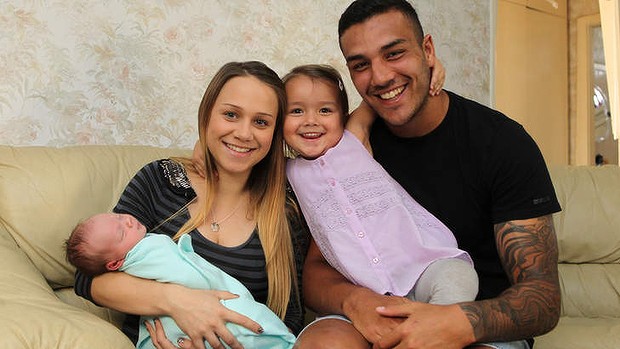
NRL player Dylan Farrell, and his partner Hayley Mundy [pictured], welcomed their son Derain about a week ago. Derain Farrell joins big sister Leilani, aged 3. Derain is a place in New South Wales, whose name is said to come from an Aboriginal language meaning “of the mountains”; Dylan grew up on an Aboriginal mission on the South Coast. Dylan has played for South Sydney Rabbitohs since 2010, and has been signed with the St. George Illawarra Dragons for next season. Souths will face Manly in the finals on Friday.

Soccer star Mark Milligan, and his wife Rhia, welcomed their daughter Audrey earlier this year. Audrey Milligan joins big sister Maya. Mark has been playing professionally since 2002, and is currently signed with Melbourne Victory; he is also a member of the national team, the Socceroos.

Local rugby league player Chris Thompson, and his wife Chrystal, welcomed their son Chandon early in the year. Chandon Thompson joins big sister Alaqua, aged 4, and big brother Mataeo, aged 2. Chris plays for CYMS in Dubbo. Chandon is a French surname, taken from a common place name in France; it is most associated with the champagne Moët & Chandon.

Rare Royal Names for Girls

01 Sunday Sep 2013

Posted by A.O. in Name Themes and Lists

≈ 11 Comments

Tags

Anglo-Saxon names, Christmas names, Danish names, english names, famous namesakes, fictional namesakes, French names, germanic names, Greek names, honouring, Latin names, locational names, middle names, mythological names, name history, name meaning, names from television, nicknames, Old English names, Old Norse names, rare names, Roman names, royal names, saints names, scandinavian names, Star Trek

Berengaria

Royal babies have been on everyone’s mind lately, and we recently saw two babies born in the royal family within less than a month of each other.

Not only have been people been doing web searches for Prince George and Maud Windsor, they’ve been searching for royal baby names in general, uncommon royal names, and royal names that nobody else is using.

So here is a list of queens and princesses connected to English royal houses by either birth or marriage, whose names aren’t popular or common in Australia (although I can’t promise nobody else will use them).

Adeliza

Adeliza of Louvain married Henry I, and became queen of England. She was considered pretty, but didn’t manage to produce any royal heirs. However, after Henry’s death she re-married, and had seven children; she is an ancestor of many of the noble English families. William the Conqueror had a daughter called Adeliza, named after his sister – the name wasn’t uncommon amongst Norman-French aristocracy. Adeliza is a medieval English form of Adelais, a short form of Adelheidis, the original old Germanic form of Adelaide. It’s pronounced ad-uh-LEE-za. Although it doesn’t have any connection to the name Elizabeth, it looks like a combination of Adele and Eliza, and might feel like a way to honour relatives who have variants of these names. It’s rare, but doesn’t seem unfamiliar.

Berengaria

Berengaria of Navarre was Queen of England through her marriage to Richard I, “the Lionheart”. She is the only English queen never to set foot in the country, since she only visited England after her husband’s death, when she was no longer queen. Richard himself spent only a few months in England during his marriage, as he was busy Crusading. Richard and Berengaria never had any children, and it is not known if their marriage was ever consummated, as they spent so much time apart. Richard’s family seem to have liked her, and there are a few other royal English Berengarias, perhaps named after her. Berengaria was a traditional name amongst Spanish royalty, and is the feminine form of Berengar, an ancient Germanic name meaning “bear spear”. It is pronounced behr-en-GAR-ee-uh, and the name has been bestowed upon a planet in the Star Trek universe inhabited by dragon-like creatures. This doesn’t sound like any currently popular names, and the nickname Berry is appealing.

Christabel

Christabel was the middle name of Princess Alice, wife of Prince Henry, Duke of Gloucester, a son of George V. Princess Alice was born into the aristocracy on both sides of her family, and was a direct descendant of Charles II, through an illegitimate line. She is related to Sarah, Duchess of York, the wife of Alice’s great-nephew, Prince Andrew. Just after the Second World War, Prince Henry was appointed Governor-General of Australia, and he and Princess Alice lived in Canberra for two years. The name Christabel is a combination of Christina with a -bel suffix, but Princess Alice was given this name because was born on December 25, and the name suggests Christmas bells. Her niece Princess Alexandra was also born on Christmas Day, and shares the middle name Christabel. Apart from the Christmas connection, this pretty name might seem like a good way to honour a Christine and an Isobel (for example) simultaneously.

Elfreda

Elfreda was one of the wives of Edgar I, and she was the first king’s wife to be crowned and anointed as Queen of England. Beautiful and powerful, she was unfortunately linked with the murder of her stepson Saint Edward the Martyr, and ever after appears in medieval history in the role of evil stepmother. Her own son, replacement to the martyred Edward, was Ethelred the Unready, only a child when he took the throne. Elfreda was a traditional name amongst Anglo-Saxon royalty, and Alfred the Great of Wessex had a daughter named Elfreda, an ancestor of Queen Matilda, the wife of William the Conqueror; through Matilda, the monarchs of England are descendants of the House of Wessex. There is a Saint Elfreda, an Anglo-Saxon princess. Elfreda is a modern spelling of the Anglo-Saxon name Ælfþryð, meaning “elf strength”. The name went out of use after the Norman Conquest, but was revived in the 19th century, although it never became popular. Freda would make a good nickname – unfortunately, sweet Elfie would probably be misheard as Alfie, leading to confusion.

Eugenie

Eugenie was the second name of Victoria Eugenie, a grand-daughter of Queen Victoria who married Alfonso XIII and became Queen of Spain. Her grandson Juan Carlos I is the current king of Spain. Unfortunately, her marriage to Alfonso wasn’t particularly happy, and she didn’t enjoy great popularity with the Spanish people – she was greeted with an assassination attempt on her wedding day. After the Republicans gained power, Victoria Eugenie went into exile with the rest of the Spanish royal family. Queen Victoria Eugenie’s middle name was in honour of her godmother, Maria Eugenia “Eugénie” de Montijo, empress consort to Napoleon III. Eugénie was a member of the Spanish nobility, and after the defeat of the Second French Empire, she lived in England, where she became friendly with the British royal family. The name remains well-known because of Princess Eugenie of York, daughter of Prince Andrew, who was named after Victoria Eugenie. Eugenie is the Anglicisation of Eugénie, the French form of Eugenia, which is the feminine form of Greek Eugenius, meaning “well born, of noble birth”. This elegant name is said yoo-JEE-nee, and Gina or Genie could be used as nicknames.

Marina

Princess Marina of Greece and Denmark was a cousin of Prince Philip. Like her cousin, she married into the British royal family when she wed Prince George, the Duke of Kent, an uncle of Queen Elizabeth II; she was the last foreign-born princess to marry into the British royal family. Princess Marina was attractive and stylish, earning her a place in the International Best Dressed List Hall of Fame, and her favourite shade of blue-green became known as “Marina blue”. Princess Marina’s mother was the grand-daughter of Tsar Alexander II of Russia, and Marina may have been named after Princess Marina of Russia. Princess Marina and the Duke of Kent were married in 1934, and a year later, Swiss water-ski champ Marina Doria was born, which looks more than coincidental. Oddly enough, Marina Doria also became Princess Marina, when she married a prince of Naples. Marina’s name has been passed down to her grand-daughter, Maud Elizabeth Daphne Marina Windsor, and I have seen a birth announcement for a Scarlett Marina this week. Marina is the feminine form of the Roman name Marinus, which may be from the Latin for “of the sea”. There are two saints named Marina, and it’s also the name Saint Margaret is known by in the Orthodox church. Marina is a very beautiful name, and familiar in Australia due to entertainer Marina Prior.

Melita

Princess Victoria Melita was a grand-daughter of both Queen Victoria and Tsar Alexander II, making her Princess Marina’s great-aunt. Her love life was one of great turmoil, because she fell in love with her cousin Kirill, Grand Duke of Russia, but was forced to marry her cousin Ernest, Grand Duke of Hesse instead. The marriage wasn’t a success, as Victoria Melita preferred Kirill, and Ernest preferred young boys. Soon after Victoria and Ernest ‘s divorce, Kirill was almost killed during the Russo-Japanese War, and this brush with death made him realise that nothing was more important than being with his true love. He defied his family, and married Victoria Melita, much to his parents’ rage and disgust. Although their marriage and family life was happy, the Russian Revolution and subsequent exile was a setback, and the couple rather naively supported the Nazi Party. More emotional pain followed for Victoria when Kirill was unfaithful to her, which she never got over. Her life contained some bitterness, but Victoria Melita’s middle name has a sweet meaning. Melita is the Latin name for the island of Malta, thought to come from its Greek name, Melite, meaning “sweet as honey”; Malta was famous for its honey production. This doesn’t sound out of place next to popular names like Mila and Layla, and would be a great way to honour Maltese ancestry; you could use Millie or Lita as nicknames.

Sibylla

Princess Sibylla (born Sibylle) was a great-granddaughter of Queen Victoria who married her second-cousin Prince Gustaf Adolf (known as “Edmund”) of Sweden; her son Carl XVI Gustaf is the current king of Sweden. The couple don’t seem to have been very popular in Sweden, being plagued by rumours of Nazi sympathising, of which there is no proof. Unfortunately, Sibylla did have quite a few relatives in the Nazi Party in Germany, who threw her a big fat Nazi wedding, and this can’t have been a help at soothing suspicions. The name Sibylla (or Sybilla) has been used amongst European royalty and nobility since the Middle Ages, and has been connected with the British royal family from early on. William the Conqueror’s son Robert was married to a Sybilla, and Henry I had an illegitimate daughter named Sybilla, who married Alexander I of Scotland. Sibylla is from the Greek word for a female prophet of the ancient world who uttered divine revelations in a state of frenzy; the word became sibyl in English. During the Middle Ages, it was thought that the Greek and Romans sybils had been precursors to Christian prophecy, and therefore gained respectability as a Christian concept and name. This name (and its variants), though uncommon, is quite trendy in Australia, being known from actress Sibylla Budd, and the heroine of My Brilliant Career, Sybylla Melvyn, whose name inspired feminist publishing house, Sybylla Press.

Sigrid

The splendidly-named Sigrid the Haughty was supposedly the wife of Sweyn Forkbeard, who ruled England before the Conquest, in the days when the Danish royal house held the throne. It’s not clear if Sigrid was her real name, because it seems that Sweyn’s wife was actually Polish rather than Scandinavian, and in fact we can’t be sure if “Sigrid the Haughty” even existed. She may well be a fictional character, but her story is compelling. Beautiful and proud, Sigrid was a woman of great political power, who tended to wreak terrible revenge on those who annoyed her, and is supposed to have burned two of her suitors to death to discourage others. It could be that this fascinating lady of legend was tacked on to a real Polish woman who married Sweyn, and became the mother of King Canute the Great. Sigrid is from the Old Norse name Sigríðr, meaning “beautiful victory”. This is another name familiar in Australia because of an actress – the very famous Sigrid Thornton. The usual nicknames are Siri and Sigi.

Thyra

Thyra was the daughter of Sigrid and Sweyn Forkbeard, the sister of Canute the Great. She was married to Godwin, the first Earl of Essex, the father of King Harold who fell at the Battle of Hastings. She didn’t live very long, and she and Godwin didn’t have any children together, so she’s rather a footnote in the history books. She may have been named after Thyra, the wife of King Gorm the Old of Denmark; they were the parents of Harald Bluetooth, the father of Sweyn Forkbeard. According to at least one source, Queen Thyra was English, the daughter of King Ethelred of Wessex. She was said to be a smart and sensible woman who led an army against the Germans, and was described as the “pride of Denmark”. According to legend, one of Thyra’s daughters was captured by trolls and carried off to their kingdom in the far north. Thyra is from the Old Norse name Þýri, derived from the name of the god Thor, and possibly meaning “Thor’s war”. The name is pronounced TEE-rah, and I think it’s attractive and contemporary-sounding, although pronunciation may be an issue, with people trying to say it THY-rah.

POLL RESULT: People’s favourite names were Marina, Adeliza, and Christabel, and their least favourite were Elfreda, Thyra, and Berengaria.

(Picture is a drawing of Queen Berengaria)

Famous Name: North West

28 Wednesday Aug 2013

Posted by A.O. in Famous Names

≈ 4 Comments

Tags

Ancient Germanic names, aristocratic surnames, celebrity baby names, english names, famous namesakes, historical records, locational names, middle names, name history, name meaning, names of compass directions, names of railway lines, nature names, surname names, unisex names, vocabulary names, Wikipedia

1

The Hills Shire is in the north-west region of Sydney. Big news in The Hills at the moment is the North West Rail Link, which will connect Rouse Hill to Epping, and involve the construction of eight new railway stations. To assist with the necessary disruptions, The Hills Shire council has put out a pamphlet: Is your business north-west rail ready? The pamphlet suggests you may want to stagger your work times, or work from home until the North West Rail Link is complete.

The North West Rail Link is the “baby” of the Hills Shire council, and as often happens, their baby name was “stolen” when Kanye West and Kim Kardashian called their daughter North West. However, in this case New South Wales has precedence, because they came up with the name North West in 1998. Why it takes 15 years between the proposal and sending out pamphlets is a question only local government can explain. (If you’re really curious, Wiki it). There is no date set for ending the project, which may not occur until 2020. Hope you’re north-west rail ready!

North is one of the four major compass points, and in Western culture, it is considered the primary direction, and the one from which all other directions are taken. By convention, north is placed at the top of globes and maps, although the word comes from an ancient Germanic root which means “down, under”. This may come from an ancient root meaning “left, below”, because north is to the left when you face the rising sun.

For people in the northern hemisphere, north is the direction towards the Arctic, and when they think of “northern lands”, they probably envisage ice and snow, or at least cooler temperatures. In many fantasy tales, dangerous or evil creatures come out of the north, such as Hans Anderson’s Snow Queen, and the dragon in Tolkien’s The Hobbit. However, the ancient Greeks believed that in the far north lay the country of the happy Hypoboreans, who lived in a land of eternal sunshine (kind of on the right track due to the Midnight Sun).

In the southern hemisphere, north is the direction of the Equator, and we may think of northern places as hot and dry, or steamy and tropical. In Australia, the northern part of the country Australia has a certain mystique as vast, hot, empty of people, and rich in natural resources.

North is also an English surname. The aristocratic North family hold the title of Earls of Guildford, and Frederick North, the second Earl, was Prime Minister of Great Britain during the American War of Independence. Frederic Dudley North, descended from the British Prime Minister, emigrated to Western Australia in the 19th century and undertook several important posts, including representing the state during Queen Victoria’s Jubilee.

The origin of the surname is unclear – it could refer to someone who lived to the north of a particular town, or possibly someone with Norse ancestry, or who looked as if they might have.

West is another major compass point, conventionally placed on the left side of maps, and lying in the direction of the setting sun. It seems to be from an ancient root which means “downward”, referring to sundown, and is closely related to the word evening.

Because the west points toward the sunset, in many cultures it represents death (to go west, means “to die”). The ancient Celts imagined the Otherworld could be found far out in the western sea, while the ancient Greeks believed the paradisaical Fortunate Isles were located in the western ocean. The island of Atlantis was also thought of as being to the west, far out in the Atlantic.

In Britain, the West End is the posh part of London, while Westminster is the seat of power, and the West Country the land of legends and fairy tales. Westward Ho!, by Charles Kingsley, is set in the West Country and deals with adventures in the West Indies. Its title is the same as a Jacobean satire by Dekker and Webster on west London, taken from the call of Thames watermen. The playwrights later wrote Northward Ho!, set in north London.

In the United States, the western frontier lands in the 19th century symbolised freedom, adventure, opportunity and progress, as in the famous phrase, Go west young man. The Old West is not so much a time and a place as part of the American psyche, and the American West helped inspire imaginative works as diverse as Little House on the Prairie, Star Wars, The Great Gatsby, On The Road, Breaking Bad, and The Wizard of Oz (which has a Wicked Witch of the West).

The iconic Wild West played a major role in the development of the Australian myth of The Bush, and there is much we can identify with, as we have our own frontier country, the Outback. Here the west is Western Australia, the largest state, and the most geologically ancient part of the country, at over 4 billion years old. The oldest life forms on Earth, the stromatolites, can be found in Shark Bay, and the world’s oldest fossil, 3.4 billion year old bacteria, was discovered in Port Hedland.

The West also refers to Western civilisation, an idea which goes back to the ancient Greeks. Today it has political connotations, with people believing that “the West” stands for any number of values they might like or dislike. It is political rather than geographic, because “western” countries are all over the world.

The English surname West denotes someone who lived to the west of a town, or someone who had moved to the area from the west. It turns up early on in Essex, the most easterly part of England. This is another aristocratic surname, for the Wests were an old family originally from Devon, in the West Country.

North and West have both been used as personal names since at least the 16th century, with West much more common overall. Most Norths and Wests have been male, although the first North I can find in the records was a girl, and there are many female examples of both names. A larger proportion of Wests have been female, compared to Norths. There are thousands of Norths and Wests of both sexes in Australian records, although most of these are middle names.

North and West are names which sound a little out of the ordinary, and yet are straightforward and instantly recognisable. Everyone can spell and pronounce them, and they’re easy to explain: “North, like the North Pole”, “West, like the Wild West”.

They seem modern, but have surprisingly long histories, and layers of meanings, of which you are free to choose the ones which appeal to you the most. Kanye and Kim reportedly chose North because they saw it as meaning “the furthest up”, and therefore the pinnacle of their relationship, which strikes me as very northern-centric, and making a second child’s name problematic. If the first child’s name marks the pinnacle of your relationship, what’s left for Number 2?

POLL RESULTS: North received an approval rating of 40%, and West a rating of 35%. Most people preferred the names North and West on a boy rather than a girl. 98% of people thought the name North West was more suitable for a railway than a human.

(Picture shows an artist’s impression of a station on the North West Rail Link)

Celebrity Sibset: Wendy Harmer

17 Saturday Aug 2013

Posted by A.O. in Sibsets in the News

≈ 4 Comments

Tags

baby name advice, celebrity baby names, celebrity sibsets, choosing baby names, classic names, famous namesakes, fictional namesakes, honouring, Irish names, locational names, name popularity, popular names, products with human names, surname names

8487-1_n

Wendy Harmer is a highly successful comedian, who for many years has entertained on stage, television and radio. She was the first woman in Australia to host her own comedy show, The Big Gig, in 1989, and for more than a decade she was co-host of a top-rating breakfast show on 2-Day FM, when she became one of the nation’s highest paid entertainers.

Wendy is a prolific and successful author, having written humour for adults, chick lit novels, teen fiction, kid’s books, two plays, and the libretto for an opera. Her best-selling children’s series, Pearlie the Fairy, has been turned into an animated TV show. She is also editor of The Hoopla, a women’s news and opinion site.

Wendy is married to Brendan Donohoe, and has two children. Her son is named Marley (aged about 15), and her daughter is named Maeve (aged about 13).

Wendy appears to be yet another star of radio with a bee-lined bonnet in regard to baby names, because she has written an article about them for The Hoopla. It’s one of those “names not to call your baby” lists, which I must admit I don’t usually care for, because they don’t seem to really be helpful to parents so much as bullying anyone who happens to have different tastes and opinions from yourself.

Interestingly, Rule Number 2 on the list states that you shouldn’t use a famous person’s surname as your child’s name. Her son is named after Bob Marley. Okaaaay. Number 4 is that you musn’t name all your children with same letter. Mmmmm.

This article is an “update” of an earlier one, where one of the pieces of advice was that the pronunciation of your child’s name should be clear from the way it is spelled. Even now, when the name is quite well-known, some people don’t know how to pronounce Maeve from its spelling, and think that it must be MAY-vee or mah-EEV.

I do notice that so often when parents criticise baby names, the same criticisms could be levelled at their own children’s names. The most obvious example is that rather ghastly woman who said that place names as baby names were lower-class, when her own daughter was named after a country in Asia. I guess we all have mother-blindness about our baby names, and I have been guilty of the same thing myself – it’s an easy trap to fall into, but luckily I didn’t do it on TV or anything.

When we come up with rules on naming babies which we ourselves cannot stick to, it may be a sign that the rules aren’t all that useful. Just a thought!

Wendy doesn’t like her own name, which peaked at #15 in the 1950s, when Wendy was born. Part of her disappointment is that her mother chose the name out of a knitting pattern book, when the layette she was knitting was called the “Wendy”. She imagined that she had been named after Wendy Darling from Peter Pan, so being named after a knitting pattern didn’t seem so special.

Wendy much prefers her father’s choice for her name, which was Claire, the name of her beloved great-aunt. In the 1950s, Claire was #224; it rose steeply in popularity during the 1960s and ’70s, and has been in the Top 100 since the 1980s.

Now I think that’s really useful naming advice taken from real life. It may not be the best idea to choose a baby name peaking in popularity and about to fall and become dated, or select one virtually at random.

A better choice could be a classic which is lower in popularity and about to start rising, to become very popular in the long-term future. And it’s probably preferable to honour a beloved family member than to name your baby after a product – it’s nice to have a name which has some significance.

Think about the name story you are going to pass on to your child – a knitting pattern clearly doesn’t cut it. And sometimes dad knows best.

PS Wendy did manage to give the name Claire to one of her characters, the heroine of her novel, Farewell My Ovaries.

(Picture of Wendy and her family taken some years ago at Uluru; photo from Body + Soul)

Famous Names: Aria and Delta

14 Wednesday Aug 2013

Posted by A.O. in Famous Names

≈ 8 Comments

Tags

alphanumeric names, celebrity baby names, english names, famous namesakes, fictional namesakes, geographical names, Greek names, historical records, Italian names, locational names, musical names, musical terms, name popularity, name trends, names from songs, names from television, nature names, nicknames, saints names, vocabulary names

thumbThe Australian music industry celebrated an important birthday a month ago, because July 10 this year marked thirty years since the Australian Recording Industry Association (ARIA) began collating sales information from music stores. The ARIA charts developed from the Kent Music Report, and the first Australian charts began in the 1960s, collated by Go-Set magazine, the music “bible” of its time which later spawned Australian Rolling Stone, and whose weekly music columnist Ian “Molly” Meldrum would go on to host seminal music show Countdown.

The first single to top the ARIA charts way back in 1983 was Total Eclipse of the Heart by Bonnie Tyler, the first #1 album was Michael Jackson’s Thriller, and the most consistently popular performer over the many years of her career has been Madonna. However, Kylie Minogue equalled Madonna for the most #1 singles (10), and was equal second with the Black Eyed Peas for most weeks (30) spent at #1 in the singles charts.

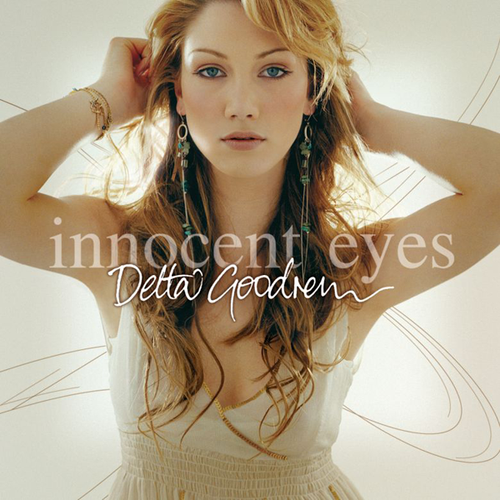
Pop singer Delta Goodrem’s debut album, Innocent Eyes, spent longer at #1 than any other Australian album at 29 weeks, and she is the first ever music artist to have five #1 singles from a debut album. Innocent Eyes went on to be the best-selling album of the 2000s. Delta played aspiring singer Nina Tucker on soapie Neighbours, where she sang Born to Try, scoring Delta her first #1 spot on the ARIA charts. She has won ten ARIA Awards, and all her albums have gone to #1, making her one of Australia’s best-selling female artists. Delta is currently a judge, coach and mentor on The Voice.

In music, an aria is a vocal piece performed by a singer, usually as part of a larger work. We often connect arias to opera, although they can be part of classical concert music too, and usually think of them as very beautiful and elaborate pieces of music that only an expert singer can do justice to.

Some famous arias are Ave Maria, O Sole Mio, La Donne e Mobile from Rigoletto, and Nessun Dorma from Turandot (if you think you don’t know them, click on the links to listen, and you’ll probably find that you have heard them before). In Italian, aria means “air”, and is from the Latin word for “atmosphere”.

As a girl’s name, Aria is usually said to be a modern English name. It’s hard to track it through historical records, as any Arias you find could easily be a misprint for Maria, so while there are hundreds of Arias in Australian records, with both English and Italian surnames, your guess is as good as mine whether they were really named Aria.

There is a Saint Aria, an obscure early Christian who was martyred in Rome, but her name seems to have been short for Ariadne.

Aria catapulted into the national Top 100 last year, debuting at #83, the second-highest rising name for girls in Australia, and possibly the highest, if we had access to all the data. The name has been popularised by the character of Aria Montgomery, from the Pretty Little Liars books and TV series, and young singer and actress Aria Wallace; it’s also been boosted by its similarity to other fashionable names, like Arya, Arianna, Ariel, Allira and Allegra. Musician Ash Grunwald welcomed a daughter named Aria earlier this year.

Delta is the fourth letter of the Greek alphabet; it’s based on a letter in several Semitic alphabets which is supposed to represent a door. The Greek letter is shaped like a triangle when capitalised, and it is for this reason that the landmass at the mouth of river became known as a “delta”. If you want to get geographically technical, it is wave-dominated deltas which tend to have this triangular form; the most obvious example is that of the River Nile, and it is the Nile Delta which was first given the name, and is the “original” delta.

The Mississippi Delta region is the area which lies between the Mississippi and Yazoo Rivers, and includes parts of the states of Tennessee, Mississippi and Arkansas. Here’s another geographical technicality – the Mississippi Delta isn’t actually a delta – it’s an alluvial plain. The Mississippi River Delta is 300 miles to the south, in Louisiana, where the river meets the Gulf of Mexico. Just in case you have, in this short space of time, due to my scintillating prose style, become obsessed with river deltas, the Mississippi River has a bird-foot delta, where long finger-like projections reach out into the sea, and isn’t actually delta-shaped in the least.

The Mississippi Delta (the region, not the actual river delta in Louisiana – gosh I hope all this geography isn’t getting too confusing) is associated with the very beginning of several genres of popular music, such as Delta blues and rock and roll. You can no doubt get yourself into some very stimulating arguments over whether Delta blues is significantly different to any other kind of blues, or just how rock and roll got started anyway, but the Mississippi Delta would be crazy not to cash in with tons of music festivals, and they’re not, so they do.

Rita Coolidge is an American singer who inspired the song Delta Lady, by her one-time boyfriend, singer-songwriter Leon Russell. I always assumed that the name came about because Ms Coolidge is from the Mississippi Delta, but – more geographical technicalities – she’s from Macon county in Tennessee, which isn’t in the Delta region. So we may be talking poetic license here rather than geographical technicalities, although from the song’s lyrics, Russell seems to be using delta as a metaphor for ladyparts (as in the erotica collection, Delta of Venus, by Anais Nin).

(Just as an aside, the faded southern belle of unsound mind in the song Delta Dawn, which became Helen Reddy’s first #1 hit, was from Brownsville in Tennessee, which prides itself on being the “heart of the Tennessee Delta”. Dawn was a real Delta Lady.)

It was the song Delta Lady which inspired Delta Goodrem’s parents to name their daughter Delta, so that is one possible source of the name, but you could see it as a geographic name, a nature name or an alphanumeric name as well. You can also see it as a musical name, because a major 7th chord is sometimes called a Delta Chord.

There are many, many women named Delta in Australian historical records, dating back to the 19th century, and it is currently #412 in Victoria.

So here’s two pretty, modern-sounding musical names for girls, both with an Australian focus. Cross-cultural Aria is much more on trend that Delta, and consequently more popular, yet Delta has a more solid history of use as a personal name. Which one do you like better?

POLL RESULTS: Aria received an approval rating of 78%, and Delta of 33%.

https://www.youtube.com/watch?v=TOz6Mt2t084

Celebrity Baby News: Liam Picken and Annie Nolan

06 Tuesday Aug 2013

Posted by A.O. in Celebrity Baby News

≈ 8 Comments

Tags

celebrity baby names, celebrity sibsets, famous namesakes, Greek names, locational names, names from television, nicknames, twin sets

art_picken2-420x0

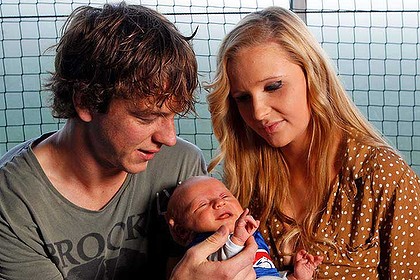
AFL footballer Liam Picken, and his partner Annie Nolan, welcomed twin girls in the autumn and have named their daughters Delphi and Cheska. The twins have only recently left hospital, as they were born premature. Delphi and Cheska are baby sisters to Malachy, aged 2 – Malachy’s birth was announced on the blog.

Liam has been playing Australian rules football professionally since 2009, and has always been with the Western Bulldogs. He is the son of Billy Picken, who played for Sydney and Collingwood in the 1970s and ’80s, and the cousin of Jonathan Brown, who is captain of the Brisbane Lions. Liam recently played his 100th game for the Western Bulldogs, and walked out through the banner with Malachy.

Delphi is a Greek place name, the ancient site of the Delphic Oracle to Apollo; its name means “womb”, and it may have begun as a worship site to the Earth Goddess. Later it was connected to “dolphin”.

Cheska is short for Francesca. It is perhaps best known from blogger and PR rep Cheska Hull, who starred on reality TV series, Made in Chelsea.

(Photo shows Liam and Annie with Malachy)

Boys Names of Australian Aboriginal Origin – Part 2

04 Sunday Aug 2013

Posted by A.O. in Name Themes and Lists

≈ 5 Comments

Tags

Ancient Germanic names, animal names, astronomical names, Australian Aboriginal names, Chinese names, colour names, days of the week names, english names, famous namesakes, fictional namesakes, Google, Hindi names, historical records, Indian names, locational names, middle names, mythological names, name history, name meaning, names from movies, names of weapons, nature names, nicknames, onomatopoeic names, rare names, unisex names

mh1

Bambam

Bambam as a person’s name might seem like an oddball suggestion, but although it would definitely be an unusual choice, I don’t think it’s an unfamiliar one either. For a start, there is Bamm Bamm Rubble from The Flintstones, first introduced as a cute blonde baby with superhuman strength. His name came from the fact that he would say Bamm bamm, and swing his club, to the general destruction of everything around him. Bam Bam is used as a man’s nickname, from American wrestler Bam Bam Bigelow to British DJ Bam Bam. There’s also skater Bam Margera, who gained his nickname from constantly running into walls as a toddler. I have seen a baby boy called Bambam – although that may have been a nickname. In English, bam bam is an onomatopoeic interjection, suggesting one thing repeatedly hitting or banging into another. In much the same way, in Nyungar (from south-west Western Australia), bam means “to hit”, and in Bundjalung (from northern New South Wales), bambam means “bruise, swelling”. However, in the Meriam language from the eastern Torres Strait Islands, bambam means “yellow”; in Indigenous art, yellow ochre is often used to represent the earth. It’s quirky, but Bambam is a rather lovable name.

Daku

Daku means “sand hill” in the extinct Diyari language; the Diyari people are from the South Australian desert, and thus very familiar with sand. Despite being generally used as a boys name in Australia, Daku is also a unisex name in India, and in Hindi it means “bandit”. Someone wrote in to the blog considering the name Daku for their son, but they never got back to me, so I don’t know whether they overcame family opposition to the name or not. This name reminds me a bit of Dakota, and it has the fashionable OO sound, such as Reuben and Jude; the name is pronounced (I think) DAK-oo. It would be a bold choice though, and I haven’t seen many boys with this name, although it can be found a few times in historical records.

Jardi

Jardi means “front” in the Ngadjumaja language; the Ngadjumaja people are from the Nullarbor Coast area of south-east Western Australia. I remember reading in the papers last year about a baby boy from Mudgee who has named Jardii, and his mother explained that his name was from the Wiradjuri language and means “first born son”. I wasn’t able to find that information for myself, but it occurred to me that “front” and “first” are similar in meaning, so Jardi also seemed like a good name for an eldest son. In the Jaminjung language from the Victoria River region of the Northern Territory, jardi means “to keep”, which also seems very positive. I found quite a few Indigenous boys and young men named either Jardi or Jardii, and I think it’s really attractive, with a similar sound to Jordie, the short form of Jordan.

Jiemba

Jiemba means “laughing star” in the language of the Wiradjuri people of central New South Wales. It refers to the morning star, or the planet Venus. (In some other Aboriginal languages, djimba simply means “star”). Astronomy was very important to the Wiradjuri, as with other Aboriginal societies, because stars and planets were used to tell the times and seasons, and this information was first given in early childhood. It is recorded that in the Wiradjuri in the 19th century, the elders would teach the children the stories behind the stars (the constellations), while the old women would teach children to count stars, which they could do into the thousands using a particular system. This information comes from radical poet and journalist Mary Gilmore, who grew up in Wagga Wagga, and was given the name Jiemba by the Wiradjuri people. Despite it being given to a little girl, I have only seen Jiemba given to boys – most likely because it is said JIM-ba, and thus shortens to Jim or Jimmy. One of the Aboriginal men from the Sydney area first encountered by Europeans was named Jimbah, so it sounds quite masculine (this Jimbah may also have been Colebee).

Lue

Lue is a small village in the Central Tablelands region of New South Wales. Its name means “chain of waterholes” in the local Dabee language – the Dabee are part of the Wiradjuri group. The village’s name is pronounced LOO-wee, which makes me think that this could be an Australian alternative to Louis or Louie. There are quite a number of people named Lue in Australian historical records – many of them are of Chinese ancestry, but there are some from the Lue area, suggesting that at least a few of them were named after the village.

Nullah

A nulla nulla, also known as a nullah or waddy, is an Aboriginal war club or hunting stick; the word comes from the extinct Darug language from the Port Jackson area of Sydney. A nullah is a heavy club which could be used in hand to hand combat, or used to stun prey; sometimes they were used to punish lawbreakers. In addition, these useful tools could be used to make fires, and grind ochre. This name is frequently Googled, because Nullah is the name of the young Aboriginal boy in Baz Luhrman’s 2008 epic, Australia, played by Brandon Walters. The film is set in the Northern territory, so the choice of Nullah for the character’s name is not meant to be authentic; I wonder if they chose it partly because it suggests the name of the Nullarbor Plain (Latin for “no trees”). Nullah is also a Hindi word for a narrow, steep-sided valley; in dry countries like Australia, these nullahs are commonly filled with brushwood, and when it rains heavily, they temporarily become streams. This could be another inspiration for the character’s name.

Omeo

Omeo is a town in Victoria which is in the East Gippsland, set high in the Great Dividing Range. Its name means “mountains, hills” in the local Gunaikurnai language, or one of its dialects, because it is set on a treeless plain on the fringes of the Snowy Mountains. There is evidence of human occupation of this region dating back around 20 000 years, and the first reported sighting by a European of Omeo was in 1832, by a naturalist on the slopes of the southern alps. It was his reports of fine grazing land which soon attracted pastoralists and squatters to the region. Gold was discovered in the 1850s, but Omeo’s isolation meant that it did not experience the massive boom of many goldfields towns – it did however, have the dubious distinction of being the roughest and most unruly place on the goldfields. Its first magistrate was Judge Browne, better known as author Rolf Boldrewood, who wrote of the area’s lawlessness in his novel, Robbery Under Arms. This name looks and sounds like Romeo without the R, which gives it recognisability as a name, although it also reminds me of Omo washing powder. Its goldfields history gives it a bit of a “wild west” feel; it seems a bit more bad boy than romantic Romeo. Omeo has had some use as a boy’s name in Australia, especially amongst people from Omeo itself, and was more often found in the middle.

Tanami

The Tanami Desert is in the Northern Territory, and is Australia’s most northerly desert. In the wet season, it rains heavily and even floods, but the high temperatures mean that most of it evaporates. Some parts of the Tanami do have wetlands though, and there is even a lake which has permanent water in it, so as deserts go, it’s on the slightly moist side. It is a refuge for several rare and endangered species of flora and fauna, making it a biologically important area. You can cross the desert on the Tanami Track, which is more than 1000 km long, and goes from Alice Springs to Halls Creek, in the Kimberly region of Western Australia. Tanami is a corruption of the local Walpiri name for the area, Chanamee, meaning “never die”, because the rock holes in a particular gully were said to never run dry of water, even in drought. When white people came here in the early twentieth century, they found to their dismay that this was not the case, so either the name was optimistic in nature, or the Indigenous people had a superior knowledge of obtaining water from the rock holes. I have seen Tanami occasionally on girls, but after seeing it given to a boy, I really like it as a male name. The pronunciation is TAN-uh-my, but the Aboriginal pronunciation would be more like TAN-uh-mee, so you could take your pick on how to say it.

Woden

Woden Valley is a district of the capital city of Canberra. The area is named after a homestead owned by Dr James Murray, which was built in 1837. In Aboriginal Place Names, Harold Koch suggests that the name of Dr Murray’s homestead may have been influenced by the word wadyan or wadhan, which means “possum” in several Indigenous languages, in an area stretching from the Monaro region right down to Omeo in Victoria. If so, then the spelling was altered to make it look like the name of the Anglo-Saxon and Germanic god Woden, whose name means “inspiration”; Dr Murray saw him as a god of wisdom. Woden was the chief god of the Germanic peoples, and is their equivalent of Odin. Anglo-Saxon royalty claimed that Woden was their ancestor, and he survives in English folklore as leader of the Wild Hunt, and perhaps even as Father Christmas. Of course, we unconsciously celebrate his special day once a week, on Wednesday (Woden’s day). With Odin being a rather hip name at present, Woden really doesn’t seem too strange, and this could be a way of celebrating Australian and English heritage together. There are a couple of men named Woden in Australian historical records, although it is more common as a middle name.

Yarramundi

Yarramundi is an outer suburb of Sydney which is a semi-rural area in the City of Hawkesbury. It is named after a famous Indigenous leader who was a member of the Boorooberongal clan of the Darug people, and a garadyi, or shaman – a healer, a man of great spiritual knowledge and power, and an enforcer of tribal law. Yarramundi’s son Colebee was the first Aboriginal person to receive a land grant, and his daughter Maria was the first Aboriginal child to be enrolled in a school for the education of Indigenous children; her marriage in 1824 was the first legally recognised union between an Aboriginal woman and a convict. Maria ended up being a successful land owner in Liverpool and Blacktown, and dozens of families in the area trace their ancestry back to Yarramundi. Yarramundi means “deep water”, and I saw a newspaper story about a baby boy named Yarramundi after this inspiring namesake.

POLL RESULT: People’s favourite names were Jardi, Lue, and Nullah, and their least favourite were Yarramundi, Omeo, and Bambam.

(Picture shows the Tanami Desert in northern Australia)

← Older posts
Newer posts →

Enter your email address to follow this blog

Categories

Archives

Recent Comments

A.O.'s avatarwaltzingmorethanmati… on Zarah Zaynab and Wolfgang…
Madelyn's avatarMadelyn on Zarah Zaynab and Wolfgang…
JD's avatardrperegrine on Can Phoebe Complete This …
A.O.'s avatarwaltzingmorethanmati… on Rua and Rhoa
redrover23's avatarredrover23 on Rua and Rhoa

Blogroll

  • Appellation Mountain
  • Baby Name Pondering
  • Babynamelover's Blog
  • British Baby Names
  • Clare's Name News
  • For Real Baby Names
  • Geek Baby Names
  • Name Candy
  • Nameberry
  • Nancy's Baby Names
  • Ren's Baby Name Blog
  • Sancta Nomina
  • Swistle: Baby Names
  • The Art of Naming
  • The Baby Name Wizard
  • The Beauty of Names
  • Tulip By Any Name

RSS Feed

  • RSS - Posts

RSS Posts

  • Celebrity Baby News: Melanie Vallejo and Matt Kingston
  • Names from the TV Show “Cleverman”
  • Can Phoebe Complete This Sibset?
  • Zarah Zaynab and Wolfgang Winter
  • Baby, How Did You Get That Name?
  • Celebrity Baby News: Media Babies
  • Celebrity Baby News: Adelaide Crows Babies
  • Celebrity Baby News: Chris and Rebecca Judd
  • Names at Work: Name News From the World of Business and Employment
  • Celebrity Baby News: Sporting Round Up

Currently Popular

  • Celebrity Baby News: Nicki Gemmell and Andrew Sholl
  • Girls Names From Stars and Constellations
  • Ruby Anne Susie Murch: A Daughter for Cathy Freeman and James Murch
  • Celebrity Baby News: Alicia Molik and Tim Sullivan
  • The Top 100 Names of the 1940s in New South Wales

Tags

celebrity baby names celebrity sibsets english names famous namesakes fictional namesakes honouring locational names middle names name combinations name history name meaning name popularity name trends nicknames popular names saints names sibsets surname names twin sets unisex names

Blog at WordPress.com.

Privacy & Cookies: This site uses cookies. By continuing to use this website, you agree to their use.
To find out more, including how to control cookies, see here: Cookie Policy
  • Subscribe Subscribed
    • Waltzing More Than Matilda
    • Join 517 other subscribers
    • Already have a WordPress.com account? Log in now.
    • Waltzing More Than Matilda
    • Subscribe Subscribed
    • Sign up
    • Log in
    • Report this content
    • View site in Reader
    • Manage subscriptions
    • Collapse this bar
 

Loading Comments...