• About
  • Best Baby Names
  • Celebrity Baby Names
  • Celebrity Baby Names – Current
  • Celebrity Baby Names – Past
  • Featured Boys Names
  • Featured Girls Names
  • Featured Unisex Names
  • Links to Name Data
  • Waltzing on the Web

Waltzing More Than Matilda

~ Names with an Australian Bias of Democratic Temper

Waltzing More Than Matilda

Tag Archives: classic names

What Makes a Baby Name Trendy?

03 Sunday Aug 2014

Posted by A.O. in Your Questions Answered

≈ 3 Comments

Tags

Baby Name Explorer, Biblical names, classic names, modern classic names, name data, name popularity, name trends, names from popular culture, popular names, saints names, trendy names

trendy baby

Trendy baby names are a hot topic that’s leaving parents feeling anxious. Parents write in to the blog to say they don’t want a trendy name, or are worried that their favourite baby name might be too trendy.

Yet what exactly is a trendy baby name? Even the authors of articles on trendy baby names disagree on the subject, or are vague as to what “trendy” actually means (many seem to think it just means popular, although parents often say popularity doesn’t bother them, as long as the name isn’t trendy).

We could fall back on that old chestnut, “I know it when I see it”, but I thought we might try for something a little more concrete. So instead we’ll look at the factors which might be linked with a name being considered “trendy”.

Going up rapidly in popularity …

This is the one which nearly everyone first thinks of – a name which is going up steeply in popularity, so that its progress through the charts looks like a mountainside or a cliff; even more so, a name which suddenly jumps in popularity in a single year.

This gets some parents so worried that even a modest increase can have them fretting because a name went up seven or eight places, but I think a name has to go up at least twenty places before it really draws attention to itself. Names in this category from last year include Aria, Penelope, Louis, and Nathaniel.

Nathaniel rising

But here’s the good news: often after a huge boost in the charts, a name will settle down and continue rising at a steadier pace, or even stabilise. Names such as Harper, Flynn, Ivy, and Sienna have had a big jump in previous years, but are now just comfortably trundling along.

… only to come down just as rapidly …

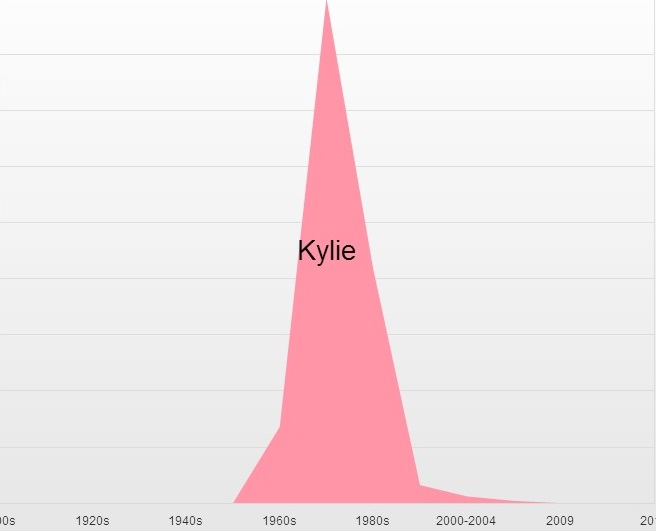
This really is a classic sign of a trendy name – it not only goes up the charts steeply, it comes down again at a similar rate, so that its progress through the charts has a cone shape; the skinnier the cone, the less years it was popular, and the more spectacular has been the name’s rise and fall. Kylie‘s cone, for example, looks quite thin.
kylie trendy

The trouble is that this isn’t very helpful for predicting whether a particular name will be trendy. It’s strictly a post mortem technique, so by the time you realise you chose a trendy name, it’s too late – your child is thirty six years old and nobody cares anyway.

Some people fear that any name going up steeply in popularity is sure to come down steeply as well, but this isn’t necessarily the case. For example, imagine you chose the name Jennifer for your daughter in the 1930s. It jumped straight into the Top 100 from nowhere, which seems very alarming, but it remained in the Top 100 for seven more decades. Your little Jenny would have collected her old age pension before her name stopped being popular, and even today Jennifer is only around the 200-300s and fairly stable. It never fell as dramatically as it rose.

Jennifer

For this reason, it seems a bit silly to avoid a name that’s trending upwards. If anything, the message seems to be to jump on a trend as early as possible, because it’s cooler to be a Jennifer born in 1935 than one born in 2000, even though the popularity was around the same in those two years.

… and has reached a certain level of popularity

Even though trendiness and popularity are not the same thing, it’s only once a name becomes reasonably popular that most people start to call it trendy, even if it’s been zooming up the charts for several years. It needs to be used by enough people that it can have those impressive rises in rank, as well as enough visibility to be considered trendy.

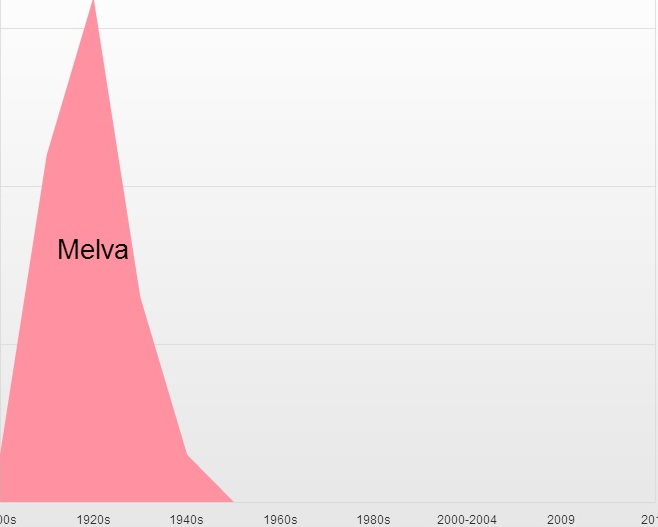
So Melva might have a steep rise and descent, but as it never reached the Top 100, it doesn’t get mentioned as a past trendy name. Persistently low usage does help protect a name against a charge of trendiness from most people (not all).
melva

New to the charts

I know many will disagree with this one, but I believe that no matter how rapidly a name is rising, it’s not trendy if it has previously been on the charts. Otherwise you get comments like “Leo is both classic and trendy“. Which is absurd when you think about it – like describing someone as an extremely tiny giant, or a colour as a very pale shade of black – because classic and trendy are opposing terms. I would say Leo is a rising contemporary classic, not a trendy classic.

Leo rising classic

Names that have been on the charts previously and disappeared before returning again are retro names. No matter how much Nathaniel may be zooming up the charts at present, I don’t consider it to be trendy, as it already has a history as a traditional name.

Inspired or boosted by popular culture

Any name that has suddenly got a boost in the charts (or even just in the public consciousness) due to a popular song, movie, TV show, celebrity, or celebrity baby is liable to be labelled “trendy”, whether it’s Elsa, Khaleesi, Penelope, Jagger, George, or Banjo.

I think that’s very unfair, because if you look through the history of naming, people have always named their children after the celebrities and culture of their day. By this standard, familiar names such as William, Eleanor, Alexander, Cordelia, Stanley, Fiona, Eric, and Rosamund have all been “trendy”. In fact, you could include all the Bible names and saints’ names in that group as well, since saints were the celebrities of the Middle Ages, and the Bible everyone’s favourite book.

Fitting in with one or more name trends

Another thing that can get a name labelled trendy, even if it’s in rare use, is if it fits in with current naming trends, especially with multiple trends. So you might claim that Liliana is a trendy name, because it fits in with the trend for L-L names for girls, like Lila, and with the trend for elaborate names for girls, like Isabella.

The trouble is that by this logic, practically every name being used today could be labelled as “trendy” – it’s very difficult to avoid ALL name trends.

This article mentions some of the current baby name trends in Australia: patriotic names, surnames as first names, place names as first names, nicknames as first names, and biblical names. Remove all those, and the choices dwindle significantly. And this isn’t even touching on mythological names, vintage names, unisex names, rare names, uniquely spelled names, literary names, virtue names, nature names, vocabulary names, and boys’ names ending with N.

* * * * * * * * * *

There you have it: six things might get your baby name labelled trendy. And the more categories it fits into, the more likely that it will seem trendy to somebody. So the current most “trendy” name in the Top 100 is Aria – it’s climbing fast, quite popular, new to the charts, inspired by popular culture, and fitting in with current trends, such as the AR sound in names.

Of course, in the 1970s there was a name which rocketed into the Top 100 from nowhere, had never been on the charts before, with use boosted by a popular singer, and whose sound fit in with other popular girls’ names such as Emily and Felicity. That name was Olivia, and although it may have been trendy in 1978, it isn’t any more. Aria could become equally as established, or even a modern classic, so there’s no guarantee that a trendy name will stay trendy.

Olivia

The big question is: what exactly is so terrible about a trendy baby name anyway? We’re always being told to avoid trendy baby names, and rarely are we given a reason. It’s just taken for granted that of course you don’t want to give your child a trendy name, in the same way that of course you don’t want them to put their hand on a hot stove.

About the only thing I can come up is that trendy names tend to become dated, except that a) sometimes they don’t eg William and b) most names date eventually anyway, even classics eg Susan.

And even if your name doesn’t become dated, it isn’t going to make your life especially wonderful. I have a non-trendy classic name which is still reasonably popular, and not only has it failed to provide me with a magically charmed life where nothing ever went wrong, its impact has been minimal at best. Meanwhile, my peers with the trendy names of our generation, such as Jodi and Jason, don’t seem to have had their lives ruined by their names.

* * * * * * * * * *

So there you have it – trendy names are something to be avoided, even though there’s no compelling evidence they’re particularly awful, or that a trendy name will remain trendy; there’s not even any real proof that trendy names actually exist as an objective phenomenon. And the criteria as to what is trendy is so broad that almost any name you can think of can be labelled as such.

Perhaps it’s time to put this baby name bogeyman behind us.

POLL RESULTS
The things that most people thought made a name trendy were:

* destined to fall as quickly as it rose – 23%
* rapidly rising in popularity – 13%
* boosted by popular culture – 12%

26% of people thought a name had to fulfil at least two or more of the stated requirements before being considered trendy, while 7% thought that it had to fulfil all six of the requirements to be a trendy name.

Just 1% of people thought that being new to the charts made a name trendy.

2% of people did not think there was any such thing as a “trendy” name.

(Popularity charts from Baby Names Explorer)

Irish Names For Girls

08 Sunday Jun 2014

Posted by A.O. in Name Themes and Lists

≈ 10 Comments

Tags

classic names, famous namesakes, fictional namesakes, French names, Gaelic names, Irish Gaelic names, Irish name popularity, Irish names, Italian names, middle names, modern classics, mythological names, name history, name meaning, name popularity, nicknames, Old Irish names, popular names, royal names, saints names, underused classics, unisex names, vintage names

3478061055_c7f655e9d0

Irish people have played an important role in Australia’s history, with many arriving in the 18th century as convicts or free settlers. By the late 19th century, a third of Australia’s population was Irish, and today around 30% of us claim some Irish ancestry. It is said that Australia is the most Irish country in the world outside Ireland.

The Irish have made an indelible mark on our history, culture, religion, sport and perhaps most especially, our politics – six of our prime ministers have had Irish ancestors. They have also helped create much of our national character: both the good bits, like our dry sense of humour and love of language, and the bad bits, like our pessimism and thin-skinned “touchiness”. When I did Italian names, I said that I could imagine an Australian without an Italian history, I just didn’t care to, but it’s impossible to imagine Australia without an Irish history.

Here’s ten Irish girls’ names, some of which have become popular here, and others which are less common. Just a heads up that I haven’t included any fadas (accent marks) on any of the names, since they are not legal in all states.

Aisling
Modern name meaning “dream, vision” in Irish Gaelic. It can be seen as a literary name, because the aisling is a poetic genre developed in 17th century Ireland, where a woman appears in a vision and predicts a turn for the better in Ireland’s fortunes. Earlier, the dream-woman was young and beautiful, and didn’t have a political message, but symbolised nature or love. Aisling can be pronounced ASH-ling or ASH-leen, and to English-speakers, seems like a fresh alternative to Ashley; it has also spawned variants such as Ashlynn. Aisling is #41 in Ireland.

Aoife
From the Gaelic for “beauty, radiance”. In Irish legend, Aífe is a warrior woman, and rival of her (possible) sister Scáthach. Legend tells that she fought the hero Cú Chulainn, but he overcame her with trickery, and promised to spare her life if she stopped fighting with Scáthach, spent a night with him, and bore him a son. She fulfilled her side of the bargain, but the story didn’t end happily. In the tale of The Children of Lir, Aoife is the wicked queen who transformed her stepchildren into swans; she was cursed by being turned into a demon by her own father as punishment. Despite this unpleasant namesake, Aoife was used by medieval Irish nobility, with a notable example being Aoife MacMurrough. This 12th century Irish princess conducted battles on behalf of her husband, and is an ancestor of the current British royal family. Aoife is pronounced like EE-fuh; although complex to spell, it sounds rather like popular Eva, and has a lovely meaning. Aoife is #11 in Ireland and #10 in Northern Ireland.

Bridget
Anglicised form of the Old Irish name Brigit, meaning “high, exalted”. In Irish mythology, Brigit is a goddess; her name is derived from the word for “fire” and most likely her title. Brigit was a poet, and the inventor of keening – the lament over a body at a burial that is a mixture of singing and weeping. She is also patron of healing, smithing, arts and crafts, cattle and livestock, sacred wells, and serpents. She ruled all things high-reaching, as well as lofty attributes, such as intelligence, wisdom, excellence, knowledge, and skill. Brigit is associated with the home and hearth, and with early spring. Her special day is Imbolc, on February 1. She has become fused with St Brigid of Kildare, one of the patron saints of Ireland – probably an attempt to Christianise the goddess. St Brigid is patron of smiths, cattle, poets and scholars, and her feast day is February 1. In Ireland, the name Bridget was too sacred to use until the 17th century, but later became extremely popular – so much so that an Irishwoman was called a “Biddy“, just as an Irishman was called “Paddy”. Bridget was #104 in the 1900s, and dropped to its lowest ranking in the 1950s, at 0. It hit a minor peak in the early 2000s at #166, and is currently in the 200s in Victoria and the 400s in New South Wales. Bridget is an underused classic which has remained on the charts while never becoming popular.

Caitlin
Anglicised form of Caitlín, Irish form of Cateline, Old French pet form of Catherine. While the Irish say it something like kat-LEEN, English-speakers say KAYT-lin, and turn the Irish pronunciation into another name, Kathleen. Caitlin has been used in Ireland since the 19th century, and became well known in the 20th. In Australia, Caitlin has ranked since the 1970s, making its debut at #554, and soaring until it entered the Top 100 in 1987 at #86. By 1990 it was in the Top 50 at #38; by 1994 it was in the Top 20 at #15. It peaked in the late 1990s at #12, and since then has declined. Currently Caitlin is #99 nationally, #78 in New South Wales, and #103 in the Australian Capital Territory. Last year Caitlin was one of the names that fell the most in popularity, suggesting its day is coming to a close (although its many variant spellings would significantly boost its ranking). Caitlin is #64 in Ireland and #33 in Northern Ireland.

Ciara
Feminine form of Ciar, meaning “black”. There is a 6th century St Ciara and a 7th century one, or else just one long-lived St Ciara. According to legend, St Ciara was of royal blood, and founded an abbey; another story says that she (unless it is a different St Ciara) saved a town from a noxious fire through her prayers. Ciara is pronounced KEER-uh, and must be one of the most heavily Anglicised Irish names, for you rarely see it with its native spelling, but more often Keira or Kira. Although to me the Ciara spelling looks more elegant, it risks being confused with the Italian Chiara. Ciara fits in with Australian’s love of names such as Kirrily and Kirra, and has a native sound to our ears. Ciara is #32 in Ireland.

Deirdre
Deirdre of the Sorrows is a tragic heroine from Irish mythology. The daughter of King Conchobar’s bard, when she was a baby a druid predicted she would be very beautiful, but that much blood would be shed for her sake. Conchobar decided he wanted this beauty for himself, and had her brought up in seclusion. As an adult, Deirdre was as stunning as the druid had foreseen, and she fell in love with a handsome warrior named Naoise. The couple eloped, and were blissfully happy until the furious Conchobar tracked them down. In the ensuing battle, Naoise was amongst those killed. Conchobar triumphantly took his gorgeous wife home, but was angry that she remained cold and depressed. To teach her a lesson, he told her that he would give her to the man who had murdered Naoise – the man she hated above all others. On the journey to deliver her, the unhappy Deirdre threw herself from the chariot and split her head open. In some versions of the story, she simply wastes away with grief. Deidre is derived from the Gaelic name Derdriu, whose meaning is debated, but is implied in the original story as meaning “noise, murmuring”, related to the word for “storm”. It could thus be understood as “weeping, wailing, storm of tears”, and is often glossed as “sorrow”. Deirdre came into use as a girl’s name in the 19th century, and became more common in the 20th, when there had been many popular re-tellings of the legend. Deirdre first ranked in the 1930s at #183, peaked in the 1940s at #180, and hasn’t charted since the 1970s. This is a vintage name which has had very little use, so hasn’t become dated. It is rather lovely, although very sad.

Erin
Derived from Éirinn, from the Irish word for Ireland, Éire. Erin was used as a poetic and nationalistic name for Ireland, or the feminine personification of Ireland. According to folklore, the country’s name comes from Ériu, the mother goddess of Irish mythology, and a symbol of Irish sovereignty. Her name is believed to come from an ancient root meaning “fat”, to indicate that Ireland was a land of abundance. Erin came into common use as an Irish name in the 19th century. It has sometimes been given to boys, perhaps because it sounds like Aaron and Eric, but has only charted for girls. The name Erin first charted in the 1950s, debuting at #457, and reached the Top 100 in 1978, at #71. By 1980 it was in the Top 50 at #46, the following year it was in the Top 20 at #17, and it peaked in 1984 at #12. Erin has been a long-time favourite, and only left the Top 100 in 2012. This modern classic is no longer popular, but still getting a reasonable level of use. It is #39 in Ireland and #19 in Northern Ireland.

Maeve
Anglicised form of the Gaelic name Medb, meaning “intoxicating”, and related to the English word mead (a fermented honey drink). In Irish legend, Queen Medb was a powerful and seductive queen known for taking a succession of husbands as her consorts. She was once married to King Conchobar, from the story about Deirdre. Medb couldn’t stick him either and walked out; she ended up defeating Conchobar and ruling in his place. She demanded that her wealth be at least equal to her husbands’, and insisted her consorts be without fear, meanness, and jealousy – the last was very important, because Medb also took lovers to supplement her husbands. Folklorists believe that Queen Medb was originally a sovereignty goddess in a matrinlineal society who the king would symbolically “marry” in order to gain power over the land. This explains her many husbands. In modern times, she has become a feminist symbol of women’s power and female sexuality. This is a sweet, spunky name which fits in with the trend for names with a V in them, like Ava, and makes a great middle name. Maeve is in the 100s in Victoria, so not particularly unusual, while it is #100 in Ireland.

Orla
Anglicised form of Órfhlaith or Órlaith, meaning “golden princess”. Órlaith was a very popular name in medieval Ireland, and there are several queens and princesses from Irish history with this name. The famous High King of Ireland Brian Boru had a sister named Órlaith who married another High King (she unfortunately came to a sticky end after getting over-involved with her stepson), and Brian also had a daughter and a grand-niece named Órlaith. For some reason, Orla is a man in The Poems of Ossian by James McPherson, a young warrior and chieftain of Lochlin who falls in battle. In Scandinavia, Orla is used as a male name, and that might be because of McPherson’s poetry, which was very popular in Scandinavia. Orla is simple to spell and pronounce, and the princessy meaning would be attractive to many parents. Orla is #82 in Ireland.

Sinead
Anglicised form of Sinéad, the Irish form of Jeanette, the pet form of the French name Jeanne. It is the equivalent of the English name Janet, which is a pet form of Joan. In practice, Sinead is often understood as the Irish form of Jane or Jean; it has even been used as an Irish form of Jennifer since Jenny is an old pet form of Jane. The name is pronounced shi-NAYD. A famous Irish namesake is Sinéad de Valera, the wife of the Rebublican leader and Ireland’s third president, Éamon de Valera. A teacher of the Irish language, Mrs de Valera was named Jane by her parents, but changed her name to Sinéad not long after she was married. Sinéad de Valera was a successful children’s writer, who wrote in both English and Irish. She helped to popularise the name in Ireland, and the Irish singer-songwriter Sinéad O’Connor was named after her. Sinéad has lost popularity in Ireland in recent years, and has never charted in Australia, although still seen occasionally.

POLL RESULTS
The public’s favourite names were Maeve, Bridget and Aoife, and their least favourite were Ciara, Deirdre and Sinead.

(Picture shows detail from an Irish pound note, which bears the likeness of Queen Medb or Maeve; the pound hasn’t been used in Ireland since 2002 when the euro was introduced)

Interview with Nancy from Nancy’s Baby Names

01 Sunday Jun 2014

Posted by A.O. in Blog Reviews

≈ 9 Comments

Tags

choosing baby names, classic names, famous namesakes, honouring, names found in cemeteries, names from songs, names of businesses, Nancy's Baby Names, Pinterest, popular names, rare names, Twitter, US name data, US name popularity, US Social Security Administration

canyon75

Nancy is the anthroponomastic maven at Nancy’s Baby Names, a rich repository of name information delivered with a wry sense of humour. Nancy has been blogging indefatigably since 2006, making Nancy’s Baby Names one of the oldest baby name blogs out there. She has thousands of blog posts on all manner of names, but especially loves hunting down rare and unusual names, and discovering the stories behind them. Nancy also adores name data – there’s popular names from around the world, and tons of US data from well beyond the Top 1000. At Nancy’s blog you will find names that are bizarre, puzzling, curious … and they are all real.

What is your name?

Nancy Man.

Have you ever wished you had a different name?

I didn’t like the name Nancy when I was young, and I remember asking my parents for permission to legally change it. They laughed at me. These days I don’t mind my name as much, so I no longer think about changing it.

How did you first become interested in names?

The graveyards are what got me hooked, though I don’t think I would have been so fascinated by the names on the headstones had I not been so dissatisfied with my own name.

I was unhappy with my own name because I’d been named for the wrong grandmother (or so I believed throughout childhood). I got the name of the distant grandmother we hardly knew, not the awesome grandmother (Helen) we saw all the time. This was a problem.

The upside, though, was that it made me very curious about names in general. So when I began using a local graveyard as a short cut through town (around age twelve) I couldn’t help but check out all the names. I was especially attracted to the unfamiliar and bizarre names I’d never seen before – Peleg, Huldah, Zenas, Experience, etc.

After exploring that first graveyard thoroughly, I began visiting other graveyards, where I discovered even more curious names, and … that’s how the name obsession began.

What inspired you to begin a name blog?

I had an interest in names and a writing habit, so I started a blog in early 2006 to put the two together. My first posts were mostly tongue-in-cheek, but I began to take things more seriously once I started getting traffic and comments.

You seem to have a special fascination with unusual names of real people – how did that come about, and what is the most unusual name you have ever found on a real person?

It must have been the graveyards. In a sea of Sarahs and Johns, you can’t help but wonder about the one random Flavilla or Micajah.

The most unusual name? Wow, that’s tough. I’ll go with one I blogged about recently: Laxative Bromo Quinine. He was born in rural Texas in the early 1900s and named after the medicine that his mother credited with saving his life.

Do you have a favourite post on Nancy’s Baby Names?

I really like the Kasara/Casara post. That name had me stumped for a long time until it finally dawned on me that Kasara was a mondegreen. My extensive knowledge of long-forgotten ’80s pop hits finally comes in handy!

Are there are any other ways to follow you online?

Twitter is probably the best way. Pinterest is another option.

Do you have a pet peeve in regard to names?

My only pet peeve is that the U.S. Social Security Administration doesn’t release all its name data. Other countries do it, SSA, why not us? Come on! Privacy, shmivacy.

What are your favourite names?

I have two types of favourites.

One type, of course, would be the bizarre names: Zeppelina, Captivity, Oleomargarine, Emancipation Proclamation and the like. I especially love the ones that come with cool stories and explanations.

The other would be short, simple classics like Jane, John, Adam, Emma, Paul, and Rose. They’re familiar, unpretentious, and easy to live with. These are the names I’m always recommending to people in real life.

What names do you dislike?

I don’t care for names that are easy to make fun of. Not a fan of Abcde, for example.

Are there any names you love, but could never use?

Duncan. I’ve always loved the name, but I can’t say it without mentally adding “Donuts.” (Dunkin’ Donuts is a coffee/donut chain very popular in the North-eastern U.S., where I grew up.)

What are your favourite names in the US Top 100?

Girls: Elizabeth (#10). Runners-up: Hannah (#23) and Sarah (#48).

Boys: Thomas (#61). Runners-up: James (#13) and Sebastian (#45).

What are your favourite names in the rest of the US Top 1000?

Girls: Jane (#355). Runners-up: Daphne (#397) and Catherine (#172).

Boys: Duncan (#821). Runners-up: Paul (#198) and Theodore (#170).

What are your favourite names that have never charted in the US?

Girls: Mehitable. It’s a variant of the biblical Mehetabel, though I actually prefer the Mehitable spelling because that’s the way I always see it written on the headstones back home. (I kinda prefer Phebe to Phoebe for the same reason.) I’m slightly surprised that the belle/bella trend hasn’t brought Mehetabel back, even just a little. I wonder if spelling it Mehetabelle or Mehetabella would help…?

Boys: Chucknorris. I was so happy when I discovered this name in the wild, years after wondering aloud (via the blog) if it could possibly exist. It’s like that Walt Disney quote, “If you can dream it, you can do it,” except my version is “If you can dream it, you can find it on a birth certificate.”

If you found out you were pregnant right now, what names might you be considering?

I like classic names, but my husband prefers trendy names, so finding a name that suits both his tastes and mine would be the goal. I know Chloe would be a contender – it’s been a favourite of his for a while, and it happens to fit my criteria pretty well.

What is something we don’t know about you?

I cannot drink soda, beer, champagne, or anything carbonated. It’s like swallowing shards of glass to me. I’m amazed that so many people find bubbly beverages refreshing.

What advice would you give someone who was choosing a baby name?

This one is tricky to answer without a specific person in mind. For instance, the advice I’d give to the person deciding between Emma and Claire would be completely different from the advice I’d give the person seriously considering Kardashianette.

(Photo shows Nancy at the Grand Canyon, from her blog)

Famous Name: Grace

21 Wednesday May 2014

Posted by A.O. in Famous Names

≈ 6 Comments

Tags

British name popularity, classic names, colour names, contemporary classics, english names, famous namesakes, germanic names, Latin names, middle names, mythological names, name history, name meaning, name popularity, New Zealand name popularity, nicknames, popular names, royal names, saints names, theological names, virtue names, vocabulary names

Thumbnail_320

Last month it was the 121st birthday of Grace Cossington Smith, one of the most important Australian artists of the 20th century, and a contemporary of Clarice Beckett.

Grace was born in Sydney, and studied under Antonio Dattilo Rubbo, an inspiring and extremely supportive art teacher who encouraged his students to experiment; he affectionately called Grace “Mrs Van Gogh”. Her painting The Sock Knitter, showing her sister knitting socks for the war effort, is considered to be Australia’s first post-Impressionist painting, and she exhibited in galleries from 1915.

Her paintings are notable for their bright patterns and vibrant energy, using careful square brushstrokes to create images of colour shimmering through sunlight. She painted scenes of Sydney, and is famous for her iconic representations of the Harbour Bridge, showing the bridge’s construction. Grace’s Sydney was bustling, busy, exciting; filled with crowds, colour and sunshine. Later in life, she became known for her still lifes and interiors.

Art museums began buying Grace’s work in the 1940s, but she did not become famous until the 1960s, and in 1973 was appointed an Order of the British Empire as an exhibition of her work toured with the Art Gallery of New South Wales. Grace was 81, and let it be known that she would have welcomed recognition a little earlier. She received her OBE while in a nursing home, and by then was too frail to paint any more.

Grace is an English word which can be understood in several different ways. We might think of grace in terms of physical elegance and poise, but there is also social grace, where a person is charming and well-mannered.

The theological concept of Divine Grace is present in several religions. In Christianity, it means the undeserved love and mercy given to us by God – a gift that allows us a share in divinity. Although there are many theological disagreements, nearly all Christians believe that the grace of God is necessary for salvation, and that it is through divine grace that we are able to resist sin.

The word grace comes from the Latin gratia, meaning “kindness, favour, esteem”, ultimately from an ancient root which means “praise, welcome”. The word is related to grateful. Both the secular and spiritual senses of the word grace have connotations of effortlessness – no matter how many lessons in physical movement or etiquette you might have, you can only appear graceful if it seems natural and easy for you. And the grace of God comes not through our own efforts, but is a gift that we are freely given without earning it.

The English name Grace was not originally linked to either of these meanings, but from a Germanic name Grece, meaning “grey”, and pronounced like Grace. However, it quickly became associated with the Latin Gratia or Gracia, to suggest “charming, pleasant”, and it is thought that women with these names would have been known as Grece or Grace in everyday life.

St Gracia of Lerida may have been an influence on the name’s development; she was the daughter of a Spanish Muslim caliph who converted to Christianity and was martyred in the 12th century. Born Zaida, she took Gracia as her Christian name, and is sometimes known as St Grace. There is also an obscure pre-Norman English saint named Grace connected with St Probus of Cornwall; some speculate that she was his wife, and others that she was a great lady who supported him in his ministry. There doesn’t seem to be any evidence that she ever existed.

In Greek mythology, the Graces are goddesses of charm, beauty, nature, creativity, and fertility, patronesses of amusements and festivities. Despite this seemingly frivolous purview, in some mysterious way they were connected to the Underworld and the secrets of the afterlife – perhaps a taste of the joys which might await us on the other side. In Renaissance art, they are usually depicted as three beautiful young women who are either naked or lightly draped in diaphanous garments, and often embracing each other or clasping hands.

These attractive figures might have influenced the choice of the name Grace from the late Middle Ages, but it is usually thought that after the Reformation, Grace would have been given by Puritans as a virtue name, with the religious meaning in mind.

Grace is a classic name which has never left the charts. It was #29 in the 1900s, left the Top 100 in the 1940s, and reached its lowest point in the 1970s at #373. It then began climbing steeply, around the time of Princess Grace of Monaco’s death, and reached the Top 100 in 1988 at #89.

By 1991, Grace was in the Top 50 at #45, and in the Top 20 by 1998 at #13 – the highest point it had ever gained historically. Grace reached the Top 10 in 2002 at #9, however it did not stay there long, and stabilised just outside the Top 10, where it remains today.

Currently Grace is #12 nationally, #11 in Victoria, #14 in New South Wales, #12 in Queensland, #11 in Western Australia, #9 in Tasmania, #11 in the Northern Territory and #10 in the Australian Capital Territory. Highly popular in all states and territories, it is also a Top 100 name in other English-speaking countries, and is most popular in Northern Ireland and Ireland at #3 and #4 respectively. Its popularity in Britain and New Zealand is much the same as here.

Grace is a true timeless classic; a solid choice as an English name which has never gone out of fashion or fallen into disuse in nearly a thousand years. Yet it is more popular now that it has been at any other time in Australia’s history, making it a contemporary classic which feels both traditional and up-to-date.

Grace is a beautiful name with simple elegance; sophisticated and unpretentious, and even more popular as a middle name. It’s a saint, a princess, a goddess, and millions upon millions of ordinary women throughout the ages. There may be many little girls named Grace, but that’s no reason why your daughter cannot join their ranks. Gracie is a common pet form, and quite a few parents are choosing this as the name on the birth certificate.

POLL RESULT
Grace received an excellent approval rating of 83%, making it one of the highest-rated names of 2014. People saw the name Grace as a beautiful timeless classic (29%), simple yet sophisticated (18%), suitable for all ages (18%), and intelligent and professional (11%). However, 6% thought it was too popular. Nobody thought the name Grace was harsh or ugly.

(Picture shows Church Interior by Grace Cossington Smith, c 1941)


Boys Names from the Top 100 of the 1920s

11 Sunday May 2014

Posted by A.O. in Name Themes and Lists

≈ 7 Comments

Tags

Anglo-Saxon names, aristocratic surnames, classic names, dated names, english names, epithets, famous namesakes, Gaelic names, germanic names, Irish names, locational names, middle names, name history, name meaning, name popularity, name trends, nicknames, Norman-French names, Old English names, Old Norse names, retro names, Roman names, royal names, saints names, Scottish names, surname names, unisex names, Welsh names

161695_medium

Happy Mother’s Day! One of my mum’s favourite hobbies is browsing in antique shops and vintage stores: sometimes you find the most wonderful items in these places, and marvel that we ever stopped making such beauties. On the other hand, sometimes there’s nothing but junk in them. But either way, you get to lose yourself in the past for a while. Here are ten boys names from the 1920s, and I will let you decide whether I have dug up something worthwhile, or whether they should be allowed to lie under dust sheets for a few years longer. 

Athol
Based on the place name Atholl, a district of the Scottish Highlands which means “New Ireland” in Gaelic. One of its towns is named Blair Atholl, and the Duke of Atholl is a member of the Scottish peerage – the only person in Europe legally commanding his own private army, the Atholl Highlanders. Both Sydney and Adelaide have suburbs named Blair Athol; the one in Sydney is named after a historic house. A famous Australian namesake is Athol Guy, from folk group The Seekers – he’s the one with glasses. Athol has been used as a first name since the 18th century, and originates from the Atholl region of Scotland. Athol was #86 in the 1900s, and peaked in the 1910s at #70; by the 1920s it was #72. It left the Top 100 in the 1940s, and hasn’t ranked since the 1950s. Athol unfortunately sounds a lot like the female name Ethel, and can be mispronounced to sound like a rude word (I went to primary school with an Athol, and can testify to this). It might be better suited as a middle name.

Bernard
Germanic name translated as “brave as a bear”. It was brought to England by the Normans, where it replaced the Old English equivalent, Beornheard. There are several saints named Bernard, including St Bernard of Mentone, founder of a famous refuge for pilgrims in the French Alps; the St Bernard dogs used to rescue people are named after him. Another is St Bernard of Clairvaux, who founded the Cistercian Order and is a Doctor of the Church, famed for his eloquence. Two Australian celebrities demonstrate the different ways this name can be pronounced: Bernard Fanning from Powderfinger says his name with the accent on the first syllable, while tennis player Bernard Tomic has his name pronounced with the emphasis on the second. Bernard was #62 in the 1900s, and peaked in the 1920s at #53. It didn’t leave the Top 100 until the 1970s, and last ranked in the 1990s. With more than sixty years in the Top 100, yet never in the Top 50, Bernard seems very usable. It’s a strong, masculine name that is quite funky, and comes with cute nicknames like Bernie, Barney, and Bear.

Herbert
Germanic name translated as “bright army”, and found very early in the form Charibert, who was King of the Franks in the 6th century; his daughter married a king of Kent. The Anglo-Saxons had their own form of the name, Hereberht, and there is a 7th century saint with this name, as well as an obscure French St Herbert. When the Normans conquered England, they brought the name with them, and it replaced the Old English form. Unlike many other medieval names, Herbert managed to remain in use because it is an aristocratic surname – the Herbert family have been Earls of Pembroke in an unbroken line since 1501. The first Earl of Pembroke was a courtier married to the sister of Catherine Parr, one of Henry VIII’s wives, and the present Earl still lives on the estate built by the first Earl. The name Herbert became popular during the 19th century, when Sidney Herbert, the 14th Earl, was a distinguished politician famous for being the most handsome MP of his day. Herbert was #23 in the1900s, and #48 by the 1920s. It left the Top 100 in the 1940s, and hasn’t ranked since the 1960s. I have seen one or two small children named Herbert, and this is one for the serious lover of vintage names, with the nicknames Herb, Herbie, and Bertie.

Ian
Anglicised form of Iain, a modern Scottish Gaelic form of John, derived from the medieval Irish name Eoin. Both Iain and Ian date from the 19th century, and it is not impossible that Iain was an attempt to Gaelicise English Ian. Ian was #128 in the 1900s, and joined the Top 100 the following decade. It was #57 in the 1920s, and peaked in the 1950s at #10. It didn’t leave the Top 100 until the 1990s, and is currently stable in the mid-200s. This makes Ian a very safe choice – it’s a classic which was popular for eighty years, and is still in reasonable use.

Lloyd
English form of the Welsh Llwyd, commonly translated as “grey”, which in practice referred to various shades of brown in different contexts, and white, in the sense of grey hair being white. Although Llwyd was sometimes used as a personal name, it became better known as an epithet, which came to describe someone with mouse-brown hair, and then developed into a surname. By this stage, the original meaning of “grey” was pretty much lost, and it was understood as “brown-haired”. The word llwyd could also be understood as meaning “holy, blessed”, although this doesn’t seem to have contributed to the surname. In Britain, Lloyd has some heavy-duty business clout, due to Lloyds Bank, and the insurance market Lloyd’s of London. Use of the name may have been boosted by David Lloyd George, Britain’s only Welsh Prime Minister. Lloyd was #148 in the 1900s, and peaked in the 1910s at #80. By the 1920s it was #91, and it left the Top 100 the following decade. However, the name Lloyd continued to chart until the late 2000s. It’s still in occasional use, and I see it quite often as a middle name in birth notices. Lloyd may be a little clunky, but it’s not an outrageous choice.

Ross
A region in north-west Scotland, said to mean “headland” in Gaelic, perhaps referring to the Black Isle, a peninsula in the Scottish Highlands. Another possibility is that it means “horse island” in Old Norse, in reference to the island of Orkney. The Scottish surname Ross originates from this area. However, the surname has English roots too, because there are places in England named Ross, with the meaning “headland”, and Rozzo was an Anglo-Saxon name meaning “fame” (related to the name Rose). The Rosses were a large Yorkshire family who came over with William the Conqueror from the village of Ros in Normandy (the name means “red’); in the Middle Ages they bought up large tracts of Ayrshire, so their surname also became Scottish. Ross has been used as a personal name since at least the 16th century, and first used in England rather than Scotland. Ross was #203 for the 1900s, and hit the Top 100 in the 1920s at #75. It peaked in the 1950s at #37, didn’t leave the Top 100 until the 1980s, and still ranked in the late 2000s. Ross is fairly common in the middle, and wouldn’t be too surprising up front.

Roy
Anglicised form of Ruadh, a Gaelic name meaning “red”, often used as a nickname for someone with red hair. One of the most famous bearers is Scottish outlaw Raibeart Ruadh MacGriogair, known in English as Rob Roy MacGregor. His story was turned into a best-selling novel by Sir Walter Scott, and Liam Neeson starred in a film about him. The name can also be derived from the surname, which can be from Ruadh, but also from Norman-French Roi, meaning “king”. This could be used as a nickname, but was a medieval personal name as well. Roy was #25 in the 1900s, and #34 by the 1920s. It left the Top 100 in the 1950s, and reached its lowest point in 2010 with a ranking of 0. Since then, Roy has begun to pick up steam, and has become rather fashionable, along with similar names like Royce, Elroy and Leroy. This classic is once again on trend.

Sidney
Aristocratic surname which probably comes from a place name meaning “at the water-meadows” in Old English. However, folk etymology derives it from the French Saint-Denis, a suburb of Paris named after the city’s first bishop. The Sidney family became prominent during the Tudor period; Sir William Sidney was squire to Henry VIII. Sir William’s grandson was poet Sir Philip Sidney, famous for creating the name Stella. The story goes he had a noble and gallant death, for as he lay dying in battle, he gave his water to another wounded soldier, with the words, “Thy necessity is yet greater than mine”. Sir Philip’s great-nephew was Algernon Sidney, a 17th century republican executed for treason, and afterwards revered as a heroic patriot and martyr. Although Sidney had been used as a first name since the 16th century, it became much more popular in the United States during the 18th and 19th, because Algernon Sidney’s anti-monarchist views were highly influential to the American conception of liberty. Although it has charted for both sexes in the US, in Australia Sidney has only charted as a male name. Sidney was #48 in the 1900s, and peaked in the 1910s at #47; by the 1920s it was #63. It left the Top 100 in the 1940s, and dropped from the charts in the 1980s. However, it ranked again in the late 2000s at #450, and has been gently increasing. This retro name is back in style, along with its short form, Sid.

Terence
English form of the Roman family name Terentius, of unknown meaning. The Roman comic playwright we call Terence was named Publius Terentius Afer, and he was a slave (probably from Libya) of a Roman senator from the Terentius family, who educated him, and later freed him; he adopted the name Terentius after gaining his freedom. There are several saints we call Terence, although most of them were named things like Terentianus, Terentian, or Tertius. Terence has been used as an English name since the 17th century, and in Ireland was used to Anglicise the name Toirdhealbhach, meaning “instigator”. Terence was #141 for the 1900s, and joined the Top 100 in the 1920s at #71. It peaked in the 1940s at #30, and left the Top 100 in the 1960s. It hasn’t ranked since the 1990s, but Terence still seems usable, and could be seen as either a “posh” choice or an Irish one.

Wallace
English surname derived from the Norman French waleis, meaning “foreigner”. Although often translated as “Welsh”, the word waleis could refer to someone from Wales, or from the English counties bordering Wales, or to Cornish Celts, or to Bretons who came to England after the Norman Conquest and settled in East Anglia. The surname became associated with Scotland because of the early medieval Kingdom of Strathclyde, which straddled northern England and southern Scotland. The people of Strathclyde spoke Cumbric, a British language closely related to Old Welsh, and were known as walensis. Even after becoming part of Scotland, it remained a distinctive area into the 12th century. The surname is famous because of Sir William Wallace, a commander during the 13th century Wars of Scottish Independence who has become an iconic Scottish national hero. There have been many books and poems written about Wallace’s exploits, and he features in the film Braveheart, played by Mel Gibson. Wallace has been used as a first name since the 17th century, and originates from Scotland. Wallace was #74 for the 1900s, and peaked in the 1920s at #68. It left the Top 100 in the 1940s, and hasn’t ranked since the 1950s. Wallace really deserves to make a comeback, and the nicknames Wally and Wal are cute.

POLL RESULTS
The public’s favourite names were Sidney, Wallace and Ian, and their least favourite were Terence, Athol and Herbert.

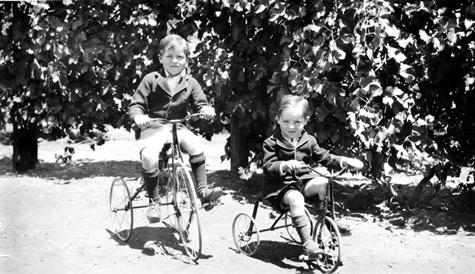
(Picture shows two boys riding their tricycles amongst grape vines in Mildura, Victoria in the 1920s; photo from Museum Victoria)

Girls Names From the Top 100 of the 1920s

04 Sunday May 2014

Posted by A.O. in Name Themes and Lists

≈ 5 Comments

Tags

African names, animal names, Arthurian names, Berber names, British names, celebrity baby names, classic names, created names, dated names, Egyptian names, english names, European name popularity, fictional namesakes, gemstone names, germanic names, Greek names, Irish names, Latin names, Libyan names, locational names, mythological names, name history, name meaning, name popularity, names from movies, names from television, nature names, nicknames, Old English names, Old French names, Old Irish names, retro names, saints names, Sanskrit names, scandinavian names, surname names, underused classics, unisex names, Welsh names, Yiddish names

palm-beach-sydney-1920s

The data on popular names are all in, but maybe none of the current Top 100 names interest you. Or perhaps you are dismayed at how much your favourite names went up in popularity last year. If so, why not look at the popular names of ninety years ago, to see if there are some gems from times gone by that are ready to shine again?

Agnes
Agnes of Rome was a 3rd century child martyr. According to tradition, she was a member of the Roman nobility, raised in a Christian family, and a very beautiful young girl. She is said to have been only twelve or thirteen when she died, and like Saint Catherine, is one of the patrons of young girls; the eve of her feast day was a time for girls to perform rituals to discover their future husbands. The name Agnes was very popular in the Middle Ages; one of its attractions was probably that in medieval English it was softened into Annis, so that it sounded as it was related to Anne. The name Agnes is from the Greek for “pure”, but because it sounds similar to the Latin for “lamb”, agnus, Saint Agnes is often depicted holding a lamb. Agnes was #28 for the 1900s, and by the 1920s had fallen to #77. It left the Top 100 in the 1930s, and hasn’t ranked since the 1940s, but is now getting some use again. This soft, elegant name has been chosen for their daughter by several celebrities, including Jennifer Connolly. It is the name of a little girl in the movie Despicable Me, and currently popular in Scandinavia. It feels as if Agnes is already making a comeback.

Beryl
Gemstone name; beryls are stones which in pure form are colourless, but usually tinted by impurities in a variety of shades. Green beryls are called emeralds, and light blue ones are aquamarines, but all colours of beryl have their own name. The word beryl is ultimately from Sanskrit, probably derived from the town of Belur in southern India. Beryl has been used as a first name since the 17th century, but only became popular during the 19th, along with other gemstone names. Historically, it has been used as a male name too, mostly in the United States, perhaps as a variant of the surname Berrill (an occupational name from the wool trade), and the Yiddish name Berel (pet form of Ber, “bear”). Beryl was #61 in the 1900s, and peaked in the 1920s at #8. It left the Top 100 in the 1950s and hasn’t ranked since the 1960s. Beryl is the bossy cook in Downton Abbey, and the evil queen in the Sailor Moon cartoons. This would make a daring gemstone revival, and offers the nickname Berry.

Elva
Variant of the Scandinavian girl’s name Alva, or an Anglicised form of the Irish unisex name Ailbhe, pronounced like Alva, and one of the influences on the name Elvis. You could see Elva as a specifically feminine form of Elvis, and the Irish origin seems most likely in Australia. Elva was #160 for the 1900s, and peaked in the 1920s at #97, before falling steeply; it last ranked in the 1950s. Elva was a “trendy” name in its day, but its relative obscurity has saved it from seeming dated. I have seen several babies named Elva recently, and it doesn’t seem out of place amongst the Evas and Avas.

Gwendoline
Variant of the Welsh name Gwendolen, first used for a legendary queen of Britain by Geoffrey of Monmouth in his History of the Kings of Britain. According to this legend, Gwendolen was the daughter of King Corineus of Cornwall. She defeated her husband after he repudiated her in favour of his mistress; he was killed in battle, and Gwendolen had the mistress drowned. She then took the throne as the first independent queen of the Britons, and ruled for fifteen peaceful years. Gwendolen appears in Edmund Spenser’s The Faerie Queene, and in the poems of William Blake, as a symbol of British sovereignty. Gwendolen has been translated as “white ring, white bow”, although it may have been an attempt to Latinise another Welsh name. Geoffrey re-used the name Gwendolen for the name of Merlin’s wife in his Life of Merlin. Gwendolen and Gwendoline were revived in the Victoria era as part of the fascination with Arthurian names, and names from British legend. Gwendoline was #68 in the 1900s, and peaked in the 1920s at #35. It left the Top 100 in the 1940s, and hasn’t ranked since the 1950s. It still receives occasional use, and has an upper-class British feel to it, while giving Gwen and Winnie as nicknames.

Hilda
Originated as a short form of Germanic names with hild in them, meaning “battle”. Hilda of Whitby was a 7th century saint from Northumberland, and her name in Old English is Hild. Born into royalty, she was baptised as part of the mission by Pope Gregory the Great to convert the English to Christianity. Hilda became a nun, then founded a monastery at Whitby (it was in the Celtic style, where men and women lived separately, but worshipped together). Hilda is described as a woman of great intelligence and energy, a fine abbess and teacher, so wise that rulers came to her for advice, yet caring towards ordinary people. Hilda was #27 in the 1900s, and #71 by the 1920s; it left the Top 100 by the 1930s, and hasn’t ranked since the 1940s. Hilda is a popular name in Sweden, giving this name a sexy Scandinavian feel as well as a sturdy English one; it doesn’t seem radically different from Heidi, and is even slightly like Matilda. It would be an unusual choice, but by no means a strange one.

Kathleen
Anglicised form of Cáitlin, the Irish form of Catelin, the Old French form of Catherine. The Irish Cáitlin can be said kat-LEEN, so it’s just a step to Kathleen. This name has a very Irish association, for Kathleen Ni Houlihan is an emblem of Irish nationalism representing the country of Ireland. She is usually depicted as an old woman who has lost her home and her lands, needing young men willing to fight and die for her. Once she has been rejuvenated by their martyrdom, she appears young and beautiful, and proud as a queen. It combines myths of both paganism and Christianity, and Kathleen Ni Houlihan has appeared in folk songs and poems, and the literary works of William Butler Yeats, Lady Augusta Gregory, Sean O’Casey, and James Joyce, amongst others. The name Kathleen was #10 in the 1900s, peaked in the 1910s at #5, and was #11 by the 1920s. A long time favourite, it didn’t leave the Top 100 until the 1990s, but hasn’t ranked since the late 2000s. Despite being out of fashion, this name was popular for more than eighty years, and still seems fresh and wholesome, with a hint of Irish charm.

Mabel
Short form of Amabel, from the Latin name Amibilis, meaning “lovable”. There were both male and female saints named Amabilis, and the female one is often known as Saint Mable to prevent confusion. Mabel was a popular name in the Middle Ages, and is found in a range of variant spellings; it is thought that it was originally said MAB-ell rather than the current MAY-bel. Mabel became rare in England, but remained in use in Ireland, where it was used to Anglicise the name Maeve. It was revived in the 19th century when Charlotte M. Yonge used it in her best-selling romance, The Heir of Reclyffe, for a character with an Irish background. Mabel was #30 in the 1900s, and had fallen to #90 by the 1920s, leaving the Top 100 the following decade. Mabel left the charts in the 1950s, but returned in the late 2000s. This retro name has plenty of spunk, and although it isn’t popular yet, don’t be surprised if it is again some day.

Monica
Saint Monica was the mother of Augustine of Hippo. A devout Christian, it was her dearest wish for her pagan son to become one as well, and after seventeen years her prayers were answered when he was converted by Saint Ambrose. Of course Augustine went the whole hog and ended up a saint, and a doctor of the church as well. Saint Monica was rather neglected after her death, but her cult became popular during the Middle Ages. Monica was from Libya and her name a Berber one that was common at the time; it is derived from the Libyan god Mon, a form of Amon, one of the most important of the Egyptian gods. In the Middle Ages, the origins of her name being unknown, it was decided that it must come from monere, Latin for “to advise, to warn”. Although this neatly tied in with Saint Monica’s story, it was etymologically incorrect. Monica was #141 in the 1900s, and peaked in the 1920s at #91; it had a minor peak in the 1990s at #127, coinciding with the sitcom Friends, which had the character of Monica Geller. Monica has never left the charts, but never been higher than the bottom of the Top 100, making it a genuine underused classic. It still sounds slightly exotic, and makes a pretty, sophisticated choice that’s never been common.

Peggy
Short form of Margaret, meaning “pearl”. It’s a variant of Meggy which has been in use since medieval times. Peggy first ranked in the 1910s at #189, and peaked in the 1920s at #63. It fell sharply, leaving the Top 100 by the following decade, and hasn’t ranked since the 1980s. Peggy is now staging a comeback, as it fits in perfectly with the trend for vintage and retro short forms. The ambitious career woman Peggy Olsen from Mad Men is a feminist icon, and this name has been chosen as a celebrity baby name by both MP Jacinta Allan, and media personality Chrissie Swan.

Una
Anglicised form of Úna, a medieval Irish name believed to come from the Old Irish for “lamb”. In Irish mythology, Úna was a fairy queen, wife of Finnbheara, the high king of the fairies. It is pronounced OO-na, and was sometimes Anglicised to Agnes, because of the lamb connection, as well as Winnie or Juno, based on similar sounds. Una is also a name created by Edmund Spenser for his epic poem, The Faerie Queene. In the allegory, Una represents the “True Church” (Protestantism), and defeats the representation of the “False Church” (Catholicism). Spenser seems to have based her name on the Latin for “one” (to reference unity and a single choice of faith); the name is said YOO-na. However, Spenser wrote his poem while living in Ireland, and it is hard not to wonder if he had been influenced by the Irish name. Una was #94 in the 1900s, and peaked in the 1920s at #69, leaving the Top 100 the following decade. It hasn’t ranked since the 1940s, but this name is really quite beautiful, and with its clear simplicity, doesn’t seem odd next to Ava and Mia.

POLL RESULTS
The public’s favourite names were Mabel, Gwendoline and Agnes, and their least favourite were Monica, Hilda and Beryl.

(Picture shows women holidaying at Palm Beach in Sydney in the 1920s; photo from the State Library of New South Wales)

Can You Help This Mum Find Some Baby Name Inspiration?

03 Saturday May 2014

Posted by A.O. in Naming Assistance

≈ 9 Comments

Tags

baby name websites, choosing baby names, classic names, honouring, Laura Wattenberg, middle names, name popularity, nicknames, Nymbler, sibsets, The Baby Name Wizard

images

Elizabeth and Thomas are expecting their second child later this month, but are yet to seriously discuss names. They already have a little boy named Xavier, but Elizabeth isn’t too fussed about “sibset flow” – she just wants the children to have names they like.

What they would like in a name

  • Not extremely popular
  • Not very uncommon
  • No unusual spellings
  • A name that can stand the test of time, and suit an adult as well as a child
  • Elizabeth would most like a classic or traditional name, combined with a more modern or contemporary middle, such as Zali or Eden

Names currently being considered
Girls: Grace or Kate, with Olive or Victoria as the middle name. Elizabeth loves the name Zara, but Thomas isn’t convinced.
Boys: Elizabeth really likes the name Jack, but believes it is too popular. She likes Ned, Ted, and Sam, but isn’t 100% sold on them. They earlier considered the name Lenny, but weren’t sure they could love it forever as much as they did initially. They may use the family name Geoffrey as the middle name.

Names that have been crossed off the list
Girls: Maggie
Boys: Elizabeth has crossed off Harry and Charlie, and Thomas has crossed off Ben, Benjamin, Clancy and Chas. Noah and Joe are also off the list.

The family surname begins with M and ends with R with an L sound in it eg Marler. Because of this, they have eliminated Amelia as a possibility, and any two-syllable name ending with -la, such as Ella or Layla. Elizabeth loves alliterative names, and would be happy with a name starting with M.

Elizabeth is feeling quite stuck in regard to name inspiration, and is hoping blog readers can help her out with some ideas. She wishes she could just have a list of names in front of her, so she could tick or cross off ones she likes or doesn’t.

* * * * * * * * * *

Elizabeth, when you said you would like a list of names that you could either say Yes or No to, that reminded me of the Nymbler website, run by Laura Wattenberg of the Baby Name Wizard.

To use it, you choose up to six names you like as your name inspirations, and then press Find Names – you can also select boy or girl names, or both. Once you receive your list of names, you can either save the names you like by pressing the heart symbol, or you can block the ones you dislike so you won’t see them again. I find the longer you go on from the same set of names, the more crazy and random the name suggestions get.

Another online tool that is a bit more focused is the Baby Name Expert on Behind the Name. You have to register to use the site (it’s free), and then you will find it under the Tools menu. You select a gender, and the country you are from (Australia is included), and then it starts suggesting names at random.

At this point, you can tell the BNE that you love the name, and save it to your list. Or you can tell it that the name is okay, and the reasons that you don’t mind it. Or you can give it the flick, and explain why this name is completely wrong for you.

Each time you either save, okay, or ditch a name, you will receive suggestions based on your preferences. Unlike Nymbler, the longer you use this app, the more focused and sensible the suggestions tend to get, and it’s very fast to move from one name to the next.

Anyway, that’s two methods of getting a long list of names that you can tick or cross off. It might be fun to do this with Thomas, so you can choose names together, and discuss your preferences. Or if he finds this kind of thing boring or stressful, it’s a way to immediately get a list of names you like that he can either agree to or nix in his own time.

I can’t give you hundreds of name ideas, but I did notice that all the names you chose were short and simple. You seem to like sensible, wholesome names for girls, like Grace and Kate, with maybe something more elaborate, trendy, retro, or modern in the middle. For boys, you seem to like cute, nicknamey names like Jack, Ned, Ted, Sam, or Lenny.

Girls names that reminded me a bit of Grace and Kate include

  • Alice
  • April
  • Audrey
  • Bonnie
  • Claire
  • Daisy
  • Hope
  • Ivy
  • Lucy
  • Maisie
  • Rose
  • Zoe

Possible middle names could be

  • Aria
  • Clementine
  • Eleanor
  • Eloise
  • June
  • Pearl
  • Penelope
  • Tess
  • Sadie
  • Scarlett
  • Susannah
  • Vivienne

Cute boys names could be names like

  • Alfie
  • Digby
  • Finn
  • Freddie
  • Gus
  • Jed
  • Jem
  • Kit
  • Mack
  • Nico
  • Rafe
  • Roy
  • Sid
  • Sonny
  • Toby
  • Vince

It seems as if you have already picked out nice names though – Grace and Kate are perfect, and Grace Victoria or Kate Victoria is quite regal.

There are several boy’s names you like, but you don’t seem ready to commit to any of them yet. I wonder whether you just need more time, or need to meet your baby first before you decide? Or maybe you’d prefer choosing a formal name for the birth certificate, with a nickname for everyday use, like Edward nn “Ned”, or Theodore nn “Ted”, or Lennox nn “Lenny”.

I know you are getting close to your due date, but don’t let that panic you. Take some time to get a list of names that you and Thomas like – names that you can imagine calling your child, and that fits in with your lifestyle. You don’t need to decide on one until after the baby is born, and if you still don’t have a name, you have weeks after the birth to choose one.

Good luck Elizabeth – for some reason I feel as if you are closer to finding a baby name than you think, even if you end up with something completely different than the names you are considering. Do let us know what name you choose for your baby once she or he arrives!

NAME UPDATE: The baby’s name is Patrick!

Interview with Kelli from NameFreak!

27 Sunday Apr 2014

Posted by A.O. in Blog Reviews

≈ 4 Comments

Tags

baby name blogs, Biblical names, British Baby Names, choosing baby names, classic names, Facebook, fictional namesakes, guilty pleasure names, Instagram, Kelli Brady, name combinations, NameFreak!, Pinterest, popular names, sibsets, Twilight names, Twitter, UK birth notices, US name popularity

namefreak

Kelli Brady is the analytical blogger at NameFreak!, which is a true name nerd’s blog – and of course I mean that in the most complimentary sense possible! There is tons of analysis of American name trends on the blog; I can tell Kelli loves sleuthing through the US data, and is a dedicated list-maker. Kelli has had several name polls on her blog, and for the past couple of years has run Name Madness play offs, where she chooses a wide variety of names on a particular theme, and gets the public to choose their favourite by vote. If you are fascinated by names, but also like to have fun with them, you will love NameFreak!

What is your name?

Kelli Joyce Brady (Brady is a pen name).

How did you become interested in names?

It started when I was maybe seven or eight years old. I remember being obsessed with the names of my friends and my Cabbage Patch Kids, as well as constantly making name lists. The name Samantha was a favourite of mine when I was young because I thought Samantha Joyce (Sammy Jo) would make an awesome name for my future daughter. It’s so fun to know that while her first name changed many times over the years, my daughter’s middle name was never under debate.

What inspired you to begin a name blog?

I started NameFreak! back in 2008 when I was pregnant with my son. I wanted a way to express my passion for names without the limitations of short Facebook status messages. I really only shared the blog with my immediate friends, so it stayed small, and once my son was born, the blog unfortunately fell by the wayside. After I moved to Thailand in 2012, I found myself with a lot of free time. The calling to blog again hit me strongly and I’m so glad it did! I discovered the name blogging community and am now able to share my name passion with a lot more readers!

Do you have a favourite post on NameFreak!?

I love to combine my passions. Being a baseball fan, I love my baseball-inspired name posts. Another passion of mine is Jane Austen, and so the analyses of her novels’ heroes and heroines names are also a favourite. Most of my posts require quite a bit of research, which is another love of mine. My favourite research-oriented post is the study I did on the names of Little Women.

Are there are any other ways to follow you online? 

Facebook, Twitter, Instagram and Pinterest. I do not post on Instagram very often, but I love that the naming community has joined the picture universe. I see so much potential there.

What are some of your favourite names?

I love the classics and am so excited when I hear of a baby Edith or George. I drool over the baby name announcements from Britain. I love biblical names as well. I think it’s safe to I say have favourites in almost every category.

What names do you dislike?

I’m not a huge fan of alternative spellings. There are exceptions however … I mean, my name is Kelli and I think it fits me a lot better than Kelly.

Are there any names you love, but could never use?

My guilty pleasure names come from my love of books/movies/baseball. Eowyn is one of my all time favourites. I also love Esme, but would probably avoid it due to the Twilight craze. And how cute would a little girl named Austen be? For boys, I am smitten with Catcher and Brooks.

What are your favourite names in the US Top 100?

Girls: Anna (#35) and Molly (#90)

Boys: Sebastian (#64) and Oliver (#73)

What are your favourite names in the rest of the US Top 1000?

Girls: Paige (#105) and Jane (#340)

Boys: Simon (#255) and Asa (#562)

What are your favourite names that have never charted in the US?

Tamsin (never charted), Elinor (hasn’t charted since 1953), and Linus (hasn’t charted since 1940).

What are your children’s names?

Rachel Joyce and Simon Brent. I explain how we chose their names here.

If you found out you were pregnant right now, what names might you be considering?

I would fight for Tamsin, but would probably lose. I have brought up Jane early on with both of my pregnancies, but have been shot down by my husband each time. Other names would be Josephine, Paige and Anna for girls, and Linus, Asa, James, and Oliver for boys.

What is something we don’t know about you? 

I have not been able to blog as much lately because I am working on a book! It’s basically my biggest research project ever and taking a lot of time to finish, but I hope to have it out as an e-book this summer. Here is something not name-related as well … After growing up without a desire to ever leave the United States, my current count of countries visited is 26. I’ve definitely caught the travel bug!

What advice would you give someone who was choosing a baby name? 

My naming philosophy is simple. Go with what you love, no matter what other people think. Your child will “make” the name. But there definitely needs to be some regard on the part of the parent. Consider this … after the gift of life, your child’s name is the first gift you give them, and one that they carry forever. What a huge, but fun, responsibility! Embrace it!

The Fastest Rising Top 100 Names of 2013

20 Sunday Apr 2014

Posted by A.O. in Naming Issues

≈ 7 Comments

Tags

Baby Center, Babynameobsessed, celebrity baby names, classic names, famous namesakes, fictional namesakes, Google, Italian names, middle names, name popularity, name trends, names from television, nicknames, popular names, royal names

Aria and Louis

GIRLS

Aria
In 2012 Aria was a newcomer to the national Top 100, and one of its highest-risers. In 2013 its success continued as the #1 rising name in Australia and Queensland, and a top rising name in New South Wales and Victoria. Aria is one of the main characters in the Pretty Little Liars book and television series, and also sounds similar to Arya from Game of Thrones. Its Italian origins make this a good cross-cultural choice too.

Evelyn
Classic Evelyn was the #1 rising name in the Northern Territory, and one of the top rising names nationally, as well as in New South Wales, Victoria, and Tasmania. In 2012 it was a top rising name nationally, and last year increased the speed at it which it rose. Ivy was the fastest-rising girls’ name of 2012, and here’s another name with a V, following hard on the heels of Evie, Eva and Ava.

Penelope
I suspect Penelope’s entrance into the Top 100 has caused some dismay. It’s certainly made me eat humble pie, as I was foolish enough last year to reassure parents that Penelope was not too popular when you had a careful look at the available data. I began to get an inkling I had made a boo-boo when day after day, I saw that the search term popularity of penelope in australia had come up yet again. I couldn’t help worrying that if all these people trustingly chose the name Penelope, its popularity was sure to increase dramatically. My fears were not unfounded, as Penelope rose more than 100 places to be the #1 rising name in Victoria, and was a top rising name nationally and in New South Wales. A slew of celebrity babies named Penelope has helped this name become hot property, and it’s back on the Top 100 for the first time since the 1970s.

Samantha
Perenially popular Samantha had been gradually sliding down the Top 100 for over a decade, but last year got a boost, going up 15 places nationally and 58 places in Victoria, as well as being a top rising name in the Australian Capital Territory, and joining the Western Australian Top 50. Perth-born model and singer, Samantha Jade, who won The X-Factor in 2012, and recently had a starring role in the hit INXS mini-series, Never Tear Us Apart, probably has something to do with it. Popular breakfast television presenter Samantha Armytage may be another factor.

Lola
Lola was the #1 name rising in New South Wales and a top rising name in Queensland. Short forms such as Maggie and Elsie did well in the charts in 2013, and although Lola is part of this movement, it seems much cheekier and flirtier than its retro sisters. Could it be the next Ruby?

BOYS

Louis
Even though classic Louis has charted since the 1900s, it was a newcomer to the Top 100 last year. It rose at least 27 places to become the #1 rising name in the country for 2013, as well as a top rising name in New South Wales and Victoria. Louis has been rising steeply for several years now, and it was only a matter of time before it made the Top 100 – but being chosen as a royal middle name can’t have done any harm.

Hudson
Hudson was one of the fastest-rising names of 2012, and continues to power up the charts. It was the #1 rising name in New South Wales, and a top rising name nationally, as well as in Victoria, Queensland, Western Australia and Tasmania. This name has been doing very well since being chosen as a baby name by two celebrities – TV chef Curtis Stone in 2011, and pop star Guy Sebastian in 2012.

Nathaniel
Nathaniel is another newcomer to the Top 100 charts, having charted in the 1900s then dropped off the charts until the 1960s. It was the #1 rising name in Victoria, and a top rising name nationally, and in New South Wales, Queensland, and Tasmania. This retro name has been making smooth and steady progress up the charts for decades, and its entry into the Top 100 coincides with the release of the first successful singles of pop singer Nathaniel (thanks to Ebony at Babynameobsessed for this tip). Another famous Australian namesake is Nathaniel Buzolic from The Vampire Diaries. This provides another way to get the popular short form Nate.

George
Remember those reports from Baby Center that Prince George hadn’t had any effect on the popularity of the name George? And how they said that before any official data had been released? Well now some has, and the name George was a top rising name nationally, and in Queensland and Western Australia (our most monarchist states?). George rose 11 places to #60; its highest ranking since the 1970s. As well as the little Prince currently gracing our shores, there is a baby George in Downton Abbey, the heir to an earldom. The Duke and Duchess of Cambridge are fans of the show, making their choice of George a possible subconscious small-screen homage. It’s interesting to note that George, Alexander and Louis all became more popular last year.

Lincoln
Lincoln was a fast-rising name of 2012, and before all the data had come in, I predicted that it would make the national Top 50 for 2013. It rose 17 places and just scraped in at #50, so a close call! Lincoln was also a top rising name in Victoria and Western Australia. Lincoln Younes plays “River Boy” Casey Braxton on Home and Away, and the name Lincoln has been increasing in popularity ever since he joined the show in 2011.

Other Names That Rose

  • Lillian – top riser nationally and in New South Wales
  • Eloise – top riser nationally and in Victoria
  • Olive – top riser nationally and in Victoria
  • Violet – #1 rising name in Western Australia and Tasmania
  • Indigo – top riser in Victoria and Queensland
  • Felix – top riser nationally and in New South Wales
  • Ryder – top riser nationally and in Tasmania
  • Lewis – top riser in Victoria and Tasmania
  • Hugo – top riser in Queensland and the Australian Capital Territory
  • Finn – top riser in Western Australia and the Australian Capital Territory

NOTE: I have chosen those names which increased in popularity in the most number of states and territories, making their popularity widest across the board in Australia. For the positions of each name in individual states and territories, please refer to the Name Data category for more information.

POLL RESULTS: People’s favourite fastest-rising names were Penelope and Louis.

Famous Names: Gatsby and Catherine

09 Wednesday Apr 2014

Posted by A.O. in Famous Names

≈ 8 Comments

Tags

adult name changes, aliases, classic names, english names, famous namesakes, fictional namesakes, German names, Greek names, locational names, name history, name meaning, name popularity, names from movies, nicknames, Old French names, Old Norse names, rare names, royal names, saints names, surname names, unisex names

The-Great-Gatsby-Movie-2013

Baz Luhrman’s The Great Gatsby won Best Film at this year’s Australian Academy of Cinema and Television Arts Awards, and scooped the pool with thirteen AACTA Awards. It was slightly controversial, because the AACTAs are for Australian films, and The Great Gatsby is an adapation of an American novel financed by Warner Brothers. It does call into question what makes a film “Australian”, but if Cate Blanchett can win an Oscar, surely Leo DiCaprio can win an AACTA?

The Great Gatsby is based on F. Scott Fitzgerald’s novel of the Roaring Twenties, with the mysteriously wealthy Jay Gatsby at its centre. Gatsby is famous for his lavish parties and grand mansion, yet this decadence is only to attract the woman he yearns for. The Greek tragedy of their summer romance provides an opportunity for lyrical musings on the illusory nature of the Great American Dream.

It was probably always going to be controversial to have an Australian direct a movie based on a classic of American literature. Furthermore, while Fitzgerald’s novel is spare and subtle, Baz Luhrman’s films are about as spare and subtle as the Sydney Mardi Gras. However, while critics were underwhelmed, audiences were more receptive to its ornateness and fidelity to the text; the film is Baz Luhrman’s highest-grossing to date, at more than $350 million.

The Great Gatsby won Best Production Design and Best Costume Design at the Oscars, both awards going to Baz Luhrman’s wife, Catherine Martin, who also won two Academy Awards for Moulin Rouge! in 2002. Having now won four Oscars, this makes her Australia’s greatest Academy Award winner of all time, taking the top spot from costume designer Orry-Kelly.

The English surname Gatsby is after the village of Gaddesby in Leicestershire, which comes from the Old Norse personal name Gaddr, meaning “spike, sting, goad”. It therefore means “Gaddr’s homestead”, and from the name we can tell it dates from the Danish Occupation of the 9th and 10th centuries. Gaddr is the basis for the word gadfly, which refers to any biting fly, and gaddr was also used to refer to hard packed snow.

Jay Gatsby’s name is a self-chosen one: he was born James “Jimmy” Gatz. In fiction, it seems whenever a character goes by a different name, they are not all that they seem. Whether it is Strider from Lord of the Rings travelling under a nom de guerre, or James Bond villain Le Chiffre going by a criminal alias, some deception is taking place, whether it be gold not glistering or something more sinister. In the case of Jay Gatsby, his name change seems like that of Cate Blanchett’s character in Blue Jasmine – an attempt to escape the past.

In real life, it’s quite normal for people to change their names, for all kinds of reasons. Baz Luhrman was named Mark by his parents, and legally changed his name to his childhood nickname (technically his “tease name”, as his schoolmates said his hair looked like vulpine puppet Basil Brush).

Gatsby has had rare use in the United States as a first name for both sexes, well before Fitzgerald’s 1925 novel. There was a small spike after the 1974 movie starring Robert Redford as Gatsby, and these were boys. Likewise, a few boys have been named Gatsby recently. Although Gatsby as a baby name seems problematic (Nancy from Nancy’s Baby Names specifically warns against it), it’s the name of an iconic Great American Dreamer who now has an Australian connection too.

Catherine is a variant of the name Katherine, from the Old French Caterine. Katherine comes from the Greek name Aikaterine, of debated meaning. The name became well known due to Saint Catherine of Alexandria, a legendary saint whose tradition states she was a 4th century princess and scholar of exceptional beauty and intelligence who converted to Christianity as a young teenager, and refused to marry. She was tortured on a spiked wheel (the “Catherine wheel”) and martyred for her faith by beheading. There is no evidence she ever existed, and most likely is a composite figure of several women martyred in Alexandria at the time, with a few romantic touches added.

Christian writers connected her name with the Greek katharos, meaning “pure”, to reflect the saint’s virgin status, and the spelling of the Latin name was changed from Katerina to Katharina because of this false etymology. It’s not clear to me whether the original Greek Aikaterine was a name already in use, or made up by Christian authors. If invented, you would expect it to have Christian significance, but if so its origin has been lost.

Saint Catherine was one of the most popular saints of the Middle Ages. There were shrines to her throughout France and England, and Saint Catharine’s College at Cambridge may have been founded in her honour as a patron of learning. She was especially venerated by young girls, who prayed for good husbands on her feast day of November 25. In France, women who hadn’t married by age twenty-five were called Catherinettes, and in English an unmarried woman was called a spinster, because Saint Catherine is a patron of spinners.

There have been several Queen Catherines in English history. One of the most popular was Catherine of Aragon, the first wife of King Henry VIII. This Spanish-born queen was descended from an English royal house and named after her English great-grandmother; Catherine was considered very beautiful, with fair skin, blue eyes and reddish hair. She was learned, with a love of literature, and because of her, it became fashionable for women to gain an education. She was also pious, and won widespread admiration for her efforts to assist the poor.

There was great public sympathy for Queen Catherine; first for not being able to provide an heir, then because she was put aside by her husband (who went on to have five more wives). Catherine of Aragon sounds like a Saint Catherine come to life – paintings of the saint often depict her with red hair, and rich clothing suitable for royalty. The queen and the saint seem to have become entwined in the popular imagination, because some of Queen Catherine’s charitable works were attributed to Saint Catherine.

There could well be another Queen Catherine one day, because the Duchess of Cambridge will become queen consort when Prince William becomes king. As the Duke and Duchess are about to visit Australia, her name has been constantly in the news.

Catherine is a classic name which has never left the charts. It was #25 in the 1900s, and peaked in the 1960s at #12. It left the Top 100 in the early 2000s, and reached its lowest point in 2010 at #268. It received a small boost in 2011 when William and Catherine were married, and in Victoria it is not far out of Top 100.

Catherine is a pretty, feminine name whose peak in the 1960s probably make it seem slightly dated, when in fact it is a timeless classic steeped in history, and still getting plenty of use without being popular. There’s something refined and regal about Catherine, yet it is unpretentious enough to sound like the girl next door. Catherine looks smart and professional on a CV, but has lots of cute nicknames, including Cathy, Cat, Catie and Cate.

POLL RESULT
Gatsby received an approval rating of 35%, while Catherine received a far warmer reception with a 74% approval rating.

← Older posts
Newer posts →

Enter your email address to follow this blog

Categories

Archives

Recent Comments

A.O.'s avatarwaltzingmorethanmati… on Zarah Zaynab and Wolfgang…
Madelyn's avatarMadelyn on Zarah Zaynab and Wolfgang…
JD's avatardrperegrine on Can Phoebe Complete This …
A.O.'s avatarwaltzingmorethanmati… on Rua and Rhoa
redrover23's avatarredrover23 on Rua and Rhoa

Blogroll

  • Appellation Mountain
  • Baby Name Pondering
  • Babynamelover's Blog
  • British Baby Names
  • Clare's Name News
  • For Real Baby Names
  • Geek Baby Names
  • Name Candy
  • Nameberry
  • Nancy's Baby Names
  • Ren's Baby Name Blog
  • Sancta Nomina
  • Swistle: Baby Names
  • The Art of Naming
  • The Baby Name Wizard
  • The Beauty of Names
  • Tulip By Any Name

RSS Feed

  • RSS - Posts

RSS Posts

  • Celebrity Baby News: Melanie Vallejo and Matt Kingston
  • Names from the TV Show “Cleverman”
  • Can Phoebe Complete This Sibset?
  • Zarah Zaynab and Wolfgang Winter
  • Baby, How Did You Get That Name?
  • Celebrity Baby News: Media Babies
  • Celebrity Baby News: Adelaide Crows Babies
  • Celebrity Baby News: Chris and Rebecca Judd
  • Names at Work: Name News From the World of Business and Employment
  • Celebrity Baby News: Sporting Round Up

Currently Popular

  • Celebrity Baby News: Alisa Camplin and Oliver Warner
  • Rare Boys Names From the 1950s
  • Sad Celebrity Baby News (contents may cause distress)
  • Celebrity Baby News: Jacinta Allan and Yorick Piper
  • Celebrity Baby News: Nicki Gemmell and Andrew Sholl

Tags

celebrity baby names celebrity sibsets english names famous namesakes fictional namesakes honouring locational names middle names name combinations name history name meaning name popularity name trends nicknames popular names saints names sibsets surname names twin sets unisex names

Create a free website or blog at WordPress.com.

Privacy & Cookies: This site uses cookies. By continuing to use this website, you agree to their use.
To find out more, including how to control cookies, see here: Cookie Policy
  • Subscribe Subscribed
    • Waltzing More Than Matilda
    • Join 517 other subscribers
    • Already have a WordPress.com account? Log in now.
    • Waltzing More Than Matilda
    • Subscribe Subscribed
    • Sign up
    • Log in
    • Report this content
    • View site in Reader
    • Manage subscriptions
    • Collapse this bar
 

Loading Comments...