• About
  • Best Baby Names
  • Celebrity Baby Names
  • Celebrity Baby Names – Current
  • Celebrity Baby Names – Past
  • Featured Boys Names
  • Featured Girls Names
  • Featured Unisex Names
  • Links to Name Data
  • Waltzing on the Web

Waltzing More Than Matilda

~ Names with an Australian Bias of Democratic Temper

Waltzing More Than Matilda

Tag Archives: popular names

The 2013 Matilda Awards

16 Thursday Jan 2014

Posted by A.O. in Blog News

≈ 4 Comments

Tags

Arabic names, Biblical names, celebrity baby names, celebrity sibsets, classic names, German names, germanic names, Irish names, name combinations, nicknames, popular names, rare names, royal names, sibsets, surname names, twin sets, underused classics

165256Welcome to the Matilda Awards, where we discover which names featured on the blog proved most popular with the public during 2013.

Waltzing With … Category

The most popular names featured in the Waltzing With … Category were LAYLA, which scored a 94% approval rating, and SULLIVAN, which scored a 96% approval rating – not just the highest-rated name for the category, but the highest-rated for the whole year.

Layla is an Arabic name with a romantic history, both in Muslim literature and popular culture; it is comfortably established in the Top 50. Sullivan is an Irish surname used as a first name; it was #306 in Victoria for 2012, and is rising in both the US and UK.

Layla and Sullivan did well not because they were deeply loved by the public, but because so few people hated them – in fact not a single respondent said they disliked the name Sullivan.

Famous Names Category

The most popular names featured in the Famous Names Category were MIRIAM, which scored an approval rating of 91%, and HENRY, which scored an approval rating of 95%.

Miriam is an ancient Biblical name, the name of one of the strongest and most interesting Old Testament heroines; it is an underused classic which has never left the charts yet never reached the Top 100. Henry is an English name of Germanic origin, long known as a royal name (and was featured as the name of a visiting prince); it is a popular classic which is gently rising in the Top 50.

Miriam was praised for being both strong and intelligent, and pretty and feminine; people also noted its many nickname options. Almost nobody disliked the name Henry.

Name Themes and Lists Category

The most popular names which were featured in the Names Themes and Lists Category were ALICE and AUGUST. Alice won convincingly, and also managed to win the original poll, while August received almost twice as many votes as its nearest opponent.

Alice is an English name of Germanic origin which has been used by royalty and aristocracy; it is currently rising in the Top 50, and was one of the fastest-rising names of 2012. August is a German short form of Augustus which featured as a rare royal name from history; it does not chart in Australia, but is currently rising in the US and UK.

Celebrity Babies

The most popular names for celebrity twins were HARVEY AND ROXANNE WELLER ALLEN, the son and daughter of singer Toby Allen and actor Darren Weller. They were the only celebrity twin names to be judged “adorable” by a majority of people – quite an achievement as there were an unusually high number of celebrity twins last year.

The most popular celebrity baby girl name was TESS CLEMENTINE HUGHES, the daughter of comedian and broadcaster Dave Hughes, and journalist Holly Ife. She was picked as favourite by 20% of respondents, who loved her hip name. Tess has a big sister named Sadie, and a big brother named Rafferty – what a cool sibset.

The most popular celebrity baby boy name was SEBASTIAN TANDER, the son of champion racing drivers Leanne and Garth Tander. He was picked as favourite by 30% of respondents, who found his smooth, stylish name appealing. Sebastian has a big sister named Scarlett – a sleek modern sibset.

From the Baby Name Round-Ups, the winning baby names were FREYA ROSE GOWER and SAMUEL ELLIOT. Freya is the daughter of NRL player Craig Gower, and model Amanda Flynn, and the name Freya has recently become a favoured choice for sporting celebrities. Samuel is the son of national women’s team cricketer Sarah Elliot, and cricket coach Rob Elliot.

Birth Announcements

The most popular names for multiples were MAGNOLIA MARY AND HENRY JOSEPH, who had a narrow win. Readers of Waltzing More Than Matilda are a broad-minded lot, and don’t believe Mary and Joseph are “too matchy” for twins. Or maybe they couldn’t resist voting for Henry once more.

In the girls name section, ETTA JUNE had a very comfortable win. Vintage, hip and extremely cute, Etta fits in with popular names such as Ella.

In the boys name section, JUDE WINTER absolutely trounced the opposition, gaining a massive 40% of the vote. This is a very stylish name combination, with Winter working just as well on a boy as it does on girls. Etta and Jude came from the same set of birth announcements in July – both their middle names seem inspired by the winter season, and both have a JOO sound in their names. Magnolia and Henry came from another set of July birth announcements – a victory for midwinter babies!

The most popular names in a sibset were ELSIE, NED, TILLY AND GUS, which just scraped through by a couple of votes. A very charming vintage short form sibset, these sisters and brothers were featured the day after Anzac Day.

What type of names did people like? Quite a variety, but royal names, vintage names, classic names, short form names, popular and rising names seem like the big winners.

The Top 50 Most Popular Names from Baby Center Australia for 2013

13 Monday Jan 2014

Posted by A.O. in Name Data

≈ 1 Comment

Tags

Baby Center Australia, name trends, popular names

GIRLS

  1. Charlotte
  2. Ava
  3. Chloe
  4. Emily
  5. Olivia
  6. Zoe
  7. Lily
  8. Sophie
  9. Amelia
  10. Sophia
  11. Ella
  12. Isabella
  13. Ruby
  14. Sienna
  15. Mia
  16. Grace
  17. Emma
  18. Ivy
  19. Layla
  20. Abigail
  21. Isla
  22. Hannah
  23. Zara
  24. Lucy
  25. Evie
  26. Annabelle
  27. Madison
  28. Alice
  29. Georgia
  30. Maya
  31. Madeline
  32. Audrey
  33. Scarlett
  34. Isabelle
  35. Chelsea
  36. Mila
  37. Holly
  38. Indiana
  39. Poppy
  40. Harper
  41. Sarah
  42. Alyssa
  43. Jasmine
  44. Imogen
  45. Hayley
  46. Phoebe
  47. Eva
  48. Evelyn
  49. Mackenzie
  50. Ayla
BOYS

  1. Oliver
  2. Jack
  3. Jackson
  4. William
  5. Ethan
  6. Charlie
  7. Lucas
  8. Cooper
  9. Lachlan
  10. Noah
  11. Liam
  12. Alexander
  13. Max
  14. Isaac
  15. Thomas
  16. Xavier
  17. Oscar
  18. Benjamin
  19. Aidan
  20. Mason
  21. Samuel
  22. James
  23. Levi
  24. Riley
  25. Harrison
  26. Ryan
  27. Henry
  28. Jacob
  29. Joshua
  30. Leo
  31. Zac
  32. Harry
  33. Hunter
  34. Flynn
  35. Archie
  36. Tyler
  37. Elijah
  38. Hayden
  39. Jayden
  40. Blake
  41. Archer
  42. Ashton
  43. Sebastian
  44. Zachary
  45. Lincoln
  46. Mitchell
  47. Luca
  48. Nathan
  49. Kai
  50. Connor

GIRLS TRENDS

Biggest risers: Layla (+19), Ava (+18), Abigail (+13), Evie (+11)

Biggest fallers: Isabelle (-26), Mackenzie (-21), Scarlett (-17), Madison and Jasmine (-16), Eva (-12)

New to list: Ivy, Alice, Georgia, Maya, Madeline, Audrey, Holly, Indiana, Poppy, Harper, Alyssa, Imogen, Hayley, Phoebe, Evelyn, Ayla

BOYS TRENDS

Biggest risers: Alexander (+14), Charlie, Isaac and Riley (+13), Jack (+12)

Biggest fallers: Nathan (-18), Joshua and Luca (-16), James (-15), Thomas and Jacob (-11), Connor (-10)

New to list: Levi, Leo, Zac, Archie, Tyler, Elijah, Hayden, Archer, Ashton, Sebastian, Zachary, Lincoln, Kai

Interview with Anna from Babynamelover’s Blog

12 Sunday Jan 2014

Posted by A.O. in Blog Reviews

≈ 4 Comments

Tags

baby name blogs, baby name books, Babynamelover's Blog, birth notices, car names, New Zealand name popularity, New Zealand name trends, popular names

DSC_4351

When I first began blogging, I soon found out there was another Anna, from New Zealand, who ran Babynamelover’s Blog. Anna has been blogging since 2009, so she’s an old hand at it, and has a relaxing cool green-themed blog with lots of fun and interesting topics. Here you can find popular names in New Zealand and New Zealand name trends, as well as good data analysis and suggestions for names that could replace ones from the Top 100. There are also lists of hot and old fashioned names for boys and girls, name combinations, name lists galore, and lots of interesting birth notices from New Zealand. Anna also offers help to parents who are unsure about a particular name. For everything on NZ baby names, and lovely names in general, cross the Tasman to see the real names of New Zealand.

What is your name?

Anna Michelle Hamilton.

Have you ever wished you had a different name?

No. I really like my name; I think my parents chose well. I was born at 32 weeks and they didn’t have one picked out so began at the As [in the baby name book]!

When did you first become interested in names?

Not sure how old I was, but perhaps around 10. I was forever reading the Christchurch Weekend Press and copying out the birth notices – my dad thought I was mad and wondered what I was up to. My brother bought me three name books on Trade Me [New Zealand classifieds] for Christmas one year and that’s how my collection of baby name books began – also the inspiration to write my own book.

What inspired you to begin a name blog?

Blogging was a fairly new thing at the time, so that was something I was interested in learning how to do – and baby names are a big passion of mine.

Do you have a favourite blog entry on Babynamelover’s Blog?

I always love it when the top names for NZ are released each year and I can compare them to previous years and other countries, and share that with others. The one blog I am especially proud of though was when I announced the birth of my daughter and shared her name with the world.

How do New Zealand baby names differ from the rest of the world?

I think in general New Zealanders are quite conservative namers, and are particularly swayed by popular choices that are currently hot eg Isla, Mila and Cooper. Most seem to stay within the top 10 which is why these are so common, especially over a period of years – but there are a few surprisingly named babies which I love to hear about. I think we are swayed more by European naming trends than American ones. [Anna O: From an outsider’s perspective, what I most notice about the New Zealand birth notices from Anna’s blog are the lovely Maori names].

Do you have a pet peeve in regard to names?

Only one thing bugs me, and that’s when people add extra letters to names.

What are some of your favourite names?

I guess my style could best be described as uncommon (in New Zealand), quirky, and fun. Some of my favourites include: Astrid, Iris, Thea, Winona and Polly, along with Casper, Gideon, Octavius, Barnaby, and August.

What names do you dislike?

Car names such as Austin, Cooper and Bentley. And very common girls names such as Emily, Charlotte, Amelia, and Lucy.

Are there any names you love, but could never use?

My hubby doesn’t like Astrid or Iris, which I adore. Jethro is too close to my daughters name.

What are your favourite names in the New Zealand Top 100?

Olive (#65) and Jasper (#84).

What are your favourite names that have never been in the NZ Top 100?

Astrid and Jethro.

What is your daughter’s name?

Juno Francesca Hamilton.

If you found out you were pregnant right now, what would be the first names you would think about using?

I am pregnant! Due 27th July 2014. Baby is nicknamed Astro right now – the name will be revealed when they are born. We will consider movie names again though! [Comment from Anna O: Wow, that was unexpected! Congratulations!]

Have you and your husband ever disagreed while choosing baby names together?

My husband and I are lucky we have names we both like – I like a lot that he doesn’t, but I am glad he has a strong opinion. Our daughter’s name we both loved – I didn’t want to compromise on that.

What is something we don’t know about you?

My favourite author is John Green. His characters have the best names!

What advice would you give someone who was choosing a baby name?

Choose one you love, one that you would regret not using.

(Photo of Anna with her daughter supplied by interviewee).

Famous Names: Mitchell and Mervyn

08 Wednesday Jan 2014

Posted by A.O. in Famous Names

≈ 8 Comments

Tags

english names, famous namesakes, historical records, Irish names, locational names, modern classic names, name history, name meaning, name popularity, nicknames, popular names, Scottish names, surname names, Welsh names

Mitchell Johnson Media Session

It is a glorious summer: beautiful weather, cloudless blue skies, golden sunshine, and best of all – victory in that ancient international cricketing rivalry, the Ashes. Having lost to England during the northern summer of 2013, Australia was itching to get revenge back on home soil, and we did.

For whatever reason, England failed to perform in Australia and had already lost the Ashes 3-0 by Christmas. The series finished 5-0 to Australia, only the third time in history such a whitewash has been achieved, and England lost all 10 wickets in every innings of the Test series – the first time either side has forfeited 100 wickets in Ashes history. Little wonder we celebrated wildly at the Fan Day at the Opera House yesterday, having taken down the team which was ranked #1 in the world and were favourites to win.

Mitchell Johnson was awarded Man of the Series, the fast bowler having taken 37 wickets – the most in an Ashes series in Australia since the late 1970s. Even more remarkably, this was a comeback with a vengeance, because not so long ago, Mitchell was battling injury, his self-confidence destroyed by the jeering of England’s fan base, the Barmy Army (a jingle about Mitchell Johnson is still their most popular song, and I use the word “song” extremely loosely).

Quite apart from his Barmy Army-silencing performance (and I use the word “silencing” with great poetic licence), Mitchell’s value during the Ashes was as a psychological weapon, because he seemed to strike fear into the English batsman. His secret? Maybe it was his training, the confidence brought about by fatherhood, or a pep talk by a war hero, but nearly everyone was convinced it was his moustache. No, seriously.

Mitchell grew a moustache for Movember to raise money for men’s health, but was urged not to shave it off at the end of the month by selector Mervyn “Merv” Hughes, who sports an impressive moustache himself. A public campaign and $10 000 donation from Gillette convinced Mitchell to keep the mo, and it seemed to work.

I was following the Ashes on the BBC, and was interested to see how much that moustache affected the English: it was the “menacing mo”, “the terrifying tash”, “the malicious moustache”, “the fearsome face-fuzz”, or the “horrid horseshoe”, and Mitchell became the “pantomime villain”. Add one moustache, and suddenly this shy, quiet man had become a bowling nightmare to the English.

Unfortunately, Mitchell says the magic mo must go for now, but confirms he will be growing it back when we take on South Africa later in the summer. I just hope it hasn’t lost its mystique by then.

Mitchell is an English surname of several origins. It is said that the first people with this surname came from Mitcham in Surrey (now in the outer suburbs of London), with Mitcham meaning “big town, large settlement”. Mitchell can also be derived from the male name Michel, a Middle English nickname for a large person, meaning “big”. The Normans had the name Michel, but in their case it was a form of the name Michael.

The surname Mitchell must have moved north during the medieval period, as it became particularly associated with Scotland. The Gaelic form of the name is based on the name Michael. In Ireland, Mitchell is used to Anglicise the Irish surname Ó Maoilmhichil, from the clan name Uí Mhaoilmhichil, meaning “devotees of the Archangel Michael”.

The surname Mitchell is one very well known in Australia, for Sir Thomas Livingstone Mitchell was a 19th explorer of Australia. Originally from Scotland, he joined the British army, where he distinguished himself during the Napoleonic Wars, then became a surveyor in New South Wales. He explored New South Wales, Victoria and Queensland, and published two books which included close and sympathetic observations of the Aboriginal people he encountered.

He is also remembered for the invention of the boomerang propeller, and being the last man in Australia to challenge anyone to a duel (both marksmen missed, so nobody was hurt). Many things are named after him, including the town of Mitchell and the Mitchell River in Queensland, the Mitchell Highway between Queensland and New South Wales, and Major Mitchell’s Cockatoo, a very beautiful bird with soft pink and grey markings, much admired by Sir Thomas Mitchell.

Mitchell has been used as a boys name since at least the 16th century, and turns up early in Scotland. There are many men named Mitchell in Australian records, and lots of them emigrated from Scotland or have Scottish surnames.

The name Mitchell has charted in Australia since the 1940s. It climbed gently until the 1980s (the decade when Mitchell Johnson was born), when it suddenly shot into the Top 25 from virtually nowhere. It peaked in the 1990s at #12, and is still stable in the Top 100. Currently it is #45 nationally, #77 in New South Wales, #53 in Victoria, #51 in Queensland, #41 in South Australia, #37 in Western Australia, and #91 in Tasmania.

Australia is the only country in the world where the name Mitchell is still in the Top 100, and with the success of Mitchell Johnson, I don’t see it going anywhere soon. It’s an Australian modern classic with a lot of history, and a name we hold dear.

Mervyn is derived from the Welsh name Merfyn, of uncertain meaning. It is sometimes said to be a variation of the Welsh name Myrddin (“sea fortress”), from whence we get Merlin, but it may mean “big”, and is often translated as meaning something along the lines of “famous to the marrow”. There was a medieval Welsh king named Merfyn.

The name Mervyn was #66 in Australia in the 1900s, and peaked in the 1920s at #44 before declining and leaving the Top 100 in the 1950s. It hasn’t charted since the 1970s. It may be dated, but it is a uniquely Australian name, because in no other country (not even Wales) did it ever become popular.

Two names more Australian than you might have thought – but which one do you prefer?

POLL RESULTS
Mitchell received a respectable approval rating of 68%, while people were less enthusiastic about Mervyn, with an approval rating of 22% – not one person loved the name Mervyn.


The Waltzing More Than Matilda Top 100 Baby Names of 2013

06 Monday Jan 2014

Posted by A.O. in Name Data

≈ 7 Comments

Tags

birth notices, popular names

You will not seen another Top 100 like this one. It is a list of names I most commonly saw in birth notices and newspaper stories during 2013, and the numbers are not an absolute tally of sightings of each name – which would have brought on a nervous breakdown – but how many times I saw a particular name in a single week. (So for a name to get a tally of 4, I would have seen two examples within the same week, twice in the year).

These non-unique names are definitely weighted in a particular direction, which explains why they won’t look like the national Top 100 for last year. I counted all variant spellings as a single name, so that the many spellings of names like Marley and Kayden were taken into account.

The papers overwhelmingly reflect what people of European descent name their children, so that Muhammad, which is a Top 100 name, was only seen once in an entire year. Most of the names are from the east coast of Australia, with a concentration in Victoria (Victorians seem much more keen on birth notices), and there is a strong representation from rural, regional and outer suburban areas.

Even so, it came as a surprise how different it looked to the official version – names like Amity and Nash were suddenly in the Top 100, while rising names like Rose and Declan don’t make the cut. I suspect all of us have our own Top 100 in our heads, which is why some people are surprised to find Olivia is a popular name, and wonder why Matthew doesn’t rank higher when they see it everywhere.

This is my personal Top 100 – perhaps not statistically valid, but still worth sharing, I think. How does it compare to your own personal Top 100?

GIRLS                                                          BOYS

  1. Charlotte 134
  2. Sophie 95
  3. Amelia 85
  4. Mia 80
  5. Ava 75
  6. Ruby 72
  7. Chloe 70
  8. Lucy 58
  9. Grace 54
  10. Ella 51
  11. Isla 51
  12. Isabel/Isabelle/Isobel 50
  13. Olivia 50
  14. Lily/Lilly 49
  15. Matilda 46
  16. Zoe 45
  17. Scarlett 44
  18. Madison/Maddison 43
  19. Emily 41
  20. Isabella 39
  21. Evie 37
  22. Ivy 34
  23. Georgia 33
  24. Sofia/Sophia 32
  25. Madeleine/Madeline 26
  26. Annabel/Annabelle 25
  27. Sienna 24
  28. Emma 22
  29. Layla 22
  30. Imogen 20
  31. Summer 20
  32. Addison 19
  33. Hannah 19
  34. Lila 19
  35. Eliza 18
  36. Mackenzie 18
  37. Alexis 17
  38. Harper 17
  39. Stella 17
  40. Abby/Abbey/Abbie 16
  41. Charlee/Charli/Charlie 16
  42. Indiana 16
  43. Maya 16
  44. Michaela/Mikayla 15
  45. Milla 14
  46. Alyssa 12
  47. Hayley 12
  48. Indi/Indie/Indy 12
  49. Jessica 12
  50. Tahlia/Talia 12
  51. Willow 12
  52. Eloise 11
  53. Poppy 11
  54. Savannah 11
  55. Abigail 10
  56. Ellie 10
  57. Elsie 10
  58. Macy 10
  59. Taylor/Tayla 10
  60. Zara 10
  61. Aaliyah 9
  62. Audrey 9
  63. Bella 9
  64. Molly 9
  65. Alannah 8
  66. Claire/Clare 8
  67. Evelyn 8
  68. Kaylee 8
  69. Lacey 8
  70. Marley 8
  71. Paige 8
  72. Phoebe 8
  73. Harriet 7
  74. Heidi 7
  75. Lara 7
  76. Peyton 7
  77. Rachel 7
  78. Violet 7
  79. Amber 6
  80. Aria 6
  81. Holly 6
  82. Lola 6
  83. Mila 6
  84. Pippa 6
  85. Bonnie 5
  86. Eden 5
  87. Lauren 5
  88. Makenna 5
  89. Alice 4
  90. Amity 4
  91. April 4
  92. Caitlin 4
  93. Chelsea 4
  94. Darcy 4
  95. Ebony 4
  96. Elise 4
  97. Elizabeth/Elisabeth 4
  98. Everly 4
  99. Georgie 4
  100. Jade 4
  1. Jack 119
  2. William 113
  3. Thomas 101
  4. Oliver 93
  5. Lachlan 87
  6. Noah 84
  7. Cooper 77
  8. Max 71
  9. Jackson/Jaxon 69
  10. James 68
  11. Henry 60
  12. Harrison 54
  13. Harry 54
  14. Ethan 50
  15. Charlie 49
  16. Flynn 47
  17. Oscar 46
  18. Riley 45
  19. Joshua 44
  20. Lucas 44
  21. Mason 43
  22. Benjamin 42
  23. Liam 40
  24. Jacob 37
  25. Isaac 36
  26. Nate 34
  27. Xavier 34
  28. Archie 32
  29. Hunter 31
  30. Samuel 30
  31. Levi 30
  32. Angus 29
  33. Logan 29
  34. Alexander 28
  35. Hudson 28
  36. Patrick 28
  37. Darcy 25
  38. Mitchell 25
  39. Edward 24
  40. Louis/Lewis 24
  41. Archer 23
  42. Hamish 23
  43. Leo 23
  44. Aidan/Aiden 22
  45. Lincoln 21
  46. Chase 19
  47. Luca 19
  48. Zac 19
  49. Beau 18
  50. Braxton 17
  51. Caleb 17
  52. Sebastian 17
  53. Elijah 16
  54. Connor 15
  55. Toby 14
  56. Daniel 13
  57. George 13
  58. Kobe/Koby 13
  59. Ryan 13
  60. Ashton 12
  61. Austin 12
  62. Finn 12
  63. Blake 11
  64. Kai 11
  65. Nicholas 11
  66. Spencer 11
  67. Nash 10
  68. Ryder 10
  69. Tyler 10
  70. Billy 9
  71. Brody/Brodie 9
  72. Hugo 9
  73. Jake 9
  74. Luke 9
  75. Brayden 8
  76. Caden/Kaden/Kayden 8
  77. Charles 8
  78. Dylan 8
  79. Eli 8
  80. Hayden 8
  81. Maxwell 8
  82. Owen 8
  83. Sam 8
  84. Xander/Zander 8
  85. Axel 7
  86. Jesse 7
  87. Joel 7
  88. Rory 7
  89. Callum 6
  90. Cody 6
  91. Hugh 6
  92. Jimmy 6
  93. Marcus 6
  94. Matthew 6
  95. Michael 6
  96. Rhys/Reece 6
  97. Tom 6
  98. Tyson 6
  99. Zane 6
  100. Anthony 5

Name News Round Up

17 Tuesday Dec 2013

Posted by A.O. in Names in the News

≈ 4 Comments

Tags

Baby Center Australia, birth data, birth registries, celebrity names, choosing baby names, fictional namesakes, French names, Kidspot, middle names, name meaning, name trends, names from television, naming laws, popular names, rare names, Starts at Sixty

News

Baby Center Australia has released its most popular names for 2013, with Oliver and Charlotte taking the #1 positions. Names with a strong V featured prominently, including Ava, Evie and Ivy, and X, with Jaxon and Jaxson included along with Jackson. Less common names from the site: Blue, Chevy, Blip and Daxx.

Meanwhile, News Limited looked at data from birth registries all over Australia to see how popular culture is affecting name choices. Some names from Game of Thrones, Breaking Bad, Dexter, Downton Abbey, Mad Men, NCIS, How I Met Your Mother, and The Big Bang Theory are up, or appearing for the first time. There’s some rubbery figures, with whole groups of names being counted together, and even quite common names like Abby and Catelyn being counted as “pop culture”. Numbers are statistically significant, but overall very low, so no need to panic in regard to popularity. Most interesting factoid: Dexter peaked in 2010 at 67 births, so the chances of this name hitting the Top 100 are slipping away. Also the fairly ridiculous assertion that “popular culture” names will put your child in hospital … Health Department, please release a health warning on names!

Sabrina Rogers-Anderson from Kidspot is French Canadian by origin, and wanted a French middle name for her daughter, so she and her husband chose Fée – French for “fairy”, and pronounced FAY. Unfortunately, when they went to register the baby’s name in New South Wales, they were told that all accents and diacritical marks were forbidden. Rather than name their baby Arabella Fee, they changed the spelling and went with Fae. However, Sabrina believes that the rule is culturally insensitive, as it disallows valid names and spellings from other countries.

Rebel Wylie from Kidspot is expecting baby number three, a boy, and finds that all is not going well in choosing the name. In her tongue-in-cheek article, she claims her husband Andy is not playing fair in the baby name discussions, because he rejects every name she comes up with, but never suggests anything himself. After moaning about it to her girlfriends, it turns out The Sisterhood believes that the mother gets automatic naming rights as the one bonus of an otherwise miserable pregnancy. Rebel enthusiastically becomes a supporter of this theory, and chooses the name herself. She says Andy only gets a say-so if he can come up with something (she likes) better. A lot of angry comments from people who didn’t find it funny, but some interesting ones too.

Starts at Sixty website looked at the top baby names of 1950, with Jennifer and Peter leading the pack. The author of the article opines that in the past, parents were much more interested in tradition and the meanings of names, and chose accordingly, while today parents choose names from favourite places, TV stars, and brand names. I’m not convinced that parents don’t care about name meaning today – I get so many search terms from people looking for a name with a particular meaning. Lots of interesting comments from the 60+ crowd on how their names were chosen – including a Julie who had her name picked out of a hat (meaning and tradition?!) There were also plenty named after film stars, showing that celebrity name inspiration is no new phenomenon.

The Logan Reporter mourns the days when Sally, Jane, David and Brian were popular names. Newsflash from Logan – the 1960s are over. They’re still coping with the time-lag, including some problems with multicultural Australia. Oh dear.

Choosing Boy Names That Won’t Become Girl Names

01 Sunday Dec 2013

Posted by A.O. in Your Questions Answered

≈ 9 Comments

Tags

choosing baby names, classic names, famous namesakes, gender-specific names, masculine names, name popularity, name trends, popular names, rare names, surname names, unisex names

tie

boys names that can’t be used for girls

That was the search term someone used to reach the blog some time ago, and ever since I have been wondering how to answer it.

There is no name that can’t be used for girls in Australia, as we don’t have any naming laws in regard to gender. It might be rare to meet a woman named Jeffrey or Andrew, but there’s no prohibition against it.

However, I do think it’s possible to choose a name for your son that is unlikely to be used for many girls. In other words, you can pick out a name which is seen as masculine rather than unisex, and which has a low probability of becoming seen as unisex, or even feminine, in the future.

1. Choose a Classic Name

Classic boys names have the advantage of possessing a long, yet recent, history of being used primarily for boys, which tends to put a masculine stamp on them. When I looked at classic names in Australia, I found that only two of them went from unisex to gender-specific – and both went to the boys (the names were Darcy and Francis).

There are lots of classic names, and they come in all styles, and are at all levels of popularity, so there’s quite a range to choose from. A classic boys name such as William, Arthur, Vincent, Duncan, Leonard, or Frederick would be an extremely safe choice for someone worried about their son’s name being chosen for girls.

2. Choose a Popular Name

When I looked at unisex names from the 2012 Victorian data, it became apparent that names are only truly unisex (used for roughly equal numbers of boys and girls) when they are at a low level of popularity. Once a name becomes popular, it only seems to do so for one gender or another – there are few names which reach the Top 100 for both sexes at once, and when they do, it’s a situation which doesn’t seem to last long.

Therefore, a popular name seems like a safe choice when picking a name to ensure that it has already been chosen for one specific gender over another. And the more popular it is, the safer a choice it probably is, because names that have switched from boy to girl in popularity haven’t peaked any higher than #60 for boys, and most of them didn’t even peak in the Top 100.

So if you’re a bit worried, pick something in the Top 100, like Declan or Hugo, and if you’re very worried, pick a Top 50 name, like Oscar or Sebastian.

3. Choose a Rare Name

A boys name seems to need a reasonable level of familiarity in order to become acceptable for use on girls: at this point, it starts to seem “cute” or “spunky” on a girl. Choosing a male name that is little used even for boys seems like a reasonable insurance policy against it becoming used by girls. So perhaps a name like Benedict or Wolfgang might seem like a good choice.

4. Choose a Name Strongly Associated with a Very Famous Man

Elvis is technically a unisex name, and in the 1920s and ’30s, it was almost entirely used for girls in Australia. But once Elvis Presley appeared on the scene in the 1950s, Elvis was a boy’s name. Other names associated with famous men include Aristotle, Banjo, Barack, Butch, Hannibal, Leonardo, Moses, Muhammad, Napoleon, and Winston.

Just make sure that the man has a high level of recognition, so that most adults would recognise him by his first name alone. If you have to explain who he was, then he’s not famous enough to ensure his name stays masculine.

And surnames don’t count – think of all the girls named Presley or Cassidy!

5. Buy a Time Machine ….

… so you can visit the future and make sure that nobody has used the name for a highly successful character in popular culture, or it doesn’t belong to a hugely famous actress who goes on to win Academy Awards for the next sixty years.

Yes, I’m joking. You can’t predict with any certainty what the future will bring (so why fret about it?). However, I do think if you choose one of the previous four options, you will have done a fair bit towards future-proofing your son’s name.

It’s not likely anyone will write a blockbuster about a spunky heroine named Leonardo, or that there will be a gorgeous movie actress named William, but even if those things happen, it’s even less likely that those names would be picked for baby girls by the general populace.

So there you go. Four simple steps you can take to make it less likely that anyone will use your son’s name for their daughter.

However, I sense many of you do not like this advice very much. You don’t want a classic name, you don’t want a name in the Top 50, you don’t want a name that’s hardly ever seen, and you definitely don’t want a name tied to someone mega famous.

Like a vast bulk of parents, what you really want is one of those fashionable boys names that are familiar but not popular. Something that seems fresh and new, yet so on trend that it blends in seamlessly with all the other kids in the playground.

However, by choosing something fresh and new, you are by definition taking a risk. You risk Axel  becoming popular, Arlo becoming stale and boring, and Ari becoming more common for girls.

Now I could go on to give further advice, such as to avoid surnames (what if Harland is the next Harper?), or anything which can be shortened to a girly nickname (what if all the Maddoxes become Maddies?), or anything ending in -lee (what if Finley becomes the new Ashley?), or anything which sounds even vaguely like a girl’s name (is Ezra too similar to Eliza?).

But I’m not going to, because

a) it sounds crazy paranoid

b) it would be foolish to avoid using your favourite name based on something which might happen in the future

c) risks make life exciting, colourful and worth living

and

d) I would prefer that femininity isn’t seen as something which taints a name so that males can no longer use it.

If you want a name used almost entirely for boys, that is likely to stay that way for a long while, then you have good options.

But I hope that we can also embrace risk and change and diversity, and live in a more accepting world that doesn’t divide us so sharply into pink or blue – a world where we all have more name choices, rather than less.

Famous Names: Indi and Mirabella

13 Wednesday Nov 2013

Posted by A.O. in Famous Names

≈ 4 Comments

Tags

Australian Aboriginal names, celebrity baby names, english names, famous namesakes, Italian names, Latin names, Latinate names, Linda Rosenkrantz, locational names, name trends, Nameberry, names of businesses, names of electorates, nicknames, popular names, unisex names

murray_river

The 44th Parliament of Australia opened yesterday at 10.40 am, with the swearing in of new MPs. When I covered a name from the election back in September, I hinted that there might be more political names coming up when all the votes had been counted. Now more than two months later, after an extraordinary vote-counting process which seems to have been more than usually disorganised, all results seem to have been declared, and we can go ahead with some names from politics.

One of the electorates which political pundits were keeping a close eye on was Indi. The division of Indi is in north-eastern Victoria, and its northern border is the Murray River, while in the south-east it is bordered by the Australian Alps. Its largest settlement is the city of Wodonga, on the border between Victoria and New South Wales. Although one of the largest electorates in Victoria, much of it lies within the Alpine National Park and is uninhabited.

Indi has existed continuously since Federation, being one of the original 75 electorates formed in 1900, and for almost all of its history has voted conservative. The last time Labor won here was in 1928, and that was because the conservative candidate rather carelessly forgot to nominate. The first person to represent Indi was Sir Isaac Isaacs, who went on to become Attorney-General, Chief Justice of the High Court, and the first Australian-born Governor-General.

The name Indi is taken from a local Indigenous name for the Murray River. Names starting with Ind- are very trendy in Australian, such Indiana, India, Indigo, Indie and Indy, and Indi seems like a great way to follow this trend with a specifically Australian meaning. It could be used for either sex, although many people feel an -i ending seems “feminine” eg Toni is for girls, Tony for boys.

Traditionally, Indi has been represented by what has been described as the “rural gentry”, but this changed in 2001 when former Melbourne barrister Sophie Panopulous (later Sophie Mirabella) won the seat with a primary vote of 40%. She was dubbed “Uptown Girl” by those who didn’t relish the thought of a young, female, Greek-Australian city lawyer representing their rural seat; however she had no trouble gaining pre-selection for the seat from the Liberal Party, and easily defeated her opponents.

Sophie continued to win elections in the safe Liberal seat, however some residents felt that she was taking them for granted. They formed a grassroots movement, Voice for Indi, to find an Independent candidate to run against Sophie Mirabella, and eventually Cathy McGowan accepted.

Cathy had been a staffer for Indi’s Liberal MP in the 1970s and ’80s, a regional councillor for the Victorian Farmer’s Federation, and President of Australian Women in Agriculture. She has a Masters in Applied Science in Agricultural and Rural Development, and received an Order of Australia for raising awareness of women’s issues in regional, rural and remote areas. Cathy lives in Indigo Valley, where she was born and raised, and works as a farmer and rural consultant.

The contest in Indi was extremely close, and counting of votes went on for eleven days, but on September 18, Sophie Mirabella conceded defeat and Cathy McGowan claimed victory by 431 votes, giving her a swing of 9.2% and a slender majority of 0.2% – the first time an Independent has won in rural Victoria since World War II, and the first Independent to ever win Indi. I believe this was the narrowest win in the lower house for this year’s election, and Sophie Mirabella was the only Liberal incumbent to lose her seat.

I can’t help feeling rather tickled that an Independent from Indigo Valley won the seat of Indi. Amazingly, nobody thought to use this as a headline, which would have been rather fetching.

An important message from the Voice for Indi election campaign is that a sitting MP should never take a safe seat for granted in the long term. The good news is that if you are stuck with a lacklustre MP in your electorate, you may be able to get rid of them with the right candidate, a well-orchestrated campaign, and grassroots support. Yay, people power!

Although she didn’t manage to make herself very popular in politics, Sophie Mirabella has a fantastic surname.

Mirabella is an Italian name which is the Latinate form of the English name Mirabel, from the Latin for “wonderful”. In the Middle Ages, Mirabel was a unisex name, but is now considered feminine, while Mirabella is specifically feminine (the male form is Mirabello – Mirabello Cavalori was an Italian painter during the Renaissance).

Beautiful, elaborate and right on trend, Mirabella would be a great choice for someone who loves Miranda and Isabella, but worries they seem too common. This has been chosen as a name for his daughter by Canadian rock singer Bryan Adams, and it’s a long-time favourite of Linda Rosenkrantz from Nameberry – that’s a very high recommendation! You could use hip Mira or popular Bella as the short form.

One other issue is that Mirabella is the name of an Australian company which makes electric light-bulbs, but when you think about it, light is a positive association. Unfortunately, I fear that the widely-loathed Mrs Mirabella may have done this pretty name more harm than a few light globes ever could.

POLL RESULTS: Indi received an approval rating of 60%, while Mirabella enjoyed more success with a rating of 75%.

(Photo shows the Murray River near Wondoga, from where the Division of Indi receives its name)

Names of Fictional Characters for Girls

10 Sunday Nov 2013

Posted by A.O. in Name Themes and Lists

≈ 18 Comments

Tags

astronomical names, Celtic names, code names, created names, Disney names, Dothraki names, english names, eponyms, fabric names, famous namesakes, fictional namesakes, German names, Google, horticultural terms, Italian words, J.R.R. Tolkien, Latin names, mythological names, name history, name meaning, name popularity, names from invented languages, names from movies, names from television, names of natural features, names of stars, nicknames, Norman-French names, popular names, portmanteau names, pseudonyms, rare names, short forms, Sindarin names, surname names, UK name popularity, unisex names, US name popularity, vocabulary names, Welsh names

Wallpaper-Iridessa-Summer-1

Arrietty

Arrietty Clock is a teenage “borrower” from Mary Norton’s classic children’s fantasy book series, The Borrowers. The borrowers are tiny people who live by “borrowing” everyday items from the Big People, who they call “human beans”. Because of the spirited Arrietty’s curiosity, she and her family end up having far more adventurous lives than the average borrower. In the UK issue of the Japanese animated film Arietty’s World, inspired by the books, Arrietty is voiced by Saoirse Ronan; in the US issue, by Disney actress Bridgit Mendler. Like everything else they own, the borrowers’ names have also been “borrowed”, and used in new ways. Arrietty is reminiscent of the word arietta, meaning “little song, a small aria” in Italian. However, it is also very similar to the name Harriet, and the short form Etty. As Aria and Harriet are quite popular, and Etta very hip, Arrietty is one of those invented names which we are half-surprised wasn’t used before the books’ publication.

Arwen

In J.R.R. Tolkien’s classic fantasy novel, The Lord of the Rings, Arwen Undómiel is an Elven princess, said to be the most beautiful of the last generation of the High Elves. She is the lover of the hero Aragorn, and because she is an immortal, Arwen must sacrifice a great deal to be with her love. In the Peter Jackson films, she is played by Liv Tyler. In the Elvish Sindarin language created by Tolkien, Arwen is said to mean “noble maiden”. However, Tolkien did not invent the name itself, which is a modern Welsh name. It may be a feminine form of Arwyn, which I have seen translated as “very fair, greatly blessed, splendid”. In the UK, the name began charting around the time The Fellowship of the Ring came out, and is currently #654 and rising. This does have a (short) history as a genuine Welsh name, and was given to a very lovely fantasy princess.

Bellatrix

Bellatrix Lestrange is an evil witch in the Harry Potter fantasy series, the Dark Lord Voldemort’s most faithful follower. In the films, she is played by Helena Bonham-Carter. Bellatrix was born into the Black family, and like all members of that clan, she is named after a star. Bellatrix is the common name of Gamma Orionis, a bright star in the constellation of Orion. Its name is Latin for “female warrior”, which was originally given to Capella, and then transferred to Gamma Orionis. It is also known as the Amazon Star, a loose translation of its Arabic name, which means “the conqueror”. Bellatrix Lestrange’s name is apt because she is a skilled warrior for Voldemort, and has won many duels. This name sounds very usable, because it has the popular Bella in it, and the -trix from hip Beatrix. However, while the Harry Potter character has raised the name’s profile, it’s also a stumbling block, because the character is evil – and not in a cool “strong yet misunderstood woman” way. Bellatrix is a fanatical racist with a love for murder and torture, and a starstruck Voldie fangirl with an annoying little-girl voice. So on one hand: great name. On the other: horrible association.

Iridessa

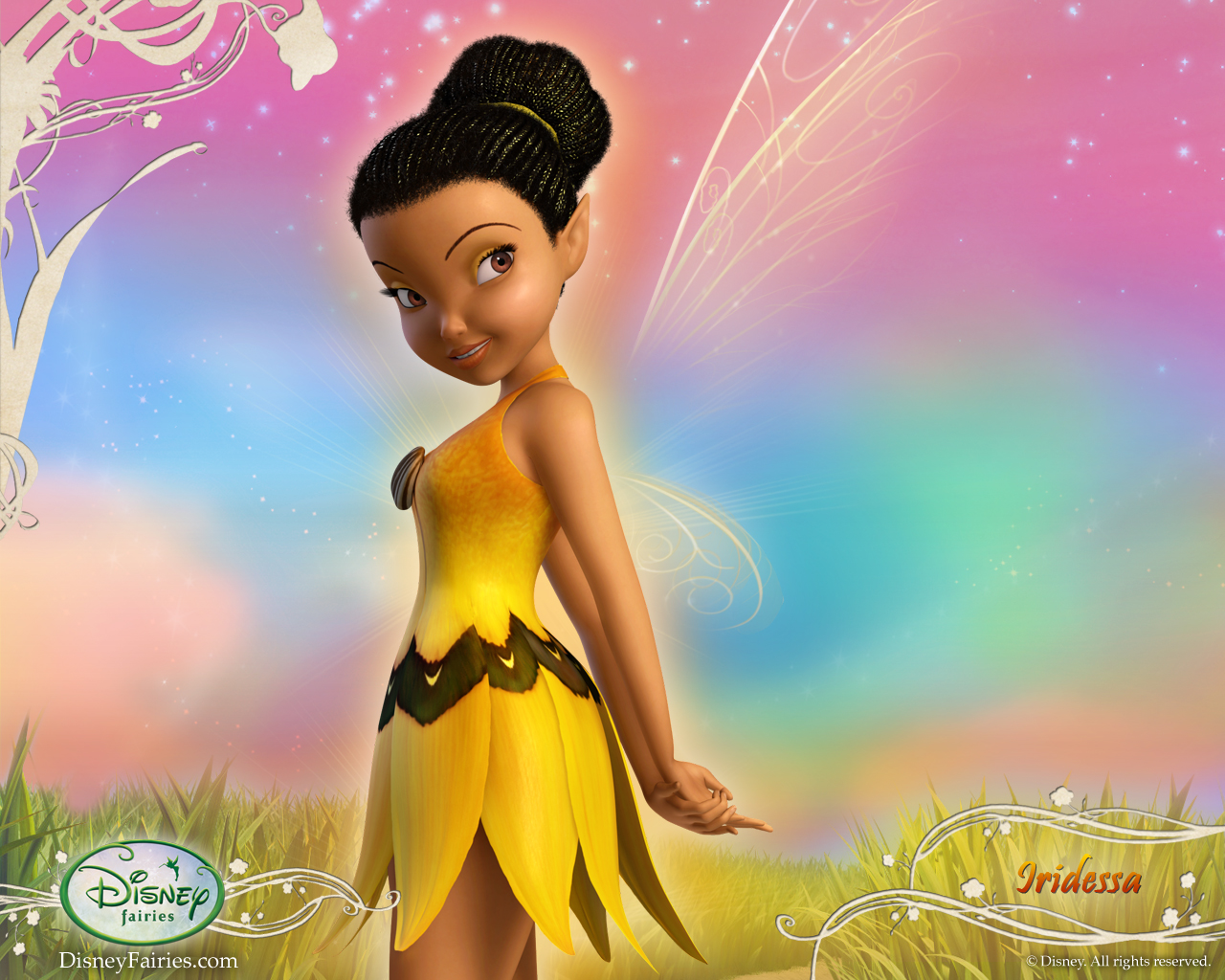
Iridessa is the name of one of the fairies in the Disney Fairies franchise. Her talent is working with light, and she wears a yellow dress, lives in a sunflower, and has clear fairy wings. In the movies, she is voiced by Raven-Symoné. Iridessa is a perfectionist and a worrier; she likes to look on the bright side of things, but can usually sense trouble approaching. When disaster strikes, she rushes in to save the day, and brings sunshine, light and brightness to every situation. The name Iridessa seems to be based on the word iridescent, meaning “producing rainbow-like colours; brilliant, lustrous, prismatic”. The word is derived from Iris, the name of the goddess of the rainbow, so you could see Iridessa as a modern spin on the older name. I have seen a baby with this name, and it’s been frequently Googled, so it seems that people find the name of this fairy intriguing. It’s not surprising, with such an attractive namesake associated with light. Looking for a nickname? Iridessa goes by Dess.

Khaleesi

Khaleesi is extremely unusual as an invented name, because it is not the name of a fictional character, but rather her title. In George R.R. Martin’s fantasy series, A Song of Ice and Fire, khaleesi is the word for the wife of a khal or ruler, in the Dothraki language from the novels. The Dothraki are a nomadic indigenous people without a written language, so the spelling of khaleesi in the novels must come from another culture. In Martin’s novel series, shy Daenerys Targaryen adopts the title of Khaleesi when she weds powerful Dothraki warlord Khal Drogo, and as his queen, grows in strength and confidence, becoming a leader in her own right known as “the Mother of Dragons”. In the television series based on the books, A Game of Thrones, the role of Daenerys is played by Emilia Clarke. Since the television series began airing in Australia, there has been a spike of interest in the name, with about 25 baby girls called Khaleesi born this year. For some reason, the name is far more popular in Queensland than elsewhere – possibly because of the connection with queens.

Lorelei

The Lorelei is the name of a famous rock on the River Rhine in Germany, and also the name of a beautiful water sprite or siren associated with the rock, who is supposed to lure men to their doom. More prosaically, the current of the river is very strong here, which explains the many accidents which have occurred in the area. The character of the Lorelei comes from a 19th century German ballad which poet Heinrich Heine turned into a poem called Die Lorelei, where a golden-haired siren unwittingly distracts men with her beauty so they crash onto the rocks. The poem has often been set to music and turned into songs, and is part of German popular culture. The name Lorelei is a combination of German dialect and Celtic, and means “murmuring rock”. Lorelei is the name of the alluring blonde in Gentlemen Prefer Blondes; in the film she is played by Marilyn Monroe. The name also features in garrulous gabfest Gilmore Girls, where both mother and teen daughter share the name Lorelei (the younger goes by Rory). Comedienne Kat Davidson named her daughter Lorelei “Rory” this year. Said LOR-uh-lie, this is better known in the US, where it is #531.

Pollyanna

Pollyanna Whittier is the title character of the Pollyanna books by Eleanor H. Porter; the series was continued by a number of writers. Pollyanna is an eleven-year-old orphan who is sent to live with her Aunt Polly in New England, and her sunny disposition soon teaches her stern relative, and the whole town, how to play the “Glad Game” – where you always look for something to feel glad about. While many are charmed by the heroine’s upbeat view of life, cynics find her too syrupy and her philosophy simplistic. Because of this, the word Pollyanna has entered our language to mean someone optimistic to the point of naivety or refusal to face facts. Pollyanna is a combination of Polly and Anna – Polly is a medieval variant of Molly, a pet form of Mary. This would be a difficult name to give a child in many ways, but would make a sunshiney middle, and easily shortens to Polly.

Rogue

Rogue is a character from the X-Men Marvel comic books created by Stan Lee and Jack Kirby. She is one of the team of mutant superheroes under the auspices of Professor Xavier, who recruits and trains young mutants to use their powers for the benefit of humanity. Rogue considers her special ability something of a curse, as she involuntarily absorbs, and sometimes removes, the memories, strength, and superpowers of anyone who touches her. For most of her life, she limited her physical contact with others, even loved ones, until after many years she was able to gain full control of her abilities. It was eventually revealed that Rogue was a code name, and her real name Anna Marie. In the movies, she is played by Anna Paquin. A rogue is a scoundrel or rascal. More to the point, a rogue animal is one which separates itself from the herd, and in horticulture the word rogue is used to describe a plant which has an undesirable mutation and must be destroyed. Anna Marie seems to have chosen Rogue as her code name to express her bitterness at the biological difference she had been lumbered with. This name can be used for both sexes; I saw it on a baby girl last year.

Scarlett

Scarlett O’Hara is the protagonist of Margaret Mitchell’s best-selling Civil War novel, Gone with the Wind; in the film version she was played by Vivien Leigh. Slender and attractive, Scarlett is flirtatious and charming, but doesn’t fit the mould of a typical Southern Belle. Smart, feisty, stubborn and very strong-willed, she nevertheless is inwardly insecure. What makes Scarlett such an interesting character are her many flaws – she is vain, selfish, spoiled, unscrupulous and manipulative, but hard as nails, with an overpowering survival instinct. Scarlett is an English surname from Norman French, referring to someone who dyed or sold brightly-coloured cloth, which was often red. It has been used as a unisex name since the 17th century, but is now usually thought of as feminine. The character’s full name is Katie Scarlett O’Hara, and she was named after her grandmother. Margaret Mitchell originally planned to call her heroine Pansy, and changed it to Scarlett just before the novel went to print. Scarlett first ranked in the 1990s at #467, the decade in which American actress Scarlett Johansson made her film debut. It climbed precipitately to join the Top 100 in the mid-2000s, and is currently #25 nationally, #23 in New South Wales, #17 in Victoria, #33 in Queensland, #17 in South Australia, #22 in Western Australia, #21 in Tasmania, and #26 in the Australian Capital Territory.

Velvet

Velvet Brown is the heroine of Enid Bagnold’s novel, National Velvet, about a teenager who rides to victory in the brutally difficult Grand National Steeplechase, the most valuable jump race in Europe. The story is about the ability of ordinary people to achieve great things – Velvet is a plain, rather sickly girl from a working-class family, and the horse she wins on is a piebald. The movie version chucks most of this inspiring message aside so they can show a radiantly pretty pre-teen Elizabeth Taylor galloping about on a chestnut thoroughbred. Velvet is a fabric which was originally very expensive to make, and therefore associated with nobility and royalty. The word is from Old French, and comes from the Latin for “tuft, down”, because of velvet’s distinctive texture. It has been used as a name since the 19th century, and has been given to both genders, but mostly to girls. This unusual fabric name is warm and luxurious, perhaps even rather sensual.

POLL RESULT: People’s favourite names were Lorelei, Arrietty, and Scarlett, and their least favourite were Rogue, Pollyanna, and Khaleesi.

(Picture is of Iridessa, from Disney website)

Interview with Clare from Name News

03 Sunday Nov 2013

Posted by A.O. in Blog Reviews

≈ 7 Comments

Tags

Anglo-Saxon names, Appellation Mountain, baby name books, changing names, Cornish names, Facebook, LibraryThing, middle names, Name News, popular names, Scoop.it, The Pan Book of Boys Names, The Pan Book of Girls Names, UK name popularity, Welsh names

DIGITAL CAMERA

Clare has a wonderful Name News page on the Scoop.it website, which collects interesting blog posts and stories in the news about names. Her collection includes posts in languages other than English, so if you want to know what they think about names in Portugal or The Netherlands, click the “Google translate” button and read on! One of the most useful functions is the “Find” key, where you can search for topics which interest you. Name News is so handy for keeping up to date with what’s going on around the blogosphere that I consult it every day – it’s easier than subscribing to hundreds of sites, or getting dozens of e-mail alerts. Attractive and user-friendly, Name News is an invaluable contribution to the naming community.

What is your name?

Yvonne Clare.

Have you ever changed your name?

I went by my first name until I was four, when I decided to use my middle name instead. Now my first name only appears in official situations, and on the odd family Christmas card – and in messages from a friend called Yvonne, who is tickled that we have a hidden name connection. I don’t dislike the name, but it feels like an old toy or a piece of baby clothing: it was great when I was little, and I’m still attached to it, but it no longer fits for everyday use. I’m happy as a Clare and I like the fact it’s more typical for someone my age.

How did you start getting interested in names?

When I was about six, I was visiting a relative who was clearing out some books, and someone handed me The Pan Book of Boys’ Names and The Pan Book of Girls’ Names. I took them home and have been dipping into them ever since. They are particularly strong on literary and legendary figures and references to names in poetry. I’m sure that they contributed to my love of languages, as they gave me a first taste of Latin, Greek, Old English, Welsh, and many others. Each book has a wonderful appendix of names considered unusual by the authors. A couple of decades on I have dozens of name books, but those two are still among my favourites.

What inspired you to sign up with Scoop.it in order to share name stories with the wider community?

At the beginning of this year I became aware of the many name blogs that are out there. I wanted to read everything, but was a bit overwhelmed by the sheer number of posts. I wanted to contribute in some way, but didn’t feel inspired to write a blog. I’m not so good at regular research and writing; I prefer reading, organising and making accessible the work of others. (That’s why I’m a librarian in real life.)

An acquaintance started a Scoop.it page gathering stories about rare books and manuscripts, and I decided to try something similar for name stories. It’s straightforward to create a Scoop.it account and set up a page, and to add “scoops” – I normally use a button on my browser. It’s pretty much as simple as reading name stories that come up on my feeds and alerts, and adding them.

I would do it just for personal interest, which sounds rather nerdy, but it’s very encouraging that others are looking at the site too. I know there’s been a huge leap in the number of views whenever the site has been mentioned by other bloggers, especially in Appellation Mountain’s Sunday Summaries, so many thanks to you all for getting the momentum going!

I know I’m a bit of a vulture, existing on other people’s hard work, but I hope the site achieves two things: providing a one-stop feed of name stories for people who don’t want to follow lots of different sites, and enabling people to easily search the archives of all the name blogs and articles.

Any other way to connect with you online?

Name News has a Facebook page, although at the moment I’m using it for following news and the odd “like”, rather than anything more dynamic. I also keep a list of my name books on LibraryThing. If anyone uses that site, feel free to connect! I doubt the list is of much use to anyone else, but it’s quite handy for me, as my collection is currently scattered between two houses.

What is it about a name story that makes you interested to know more?

I always get excited when I see one of my favourite names in the title. For example, the very first scoop I made was Appellation Mountain’s post Edith, Everild, and Eden: Getting to Edie. Everild was the catalyst – I just couldn’t resist sharing it! I also enjoy birth announcements, clever data analysis, gems from historical records, personal stories … pretty much anything that’s informative, positive, and open-minded.

Do you have a pet peeve when it comes to names?

My peeves are with writing about names, rather than the names themselves. I’m sure I’m not alone in disliking:

  • proscriptive advice and “rules” that will make precious little difference to naming habits as a whole
  • unhelpful criticism and negativity about parents’ name choices
  • false claims about the “meaning” of names – and false information in general
  • overuse of the word “unique” (I know: now who’s being proscriptive?!)

What are some of your favourite names?

Girls: Annest/Annice, Everil/Everild, Freda/Frida, Hilda, Miriam, Naomi, Tamsin, Tess

Boys: Arthur, David, Edward, Henry, Hugh/Huw, Robin

What names do you dislike?

I’m not so keen on names with excess “frilly” syllables. I usually prefer the streamlined option, so Isabel over Isabella, Mark over Marcus. Maybe even Em over Emma, or is that going a bit far? By that logic, I should prefer Hild to Hilda, and in some ways I do, but sadly it crosses the threshold of being a bit too much to inflict on an unsuspecting British child.

Are there are names you love, but could never use?

Names that would be hard to spell and pronounce, culturally unsuitable, and more about me showing off than the child’s best interests. For example, Ælfric (“Alf-rich”), Buddug (“Biðig“, the Modern Welsh form of Boudicca), and Elestren, which I’ve loved since I saw it in a book of Cornish names years ago. I’ll save them for pets and inanimate objects! I’d also be wary of names that sound similar to mine or my partner’s, like Cleo and Robin.

What are your favourite names in the England/Wales Top 100?

Amy (#62) and Arthur (#52).

What are your favourite names which have never been in the England/Wales Top 1000 (since 1996)?

Hilda and Clem.

Do you have any names picked out for your future children?

I have an ongoing list of favourites, but don’t really have a clue how my partner and I will feel if/when the time comes. I expect that choosing a name for a real person will bring out sides of us that we never knew existed.

What is something we don’t know about you?

I’ve recently taken up morris dancing, a traditional English dance style with props such as sticks, bells and handkerchiefs. It’s great fun, but a challenge as I’m not very co-ordinated!

What advice would you give someone who was choosing a name for their baby?

I’ve tried and failed to come up with a wise, snappy, universal answer to this question. Every time I think I’ve got it, I think Oh, but there could be exceptions, or But that might not work for everyone. Maybe that’s a cop-out, but it’s a personal, sometimes complicated decision, with no clear right or wrong way to do it. Plus it’s not something I’ve had experience of yet. I think I’d have to ask for a few more specifics before feeling qualified to give advice. Or, true to form, I could point people towards helpful books and websites.

(Clare’s profile photo of her favourite name books supplied by interviewee)

← Older posts
Newer posts →

Enter your email address to follow this blog

Categories

Archives

Recent Comments

A.O.'s avatarwaltzingmorethanmati… on Zarah Zaynab and Wolfgang…
Madelyn's avatarMadelyn on Zarah Zaynab and Wolfgang…
JD's avatardrperegrine on Can Phoebe Complete This …
A.O.'s avatarwaltzingmorethanmati… on Rua and Rhoa
redrover23's avatarredrover23 on Rua and Rhoa

Blogroll

  • Appellation Mountain
  • Baby Name Pondering
  • Babynamelover's Blog
  • British Baby Names
  • Clare's Name News
  • For Real Baby Names
  • Geek Baby Names
  • Name Candy
  • Nameberry
  • Nancy's Baby Names
  • Ren's Baby Name Blog
  • Sancta Nomina
  • Swistle: Baby Names
  • The Art of Naming
  • The Baby Name Wizard
  • The Beauty of Names
  • Tulip By Any Name

RSS Feed

  • RSS - Posts

RSS Posts

  • Celebrity Baby News: Melanie Vallejo and Matt Kingston
  • Names from the TV Show “Cleverman”
  • Can Phoebe Complete This Sibset?
  • Zarah Zaynab and Wolfgang Winter
  • Baby, How Did You Get That Name?
  • Celebrity Baby News: Media Babies
  • Celebrity Baby News: Adelaide Crows Babies
  • Celebrity Baby News: Chris and Rebecca Judd
  • Names at Work: Name News From the World of Business and Employment
  • Celebrity Baby News: Sporting Round Up

Currently Popular

  • Girls Names of Australian Aboriginal Origin
  • Celebrity Baby News: Virginia Trioli and Russell Skelton
  • Rare Boys Names From the 1950s
  • Celebrity Baby News: Toby Allen and Darren Weller
  • The Top 100 Names of the 1930s in New South Wales

Tags

celebrity baby names celebrity sibsets english names famous namesakes fictional namesakes honouring locational names middle names name combinations name history name meaning name popularity name trends nicknames popular names saints names sibsets surname names twin sets unisex names

Create a free website or blog at WordPress.com.

Privacy & Cookies: This site uses cookies. By continuing to use this website, you agree to their use.
To find out more, including how to control cookies, see here: Cookie Policy
  • Subscribe Subscribed
    • Waltzing More Than Matilda
    • Join 517 other subscribers
    • Already have a WordPress.com account? Log in now.
    • Waltzing More Than Matilda
    • Subscribe Subscribed
    • Sign up
    • Log in
    • Report this content
    • View site in Reader
    • Manage subscriptions
    • Collapse this bar
 

Loading Comments...