• About
  • Best Baby Names
  • Celebrity Baby Names
  • Celebrity Baby Names – Current
  • Celebrity Baby Names – Past
  • Featured Boys Names
  • Featured Girls Names
  • Featured Unisex Names
  • Links to Name Data
  • Waltzing on the Web

Waltzing More Than Matilda

~ Names with an Australian Bias of Democratic Temper

Waltzing More Than Matilda

Tag Archives: Irish names

Famous Names: Ned Kelly

29 Wednesday Aug 2012

Posted by A.O. in Famous Names

≈ 12 Comments

Tags

African names, African-American names, American names, Anglo-Saxon names, Australian idioms, banned names, birth announcements, British Baby Names, Cornish names, English name trends, english names, famous namesakes, folk etymology, Google, Irish names, locational names, middle names, name history, name meaning, name popularity, nicknames, popular culture, Scottish slang, surname names, unisex names, US name popularity

On August 2 this year, it was reported that the descendants of notorious bushranger Edward “Ned” Kelly were about to receive his remains, 132 years after he was hanged for murder. At that time, the bodies of executed prisoners were buried in unmarked graves in Melbourne Gaol, and Kelly was one of them. In 1929, he and several others were re-buried in Pentridge Prison during renovations to Melbourne Gaol, and last year scientists were able to identify Ned Kelly’s skeleton from a group of twenty-four at Pentridge, by comparing his DNA to that of living members of the Kelly family. The Kellys can now give Ned a private burial.

Ned Kelly was the son of an Irish convict, and gained notoriety as a horse thief and cattle rustler before being convicted of bank robbing and murder. He was hanged on November 11 1880. He looms large in the Australian imagination, and is widely seen as a folk hero, and a symbol of Irish-Australian resistance against the ruling classes and police corruption. There is in the Ned Kelly legend a particular type of Australian masculinity which is admired: physically powerful, ballsy, defiant, daring, anti-authority, and an under-dog. The phrase, As game as Ned Kelly, is the ultimate praise for bravery, and his legend has spawned countless folk stories and ballads – not to mention a few films.

The name Ned is a pet form of names starting with Ed-, such as Edward and Edmund. It has been used as a nickname since at least the 14th century, and as an independent name since the 17th century. One theory is that it began life as a contraction of the affectionate “mine Ed“, which became understood as “my Ned”. Although this can’t be verified (and Elea at British Baby Names remains slightly sceptical), the story does add a layer of sweetness to the name.

It is among the first names that crossed the pond, because a baby named Ned was born in the English colony of Virginia, so it became a British and American name almost simultaneously. It has often appeared in American popular culture, such as Ned Flanders on The Simpsons and Ned Dorsey from 1990s sit-com Ned and Stacey. All-American girl detective Nancy Drew even had a boyfriend named Ned Nickerson. (Ned and Nancy! Adorable!). Ned was on the US Top 1000 until the mid-1970s.

Like Kevin in England and Bevan in Australia, it’s a name with a bad rep elsewhere, because in Scotland ned is slang for a hooligan or petty criminal. Given our own history with the name, this seems unlikely to put Australian parents off. Here solid unpretentious Ned will always be associated with folk hero Ned Kelly, but as it’s currently fashionable as an upper-class name in England, this makes it seem quite chic as well.

Kelly is an Anglicisation of the Irish surname Ó Ceallaigh, meaning “son of Ceallach”. Ceallach is often interpreted as meaning “bright headed”, but it may mean “church-going”, as the Irish word for church is ceall. It can also be seen as an Anglicisation of Ó Cadhla, meaning “son of Cadhla”, with the male name Cadhla meaning “attractive, graceful”.

Outside Ireland, the surname Kelly can be from place names in Scotland (in this case, probably from the Anglo-Saxon meaning “calf hill”) and in Devon, the latter derived from the Cornish word for “grove”. However, it is much more common as an Irish surname.

Kelly has been used as a first name since at least the late 17th century, and is another name which seems to have been used in Britain and America almost at the same time. It appears to have quickly become far more common in America as an Irish heritage name.

Although the name was first given to boys, in a relatively brief space of time the name seems to have been accepted as unisex, with roughly even numbers of males and females named Kelly in colonial America. Quite a few of the early American Kellys arrived directly from Ireland itself, and these were just as likely to be female, if not more so.

I don’t know why, but the name seems to have been commonly given to the sons and daughters of Christianised black African indentured servants in early colonial America. I would be fascinated to know the reason for this, and wonder if there is an African name Keli that seemed familiar to both cultures. Or perhaps working alongside Irish indentured servants gave them a fondness for the name.

Kelly first shows up on the US Top 1000 in 1880 as a male name, and first appears there for females in 1944. It grew in popularity for both sexes, but really took off as a girl’s name in the 1950s with the fame of glamorous Hollywood actress Grace Kelly (of Irish background). After she became Princess Grace of Monaco, the name simply bounded up the popularity charts.

Kelly peaked for both boys and girls in the late 1960s, but then lost ground as a boy’s name, while maintaining a female presence; it even managed to peak again for girls in the 1970s. Kelly hasn’t ranked as a boy’s name in the US for ten years, while it is now #335 for girls, and falling.

In Australia, the history of the name is much shorter, and it only ever charted for girls. It first appears in the charts in the 1950s at #560 (about one Kelly per year). By the following decade, it was already in the Top 100, and peaked in the 1970s at #13. It left the Top 100 in the early 2000s, and last year just ten baby girls named Kelly were born in New South Wales, giving it a ranking of #641.

Amongst the most common Google searches used to reach my blog are those enquiring about using Kelly as a boy’s name, and many of these are from Australia. With Kelly becoming rare as a name for girls, and the fame of American world surfing champion Kelly Slater (of Irish background) lifting its profile internationally as a male name, this seems the perfect time for Kelly to step up and gain more use for boys in Australia.

I hope that these assiduous Googlers are giving serious thought to choosing Kelly as their son’s name. I scan the birth notices for Kelly, and this year I have only seen it used as a middle name for boys. However, Kelly Slater himself uses his middle name (his first name is Robert), so these babies do have the choice to go by the name Kelly when they get older.

NOTE: Although you are free to call your child Ned, or Kelly, it is, bizarrely, forbidden in New South Wales to name a baby Ned Kelly. This makes Ned Kelly one of Australia’s rare illegal names.

(The picture is from Sidney Nolan’s series of paintings of Ned Kelly in his armour 1946-47. These images are some of the most iconic and recognisable of Australian artworks. Taken from ABC News).

Names of Australian Male Olympic Medalists

19 Sunday Aug 2012

Posted by A.O. in Name Themes and Lists

≈ 9 Comments

Tags

American slang terms, aristocratic names, Arthurian names, Australian slang terms, Babylonian names, Biblical names, epithets and titles, famous namesakes, French names, Gaelic names, Greek names, hebrew names, Indian names, Irish names, Italian names, Korean names, Latin names, locational names, meteorological names, mythological names, name history, name meaning, name popularity, nicknames, Norman names, Norman-French names, Old Irish names, Old Norse names, Pictish names, popular culture, popular names, royal names, saints names, Scottish names, surname names, tribal names, unisex names, Welsh names

Bevan (George)

Bevan George is a hockey player who won gold at the Olympics in 2004, and bronze in 2008. Bevan is a Welsh surname meaning “son of Evan”; as Evan is a Welsh form of John, this is the Welsh form of Johnson. One of the most prominent people with this surname was Aneurin Bevan, a Welsh Labour Party politician most active in the 1950s. Recognised as one of the leaders of the party’s left-wing, he was a champion of social justice and the rights of working people. As Minister of Health, he was responsible for bringing in the National Health Service – that wonderful institution celebrated so effusively in the opening ceremony of the 2012 Olympics. For reasons unclear to me, this name seems to have been used more often in Australasia than anywhere else, and unfortunately, familiarity seems to have bred a certain amount of contempt, for in Queensland especially, Bevan is seen much in the same way that Kevin is perceived in the United Kingdom, the word bevan used to denote a lower-class person. As such, parents would rather use the name Evan.

Deveraux (Mytton)

Deveraux “Dev” Mytton won a bronze medal in sailing at the 1956 Olympics. The surname Deveraux is a variant of Devereux, and it’s Norman-French, meaning “from Évreux” in Normandy. The city of Évreux gained its present name from the Gallic tribe the Eburovici, whose name may be related to the word for “yew tree”, so the French city could have a similar meaning to that of York in northern England. According to the BBC, so many of the gold medal-winners from Team GB were from Yorkshire that if this historic county was its own nation, it would have finished 15th on the Olympics medal tally – ahead of South Africa and Brazil. The city of Évreux has its own Olympic champion – Didier Courrèges, who won gold as an equestrian in 2004. The surname is one with an aristocratic air to it, and in the early twentieth century would have been considered a very upmarket, perhaps even pretentious, name to bestow upon your son (a 1920s version of a “preppy” name). Pronounced DEV-er-oh, I cannot see this name coming into use, despite the fashionable ending, but Dev has a brisk sound to it.

Eli (Matheson)

Eli Matheson is a hockey player who won bronze at the 2008 Olympics. Eli is a Hebrew name which means “ascension”, and in the Old Testament, Eli is a judge and high priest of Israel who is the teacher and mentor of the prophet Samuel. Eli himself is regarded as a prophet also in Judaism. According to how it is written in Hebrew, Eli can also be a separate name which means “my God”. In Hebrew, it is said EH-lee, but English-speakers tend to pronounce the name EE-lie (probably so it doesn’t get confused with the girl’s name Ellie). One well known person with this name is Hollywood actor Eli Wallach, who starred in the westerns, The Good, the Bad and the Ugly, and The Magnificent Seven. As Old Testament names for boys gain increasing momentum, Eli continues to rise and rise. It first entered the charts in the 1970s, and joined the Top 100 in 2009. It’s already #45 and still forging ahead.

Fergus (Kavanagh)

Fergus Kavanagh is a member of the men’s hockey team, and won bronze medals in 2008 and 2012. Fergus is the Anglicised and Old Irish form of Fearghas, a Gaelic name meaning “man of vigour, strong virile man” – very apt for an Olympian. It was a name common amongst royalty in both ancient Ireland and Scotland, and is still often used amongst Scottish nobility. One of Queen Elizabeth II’s uncles was named Fergus, and another royal connection is Fergus Boyd, a friend and former flatmate of Prince William. There is a Saint Fergus, an 8th century Irish bishop who was a missionary in Scotland. King Arthur also had Sir Fergus as one of his knights, and he appears in a witty 13th century romance in which he appears valiant but lacking in sophistication. The name Fergus is currently gaining favour with the sort of parents who love Angus and Hamish, but are dismayed by their popularity. Aristocratic Fergus seems so much more select.

Hector (Hogan)

Hector “Hec” Hogan was a sprinter who was Australian champion seven times over in the 100 metres, and was able to equal the world record in this event. He attended the 1956 Olympics, and although he was already feeling strangely fatigued, still managed to win bronze. He was afterwards diagnosed with leukaemia, and died in hospital a few years later, while listening to the 100 metre sprint race at the Rome Olympics. In Greek mythology, Hector is a Trojan prince, and the greatest warrior of Troy, who slays Achilles in battle. A leader noted for his brave and noble nature, he is seen as far more worthy than his younger brother Paris, who caused the war. In Greek, Hector means “to hold”, and is interpreted as “holding firm, holding everything together”. It may be an epithet or title rather than a real name. In Scotland, Hector is used to Anglicise the Gaelic name Eachann, meaning “horse lord” or “brown horse”. Sir Hector is one of King Arthur’s knights in the legends, and is the brother of Sir Lancelot, while Arthur’s foster-father Sir Ector shows another form of the name. In Australia, Hector is the name of a cloud which forms each afternoon in the Tiwi Islands during certain months. This name is fast becoming seen as hip and quirky.

Ji (Wallace)

Ji Wallace is a gymnast who won a silver medal for trampolining at the 2000 Sydney Olympics. He later came out as gay, and was the first Australian to be an ambassador for the Gay Games; while attending the 2012 Olympics, he revealed that he is HIV-positive. Ji is a unisex Korean name which means “wisdom”; it’s also the word for an ancient Korean flute. This name sounds similar to the Indian name Jai, but manages to use even fewer letters, and is suitable for both boys and girls.

Kenneth (Wallace)

Kenneth “Ken” Wallace started out competing in Ironman, and switched to sprint canoeing while still in his teens. He won gold and bronze medals at the 2008 Olympics, and last year took part in Channel 7’s Australia’s Greatest Athlete. He came third, with Shannon Eckstein beating him to second place. Kenneth is the Anglicised form of two separate names. One is the Pictish Coinneach, meaning “handsome”; the other is Gaelic Cináed, meaning perhaps “born from fire” or “fire-head”, possibly to denote someone red-haired or hot-headed. According to tradition, the 9th century Kenneth MacAlpin was the first king of Scotland, and is known as Kenneth I (during his lifetime, he would only have been known as king of the Picts, however). There also two legendary saints named Kenneth, one Irish, one Welsh. For some reason, Kenneth became a “funny name” – perhaps because of uber-camp comic actor Kenneth Williams, from the Carry On movies. Kenneth was #38 for the 1900s, and peaked in the 1920s at #6. It left the Top 100 in the 1980s, and is currently #409. It rose last year, so things may be looking up for this attractive name.

Nimrod (Greenwood)

Nimrod Greenwood won bronze for rowing at the 1952 Olympics. In the Old Testament, Nimrod is a great-grandson of Noah, and king of several Mesopotamian cities. He is depicted as a man wielding great political power, a warrior, and a mighty hunter. Although the Bible never states this, according to tradition, he is the king for whom the Tower of Babel was constructed. This hubristic piece of engineering sought to build a tower into heaven itself, and so alarmed God that He scattered humanity over the globe, and made them speak different languages, to prevent further outbreaks of co-operation and harmony. It’s obviously a story to explain cultural differences, and there are similar myths around the world. The name Nimrod is traced to the Hebrew for “rebel”, but as he was Sumerian, this seems unlikely. The most convincing theory is that he is based on the Babylonian god Bel Marduk, one of whose titles was Bel-Nimrod, meaning “to pursue, to make someone flee before him”. Nimrod has entered our language to mean either a tyrant, a warrior, or a huntsman; however, in the United States it is slang for “idiot” – perhaps due to a 19th century play with a character called Nimrod Wildfire. It is still an Olympian name, for one of the Israeli swimmers at this year’s Olympics was Nimrod Shapira-Bar-Or.

Ralph (Doubell)

Ralph Doubell had a brief career in athletics, but was lucky enough to peak just as an Olympics came around. He won gold in 1968 in the 800 metres, and set a world record of 1:44.3. No other Australian has ever managed to equal this, and it’s stood as the Australian record for more than 40 years. Ralph is a contraction of the Old Norse name Ráðúlfr, meaning “wolf counsel”, which was introduced to England by Scandinavian settlers. When the Normans arrived, they brought with them their own form of the name, Radulf, and English Ralph can be seen as a continuation of both these names. Ráðúlfr is pronounced ra-THOOL-fer, and Radulf is said RAD-oolf; in the beginning Ralph was spelled Ralf and pronounced RAYF. By the 17th century the spelling had been changed to Rafe to reflect the pronunciation, and the Ralph spelling appeared in the 18th century. You are now free to pronounce this name either RAYF or RALF, but as far as I know, only one Ralph seems to say his name like Rafe, and that’s English actor Ralph Fiennes. The name was favoured by the ruling classes during the Middle Ages, but American pop culture has not been kind to it, often assigning it to comic or dim-witted characters. In American slang, ralph means “to vomit”, which can’t have done its image any good. Ralph was #91 in the 1900s, and peaked in the 1920s at #89. It left the Top 100 by the 1950s, and hasn’t ranked since the 1980s.

Verdi (Barberis)

Verdi “Vern” Barberis was a seven times Australian champion in weight-lifting, and took the bronze medal in the Lightweight category at the 1952 Olympics. He was the first Australian lightweight to clean and jerk over 300 lb (140 kg), which at that time exceeded his state’s heavyweight record. The name Verdi is an Italian surname, common in the north of Italy, and best known as that of the composer, Giuseppe Verdi. One of the most influential composers of the 19th century, he is famous for such operas as Rigoletto, Aida and La Traviata. The name means “green”, from the Latin viridis, related to the word virere, meaning “to bloom and flourish”. In the same way, the English word verdant, from the same Latin root, means “green”, but also has connotations of lush vegetation. It’s very much a name of freshness, spring time and new life. I think this rare unisex name is very appealing, and also begins with the fashionable V.

(Photo shows Ken Wallace after winning gold at the 2008 Olympics)

More About Matilda

29 Sunday Jul 2012

Posted by A.O. in Your Questions Answered

≈ 15 Comments

Tags

angel names, Australian Aboriginal names, Australian names, Biblical names, celebrity baby names, famous namesakes, fictional namesakes, germanic names, Google, Irish names, name combinations, name history, name meaning, name popularity, name trends, names of convicts, names of roses, names of ships, names of stars, names of trains, rhyming names, saints names, Shakespearean names, sibsets, US name popularity, Waltzing More Than Matilda

I love the title I chose for my blog, and as time goes by, it seems to be growing into its name even better. Although I don’t suffer from one ounce of name regret, an unintended side effect of its title is that it when people Google anything to do with the name “Matilda”, they often seem to be guided to Waltzing More Than Matilda.

They have been sent here under false pretences, because the blog isn’t dedicated to the name Matilda, or people named Matilda, or the song Waltzing Matilda. Even though Matilda is a Featured Name, in the wider scheme of things, it doesn’t rate too many mentions at all on the blog. I feel bad that so often, the information they are looking for just isn’t here.

So this is my attempt to answer as many of the Googled questions as I can about the name Matilda. They are all genuine questions, but I have added punctuation and corrected the odd typo to make things easier (it seemed fair enough as people don’t write their Google searches for publication). I’ve added information in brackets to make questions clearer, and where there were several questions asking similar things, I have amalgamated them into a generic enquiry.

I hope you enjoy learning more about Matilda; I ended up learning a great deal myself!

Matildas in the Bible/What is the Biblical significance of the name Matilda?

There aren’t any, and there is none.

Is Matilda the name of an angel?

No. Angels are always given male Hebrew names by tradition.

Is Matilda a saints name?

Yes. Saint Matilda was the wife of King Henry I of Germany, and she was therefore Queen Matilda too. She is said to have been very beautiful and virtuous, and was famous for her devotion to prayer and works of charity. Her feast day is March 14, and she is the patron saint of parents with large families, although she only had five children herself – Hedwig, Otto, Gerberga, Henry and Bruno.

Is there a character named Matilda in Shakespeare?

No.

Is there a star or constellation named Matilda?

No.

Is there a rose named Matilda?

Yes. There’s a hybrid named Rosa “Matilda” which was registered in France in 1988. It’s a hardy perennial shrub, and its scentless blooms are white with delicate pink edges.

Is Matilda an Irish or an Australian name?

Neither – it’s the Latinised form of a Germanic name, Mahthildis.

What is the Irish form of Matilda?

Maitilde. It was never a common name in Ireland though.

Why do Australians claim Matilda (as their own)? It’s not really Australian

It’s because of our national song, Waltzing Matilda. I’m sorry if it annoys you – you sound annoyed. You’re right that it’s not Australian, it’s German originally, but a German migrant to Australia helped to inspire the song.

What was Waltzing Matilda‘s first name?

As far as I know, the song’s title was always Waltzing Matilda.

Is Waltzing Matilda a train?

Not that I know of.

Did James Cook have a kid named Matilda?

No. His children were called James, Nathaniel, Elizabeth, Joseph, George and Hugh.

Were any of the convicts named Matilda?

When I searched the Australian Convict Collection at Ancestry.com.au, I got almost 2000 hits for the name “Matilda”. Some of those would be middle names, and some would be doubled-up entries, so maybe around 1000 convicts had the name Matilda.

There was also a convict ship named the Matilda; she came out in 1791 as part of the Third Fleet. However, she only carried male convicts, so there were no Matildas on the Matilda, alas.

How popular is the name Matilda in Australia?

It made #19 on the national chart for 2011.

A beautiful rocking Australian girl named Matilda?

I’m sure there’s absolutely tons of them.

Is there an Aboriginal name that’s the equivalent of Matilda?

It depends what you mean by “equivalent”. If you mean, Is there an Aboriginal girl’s name with the same meaning as Matilda?, then I don’t think so. Matilda means something like “strong in battle”, as the ancient Germanic tribes had a warrior culture. Aboriginal names tend to be inspired by nature.

However, if you mean, Is there a girl’s name of Aboriginal origin which, like Matilda, is considered to be a stereotypically Australian girl’s name?, then I would suggest that the name Talia fits that description, and Allira seems to be preparing to take its place.

Famous people named Matilda

One of the most notorious in Australia is Matilda Mary “Tilly” Devine, who was a prostitute and madam prominent in the 1920s and ’30s. The press called her “The Worst Woman in Sydney” and “The Queen of the Night”. Her colourful career continued until the late 1960s, and she died relatively well off.

Celebrity babies named Matilda

Matilda Esma Birmingham – Simon Birmingham (2011)

Matilda Thomson – Craig Thomson (2009)

Matilda Kewell – Harry Kewell and Sheree Murphy (2008)

Matilda Rose Ledger – Heath Ledger and Michelle Williams (2005)

Matilda Elizabeth Ramsay – Gordon Ramsay (2002)

In what year was Matilda a name?

Wow, that’s very specific. The name’s origins go back to the Dark Ages, but I’m not sure at which point it was Latinised as Matilda. I do know that it became an English name in 1066, as this was the name of William the Conqueror’s wife. However, her name was pronounced Maude. I think the modern-day pronunciation dates to the 18th century.

There must be a “first Matilda” – the first person with both the modern spelling and pronunciation of the name – but who she is, and what year she was born, I’m afraid I cannot say. I welcome input and suggestions from others more knowledgeable than myself.

Is Matilda too trendy?

No, I don’t think so. It’s trending downwards in Australia and the UK, and is still underused in the United States.

Will Matilda reach Top 100 in North America?

It’s been back on the US Top 1000 for only four years, and you are already worrying about it getting into the Top 100? Sheesh. It’s not even going up in popularity very quickly! If it does, it won’t be for years and years, so quit stressing already.

Is Matilda a boy or a girl name?/Matilda as a boy’s name/Any boys named Matilda?

It’s a girl’s name, and although you are free to use it on a boy, it’s an idea that doesn’t appeal to me. I’ve never heard of a boy named Matilda; they may all call themselves Matt to avoid terminal embarrassment.

What’s a good boy’s name to match with Matilda?

Angus, Banjo, Barnaby, Charlie, Darcy, Harry, Henry, Jack, Jasper, Lachlan, Liam, Sam, William

What girl names go good with Matilda?

Adelaide, Alice, Charlotte, Clementine, Harriet, Edith, Emmeline, Lucy, Poppy, Rose, Ruby, Sophie

An Aussie-style sibset for Matilda?

I think the quintessential Australian sibset is Jack, Matilda, Lachlan, and Ruby.

Names to go with the middle name Matilda?

Annabel Matilda, Caroline Matilda, Eloise Matilda, Jane Matilda, Phoebe Matilda, Violet Matilda

A boy’s name that rhymes with Matilda?

Bob the Builder? Seriously, I don’t think there is one.

Name of story about mean stupid couple who have nice smart kid called Matilda?

Matilda, by Roald Dahl. It was originally published in 1988, made into a film in 1996, and adapted as a musical in 2012.

What’s that song at the start of (the movie) Matilda where she makes stuff spin round?

Little Bitty Pretty One. It was written and originally recorded by Bobby Day; the movie features the 1957 version sung by Thurston Harris.

What are the cast of (the movie) Matilda all doing now?

The whole cast? For flip’s sake, that’s dozens of people! Go look it up at the Internet Movie Database or something.

Matilda is an awesome name

Too right it is!

(Image from Flickr)

Melbourne Suburbs That Could Be Used as Boy’s Names

15 Sunday Jul 2012

Posted by A.O. in Name Themes and Lists

≈ 1 Comment

Tags

Ancient Celtic names, Anglo-Saxon names, Appellation Mountain, Australian Aboriginal names, birth announcements, birth records, British Baby Names, celebrity baby names, Celtic names, english names, fictional namesakes, Gaelic names, Gypsy names, Harry Potter names, Irish names, K.M. Sheard, locational names, mythological names, name history, name meaning, nicknames, Norman names, Norse names, Old English names, popular culture, Scottish names, sibsets, surname names, unisex names, Upswing Baby Names, Victorian name trends, virtue names, vocabulary names

Albion

Albion is right next to the suburb of Sunshine, and was developed by H.V. McKay as part of his Sunshine Estate. His own house was in Albion, showing that he was not too proud to live alongside his workers. Albion is the oldest known name for the island of Great Britain. The meaning, which comes from Ancient Celtic, may either mean “white”, perhaps referring to the white cliffs of the southern shores, or “hill”. According to K.M. Sheard, it should be interpreted as “white upper world”, to distinguish it from the dark Underworld (and thus similar to the Midgard of Norse mythology, which became the Middle Earth of Tolkien’s fantasy world). It’s related to a Welsh word which simply means “earth, world”. The Ancient Greeks and Romans knew of Albion, and even in their time, it was considered a name of great antiquity. Today Albion is often used as a poetic term for Britain, such as in our national anthem – “when gallant Cook from Albion sail’d”. In British mythology, Albion was a giant who ruled Britain and gave his name to the island. It’s an imposing heritage choice, very suitable for a baby born in a Jubilee year.

Baxter

Baxter is a rural locality on the Mornington Peninsula, and received its name because it was founded by pastoralist Benjamin Baxter, who came here as a member of the 50th Regiment. The property he owned, and the cottage he and his wife Martha lived in, are both still in existence today. The township developed in the late 19th century once the railway arrived. Baxter is an occupational surname from the English word bakester, originally referring to a female baker, as opposed to the male baker, but very soon accepted as meaning both men and women, and then as masculine only. The surname is most common in Scotland, and the northern counties of England, especially Yorkshire. There are several famous Australians with the surname Baxter, including the explorer John Baxter, who was killed on the expedition across the Nullarbor Plain. With its fashionable X and nickname Bax fitting in with Max and Jax, this now seems a pretty cool option as a boy’s name. This was chosen as a celebrity baby name last year by radio host Kate Dimond.

Brighton

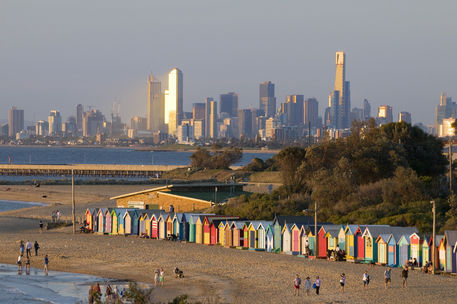
Brighton is a beachside suburb named after the English seaside town. Brighton is from the Old English, meaning “Beorhthelm’s farmstead” (Beorhthelm is a man’s name meaning “bright helmet”). The suburb was bought by an Englishman named Henry Dendy in 1840, who got it for 1 pound an acre, sight unseen. He chose the name Brighton, hoping this would also become a fashionable seaside resort. Unfortunately, there was a depression at the time and Dendy was forced to sell the land to his agent. Dendy died a pauper, but his dream did come true, because very soon Brighton began attracting wealthy residents, and it remains a very exclusive address, full of luxury mansions. One of its most notable sights is the 82 colourful bathing boxes, which have been on Dendy Street Beach since the 19th century. These can only be owned by rate-paying residents, and will set you back at least a couple of hundred thousand dollars. Brighton is the home of many of the rich and famous, including former athlete Catherine Freeman. I’ve been seeing this bright, right-on name quite a bit lately in birth announcements for boys, and the suburb does give it a swanky air.

Elwood

Elwood did not have the most glamorous beginning. A piece of swampland, the first settlers came here because of fever. It was Victoria’s first quarantine station, and the area’s first cemetery. Elwood became a working class suburb with such lovely features as an abattoir, a very smelly canal, and, before sewage, a dumping ground for human waste. However, today the Art Deco houses, pleasant beach, leafy streets, and busy cafe strip make it a very upmarket suburb. It’s thought to have been named after the Quaker poet Thomas Ellwood, because Governor La Trobe, who named it, had a thing for Quakers. The surname can be after Ellwood in Gloucestershire, which means “elder wood”, or derived from the Anglo-Saxon man’s name Aelfweald, meaning “elf ruler”. As elder trees play a big part in folklore, and The Harry Potter books feature the Elder Wand, it’s a very magical sort of name. I saw this at Mer de Noms and in a birth announcement, then it was covered by Upswing Baby Names, and then at Appellation Mountain. Perhaps because of the Blues Brothers, this name is seemingly now very hip. Please do not match it with a brother named Joliet or Jake though.

Fingal

Fingal is a rural suburb that may be named after the Irish county of Fingal; the county’s name means “foreign territory”, because the Vikings settled in the area. However, Fingal is also the Anglicised form of the Gaelic name Fionnghall, meaning “white stranger”. This also refers to the blonde Viking settlers, and Fingal mac Gofraid, a ruler in the Scottish Hebrides, was part of this same Norse dynasty. The name has a distinct literary air, as Fingal is the hero of James McPherson’s epic poem Fingal, and Irish author Oscar Wilde had Fingal as one of his middle names (Oscar is another name from McPherson’s poetry). McPherson claimed to have based Fingal on the legends of Irish folk hero, Fionn mac Cumhaill – Fionn’s name simply means “white”, and was a nickname; his real name was Deimne (meaning “sureness, certainty”). Fingal’s Cave in the Hebrides is named for the epic hero, and the sea echoes there so melodiously that it inspired a piece by composer Felix Mendelssohn. Irish names starting with Fin- are very fashionable right now, but I haven’t really seen Fingal in use. It seems poetic, musical, and quite fairytale to me.

Gilderoy

Gilderoy is a rural locality in the outer suburbs; it’s a rare variant of the Irish surname Gilroy, an Anglication of two possible Gaelic names which either mean “son of the red haired servant” or “son of the king’s servant”. As a first name, Gilderoy was used by British Gypsies, and a man who rejoiced in the name Gilderoy Scamp was King of the Kentish Gypsies in the late nineteenth and early twentieth centuries. Of course, this name will remind many of Gilderoy Lockhart, the vain and boastful fraud from the Harry Potter books. J.K. Rowling apparently named him after the handsome Scottish highwayman, Patrick Macgregor, whose nickname was Gilderoy (from the Gaelic Gillie Roy – “red-haired lad”). Both Lockhart and Macgregor had reputations for winning women’s hearts undeservedly, and one of Macgregor’s smitten female fans is supposed to have written the song Gilderoy about him. Perhaps Rowling was also thinking the name sounds like the English word gild, meaning to give a thin veneer of gold (to cheaper materials). I don’t know if anyone will actually use this name, but it’s a pretty fabulous one, with some very colourful namesakes.

Harkaway

Harkaway was settled by German immigrants, and is now an attractive suburb with large distinguished houses and extensive parkland. I first saw this name given to a minor character in Stella Gibbons’ hilarious novel, Cold Comfort Farm, and found it fascinating. Another famous literary Harkaway was Jack Harkway, from the Victorian era “penny dreadfuls” – a schoolboy who ran away to sea and had a life of adventure. There is also the novelist Nick Harkaway, although it’s a pseudonym; he’s a son of writer John Le Carre, and his real name is Nicholas Cornwell. Hark away! is a cry traditionally used in hunting to encourage the hounds; to hark means “to hear, heed, listen”. It’s a genuine, although rare, surname, and I presume an occupational one to denote someone who worked with fox hounds. I have seen this used as a man’s name in old records from the United States; I’ve only seen it used as a middle name in Australia. This is a really unusual vocabulary name which, with its meaning of “to listen”, almost qualifies as a virtue name as well. It isn’t much like any name on the Top 100, but it continues to fascinate me.

Ivanhoe

Ivanhoe is a suburb with many old homes and an Art Deco town hall, famous for the extravagant Christmas lights display it puts on each year. It was named by a Scottish settler after Sir Walter Scott’s 1819 novel, Ivanhoe. The book is a romance about one of the few remaining Saxon noble families at a time when the English nobility were almost all Norman. The protagonist is the Saxon Wilfred of Ivanhoe, who has sworn allegiance to King Richard I, and amongst the many characters are Robin Hood and his merry men. The novel is credited for starting the medieval revival of the 19th century – hence the number of Victorian babies named Alfred or Edith. Although the book is set in Yorkshire and Nottinghamshire, the English village of Ivinghoe is in Buckinghamshire. The village’s name is Anglo-Saxon, and means “Ifa’s hill spur”. The Anglo-Saxon Ifa later merged with the Norman Ivo, both names meaning “yew bow”. It’s dashing and looks like Ivan with a fashionable OH sound, but will the -hoe at the end prove problematic? If you are stuck for sibling ideas, Elea at British Baby Names has many suggestions!

Skye

Skye is named after the Isle of Skye in Scotland, the largest island in the Inner Hebrides. It was at one time ruled by Vikings, and even the Gaelic clans who were chieftains here have Norse ancestry. The island’s name is an etymological tangle of several languages. However, the Norse referred to it as skuyö – “the isle of cloud” – and this looks a lot like the English name for the island. The ruggedly beautiful Isle of Skye has spectacular Highland scenery and abounds in wildlife such as red deer and golden eagles; a popular tourist destination, it was recently voted the fourth best island in the world. It is known for its castles, including Dunvegan, which has an ancient flag supposedly gifted by the fairies, and is the oldest Scottish castle continuously occupied by a single family (since the 13th century). The island features in the lovely Skye Boat Song, which tells of the Jacobite heroine Flora McDonald helping Bonnie Prince Charlie escape “over the sea to Skye”, after the defeat of the Jacobite rising. This attractive unisex name is more often given to girls, but to me it seems equally suitable for boys.

Yannathan

Yannathan is a rural area in the Shire of Cardinia, and its name, from a local Aboriginal language, is translated as “to walk about, wander, travel, journey, roam”. Walkabout is a term from Indigenous culture which is understood to mean a journey undertaken as a rite of passage; a deeply meaningful spiritual quest which involves connecting with the traditional land and understanding cultural obligations. Australians of British descent also use the term loosely and colloquially to mean anything from going on holiday to escaping your customary obligations to disappearing without apparent cause (as in “the scissors seem to have gone walkabout”). I am not sure if yannathan was meant in any other way than just to take a walk or go on a journey, but it’s a word which may resonate with many Australians. Pronounced YAN-a-thun, it sounds like a variant of Jonathan, and seems very usable. It’s yet another name you could get the popular nickname Nate from.

(Photo shows the iconic bathing boxes in Brighton)

Melbourne Suburbs That Could Be Used as Girl’s Names

08 Sunday Jul 2012

Posted by A.O. in Name Themes and Lists

≈ 12 Comments

Tags

astronomical names, Australian Aboriginal names, bird names, Brazilian names, Bunurong names, created names, english names, famous namesakes, Gaelic names, gemstone names, germanic names, Greek names, Irish names, Latin names, literary namesakes, locational names, mythological names, name history, name meaning, name popularity, nature names, Old Norse names, Palawa names, plant names flower names, popular culture, Portuguese names, Scottish names, Spanish names, tree names, unisex names, Visigothic names, vocabulary names

Cardinia

Cardinia is an outer suburb of Melbourne, in the shire of the same name. The name Cardinia is taken from the local Bunurong phrase Kar Din Yarr, meaning “to look towards the rising sun”. I’ve always thought this would make a great girl’s name, with an interesting sound and an inspiring meaning. To me it sounds like a cross between Caroline and Gardenia, and is a native alternative to Dawn and Aurora.

Clematis

Clematis is another outer suburb in the Shire of Cardinia, leading into the Dandenong Ranges. It’s a tiny village dating to the turn of the century, with a few basic amenities. Its fire brigade formed in 1936, takes about 100 emergency calls per year, and has fought many major blazes in Victoria and New South Wales. The suburb is named after the climbing plant, which looks wonderful in the garden and has large, beautiful flowers. The plant’s name is Ancient Greek, and probably referred originally to the periwinkle (the plant we call clematis is from Asia, and related to the buttercup). Clematis is an elegant name filled with Edwardian charm; it’s more unexpected and alluring than Clementine.

Doreen

The name Doreen looks like an elaboration of the name Dora, perhaps influenced by Kathleen, and is said to have been invented by English author Edna Lyall, who published a novel called Doreen in 1894. The Doreen in her story was an Irish singer, and possibly Lyall had heard of the Irish name Dáiríne, which is pronounced daw-REEN-uh, and means “fertile”. Although this outer suburb of Melbourne had been settled since 1844, it was renamed Doreen in 1895, just a year after Lyall’s novel. Perhaps someone was a big fan of the book? Doreen plays a role in Australian literature too, for poet C.J. Dennis wrote a famous verse-novel called Songs of a Sentimental Bloke (1915), in which larrikin Bill meets, courts and marries his sweetheart. This is a girl who works in a pickle factory called Doreen, and she turns Bill from a Melbourne gang-member into a contented husband and father. It’s been made into two movies, a musical, a TV show and a ballet. Doreen was #83 in the 1900s, and peaked in the 1920s at #21, no doubt influenced by the rhymes of C.J. Dennis. It hasn’t charted since the 1970s.

Emerald

Emerald is a town and semi-rural area in the Shire of Cardinia, and its post office first opened in 1899. It’s a popular tourist destination, because it has the Puffing Billy steam train railway which opened in 1900, and enjoyed its heyday in the 1920s. The town also holds a number of festivals through the year. Emeralds have been mined on a small scale in New South Wales and Western Australia; there is a town in Queensland named Emerald; and David Williamson’s play Emerald City is a classic of modern theatre – the title a reference to The Wizard of Oz. Emerald is a name that I’ve seen in occasional use, and the popularity of Ruby is almost certainly making other gemstone names for girls seem more usable. It also has a connection to Ireland, because this country is known as The Emerald Isle. The name is ultimately from the Greek, meaning “green gem”. Perhaps the town got its name because it is set in the forest like a green jewel – although Gembrook is just up the road.

Iona

Iona is a rural area in the Shire of Cardinia; its post office opened in 1898, and it received its current name in 1905. It is named after an island in the Hebrides, off the coast of Scotland. According to tradition, Saint Columba founded a monastery there in the 6th century, and it played a vital role in converting the Picts of Scotland and the Anglo-Saxons of northern England to Celtic Christianity. A renowned centre of learning for four hundred years, Viking raiders plundered it, and the monastery was abandoned. Today it has an ecumenical Christian community, active since the 1930s; they worship in the restored medieval Iona Abbey. The island’s name is thought to come from the Gaelic for “place of yew trees”, but may also be from the Old Norse for “island of the bear cave, island of the animal den”. It is still a popular name in Scotland, and seems like a good alternative to the popular Isla with the fashionable OH sound in it (it’s said ie-OH-na).

Jacana

The suburb of Jacana was originally farmland owned by Duncan Kennedy in the 1840s, and its streets were laid out in 1923 after the land was sold. During the 1950s to 1970s, the land was developed by the government Housing Commission, who built most of the houses. They also re-named some of the early streets, which had been given jocular names such as Emu Parade and Sunset Boulevard. Being developed as a Housing Commission suburb, it is a lower-middle and working-class area with good amenities. The suburb is apparently named after Jacana Avenue, which is in the next suburb of Broadmeadows; other streets nearby also have bird names, such as Ortolan and Dacelo. Jacanas are tropical birds that live on lily lakes in wetlands and found world-wide; in Australia we have the Comb-Crested Jacana. Its name is Brazilian-Portuguese, and pronunciation is very diverse around the globe. The Australian way to pronounce it is juh-KAH-nuh, although the original is more like ZHAH-suh-NUH. I think this is a pretty and unusual bird name that sounds similar to Jacqueline, Jana and Jacinta, but with its own “feel”.

Kallista

Kallista is in the outer suburbs, and the first European inhabitants were loggers in the 1850s; gradually farmers began settling in the area as the forest was cleared. From early on, the government preserved a section of it as state forest, and once the roads were completed, Melburnians began using it for weekenders and holiday homes. During the Depression, many people could not afford the luxury of a second home for holidays, and they were bought up cheaply by those hoping to support themselves by living off the land. The suburb gained its name in 1925, from the Ancient Greek Kalliste, meaning “most beautiful”. In Greek mythology, Callisto or Kallisto was one of the nymphs of Artemis, although Kalliste was one of the epithets of the goddess herself, and the stories of the nymph were probably originally about Artemis. Callisto was seduced by Zeus, and gave birth to a son named Arcas, who became the king of Arcadia. Jealous Hera turned Callisto into a bear, and when a teenaged Arcas was hunting in the woods, he almost shot his own bear-mother. Zeus placed them in the sky as the constellations Ursa Major and Ursa Minor to protect them. A very pretty “star” name.

Olinda

The outer suburb of Olinda began as a logging settlement, but began growing in the early 1900s as land became available for market gardening. It is famous as the home of artist Sir Arthur Streeton, and today is an artsy-craftsy sort of suburb, studded with antique shops and galleries. Olinda is named after Olinda Creek, which has its source in the suburb, and the creek was named after Alice Olinda Hodgkinson, the daughter of Victoria’s acting surveyor-general in 1859. Her unusual middle name is something of a mystery to me – I have seen it defined as a German name meaning “defender of the land”, which became used in Spain thanks to the Visigoths. However in English, this name is said to be derived from the place Olynthus in Greece, meaning “fruit of the wild fig tree”. Olinda’s Adventures was the first novel of a precocious teenage writer in the 17th century called Catherine Trotter. It fits in with other literary names of that period, such as Orinda and Belinda. It sounds like retro Linda, dressed up with the fashionable OH sound, and still seems exotic and poetic.

Sassafras

Sassafras is in the outer suburbs, and lies between Olinda and Kallista. It was opened to farming in the 1890s, and a small township developed. Around the turn of the 20th century, it began to attract tourists, and still caters for them, with boutique stores, cafes serving Devonshire teas, and garden nurseries. Sassafras has very fertile volcanic soil, which makes it ideal for growing plants. Aptly enough, it is named after the sassafras tree, found growing there in profusion. These are not true sassafras, which are native to North America and Asia, but Southern Sassafras, an ancient tree from the southern hemisphere, with several species native to Australia. The one in Victoria is Atherosperma moschatum, and it grows in cool temperate rainforest. An evergreen, it flowers in winter with white petals, and its springy timber is in demand for speciality woodwork. The word sassafras is thought to be a corruption of saxifrage, an unrelated genus of tough alpine plants; their name is from the Latin for “stone breaker”. I have seen this once in a birth notice for a baby girl; it’s an unusual plant name which gives the nicknames Sass and Sassy.

Sunshine

This inner-city suburb has been a township since the late 19th century, and is an important part of our industrial history, because the Sunshine Harvester Works were moved here in 1906 by H.V. McKay, and became the largest manufacturing plant in Australia. It was after this that the suburb was given its present name; it is believed that McKay chose Sunshine for the name of his business after hearing a sermon by visiting American evangelist Rev. Thomas de Witt Talmage. The word sunshine seems to have been frequently used in Talmage’s writings, as a symbol of happiness and God’s blessings. McKay planned Sunshine on Garden City principles, and workers flocked there to live. The manufacturing plant was demolished in the early 1990s, but there is still plenty of industry, and it has attracted many migrants, especially from Malta and Vietnam. Skier Lydia Lassila grew up here, as did singer Bon Scott; Prince Philip lived here briefly. This cheerful, friendly name isn’t just from nature – it’s one connected to our manufacturing history, and also has idealistic Christian roots. Although unisex, the film Little Miss Sunshine helps give it a feminine edge. Sunny makes a cute nickname.

Truganina

This suburb is named after Truganini, considered to be the last “full blood” Palawa (Tasmanian Aborigine). Truganini was a chieftain’s daughter born in 1812 on Bruny Island, described as a vivacious and intelligent woman by contemporary sources. Her mother was killed by whalers, her two sisters were abducted and taken as slaves, her fiance died saving her from being abducted herself. Efforts at conciliation meant that Truganini and the last surviving Palawa people were moved around, including a short time in Melbourne, which is how the suburb received its name. By 1873, Truganini was the last Palawa left, and she died three years later. Her final request, that her ashes be scattered in the D’Entrecasteaux Channel near her island home, was ignored; she was buried in a convict workhouse in Hobart. Two years later, her skeleton was exhumed, and put on display by the Royal Society of Tasmania. In 1976, a century after her death, her last wish was finally fulfilled. Her name is the Palawa word for the tough plant we call grey saltbush (Atriplex cinerea), and can be spelled a number of ways. This could make an interesting heritage choice, although its namesake is a tragic symbol of Indigenous genocide. The correct pronunciation is not known, but Truganina could be said to give the nicknames True and Nina.

(Picture shows the Puffing Billy steam railway in Emerald)

Famous Name: King

04 Wednesday Jul 2012

Posted by A.O. in Famous Names

≈ 8 Comments

Tags

english names, famous namesakes, Gaelic names, illegal names, Irish names, name history, name meaning, surname names, title names, US name popularity, vocabulary names

It’s a big week in North America, because Canada Day was on July 1, and today is Independence Day in the United States. I thought we’d look at the name of someone from our history who hailed from the North American continent, and is one of the most colourful and mysterious characters in Australian politics – King O’Malley.

According to his own account, King O’Malley was brought up by an uncle and aunt in New York, and began working in their bank. He then became an insurance salesman, and according to him, was an extremely successful one who worked his way across the United States. In Texas, he founded his own church, with the extravagant title of the Waterlily Rockbound Church – the Redskin Church of the Cayuse Nation. The story he told was that he performed many miracles, and married a beautiful young devotee, who unfortunately soon died of tuberculosis.

O’Malley was told he had contracted the disease himself, and had six months to live. Apparently, going to Australia was #1 on his bucket list, and he arrived here around 1888, being perhaps thirty years old (there is no birth certificate to verify his age). Far from dying, he established himself (once again?) as a successful and well-known insurance agent. His interest in politics grew, and in 1896 he announced he would be running for the South Australian state parliament.

This was a bit awkward, because he had told everyone he was an American, which made him ineligible as a candidate. He changed his story, and said that, now he thought of it, he had actually been born in Quebec, Canada, making him a British citizen. He had merely been raised in the United States. It seems nobody asked to see any paperwork, and he was duly elected as an Independent.

Soon after the election, a man who had known him in the US claimed that O’Malley was an American citizen who had fled the country on embezzlement charges. O’Malley sued, but refused to allow himself to be cross-examined. He won his case, but people surely had to be a little suspicious that financial scandal was the cause of his migration to Australia. This might be why he had trouble getting re-elected.

Nothing daunted, he moved to Tasmania and joined the Australian Labor Party, where he began to make his mark, being elected to Australia’s first national parliament in 1901. In fact, one of his lasting legacies is that the ALP spells Labour the American way. He convinced them it looked more modern, and differentiated the party from the labour movement. He was also a leading proponent of the need for a national bank, and the government founded the Commonwealth Bank in 1911.

Made responsible for the planning of the national capital, he at first said that Canberra was so dry a crow on vacation would need to bring its own water bottle, but then became an enthusiastic supporter. He approved the designs for the city by fellow American, Walter Burley Griffin.

Today a suburb of Canberra, O’Malley, is named after him, and there is also an Irish pub in the capital named King O’Malley’s which sports a picture of him on its signboard. This is something of an inside joke, as O’Malley was a member of the temperance movement, and introduced prohibition to the city of Canberra – something which made him extremely unpopular.

His political career ended after World War I, at least partly because of his pacifist views. Although only 59, he retired, and spent the rest of his life building up and embellishing his own legend, telling tall stories of his feats that were eagerly believed by his trusting supporters. He died in 1953, which would make him ninety-five by his own reckoning – it’s hard not to wonder if he put his age up a bit in order to fit in more years in which his exploits could have occurred. He was honoured with a state funeral.

O’Malley was an arresting character with a mischievous, mocking personality that many people found almost instantly annoying. His politics were considered radical to the point of charlatanism, and his oratorical style was a cross between P.T. Barnum and a revivalist preacher, with a rich range of original expressions, such as calling alcohol stagger-juice, and pubs drunkeries.

The secret to his success was that he was a massive hit with the ladies, and had no trouble at all getting the female vote. Tall, fashionably-dressed, flamboyant and loquacious, women went slightly ga-ga around him. He also had a number of policies which appealed to women, such as trying to pass a law that barmaids couldn’t be too attractive.

His commitment to women’s interests was probably genuine. When he married, he bought his wife several cottages so that she could be financially independent and have her own career, and after his death, he left in his will a trust fund for scholarships for female students of Home Economics.

O’Malley told so many stories about himself that I’m not sure the truth about him can be found now; I don’t think we even know who he really was. He had the hubris to give himself American Independence Day, July 4, as his birthday, although at other times it seemed to be July 2. It is now believed that he was from Kansas, that place about which another American story-teller would create a dream of a magical land with a fraudulent ruler in its Emerald City. King O’Malley was our Wizard of Oz – a mountebank, but a harmless one. He was a bounder, a fraud, a rapscallion, and a politician. But I repeat myself.

The name King is usually taken from the surname, which comes directly from the English word king, originally meaning a tribal chieftain. It’s very unlikely the ancestors of people named King were actually royal – the name may have denoted people who worked in the king’s household as his servants, or given as a nickname to someone who acted in a regal and perhaps arrogant manner.

In America, the surname King was often given to Irish immigrants to Anglicise an Irish name, such as Conroy (although the –roy in Conroy sounds like the French roi, meaning “king”, the name means “son of the keeper of hounds” or “servant of the keeper of hounds” in Gaelic). This seems significant in light of King O’Malley’s Irish surname.

King O’Malley claimed to be the son of Irish immigrant William O’Malley and Ellen King, with the implication that he had received his mother’s maiden name as his first name. This cannot be verified, as no such people can be found in the US census of the time. King may have been his middle name, or he may have made it up. Soon after his arrival in Australia, he styled himself as the Arizona Kicker King – the Arizona Kicker was a newspaper that O’Malley purported to have worked for.

It may sound fantastically over-the-top to us, but the name King was on the US Top 1000 from 1880 until the mid-1960s, and recently made a comeback in 2006. Since then use has steadily increased, and it is currently #389 (just one position behind Phoenix).

Although King Vidor was a famous Hollywood director, I wonder whether use of the name might be inspired by iconic civil rights leader, Martin Luther King. Jesus Christ is also known as The King of Kings in Christianity, which might give it a religious connotation.

King is one of those names that are not permitted to be registered in Australia, as King is an official title as well as a word. It might be possible to use it as a middle name though, and if King is a name in your family, that could give you a personal connection to it.

(Picture of King O’Malley from the ACT Museum and Art Gallery)

MYTH: Australian Baby Names are Becoming Increasingly Influenced by American Trends

01 Sunday Jul 2012

Posted by A.O. in Baby Name Mythbusters

≈ 20 Comments

Tags

Australian names, Biblical names, classic names, created names, famous namesakes, fictional namesakes, flower names, French names, germanic names, Greek names, Irish names, Italian names, Mer de Noms, name data, name popularity, name trends, nicknames, Old English names, popular names, saints names, Scottish names, Spanish names, surname names, unisex names, US name trends, US popularity, Welsh names

Since I last went mythbusting, the 2011 name data from the United States has been released, and this week it’s American Independence Day. To celebrate both events, I decided to compare Australian and US name data. (Lou at Mer de Noms brought out her own comparison of the data for the United States and England/Wales in May, and did something pretty interesting with it.)

That Australians are becoming increasingly Americanised, including their choice of baby names, is something not debated, but accepted as a truism. It is often mourned by older generations that Australians used to call their children good solid Aussie names like Barry and Sheila, and now give them sleek American-style names like Logan and Scarlett.

It’s a myth which sounds very plausible – I certainly know far more children named Logan and Scarlett than I do Barry and Sheila (actually I don’t know any children called Barry or Sheila). But I thought we should try to get some numbers to back the myth up.

So I decided to look at the Top 100 names from both countries, in the years 1930, 1950, 1970, 1990 and 2011. If the number of names shared by both countries went steadily up, that could help support the theory that Australian names were becoming increasingly “American”. By no means conclusive proof, but it would be a start, and frankly I couldn’t think of any other way of doing it.

As I went through calculating the number of shared names, I also took note of those trends at work in Australia and the United States, where they were the same and where they differed. This gave me a picture of changing trends through the years. (The data is from Victoria, because theirs go back to 1929).

1930

MALE – 65% shared with US Top 100

1930 marked the highest percentage of shared names between the countries. This wasn’t because Australians were more “American” in 1930, but because in every year, the common denominator for both countries were classic names like John, Thomas and William, and these sort of names took up more space of both countries’ Top 100.

Trends noticeable on the Australian Top 100 were names from Ireland, Scotland and Wales, such as Kevin, Malcolm and Trevor, and aristocratic English surnames, such as Neville. Americans preferred prominent surnames of their own citizens, such as Elmer and Lee. Popular names from America we didn’t share were “cowboy” names – Wayne, Earl and Jesse. In America, nicknames for boys were all the rage, including Billy, Bob and Jimmie.

FEMALE – 51% shared with US Top 100

Popular girls names in both countries were homespun names such as Margaret and Dorothy, as well as plant names like Hazel and Rose.

Australian trends for girls included names from Ireland and Wales, such as Sheila and Gweneth, saints names such as Carmel and Veronica, and literary inventions like Doreen and Mavis. American trends were for Germanic names such as Emma and Clara, and the clunky Old English Mildred and Bertha. America’s Hispanic population meant that Delores and Juanita were Top 100 there.

1950

MALE – 59% shared with US Top 100 (down 6%)

American trends for boys we had picked up by 1950 include Gary, after Hollywood star Gary Cooper, and that supposed Australian favourite, Bruce, also popular in the US.

America continued its love of nicknames, with Bobby, Joe and Fred all Top 100. Several of the Irish boys names such as Kevin and Barry were now on the US Top 100 as well, but new Irish-style names such as Shane were still to gain American acceptance. Already in the US you can see a reluctance to use “feminine sounding” or unisex names such as Lindsay and Noel, which were Top 100 in Australia. In Australia, that same 1950s gender-anxiety produced the opposite result, with some unisex names like Leslie becoming male-only.

FEMALE – 47% shared with US Top 100 (down 4%)

The most noticeable shared trends for girls were those glamorous Hollywood names such as Marilyn (Monroe) and Rita (Hayworth). Even when Australians did take a name from America, such as Jennifer from Hollywood star Jennifer Jones, it didn’t always follow that Americans would embrace it as rapidly themselves. Jennifer was a 1950s name in Australia, but didn’t peak in the US until the 1970s.

Australian girls were being given French names like Annette and Jeanette, while Americans girls had Jacqueline. Another popular Australian “French” name was Lorraine, given in honour of St Joan of Arc, sometimes called The Maid of Lorraine. The American love of the nickname meant that names such as Judy and Peggy were Top 100 for girls.

1970

MALE – 56% shared with US Top 100 (down 3%)

Popular 1970 names which we think of as “American style” were in evidence on both charts, such as Bradley, Jason, Glenn, Darren and Craig.

Australian boys names not picked up in the US included Scottish-style names such as Ross, Graham, Stuart and Gavin, and the “feminine sounding” Ashley and Jamie. Differing ethnicities also made their mark, with Spanish Carlos in the US Top 100, and Italian and Greek names like Giovanni and Giorgio in the Australian Top 100. American nicknames powered on, with Larry, Terry and Jerry amongst them.

FEMALE – 51% shared with US Top 100 (up 4%, return to 1930 level)

It was the decade of those 1970s names Sharon and Tracey, although Sharon in particular had been popular in America for some time and we’d only just caught up.

Names such as Samantha and Amanda were already popular in Australia in 1970, but would have to wait until the 1980s to make it big in the US. Conversely, Amy was popular in the US, but wouldn’t be here until the 1980s. French Nicole was in vogue in both countries, and we’d caught up with Jacqueline; however Australia also had Danielle, Louise, Justine, Natalie, Simone and Josephine – typical 1970s girls names that were underused in the US. Scottish and Welsh names like Fiona, Megan and Bronwyn were popular here but didn’t get a look-in in the US. We were proudly using names of Australian origin, like Kylie and Narelle; naturally these were unknown in the US.

1990

MALE – 56% shared with US Top 100 (no change)

Trends from the US we were embracing were Old Testament names, such as Jacob and Zachary; and the new surname names, such as Ryan and Mitchell.

A new generation of “too feminine” boys names that were popular in Australia were ignored in the US, such as Shannon, Tristan and Leigh, as were more Scottish, Welsh and Irish-ish names, such as Lachlan, Rhys and Kane. Hayden and Jayden were already Top 100 in Australia, but not in the US. America had finally gone off nickname names, while Australia now had Jack, Jake and Ricky. American names Beau, Jackson and Tyson were popular then, as now, in Australia; of the three, only Jackson has hit the US Top 100 so far.

FEMALE – 56% the same as the US Top 100 (up 5%)

Names that both countries had in common were those typical 1990s names, like Tiffany, Brittany, Kayla and Caitlin.

Americana we were still to discover included unisex names for girls like Ariel, Shelby and Paige. Although the US had Danielle and Natalie by now, French names such as Monique, Elise, Renee and Madeleine which were popular here had apparently failed to make an impression. Although Welsh Caitlin was all the rage, the US were not on board with Tegan and Rhiannon, as we were. Most notably, Emma, Amelia, Charlotte, Sophie, Chloe and Zoe were missing from the US Top 100 – while American parents who chose these names in 1990 were ahead of the trends, in Australia, parents choosing these names in 1990 were just following the trends.

2011

MALE – 59% shared with US Top 100 (up 3%, return to 1950 level)

Congruence in popularity between the two nations has risen to 1950 levels, with many name trends in common, mostly a fresh crop of Biblical names, such as Elijah, and surname names, such as Mason.

American parents are now avoiding a new generation of Scottish names, such as Angus and Hamish, while Irish names like Declan and Flynn are also neglected in the US. Oddly enough, Kevin is still Top 100 in the US, while it’s considered a bit dated here. The scunner against nicknames continues as Americans shun Australian populars Charlie, Harry, Archie, Sam and Nate. No longer merely  shying away from “feminine sounding” names for boys like Bailey and Riley, parents in the US have actually given these names to their daughters in such numbers that they are now Top 100 for girls, while Top 100 for boys here. Several names we have taken from the US, such as Jett, Hudson and Jasper, are still not popular in America.

FEMALE – 47% shared with US Top 100 (down 9%, return to 1950 level)

Girls names have also returned to 1950s levels. Many names are shared because America has caught up with our popular names from 1990, but Australian parents have also begun to use unisex names for girls like Madison and Addison.

America has abandoned many names as “outdated” such as Amy, Jessica, Holly and Amber that have taken on “modern classic” status here. While America has accepted Lily, it is less keen on our popular plant names Daisy, Ivy, Violet, Willow, Olive and Rose. British-style names such as Isla and Imogen cut no mustard in the States. Meanwhile, popular American virtue names like Genesis, Serenity, Trinity, Nevaeh and Destiny do not resonate here. Perhaps they will in the future.

CONCLUSIONS

I did not manage to bust this myth, but neither did I find much evidence to support it, so I will give its status as MYTH UNCONFIRMED.

As I compared popularity charts from the two countries, I realised more and more that it was a case of apples and oranges. Names took longer to gain popularity in the US, and it was harder for them to stay in the Top 100; name popularity was a competitive environment there. Australia has a much smaller population size, which means that name trends show up faster here. We’re also more likely to hold onto our favourite names once we’ve found them, sometimes for generations.

I don’t think it’s an exaggeration to say that American parents are absolutely obsessed with getting ahead of the current trends, and can watch the slowly rising popularity of their chosen names with almost comical anxiety. This makes some sense, because trending names can take so long to reach the Top 100 that they have a good chance of having ten to twenty years before that happens. In Australia, this behaviour makes no sense at all, because as soon as a name begins to show up in the data, it’s basically already quite popular. As we keep names around for longer, there’s no real rush to “catch” a name on the way up either; we can always wait until it’s a cosy, familiar “classic”.

In any given year, Australia and the US will share around half the names on their respective Tops 100s, and this has not changed across time. We share many name trends, and since at least 1950, Australia has been drawn to names from America. Sometimes it took us a long time to get onto a particular trend from America, and other times we took to it with greater enthusiasm than Americans did themselves.

Both countries also have their own styles of naming. Australia has always been fond of Irish-inspired names, and although Barry and Sheila have fallen by the wayside, we now have Finn and Molly. Scottish names continue to be a growth area, with Angus, Hamish, Callum and Isla seeming rather stylish to us. Through the years, there were many names unique to the Australian popularity charts. Names that I thought of as typical of their period, such as Dulcie in 1930, Glenys in 1950, and Jacinta in 1970 seemed to be unknown in the US.

Americans are slow to adopt Irish names, but often touchingly faithful to them, and are wary of Scottish and Welsh names. They have a deep suspicion of unisex names for boys or anything that even sounds remotely feminine, while comfortable with briskly masculine names for girls. Flower names are not popular there; perhaps they seem too girlish even for girls.

Due to going overboard on nicknames in the past, America has developed almost a horror of them, much in the same way I can no longer stomach gingerbread after overindulging on it a few Christmases ago. As nicknames are currently internationally popular, this has seen them unfairly branded as a bit stuffy on the issue, when they’re really just over the whole thing.

We don’t have to try to follow American trends, and in fact a couple of them would be downright foolish for us to imitate. But the United States has proved a rich source of name inspiration for many decades, and I know it will continue to be so for many decades to come.

More of Your Questions on Unisex Names Answered

24 Sunday Jun 2012

Posted by A.O. in Your Questions Answered

≈ 7 Comments

Tags

classic names, english names, famous namesakes, Irish names, locational names, mythological names, name meanings, name popularity, nature names, nicknames, Old French names, Old Norse names, sibsets, surname names, The Name Agender, unisex names, US name popularity, vocabulary names

It’s been more than two months since my first foray into answering questions on unisex names, and as I just started a new page for them, it seemed like a good opportunity for another lot. In the interval, the number of questions on this subject has piled up alarmingly, so it’s obviously topic de jour.

As with my first entry on this topic, I consider the origin, meaning, history, namesakes and popularity of a name to determine whether it’s male, female, or unisex.

Keep in mind that by law all names are unisex, and it is purely personal choice and social convention which dictate whether they are given to boys or girls. Unless otherwise specified, popularity of names is based on Australian data.

I: GIRLS OR BOYS?

Flynn as a girl’s name

Flynn is an Irish surname meaning “son of Flann“, so it’s a boy’s name.

Is Chase a unisex name? Are there any girls called Chase?

Technically it’s male, as the surname is an occupational one given to a huntsman, from the Old French for “hunter” (male form). However, you could argue that the name is given directly from the vocabulary word, meaning “to pursue”. I have also seen parents say that on a girl, Chase is short for Chastity. There are most certainly girls named Chase in the world.

Sutton as a girls name

There’s no reason why this surname can’t be used on either a boy or a girl, as it is taken from a common English place name meaning “south settlement”. In Australia, Sutton is a small village in country New South Wales on the Yass River. There is an American actress named Sutton Foster who has appeared in the show, Flight of the Conchords.

Peter as a girl’s name is that Aussie?

No, it’s not. In Australia, Peter is a classic name for boys which has never been off the charts, peaked at #1 in the 1950s and is currently in the 100s. It’s never charted for girls. You may be thinking of the female form, Peta, which was on the charts from the 1930s to the late 2000s. It peaked in the 1970s at #73, the only decade it was in the Top 100. It does seem to be a name from the Southern Hemisphere, as it only seems to have been popular in Australia, New Zealand and South Africa.

Gunner as a girl’s name

Gunner is one of those rare surnames which can be taken as coming from a woman’s name, the Old Norse Gunvor, meaning “female battle warrior”. However, we usually think of it as coming from the occupational name for a soldier who manned the cannons during war. So I think this can be either a girl’s name or a boy’s name.

II: BOYS OR GIRLS?

Can Sky be a guy’s name?

Yes it can. In Greek mythology, Uranus was the god of the sky, seen as male compared to the earth goddess Gaia. So if anything, the sky seems to be masculine in Western culture. Sky can also be be short for Schuyler or Skyler.

Is Addison a boy’s name?

It means “son of Adam”, so yes it is a boy’s name. However, it is currently Top 100 for girls, and doesn’t rank for boys, so it’s much more commonly given to females. We had a celebrity baby boy named Addison this year.

Any dudes named Courtney?

A famous Australian one that springs to mind is singer Courtney Murphy, who was on Season 2 of Australian Idol. Another is the triathlete Courtney Atkinson, and Courtney Johns plays Australian rules football for Essendon.

Stolen boys name – Kelly?

I don’t think it’s possible to “steal” a name from one gender – it’s usually more about the name being rejected or neglected on behalf of its original gender.

However, let’s assume that “gender stealing” actually exists. For a name to be classified as “stolen” from the boys, it would have to be popular as a male name, and then show the name in decline for boys, accompanied by a corresponding rise in the use of the name for girls. That doesn’t seem to be case with Kelly – it has never charted as a male name in Australia, and has charted as a female name since the 1950s.

In the US, which has data going back to the 19th century, Kelly has been on the Top 1000 since 1880, and only stopped charting for boys in 2003. It began charting for girls in the 1940s, but as the name rose for girls during the 1950s, it also continued rising for boys.

Kelly for boys peaked in 1968 when it just scraped into the Top 100, which corresponds to it also hitting a peak for girls at #12. That doesn’t fit the profile of a “stolen” name – that fits the profile of a unisex name. Kelly for girls peaked again in the late 1970s, but by that time Kelly for boys was on the wane.

You could say that was because it was remaining fairly popular as a girl’s name – but that doesn’t explain all those years that both names grew in popularity together. Nor does it explain the many, many decades that Kelly spent as a male name only, free of all feminine interference, without ever gaining any level of significant popularity.

Having said that, Kelly actually is a male name, although usage is now primarily female. So whether it’s “stolen” or not depends on your perspective.

Chelsea can be for boys? Is Chelsea a boy name too? (asked multiple times in various ways)

There’s really nothing especially feminine about the place name Chelsea, which means “chalk wharf” and is the name of a football club, so by meaning and association this name seems unisex, and it has been occasionally given as a male name. In fact, the blogger at The Name Agender is a man named Chelsea, and he has written an article about growing up as a boy named Chelsea, as well as an interesting article on several men and boys named Chelsea, including a celebrity baby from last year.

III. JUST PLAIN CONFUSED

Is there more boys or girls named Taylor?

More girls – Taylor has always been much more popular as a girls name than a boys name in Australia.

Is Edith a unisex name?

No, it’s a woman’s name, and has a history of over a thousand years being given to females. In Australia it has only ever charted as a girl’s name.

Is Bailey a girls or boys name in Australia based on statistics?

Based on Australian statistics, it’s a boy’s name. It has only ever charted for boys, and never for girls.

Mackenzie boy or girl name?

It means “son of Kenneth“, so it’s a boy’s name. However, it has only ever charted as a female name, so it’s much more commonly given to girls.

I named my daughter Riley can I use a unisex name again?

Well of course, nobody is going to stop you. You can name your children exactly as you please, and there is no “One Unisex Name Per Family” law. But if you are asking for an opinion, this is mine:

If your next child is a girl, I would advise choosing another unisex name to match her sister’s, like Cameron or Alex. I’ve noticed girls often tend to get a bit jealous if one sister has a girly name and the other one has a boyish name – or at least it is made an excuse for sisterly jealousies.

However, if your next child is a boy, I would advise choosing a name that is unambiguously male, like Jake or Brendan. This is purely my own preference, but I think a boy should have a name that is more masculine than his sister/s.

Just for practical reasons, if you tell someone, “I have a daughter and a son; their names are Riley and Avery”, the person would be confused as to which one was the girl and which the boy, and it’s considered rude to ask.

Well, those are my opinions: what are yours? Do you prefer Edith for a boy and Peter for a girl? Has Kelly been stolen? How many dudes named Courtney do you know? And what would you name the siblings of a girl called Riley?

(Picture shows Katherine Hepburn in the 1935 movie, Sylvia Scarlett, in which Hepburn must disguise herself as a boy, despite the difficulties involved when it comes to public toilets).

Saturday Celebrity Sibset: The Passing of a Legend – Jim Stynes

31 Saturday Mar 2012

Posted by A.O. in Sibsets in the News

≈ 1 Comment

Tags

celebrity baby names, celebrity sibsets, Gaelic names, honouring, Irish names, nicknames, surname names

This is a sibset which has been in the news recently for sad reasons, because their father Jim Stynes passed from cancer on March 20, aged 45.

James or Jim was born in Dublin to Brian and Teresa, one of six siblings. His grandfather Joe was an All-Ireland Gaelic footballer with Dublin in the 1920s, and Jim followed in his footsteps, becoming a successful Gaelic footballer while still a teenager. His younger brothers Brian and David were also footballers.

Jim Stynes emigrated to Australia at the age of 18 to play Australian rules football. He played 264 games with the Melbourne Football Club, including a league record of 244 consecutive games, and was the only non Australian-born AFL player to win the prestigious Brownlow Medal. He was inducted into the Australian Football Hall of Fame in 1991.

When his football career ended, Jim chose to put his energy into charity, setting up a foundation to help young people, and authored self-help books for children. He sat on several government advisory boards to do with youth issues, and also became President of the Melbourne Football Club; his fundraising efforts brought the club out of debt.

He won the Australian Sports Medal, the Centenary Medal, and was named Victorian of the Year in 2003. He was awarded the Medal of the Order of Australia, named Melburnian of the Year in 2010, and was awarded an honorary doctorate by the Australian Catholic University in recognition of his social work.

He was honoured with a state funeral on March 27; the service was shown on screen in Federation Square since there were thousands of fans who couldn’t fit into the church. Jim’s life was short, but he packed an enormous amount into it.

Jim’s wife was Samantha “Sam” Ludbey-Stynes, who was originally a schoolteacher. After Jim’s cancer diagnosis in 2009, the family went on a strict anti-cancer diet, and Sam is currently the Managing Director of Non-Fiction Foods, which produces Jimbo Super Muesli, to a recipe Jim created himself.

Jim and Sam have a daughter and a son:

Matisse (aged 10)

Tiernan (aged 7)

Matisse is still a fashionable girl’s name, and Tiernan is a Gaelic surname meaning “lord, master” – a nod to Jim’s Irish origins.

At his funeral, Jim’s family thanked Australia for giving Jim so many opportunities he wouldn’t have received in Ireland, but as often happens, Jim gave us much more in return.

Cute and Concise: Nicknames, Short Forms and Pet Forms for Boys from Bonds Baby Search

20 Tuesday Mar 2012

Posted by A.O. in Baby Contests

≈ 3 Comments

Tags

Irish names, Italian names, nicknames

Are you stressed, busy, leading a hectic lifestyle? Too time-poor to keep saying a full name every day? Then you need … a nickname for your child! A nickname can shave valuable seconds off each day, saving you minutes every year. Minutes you can productively spend saying, “No that’s his full name”. (Unless you’ve picked a pet form which is the same length as the original name, in which case no time will be saved).

Abe

Alby (as well as being short for Albert etc, this can also be an Anglicisation of the Irish name Ailbhe)

Alfie

Andy

Ardie (short for Arden?)

Augie (short for Augustus etc)

Bastian (short for Sebastian)

Benji

Bob or Bobby

Brax (short for Braxton)

Cam (short for Cameron or Camden)

Chas (short for Charles)

Clarrie (short for Clarence)

Danny

Dennie (short for Dennis)

Dion (short for Dionysus etc)

Drew

Ed, Eddy or Eddie

Franky

Fred, Freddy or Freddie

Gabe

Geordie (pet form of George)

Gus (short for Augustus or Angus)

Jace (short for Jason)

Jamie

Jax

Jed

Jens (short for Johannes)

Jez (short for Jeremy)

Jimmy

Joe or Joey

Jonty (short for Jonathan)

Jordi (short for Jordan)

Josh

Judd

Kal

Lex

Mack

Manny (short for Emmanuel etc)

Matt or Matty

Mick

Monty (short for Montgomery etc)

Ned

Oli or Ollie (short for Oliver)

Ozzie (short for Oscar et al)

Raffy (short for Rafferty)

Rafi (short for Rafael)

Randy (short for Randall et al)

Reggie (short for Reginald)

Ricky

Rino (short for Italian names ending in -rino)

Robbie

Sacha

Sandy

Sol (as well as being short for Solomon, can also be named after the sun)

Tavian (short for Octavian)

Ted or Teddy

Terry

Theo

Tom or Tommy

Tyler (short for Tyler et al)

Vinnie

Will

Zah (short for Zahmir et al)

Zeph (short for Zephaniah or Zephyr)

Zeke

← Older posts
Newer posts →

Enter your email address to follow this blog

Categories

Archives

Recent Comments

A.O.'s avatarwaltzingmorethanmati… on Zarah Zaynab and Wolfgang…
Madelyn's avatarMadelyn on Zarah Zaynab and Wolfgang…
JD's avatardrperegrine on Can Phoebe Complete This …
A.O.'s avatarwaltzingmorethanmati… on Rua and Rhoa
redrover23's avatarredrover23 on Rua and Rhoa

Blogroll

  • Appellation Mountain
  • Baby Name Pondering
  • Babynamelover's Blog
  • British Baby Names
  • Clare's Name News
  • For Real Baby Names
  • Geek Baby Names
  • Name Candy
  • Nameberry
  • Nancy's Baby Names
  • Ren's Baby Name Blog
  • Sancta Nomina
  • Swistle: Baby Names
  • The Art of Naming
  • The Baby Name Wizard
  • The Beauty of Names
  • Tulip By Any Name

RSS Feed

  • RSS - Posts

RSS Posts

  • Celebrity Baby News: Melanie Vallejo and Matt Kingston
  • Names from the TV Show “Cleverman”
  • Can Phoebe Complete This Sibset?
  • Zarah Zaynab and Wolfgang Winter
  • Baby, How Did You Get That Name?
  • Celebrity Baby News: Media Babies
  • Celebrity Baby News: Adelaide Crows Babies
  • Celebrity Baby News: Chris and Rebecca Judd
  • Names at Work: Name News From the World of Business and Employment
  • Celebrity Baby News: Sporting Round Up

Currently Popular

  • Rare Boys Names From the 1950s
  • The Top 100 Names of the 1930s in New South Wales
  • Girls Names From Stars and Constellations
  • The Top 100 Names of the 1940s in New South Wales
  • Celebrity Baby News: Caroline Craig and Callum Finlayson

Tags

celebrity baby names celebrity sibsets english names famous namesakes fictional namesakes honouring locational names middle names name combinations name history name meaning name popularity name trends nicknames popular names saints names sibsets surname names twin sets unisex names

Blog at WordPress.com.

Privacy & Cookies: This site uses cookies. By continuing to use this website, you agree to their use.
To find out more, including how to control cookies, see here: Cookie Policy
  • Subscribe Subscribed
    • Waltzing More Than Matilda
    • Join 517 other subscribers
    • Already have a WordPress.com account? Log in now.
    • Waltzing More Than Matilda
    • Subscribe Subscribed
    • Sign up
    • Log in
    • Report this content
    • View site in Reader
    • Manage subscriptions
    • Collapse this bar
 

Loading Comments...