• About
  • Best Baby Names
  • Celebrity Baby Names
  • Celebrity Baby Names – Current
  • Celebrity Baby Names – Past
  • Featured Boys Names
  • Featured Girls Names
  • Featured Unisex Names
  • Links to Name Data
  • Waltzing on the Web

Waltzing More Than Matilda

~ Names with an Australian Bias of Democratic Temper

Waltzing More Than Matilda

Tag Archives: famous namesakes

Famous Name: Orry

11 Wednesday Dec 2013

Posted by A.O. in Famous Names

≈ 2 Comments

Tags

famous namesakes, Manx names, Old Norse names

Annex-Kelly-Gene-An-American-in-Paris_02

Lots of movies get released just before Christmas – are you looking forward to seeing any? This puts me in mind of one of Australia’s Hollywood success stories, who was born on New Year’s Eve 116 years ago.

Orry Kelly (known as Jack) was from Kiama, in the Illawarra region of New South Wales, the son of a gentleman’s tailor. After studying art in Sydney, he worked as a tailor’s apprentice and window dresser before sailing to New York. Kelly got his start painting murals in nightclubs, which led to a job illustrating titles for Twentieth Century Fox, and designing costumes and sets for Broadway shows, but at times he ran speakeasies, designed bathrooms, and sold hand-painted ties to make a buck.

He also fell in love with a young British vaudeville actor named Archie Leach. Jack and Archie lived together in a Manhattan apartment for about five years, and they both moved to Los Angeles at the start of the 1930s to further their careers. Things went well for each of them. Archie changed his name to something more debonair, and became one of Hollywood’s leading men, while Jack worked for all the major Hollwood studios as a designer, under the professional name Orry-Kelly.

Orry-Kelly designed costumes for famous actresses such as Bette Davis, Rosalind Russell, Katharine Hepburn, Marilyn Monroe, and Ava Gardner. He worked on almost 300 films during the Golden Age of Hollywood, with classic movies like 42nd Street, The Maltese Falcon, Casablanca, and Oklahoma! on his CV. He won three Academy Awards for Best Costume Design – for An American in Paris, Cole Porter’s Les Girls, and Some Like It Hot. That makes him our biggest Oscar winner ever.

Kelly was a great wit, very outspoken, and had little respect for authority. Unlike many in Hollywood at the time, he made no secret of his homosexuality. It’s said that people either loved or hated Jack Kelly: a lot of the hate was because he was an alcoholic, and a mean drunk. The drinking eventually killed him, and the pallbearers at his funeral included Tony Curtis, Billy Wilder, and Cary Grant – otherwise known as his old flat-mate Archie.

Intriguingly, Kelly wrote a memoir towards the end of his life, titled Women I’ve Undressed. While publishers apparently loved the book, it never reached print – allegedly because of legal issues. Rumour has it that Cary Grant’s estate put a stop to it. The whereabouts of this book is now unknown, and just one chapter survives, filled with amusing anecdotes and sharp observations about the famous ladies he worked with.

Earlier this year, Orry-Kelly featured as part of the Australian Centre for the Moving Image (ACMI) Hollywood Costume exhibition in Melbourne, together with a programme of classic films featuring his costumes. Director Gillian Armstrong, who has made films based on famous Australians such as Florence Broadhurst and Nancy Wake, is planning a cinema documentary about his life. It won’t be out for Christmas, but I’m very much looking forward to it.

Orry Kelly’s father, William, was originally from the Isle of Man, and he gave his son a name from the island’s history.

Godred Crovan was a medieval Norse-Gaelic ruler of Dublin, and King of the Isles. He invaded the Isle of Man three times before he took it, and the last time used a certain amount of trickery. He hid 300 men in the woods overnight, and when the men of Man rose at dawn, ready to do battle against Godred’s forces, 300 men charged out of the woods and ambushed them. Godred later took Dublin as well, but was driven out at some medievally vague date, and the next year died of a medievally vague ailment – pestilence.

Godred is derived from Old Norse names which combine the word for either god or good with the word for peace, so that the name can be understood as “god’s peace” or “good peace”. The modern English form of the name is Godfrey. In Manx, the name is Goree or Gorry, and then became Orry.

The legend of King Orry survives in Manx folk songs, and they call the Milky Way “the great track of King Orry” in his honour. A Stone Age barrow is known locally as King Orry’s grave, although Godred was apparently buried on the island of Islay, in Scotland. According to legend, King Orry was the founder of the Tynwald, the ancient Norse-based Parliament of the Isle of Man, which has existed for over a thousand years, and thus claims to be the oldest continuous parliament in Europe.

Just to confuse things, the name Godred was traditional amongst Norse nobility, and the “King Orry” of Manx legend may very well be a much earlier Godred, although traditionally Godred Crovan is considered to be the “real” King Orry. If you are starting to get the impression that King Orry’s existence is more in the realm of fiction than of fact, mentally hand yourself a kewpie doll and a stuffed animal.

The name Orry commemorates a fascinating character from Manx folklore, and has a nicknamey feel that doesn’t seem out of step with current trends. If you squint a little, it doesn’t seem too different from familiar names like Harry and Ollie. There’s something about it I can’t help liking – it seems cheerful and rugged, and even rather cuddly. And if your son doesn’t like being called Orry, he can always go by Jack.

POLL RESULT: Orry received a surprisingly high approval rating of 75%. People saw the name Orry as cute (29%), an interesting part of Manx history and culture (20%), and not much different to familiar nicknames like Ollie (17%). However, 9% thought the name was ugly, and a further 9% considered it weird. Only one person preferred either Godred or Godfrey.

(Photo shows Gene Kelly and Leslie Caron wearing Orry-Kelly’s Oscar-winning costumes in An American in Paris)

Famous Name: Diamantina

04 Wednesday Dec 2013

Posted by A.O. in Famous Names

≈ 2 Comments

Tags

famous namesakes, gemstone names, Greek names, honouring, Italian names, locational names, middle names, nicknames

Ancher-Mortlock-Woolley-joins-Conrad-Gargett-Riddel-415086-xl

On December 10, it will mark 154 years since Lady Diamantina Bowen arrived in Queensland. Lady Bowen was the wife of Queensland’s first governor, Sir George Bowen, whose history and surname we looked at in Brisbane Suburbs That Could Be Used as Boys Names.

Lady Bowen was born in the beautiful Ionian Islands of Greece as the Contessa Diamantina di Roma, one of a large aristocratic family descended from Venetians who had occupied the Ionian Islands for centuries as part of the Republic of Venice. Diamantina’s father was President of the Ionian Senate, and had been appointed Poet Laureate of the islands by Queen Victoria, as the Ionian Islands were then a British Protectorate.

Diamantina grew up in a privileged world, was well-educated, and familiar with government, politics and diplomacy. She was described as pretty, slender and graceful, with an attractiveness which came from her expression rather than her features. She was softly-spoken, and had a slight accent when speaking in English; in private, she spoke Italian. Despite their Italian origins, the di Roma family were members of the Greek Orthodox faith.

Diamantina married Sir George Bowen, government secretary to the islands, in 1856, and came to Brisbane three years later with her husband and baby daughter. The Bowens were met by a crowd of 4000 people, waving both the Union Jack and the Greek flag in welcome. Brisbane was enormously excited by their arrival, and there was a 21-gun salute, triumphal arch, fireworks, and days and days of speeches, proclamations, and general celebrations in their honour.

One of the ladies who presented Diamantina with a bouquet described her as a “beautiful Greek fairy princess … stepped out of a poetry book”. The poor fairy princess had endured agonising sea sickness to get there, and being pregnant, possibly morning sickness as well; it must have been an ordeal for her to stand there in the heat and humidity through all the official events.

Brisbane itself must have been something of a culture shock to Diamantina, because although it was a prosperous and thriving community, it was also a pioneering one, and would have seemed rough and dusty, with lumpy roads, and an unreliable water supply.

However, Lady Bowen fulfilled her duties as Queensland’s first lady admirably. She became a celebrated hostess,  and her balls and dinner parties were the highlight of the social scene. She held a weekly salon, and her graciousness is credited with raising the general tone of Brisbane society.

Diamantina was an accomplished pianist and singer, and her interest in music led to her to become a patroness of the arts. When their official residence was ready, the Bowens had an elegant and spacious sandstone mansion to entertain in. Diamantina personally supervised the layout of the grounds, and assisted with the development of the surrounding Royal Botanic Gardens.

Diamantina was also a tireless worker for charity. She started the first Sunday School for children, and helped found the Lady Bowen Lying-In Hospital, Brisbane’s first maternity hospital, and forerunner to the Royal Brisbane Women’s Hospital. She was also a patron of an orphanage, and of a hospital for the incurably ill. At a time marked by religious bias, Lady Bowen befriended the Sisters of Mercy, and became a patroness of their fund-raising efforts.

Diamantina was greatly admired in Brisbane, and became a great favourite. She was dignified without being aloof, and reserved without being cold, but most of all kind-hearted and compassionate, with a genuine desire to be accessible. I suspect it was because of his wife that Sir George was asked to stay on a further two years after his term of office ended.

When the Bowens finally left after eight years, 120 of Brisbane’s married women presented Diamantina with a diamond necklace, and 120 of its single women gave her a gold bracelet studded with emeralds. Diamantina must have made several close personal connections in Brisbane, because we are told that she wept bitterly as she left, becoming so distraught that she had to be carried to the ship to New Zealand, where Sir George had been appointed governor-general.

Diamantina had many namesakes in Queensland – not only Roma Street and Lady Bowen Park in Brisbane, but the town of Roma, the Diamantina River, and Diamantina Island are just a few that come to mind.

Diamantina returned to Australia when Sir George became governor of Victoria. Now in her mid-life, Diamantina’s manner had become impressively regal, and she was seen as exotic, fascinating, and elegant. A Melbourne gossip columnist noted her dazzling black eyes, flawless creamy complexion, and lovely figure. She inspired awe and respect, but never again did she seem quite so loved as she had been in Queensland, where she was a figure of poetry and romance.  

Diamantina is a variation of the Greek name Diamanto, meaning “diamond”. The name is used in both Greece and Italy, and can be pronounced dee-uh-man-TEE-nuh or dy-uh-man-TEE-nuh. The obvious nicknames are Di, Dee and Tina, although Diamond, Mandy and Monti seem possible as well. Lady Bowen’s eldest daughter had Diamantina as her middle name, and she went by Nina, which appeals to me most of all.

Diamantina is a pretty and elaborate girl’s name which belonged to one of the most charming ladies to grace our shores. Diamantina was a heroine to the Greek community in Queensland, and this could be a Greek heritage choice, or a Queensland heritage choice. If the name Diamond seems too hard or crude, Diamantina may seem softer and more elegant.

POLL RESULT: Diamantina received an approval rating of 42%. 36% of people thought it was too fussy and frilly, although 21% saw it as romantic and fairytale.

(Picture shows the governor’s official residence, now Old Government House, in the grounds of Queensland University of Technology, where it is used for functions)

Choosing Boy Names That Won’t Become Girl Names

01 Sunday Dec 2013

Posted by A.O. in Your Questions Answered

≈ 9 Comments

Tags

choosing baby names, classic names, famous namesakes, gender-specific names, masculine names, name popularity, name trends, popular names, rare names, surname names, unisex names

tie

boys names that can’t be used for girls

That was the search term someone used to reach the blog some time ago, and ever since I have been wondering how to answer it.

There is no name that can’t be used for girls in Australia, as we don’t have any naming laws in regard to gender. It might be rare to meet a woman named Jeffrey or Andrew, but there’s no prohibition against it.

However, I do think it’s possible to choose a name for your son that is unlikely to be used for many girls. In other words, you can pick out a name which is seen as masculine rather than unisex, and which has a low probability of becoming seen as unisex, or even feminine, in the future.

1. Choose a Classic Name

Classic boys names have the advantage of possessing a long, yet recent, history of being used primarily for boys, which tends to put a masculine stamp on them. When I looked at classic names in Australia, I found that only two of them went from unisex to gender-specific – and both went to the boys (the names were Darcy and Francis).

There are lots of classic names, and they come in all styles, and are at all levels of popularity, so there’s quite a range to choose from. A classic boys name such as William, Arthur, Vincent, Duncan, Leonard, or Frederick would be an extremely safe choice for someone worried about their son’s name being chosen for girls.

2. Choose a Popular Name

When I looked at unisex names from the 2012 Victorian data, it became apparent that names are only truly unisex (used for roughly equal numbers of boys and girls) when they are at a low level of popularity. Once a name becomes popular, it only seems to do so for one gender or another – there are few names which reach the Top 100 for both sexes at once, and when they do, it’s a situation which doesn’t seem to last long.

Therefore, a popular name seems like a safe choice when picking a name to ensure that it has already been chosen for one specific gender over another. And the more popular it is, the safer a choice it probably is, because names that have switched from boy to girl in popularity haven’t peaked any higher than #60 for boys, and most of them didn’t even peak in the Top 100.

So if you’re a bit worried, pick something in the Top 100, like Declan or Hugo, and if you’re very worried, pick a Top 50 name, like Oscar or Sebastian.

3. Choose a Rare Name

A boys name seems to need a reasonable level of familiarity in order to become acceptable for use on girls: at this point, it starts to seem “cute” or “spunky” on a girl. Choosing a male name that is little used even for boys seems like a reasonable insurance policy against it becoming used by girls. So perhaps a name like Benedict or Wolfgang might seem like a good choice.

4. Choose a Name Strongly Associated with a Very Famous Man

Elvis is technically a unisex name, and in the 1920s and ’30s, it was almost entirely used for girls in Australia. But once Elvis Presley appeared on the scene in the 1950s, Elvis was a boy’s name. Other names associated with famous men include Aristotle, Banjo, Barack, Butch, Hannibal, Leonardo, Moses, Muhammad, Napoleon, and Winston.

Just make sure that the man has a high level of recognition, so that most adults would recognise him by his first name alone. If you have to explain who he was, then he’s not famous enough to ensure his name stays masculine.

And surnames don’t count – think of all the girls named Presley or Cassidy!

5. Buy a Time Machine ….

… so you can visit the future and make sure that nobody has used the name for a highly successful character in popular culture, or it doesn’t belong to a hugely famous actress who goes on to win Academy Awards for the next sixty years.

Yes, I’m joking. You can’t predict with any certainty what the future will bring (so why fret about it?). However, I do think if you choose one of the previous four options, you will have done a fair bit towards future-proofing your son’s name.

It’s not likely anyone will write a blockbuster about a spunky heroine named Leonardo, or that there will be a gorgeous movie actress named William, but even if those things happen, it’s even less likely that those names would be picked for baby girls by the general populace.

So there you go. Four simple steps you can take to make it less likely that anyone will use your son’s name for their daughter.

However, I sense many of you do not like this advice very much. You don’t want a classic name, you don’t want a name in the Top 50, you don’t want a name that’s hardly ever seen, and you definitely don’t want a name tied to someone mega famous.

Like a vast bulk of parents, what you really want is one of those fashionable boys names that are familiar but not popular. Something that seems fresh and new, yet so on trend that it blends in seamlessly with all the other kids in the playground.

However, by choosing something fresh and new, you are by definition taking a risk. You risk Axel  becoming popular, Arlo becoming stale and boring, and Ari becoming more common for girls.

Now I could go on to give further advice, such as to avoid surnames (what if Harland is the next Harper?), or anything which can be shortened to a girly nickname (what if all the Maddoxes become Maddies?), or anything ending in -lee (what if Finley becomes the new Ashley?), or anything which sounds even vaguely like a girl’s name (is Ezra too similar to Eliza?).

But I’m not going to, because

a) it sounds crazy paranoid

b) it would be foolish to avoid using your favourite name based on something which might happen in the future

c) risks make life exciting, colourful and worth living

and

d) I would prefer that femininity isn’t seen as something which taints a name so that males can no longer use it.

If you want a name used almost entirely for boys, that is likely to stay that way for a long while, then you have good options.

But I hope that we can also embrace risk and change and diversity, and live in a more accepting world that doesn’t divide us so sharply into pink or blue – a world where we all have more name choices, rather than less.

Famous Names: Narcissus and Echo

27 Wednesday Nov 2013

Posted by A.O. in Famous Names

≈ 6 Comments

Tags

car names, english names, famous namesakes, fictional namesakes, flower names, Greek names, locational names, Metamorpheses, mythological names, name history, name meaning, nature names, Ovid, plant names, saints names, unisex names, vocabulary names

EchoandnarcissusAs you probably know, a selfie is a photo that someone has taken of themselves, usually with a phone or webcam, for the purpose of being uploaded to social media. Last week, the Oxford English Dictionary named selfie as the Word of the Year for 2013, noting that use of the word has increased by 17 000% in the past 12 months.

Research from the OED has shown that the word selfie is of Australian origin, with the first recorded use of it in an ABC Online forum in 2002. A user named Hopey posted a photo of his bottom lip, which had been injured when he fell over while drunk, apologising for the photo’s poor quality, as it was only “a selfie”.

Judy Pearsall from the OED explains: “In early examples, the word was often spelled with a -y, but the -ie form is more common today and has become the accepted spelling. The use of the diminutive -ie suffix is notable, as it helps to turn an essentially narcissistic enterprise into something rather more endearing. Australian English has something of a penchant for -ie words –barbie for barbecue, firie for firefighter, tinnie for a can of beer – so this helps to support the evidence for selfie having originated in Australia.”

To celebrate this Australian word being so warmly embraced by the rest of the world, there were just two names that came to mind, suggested by Judy’s appraisal of a selfie as “essentially narcissistic”, and because a photograph is a visual echo of its subject.

In Greek mythology, Narcissus was a stunningly handsome young hunter, the son of a river-god and a nymph. Many admired him, but he proudly spurned them all, even driving his suitors to suicide – Narcissus is said to have cruelly placed a sword in the hands of one despairing fellow, with the obvious suggestion of what he was to do with it.

The best known version of his story is given by the Roman poet Ovid in his Metamorpheses. He tells of a talkative mountain nymph named Echo, whose chattering tongue annoyed the goddess Juno one too many times.

Echo had a habit of waylaying Juno with one of her long-winded stories while Juno’s hubby Jupiter enjoyed himself with some nymph or other, giving the nymph plenty of time to escape Juno’s wrath. Juno cursed Echo’s voice, so that she could never speak until someone else did, and when they did, Echo could only repeat what they said, or even just the last few words of their speech.

The luckless Echo happened to see Narcissus wandering in the woods, and fell madly in love with his beauty. She longed to eloquently tell him of her passion, but could only repeat his own phrases back to him, which just annoyed Narcissus. She embraced him, and he angrily told her to get her hands off – he would rather die than be caressed by such a thing.

The rejected Echo was so ashamed and unhappy that she ran into the mountains and hid herself in the wilderness, until she wasted away with unrequited passion. Only her voice was left, which you can still hear in the hills sometimes – a voice which repeats your own phrases back to you, called an echo.

Meanwhile the gorgeous Narcissus continued to reject many nymphs and youths, always in the nastiest way possible, until one of his victims lifted their hands to heaven and implored the gods that one day Narcissus might fall in love, and his love be denied, so that he could know the pain of rejection in his turn. The prayer was answered by Nemesis, the goddess of divine retribution, who punishes arrogance.

One day, hot and tired from hunting in the heat of midday, Narcissus stopped by a pool in the forest to get a drink. Seeing his own reflection in the pool, he became entranced by its beauty – those starry eyes! Those flowing golden locks! That ivory skin and rose-leaf complexion! Those sweet pouting lips! Yep, the vain Narcissus had fallen head over heels at last – with his own image.

He tried to embrace the stranger in the water, and to kiss him, but although the reflection seemed as eager as he, smiling whenever he did, and offering his lips in return, Narcissus just ended up with his face in the pool, wet and ridiculous. Tortured by his love, he longed to die, and wasted away by the pool, consumed by hopeless desire for himself.

The nymph Echo, now a mere disembodied voice, still loved Narcissus, even as his beauty withered away with neglect. She watched over him, and pitied him in his plight, managing to whisper a sad “Farewell!” to him as Narcissus died and said goodbye to his reflection. Death brought him no relief, for in the afterlife he continued to miserably roam, gazing at his reflection in the underworld River Styx.

When Narcissus’ grieving sisters came to collect him for his funeral, they found his body had disappeared, and in its place was a beautiful narcissus flower, its drooping head still looking into the pool at its own reflection. Narcissus is a genus of spring bulbs native to the woodlands of Europe, West Asia and North Africa. Coming in a range of colours from white through the yellows to dark orange, we call some varieties daffodil or jonquil.

The meaning of Narcissus is not known – the Greeks understood it as meaning “I grow numb”, as if it was related to the words narcotic and narcolepsy. However, this isn’t accepted by scholars, who believe it is more likely an attempt to understand a word originally from another language, most likely one from the Near East. Although legend says the flower’s name came from the mythological character, it is almost certainly the other way around, with Narcissus named after the flower.

The name Narcissus wasn’t uncommon in ancient Greece. Narcissus was a wrestler who assassinated the Emperor Commodus, and is one of the inspirations for the movie Gladiator starring Russell Crowe, while another Narcissus was the slave of the Emperor Claudius, became his personal secretary, and had a lot of influence over him. There are several saints named Narcissus – Narcissus of Athens is mentioned in the New Testament as one of the Seventy Disciples of Christ, and an assistant to Saint Andrew.

In modern times, men named Narcissus were more likely named after one of the saints than the mythological character. However, Narcissus is actually far more common as a female name, because of the flower. One of its many issues is that it has given rise to the term narcissism, to describe inflated self-regard – although some degree of narcissism is probably normal and healthy, when it goes overboard it is seen as a psychological disorder.

The word Echo is from the Greek and means “sound”. Just as with Narcissus, the mythological nymph is named after the word, and not the other way around. There is a Marvel superheroine named Echo (she’s deaf), and Echo is the lead character in the television drama series, Dollhouse. An Australian connection is Echo Point in the Blue Mountains, a wonderful place to hear echoes. Because an echo is a vocabulary word as well as a character, it has sometimes been given as a name to boys, and OH- ending names are fashionable for both sexes. One of the issues with the name Echo is that there is a car called the Toyota Echo.

Can you imagine ever using one of these names from Greek mythology?

POLL RESULT: Narcissus received an approval rating of 13%, making it the lowest-rated boys name of the year, and the lowest-rated name overall. Echo did much better, with an approval rating of 58%.

(Picture shows the 1903 painting Echo and Narcissus by John William Waterhouse, illustrating the story by Ovid )

Waltzing with … Anastasia

24 Sunday Nov 2013

Posted by A.O. in Waltzing with ...

≈ 7 Comments

Tags

Easter names, famous namesakes, Greek names, name combinations, name history, name meaning, name popularity, names from movies, patriotic names, retro names, royal names, saints names, sibsets, underused names

southern cross

On November 29, it will be the 159th anniversary of the first flying of the Eureka Flag at Bakery Hill, in the goldfields town of Ballarat in Victoria. This flag was that of the Ballarat Reform League, formed to protest the regulation of the gold diggings, with the goal of having miner’s licenses abolished. It was necessary to pay 8 pounds a year to dig for gold, and the license had to be paid whether the miners found any gold or not.

The Reform League tried to negotiate with the authorities, but they were treated as a rabble, and police reinforcements were brought in to quell them. On November 29 1854, a meeting was called, and the Reform League announced their peaceful tactics had not worked. The miners decided on open resistance, and burned their mining licenses in protest. The next day, they constructed a stockade, a makeshift wooden barricade, and prepared to defend it.

On December 1, the Eureka Flag was consecrated, and the miners swore a solemn oath upon it to stand by each other and defend their rights. Two days later came the Eureka Stockade, Australia’s first, and only, violent act of civil disobedience. A hopelessly one-sided battle, the rebels were swiftly and brutally overcome by the military, with more than twenty of the diggers killed. However, there was such public support for the captured rebels in Melbourne that the hated mining licenses were abolished, and there was a complete overhaul of the goldfields administration.

The Eureka Flag is thought to have been designed by a Canadian miner called Henry Ross, showing five eight-pointed stars of the Southern Cross on a dark blue background, joined together with a cross representing unity. The background was probably inspired by the blue work shirts worn by the miners. According to local legend, the flag was handstitched by three women of the Ballarat goldfields – Anastasia Withers, Anne Duke, and Anastasia “Annie” Hayes.

Anastasia Hayes was a fiery-tempered redhead who had survived the potato famine in Ireland, and was tough enough to cope with life on the goldfields. Her husband was one of the leaders of the Eureka Rebellion, and Anastasia had attended the political meetings with him. Still breast-feeding her last baby at the time, she gave medical aid to miners injured during the rebellion, including assisting with surgery. Later deserted by her husband, Anastasia brought up their six children alone, supporting herself as a teacher.

Anastasia Withers is said to have sacrificed her white lawn petticoat to make the stars for the Eureka Flag. Anne Duke is believed to have been one of the women who sewed the stars for the flag, and was inside the Eureka Stockade during the battle, hiding while she listened to bullets hit the cooking utensils in her tent. Heavily pregnant at the time, she gave birth just a few days later under a cart on the road to Bendigo. Henry Ross was killed during the Eureka Stockade, but the flag he designed has gone on to become a potent symbol of rebellion against oppressive authority.

Anastasia is the feminine form of Anastasios, meaning “resurrection” in Greek; the name was chosen by early Christians in honour of the resurrection of Christ. Saint Anastasia of Sirmium was a 4th century martyr, and the only saint who has their feast on Christmas Day. Because of the meaning, the name Anastasia is sometimes chosen for baby girls born during the Easter season.

Anastasia has been used in England since the Middle Ages, but was more common in Eastern Europe, where it has been used amongst royalty and nobility. The most famous of these is the Grand Duchess Anastasia Nikolaevna, youngest daughter of Nicholas II, the last emperor of Imperial Russia. Reportedly a lively and even mischievous teenager, she was executed by the Bolshevik secret police with the rest of her family in 1917.

However, there were persistent rumours she had managed to escape and gone into exile, and several women claimed to be Anastasia. It became one of the great urban legends of the twentieth century, the subject of many books and several films. Recent DNA testing has conclusively proven these rumours false, and the supposed Anastasias either imposters, or suffering from delusion. Anastasia, and all her family, have been canonised as martyrs by the Russian Orthodox Church.

Anastasia was #226 in the 1900s, but left the charts the following decade – perhaps the death of the Grand Duchess in 1917 made the name seem an unfortunate choice. Anastasia began ranking again in the 1950s at #484 – my guess is because of the 1956 film Anastasia, starring Ingrid Bergman, which hinted that Anastasia could still be alive. That slender hope was enough to resurrect the name Anastasia in the Australian charts.

The name Anastasia peaked in the early 2000s at #140, not long after the release of an animated movie called Anastasia in the late 1990s, loosely based on the 1956 film. It suffered a sharp drop in popularity in 2010, the year after it was confirmed that Anastasia had been killed during the Russian Revolution. Since then it has recovered somewhat, and is now #176 in New South Wales and #150 in Victoria.

Anastasia is a retro name, but doesn’t sound old-fashioned in the least, and has remained in constant use since the 1950s without ever becoming popular. For many years its fortunes have been tied to a mysterious member of the Russian Imperial family, but with her sad riddle finally solved, it can hopefully move on and be judged on its own merits.

Anastasia is a vital part of Australian history, and a very patriotic name. It is beautiful and elaborate, although too strong and meaningful to be “frilly”. But don’t let anyone tell you it’s a princessy name, or suggest that an Anastasia sounds fragile and dainty. Anastasia is a rebellious heroine; a woman tough enough to survive a battle, but still have the heart to care for the wounded. She isn’t afraid to get her hands dirty, or too prissy to tear up her own petticoat for the cause.

If you have a little Anastasia, she is part of a proud tradition, and you will be reminded of her name every time you see the shining stars of the Southern Cross.

Name Combinations for Anastasia

Anastasia Chloe, Anastasia Juliet, Anastasia Lucy, Anastasia Mathilde, Anastasia Paige, Anastasia Sophie

Sisters for Anastasia

Genevieve, Hermione, Isabelle, Madeleine, Seraphina, Temperance

Brothers for Anastasia

Calvin, Joseph, Kai, Lucas, Sebastian, Xander

POLL RESULT: Anastasia received an approval rating of 85%. 41% of people thought it was a good name, while 33% loved it.

Famous Name: Clive

20 Wednesday Nov 2013

Posted by A.O. in Famous Names

≈ 3 Comments

Tags

english names, famous namesakes, locational names, name history, name meaning, name popularity, surname names

SiegeOfCuddalore1783

It’s time for another name from the recent election, and yet another case where voting went down to the wire in a safe seat. This time it was the Division of Fairfax, which is a rural seat on Queensland’s Sunshine Coast, comfortably in Liberal hands since 1990.

The reason it received so much attention is because of Queensland multi-millionaire Clive Palmer, who contested the seat for the Palmer United Party, a new political party. Well, newish – the United Australia Party was the precursor to the Liberal party, and this reboot had the Palmer tacked onto it to avoid conflict with the Uniting Australia Party (all I know of them is from their Facebook page, where they vaguely promise to get real people into politics, and make common sense decisions once elected – which they never were).

Clive Palmer is the sort of larger-than-life multi-millionaire who tends the hog the headlines and is almost certain to end up being described as a “colourful character” or even an “eccentric”. A couple of his recent ideas have been to construct a life size replica of the RMS Titanic, to be named Titanic II, and to create a simulation of Jurassic Park filled with animatronic dinosaurs. He has also courted controversy by sharing some of his conspiracy theories, such as Rupert Murdoch’s ex-wife being a spy, and Greenpeace being funded by the CIA.

Clive won the seat of Fairfax by a mere 7 votes; as this was less than 100 votes, it automatically triggered a full re-count. After this second count, Clive won by 53 votes, making Cathy McGowan’s win in Indi by over 400 votes look like a landslide victory. He holds the seat by a margin of 0.03%, making it one of the closest results in Australian political history.

Some hope we are in for an entertaining time from our new MP, while others fear he will make our Parliament a laughing stock. However, eager followers of Australian baby name news may be more interested that Clive and his wife are expecting a baby, and will be welcoming their second child together before Christmas. Stay tuned!

Clive is an English surname derived from clif, the Old English for “cliff”. In Old English, the word didn’t just mean cliffs as we think of them, but was also applied to gentler slopes and riverbanks. The surname can also be through association with any of the several English places named Cliff or Cliffe.

Clive has been used as a boy’s name since the 16th century, and during the 18th it began to be given in honour of Major-General Robert Clive, otherwise known as Clive of India. Sir Robert Clive was a British officer who established the military and political supremacy East India Company in Bengal; although he had no military training, his bravery during the Siege of Arcot made him a hero in Britain by the age of 25.

Clive was one of the key figures who helped secure India, and all its vast wealth, for the British crown. As that wealth and power was consolidated during the 19th century, it is little wonder that the name Clive continued to be associated with the might of the British Empire. Even today, you may have a container of Clive of India curry powder in the pantry, bearing Robert Clive’s likeness.

The name Clive was #80 in the 1900s, and peaked in the 1910s at #73. It left the Top 100 in the 1950s, and hasn’t ranked since the 1970s. It doesn’t seem like a coincidence that British rule ended in India after World War II, and that by the 1970s, our view of India as a nation had radically changed, while we now felt much more uneasy about British imperialism in general.

Clive is a solid, masculine name which still has an air of authority to it. It also possesses quite a number of attractive namesakes, such as charming broadcaster Clive James, hunky actor Clive Owen, horror writer Clive Barker, witty comedian Clive Anderson, comedy actor Clive Dunn, art critic Clive Bell, rugby league star Clive Churchill (after whom the Clive Churchill Medal is named), and Clive Staples Lewis, who wrote The Chronicles of Narnia.

As Clive peaked a century ago, it has more of a vintage feel than a dated feel. It’s not fashionable, but it doesn’t seem unusable. However, it is a truth universally acknowledged (by name nerds) that politics almost never does a name any favours, and whatever else he does in Parliament, Clive Palmer most likely won’t help the fortunes of the name Clive. The sun has set on the British Empire – but has the name Clive also disappeared into the sunset? Only time will tell.

POLL RESULT: Clive received an approval rating of 46%. 22% of people saw the name Clive as horribly dated, and an “old man” name, while 16% thought it sounded intelligent and practical. 14% were put off the name because of Clive Palmer. Nobody thought the name Clive sounded snooty or stuck-up.

(Picture shows the Siege of Cuddalore, in which Robert Clive also distinguished himself; drawing by Richard Simkin, 1890)

Names of Fictional Characters for Boys

17 Sunday Nov 2013

Posted by A.O. in Name Themes and Lists

≈ 5 Comments

Tags

American names, American slang terms, berry names, created names, Dutch names, english names, ethnonyms, famous namesakes, fictional namesakes, food names, fruit names, Greek names, Irish names, locational names, name history, name meaning, name popularity, name trends, names from movies, names from television, nature names, nicknames, North American dialect names, Old English names, Old Gaelic names, plant names, rare names, surname names, UK name popularity, unisex names, US name popularity

an_27510937Asterix

Asterix is the hero of the Asterix comic books by René Goscinny and Albert Uderzo. The comic book series follows the adventures of a village of Gauls resisting Roman occupation. They manage to do this through a magic potion brewed by their local druid, which temporarily gives superhuman strength. Asterix is a diminutive warrior of great shrewdness, and because of his cunning and common sense, is usually chosen to lead important missions. Most of the Gauls in the comics have names ending in a suitably Gaulish -ix, echoing famous Gauls from history, such as Vercingetorix. However, each name is also a jokey pun – translations into English have been very clever at maintaining the spirit of the humour. In the case of Asterix, his name is a play on the typographical mark – the word asterisk comes from the Greek for “little star”, and Asterix is the “star” of the comic series. I have seen Asterix on an Australian baby, and this makes a quirky name for your own little star.

Atreyu

Atreyu is a character in the fantasy novel, The Neverending Story, by Michael Ende. In fact, he is the hero of the book which is read by a little boy named Bastian Bux, so he exists in a story within a story. Atreyu is a young warrior who is sent on a great quest to save the land of Fantastica by seeking a cure for the mysterious illness suffered by the land’s empress. He serves as a projection of Bastian’s “inner hero”, and only Atreyu can save Bastian from his own mistakes. In the 1984 movie version, Atreyu is played by Noah Hathaway. Atreyu was orphaned as a baby, and his name means “son of all” in his own (fictional) language, because he was raised by his entire village. It is pronounced ah-TRAY-yoo. Atreyu has strong connections with music, because not only is there a band with the name, but Atreyu himself has been referenced in songs. In the novel’s original German text, his name was Atréju, and this has proven a slightly geekier alternative.

Caspian

Caspian is a character in C.S. Lewis’ children’s fantasy series, The Chronicles of Narnia. As a young boy in Prince Caspian, he had to fight for his throne against his usurping uncle to become king of Narnia, and as a youth in The Voyage of the Dawn Treader, he led a daring expedition to the end of the world. In The Silver Chair, we meet him as a very old man, having reigned wisely and well, but also suffering personal tragedy. In the movies, he was played by Ben Barnes. Because of his great sea voyage, he is known as Caspian the Seafarer. Perhaps because of this connection, Lewis named his character after the Caspian Sea, the world’s largest inland body of water, which is bound by Russia, Azerbaijan, Iran, Turkmenistan, and Kazakhstan. It is named after the Caspi, an ancient people believed to be the same as the Kassites, who were from modern-day Iran. The meaning of their tribal name is unknown. Caspian is a romantic geographic name which sounds rather like Casper with a Latin -ian ending, as in Lucian or Julian.

Dexter

Dexter Morgan is the protagonist of the Dexter series of psychological thrillers by Jeff Lindsay. Dexter works for the police as a forensic blood spatter analyst, but is a serial killer in his spare time. A violent sociopath, he has been carefully trained to satisfy his homicidal urges by only killing murderers, rapists, and other criminals. Dexter is an English occupational surname for someone who dyed cloth, literally “dyer” in Anglo-Saxon. The word was originally specifically feminine, but Dexter has overwhelmingly been used as a male name. Dexter also happens to coincide with the Latin for “right handed”, with connotations of being skilful. Dexter Morgan is certainly dexterous in committing his crimes, while it seems apt the name is connected with dying. The books have inspired a popular television series, with Michael C. Hall in the title role, and since Dexter began airing in 2006, the name Dexter (which was about to slip off the Top 1000) has gone steadily up in popularity in the US; it is currently #362. It may seem strange that a serial killer could save the name, but Dexter Morgan is an oddly sympathetic murderer. Michael C. Hall makes him both likeable and amusing, and (perhaps slightly worryingly) female viewers find the character very attractive. Dexter fits in the surnames-for-boys trend, and has a cool X sound in it. The name Dexter is #218 in Victoria.

Dorian

Dorian Gray is the protagonist of Oscar Wilde’s only novel, The Picture of Dorian Gray. Dorian is an extremely handsome young man, who wishes his portrait could age while his own beauty remain changeless. His narcissistic wish is granted, and he spends his life in debauchery while retaining a youthful and innocent appearance. Meanwhile, Dorian’s hidden portrait bears the mark of his every corruption. The story has often been adapted into film; the most recent is Dorian Gray, with Ben Barnes in the title role. It is usually assumed that Wilde took the name Dorian from the Dorian people of ancient Greece, whose name means “upland, woodland”. The ancient Greeks did have names from this source, such as Dorieus and Doris. However, Dorian is also an Irish surname from O’Deoradhain, meaning “son of Deorain”. Deorain is an Old Gaelic name meaning “exile, wanderer, stranger”. Use of the name predates the novel’s publication, and in Eastern Europe it may be a pet form of Teodor. Dorian is sometimes used for girls. Despite Dorian Gray being an evil character, the name has remained in use, and is #558 in the US, and #549 and rising in the UK.

Heathcliff

Heathcliff is the male lead character in Emily Bronte’s Wuthering Heights, the foster-brother and love interest of Catherine Earnshaw. The novel explores the deep and obsessive love that Cathy and Heathcliff have for each other, and how the thwarting of that love turned Heathcliff into a tortured monster – or perhaps revealed the brute he already was. It’s an eerie tale, but many will think of Heathcliff as the Byronic hero and romantic lover whose passion lived beyond the grave. In film, he has been portrayed by Laurence Olivier, Timothy Dalton, and Ralph Fiennes. Heathcliff is an uncommon English surname meaning “heath on the cliff”; it doesn’t seem to have been used as a personal name before Wuthering Heights, and only rarely since. The name connects Heathcliff to the Yorkshire moors, the natural world outside society where Heathcliff and Cathy can love each other freely. Actor Heath Ledger was named after Heathcliff (and his sister after Catherine!), and as Heath is a fashionable name at present, Heathcliff doesn’t seem too bizarre as a long form, although admittedly a bold choice.

Huckleberry

Huckleberry “Huck” Finn is the protagonist of Mark Twain’s Adventures of Huckleberry Finn, and the best friend of the hero in The Adventures of Tom Sawyer. Huck is the son of the town drunk, a neglected vagabond who lives a carefree existence until he is adopted and “civilised”. He runs away with an escaped slave named Jim, and the two of them travel down the Mississippi River by raft in search of freedom. Huck has been portrayed on film by Mickey Rooney, Ron Howard, Elijah Wood and Jake T. Austin, among others. Huckleberry is North American dialect for the bilberry, although in practice applied to several wild berries. The word has long been part of American slang, usually to suggest something small and insignificant – the perfect name for Huck Finn, a child of little consequence in his town. Later it came to mean “companion, sidekick”. Huckleberry was in occasional use as a personal name prior to the publication of Twain’s novels. This would make a sweet, offbeat name, while Huck is a hip short form.

Rhett

Rhett Butler is the love interest of Scarlett O’Hara in Margaret Mitchell’s Gone With the Wind. A black sheep, he becomes entranced with the spirited Scarlett, and admires her will to survive. Although viewed as a cad by polite Southern society, Rhett is tall, dark, handsome, charming, intelligent, and has a very good understanding of human psychology – especially female – which he utilises to devastating effect. He is the only person who can stand up to Scarlett, and beat her in a battle of wits. In the 1939 movie, the biggest box office smash in history when adjusted for inflation, Rhett is played by Clark Gable. Rhett is a surname which comes from the Dutch de Raedt, meaning “counsel, advice”. Mitchell seems to have chosen the name as an allusion to her first husband, “Red” Upshaw, on whom the character of Rhett Butler is based (with a dash of Rudolf Valentino). Rhett is a sexy bad boy name, not often seen here, although cricketer Rhett Lockyear is one Australian example. In the US, it is #508 and rising.

Rocky

Robert “Rocky” Balboa is the title character in the Rocky movies, played by Sylvester Stallone. Rocky is from the slums of Philadelphia, a grade school drop-out with few skills apart from being able to land punches, so he makes his living as a boxer known as “The Italian Stallion”. Always the underdog, his main weapon (apart from fists like bricks) is a refusal to give up. The movies follow his career through the victories, the losses, the fame, the fortune, the brain damage, and the incredible comeback. Rocky is a humble man with great heart, and although barely literate, possesses a lot of wisdom about life and love. He is named after the boxer Rocky Marciano, whose real name was Rocco. Rocky can be a nickname for similar names, but also signifies incredible strength and toughness. A famous Australian with the name is rugby union champion Rocky Elsom. Rocky is a fun and even cute name, with a namesake that has an important message: it doesn’t matter whether you win or lose, but whether you go the distance.

Sherlock

Sherlock Holmes is the world’s most famous detective, the creation of Arthur Conan Doyle, and the hero of many stories. Known for his use of deductive logic and bewildering array of disguises, he has become an archetype, with his interest in forensic science helping spawn the modern crime genre. The character of Sherlock Holmes was so loved by the public in his own day that Doyle was forced to resurrect him after killing him off, and his popularity continues, with numerous adaptations to stage, radio, film and television – in fact, he is the most prolific character in cinema. Sherlock is an English surname dating to before the Norman Conquest; it comes from the Old English for “shining locks”, referring to someone with fair hair (although dark-haired, brainy Sherlock Holmes does have a “bright head”). Sherlock has been used as a personal name since the 18th century, and early use may have been influenced by Thomas Sherlock, a popular bishop and Christian apologist. Contemporary adaptations of the Sherlock Holmes stories, such as Sherlock, starring Benedict Cumberbatch, and Elementary, starring Johnny Lee Miller, show this character has lost none of his pulling power, although the name is still closely tied to the brilliant detective. Locky would make an appealing short form – more appealing than Shirley, anyway.

POLL RESULT: People’s favourite names were Caspian, Dexter and Rhett, and their least favourite were Asterix, Atreyu, and Rocky.

(Picture shows Benedict Cumberbatch in the title role of the BBC TV series, Sherlock)

Famous Names: Indi and Mirabella

13 Wednesday Nov 2013

Posted by A.O. in Famous Names

≈ 4 Comments

Tags

Australian Aboriginal names, celebrity baby names, english names, famous namesakes, Italian names, Latin names, Latinate names, Linda Rosenkrantz, locational names, name trends, Nameberry, names of businesses, names of electorates, nicknames, popular names, unisex names

murray_river

The 44th Parliament of Australia opened yesterday at 10.40 am, with the swearing in of new MPs. When I covered a name from the election back in September, I hinted that there might be more political names coming up when all the votes had been counted. Now more than two months later, after an extraordinary vote-counting process which seems to have been more than usually disorganised, all results seem to have been declared, and we can go ahead with some names from politics.

One of the electorates which political pundits were keeping a close eye on was Indi. The division of Indi is in north-eastern Victoria, and its northern border is the Murray River, while in the south-east it is bordered by the Australian Alps. Its largest settlement is the city of Wodonga, on the border between Victoria and New South Wales. Although one of the largest electorates in Victoria, much of it lies within the Alpine National Park and is uninhabited.

Indi has existed continuously since Federation, being one of the original 75 electorates formed in 1900, and for almost all of its history has voted conservative. The last time Labor won here was in 1928, and that was because the conservative candidate rather carelessly forgot to nominate. The first person to represent Indi was Sir Isaac Isaacs, who went on to become Attorney-General, Chief Justice of the High Court, and the first Australian-born Governor-General.

The name Indi is taken from a local Indigenous name for the Murray River. Names starting with Ind- are very trendy in Australian, such Indiana, India, Indigo, Indie and Indy, and Indi seems like a great way to follow this trend with a specifically Australian meaning. It could be used for either sex, although many people feel an -i ending seems “feminine” eg Toni is for girls, Tony for boys.

Traditionally, Indi has been represented by what has been described as the “rural gentry”, but this changed in 2001 when former Melbourne barrister Sophie Panopulous (later Sophie Mirabella) won the seat with a primary vote of 40%. She was dubbed “Uptown Girl” by those who didn’t relish the thought of a young, female, Greek-Australian city lawyer representing their rural seat; however she had no trouble gaining pre-selection for the seat from the Liberal Party, and easily defeated her opponents.

Sophie continued to win elections in the safe Liberal seat, however some residents felt that she was taking them for granted. They formed a grassroots movement, Voice for Indi, to find an Independent candidate to run against Sophie Mirabella, and eventually Cathy McGowan accepted.

Cathy had been a staffer for Indi’s Liberal MP in the 1970s and ’80s, a regional councillor for the Victorian Farmer’s Federation, and President of Australian Women in Agriculture. She has a Masters in Applied Science in Agricultural and Rural Development, and received an Order of Australia for raising awareness of women’s issues in regional, rural and remote areas. Cathy lives in Indigo Valley, where she was born and raised, and works as a farmer and rural consultant.

The contest in Indi was extremely close, and counting of votes went on for eleven days, but on September 18, Sophie Mirabella conceded defeat and Cathy McGowan claimed victory by 431 votes, giving her a swing of 9.2% and a slender majority of 0.2% – the first time an Independent has won in rural Victoria since World War II, and the first Independent to ever win Indi. I believe this was the narrowest win in the lower house for this year’s election, and Sophie Mirabella was the only Liberal incumbent to lose her seat.

I can’t help feeling rather tickled that an Independent from Indigo Valley won the seat of Indi. Amazingly, nobody thought to use this as a headline, which would have been rather fetching.

An important message from the Voice for Indi election campaign is that a sitting MP should never take a safe seat for granted in the long term. The good news is that if you are stuck with a lacklustre MP in your electorate, you may be able to get rid of them with the right candidate, a well-orchestrated campaign, and grassroots support. Yay, people power!

Although she didn’t manage to make herself very popular in politics, Sophie Mirabella has a fantastic surname.

Mirabella is an Italian name which is the Latinate form of the English name Mirabel, from the Latin for “wonderful”. In the Middle Ages, Mirabel was a unisex name, but is now considered feminine, while Mirabella is specifically feminine (the male form is Mirabello – Mirabello Cavalori was an Italian painter during the Renaissance).

Beautiful, elaborate and right on trend, Mirabella would be a great choice for someone who loves Miranda and Isabella, but worries they seem too common. This has been chosen as a name for his daughter by Canadian rock singer Bryan Adams, and it’s a long-time favourite of Linda Rosenkrantz from Nameberry – that’s a very high recommendation! You could use hip Mira or popular Bella as the short form.

One other issue is that Mirabella is the name of an Australian company which makes electric light-bulbs, but when you think about it, light is a positive association. Unfortunately, I fear that the widely-loathed Mrs Mirabella may have done this pretty name more harm than a few light globes ever could.

POLL RESULTS: Indi received an approval rating of 60%, while Mirabella enjoyed more success with a rating of 75%.

(Photo shows the Murray River near Wondoga, from where the Division of Indi receives its name)

Names of Fictional Characters for Girls

10 Sunday Nov 2013

Posted by A.O. in Name Themes and Lists

≈ 18 Comments

Tags

astronomical names, Celtic names, code names, created names, Disney names, Dothraki names, english names, eponyms, fabric names, famous namesakes, fictional namesakes, German names, Google, horticultural terms, Italian words, J.R.R. Tolkien, Latin names, mythological names, name history, name meaning, name popularity, names from invented languages, names from movies, names from television, names of natural features, names of stars, nicknames, Norman-French names, popular names, portmanteau names, pseudonyms, rare names, short forms, Sindarin names, surname names, UK name popularity, unisex names, US name popularity, vocabulary names, Welsh names

Wallpaper-Iridessa-Summer-1

Arrietty

Arrietty Clock is a teenage “borrower” from Mary Norton’s classic children’s fantasy book series, The Borrowers. The borrowers are tiny people who live by “borrowing” everyday items from the Big People, who they call “human beans”. Because of the spirited Arrietty’s curiosity, she and her family end up having far more adventurous lives than the average borrower. In the UK issue of the Japanese animated film Arietty’s World, inspired by the books, Arrietty is voiced by Saoirse Ronan; in the US issue, by Disney actress Bridgit Mendler. Like everything else they own, the borrowers’ names have also been “borrowed”, and used in new ways. Arrietty is reminiscent of the word arietta, meaning “little song, a small aria” in Italian. However, it is also very similar to the name Harriet, and the short form Etty. As Aria and Harriet are quite popular, and Etta very hip, Arrietty is one of those invented names which we are half-surprised wasn’t used before the books’ publication.

Arwen

In J.R.R. Tolkien’s classic fantasy novel, The Lord of the Rings, Arwen Undómiel is an Elven princess, said to be the most beautiful of the last generation of the High Elves. She is the lover of the hero Aragorn, and because she is an immortal, Arwen must sacrifice a great deal to be with her love. In the Peter Jackson films, she is played by Liv Tyler. In the Elvish Sindarin language created by Tolkien, Arwen is said to mean “noble maiden”. However, Tolkien did not invent the name itself, which is a modern Welsh name. It may be a feminine form of Arwyn, which I have seen translated as “very fair, greatly blessed, splendid”. In the UK, the name began charting around the time The Fellowship of the Ring came out, and is currently #654 and rising. This does have a (short) history as a genuine Welsh name, and was given to a very lovely fantasy princess.

Bellatrix

Bellatrix Lestrange is an evil witch in the Harry Potter fantasy series, the Dark Lord Voldemort’s most faithful follower. In the films, she is played by Helena Bonham-Carter. Bellatrix was born into the Black family, and like all members of that clan, she is named after a star. Bellatrix is the common name of Gamma Orionis, a bright star in the constellation of Orion. Its name is Latin for “female warrior”, which was originally given to Capella, and then transferred to Gamma Orionis. It is also known as the Amazon Star, a loose translation of its Arabic name, which means “the conqueror”. Bellatrix Lestrange’s name is apt because she is a skilled warrior for Voldemort, and has won many duels. This name sounds very usable, because it has the popular Bella in it, and the -trix from hip Beatrix. However, while the Harry Potter character has raised the name’s profile, it’s also a stumbling block, because the character is evil – and not in a cool “strong yet misunderstood woman” way. Bellatrix is a fanatical racist with a love for murder and torture, and a starstruck Voldie fangirl with an annoying little-girl voice. So on one hand: great name. On the other: horrible association.

Iridessa

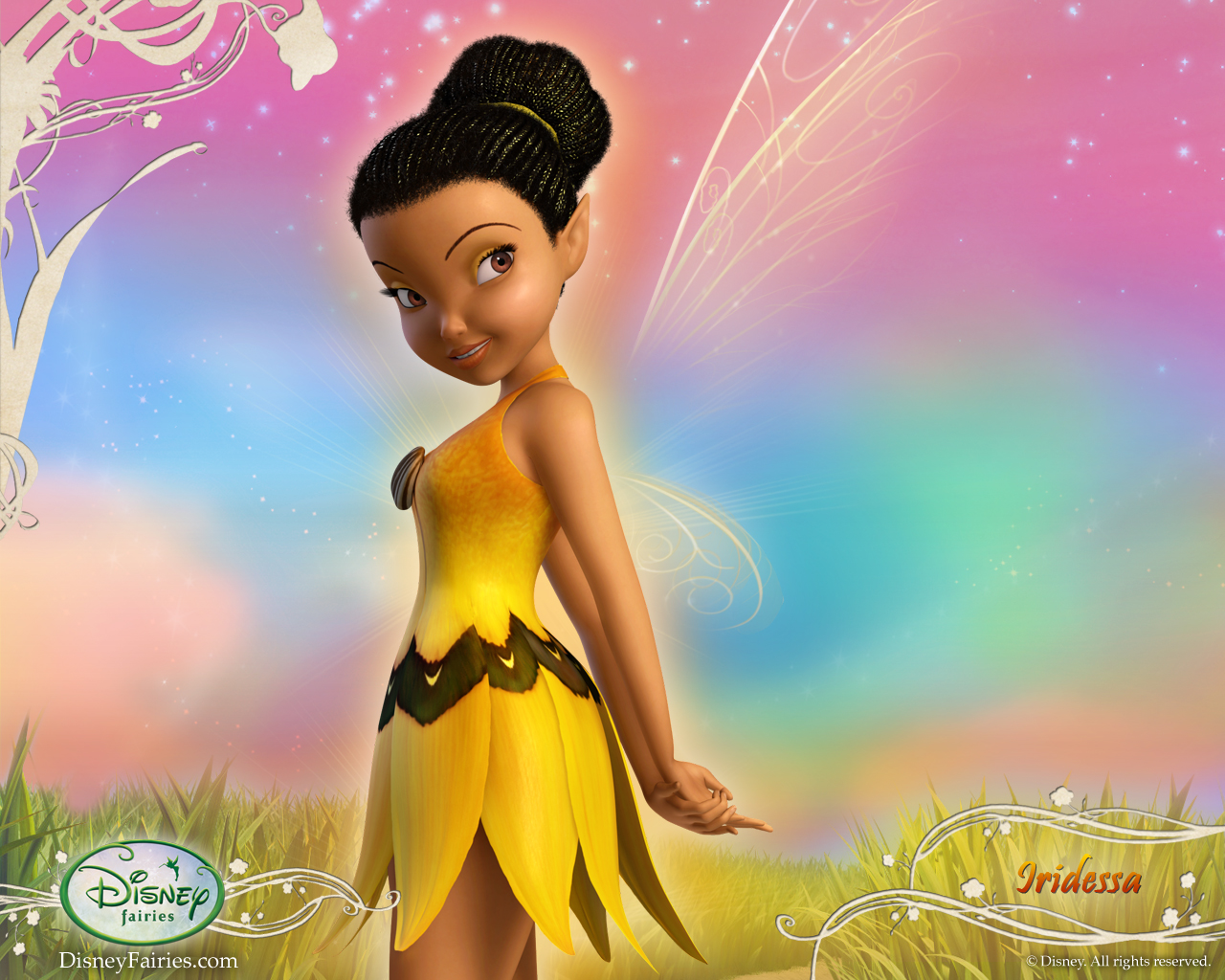
Iridessa is the name of one of the fairies in the Disney Fairies franchise. Her talent is working with light, and she wears a yellow dress, lives in a sunflower, and has clear fairy wings. In the movies, she is voiced by Raven-Symoné. Iridessa is a perfectionist and a worrier; she likes to look on the bright side of things, but can usually sense trouble approaching. When disaster strikes, she rushes in to save the day, and brings sunshine, light and brightness to every situation. The name Iridessa seems to be based on the word iridescent, meaning “producing rainbow-like colours; brilliant, lustrous, prismatic”. The word is derived from Iris, the name of the goddess of the rainbow, so you could see Iridessa as a modern spin on the older name. I have seen a baby with this name, and it’s been frequently Googled, so it seems that people find the name of this fairy intriguing. It’s not surprising, with such an attractive namesake associated with light. Looking for a nickname? Iridessa goes by Dess.

Khaleesi

Khaleesi is extremely unusual as an invented name, because it is not the name of a fictional character, but rather her title. In George R.R. Martin’s fantasy series, A Song of Ice and Fire, khaleesi is the word for the wife of a khal or ruler, in the Dothraki language from the novels. The Dothraki are a nomadic indigenous people without a written language, so the spelling of khaleesi in the novels must come from another culture. In Martin’s novel series, shy Daenerys Targaryen adopts the title of Khaleesi when she weds powerful Dothraki warlord Khal Drogo, and as his queen, grows in strength and confidence, becoming a leader in her own right known as “the Mother of Dragons”. In the television series based on the books, A Game of Thrones, the role of Daenerys is played by Emilia Clarke. Since the television series began airing in Australia, there has been a spike of interest in the name, with about 25 baby girls called Khaleesi born this year. For some reason, the name is far more popular in Queensland than elsewhere – possibly because of the connection with queens.

Lorelei

The Lorelei is the name of a famous rock on the River Rhine in Germany, and also the name of a beautiful water sprite or siren associated with the rock, who is supposed to lure men to their doom. More prosaically, the current of the river is very strong here, which explains the many accidents which have occurred in the area. The character of the Lorelei comes from a 19th century German ballad which poet Heinrich Heine turned into a poem called Die Lorelei, where a golden-haired siren unwittingly distracts men with her beauty so they crash onto the rocks. The poem has often been set to music and turned into songs, and is part of German popular culture. The name Lorelei is a combination of German dialect and Celtic, and means “murmuring rock”. Lorelei is the name of the alluring blonde in Gentlemen Prefer Blondes; in the film she is played by Marilyn Monroe. The name also features in garrulous gabfest Gilmore Girls, where both mother and teen daughter share the name Lorelei (the younger goes by Rory). Comedienne Kat Davidson named her daughter Lorelei “Rory” this year. Said LOR-uh-lie, this is better known in the US, where it is #531.

Pollyanna

Pollyanna Whittier is the title character of the Pollyanna books by Eleanor H. Porter; the series was continued by a number of writers. Pollyanna is an eleven-year-old orphan who is sent to live with her Aunt Polly in New England, and her sunny disposition soon teaches her stern relative, and the whole town, how to play the “Glad Game” – where you always look for something to feel glad about. While many are charmed by the heroine’s upbeat view of life, cynics find her too syrupy and her philosophy simplistic. Because of this, the word Pollyanna has entered our language to mean someone optimistic to the point of naivety or refusal to face facts. Pollyanna is a combination of Polly and Anna – Polly is a medieval variant of Molly, a pet form of Mary. This would be a difficult name to give a child in many ways, but would make a sunshiney middle, and easily shortens to Polly.

Rogue

Rogue is a character from the X-Men Marvel comic books created by Stan Lee and Jack Kirby. She is one of the team of mutant superheroes under the auspices of Professor Xavier, who recruits and trains young mutants to use their powers for the benefit of humanity. Rogue considers her special ability something of a curse, as she involuntarily absorbs, and sometimes removes, the memories, strength, and superpowers of anyone who touches her. For most of her life, she limited her physical contact with others, even loved ones, until after many years she was able to gain full control of her abilities. It was eventually revealed that Rogue was a code name, and her real name Anna Marie. In the movies, she is played by Anna Paquin. A rogue is a scoundrel or rascal. More to the point, a rogue animal is one which separates itself from the herd, and in horticulture the word rogue is used to describe a plant which has an undesirable mutation and must be destroyed. Anna Marie seems to have chosen Rogue as her code name to express her bitterness at the biological difference she had been lumbered with. This name can be used for both sexes; I saw it on a baby girl last year.

Scarlett

Scarlett O’Hara is the protagonist of Margaret Mitchell’s best-selling Civil War novel, Gone with the Wind; in the film version she was played by Vivien Leigh. Slender and attractive, Scarlett is flirtatious and charming, but doesn’t fit the mould of a typical Southern Belle. Smart, feisty, stubborn and very strong-willed, she nevertheless is inwardly insecure. What makes Scarlett such an interesting character are her many flaws – she is vain, selfish, spoiled, unscrupulous and manipulative, but hard as nails, with an overpowering survival instinct. Scarlett is an English surname from Norman French, referring to someone who dyed or sold brightly-coloured cloth, which was often red. It has been used as a unisex name since the 17th century, but is now usually thought of as feminine. The character’s full name is Katie Scarlett O’Hara, and she was named after her grandmother. Margaret Mitchell originally planned to call her heroine Pansy, and changed it to Scarlett just before the novel went to print. Scarlett first ranked in the 1990s at #467, the decade in which American actress Scarlett Johansson made her film debut. It climbed precipitately to join the Top 100 in the mid-2000s, and is currently #25 nationally, #23 in New South Wales, #17 in Victoria, #33 in Queensland, #17 in South Australia, #22 in Western Australia, #21 in Tasmania, and #26 in the Australian Capital Territory.

Velvet

Velvet Brown is the heroine of Enid Bagnold’s novel, National Velvet, about a teenager who rides to victory in the brutally difficult Grand National Steeplechase, the most valuable jump race in Europe. The story is about the ability of ordinary people to achieve great things – Velvet is a plain, rather sickly girl from a working-class family, and the horse she wins on is a piebald. The movie version chucks most of this inspiring message aside so they can show a radiantly pretty pre-teen Elizabeth Taylor galloping about on a chestnut thoroughbred. Velvet is a fabric which was originally very expensive to make, and therefore associated with nobility and royalty. The word is from Old French, and comes from the Latin for “tuft, down”, because of velvet’s distinctive texture. It has been used as a name since the 19th century, and has been given to both genders, but mostly to girls. This unusual fabric name is warm and luxurious, perhaps even rather sensual.

POLL RESULT: People’s favourite names were Lorelei, Arrietty, and Scarlett, and their least favourite were Rogue, Pollyanna, and Khaleesi.

(Picture is of Iridessa, from Disney website)

Famous Name: Winsome

30 Wednesday Oct 2013

Posted by A.O. in Famous Names

≈ Comments Off on Famous Name: Winsome

Tags

Abby Sandel, American names, english names, famous namesakes, historical records, locational names, modern names, name history, name meaning, Nameberry, Nameberry Nine, nicknames, rare names, surname names, virtue names, vocabulary names

giovanni_boccaccio_women_playing

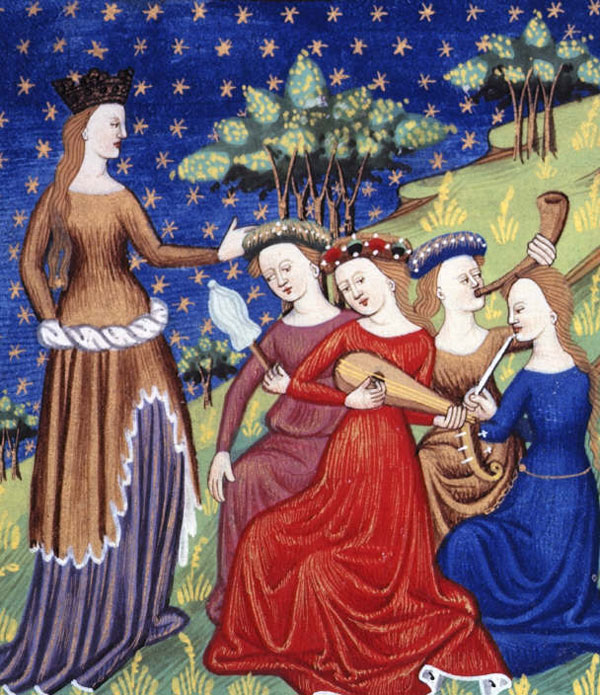
If you were in Sydney in early October, you could have attended the Royal Australian Navy International Fleet Review, celebrating one hundred years of our navy. Or, if you were of a more musical bent, you could have been there for The Renaissance Player’s 35th Runnymede Pop Festival. Held at Sydney University in its Gothic-style Great Hall, this is a unique concert of music, mime and poetry from medieval Europe, performed in brightly-coloured costumes.

The Runnymede Pop Festival has been going since 1973, and from the beginning has featured early music specialist Winsome Evans. Winsome is the director of the Renaissance Players, Australia’s oldest early music ensemble, and she is a professional harpsichordist, composer, and arranger. She conducted the first Renaissance Players concert while still a student.

Winsome is a recipient of the British Empire Medal in the Queen’s Birthday Honours List, The Order of Australia, and a NSW Jaycees Award for services to music.

Winsome is an English word meaning “charming in an innocent manner”. A winsome person is cheerful and open-hearted, engaging, and perhaps slightly naive, in a completely delightful way. The word comes from the Old English for “joy”, and is ultimately from an ancient root meaning “wish, love”.

Winsome is also an English surname, coming from the village of Winchcombe in Gloucester, or from Winscomb in Somerset. In either case, the name is Old English, and means “remote valley”. However, in some cases, the surname may have come directly from the Old English word winsom, meaning “attractive, lovely”, used as a personal name. If so, it means that the first name Winsome could date back to medieval times.

The first name Winsome can be found in records from the middle of the 19th century in North America, and seems to have been especially associated with Ontario, Canada. The reason for this may be Winsome Lake, which is one of the many thousands of smaller lakes in the Great Lakes region of Ontario, but why it inspired baby names is something of a mystery to me. I have been unable to discover how Winsome Lake received its name, because it is relatively obscure.

There are over one hundred women named Winsome in Australian records, most of them born around the turn of the twentieth century. There is another famous Winsome in Australia – Winsome McCaughey, who was Lord Mayor of Melbourne in the late 1980s. And another Australian musical connection too – Peggy Winsome Glanville-Hicks was a Melbourne-born opera composer and music critic who flourished in the middle of the 20th century.

Other successful Winsomes include British playwright Winsome Pinnock, and US Republican politician Winsome Sears. Interestingly, Sears was born in Jamaica and Pinnock’s parents were Jamaican, so there seems to be a West Indian connection. There was a grassroots playwright in Jamaica who wrote under the code name “Winsome” about 20-30 years ago. You can still find the name Winsome in use in Jamaica today, including singer Winsome Benjamin, and prize-winning cook Winsome Murphy.

Although Winsome is a secular virtue name like Felicity or Honour, the word winsome has come to have a particular meaning for evangelical Christians. The book Winsome Christianity by Henry Durbanville was published in 1952, and Winsome Evangelism by Ponder W. Gilliland came out in 1973.

I can’t pretend to be an expert on the subject, but my understanding is that the general message is to be winsome in your Christianity in order to attract more converts, and that some evangelists even use the word winsome to mean “capable of winning souls to Christ”. Author Neil Gaiman is apparently a big fan of the meaning of language changing over time, so I expect this example would be of great pleasure to him. It does give the name Winsome a special meaning for some Christians, so that it could become a religious virtue name in this context.

Winsome is a name I find very intriguing – the meaning of the word winsome seems very feminine to me, and Winsome is overwhelmingly used as a female name. Yet the name itself isn’t frilly in the least, having a similar sound to the male name Winston (which also comes from the Old English for “joy”). It’s a strong-sounding name for a girl, but with a dainty meaning.

Winsome isn’t a name I’ve ever seen on a baby or a child, and its heyday (if it can ever be said to have had one) was over many years ago. However, Winnie is becoming hip once more, and Winsome would be a rare and unusual way to reach it.

POSTSCRIPT: Abby Sandel mentioned Winsome in her Nameberry Nine column, and I was surprised and pleased at how many Berries liked or even loved the name Winsome.

POLL RESULT: Winsome received an approval rating of 61%. 21% of people thought it was an interesting modern virtue name, while 19% loved the idea of Winnie as the short form. However, 18% were reminded too strongly of the phrase win some, lose some. Only one person thought the name Winsome was too cutesy.

← Older posts
Newer posts →

Enter your email address to follow this blog

Categories

Archives

Recent Comments

A.O.'s avatarwaltzingmorethanmati… on Zarah Zaynab and Wolfgang…
Madelyn's avatarMadelyn on Zarah Zaynab and Wolfgang…
JD's avatardrperegrine on Can Phoebe Complete This …
A.O.'s avatarwaltzingmorethanmati… on Rua and Rhoa
redrover23's avatarredrover23 on Rua and Rhoa

Blogroll

  • Appellation Mountain
  • Baby Name Pondering
  • Babynamelover's Blog
  • British Baby Names
  • Clare's Name News
  • For Real Baby Names
  • Geek Baby Names
  • Name Candy
  • Nameberry
  • Nancy's Baby Names
  • Ren's Baby Name Blog
  • Sancta Nomina
  • Swistle: Baby Names
  • The Art of Naming
  • The Baby Name Wizard
  • The Beauty of Names
  • Tulip By Any Name

RSS Feed

  • RSS - Posts

RSS Posts

  • Celebrity Baby News: Melanie Vallejo and Matt Kingston
  • Names from the TV Show “Cleverman”
  • Can Phoebe Complete This Sibset?
  • Zarah Zaynab and Wolfgang Winter
  • Baby, How Did You Get That Name?
  • Celebrity Baby News: Media Babies
  • Celebrity Baby News: Adelaide Crows Babies
  • Celebrity Baby News: Chris and Rebecca Judd
  • Names at Work: Name News From the World of Business and Employment
  • Celebrity Baby News: Sporting Round Up

Currently Popular

  • Girls Names From Stars and Constellations
  • Rare Boys Names From the 1950s
  • The Top 100 Names of the 1920s in New South Wales
  • Celebrity Baby News: Mick and Angie Molloy
  • Celebrity Baby News: Holly Valance and Nick Candy

Tags

celebrity baby names celebrity sibsets english names famous namesakes fictional namesakes honouring locational names middle names name combinations name history name meaning name popularity name trends nicknames popular names saints names sibsets surname names twin sets unisex names

Blog at WordPress.com.

Privacy & Cookies: This site uses cookies. By continuing to use this website, you agree to their use.
To find out more, including how to control cookies, see here: Cookie Policy
  • Subscribe Subscribed
    • Waltzing More Than Matilda
    • Join 517 other subscribers
    • Already have a WordPress.com account? Log in now.
    • Waltzing More Than Matilda
    • Subscribe Subscribed
    • Sign up
    • Log in
    • Report this content
    • View site in Reader
    • Manage subscriptions
    • Collapse this bar
 

Loading Comments...