• About
  • Best Baby Names
  • Celebrity Baby Names
  • Celebrity Baby Names – Current
  • Celebrity Baby Names – Past
  • Featured Boys Names
  • Featured Girls Names
  • Featured Unisex Names
  • Links to Name Data
  • Waltzing on the Web

Waltzing More Than Matilda

~ Names with an Australian Bias of Democratic Temper

Waltzing More Than Matilda

Tag Archives: Latin names

Famous Name: Venus

13 Wednesday Jun 2012

Posted by A.O. in Famous Names

≈ 7 Comments

Tags

astronomical names, Australian Aboriginal names, Babylonian names, english names, Greek names, Latin names, locational names, mythological names, Norman-French names, Phoenician names, planet names, popular culture, Roman names, ship names, surname names

Last Wednesday was the transit of Venus, the planet taking about six and a half hours to cross the face of the Sun. Most of Australia was in a prime position to view this astronomical event (with special protective glasses, or else streamed live on the Internet so as not to damage our eyes).

Transits of Venus occur in pairs 8 years apart, separated by gaps of 121.5 years and 105.5 years. So the one before this one was in June 2004, and the next one will be in December 2117. I don’t want to be a pessimist, but if you missed this last one, I think you’ve lost your chance to see another.

The transit of Venus is not only a rare and lovely astronomical event, it is also an essential part of Australian history. It was in 1766 that the Royal Society sent Captain James Cook to observe the transit of Venus from the Pacific region. The reason scientists were so keen to get accurate observations was because astronomer Edmond Halley (of Halley’s Comet fame) had suggested that if you measured one of the transits, you could then use the data to figure out the distance from the Earth to the Sun, and thence to work out the distances to all the other bodies in the solar system.

For a variety of reasons, nearly all the scientists sent around the world ran into technical problems, and it was up to Captain Cook to take the observations, which he did in Tahiti in 1769. He then opened his sealed orders from the British Admiralty to find he had been sent on a secret mission to discover the mythical Terra Australis. There was no such place, and discovering New Zealand was a massive disappointment, as it was nowhere near the size the expedition had been hoping for.

Now some men would have gone home, feeling that observing the transit of Venus and discovering New Zealand was enough for one trip. But Captain Cook was made of sterner stuff, and he took it upon himself to become the first European to explore the east coast of Australia, and also to claim it as British territory. His reward was to be given a promotion, and sent back again to look just a bit harder for Terra Australis.

By sailing around diligently discovering places and claiming them for Britain, he was at last able to establish that Terra Australis didn’t exist, although Britain now owned a reasonable sized country it could send convicts to. The maps Cook made in the process were so good that they were still being used in the twentieth century, and the observations he took of the transit of Venus were used to calculate the distance between the Earth and the Sun with reasonable accuracy.

The planet Venus has an ancient connection to Australia as well, because the Yolngu people of Arnhem Land believe she is an important creator spirit called Banumbirr. Through dawn ceremonies performed with beautifully decorated Morning Star poles, they communicate with their dead ancestors through a rope of light which Banumbirr trails behind her. The ceremony means the ancient Yolngu people must have had enough astronomical knowledge to track the complex motion of Venus, as it rises before dawn only at certain times of the year.

I love stars, and although Venus is a planet, I, like almost everyone else, know it as both the Morning Star and the Evening Star. The brightest object in the night sky after the Moon, Venus is the first light to appear at dusk, and the last to disappear at dawn. In fact, I have often wished on Venus, with that little rhyme which begins, Star light, star bright, first star I see tonight …. Sometimes my wishes came true, sometimes they didn’t! Fickle Venus.

The Babylonians may have been the first to understand that the morning and evening stars were the same object, and called it Ishtar, after their goddess of love, sex, fertility and war. Other cultures followed the tradition, and to the Romans she was Venus; her morning aspect was called Lucifer (“light-bringer”), and her evening one Vesper.

Venus was a Roman goddess of love, beauty, sex, fertility, luck and war; her name is from the Latin word venus, meaning “sexual love, sexual desire”. The word is closely related to venenum, meaning “poison, venom”, which probably demonstrates a certain ambivalence towards passionate love we share today. The word venenum also meant charm, as in a love potion. Falling madly in love with someone can feel as if we have been given some sort of magic potion, and if it all goes wrong, we do indeed feel as awful as if we had swallowed poison instead!

The Romans said that Venus was the mother of Aeneas, the Trojan ancestor of Rome’s founder, Romulus, and therefore the mythological ancestor of the Roman people. The month of April was sacred to her, and she was associated with springtime flowering and the fecundity of nature. Her earliest festivals were ones that celebrated gardens and wine-drinking, and many of her attributes seem to be taken from more ancient goddesses of water and purity. Later on, Venus was identified with the Greek goddess Aphrodite and the Phoenician goddess Astarte.

The beauty of Venus has made her a popular subject in art, especially as it was acceptable (and practically mandatory) to show her nude or semi-nude. Two of the most famous are probably the classical statue, the Venus de Milo, which has the arms missing, and Bottichelli’s painting, The Birth of Venus. To call a woman “a Venus” means that she is beautiful and desirable in a very erotic way.

As well as being a female first name, Venus can be an English surname. It’s not related to the goddess, but is from the Norman-French place name of Venoix, near the city of Caen.

Venus is also a place name; there are two towns in Australia called Venus Bay – one in South Australia and the other in Victoria. Both these fishing villages are named after ships called Venus, which brings us to another intriguing Australian connection to Venus.

It is said that the drinking song, The Good Ship Venus, may have been influenced by actual events, when convicts travelling on the brigantine Venus mutinied and took the ship to New Zealand, becoming Australia’s first pirates. Two of the convicts were female, and there were reports of great immorality aboard ship – a possible inspiration for the song’s bawdy lyrics.

Venus is a rarely used name, but one which evokes both feminine beauty and the twinkle of a lovely “star” which can grant wishes …. sometimes. It’s one which has several connections with Australia, and is deeply woven into our nation’s history and culture. That makes Venus a surprisingly patriotic name choice, although I do feel on this one, we have waltzed far, far beyond Matilda!

(Photo of the transit of Venus from NASA)

Less Commonly Used Boys Names

10 Sunday Jun 2012

Posted by A.O. in Name Themes and Lists

≈ 9 Comments

Tags

Anglo-Norman names, Apache names, Australian vocabulary words, celebrity baby names, english names, fabric names, famous namesakes, fictional namesakes, germanic names, Hindi names, Indian names, Italian names, Latin names, locational names, mythological names, name data, name history, name meaning, name popularity, Native American names, nicknames, popular culture, Roman names, saints names, slang terms, surname names, unisex names, US name popularity, vocabulary names, Welsh names, Yorkshire dialect names

This follows on from Less Commonly Used Girls Names. The names are from the bottom of the popularity charts in New South Wales, Victoria, Queensland and Tasmania, and in each case, the name was used less than ten times in 2011.

There seems to be a lot of musical references in this entry, so I’ve linked relevant names to YouTube videos of the person performing.

Atticus

This Roman name means “man from Attica” – Attica being the area of Greece surrounding the city of Athens. This name wasn’t uncommon in the ancient world; there is a Platonist philosopher called Atticus, and there is also a Saint Atticus, a soldier who died a martyr by being burned at the stake. However, today it is most associated with Atticus Finch, the principled lawyer and loving single father in Harper Lee’s novel, To Kill a Mockingbird. Atticus Finch, who defends a black man on a rape charge in a small Southern town during the 1930s, is considered a folk hero in legal circles. In the 1962 film adaptation, Atticus is played by Gregory Peck, who was a civil rights activist; Peck won an Academy Award for his performance, and in 2003 the American Film Institute voted his character the greatest hero in American film. It is that decent, understated heroism of Atticus Finch that makes him such a beloved character in literature and film. The character has inspired the names of both a clothing line run by musicians and an alternative rock band. It’s a hip choice which has been burning up the US popularity charts since 2004.

Bryn

Bryn is a modern Welsh name which means “hill”; as well as being a man’s name, it is also a common place name in Wales and England. A famous person with this name is Welsh opera star Bryn Terfel, a bass-baritone best known for his roles in the works of Mozart and Wagner. Apparently he applied to study music in Cardiff, but was so annoyed when they assumed he was a woman that he ended up studying in London instead. Bryn Terfel, whose first language is Welsh, is a patron of Welsh language and culture, and hopefully by now everyone in Wales recognises his name as male. Even though Bryn isn’t a common name in Australia, I don’t think it would seem too out of place either, as there are several boy’s name beginning with Br-, such as Brent and Brody. It looks rather like a cooler version of Irish Brian, which may have a similar meaning.

Corbin

Corbin is an English surname which started as a nickname based on the Anglo-Norman word for “raven”. It may have been given to someone who had raven-black hair, although less flattering possibilities also come to mind. Corbinus, the Latinised form, is found as a first name in the Domesday Book, so it has a long history of use. Despite being an old English name, this tends to be thought of as a modern American one, because it’s been solidly Top 500 in the US since the late 1980s. This may be because of television actor Corbin Bernsen, who began playing lawyer Arnold Becker on LA Law in 1986 and remained on the show until it finished in 1994. Another famous namesake is Corbin Harney, an elder and shaman of the West Shoshone people. He devoted his life to spreading a message about the dangers of nuclear energy, and the environmental issues facing the world. You may also know the name from Corbin Bleu, who was in High School Musical. This name is apparently so unusual in Australia that the article the information came from described it as a “bizarre” choice, although it seems a perfectly nice, normal name to me.

Denim

The fabric denim was originally called serge de Nîmes, after the French city where the tough cotton material was originally made by the Andre family. This was eventually shortened to denim. Denim is inextricably linked with jeans, which began life as sturdy clothing for workers, and then became fashion icons which symbolised teen rebellion. Today they are worn by pretty well everybody. Denim is an interesting name choice; it’s not really a “bad boy baby name” like Axe or Vandal, because while denim is worn by rebel icons like rock stars and bikers, it’s also worn by suburban mums and little kids. Also fabrics are usually thought of as girls names, like Velvet and Paisley, but denim is tough and hard-wearing. It’s definitely an ambiguous sort of name – one that, like the fabric, may grow with the person better than you’d expect. It’s also a soundalike with the surname and place name Denham.

Jagger

This English surname originated in Yorkshire, and means “hawker, carrier”, the word jagger being Yorkshire dialect for someone who carries a pack or load. It is claimed that most people with this surname are descended from a single family who came from Staniland, near Halifax. There was a high concentration of people named Jagger in Yorkshire, compared to the rest of England. The most famous person with this surname is undoubtedly Sir Michael “Mick” Jagger from The Rolling Stones, whose mother was born in Australia. I don’t know if this is correct, but Mick Jagger is said to be distantly related to Joseph Jagger, the 19th century British engineer famous for being “the man who broke the bank at Monte Carlo”. Joseph Jagger was indeed from Halifax in Yorkshire. The name Jagger is almost always given in relation to The Rolling Stones frontman, and may have been given a boost in 2011 from the Maroon 5 song, Moves Like Jagger, which is a tribute to Sir Mick. The number of baby boys named Jagger went from 5 to 8 in Queensland last year.

Naiche

Naiche was the last hereditary chief of the Chiricahua band of Apache Native Americans. He was an ally, protege and relative by marriage of Geronimo, the famous Apache leader and war chief. Naiche and Geronimo successfully went to war together in the 1880s, but Naiche ended up being imprisoned. Although he had resisted the process of being moved onto an “Indian Reservation”, eventually he was forced to give in, and ended his days on an Apache reservation in New Mexico. He lived only six years after moving there, and his descendants are still on the reservation. The name Naiche means “meddlesome one, mischief-maker” and it can apparently be pronounced NAY-chee, but I’m not sure if that’s the correct Apache pronunciation, or even whether it depends on which Apache accent you’re using. Naiche is for sure a very unusual name in Australia, but it has a fascinating namesake, and actually sounds slightly like Nate and Nathan. Pronunciation and spelling seem like they would be an issue.

Occy

Occy is the nickname of Australian surfer Marco “Mark” Occhilupo. Occy is short for his Italian surname, which means “eyes of the wolf”. At the same time, it is a play on the Australian word occy straps, short for octopus straps – those stretchy cords which are used by surfers to tie their surfboards onto their car’s roof rack. Mark Occhilupo was a precocious teenage surf god of the 1980s who lost his way for several years as his life spiralled out of control. In the mid-1990s, he made a comeback, and stunned everyone when he won a world title in 1999 at the age of 33. He considered retiring in 2005, but realised he still had a lot left in him. Now aged 45, he only competes part-time, but this year he made it into the final four of the Telstra Drug Aware Pro semi-finals, defeating top-ranked surfers to do so. Mark, also dubbed The Raging Bull, is an inspirational sporting icon who teaches us that mature experience can be more important than youthful talent, and that things are never over until you give up. Although Occy is a nickname and a slang term, it means so much more.

Pax

Pax is the Latin word for “peace”, and the Romans recognised a goddess of this name who symbolised peace, and was associated with the spring. The word pax also means “treaty, accord”, and the Pax Romana is the name given to the two-century period (approximately 27 BC to 180 AD) of stability and minimal military expansion in the Roman Empire. For the Romans, peace wasn’t about everyone holding hands and singing Imagine together in a field of daisies – it described that period during war when all your opponents had been thoroughly beaten and were no longer able to resist. It denoted ultimate military victory, rather than co-operation and unity. Today we see peace rather differently, and the name is probably given with the modern concept in mind rather than the ancient Roman one. In 2007, Angelina Jolie adopted a son from Vietnam and named him Pax Thien. Pax may be the name of a goddess, but this one has very much gone to the boys, as it fits so well with popular male names such as Max and Jax.

Veer

Veer is an Indian name meaning “bravest of the brave” in Hindi. Veer (“valour”) is one of the nine rasas of ancient Hindu philosophy. These emotional states are repositories of energy drawn from our life force, and by learning to master these energies, we gain emotional balance. The rasa of Veer stops us from running away from our problems, and instead face them head on; it also gives us the courage to not allow adversity to defeat us, but to get up after a fall, and continue on. It also allows us to have the healthy confidence and self-esteem needed to achieve in life. Veer Teja Ji is an Indian folk hero and saint, and the highly successful 2004 Bollywood film Veer-Zaara is about the star-crossed romance between Indian Air Force Squadron Leader, Veer Pratap Singh, and a wealthy Pakistani woman, Zaara Haayat Khan. Veer has a very positive meaning, and looks the same as the English word veer, meaning “to swerve”. It’s also a homonym of the English name Vere, so both sound and spelling are familiar to English-speakers, and it seems a very usable heritage choice.

Ziggy

Ziggy is a nickname for Germanic names such as Sigmund, but in practice is used for a variety of names starting with Z. It is famous as the name of pop star David Bowie’s alter ego, Ziggy Stardust. Bowie based the name on a London tailor’s shop called Ziggy’s that he saw from a train one day. The surname Stardust was taken from American country and western singer Norman Carol Odom, a weird novelty act billed as The Legendary Stardust Cowboy. Norman appealed to Bowie because he had a crazy band of misfits who barely understood music, and was unconsciously hilarious. The character of Ziggy was based on pioneering English rocker Vince Taylor, who modelled himself on Elvis Presley. Like so many after him, drugs proved his downfall, and he ended up believing he was the son of God, and existing solely on eggs. Bowie got to know him, and was impressed by his magnificent repertoire of dottiness. So Ziggy Stardust was a mixture of fashion, madness, outsider art, and rock and roll excess. Ziggy is also the nickname of Bob Marley’s son David, although in his case it was a drug reference. Cute name, with a solid musical background.

(Photo shows David Bowie’s final performance as Ziggy Stardust at the Hammersmith Odeon in London, 1973)

Interesting Names Spotted in Print, on Radio and on TV – Autumn Edition

05 Tuesday Jun 2012

Posted by A.O. in Names Spotted at Home and Abroad

≈ 7 Comments

Tags

animal names, astronomical names, Australian Aboriginal names, Chinese names, Cornish names, created names, english names, famous namesakes, Fijian names, Greek names, honouring, Indian names, Latin names, literary namesakes, locational names, mythological names, name history, name meaning, nature names, popular culture, Scottish names, sibsets, unisex names, vocabulary names, Welsh names

This celebrates the fourth birthday of a little boy who was the first baby born at Saltwater in New South Wales in over a century. The beachside area is the traditional place of the Worimi-Biripi people, and is now in a national park. Dawn Morcombe gained special permission to give birth at this spiritually significant location, and she named her son Yarramundi John Michael Hollis. Yarramundi was a famous Indigenous leader of the colonial era; his son was Colebee, who was featured on the blog last year. His name is said to mean “deep water”. Fantastic story, namesake, and meaning, especially for a baby born at Saltwater!

Debbie Bell from South Australia has had a rough life and been through more than her fair share of heartache. However, after a great deal of physical and emotional suffering, she and her husband Ian were at last able to have a baby through a donated embryo, and named their son Derlerean. I think Debbie and Ian may have created this name themselves. It reminds me of the car, the Delorean.

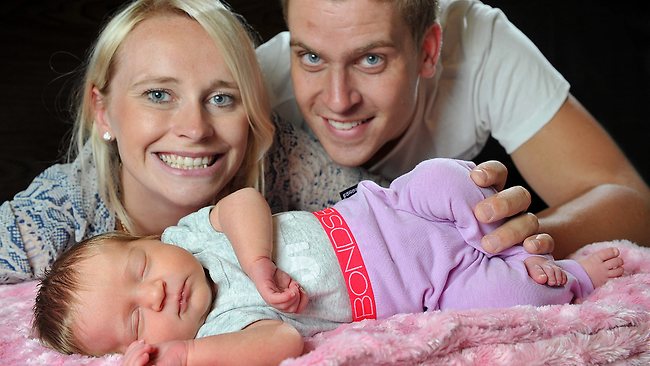
Victorian couple Charlotte Gernandt and Dale Hynes called their first baby Tinkabell Darling [pictured]. Now this sounds like a name straight out of Peter Pan, but Charlotte and Dale say she is not named after the fairy. Um, okay … must be inspired by some other Tinkerbell … She’s called Tinka for short.

Emma Preston was so crippled by endometriosis that she was confined to a wheelchair, and had little hope of ever having a baby. But then Sydney fertility specialist Dr Geoff Reid not only got her out of her wheelchair, he helped her to conceive through embryo transfer. Emma was so grateful, she named her baby after him. No, the baby’s not called Geoff; her name is Reid Louise. Nice gesture and name story.

It’s not often a baby ends up in the paper just because of his name, but this one is quite striking. Kate Anderson and Lance Walshe, from the Yarra Ranges just outside Melbourne, named their son Viper. His name was inspired by Lance’s love of snakes, and the couple wanted an original name that nobody else had. They considered Wolfgang, but rejected it because they thought it might lead to teasing. Viper Walshe doesn’t have a middle name, and if he’d been a girl, his name would have been Ruby Joanne. Kate says his name has met with mixed reactions.

A story from Port Macquarie on the ever-rising prices on electricity bills featured a struggling single mum named Bek Latimore. Bek’s baby girl is named Arizona; although I generally don’t go for American-states-as-names, this one always puts a smile on my face. I’m not sure I can ever imagine using it myself though. Arizona’s older brother is named Nick, which made me think – could Nick be short for Phoenix? Hmm?

This story about a midwifery programme at Canterbury Hospital in Sydney showed a mother with an elegant name: Eglantine Jalicot. Eglantine’s son has an equally stylish name – Lysander. His ancient Greek name means “release of a man”, and belonged to a famous military general of ancient Sparta. Eglantine is another name for the sweetbriar, and is first found as a personal name in Chaucer’s Canterbury Tales.

Two interesting and pretty girls’ names from a story on sleep and babies: Luna and Reya. Luna is of course Latin for “the moon”, and Reya is an Indian name which means (I think) “wealth”.

A story on a new breech birth clinic at Westmead Hospital in Sydney showed mum Mallissa Tulfua with her son Tevita. His name is the Fijian form of David.

A Brisbane columnist covers a naming dilemma from real life when two of her friends cannot agree what to name their baby. Readers are invited to help name their sprog, but as we’re not told what names they’ve come up with already, it seemed a rather futile exercise (although apparently the mother had rejected Luke as “not masculine”, which seemed odd). The columnist notes some of the baby names from her own extended family are Echo, Theo, Roarke, Ziad, Ingrid and Rudi.

Alana Mahadik had a very difficult childbirth with her first son, Avighna. With her second, she opted for hypnobirthing at Caboolture Hospital in Queensland on Anzac Day, and found the whole experience very quick and stress-free. Her new baby son’s name is Rudra, which is an Indian name meaning, aptly enough, “remover of pain”. Avighna’s name means “remover of obstacles”.

A rather adorable little baby girl was sadly abandoned at Canterbury Hospital early this year. The baby has been named Li-Ye, which means “beautiful child” in Chinese. Only a few babies have been abandoned this way in New South Wales in recent years: two others were named Adam and Sunday April. All of these babies were eventually adopted after their birth mothers failed to come forward.

Interesting Names of Adults

An ABC radio podcast on parenting featured a Melbourne child psychologist named Angharad Candlin. This Welsh name meaning “greatly loved” is one I have admired since childhood, yet never before seen on a real person (although I didn’t actually see her, as it was radio).

This travel writer, enjoying the Sicilian sun, has the name Dugald Jellie. There’s quite a few Australians with this Scottish form of Douglas as their name, but Dugald Jellie seemed just a bit more interesting and storybook-character somehow.

The junk mail of one April morning produced a community newsletter about a new medical centre opening in the area. One of the doctors was named Demelza – a Cornish place name from the Poldark books and TV series. I briefly thought about changing doctors just to have a GP named Demelza, but couldn’t face all the paperwork.

I read One Way or Another: The Story of a Girl Who Loved Rock Gods, the memoirs of Gold Coast rock star groupie Nikki McWatters. Eventually she sees the error of her ways, and settles down by sensibly marrying a schoolteacher. Her husband’s name? The very rockstar-sounding Zeus. As well as teaching school, Zeus is a trained opera singer, so she obviously never lost her thing for male vocalists.

Channel 7 have resurrected The Price is Right, which I find keeps the troops quietly occupied while I make dinner. As I stir and chop, I keep an ear out for names: so far I have seen a pair of sisters named Jalila and Janita (late teens to early twenties), a woman named Feda, pronounced like “feeder” (twenties), and a grandmother named Dixie (around sixtyish).

Popular Names for Boys

06 Sunday May 2012

Posted by A.O. in Name Themes and Lists

≈ 23 Comments

Tags

Aramaic names, band names, Biblical names, car names, celebrity baby names, classic names, english names, famous namesakes, fictional namesakes, French names, germanic names, Greek names, hebrew names, honouring, Latin names, locational names, name history, name meaning, name popularity, nicknames, Old Norse names, popular culture, popular names, royal names, saints names, Scottish names, surname names

Follows on from Popular Names for Girls.

William

William is a solidly classic name which has never left the Top 50. It was the #1 name of the 1900s, and gradually decreased in popularity, hitting its lowest point during the 1970s, at #48. However, its fortunes were soon to recover, because in 1982, heir to the British throne Prince Philip, and his then wife, Diana, Princess of Wales, welcomed their first child and eldest son, William Arthur Philip Louis. Prince William was named after his father’s cousin and personal hero, Prince William of Gloucester, who died in an air crash ten years earlier. Prince William made his first visit to Australia as a baby, and this was an immediate help to the name’s popularity. By the time Prince William began university in 2001, the name was already in the NSW Top 10. It reached #1 in 2009, the year after Catherine Middleton began accompanying Prince William to official functions, and there it has remained. In 2011, Prince William made a much-appreciated visit to flood-affected areas of Australia, and shortly afterwards treated the world to a slap-up royal wedding. It’s likely this princely name will remain at the top for at least another year.

Jack

Jack is a classic name which has never left the charts. Top 100 during the 1900s-30s, it sunk to its lowest point in the 1970s, at #269. However, so rapid was its growth that it joined the Top 100 again during the 1980s – the same decade that pop singer John Farnham released his Whispering Jack album. Whispering Jack went to #1, and is the highest-selling album ever in Australia, having gone platinum 24 times over. By the 1990s, Jack was already Top 10, a decade when Leonardo di Caprio played water-logged lover Jack Dawson in the romantic movie Titanic, and teen heartthrob Daniel Amalam played bad boy Jack Wilson in soapie Home and Away. By the start of the 2000s, Jack was #2. It made #1 by 2004, the year that the TV show LOST began, with its hero Dr. Jack Shephard, and the year after Johnny Depp played Captain Jack Sparrow in the first Pirates of the Caribbean film. Jack remained in first place until 2008, the year that AC/DC released their single Big Jack. Jack the Lad may have had his day, but won’t be going anywhere fast, and is still the #1 name in some states.

Ethan

Ethan is a name from Hebrew which means “solid, enduring”. In the Old Testament, Ethan is said to have been a very wise man who wrote Psalm 89. Ethan first entered the charts in the 1970s, and took off during the 1980s, as film-maker Ethan Coen began his career, working in tandem with his brother Joel. At the end of the 1980s, actor Ethan Hawke got his big break in Dead Poets’ Society. By the 1990s, Ethan was a Top 100 name, and it was in this decade that Tom Cruise first played Ethan Hunt, the hero of the Mission Impossible films, Ethan Philips joined the cast of TV show Star Trek, and Ethan Rayne was introduced as a character on Buffy the Vampire Slayer. It was also during the 1990s that surfing champ Wendy Botha welcomed a son named Ethan. In 2006, Ethan joined the Top 10 – the year after the Ethan Group, an Australian IT company, won the BRW Fast 100. Singer Dannii Minogue, Kylie’s sister, welcomed a son named Ethan in 2010, and that probably won’t hurt the chances of this strong yet gentle-sounding name going higher still.

Oliver

Oliver is the English form of French name Olivier, but it’s unclear whether it’s the Norman form of Germanic Alfher, meaning “elf warrior”, or Old Norse Aleifr, meaning “ancestor’s descendant” (related to Olaf). The spelling was altered to make it seem as if the name came from the Latin oliva, meaning “olive tree”. A classic which has never left the charts, Oliver was Top 100 in the 1900s, but then sank into rare use. It recovered during the 1970s, the decade after the release of Oliver!, the musical based on Dickens’ novel, Oliver Twist. In this decade, actress Goldie Hawn welcomed a son named Oliver. The name gained ground during the 1980s, and was Top 100 during the 1990s. Late in the ’90s, the first Harry Potter book was published, featuring Harry’s Quidditch captain, Oliver Wood. In the 2000s, the books were turned into films, with Oliver Phelps playing the role of George Weasley. By 2006, the debut of TV show Hannah Montana, where Oliver Oken is the best guy-friend of the heroine, it was Top 20, and by 2008 it was Top 10. By 2010 it was Top 5; Oliver may go higher if you want some more.

Lucas

Lucas is the Latin form of Greek Loukas, on which English Luke is based. Lucas first entered the charts in the 1950s. There was noticeable growth during the 1970s, the decade that George Lucas made the first Star Wars movie, and then it remained stable for several decades in the very low 100s. However, in the 2000s it made the Top 100, and at this point it fairly raced up the charts. A possible help to the name was the television drama series, One Tree Hill, in which Chad Michael Murray plays the main protagonist, Lucas Scott. This brooding, blue-eyed, sporty yet bookish hero proved something of a hit with the female demographic. Meanwhile, Lucas Holden on Australian soap Home and Away was also a literary teenager, who ended up having a controversially steamy scene with his onscreen girlfriend. By 2006, the year that soccer star Lucas Neill played for Australia in the World Cup, it was in the Top 50. By 2007 it was Top 20, and by 2010 it was Top 10. The 2000s were kind to Lucas, and at this point, lucky Lucas seems almost certain to go to #1.

Noah

Noah is derived from the Hebrew name Noach, meaning “rest, comfort”. Noah is well known from the Old Testament story, where he builds an ark which saves his family and the animals of all species to survive the Great Flood, sent by God as a one-off punishment to wicked humanity. The name Noah entered the charts in the 1980s, the decade when Noah Hathaway gave an award-winning performance as boy-warrior Atreyu, in the fantasy film, The Neverending Story. Also in the 1980s, Australian actor Noah Taylor made his film debut as the main character in the critically acclaimed The Year My Voice Broke. Noah climbed steadily, then suddenly shot up during the 1990s, the decade that Boris Becker welcomed a son named Noah, so that it was in the Top 50 by the 2000s. Noah joined the Top 20 in 20005, the year after Ryan Gosling played the young version of Noah Calhoun, the devoted lover from romantic film, The Notebook. In 2006, Noah was in the Top 10. However, Noah has remained reasonably stable, with no signs of moving significantly up or down, and we must wait to see whether it sinks or swims.

Lachlan

Lachlan is a Scottish name which began as a nickname for someone from Norway. In Scotland, Norway was known as the “the land of the lochs”, or Lochlann. Lachlan Macquarie was born in the Hebrides, and became Governor of New South Wales in 1809. To the British government of the time, Australia was a penal colony for offloading the dregs of their society; convicts must be treated cruelly, former convicts exploited, and little money spent. The government fretted as Macquarie pardoned convicts, employed freed convicts in important positions, put up beautiful Georgian buildings, and spent lavishly on public works. Eventually the British booted him, but for giving us a future and sticking up for us, he is considered the father of our nation. Lachlan has been almost continuously in the charts, only dropping out in the 1930s, but was in rare use until it began rising in the 1960s. In 1971, media magnate Rupert Murdoch chose this name for his eldest son, and the name rose significantly. It was Top 100 by the 1980s, Top 20 by the 1990s, and Top 5 by the early 2000s. The position of this patriotic favourite has been stable for more than a decade.

Cooper

Cooper is an English surname which means “barrel-maker”. One of the most famous rivers in Australia is Cooper Creek, where doomed explorers Burke and Wills met their end, and Australian racing car driver Jack Brabham drove for the Cooper Car Company. Cooper first entered the charts in the 1980s, and made good ground during the 1990s, a decade when Bill Murray and Hugh Hefner both welcomed sons named Cooper. By the 2001, the name was in the Top 50, and then it soared. It got some serious sporting muscle as Quade Cooper joined the national men’s rugby union team, the Wallabies, and Cooper Cronk joined the national rugby league team. Cronk was also part of the Melbourne Storm team which won five Premierships or Minor Premierships within four years. Originally from Brisbane, he plays for the Queensland state side, which insists on winning the State of Origin series every year. Handsome, athletic and an extremely talented player, Mr Cronk seems like a big part of the reason the name Cooper is #1 in Queensland. Cooper made the Top 10 in 2007, and the Top 5 the following year, but now seems to be falling without reaching the top spot.

Thomas

Thomas is from an Aramaic word meaning “twin”, and in the New Testament, Saint Thomas was one of the Twelve Apostles. Thomas was his nickname; his real name was Judas. Presumably he was the twin of someone in the Biblical stories, or just a lookalike or kindred soul, but frustratingly, the Bible neglects to explain whose “twin” he was. People who like logical explanations for things often cite Thomas as their favourite Apostle, because when he heard that Jesus had been resurrected, he refused to believe it until he could see and touch Jesus for himself – hence the phrase, Doubting Thomas for a sceptical person. Thomas is a classic which has never left the Top 100. In the Top 5 of the 1900s, it gradually declined, and reached its lowest point in the 1970s, at #68. It climbed smoothly through the 1980s, the decade that saw Tom Cruise and Tom Hanks become stars. By the 1990s, it was in the Top 5, and maintained position in the 2000s as Tom Felton played Draco in the Harry Potter films, making many a teen girl switch to Team Slytherin. However, it may be very gradually going down now.

James

James is the Latinised form of Jacob, and must be one of the most successful names from the New Testament. The name of two of the apostles, this doubly saintly name is also a royal one in Britain, where there have been seven Scottish kings called James. The King James Version of the Bible was commissioned by King James I of England (James VI of Scotland), giving it yet another tie to this sacred book. In Australia, the most famous James is Captain James Cook, the explorer who discovered our continent. A classic which has never left the Top 20, James reached its lowest point in the 1960s and ’70s at #19. Recovery was so swift that it was Top 10 in the 1980s, and Top 5 in the 1990s. Since the 1970s, there have been many Jameses in the public eye, real and fictional. Actors James Woods, James Spader, James Marsters, and James Phelps; singers James Blundell, James Morrison and James Blunt (not to mention the band James); Captain James Kirk from Star Trek; and the inimitable James Bond. James is the name of Harry Potter’s father – his mum’s name Lily is also Top 10. Cool James is falling again, at glacial speed.

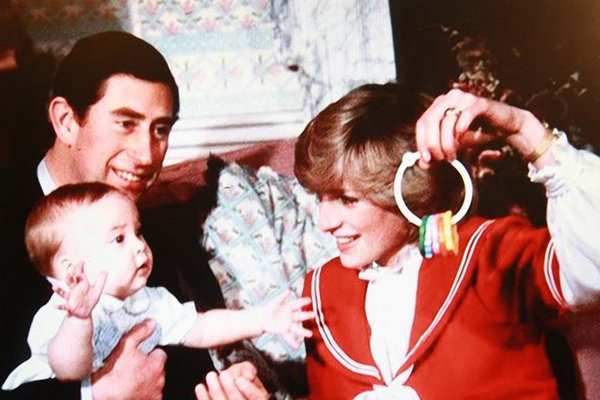
(Picture shows Prince William as a baby with his parents, Prince Philip and Diana, Princess of Wales; image from Royal Wedding)

Popular Names for Girls

29 Sunday Apr 2012

Posted by A.O. in Name Themes and Lists

≈ 29 Comments

Tags

acronyms, Appellation Mountain, band names, Biblical names, celebrity baby names, created names, english names, Etruscan names, famous namesakes, fictional namesakes, flower names, French names, gemstone names, germanic names, Greek names, Italian names, Latin names, Linda Rosenkrantz, locational names, mythological names, name data, name history, name meaning, name popularity, name trends, Nameberry, nature names, nicknames, Norman names, popular culture, popular names, retro names, royal names, Shakespearean names, ship names, tribal names, vocabulary names

In honour of the name data being released, I thought I’d do lists of the most popular names in Australia for last year. I admit this was something of a last-minute decision, but it seemed like a good opportunity to cover some of the best-loved names.

People often ask how popular names got to be popular. I’m not sure there’s really a good answer to that – clearly people like the sound of them, and they fit in with current trends. Yet there must be many names, equally as nice-sounding and trend-friendly, that lurk around the 200s and don’t seem as if they are going anywhere much.

Although I cannot tell you what events caused these names to become popular, I can tell you some of the events which accompanied their rise. I’m definitely not trying to say that they were the cause of a name’s popularity, just that they coincide with it (and really sometimes it seems more than merely coincidental). Feel free to add other events you can think of, or any theories of your own!

Note: I’ve used data from New South Wales, but it must be broadly accurate for the rest of the nation too.

Lily

Lily seems to have begun as a pet form of Lilian, but must soon have become thought of as a flower name. The lily is sacred to the Virgin Mary, and Jesus urged his followers to “consider the lilies of the field” as a model in trusting Divine Providence. Lily has been almost continuously in the charts, only dropping out during the 1960s. It began rising in the 1980s – a decade when Princess Lily was the main female character in fantasy film Legend, and when Phil Collins and Kevin Costner welcomed daughters named Lily. A Top 100 name in the 1990s, it continued climbing, as Kate Beckinsale welcomed a daughter named Lily, while Johnny Depp named his baby girl Lily-Rose. By the early 2000s, Lily was already a Top 20 name, and during this decade, Lilly was the main character’s best friend in The Princess Diaries movie, Lily Potter was Harry’s mum in the Harry Potter movies, and pop singer Lily Allen released her first hit. Last year Lily was the most popular name for girls, once combined with the spelling Lilly. Delicate and pure, yet with several spunky namesakes, pretty Lily became a favourite.

Ruby

Ruby is named after the precious gemstone, whose name from Latin simply means “red”. Retro Ruby was popular during the 1900s, then dropped out completely during the 1960s and ’70s, despite being a popular name in songs; notably Ruby Tuesday and Ruby Don’t Take Your Love to Town. It began rising in the 1980s, as comedienne Ruby Wax barged her way onto our TV screens, and singer Rod Stewart welcomed a daughter named Ruby. The name climbed steeply during the 1990s, and turned up in more songs: Ruby Soho by Rancid, Thru’ the Eyes of Ruby, by The Smashing Pumpkins, and Ruby Wednesday by Eskimo Joe. By the early 2000s, Ruby was a Top 50 name, and by the late 2000s, it was Top 20. During this decade, the song Ruby was a hit for The Kaiser Chiefs, Renee Zellweger played Ruby in the movie Cold Mountain, and Ruby Buckton was a free spirited teen on popular soap, Home and Away. Charlotte Church, Tobey Maguire, and Harry Kewell all welcomed daughters named Ruby. Last year it was #2 for girls, once combined with the spelling Rubi. Flaunting Ruby sparkles, and is a name worth singing about.

Chloe

Chloe means “young green shoot” in Greek, and was one of the epithets of the earth goddess Demeter. From early on, it was a favoured literary name; Chloe is the heroine of the pastoral romance Daphne and Chloe, by the Ancient Greek writer Longus. The name was also considered suitable for use by the Puritans, because Chloe is an early Christian mentioned in the New Testament. Chloe first appeared on the charts in the 1970s; a decade when an arty French film, re-titled Chloe in the Afternoon, was released to English-speaking audiences. Chloe stormed up the charts and was Top 100 by the 1980s. During this decade, actress Candice Bergen and singer Olivia Newton-John both welcomed daughters named Chloe, and Chloe Jones was one of the characters in long-running soap, A Country Practice. By the 1990s it was Top 20, and Logie-winning actress Kristy Wright played the tragically troubled Chloe Richards on popular soap, Home and Away. Chloe was Top 5 by the early 2000s; it reached #1 in 2006. Fresh and spring-like, Chloe has been recommended at Appellation Mountain, and Linda Rosenkrantz from Nameberry named her daughter Chloe – some serious name-guru approval.

Mia

Mia seems to have become popularly known through actress Mia Farrow, the daughter of Australian film director John Farrow, and Irish actress Maureen O’Sullivan. Mia is short for Ms Farrow’s real name, Maria. Mia first appeared on the charts in the 1960s, after Mia Farrow began her career, but rose in popularity very gradually. An interesting link with another name on the list is that Princess Lily in Legend was played by actress Mia Sara; is it a coincidence that both names began climbing at the same time? It started making significant gains in the 1990s, a decade when Uma Thurman played Mia Wallace in Pulp Fiction. Although not yet Top 100 in the 1990s, by the early 2000s it was already Top 20. In this decade, we met Amelia “Mia” Thermopolis, heroine of The Princess Diaries movie, and Mia Toretto from The Fast and the Furious films. It was chosen as the name for their daughter by actress Bec Cartwright and tennis champion Lleyton Hewitt. Top 10 by the late 2000s, it reached #1 in 2008. Simple and cute, Mia has another Australian connection – it is an acronym for Made in Australia.

Olivia

Olivia is a name invented by William Shakespeare for a character in Twelfth Night. Olivia is a beautiful noble lady in mourning for her brother; through an amusing misunderstanding, she falls in love with a woman named Viola disguised as a man. Through another amusing misunderstanding, she marries Viola’s twin brother Sebastian by mistake, but fortunately he is so much like his sister in looks and personality that she is happy with the outcome. Famous Olivias include actress Olivia de Havilland and Olivia Arias, the widow of Beatle George Harrison. Olivia first appeared on the charts in the 1960s, just as singer Olivia Newton-John began her career, and rose steadily. Her popularity took off in the 1980s (perhaps by coincidence, the era when Ms Newton-John enjoyed her greatest success), and by the 1990s she was already a Top 20 name. During the 1990s, Denzel Washington and Lance Armstrong welcomed daughters named Olivia. In the early 2000s, Mariska Hargitay was playing Olivia Benson on Law and Order: SVU, and by 2005 Olivia had reached #1. Shakespeare had a knack with names, and this one is elegant; I picked it to be the Jessica of our time, and equally resilient.

Isabella

Isabella is a Latinate form of the name Isabel; it was a favourite amongst European royalty from the Middle Ages onwards. Isabella is a stock character in the Italian commedia dell’arte, the flirtatious and alluring female lover that men make fools of themselves over. She is named in honour of the actress, playwright and poet Isabella Andreini, who became famous in the role. Isabella has been on the charts almost continuously, although her last time in the Top 100 was in the 1900s. She dropped out completely during the 1950s, and then again in the 1970s. She made a recovery in the 1980s just as Italian actress Isabella Rosselini became internationally known, and then skyrocketed. Nicole Kidman and Tom Cruise adopted a daughter in the early 1990s and named her Isabella, and the name was comfortably Top 50 for that decade. When Stephenie Meyer’s novel Twilight was published in 2005, its heroine named Isabella “Bella” Swan, Isabella was already #7; Isabella reached #1 in 2009, the year after the Twilight film was released. Ornate and ultra-feminine, it is an Australian royal baby name, as Prince Frederik and Princess Mary of Denmark named their first daughter Isabella.

Charlotte

Charlotte is a French feminine form of Charles; a common name amongst European royalty, it was introduced to Britain in the 17th century by the Hanoverians. The Charlotte was one of the ships of the First Fleet, who reached Australia in 1788. Charlotte has been almost continuously on the charts, only disappearing in the 1950s. She began climbing gradually in the 1960s, a decade when English actress Charlotte Rampling’s film career began. The name grew steeply in the 1980s, a decade in which Charlotte “Charlie” Blackwood, played by Kelly McGillis, is the love interest to Tom Cruise’s Maverick in the movie Top Gun. It made the Top 100 by the 1990s, when actress Sigourney Weaver welcomed a daughter named Charlotte, and when the band Good Charlotte began their career. It was Top 20 in the early 2000s, while we got to know the romantically optimistic Charlotte York in Sex and the City, played by Kristin Davis; by the end of the decade it was Top 10, as as singer Charlotte Church progressed her career from classical to pop. Sophisticated yet sensible, with the option of a tomboy nickname, Charlotte has yet to make #1.

Sophie

Sophie is the French form of Sophia; the name was used in several European royal families. Sophie first entered the charts in the 1950s, and through steady growth, made the Top 100 by the 1980s. It was during this decade that William Styron’s Sophie’s Choice was made into a film; Meryl Streep won an Oscar for her performance as Zofia “Sophie” Zawistowski, the beautiful Polish immigrant with a tragic secret. The same year the film came out, Roald Dahl‘s book, The Big Friendly Giant was published; the heroine is called Sophie, named after Roald Dahl’s grand-daughter (later fashion model Sophie Dahl). During the 1990s Sophie took off, and was a Top 20 name during that decade. It was during the ’90s that the best-selling novel, Sophie’s World, was published, and actress Sophie Lee and singer-actress Sophie Monk both began their careers this decade. At the end of the 1990s, Sophie Rhys-Jones joined the British Royal Family when she married Prince Edward. Sophie was Top 10 by the early 2000s, and many are tipping sweet and simple Sophie to become the #1 name within the next few years.

Sienna

Sienna is the English name for the Italian city of Siena,in Tuscany. As a word, it refers to a type of clay used to make oil paints, and a shade of yellow-brown, after the hue of said clay. The city’s name comes from the Etruscan tribe who originally inhabited the area, the Saina, but the Romans derived it from the Latin for “old” (the same Latin root which gives us the word senile). Sienna first entered the charts in the 1980s, and climbed steeply during the ’90s. I think the name suited the aspirational nature of that era. Italy was very “big”; pizza was becoming a mainstream food, and the adults around me were guzzling Chianti and buying time-shares in Tuscan villas. British model-actress Sienna Miller is not responsible for the name’s popularity, because it had been climbing for some time, but can it be purely coincidental that it first joined the NSW Top 100 in 2002, the year after Ms Miller’s career began? From that point, its climb was so vertiginous that it was Top 10 by 2006. Smooth, modern Sienna seems certain to go higher still.

Ella

Ella is the Norman form of the Germanic name Alia, a short form of names with the element ali, meaning “other”. However, it can also be used as a short form for Eleanor, Ellen, Elizabeth or any name starting with El, and also the many names ending with -ella. It’s hard not to connect this name with jazz great, Ella Fitzgerald. Ella has been on the charts almost continuously, with her last time in the Top 100 in the 1900-10s. She was soon in rare use, although she only disappeared completely during the 1960s. She climbed slowly during the 1980s, and steeply during the 1990s. It was during the ’90s that Ella got a new singing namesake – Ella Hooper from rock band Killing Heidi. Ella was Top 20 by the early 2000s. She received several boosts around this time, for the movie Ella Enchanted was released, a re-telling of the Cinderella story. Warren Beatty, John Travolta, Mark Wahlberg and Ben Stiller all welcomed daughters named Ella, giving the name a distinct celebrity flavour. Top 5 in the second half of last decade, Ella feels as if she may have peaked, and is possibly on her way down again.

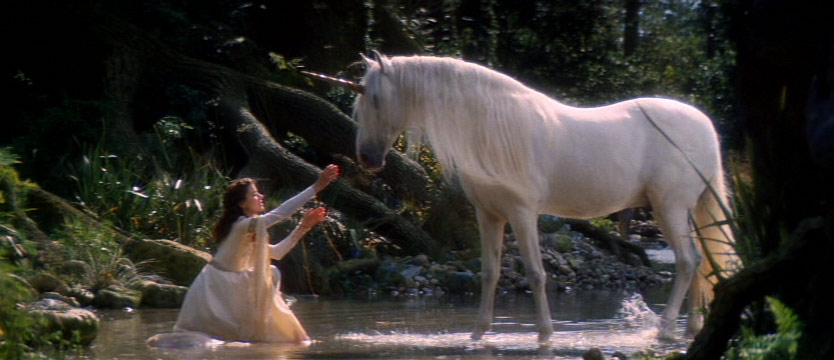
(Picture shows Princess Lily and unicorn, from Ridley Scott’s 1985 cult fantasy film Legend)

Googly Gender-Bending: Your Questions on Unisex Names Answered

15 Sunday Apr 2012

Posted by A.O. in Your Questions Answered

≈ 20 Comments

Tags

blog reviews, classic names, famous namesakes, fictional namesakes, French names, Google, hebrew names, Hungarian names, Italian names, Japanese names, Latin names, Mer de Noms, mythological names, name meaning, name popularity, naming laws, nature names, nicknames, Nook of Names, place names, polynesian names, popular culture, surname names, unisex names

You may be expecting a blog review this week, and I hope you are not too disappointed that one isn’t appearing. The truth is, I feel quite burned out in regard to the reviews, and also think that several name blogs are currently in a state of flux. I hope that if I wait a few months, it will give new blogs a chance to catch up, and abandoned ones a chance to resume.

In the meantime, here I am starting yet another Category – this one, Your Questions Answered. I’ve noticed many interesting questions typed into Google, and although they got sent to my blog, alas, they received no answer here. So this is my chance to make good on their requests.

I thought I’d begin with a few of the many enquiries in regard to unisex names, since it is such a popular topic. I think it is worth mentioning that so far, nobody has Googled, “what is a male name I can steal for my daughter so there are no names left for parents of boys to use” or “how can I give my son a feminine name in order to scar him psychologically”, which is how some people seem to imagine the mental workings of the bestowers of unisex names.

The fact that so many people are so frequently searching suggests that far from using a unisex name in a frivolous way, a lot of thought is going into it. In turn, I’ve tried to put a lot of thought into answering them, steering a steady course between a laissez faire “anything goes” attitude, and a shrill denouncement of anyone daring to suggest that any name at all can be unisex.

In doing so, I’ve considered the origin, meaning, history, namesakes, and popularity of a name, both current and past. I’ve tended to go with the theory that surnames are unisex, unless they have a specifically gendered meaning, or are derived from specifically gendered personal names.

One thing I should make clear is that unlike some other countries, Australia has no naming laws in regard to gender. According to legislation, all names are unisex, and you are quite free to name your daughter Matthew or your son Chloe if you wish.

I’m presuming that when people ask if a name is male, female, or unisex, they are asking the community for their opinions on the subject. Of course, my opinions are just that – opinions. Feel free to leave your own opinions!

Note: Popularity of names based on Australian data.

I: BOYS TO GIRLS?

Henry as a girl’s name

At first glance, the idea of Henry as a girl’s name seems utterly potty. Henry is not only Top 100 for boys, but also a classic boy’s name which has charted for males for over a century, and been accepted as such for more than a thousand years. However, I do remember a Famous Five book where there was a female character named Henry – short for Henrietta.

My Verdict: A boy’s name, unless short for Henrietta

Luca as a girl’s name

Luca can be the Italian form of Luke, but also the Hungarian form of Lucia. In the latter case though, it is pronounced LOO-tsa, rather than LOO-ka. Luka seems to have a reasonable history of use as both a male and female name across a range of different cultures. I’d probably lean towards using Luka for a girl instead.

My Verdict: Both a boy and a girl name, but the two names are pronounced differently

Dylan as a girl’s name

Dylan was a Welsh god, so the name’s origins are masculine. Furthermore, Dylan has charted as a boy’s name since the 1960s, but never for girls. You could use the completely unrelated Irish surname Dillon though, which an English speaker would pronounce the same way anyway.

My Verdict: A boy’s name, sometimes used on girls

can Cadel be a girl’s name

It is a variant of Cadell, which for many centuries has been used and accepted as a male name. However, the explorer Francis Cadell has a few places in South Australia named after him – you could always claim Cadell as a place name. Place names based on surnames based on gendered personal names seem to be something of a grey area.

My Verdict: A boy’s name

can Myles be a girl name

In Greek legend, Myles was most definitely a man, and this name has a long history as a male name. However it’s now being used on girls – perhaps it seems like the “correct” form of Miley?

My Verdict: A boy’s name, currently being used on girls

II: GIRLS TO BOYS?

when can Hazel be a boy name?

I guess whenever you feel like using it as such. Hazel is a nature name and a surname, so seems quite unisex, and in fact does have some history as a male name. Having said that, it’s currently rising in popularity as a girl’s name, and has never charted for boys.

My Verdict: Technically unisex, but usage is almost entirely feminine

Can I call my boy Kaia

I think you can, but nobody seems to agree. Kaia seems unisex to me, but nearly everyone insists that it’s feminine. However, the name Kaya definitely is unisex, and worldwide seems to be used by more men than women. It’s used in so many different countries that it’s practically unicultural as well. I think I’d prefer to go with Kaya, although I don’t see why Kaia can’t be a variant of Kaya.

My Verdict: Your choice!

Noa as a boys name

Although Noa is a female name in Hebrew and Japanese, it’s also a Polynesian male name meaning “freedom”. There was a famous rugby league player from Fiji named Noa Nadruku, who played for Australian teams in the 1990s.

My Verdict: Both a boy and a girl name depending on origin

can Starr be a boy’s name?

Sure it can, it’s a surname as well as a place name. In fact, the surname seems to derive from a masculine first name which may mean “ox”, so if anything it’s more male than female. There’s a comic book hero called Starr the Slayer, a barbarian king. He seems pretty blokey.

My Verdict: Unisex, leaning towards male by history and meaning

is Kelly becoming popular as a boys name

Apparently not. It’s still charting as a girl’s name, although slowly declining, and has never charted as a boy’s name. I have seen some boys named Kelly though; it’s rare as a boy’s name, but not unheard of.

My Verdict: Unisex, but usage is almost entirely feminine

III: CONFUSED ON THE ISSUE

is Stacey more common as a boy or girl name

It isn’t common for either sex – currently it’s not on the charts at all. However, when it did chart, it was only as a female name.

My Verdict: Historically, much more common as a girl’s name

can a man’s name be Ashley or it that just a girls name

It can be used for both sexes. Famous Australian men named Ashley include tennis player Ashley Cooper, and swimmer Ashley Callus. It charts as both a male and female name, although as a female name it is still Top 100, and as a male name it is now in rare use. Historically it has been male for longer, but hit a higher peak of popularity as a female name.

My Verdict: Historically more common for boys, but currently more common for girls

Is Remy a boy name or a girl name

It’s based on the Latin name Remigius, so it’s usually a boy name. However, Kay from Nook of Names pointed out that it could just as easily be based on the female form Remigia. In its country of origin, France, Remy is occasionally used as a female name.

My Verdict: Most often a boy name, but can be used as a girl name

is Jade boy or girl

It’s a unisex name. Famous Australian men named Jade include soccer player Jade North and AFL player Jade Rawlings. Famous Australian women named Jade include swimmer Jade Edmistone and singer Jade McRae. Jade has charted for both sexes, but currently it’s Top 100 for girls, and in rare use for boys.

My Verdict: A name for both boys and girls, but much more common for girls

Is Darcy considered a boy or girl name

Ooh good question. Darcy charted as a unisex name from the 1900s to the 1950s, and then in the 1950s it became a male name only. Currently it generally seems to be rising as a female name and declining as a male name.

My Verdict: Originally unisex, and may be returning to that state

(Picture is of Australian androgynous model Andrej Pejic, who successfully models both male and female clothing)

More Eastertide thanks are due to the unisexily named Lou from Mer de Noms, for reblogging Boys Names of Australian Aboriginal Origin! (If you read that carefully, it’s a poem).

Iridessa and Bambam: Created Names from the Bonds Baby Search

03 Tuesday Apr 2012

Posted by A.O. in Baby Contests

≈ 7 Comments

Tags

Australian Aboriginal names, car names, created names, famous namesakes, fictional namesakes, Indian names, Latin names, popular culture, Shakespearean names

Obviously all names are created at some point, but these are ones whose origins  seem easier to spot than most, or which were created for a specific purpose, or for a person who later became famous.

GIRLS

Alinta (an Aboriginal name meaning “fire”, used by a power company as their name)

Chevelle (a make of car)

Chevi (from Chevy, a make of car)

Cordelia (seems to have been created by Shakespeare for King Lear, from older sources)

Evangeline (said to have been created by Longfellow in his poem of the same name, from Greek)

Haidee (created by Byron in his poem Don Juan, probably from Greek)

Iridessa (one of the Disney Fairies in the Tinkberbell films; based on the word iridescent?)

Jovie (a character from the movie Elf; based on the word jovial?)

Juliet (created by Shakespeare for Romeo and Juliet; an Anglicisation of Giulietta)

Katara (a character from Avatar: The Last Airbender TV show; the word for an Indian dagger)

Lorna (created by R.D. Blackmore for his novel Lorna Doone; perhaps from a Scottish place name)

Lyra (created by Philip Pullman for the His Dark Materials series, from the constellation)

Miranda (created by Shakespeare for The Tempest, from Latin)

Mahalia (singer Mahala Jackson put an i in her name to become Mahalia Jackson)

Mavis (created by Marie Corelli for The Sorrows of Satan; old name for a song thrush)

Miakoda (touted as a Native American name, but actually from an obscure 1970s sci-fi novel)

Miette (often used in French cinema and from The Sleeping Ballet ballet; means “crumb, morsel”)

Miley (nickname of actress Destiny Cyrus, based on the word smiley)

Nessa (an angelic character mentioned in Tolkien’s The Lord of the Rings)

Perdita (created by Shakespeare for The Winter’s Tale, from Latin)

Pollyanna (perhaps created by Eleanor H. Portman for her novel of the same name)

Scout (nickname of Jean Finch, the narrator of Harper Lee’s To Kill a Mockingbird)

Shara (a place name in Robert Jordan’s Wheel of Time fantasy series).

Solara (a make of car)

Talaara (a character from World of Warcraft role-playing game)

Talitha (taken from an Aramaic phrase in the New Testament, meaning “little girl)

Tandia (seemingly created by Bryce Courtenay for his novel of the same name; an African surname)

Vanessa (created by Jonathan Swift for his poem Cadmus and Vanessa, based on a friend’s name)

Zali (ski-er Zali’s Steggall’s name seems to be a created name, possibly from a Slavic place name)


BOYS

Arda (the name given to Earth in Tolkien’s fantasy world)

Aslan (the name of the Christ-like Lion in C.S. Lewis’s Chronicles of Narnia series)

Atreju (original German name for Atreyu from The Neverending Story)

Bam (nickname of skateboarder Brandon Margera, from the onomatopoeic word)

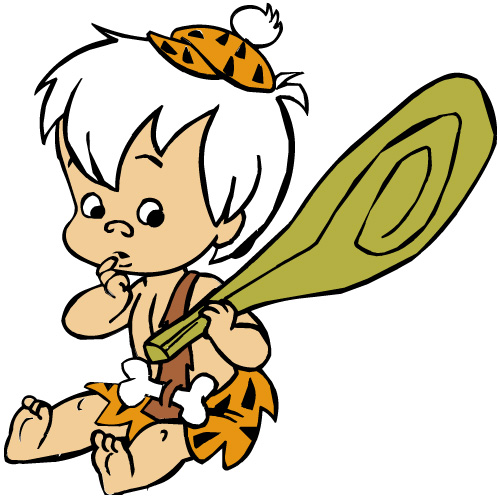
Bambam (a character from The Flintstones cartoon; onomatopoeic)

Caeulum (the Latin word for “sky, heavens”)

Che (nickname of revolutionary Ernesto Guevara; slang for “mate, buddy, pal”)

Dorian (used as a name by Oscar Wilde for The Portrait of Dorian Gray, from Greek)

Dre (nickname of radio personality André “Doctor Dré” Brown, short for his first name)

Jaylen (based on Jalen; basketballer Jalen Rose’s name is James + Leonard)

Jharral (based on Jharal; NRL player Jharal Yow Yeh’s name is the initials of the men in his family)

Kailo (from a Proto-Indian-European word meaning “whole, healthy”)

Keanu (seemingly created by the parents of actor Keanu Reeves)

Neo (main character from The Matrix movies, Latin for “new”)

Reiv (character from the Fire Emblem video games)

Rohan (a place name in Tolkien’s fantasy world)

Sonova (a combination of the Latin words for sound and new)

Stryder (Strider is the alias of Aragorn in Tolkien’s The Lord of the Rings)

Thorion (character from the comic book Thorion of the New Asgods)

Tynnan (a species in the Star Wars franchise)

Boys Names from the Top 100 of the 1900s

01 Sunday Apr 2012

Posted by A.O. in Name Themes and Lists

≈ 12 Comments

Tags

Appellation Mountain, celebrity baby names, classic names, ethnonyms, famous namesakes, fictional namesakes, French names, German names, germanic names, Latin names, locational names, name data, name history, name meaning, name popularity, name trends, nicknames, Norman-French names, Old English names, Old Norse names, popular culture, popular names, Roman names, royal names, Sabine names, saints names, surname names, tribal names

This follows on from Girls Names from the Top 100 of the 1900s. Once again, I’ve tried to get a balance between those names coming back into fashion, and those which haven’t charted for a while; once again, it is based on data from New South Wales. If you are attracted to names like these for boys, you should check out Abby’s two parter at Appellation Mountain – Fetching Names: The Nevilles, as many of her suggestions are very much in tune with this style.

Albert

This is derived from the Germanic name Adalbert, meaning “noble and bright”, which was common amongst German royalty. It was introduced to England by the Normans, where it readily overtook the Old English form, Æðelbeorht. A rare name by the 17th century, it came back in the 19th, as Prince Albert was the name of Queen Victoria’s dearly loved husband, born in Germany. Famous Australians with this name include Albert Matthews, the last Gallipoli veteran to die, in 1997, and popular long-time entertainer, Bert Newton. Albert is a classic name which has never been out of use; it was #12 in the 1900s, and didn’t leave the Top 100 until the 1950s. It’s remained relatively stable for several decades, and is currently in the low 300s. Albert is one of those names which sound slightly “grandpa” while remaining steadily in use. It’s a good reliable choice, and Alby, Bertie and Bert all make cute nicknames.

Aubrey

The Norman-French form of Germanic Alberich, meaning “elf power” or “elf ruler”, which replaced the Old English equivalent, Ælfrīc. The name was used for both sexes during the Middle Ages, especially amongst the aristocracy, but gradually fell out of use. It was revived in the 19th century, possibly influenced by the surname. There have been a few famous men in Australia named Aubrey, including motorcycle racer Aubrey Lawson, and Australian rules footballer, Aubrey Mackenzie. Aubrey was #59 in the 1900s, and left the Top 100 in the 1930s. It hasn’t charted since the 1950s. Aubrey may seem old-fashioned and effete to some people; others may think it sounds feminine, due to the popularity of similar-sounding girls’ name, Audrey. However, this unisex name is certainly in use as a boys’ name, and I have actually seen it on more boys than girls, with parents of girls often preferring specifically feminine spellings such as Aubree or Aubrie. I think it sounds handsome and dashing, and Jack Aubrey from Master and Commander (played by Russell Crowe in the film) even helps give it a nautical air. The usual nickname is Aub or Auby.

Claude

The French form of the Roman family name Claudius. The Claudii interpreted their name as from the Latin claudus, meaning “lame, crippled”, but according to legend, the first of their house was not Roman, but Sabine, and his family name was Clausus or Closus. When he joined the Romans, his name was Latinised. The Claudii were very proud of their Sabine heritage, very powerful, and had a reputation for arrogance and haughtiness. The name Claude became common in France during the Middle Ages due to the 7th century Saint Claude of Besancon, a monk to whom many miracles are ascribed. The name was brought to Britain by the aristocratic Hamilton family of Scotland in the specifically male form Claud; being Scottish they naturally had ties to France. Australian Claude Choules was the last surviving male World War I veteran in the world until his passing last year. Claude was #49 in the 1900s, left the Top 100 in the 1930s, and hasn’t charted since the 1970s. The name still packs a patrician punch, and namesakes such as painter Claude Monet and composer Claude Debussy make it seem quite artistic as well.

Frank

Used as a short form of Francis or Franklin, but is a name in its own right, referring to the Germanic tribe of the Franks. They conquered most of Gaul, which was later named France in their honour. A powerful tribe, they were the ultimate founders of what would later become the Holy Roman Empire, controlling much of Europe. The meaning of their name is disputed; it may mean “javelin” after their weapon of choice (although the weapon might have been named after them, not the other way around). Another theory is that it meant “bold, fierce”; the Romans sometimes addressed or referred to them as “the fierce people”. The English word frank, meaning “free, honest” is named after the Franks, and is not the source of the name. The most well-known Australian called Frank is probably charming comedian Frank Woodley. Frank’s a classic that has never been off the charts; #27 in the 1900s, it didn’t leave the Top 100 until the 1970s. It’s currently having a growth spurt in the low 400s. Brisk, sensible Frank is a worthy choice for someone wanting an old-style replacement for popular Jack. The usual pet form is Franky.

Harold

Derived from the Old English name Hereweald, meaning “army leader”; the Old Norse form Haraldr was also common amongst Scandinavian settlers in England. It was popular amongst the royal houses of Norway and Denmark, and the two kings of England named Harold were of mixed Scandinavian and Anglo-Saxon ancestry. It was Harold II who was defeated and killed at the Battle of Hastings, leading to the Norman Conquest. Not surprisingly, the name died out almost immediately, but was revived by the Victorians. The most famous Australian with this name is former Prime Minister Harold Holt, who disappeared in 1967 at the beach, and is presumed drowned, although many conspiracy theories have existed. Oddly enough, there is a swimming centre named after him. Harold was #13 in the 1900s, peaked in the 1910s, left the Top 100 in the 1940s, and remained in (rare) use until the early 2000s, with a dampener put on it by Mr Holt’s watery demise. Until recently, I would have said Harold made a great way to get the popular nickname Harry – unfortunately, Harry is rapidly falling. It’s got some challenges, but I do like this noble and besieged name.

Reginald

From the Germanic name Raginald, meaning something like “well-advised ruler”. The Normans brought it to Britain in the forms Reinald and Reinold; there were already Old English and Norse forms in use there. Reginald is the Latinised form of all these variants, and is another of those names from the Middle Ages which made a comeback in the Victorian era. There are many well known Australian Reginalds, including popular actor Reg Livermore, and Sir Reginald Ansett, the founder of Ansett Airlines. Reginald was #20 in the 1900s, and left the Top 100 in the 1960s. It hasn’t charted since the 1980s. Reginald may seem very fusty and pompous – then again, that’s exactly what people would have said about Archibald a few years ago, and now it’s quite fashionable as a way to the nickname Archie. I don’t really see what makes Reggie any different from Archie, Alfie or Freddie, which makes Reginald a genuine contender.

Rupert

A German form of Robert, this was introduced to Britain in the 17th century by Prince Rupert of the Rhine, a nephew of King Charles II of England. When still young, he was appointed commander of the Royalist cavalry during the English Civil War; after the Restoration he returned and became a senior naval commander. Prince Rupert was a man of fashion who also was one of the founders of the Royal Society and a patron of the arts – he made the name seem distinctly aristocratic, and perhaps slightly flamboyant. Famous Australians with the name include artist Rupert Bunny and media mogul Sir Rupert Murdoch. Rupert was #97 in the 1900s, and left the Top 100 the following decade; it left the rankings in the 1940s. Very recently, it has entered the charts again, and is currently climbing in the 400s. Rupert seems to be making a comeback – perhaps Rupert Grint from the Harry Potter movies has given it a more likeable, down-to-earth image. It’s certainly handsome, and Ru would make a cute nickname.

Stanley

An English surname meaning “stony meadow”; it comes from the place name Stoneley in Staffordshire. It has quite an aristocratic heritage, for the Stanleys were Earls and Barons, prominent in the Conservative Party, and at times, one of the richest landowning families in Britain. Members of the Stanley family have held high political office, including Prime Minister, been connected to royalty, and generally a force through the pages of British history. Sir Lyulph Stanley was part of this august clan; he was Governor of Victoria and held several other important posts in Australia. Great men called Stanley from our nation include tennis champion Stanley Doust, and legendary cartoonist Stanley Cross; the Stanley Award for cartoonists is named in his honour. A classic which has never left the charts, Stanley was #22 in the 1900s and left the Top 100 in the 1950s. It has remained stable since the 1960s. It’s an oldie but goodie, made to seem quite cool since Dido gave her son this name last year, named after the song Stan, by American rapper Eminen. It seems eminently usable, and sturdy nickname Stan is right on trend.

Vincent

This is from the Roman name Vincentius, derived from the Latin for “to conquer”. Its meaning made it popular amongst early Christians, who no doubt wished to indicate that they were ready to conquer sin, and there are several martyrs of the church with this name. A later saint with this name is the 16th century French priest famous for his works of charity, St Vincent de Paul. Vincent was used in Britain in the Middle Ages, but didn’t become common until the 19th century. Vince Jones is an Australian jazz artist, and Vince Melouney was one of the founding members of Billy Thorpe & The Aztecs, so it’s a very musical name. Handsome and romantic, Vincent is a classic which has never left the charts or been out of the Top 200. It was #47 in the 1900s, and left the Top 100 in the 1950s; the lowest it’s ever been is #179 in the 1970s. It’s usage has been erratic, but generally improving since then, and it’s currently in the mid 100s. Prince Vincent of Denmark, son of Princess Mary, may help it along further. Vin, Vince and Vinnie are all used as nicknames.

William

From the Germanic name Willahelm, meaning something like “willing helmet”, or “strong-minded protection”. William of Gellone was a cousin of Charlemagne, and an 8th century Norman count who defeated an army of Moors and forced them to retreat to Spain; his deeds are immortalised in the epic poem, Chanson de Guillaume (Song of William). In case this didn’t make him famous enough, he founded a monastery, gave it a piece of the True Cross, and became a monk, being declared a saint after his death. This made William a favourite name amongst the Normans, and when a Duke of Normandy called William invaded England in 1066 and was crowned king, it became the most commonly-used name in his kingdom. There have been four kings of England/Britain called William, and if Prince William attains the throne, he will be William V. Australia has had two Prime Ministers named William – Hughes and McMahon. Solid classic William has never left the Top 50; it was the #1 name of the 1900s and is #1 today. This never out fashion name is very versatile, because although William is so dignified, its nicknames Will, Bill and Billy are simple and unpretentious.

(The picture is of a prospector on the gold fields in 1904; image held by Museum Victoria).

Girls Names From the Top 100 of the 1900s

25 Sunday Mar 2012

Posted by A.O. in Name Themes and Lists

≈ 18 Comments

Tags

Anglo-Saxon names, Arabic names, classic names, famous namesakes, fictional namesakes, flower names, gemstone names, germanic names, Google, honouring, Italian names, K.M. Sheard, Latin names, locational names, mythological names, name data, name history, name meaning, name popularity, name trends, nature names, nicknames, Old English names, Old French names, Old Norse names, plant names, popular names, retro names, royal names, saints names, Shakespearean names, Victorian names

There have been many Googled requests for names from the 1900s, so this is my selection of ten girls names that were Top 100 in the 1900s which I think are usable today. I’ve tried to get a balance between names which are currently rising in popularity, and those which haven’t charted for many decades. All the data comes from New South Wales – the only state which has made public its data kept since Federation.

Amelia

A variant of Amalia, the Latinised form of Germanic Amala, a pet form of any name beginning with Amal-, and meaning “work”. This was one of the many names introduced to Britain by the Hanoverians; part of its easy acceptance was that it was considered a variant of the unrelated Emilia, and indeed Princess Amelia of Hanover was called Emily in everyday life. In the 1900s, Amelia was #95, and it had left the Top 100 by the following decade. It has been on the rankings almost continuously, dropping out in the 1940s and ’50s. Rejoining in the the 1960s, it grew steadily in popularity, until it was in the Top 100 by the 1990s. It’s currently stable at #10. Famous Australians named Amelia include Amelia Best, who was one of the first women elected to the Tasmanian House of Assembly, and opera singer Amelia Farrugia. Amelia was under-appreciated for many years, but is now extremely popular, with a host of nicknames such as Amy, Melia, Millie, Mia and Lia. Pretty and unpretentious, it has a ready-to-wear quality that makes it a handy choice.

Bessie

A short form of the name Elizabeth, in use since the 16th century. The name Bessie was #78 in the 1900s, and grew in popularity during the 1910s. It took a nosedive in the 1920s, left the Top 100, and hasn’t been in the rankings since the 1940s. Famous Australians named Bessie include portrait painter Bessie Davidson, who was celebrated in France in the pre-war era, and Bessie Guthrie, a designer of the 1920s who was an ardent feminist and early proponent of solar energy and ecological balance. She founded the Viking publishing house, and in later life was a crusader for the rights of abused children, before finally, in old age, being able to join a movement of feminist political protest she had waited all her life for. Bessie is such a sweet yet spunky name for a girl, and one I saw recently mentioned as having been given to a baby in 2011. I think it’s one which is ready to shed its “old lady” image and be used once more.

Edith

Based on the Old English name Eadgyð, meaning “rich war”, this was popular amongst Anglo-Saxon royalty; Saint Edith was the illegitimate daughter of King Edgar the Peaceful, and Edith of Wessex was the wife of King Edward the Confessor. Unlike many Anglo-Saxon names, it remained in use after the Norman Conquest, and didn’t fall out of favour until the 16th century. It was revived in the 19th century by the Victorians. The most famous Australian with this name was Edith Cowan, the social campaigner and first woman elected to parliament; she was part of the group which helped give women the vote in 1899 (her picture is now on the $50 note). The name Edith was #16 in the 1900s, and remained Top 100 until the 1940s, leaving the rankings in the 1970s. Very recently, it has had a revival, and is now increasing in popularity in the 500s. Strong, patriotic, and still aristocratic-sounding, it’s fast becoming a fashionable favourite. The short form Edie seems to be even more popular.

Ida

This name was introduced to England by the Normans; it may come from the Old Norse word for “work”, or be related to the Norse goddess of youth, Iðunn. Folklorist Jakob Grimm theorised that her name may come from idis, a divine female being in Germanic mythology, meaning “respected woman”. Ida died out in the Middle Ages, but was revived in the 19th century. This may have been partly inspired by Alfred, Lord Tennyson’s poem on female education, The Princess, where the heroine is named Ida. Gilbert and Sullivan parodied the poem in their operetta, Princess Ida. Tennyson probably took the name from Mount Ida; there is one in Crete and one near ancient Troy, and both were sacred to the Mother Goddess Rhea or Cybele. According to K.M. Sheard, the name is from the Greek for “woodland”. Ida was #42 in the 1900s and fell rapidly, leaving the Top 100 in the 1920s. It hasn’t been on the charts since the 1950s. Ida Standley was a pioneering schoolteacher in Central Australia. Ida is similar to popular names such as Ivy, Eva and Ava; it can also be used as a form of the Irish name Ita.

Leila

This variant of the Arabic name Layla was introduced to English-speakers by Lord Byron, who used it in his poems The Giaour and Don Juan. In Don Juan, Leila is a little Turkish girl rescued and adopted by the hero; in The Giaour, Leila is a member of a Turkish harem who falls in love with a non-Muslim, and is punished for adultery by being sent to a watery grave (vampires also get a mention). As such, it seems exotic, romantic, Gothic, and literary. Leila was barely Top 100 in the 1900s at #99, but has remained in continuous use, although very rare in the 1950s and ’60s. It’s never managed to join the Top 100 since, but has been climbing sharply since the 1990s, and is currently only just outside it in the very low 100s. Famous Leilas include Leila Hayes, who was in soap opera Sons and Daughters, and Leila Mackinnon, Channel 9 journalist. Leila fits perfectly with current related favourites Layla and Lila, and I wouldn’t be surprised if it was back in the Top 100 soon. Pronunciations vary, and as far as I’m aware, LAY-luh, LY-la and LEE-la are all considered correct.

Louisa

A Latinate feminine form of Louis, this was another name introduced to Britain in the 18th century by the Hanoverian royal family. The most famous woman named Louisa from Australian history is undoubtedly Louisa Lawson, the mother of national poet, Henry Lawson. A poet and publisher in her own right, Louisa was also a leading feminist who was called The Mother of Suffrage in New South Wales, and helped bring women in her state the vote. It is generally believed that she is the prototype for all the kind, capable, and hard-working country women who appear in Henry Lawson’s stories. Louisa manages to be a classic, remaining constantly on the charts, while being underused, for it has not been Top 100 since the 1900s, when it was #79. It’s currently around the #500 mark. You really can’t go wrong with Louisa – it’s never been in vogue, yet never been out of style either, so it doesn’t sound old-fashioned. It’s pretty and sensible, and honours one of Australia’s heroines. Nicknames can range from brisk Lou, to cutesy Lulu, and anything in between.

Maud

This is another form of Matilda. The Old Germanic Mahtild became Maheud in Old French, and Anglicised as Maud. Matilda was thus the Latin and written form of the name, while Maud was the way the name was said aloud. For example, Matilda of England, the first female ruler of the English kingdom (her reign was brief), was known as Maud in everyday life. Although the name may remind you of the word maudlin, that is actually from the name Madeline (its original pronunciation). Maud became rare at the end of the Middle Ages, but was another old name which Alfred, Lord Tennyson helped revive, due to his tragic and enigmatic love poem, Maud. Maud McCarthy was a nurse who served with distinction during the Boer War and World War I, receiving several medals. Maud was #94 in the 1900s, and slipped off the Top 100 the following decade. It hasn’t charted since the 1930s. It’s a genuine antique, and if you are determined on Maddie as a pet name, Maud would make a far more distinguished “proper name” than Madison.

Myrtle

Myrtles are graceful, fragrant flowering evergreen bushes, which in ancient times were sacred to Aphrodite or Venus, the goddess of love. Perhaps because of this, they are traditionally included in wedding bouquets; they are always used at weddings amongst the British royal family, a custom began by Queen Victoria. Myrtle has been used as a name since the 19th century, when other flower and plant names became the fashion. A famous person with this name is Myrtle White, who wrote books describing her life on a remote outback station. Myrtle was #47 in the 1900s, and had left the Top 100 by the 1930s. It hasn’t charted since the 1950s. I added Myrtle to the list, not only because we have myrtle species native to Australia, but because Baz Luhrman’s remake of The Great Gatsby will be released soon. There is a character named Myrtle in it, and this may give the name a new image than that of Moaning Myrtle from the Harry Potter books and films.

Pearl

Pearls are produced by molluscs such as oysters and mussels; they are essentially calcium carbonate or limestone in crystalline form. Ones occurring naturally in the wild are very rare, so that they are considered extremely valuable gemstones. Pearl became used as a name in the 19th century, when other gemstone names became fashionable. It probably also had religious connotations, because pearls are mentioned in the Bible, and Jesus compares the Kingdom of Heaven to “a pearl of great price”. Australia still has a significant pearling industry in Broome, Western Australia. A famous Australian with this name is Pearl Gibbs, an Aboriginal leader and activist who focused on women’s and children’s rights. Pearl was #87 in the 1900s, and left the Top 100 the following decade. It did not chart in the 1960s and ’70s, but staged a comeback in the 1980s, and has been climbing precipitously in recent years. It’s currently in the mid 200s, and this name from the sea still has plenty of lustre. It’s similar to the more popular Ruby, but seems more delicate and lady-like.

Sylvia

A variant of the Latin Silvia, meaning “of the woods”. The mother of the legendary Romulus and Remus was called Rhea Silvia (Rhea of the woods), because it was supposedly in the woods that she was seduced by the god Mars. Saint Silvia was the mother of Pope Gregory the Great, famous for her great piety; according to her portrait made during her lifetime, she was beautiful with large blue eyes. A common name in Italy, Silvia was introduced to England by Shakespeare, in his play The Two Gentlemen of Verona. Famous Australians with this name include Sylvia Harper, a tennis champion of the 1920s, and Sylvia Breamer, who was a Hollywood actress from the silent film era. Sylvia is a classic which has never left the charts. It was #58 in the 1900s, and didn’t leave the Top 100 until the 1950s. It hit its lowest point in the early 2000s, and is currently gently rising in the 500s. It’s lovely seeing this pretty name gaining in use; it almost seems like a nature name, because of its woodsy meaning and silvery bell-like sound.

(Photo used is of a bride in 1906; image is held by Culture Victoria)

Famous Name: Australia

26 Thursday Jan 2012

Posted by A.O. in Famous Names

≈ 17 Comments

Tags

english names, holiday names, Latin names, locational names, name history, name meaning, rare names, unisex names

FAMOUS PLACE
Today is Australia Day, which commemorates the landing of the First Fleet in Sydney Cove on January 26 1788. The date was first celebrated by emancipated convicts and their families, who had grown to love their new land, and identified themselves as Australian rather than British. It was the popular Governor Lachlan Macquarie who first declared it an official holiday in New South Wales.

When you think about it, it’s a funny date to choose for our national public holiday, because the landing of the First Fleet wasn’t the foundation of Australia, or even the foundation of Sydney or New South Wales (which took place on February 7 1788). It would be more logical to celebrate Federation Day, the day in 1901 when all the colonies were united, and we were given the right to self-govern – our Independence Day, in fact.

Unfortunately, the worthy bureaucrats who helped forge us into one nation chose the most bureaucratically sensible day to begin our independence – January 1. Apparently they never thought we might have something else to celebrate on that date: a little thing called New Year’s Day.

Despite other days being suggested, in the end we stuck with January 26, and by 1935, it had been called Australia Day. It wasn’t until 1994 that it was accepted by all state and been made a national public holiday.

It’s the biggest celebration in Australia, but is also a controversial one, as it is a celebration of European arrival in Australia – a narrative which ignores our Indigenous history and culture. Let’s hope we can find a way to make Australia Day a holiday to bring us all together and include all Australians.

NAME INFORMATION
Even before anyone knew Australia existed, there was Terra Australis Incognita (Latin for “unknown southern land”). The ancients hypothesised that there must be a land mass in the south to balance all the land in the north.

This idea persisted into the Renaissance, and it began showing up on maps as Terra Australis or Australia, even though it was fictitious. Travellers’ tales of actually reaching this land, or at least seeing it in the distance or hearing about it down the pub, resulted in the British government ordering Captain James Cook to investigate.

It was discovered that this mammoth land-mass, envisaged as stretching from South America and including Antarctica, just didn’t exist. There were lots of small countries and islands, and there was Australia, which is biggish, but by no means a great super-continent covering most of the southern hemisphere. Being the biggest thing they managed to find, it was decided the place we live now must be Terra Australis, or at least be given the name of that legendary land.

It was explorer Matthew Flinders who pushed for the name Australia as early as 1804, and in his charts, notes that the sound of Australia “is more agreeable to the ear”. The term gradually caught on, and once again the enlightened Lachlan Macquarie stepped in, and recommended that the name be formally adopted, which the British Admiralty agreed to in 1824. (You can see why the name Lachlan has prospered).

Australia has been occasionally used as a personal name since the 19th century, and has been nearly always given to girls – as a middle name it is more gender-flexible. It is very rarely given to babies today, even in the middle.

In Australia the name would have been bestowed for patriotic reasons, while in other nations it is not possible to be certain that the name had anything to do with the country at all. In Latin America, for example, the name could have been given simply from the Spanish or Portuguese for “southern”, while in the US it could have at least sometimes been from the Latin for “south”.

Australia is probably the most patriotic name you could choose, and it certainly makes a statement. It’s a part of history – not just our history, but world history and ancient history. It was chosen by Lachlan Macquarie and judged aurally pleasing by Matthew Flinders. It has classical etymology, and it’s a name for a nation that rose out of legend.

← Older posts
Newer posts →

Enter your email address to follow this blog

Categories

Archives

Recent Comments

A.O.'s avatarwaltzingmorethanmati… on Zarah Zaynab and Wolfgang…
Madelyn's avatarMadelyn on Zarah Zaynab and Wolfgang…
JD's avatardrperegrine on Can Phoebe Complete This …
A.O.'s avatarwaltzingmorethanmati… on Rua and Rhoa
redrover23's avatarredrover23 on Rua and Rhoa

Blogroll

  • Appellation Mountain
  • Baby Name Pondering
  • Babynamelover's Blog
  • British Baby Names
  • Clare's Name News
  • For Real Baby Names
  • Geek Baby Names
  • Name Candy
  • Nameberry
  • Nancy's Baby Names
  • Ren's Baby Name Blog
  • Sancta Nomina
  • Swistle: Baby Names
  • The Art of Naming
  • The Baby Name Wizard
  • The Beauty of Names
  • Tulip By Any Name

RSS Feed

  • RSS - Posts

RSS Posts

  • Celebrity Baby News: Melanie Vallejo and Matt Kingston
  • Names from the TV Show “Cleverman”
  • Can Phoebe Complete This Sibset?
  • Zarah Zaynab and Wolfgang Winter
  • Baby, How Did You Get That Name?
  • Celebrity Baby News: Media Babies
  • Celebrity Baby News: Adelaide Crows Babies
  • Celebrity Baby News: Chris and Rebecca Judd
  • Names at Work: Name News From the World of Business and Employment
  • Celebrity Baby News: Sporting Round Up

Currently Popular

  • Celebrity Baby News: Alisa Camplin and Oliver Warner
  • Rare Boys Names From the 1950s
  • Sad Celebrity Baby News (contents may cause distress)
  • The Top 100 Names of the 1930s in New South Wales
  • The Top 100 Names of the 1940s in New South Wales

Tags

celebrity baby names celebrity sibsets english names famous namesakes fictional namesakes honouring locational names middle names name combinations name history name meaning name popularity name trends nicknames popular names saints names sibsets surname names twin sets unisex names

Create a free website or blog at WordPress.com.

Privacy & Cookies: This site uses cookies. By continuing to use this website, you agree to their use.
To find out more, including how to control cookies, see here: Cookie Policy
  • Subscribe Subscribed
    • Waltzing More Than Matilda
    • Join 517 other subscribers
    • Already have a WordPress.com account? Log in now.
    • Waltzing More Than Matilda
    • Subscribe Subscribed
    • Sign up
    • Log in
    • Report this content
    • View site in Reader
    • Manage subscriptions
    • Collapse this bar
 

Loading Comments...