• About
  • Best Baby Names
  • Celebrity Baby Names
  • Celebrity Baby Names – Current
  • Celebrity Baby Names – Past
  • Featured Boys Names
  • Featured Girls Names
  • Featured Unisex Names
  • Links to Name Data
  • Waltzing on the Web

Waltzing More Than Matilda

~ Names with an Australian Bias of Democratic Temper

Waltzing More Than Matilda

Tag Archives: surname names

Curl Up With a Good Book in the Nook of Names

11 Sunday Mar 2012

Posted by A.O. in Blog Reviews

≈ 6 Comments

Tags

Amazon, book reviews, choosing names, eymology, KM Sheard, Llewellyn's Complete Book of Names, locational names, mythological names, name advice, name books, name history, name meaning, nature names, Nook of Names, Pagan names, popular names, surname names

Most of us started our name blogs as a way to store and share our information, or as an extension of our online activities in forums, or even on a whim. Kay started her blog, Nook of Names, to promote the book she was preparing for publication: Llewellyn’s Complete Book of Names: For Pagans, Witches, Wiccans, Druids, Heathens, Mages, Shamans & Independent Thinkers of All Sorts Who Are Curious About Names from Every Place and Every Time.

That’s an impressive title, which embraces a wide spectrum of people who will want to read this book. If you are not a Pagan, Druid or Shaman, I hope at least you fit under the heading of being an Independent Thinker Who is Curious About Names. Slavish Non-Thinkers Who are Incurious About Names should leave now …. and in fact, how ever did you get here in the first place?

Because Kay has both a book and a blog, I am going to attempt to review both of them simultaneously. It sounds an insane plan, but in my defence I did try to do them separately. In the blog review, I kept needing to refer to the book, and in the book review, I needed to keep referring to the blog – the two are so intertwined that I felt compelled to combine them.

Kay started blogging on Midsummer Eve last year; although she says it is her first attempt, it is a beautiful and professional-level name blog. The Misty theme is a perfect match, the colours are soft and natural, and the background design from the book’s cover suitably mysterious. I must pay tribute to the illustrations for the blog; they are sumptuous and lovingly chosen works of art.

Nook of Names was set up to whet our appetites for The Complete Book of Names, with great success. The first post introduced The Complete Book of Names, the second explained why it wasn’t just for Pagans, and then began the process of providing some sneak peeks into the book’s contents based on names of people who connected to her on Facebook. For example, the entry on Estelle, also covers Stella and Esther, and hints that looking up the entries for Ishtar, Hester, Easter and Vanessa will prove rewarding.

Kay addresses the fact that a Complete Book of Names cannot ever literally contain every single name ever given on earth, and Nook of Names is thus her way of covering many names that couldn’t be included in the book. As a result, the blog has a huge number of names, and they are all indexed, from Abel to Zygus.

Llewellyn’s Complete Book of Names was published at the start of this year, and is available at Amazon and Amazon UK, as well as other good bookstores. UK-based readers can buy a signed copy of the book directly from Kay through Paypal. Australians can buy it from Angus and Robertson, which is rather pricey; if you don’t mind a longer waiting period, The Book Depository has free postage.

I have had my copy since the end of January, and for over a month it has been my constant bedtime companion. It’s a hefty tome – nearly 800 pages, and weighing almost 2 kg. It contains thousands of names, and a wealth of information for each one.

Massive reference books often come in small print, presumably in the belief you will only be looking something up for a few minutes, but Llewellyn have been very generous, and The Complete Book of Names is easy and pleasurable to read. The print is large and black on very white paper, and although there are many codes used to save repeating the same phrases, they are so commonsense that you can probably figure most of them out without consulting the key every time.

(I must confess to not actually using this key, as it is easy enough to decipher that ESW means English-speaking world, and Hist means historical – although having a quick glance at it now, I see it might be possible to confuse yourself, with Lat meaning Latvian and not Latin).

Each entry contains much more information than the usual “name book”, providing not just origin and meaning, but a mini-history of the name, with links to related names which may provide further elucidation. You may wonder what makes the book particularly Pagan; although there are plenty of “ordinary” names, like Henry and Katherine, and “modern” names like Sienna and Chase, the CBM includes many names from world mythologies, and also more nature names than are usual in a name book.

Pagans of all sorts are united by their love and respect for Nature, and so it is not surprising to see unusual name suggestions from the natural world, such as Paprika, Chaffinch, and Hypericon. Names of plants and gemstones often have magical associations, and it is fascinating to read that Parsley was dedicated to Persephone and used in funeral rites, or that Bears were sacred to Artemis, so that young initiates to her cult were called little she-bears. This gives a much deeper understanding of the “meanings” of such natural names.

Kay’s qualifications for writing the book are impressive. According to the back of the book, she is a scholar of history, Assyriology, Latin and Greek; a graduate of the University of Cambridge; and knows a number of modern and ancient languages. She also belongs to the Order of Bards, Ovates and Druids, and is a member of the British Pagan Federation. In other words, she is a pagan name expert.

Kay has her own theories on names, and that’s one of the things I most appreciated about her book. There’s nothing more annoying than looking up a name and being given the unhelpful entry: “meaning unknown”. I always feel like saying, “Surely you must have some idea?” Kay does have some idea, often several of them, and she’s happy to share her thoughts as to the most likely derivation of an obscure name. When the meaning is lost beyond all finding, she can still help explain its cultural context, and thus what it “means” on another level.

Despite her interest in languages and etymology, this is not just a “name dictionary” which gives a definition of a name. Although it is certainly a valuable reference work, it is intended to be used in choosing real life names, whether that be a name for yourself, a pen name, a name for a baby, names for literary characters, or even a name for a pet.

Although I’m sure most readers will be eager to dive right in to look up their favourite names, or skim through it for more name ideas, it’s worthwhile to read the excellent introduction. It contains a history of naming in the western world which I think everyone who is interested in names should read, and also has thoughtful advice on choosing a baby name. Even this has a certain Pagan flavour – most name books don’t suggest that you might like to consult an astrologer, or seek guidance from your tarot cards or rune stones!

And yet most of it is sensible advice that anyone would benefit from. Although Kay feels that Pagans are more likely to think deeply about their name choices, I’m sure most people do choose baby names with care, and certainly all of us should think deeply about it, and follow our intuition, even if we don’t necessarily use rune stones to do so. One of Kay’s principles of naming is that we don’t so much select a name for someone as undertake a journey to discover it, which I think is a wonderful way to see it, and also puts you in the right frame of mind and heart to find the perfect name.

This is a book that anyone who cares about names will want to own, and consult again and again. It’s filled not only with fascinating information on each name, but contains a multitude of creative naming ideas, including lists of names grouped together by meaning or theme. It may be written from a Pagan perspective, and no doubt fellow-Pagans will find it suits their needs better than any other name book, but it is a book for almost everyone. In short, I don’t know how any name aficionado or name blogger can live without this book.

Now with the book out, and hopefully walking off the shelves, does this mean that Nook of Names has served its purpose and will be laid to rest? There are no signs of it, because there are so many names out there in the world still waiting for Kay to document them. Besides, I bet she’s already working on a revised edition of The Complete Book of Names!

There’s a lot to discover at the Nook of Names. There are essays on onomastics, such as one on Surnames as First Names, which has generated alphabetical lists of English surnames which could make unusual and interesting personal names. There’s Pagan Name of the Month; these always show the pagan roots or pagan connotations of commonly used names such as Aidan or Ruby, making them pagan-friendly populars. Pick of the Week looks at a less usual name; it’s impossible to pick a favourite, but the one on Coventry stuck in my mind.

A series inspired by the runes gives interesting lists of names, there’s names from the world of fiction, including a two-parter on characters in Dickens (lots of cat names!), and inspiration from travel, such as this essay on the sacred landscape of Somerset. British name bloggers, perhaps because they are surrounded by such richness of history, seem remarkably skilled at finding name inspiration wherever they go.

There’s plenty of Paganesque entries, such as ones of names from Nature, names for Pagan festivals such as Imbolc, and names from the history of the Salem witch trials. Kay seems to enjoy starting a new Category as much as I do; however, like me, she sometimes bites off more than she can chew, and Witch of the Week still seems to be a work in progress. It’s an excellent start though, and the entry on Ceridwen was especially lovely, bringing in plenty of first-hand information from Wales, where Kay lives.

Many of these posts are a chance for her to expand on the entries in Complete Book of Names, so if you are a fan of the book, then Nook of Names is essential reading. On the other hand, if you can’t get enough of the blog, then you need to get yourself a copy of Complete Book of Names at once. Then curl up in a cosy nook, and lose yourself in Kay’s magical world of names.

Q & A WITH KAY

Name: Kay Michelle Sheard

Have you ever wished for a different name?: Frequently! I’ve come to like Kay more, as it has a lot of meaning when you start to dig. But I don’t like Michelle. There’s nothing wrong with it, but it’s never felt “me”.

When did your interest in names begin?: Like a lot of name buffs, I used to collect names as a child – not just first names, but surnames and place-names too. The whole concept of naming and how names began and evolved really fascinated me. It all goes hand in hand with my interest in etymology and social anthropology in general.

How did you first decide to write a book on names?: Writing a book about names was always at the back of my mind, but its birth was sparked by two things in August 2009. I was lamenting the lack of a really comprehensive book of names for Pagans/alternative-minded folk. Meanwhile, one of those Facebook apps offered to tell me what my name meant. I knew already, but did it for fun, and it came out with something so outrageously wrong that that was that!

How long did the book take?: The whole process has eaten up the best part of two years.

How did you find a publisher?: Finding a publisher was very straightforward. I approached Llewellyn in October 2009 with the idea, and was offered a contract in December.

Hardest thing about writing a book: Keeping a balance between work and everyday life. There were times when I ended up having to work on it virtually round the clock, and on more than one occasion I ended up working through the night, snatching an hour or two’s sleep when sheer exhaustion took over.

Your favourite blog entry at Nook of Names: Incan Inspiration – it was great fun to research and write. Plus, my sister-in-law had just got back from a trip to Peru and very kindly let me use some of her amazing photos of llamas.

Your pet naming peeve: Top of mine has to be the school of thought that tries to frighten people into choosing “safe names” with prophecies of doom and disaster, or howls of derision over the choice of something more unusual. The former, I feel, perpetuates the tendency to put the blame on victims for things like bullying, rather than on the perpetrators. And the latter demonstrates ignorance.

Your favourite names: My favourite names are those of Greek and Latin origin, especially those from Greek and Roman mythology. A close second are Welsh names, and names from Welsh mythology, born out of my Welsh heritage and love of all things Celtic.

Your least favourite names: Michelle – for reasons already stated (poor Michelle!). Other than that, I can’t say there’s anything I really despise, except, perhaps those that make a really strong statement about the parents’ world-view, like Neo-Nazis calling their son Adolf Hitler, and truly outrageous stuff like Talula Does The Hula From Hawaii.

Names you love, but can’t use for some reason: Ptolemy. Its meaning – “war” – I can’t embrace, no matter how much I try to persuade myself that the word has a broader meaning than just physical fighting, and that Ptolemy as a name has accrued many positive associations.

Your child’s name: I deliberately keep Small Child’s name private, as it belongs to her, not me. But I will reveal what she would have been called had she been a boy: Octavian Theodore Rhufon.

Did you and your husband/partner have any issues agreeing on names?: Not a great deal; we share similar tastes and attitudes. We came to an agreement that if Small Child was a girl, he’d get to choose her first name, and if it was a boy, I would. I was happy with that, as we both approved each other’s choices, and I got to choose all middle names regardless.

Names you are considering for future children: We probably won’t have any more, but if we did, there really are too many for me to say. However, I think it would be a safe bet to assume that his or her first name would probably be Greek or Latin, and they’d have at least one Welsh name too.

The one piece of advice you would give to someone choosing a name for their baby: Listen to your intuition – your heart – and don’t pay too much attention to what others say, be it family (other than your partner, of course), friends, books, articles or online forums. I can’t help feeling there is something in the notion that there’s a name that’s exactly right for each of us – unfortunately, not all of us get that name because our parents bowed to those external pressures, and that’s a shame.

Boys Names of Australian Aboriginal Origin

26 Sunday Feb 2012

Posted by A.O. in Name Themes and Lists

≈ 18 Comments

Tags

Australian Aboriginal names, Buddhist names, famous namesakes, fictional namesakes, Indian names, Indonesian names, Japanese names, Korean names, locational names, Maori names, name history, name meanings, Native American names, New Zealand names, nicknames, Quechuan names, Samoan names, scandinavian names, scientific names, seasonal names, Slavic names, South American names, Spanish names, surname names, unisex names

This follows on from last week’s list, Girls Names of Aboriginal Origin. It was more challenging to find boys’ names, because many, if not most, Aboriginal words end in a vowel, and easily conform to we think of a “feminine sounding” name. They are similar to names in Hebrew, Arabic, and in the Indian languages in that regard, and even now you will find people who insist that Ezra must be a female name, because it ends in -a.

These are not traditional or tribal Aboriginal names for men, but rather words from Aboriginal languages that I thought could be used as names by people from any culture. Some of them coincide with words or names from other languages, as I thought people may be interested to know that a word from their own heritage has a distinct Australian meaning as well.

Dural

Dural is a pleasant semi-rural suburb of Sydney, and its meaning has been in some dispute. It is said that dural was a word from the Dharug language, meaning “gully, valley”, and this information came from a traditional owner of the land in the 19th century. It was also said to mean “burning logs”, from the word dooral dooral, but this belief only dates from the 1940s, and is taken from the Wiradjuri language. As the Wiradjuri people are from central New South Wales, the local meaning is claimed to be the correct one. Translations of this name as “hollow tree” or “burned out tree” in baby name books can be safely discarded as invention. I think Dural seems very usable as a personal name, and I considered it for Sydney Suburbs That Could Be Used as Boy’s Names. It sounds like familiar names such as Darrell, and sturdily similar to the word endure.

Jarli

This word means “barn owl” in the Jiwarli language of northern Western Australia. As in many other societies, several Australian Aboriginal cultures saw owls as symbols of wisdom, mystery, secrets and sacred knowledge; messengers from one world to another, and companions of the medicine men. The owl features in several myths and legends, and is sometimes depicted in Aboriginal art. This name seems familiar to us, because Jarli is also a Scandinavian boy’s name based on the word for “earl”, and I have seen one or two boys with this name. I like the sound and the meaning of this name, and it is similar to another Jiwarli word: jali, meaning “friend”.

Kaiya

This word from a Queensland language refers to a spear with two barbs, and is pronounced KY-uh. It has been used in the Latin name for a species of caddisfly – Chimarra kaiya – who is so called because of its distinctive barb-like projections. In the Kaurna language of South Australia, the similar sounding kaya means “spear”, although in Nyungar it means “hello; yes”. This is always listed as a girl’s name in baby name books, but the name Kai makes this name look masculine to me. I don’t see how the sound of it is any more “girly” than, say, Hezekiah. The meaning does not seem feminine either. I would say it is a unisex name, and suitable for a boy.

Kuparr

This means “red earth, burnt earth” in the Ngiyampaa language of New South Wales. It refers to the ochre used for making body paint for the Coroborees; the sacred ceremonies of Indigenous Australians involving ritual, dance and music. Red ochre is also used in other Aboriginal forms. Kuparr was the basis for the name of the mining town Cobar, and because copper was mined there, it has also been suggested that it may have been the local way of translating the word copper. Most likely the similarity between the words is a coincidence though. The attraction of this name is that it sounds a bit like Cooper. If you like the sound of Cooper but think it seems a bit boring or surnamey, Kuparr might be for you.

Miro

Miro (MEE-roh) is a Nyungar word for a type of spear thrower which propels the aim of the gidgee; a fearsome qaurtz-tipped spear about 8 feet long. Miro exists as a name or word in several other languages. It’s a Slavic name which is short for Miroslav, meaning “glorious peace”. In Japanese, it’s short for Miroku, a Japanese form of Maitreya, the fifth (future) incarnation of the Buddha. In New Zealand, it’s the name for a species of conifer tree. In Korea, it means “maze”. It’s also the surname of Spanish artist, Joan Miró i Ferrà (Joan was a man) – his surname was short for Ramiro, the Spanish form of a Germanic name meaning “famous counsel”. It’s very multicultural, and none of the meanings that I’ve seen are negative. I think it’s attractive. We had a baby boy in a recent birth announcement named Finn Joseph Miro, so it’s considered usable in Australia.

Monti

This is one of the Aboriginal names for the Black-necked Stork, which is found across the tropical north of Australia, and is the only stork species native to Australia. I have not been able to track down which language it is from, except that it’s not from the Northern Territory, where this bird is called a jabiru. It’s therefore either from Queensland or northern New South Wales, as the only other places where this bird exists. It’s listed as one of the Indigenous names by museums, so I feel fairly confident it’s authentic. The stork is mentioned in several Aboriginal legends, one of them an extremely touching love story. The attraction of this name is that it sounds exactly like the fashionable name Monty, but has its own significance.

Tarka

This means “eggshell” in the Kaurna language of South Australia. I thought of it because I have seen the name Tarka used in the birth announcements from the London Telegraph. It has a number of meanings in other contexts. There is a well-loved English children’s book called Tarka the Otter, so famous that it has given its name to a railway line and a bike path in the West Country. It was made into a film in the 1970s. In the book, Tarka’s name was meant to suggest the barking sound that an otter makes. In India, tarka is a word for seasoning added to a meal, and in Quechuan, a tarka is a type of flute played by the Indigenous people of the Andes. Tarka Cordell was a British musician who died in tragic circumstances a few years ago; I’m not sure where his name was taken from, or whether he is the inspiration for British children having Tarka as one of their names. This is the second name with the meaning of “eggshells” I have suggested; the other was Keid. Because eggshells appear so fragile, and yet are surprisingly strong under compression, I find this meaning very evocative.

Tau

Means “evening, dusk, twilight” in the Kaurna language of South Australia, and is said to rhyme with the word cow. In Maori, it can mean a number of different things, including “sweetheart”, “song, chant”, “string”, or “ridge”. In one of the Indigenous languages of Indonesia, it means “man”. In Samoan, it can mean “anchor” or “war”. It’s known to many people in the context of the Tau Cross, a symbol of life which was used by the Egyptians, and became important in a number of different religions and spiritual paths, including Christianity. I have met men named Tau, but I’m not sure which meaning was associated with their names. I think Tau fits in very well with other popular names for boys, such as Ty, Tai and Taj, and would be readily accepted.

Warragul

Warragul, pronounced WOHR-uh-guhl, is a town in the West Gippsland region of rural Victoria, the birthplace of legendary Aboriginal boxer Lionel Rose. Its name is said to come from a local word, warrigal, meaning either “wild” or “wild dog”, referring to the dingo. The dingo is Australia’s largest predator on land, and its ancestor is thought to have been introduced to Australia by seafarers from south east Asia thousands of years ago, when dogs were less domesticated and more closely related to wolves. Dingoes play a major role in Aboriginal myths and legends; in stories they are often guardians of humans who can warn them of the supernatural or evil spirits. There are also myths of dingo-people shapeshifters, or “were-dingoes”, and often the dingo in legends is a rebel or trickster figure. In everyday life, dingoes were tamed and kept in Aboriginal camps as guard dogs. They were treated with great affection, given names, slept with their human companions, and were even breastfed. At least sometimes they were buried alongside humans. I saw someone in a parenting forum say they had already used Warragul as a baby name.

Warrin

Warrin meant “winter, cold and frosty season” in one the language spoken around the Sydney region when Europeans first arrived. However, there are a number of similar words used throughout Indigenous languages. Warran or Warrung was the original name for the place we call Sydney Cove, and by extension, Sydney itself; it is said to mean “the other side [of the harbour]”. In the Brisbane area, Warun was a place name in the suburb now called Redcliffe; it may have meant “neck”. There are historical records of a man from south-west Queensland named Warun, so it was used as a personal name. In the Melbourne area, warun meant “eel” in the local language, a fish prized as a valuable food source; there is a suburb of Geelong named Warun Ponds. I have also seen the word warun translated to mean “diving ducks” in the Northern Territory. Baby name books translate Warun as meaning “sky”, but I don’t know which language they are deriving it from. From this I deduce that the English name Warren is the most “indigenous sounding” of our names, and perhaps it deserves a closer look.

(The photo is of young actor Brandon Walters, who starred in Baz Luhrman’s film, Australia).

Saturday Celebrity Sibset: A Taste of Scotland – Leigh McClusky and Simon Haigh

18 Saturday Feb 2012

Posted by A.O. in Sibsets in the News

≈ Comments Off on Saturday Celebrity Sibset: A Taste of Scotland – Leigh McClusky and Simon Haigh

Tags

celebrity sibsets, famous namesakes, fictional namesakes, food names, nature names, plant names, Scottish names, surname names, twin sets, unisex names

Last year we featured celebrity mum, Rosanna Mangiarelli, who took maternity leave from Channel 7’s current affairs show, Today Tonight, after the birth of her second daughter, Olivia.

The Today Tonight presenter that Rosanna took over from was Leigh McClusky, who was the show’s anchor from 1995 to 2007. She left when she became pregnant with twins, and later founded her own media and public relations firm in Adelaide. Leigh is currently the host of SA Life, a lifestyle show promoting South Australia. On her team of presenters is Michael Keelan, Grant Cameron, Briony Hume, Rosa Matto, and Pete Michell.

In 2000, Leigh married Simon Haigh, owner of Haigh’s Chocolates. This family-owned boutique chocolate business was started by Simon’s great-great grandfather, Alfred Ernest Haigh in 1915, and continued on by his son Claude. He left the business to John, Simon’s father, who trained in Switzerland, and now Simon and his brother Alister run the business together.

The family motto? “If you’re born a Haigh, you eat dark chocolate,” says Simon.

I’m so glad I am not writing this story at the age of six, for I would have cried with jealousy at children who had a dad with his own chocolate factory, and where you inherit a family tradition of eating dark chocolate.

Now grown-up, and unable even to finish my Valentine chocolates without generous assistance, I feel I can press on without too many tears.

The Haighs chocolate-inheriting children are:

Murdoch (born 2002)

Sigourney (born 2006)

Jock and Tansy (born December 2007, and 18 months younger than Sigourney)

The twins were born with the help of IVF, and according to Leigh, made their different personalities apparent even as new babies – Jock serious, Tansy laid-back.

There’s a Scottish theme going with the boy’s names, suitable for sons of someone named McClusky. Interestingly for the son of a journalist, Murdoch also has the name of a famous family of media magnates; most of us will have heard of Keith Rupert Murdoch, so often in the news recently because of his newspaper, The Sun. Leigh never seems to have worked for the Murdochs, so it may just be a coincidence. Jock seems to have been given the Scottish version of the popular boy’s name Jack.

Sigourney reminds us of American actress Sigourney Weaver. Ms Weaver’s real name was Susan, and she chose Sigourney as a stage name from an off-page character barely mentioned in F.Scott Fitzgerald’s The Great Gatsby, Mrs Sigourney Howard, who is the aunt of the sporting Jordan Baker. It’s a surname occasionally used as a first name, often for males. Because of the actress and the classic novel, it seems very American, although Sigourney Weaver is of Scottish heritage too.

Tansy is the name of a bitter and toxic herb, considered useful in cooking, gardening and medicine for thousands of years. It has cheery yellow flowers, and is a good companion plant as it keeps away insects. A tansy is also a type of sweet omelette pudding, flavoured with the herb; British comedian Sue Perkins got slightly poisoned eating one on the entertaining Supersizers Go … series. The plant grows abundantly wild in Scotland.

(Both photos from the Herald Sun archives).

Waltzing with … Skyler

29 Sunday Jan 2012

Posted by A.O. in Waltzing with ...

≈ 5 Comments

Tags

American names, celebrity baby names, Dutch names, famous namesakes, fictional namesakes, name combinations, name history, name meaning, name popularity, name trends, nicknames, sibsets, surname names, UK name popularity, unisex names, US name popularity, US name trends

4c86fe452cad39ae2f1075e407eda5e1

This post was first published on January 29 2012, and heavily revised on February 10 2016.

Tomorrow school goes back in three different states and territories (Queensland has already been back a week), which means that the summer holidays are drawing to a close. I chose this name as suitable for the start of term, thanks to its educational meaning.

Name Information
Skyler is a variant of Schuyler; a Dutch surname of German origin meaning “scholar”, said SKIE-luh. This name was brought to what is now the United States by Dutch colonists, who settled in the east during the 17th century.

The Schuylers were a prominent New York family. Pieter Schuyler was the first mayor of Albany in New York, and a commander of the British forces at the Battle of La Prairie, near Montreal. His descendants were numerous and distinguished, including his grand-nephew Philip Schuyler, who was a general in the American Revolution and Senator for the state of New York. It is said that the first use of the names Schuyler and Skyler was in honour of this family.

Schuyler has only appeared on the US Top 1000 a smattering of times. It shows up first at the beginning of the twentieth century, and then again between the mid 1980s and mid 1990s, only charting as a male name, and never getting higher than the bottom of the Top 1000. Currently Schuyler is almost equally given to both sexes in the US – 17 girls and 15 boys last year.

Famous people with the name include Schuyler Colefax, the 17th US Vice-President, who was a distant cousin of Philip Schuyler, and Schuyler Wheeler, inventor of the electric fan. Schuyler has been chosen as a baby name by actors Michael J. Fox and Sissy Spacek – both times for daughters. The name is barely used outside the United States, and pronunciation would be a puzzle to most.

During the 1940s and 1950s there was a popular American radio and television series called Sky King, about an Arizona rancher and pilot called Schuyler “Sky” King. During the 1950s, the spelling variant Skyler begins showing up in the data. It’s tempting to imagine that people tuned into the show, and began spelling the name as it sounded, or in such a way as to make the nickname Sky more obvious.

Skyler joined the US Top 1000 in 1981 for boys, and for girls in 1990 – it began showing up in data as a girls name in the late 1970s, so it had a brisk rise as a girls name. Skyler peaked for boys in 1996 at #217, and is currently #351. For girls, it peaked in 2000 at #250, and is currently #302.

Famous Skylers include Skyler Green, a footballer who played for the Dallas Cowboys in the NFL, and actress Skyler Samuels, who played Gigi on Wizards of Waverley Place. A fictional Skyler is Skyler White from the TV series Breaking Bad, played by Anna Gunn. Fashion stylist Rachel Zoe has a son named Skyler.

In the UK, Skyler has charted for boys and girls since the late 1990s. Currently it is #406 for girls, while in 2014, there were 13 boys named Skyler. It is rising rapidly for both sexes.

Rising alongside Skyler is the variant Skylar. While it has never been higher for boys in the US than the 300s, and is currently #635, it is Top 100 for girls, being #48 and rising. A famous namesake is American singer and songwriter Skylar Grey, born Holly Hafermann – her stage name a reference to mysterious “grey skies”.

In the UK, Skylar is #212 for girls and rising steeply. It is occasionally used for boys, and in 2014 there were 5 baby boys named Skylar.

There are also spelling variants of Skyler/Skylar which are specifically feminine. Skyla is #531 in the US, #156 and rising in the UK, and in 2012 made the Top 100 in New Zealand. It is much more popular than Skylah, but that is rising rapidly as well.

Skyla and Skylah are much more common in Australia than any other spellings of Skyler, and the numbers in the UK and New Zealand suggest that this spelling makes the most sense for someone with a British/Commonwealth accent. I estimate that if Skyla and Skylah were added together, the name would be in the Australian Top 100 by now, or very close to it, while other spelling variants are extremely rare for either sex.

You can see that if all the different spellings of Skyler were added up, it would be an extremely common name in the English speaking world. So Skyla or Skylah may not be an original choice for girl, but a boy named Skyler would stand out in Australia. Some of the other spelling variants would be worth considering, although I think Schuyler will cause more problems than it is worth.

By now this name has become almost completely divorced from its true meaning, and we now connect it with such things as clear or cloudy skies, free-wheeling flight, and the wild blue yonder. The obvious nicknames are Sky and Skye, and it fits in with names like Shyla, Myla, Kayla, Kai, and Tyler. Its sound is at least part of the reason for its success.

POLL RESULTS
As a girl’s name Skyler received an approval rating of 52%. 38% of people thought it seemed okay, although only 5% of people actually loved it.

Skyler had a lower approval rating as a boy’s name, at 46%. 28% disliked Skyler on a boy, and only 4% loved it.

The favoured spelling of the name was Skyler, with 37% of the vote, although Schuyler was not far behind on 33%. The least popular was Skyla, which only one person voted for.

(Photo is of the NSW Schoolhouse Museum of Education in Sydney)

Names of Convicts on the Second Fleet

22 Sunday Jan 2012

Posted by A.O. in Name Themes and Lists

≈ 8 Comments

Tags

angel names, astronomical names, Biblical names, celebrity baby names, famous namesakes, germanic names, Greek names, hebrew names, Irish names, Italian names, literary namesakes, mythological names, name history, name meaning, name popularity, popular names, Provencal names, Roman names, royal names, saints names, Shakespearean names, surname names, virtue names, vocabulary names

The Second Fleet arrived in Sydney in June 1790, and proved something of a disaster. The colony founded by the First Fleet was already struggling and in the grip of starvation, and the Second Fleet was sent partly to aid them with further supplies. The first ship to arrive was the Lady Juliana, which contained female convicts. It took such a leisurely route that although it left months before the other ships, it arrived only a couple of weeks before them.

The convicts on the Lady Juliana provided Australia with its first sex scandal, because the women and ship’s crew consorted freely together, some of the women sold themselves for money or alcohol, and whenever the ship made a port of call, the women entertained men from other ships. Several gave birth on the ship, and many were pregnant by the time they reached Australia.

The women were well treated on board, but on arriving in Sydney, the Lady Juliana was called “a floating brothel”, and its female occupants “damned whores”. A cargo of more than 200 women when provisions were wanted, the ladies couldn’t have been more unwelcome.

Worse was to follow. While the First Fleet had been an effort of the British government, and generally well-organised, the Second had been handed over to private contractors. They had little concern for the convicts’ welfare, and although only a small number died on the first voyage (the unfortunate Ishmael Colman being the exception rather than the rule), the mortality rate on the second was 40%. The ship carrying the majority of the supplies, such as livestock, hit an iceberg en route and was wrecked.

When the remaining convicts reached Sydney, the colonists were horrified to see that the new batch was in terrible condition – starved, filthy, sick with scurvy, covered in lice, and bearing the marks of cruelty on their emaciated bodies. Instead of being the saviours of the colony, the people of the Second Fleet were instead a great drain on its resources. A Third Fleet had to be sent (amazingly, they chose to use the same private contractors again).

More than 165 000 convicts were sent to Australia over eighty years. This is a tiny number compared to the number of free settlers. For many years, convict ancestry was something of which people were deeply ashamed, and it was hidden from the family histories. These days, people are proud of their convict ancestors, and there’s a wealth of information available to them.

WOMEN

Dorcas (Talbot)

At the age of 39, Dorcas was convicted at the Old Bailey of stealing sixty yards of material from a shop, and sentenced to seven years transportation. Dorcas was sent to the penal colony on Norfolk Island, a place of untold horror and abject misery. In 1804 she married John Hatcher, who had arrived on the First Fleet. She died on Norfolk Island in 1811. The name Dorcas is a Greek translation of the Aramaic name Tabitha, meaning “gazelle”. In the New Testament, Dorcas (or Tabitha) was one of the disciples of Jesus; the Bible makes her seem important, and she may have been a leader in the early church. It is said that she was a widow who did charitable works, and Dorcas Aid International is an organisation which raises money for the poor and needy. Dorcas is regarded as a saint in some denominations. Often used in fiction, Dorcas is a shepherdess in Shakespeare’s The Winter’s Tale. She has also given her name to a species of gazelle – the dorcas gazelle, meaning “gazelle gazelle”.

Isabella (Manson, aka Isabella Smith)

At the age of 28, Isabella was convicted at the Old Bailey for stealing clothes and sentenced to 7 years transportation; she seemed to have a male partner, but took full responsibility for the crime. She married John Rowe in Sydney in 1790. John had arrived on the First Fleet, and there was a scheme of marrying off the “best” Second Fleet convict women to the “best” remaining First Fleet men and giving them farmland to work. John and Isabella ran a farm together without much success, and had three children named John, Joseph and Sarah, and possibly another named Mary. They have many living descendants. Isabella died a widow in Gosford in 1847. The name Isabella is the Latinate form of Isabel, a medieval Provencal form of Elizabeth. It was commonly used by royalty, and is the name of Princess Mary of Denmark’s eldest daughter. Isabella has been on the charts since 1900, dropping from it in the 1950s and ’70s. In 1900 it was #75, and today it is #1; its big jump in popularity occurred in the 1990s, although rising since the 1980s. Nicole Kidman and Tom Cruise naming their daughter Isabella in 1992 may have assisted.

Phoebe (Williams)

At the age of 41, Phoebe was convicted at the Old Bailey of stealing 5 yards of cloth and sentenced to seven years transportation. She married Edward MacLean, a First Fleeter, in 1790, and they ran a farm together in Parramatta. Edward died in 1794 and Phoebe died in Parramatta in 1798. The name Phoebe is from the Greek for “bright, shining”. In mythology, Phoebe is one of the Titans, a moon goddess who was the grandmother of Artemis; her name was given to one of the moons of Saturn. Phoebe was also one of Artemis’ titles, and there are several Phoebes in legend, including an Amazon, and the sister of the beautiful Helen of Troy. In the New Testament, Phoebe was a deacon in the early church regarded as a saint by several denominations. It was used by Shakespeare for another of his shepherdesses in As You Like It. Phoebe was #148 in the 1900s and by the 1930s was off the charts altogether. It made a comeback in the 1960s, and climbed at such a rate that it was in the Top 100 by the 2000s. It is maintaining its position around the #50 mark.

Rosamond (Dale, aka Rosina Dale, aka Mary Woods)

At the age of 22, Rosamond was convicted at the court in Lincoln, and sentenced to seven years transportation. She married James Davis from the First Fleet, and they were sent to the penal colony on Norfolk Island, where she died. The name Rosamond is a variant of Rosamund, a Germanic name meaning “horse protection” which was introduced to England by the Normans. From early on, the name was associated with the Latin phrases rosa munda (“pure rose”) and rosa mundi (“rose of the world”), referring to the Virgin Mary. Rosa mundi was transferred from the cult of the goddess Isis who was worshipped throughout the Roman Empire; roses were sacred to her, as they became for Mary as well. There is a heritage rose called the Rosa Mundi which has existed since the 1500s. One of the old Gallica roses, it has red and white striped petals.

Violetta (Atkins)

Violetta was a servant. She was convicted of stealing from her employer at the Old Bailey and sentenced to seven years transportation. I think Violetta must have either died on the voyage, or soon after her arrival in Sydney. Violetta is the Italian form of Violet. Violetta Valéry is the main character in Verdi’s 1853 opera La Traviata, based on the play adapted from the novel La Dame aux camélias by Alexandre Dumas, fils. It’s a romantic and emotionally wrought tale of a courtesan who finds true love, but tragically dies of tuberculosis.

MEN

Ephraim (Lindsay)

Ephraim was convicted by the court in Northampton and sentenced to seven years transportation. In the Old Testament, Ephraim was a son of Joseph, born during his years in Egypt. Ephraim’s mother was a priest’s daughter named Asenath; their marriage was arranged by the Pharaoh. A Christian story is that she converted from paganism to the worship of Yahweh; it’s a fanciful tale involving an angel and some magical bees. According to Jewish tradition, she was actually Joseph’s half-niece, conceived in rape. How she got to Egypt involves yet another angel who leaves her under a bush wearing a necklace inscribed with an explanation of her origins; the priest finds and adopts her. You can see there is some discomfort with the idea of Joseph’s bloodline being “besmirched” by an Egyptian. Ephraim can be pronounced several ways, including EE-free-im and EE-fruhm. It seems like a good alternative to popular Ethan.

Janus (Everard)

Janus was convicted at the Middlesex Guild Hall and sentenced to transportation for life. Janus was the Roman god of beginnings, and thus all points of transition, such as gates and doors. He is famously depicted as having two faces, to indicate that he looks forward to the future and backward to the past simultaneously – a rather neat visualisation of the flow of time, which Janus oversees. The Latin name for “door”, janua, is named after him, and thus doorkeepers and caretakers of building are sometimes known as janitors. Janus was an important deity, and when the Roman calendar was regulated, the first month of the year was called Januarius in his honour. We still start the year off in January, making Janus suited to this month.

Ormond (Burcham)

Ormond was convicted of stealing five bushels of barley and sentenced to death by the court of Norfolk. This was commuted to seven years transportation. Ormond is an Irish surname named after the ancient Irish kingdom in Munster. It simply means “east Munster”, and was a hereditary title within the Irish aristocracy. It may also have become (perhaps deliberately) confused with the Irish surname O’Ruadh, meaning “son of the red one”. Francis Ormond was a philanthropist who founded the college which later became the Royal Melbourne Institute of Technology, as well as endowing Ormond College at the University of Melbourne. There is a 6th century French abbot named Saint Ormond, however, this is an Anglicisation of Armand, the French form of Herman.

Traverse (Spileye)

Traverse was convicted of attempting to steal five dozen tallow candles by the court in Nottingham and sentenced to seven years transportation. This may be a Puritan virtue name, very interesting if so, because they are rarely found in Australia compared to the United States. As the word traverse means to travel, it could refer to pilgrimage, or the soul’s journey through life, or perhaps even the Israelites traversing the desert for forty years. However, I can’t help wondering if it is just a variant of the surname Travers, coming from the French for “to cross”; it was an occupational name for someone who collected tolls at crossing places such as city gates and river fords. There is a Puritan connection with this surname, because Walter Travers was an English Puritan theologian.

Uriel (Barrah, aka Uziel Baruch)

Uriel was a Jewish butcher with a long history of being convicted for debt and theft, although he had also been a constable. His wife’s name was Judith. He was convicted of theft by the Old Bailey and sentenced to seven years transportation. He was originally going to be sent to a penal colony in Africa, an idea the British tried which didn’t work out, so he was sent to Australia instead. When he completed his sentence he returned to England; a relative seems to have taken over his butcher shop during his absence. Uriel is one of the archangels in Jewish and Christian tradition; he isn’t mentioned in the scriptures. He is given several interesting roles, one of which is to guard the gates of Eden with a flaming sword so that none living may enter; he is said to have buried Adam and Abel there. In Jewish mystical tradition, he is called the Angel of Poetry. Uriel appears several times in literature, including Milton’s Paradise Lost. His name means “light of God”.

Famous Name: Beyoncé

21 Saturday Jan 2012

Posted by A.O. in Famous Names

≈ 1 Comment

Tags

American names, celebrity baby names, created names, Creole names, French names, honouring, Louisiana names, popular culture, surname names, UK name popularity, unique names, US name popularity, virtue names

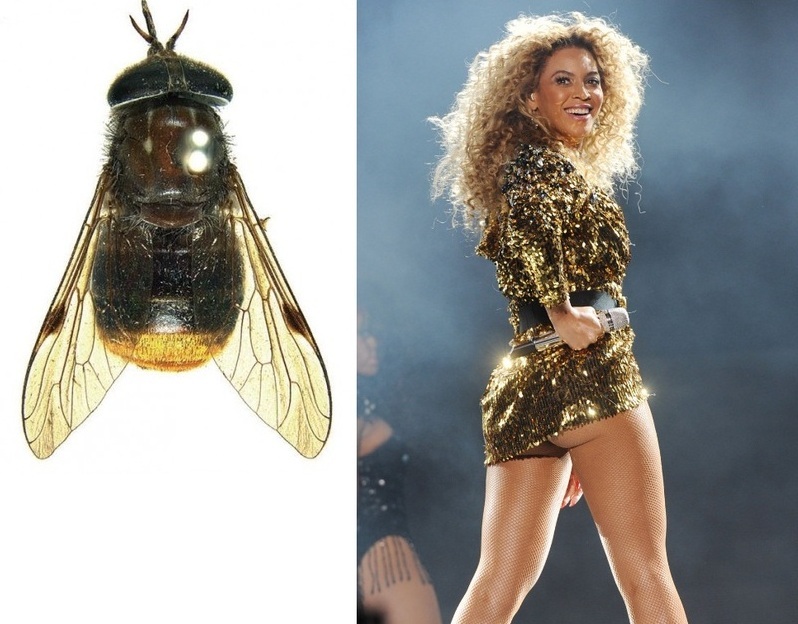
Pop diva Beyoncé has been in the news a lot recently, since the birth of her first child, Blue Ivy Carter. However, her name has hit the headlines for a different reason, after inspiring an Australian taxonomist to name a horse fly after her.

Bryan Lessard, from the CSIRO’s Australian National Insect Collection in Canberra, named the fly Scaptia (Plinthina) beyonceae because it has a prominent golden lower abdomen. To Bryan, who admits to being something of a fan, the unique dense gold hairs on the fly reminded him of Beyoncé’s flashy golden stage outfits.

The rare fly was collected in 1981, the same year Beyoncé was born, from eucalypt forests in the Atherton Tablelands of Queensland.

I’m not sure whether this is the most flattering thing that’s ever happened to Beyoncé, but I love that it shows scientists are just normal people who listen to R&B in their labs while they work, and find themselves as captivated by a gold frock as the next person. And perhaps are human enough to want to see their names in the gossip magazines, and maybe even get a personal response from their idol (she hasn’t made one).

BEYONCE

Beyoncé’s name is as unique as the horse fly, being created especially for her. Her mother Tina’s maiden name is Beyincé, a Creole surname from Louisiana. When she discovered that the Beyincé name was dying out, Tina decided to call her daughter Beyoncé, her own version of the surname. Apparently Tina’s parents were not impressed at first, because “that’s a last name”.

Beyincé is a form of the French surname Boyancé, related to the Old French word for “wood”. It’s an equivalent of English surnames such as Woodward or Forrester.

While the names of celebrities often become popular baby names (think Scarlett and Ashton, for example), Beyoncé’s name remains in very rare use. It belongs so completely to herself, and no other.

DESTINY

Destiny’s Child was the successful girl group of which Beyoncé was a founding member, prior to her embarking on her solo career.

The English word destiny comes from French, and ultimately from the Latin destino, the source of the word destination, meaning “appoint, establish”. It comes from an ancient root meaning “to stand, to place” (also the source of the word obstinate). Destiny is used as a synonym for the word fate, although technically fate is the divine agency or power which brings about the predetermined future events which are our destiny.

Destiny has been used as a girl’s name since the 19th century, and originated in the United States. It has been on the US Top 1000 since 1975, and reached the Top 100 in 1994, leaving it in 2012. It is currently #203.

In the UK, Destiny peaked in 2001 at #211 , and is currently #412. It is also in use in The Netherlands, and is a fairly uncommon name in Australia, although certainly not unknown.

Apart from Destiny’s Child, the name may remind you of Destiny Cyrus, the birth name of actress and singer Miley Cyrus (born just after the name reached the Top 100). It’s a slightly dated virtue name which still has a spiritual or philosophical feel to it, but also suggests the strength to forge your own path in life, to make your own destiny.

POLL RESULTS

Beyoncé gained an approval rating of 15% from the public. Only one person liked the name Beyoncé, while 68% thought it was terrible.

Destiny did rather better, with an approval rating of 32%. However, once again only one person liked the name, and 48% thought it was terrible.


Names of Convicts on the First Fleet

15 Sunday Jan 2012

Posted by A.O. in Name Themes and Lists

≈ 31 Comments

Tags

Aramaic names, Biblical names, english names, famous namesakes, fictional namesakes, germanic names, Greek names, hebrew names, Latin names, locational names, mythological names, name history, name meaning, name popularity, popular names, royal names, saints names, Shakespearean names, Spanish names, surname names

It is Australia Day next week, and so my name lists for January are names of convicts from the First and Second Fleets.

Convicts were the prisoners who filled overcrowded British prisons in the 18th and early 19th centuries. Because the death penalty was applied even to what we would consider minor offences, people were sent to prison for what we would consider to be misdemeanours, such as petty theft, or not crimes at all, such as being in debt.

Many convicts were disposed of by sending them to the colonies as cheap labour – nearly always North America – until the term is now understood as those prisoners sent to the colonies. The American War of Independence putting an end to America as a colony, another place had to be thought up to send convicts, and the east coast of Australia seemed a likely spot.

The First Fleet sailed from Portsmouth, Hampshire on May 13 1787, and consisted of eleven ships, led by Captain Arthur Phillips. Aboard were around 1487 people, including 778 convicts (192 women, 586 men). They travelled 24 000 km (15 000 miles) across the sea for 252 days.

On January 26 1788, the ships sailed into Port Jackson, which Phillips called “the finest harbour in the world” – an opinion many have shared since. They anchored in a sheltered place they called Sydney Cove, after British Home Secretary, Lord Sydney.

Life was very difficult in the new colony, and punishments could be extremely harsh. Convicts were basically slaves, mostly used on public works, but also assigned to individuals as a personal labour force.

The names of the convicts were those common in Britain in the 18th century, with names from the Bible being often used. Rather than cover historically famous convicts, I chose people for their names, giving a rather random selection of ordinary people and their unremarkable fates.

[All convicts’ names can be found here. Information on convicts from the First Fleet Database].

WOMEN

Deborah (Elam/Ellam/Elias)

At the age of 20, Deborah was found guilty of stealing 36 shillings worth of clothing, and sentenced by the court in Chester to seven years transportation. She sailed to Australia on the Prince of Wales. She married a fellow convict and brought a complaint against him; it was judged to be “trivial” and she received 25 lashes in punishment. The couple had seven children and have many descendants. Deborah died in 1819, “universally respected by her numerous friends and acquaintances”. The name Deborah means “bee” in Hebrew, and in the Old Testament Deborah was a prophetess, judge, advisor and warrior. The Song of Deborah, which she is said to have composed, may be the earliest Hebrew poetry we know of. Deborah didn’t rank in Australia until the 1940s, and peaked in the 1960s at #12. It left the Top 100 in the 1980s and hasn’t ranked since the 1990s.

Dorothy (Handland aka Dorothy Gray)

Dorothy made her living as a dealer in old clothes. In her early 60s, she was found guilty of perjury at the Old Bailey and sentenced to 7 years transportation. She sailed to Australia on the Lady Penrhyn. Dorothy is believed to be the oldest convict, and despite her age, she survived the voyage and returned to England when she had completed her sentence. Dorothy is the English form of Dorothea, from the Greek meaning “gift of God”. There are three saints named Dorothea, one of whom we call Saint Dorothy. A legendary virgin martyr of the 4th century, said to be of surpassing beauty, her cult spread across Europe in the Middle Ages. The name Dorothy was #2 in the 1900s and 1910s, and remained Top 100 until the 1950s. It has been unranked since the 1980s.

Flora (Lara/Larah, aka Laura Zarah)

Flora is thought to have been Jewish. She was found guilty of stealing a mahogany tea chest and money to the value of 5 shillings, and sentenced by the court in Westminster to seven years transportation. She sailed to Australia on the Prince of Wales. She was described in the court records as being of an evil disposition; she married in Australia and left the colony in 1801. Flora was the Roman goddess of spring, married to the west wind, Zephyr; her name is from the Latin for “flower”. Flora is the scientific term for all plant life. Flora was first used as a personal name in France, and it’s especially famous in Scotland, because of Jacobite heroine Flora MacDonald. Flora has never been Top 100 in Australia – it peaked at #112 in the 1900s, and left the charts in the 1950s.

Lydia (Munro, aka Letitia Munro)

At the age of 17 Lydia was found guilty of stealing material to the value of 20 shillings. She was sentenced to death by the court in Kingston-upon-Thames, which was later commuted to 14 years transportation. She sailed to Australia on the Prince of Wales. The convict records show that she was the victim of a sexual assault and attempted rape by another convict. She married, and she and her husband went to Tasmania where they raised a family of eleven children; they have numerous descendants. She died in 1856. Lydia of Thyatira is a character in the New Testament, regarded as the first convert to Christianity in Europe. She was a successful merchant who was baptised by St Paul and became a deacon in the early church; she is considered a saint by several denominations. Her Greek name is after the place name Lydia, an area of the ancient world now part of modern Turkey. Lydia has charted almost continually without ever hitting the Top 100. It peaked in the 1900s at #137, disappeared from the rankings in the 1930s and ’40s, and is currently #322.

Rachel (Earley/Early/HurleyHarley/Arrly)

At the age of 25 Rachel was found guilty of stealing tea and silk worth 3 shillings, and sentenced by the court in Reading to seven years transportation. She sailed to Australia on The Friendship, and spent time in irons onboard, for the twin crimes of “theft and dirtyness”. As a convict, she once received 10 lashes for not obeying orders. She married twice, and had a daughter, but was left by both husbands; she has living descendants. She died in Tasmania in 1842. In the Old Testament, Rachel was one of the wives of Jacob. Her name is Hebrew for “ewe”, perhaps with connotations of purity and submissiveness, although in the Bible Rachel did literally take care of her father’s sheep. Rachel is said to have been of overwhelming beauty, and Jacob loved her best of his wives. She was plagued by infertility issues, but managed to give birth to Joseph and Benjamin, her husband’s favourite children. Unfortunately, she died in childbirth, and her tomb is still a place of pilgrimage. The name Rachel has charted almost continually since 1900, dropping from the rankings during the 1940s. It peaked in the 1970s at #19, and is currently #118.

MEN

Barnaby (Denison/Dennison/Deneson)

At the age of 28 Barnaby was found guilty of “intent to rob”, and sentenced by the court in Bristol to seven years transportation. He sailed to Australia on the Alexander. According to the convict records, he was once sentenced to 50 lashes for “singing loudly at an improper time”, and became a night watchman. He died in 1811. The name Barnaby is a medieval English form of Barnabas. In the New Testament, Barnabas was a companion of St Paul and fellow missionary. His name was Joseph, but when he converted from Judaism to Christianity he was given the name Barnabas, which is a Greek form of Aramaic, and can be translated as “son of prophecy” or “son of encouragement”. There are many literary characters named Barnaby, most notably Dickens’ eponymous Barnaby Rudge.

Cooper (Handy/Handley/Henley)

Cooper made his living as a weaver. At the age of 33 he was found guilty of assault and highway robbery to the value of 20 shillings and sentenced to death by the court in Salisbury. This was commuted to seven years transportation, and he sailed to Australia on the Friendship. Cooper was held in a hulk at Dunkirk before he left, and at one point managed to escape during an uprising, but was recaptured. His report says that he behaved “remarkably well” otherwise. Not long after his arrival in Australia, Cooper was killed by Aborigines while gathering greens. Cooper is an English surname referring to someone who makes barrels as their occupation. Apart from being a popular name, Cooper is well known in Australia as the surname of the family who owns Cooper’s Brewery in South Australia. The name Cooper first joined the charts in the 1990s and peaked in 2009 at #4. It’s currently #7.

Ferdinand (Dowland/Dowlan/Doolan)

Ferdinand was a dustman. At the age of 32 he was found guilty of stealing a horse worth 30 shillings. He was sentenced to death at the Old Bailey, commuted to seven year’s transportation, and sailed to Australia on the Scarborough. He died in 1827. The name Ferdinand is from the Spanish form of a Germanic name meaning “daring journey”. Brought to Spain by the Visigoths, it was used amongst the royal houses of Spain and Portugal, and through them became common in the Hapsburg family, rulers of the Holy Roman Empire. One of its most famous namesakes is Ferdinand Magellan, a Portuguese explorer whose expedition was the first to circumnavigate the globe (although Ferdinand himself did not survive the voyage). Ferdinand is also a character in Shakespeare’s play The Tempest; a prince who is shipwrecked on Propsero’s island, and falls in love with his daughter Miranda.

Ishmael (Colman)

At the age of 32 Ishmael was found guilty of stealing woollen blankets worth 14 shillings, and sentenced to seven years transportation by the court in Dorchester. Ishmael was held in a hulk at Dunkirk before sailing, where he was described as “decent and orderly”. He died after only 16 days at sea on the Charlotte; the report from the ship’s doctor says that his death was brought about through his long confinement before the trip, which had brought about “low spirits and debility”. Ishmael is a name from the Bible which is translated as “God has heard”. In the Old Testament, Ishmael was the son of Abraham and his wife’s handmaiden, Hagar; Ishmael and his mother are two Biblical characters who get a raw deal, being cast into the wilderness to fend for themselves and not receiving any inheritance from Abraham. According to tradition, he is the father of the Arabic people, and is considered such in Islam, Judaism and Christianity, although this isn’t historically accurate. The prophet Muhammad traced his bloodline from Ishmael, and he is one of the prophets of Islam. In literature, Ishmael is the brooding narrator of Herman Melville’s famous novel, Moby Dick.

Job (Hollister)

At the age of 21 Job was found guilty of stealing tobacco and sentenced to seven years transportation by the court in Gloucester. He sailed to Australia on the Alexander. When he completed his sentence, Job left the colony and migrated to Vancouver Island in Canada. Job is another Old Testament character who has a miserable time. A righteous man, God allows Satan to take away his wealth, his children and his health in an effort to tempt him to curse his Creator. He never does so, although he is aggrieved by the process, and spends a lot of time wondering why all these dreadful things keep happening to him. The story ends happily, with God rewarding him many times over, but with no reasonable explanation for his treatment. Although the tale bears all the hallmarks of an allegory on the human condition, Job is regarded as a prophet in Judaism and Islam, and is given a saint’s day in several Christian denominations. In line with the narrative, Job’s name is translated as “hated, persecuted”.

Image is of The First Fleet in Sydney Cove, January 27, 1788 by John Allcott (1938). Painting held by the National Library of Australia.

Famous Name: Elvis

14 Saturday Jan 2012

Posted by A.O. in Famous Names

≈ 12 Comments

Tags

famous namesakes, honouring, Irish names, Latin names, mythological names, name history, name meaning, saints names, surname names, UK name popularity, unisex names, US name popularity

This article was first published on January 14 2012, and substantially revised and re-posted on September 14 2016.

Famous Festival
On January 11, the 20th annual Elvis Festival kicked off in the country town of Parkes, west of Sydney – an annual celebration of Elvis Presley’s life and music. For five days in the second week of January, the population of Parkes is swelled by Elvis impersonators, women with big hair, and people wearing blue suede shoes. There are parades, contests, dancing, singing, hip swivelling, and a mass renewal of wedding vows performed by a celebrant in an Elvis costume.

The festival began in 1992, when a small group of local Elvis fans decided to hold a festival on the day of the star’s birthday, January 8.  The next year the festival attracted 200 people from around the country; by 2005 they came in their thousands, by 2007 it had been extended to five days, and now there are more than a hundred events, and the town’s population of 10 000 more than doubles during the Elvis Festival.

The townspeople were originally lukewarm on the Elvis Festival idea. Parkes is the proud owner of an observatory, which has at times assisted NASA on space missions (as fictionalised in the movie The Dish), and had always seen itself as devoted to science and research. An Elvis Festival seemed a bit frivolous.

However by now Parkes has fully embraced the festival, and the whole town gets into the fun by dressing up and decorating the buildings. It’s one of the mayor’s roles to dress as an Elvis impersonator and meet the train from Sydney, where all the similarly-attired fans have travelled together.

People flock here from all over the globe to come to the self-proclaimed Elvis Capital of the World. It injects millions into the economy of the town, and in 2007 they set a record for the most number of Elvis impersonators in one place.

In 2017 the Festival will celebrate its 25th birthday and the theme will be Viva Las Vegas.

Name Information
Elvis Presley was one of those performers lucky enough to have been given such a distinctive name that he had no need to choose a stage name. He was named for his father Vernon, whose middle name was Elvis.

Elvis is an Anglicisation of the Irish name Ailbhe, said like Alva: the meaning is not known for sure, but may derive from the Gaelic albho, meaning “white” – it is also Anglicised as Albus, the Latin for “white”. The name Ailbhe could be given to either sex, and in Irish legend there is a female warrior and follower of Finn McCool named Ailbhe.

A male example of the name is Saint Ailbhe, nearly always known as Saint Elvis. He was a 6th century bishop venerated as one of the four great patron saints of Ireland. Saint Ailbe’s legend is quite fairy-tale – cast out by his royal father (like Oedipus), he was raised by a she-wolf (like Romulus and Remus), and at the end of his life voyaged by ship to the Otherworld (like King Arthur going to Avalon). There is a Welsh village named St Elvis in the saint’s honour, as he is said to have baptised Saint David, the patron of Wales, in this area.

The English surname Elvis does not seem to be derived from the Irish name, and is probably a variant of the surname Elwes, which comes from the female name Heloise or Eloise.

Elvis has been used as a name since perhaps the 18th century, and in Ireland seems to have been used as a female name, although it wasn’t common (today Ailbhe is a popular name for girls in Ireland). However in England the name was mostly masculine, suggesting that there the surname was the primary influence.

The name Elvis went on to become most commonly used in the United States, and was usually a boy’s name. Despite the feminine origin of the surname, it probably sounded like male names such as Alvis and Alvin, giving it a masculine feel.

In Australian records Elvis was nearly always given to girls in the late 19th and early 20th centuries which makes sense considering our strong Irish heritage. It also fit in with turn-of-the-century name trends for girls, such as Alva and Elva. Once Elvis Presley became famous in the 1950s, the name virtually disappeared from records as a girl’s name.

In the US, the name Elvis has charted on and off in the Top 1000 for boys since the late 19th century, becoming more established there around 1910. Before Elvis Presley became famous, its highest peak was #584 in 1919, and it was #900 in 1935, the year Elvis Presley was born.

The name Elvis went off the charts around the time Elvis Presley began his career in 1954, but returned in 1955, so the star did affect the name’s popularity. Elvis peaked in 1957 at #312, the year after Presley released number one hits such as Heartbreak Hotel and made his film debut in Love Me Tender – female fans screamed with excitement non-stop during the movie, even though it had quite a serious plot and a sad ending.

The name Elvis last charted in the US Top 1000 in 2011. Last year in the US there were 180 baby boys given the name Elvis, and numbers are fairly stable.

In the UK, the name Elvis has charted since the 1990s, and the name made the Top 1000 in the early 2000s, peaking at #761 in 2003, and again in 2008 when it made #943. It rose steeply last year, and was back on the Top 1000 at #873.

In Australia, Elvis is not a common name, but I generally see two or three examples of it as a baby name per year – enough to convince me it isn’t a rare name either, and probably has a similar popularity to the UK. A famous Australian with the name is former mixed martial artist Elvis Sinosic.

Elvis has two other musical namesakes. One is British star Elvis Costello, who was born Declan MacManus, and the other is American folk singer Elvis Perkins, the son of actor Anthony Perkins (Elvis Perkins was born the year before Elvis Presley died). Costello’s manager chose the stage name Elvis in reference to Presley, while Anthony Perkins was an Elvis fan.

Elvis, if you forget about its most famous namesake for a moment, sounds like a vintage name ready for revival, complete with fashionable V. And yet it never can be separated from Mr Elvis Aaron Presley. The name will always conjure images of white satin bodysuits covered in rhinestones, brilliantined dark hair, and a heart-stopping smile.

Even though Elvis is not a rare or unusual name, it’s still something of a bold choice as it’s likely to elicit some strong opinions. But you’ll have to tell the naysayers you’d like a little less conversation about it, because you can’t help falling in love with the name Elvis. It’s a truly royal name because it belongs to the one and only king, baby!

POLL RESULTS
Elvis received an approval rating of 42%. 35% of people thought the name was too closely associated with Elvis Presley, although 9% thought it was either handsome or cute. Only one person thought the name Elvis sounded redneck.

(Picture shows Elvis impersonators at the Parkes Elvis Festival, with the Observatory in the background)

Famous Names: Tully and Yasi

07 Saturday Jan 2012

Posted by A.O. in Famous Names

≈ 8 Comments

Tags

Australian name trends, created names, cyclone names, famous namesakes, Fijian names, Game of Thrones names, Irish names, locational names, name history, name meaning, names of rivers, nature names, pen names, rare names, Roman names, surname names, tree names, UK name popularity, unisex names, US name popularity

This blog entry was first posted on January 7 2012, and revised and republished on August 31 2016.

TULLY
On January 3, the town of Tully in Queensland celebrated the upgrade of its famous Golden Gumboot, which was damaged by Cyclone Yasi nearly a year ago. The tourist attraction is a 7.9 metre (26 feet) high gumboot, painted gold, built to commemorate the town’s 1950 highest recorded annual rainfall level of 7.9 metres (310 inches), earning Tully the distinction of being Australia’s wettest town.

When the Golden Gumboot was re-opened, it had received a fresh coat of paint and a new viewing platform. Fittingly, it rained heavily throughout the ceremony.

The town of Tully is named after the nearby Tully River, which received its name from Surveyor-General William Alcock Tully. William Tully was originally from Dublin, and arrived in Hobart as religious instructor on a convict ship in 1850 before embarking on a career of conscientious public service.

Tully is an Anglicised form of an Irish surname, originally MacTully, and having a host of variants, which is often derived from tuile, the Gaelic word for “flood”. Another theory is that it has been mistranslated from toile, meaning “will” (as in the will to keep going). However, some Tullys are so convinced of the first interpretation that they have hyper-Anglicised their surname to Flood.

The meaning of “flood” is very appropriate for the name of a river, and a town famous for its sogginess. In Game of Thrones, the Tully family is one of the Great Houses and as it is the principal house in the Riverlands and their ancestral home is Riverrun, perhaps George R.R. Martin also had the Irish surname and meaning in mind.

Tully has been used as a personal name since the late 18th century. Although the name can be found in early records from Ireland, it seems to have been more frequently used in the United States.

One inspiration for it may have been the Founding Father Alexander Hamilton, who wrote patriotic pamphlets under the pen name Tully – in his case, a reference to the Roman philosopher Marcus Tullius Cicero, whose name was occasionally Anglicised to Tully. The Tullia took their surname from the legendary Roman king Servius Tullius; the name is so ancient we do not know its meaning.

Tully has never been a common name. Last year in the US there were 8 boys named Tully with no girls listed with the name since 2013. In the UK the name has been in sporadic use, and in 2014 there were 4 baby boys named Tully. No girls are listed as having been given the name since 2009.

In Australia I have seen a roughly equal number of boys and girls with this name, and the name may be more evenly unisex here than elsewhere. One boost to the name for girls is women’s basketball champion Tully Bevilaqua, and after the attractive but controversial Tully Smyth competed on Big Brother in 2013, I heard many Australian parents refer to Tully as a “girl’s name”. Perhaps more importantly, it fits with the Australian trend for female names with a T-L pattern, such as Talia, Tilly, and Tallina.

YASI
The town of Tully was one of the worst affected by Cyclone Yasi, which hit the coast of northern Queensland early in the morning on February 3 2011. The town suffered extensive damage to its main street, and the area’s banana crops were completely flattened. Because Cyclone Yasi originated in Fiji, it was a Fijian cyclone forecaster called Misaeli Funaki who chose its name.

If you think naming a baby is difficult, spare a thought for the meteorologists who name cyclones. The cyclone had to start with Y, and nobody could think of an appropriate name for either gender.

So Mr Funaki suggested Yasi, which is the Fijian word for “sandalwood”. It didn’t have a history as a personal name in Fiji, but with no other candidates, his nomination was accepted by the ruling UN body. And so a new name was created.

Sandalwood is a tree with fragrant wood native to Asia and the Pacific. Australia has a sandalwood industry; the tree’s oil is used to make incense, soaps and cosmetics. Its antibacterial properties make it excellent as a skin cleanser, and Australian Aborigines eat its fruit as a bush food. Sandalwood is also used in the rituals of several eastern religions.

Yasi is neither used for boys or girls in Fiji. The cyclone forecasters were looking for a male name when they chose it, but they often resort to unisex names, and probably meant Yasi to be one. It’s commonly said to rhyme with Darcy, but seems to be more correctly pronounced YAH-zee.

During Cyclone Yasi, one doctor was apparently very keen for all babies born during the cyclone to be named Yasi, but there is no record of anyone following his advice. However you can find people around the world with the name Yasi, mostly female – perhaps a short form of names such Yasmin.

These are two short unisex names important to Australia’s history, especially connected with Queensland, rain, and storms. Tully is uncommon, but not unheard of, while Yasi is a true rarity, but not unusable.

POLL RESULTS
Tully received a very good approval rating of 70%. 46% of people thought it was a good name, while not one person hated it. Yasi was far less popular, with an approval rating of 22%. 53% of people weren’t keen on the name, and only one person loved it.

(Photo shows the Golden Gumboot in Tully, Queensland)


Boys Names from Stars and Constellations

18 Sunday Dec 2011

Posted by A.O. in Name Themes and Lists

≈ 21 Comments

Tags

Akkadian names, Arabic names, astronomical names, Chinese names, colour names, english names, fictional namesakes, gemstone names, Greek names, Latin names, locational names, mythological names, name history, name meaning, popular culture, popular names, surname names, unisex names, vocabulary names

It is only a few days until the Christmas holidays, or the holidays have already begun. Although the stars seem more crisp and vivid in winter, and some constellations of spring and autumn are spectacular, it is summer I connect with star-gazing. The warm nights and long lazy Christmas holidays seem to go with lying in your backyard looking upwards, or watching the night sky glittering above you on camping trips. Little wonder that the stars of summer are often the first we learn to identify, and the first we yearn towards as we gaze into infinitude.

This is the companion list to Girls Names from Stars and Constellations, and should be read in conjunction with it. Need a super quick guide to the southern skies? Go here! The picture used is a Christmas card created by Thomas Le, a refugee from Vietnam. He donated this artwork to help other migrants, and it is on show at the Museum of Victoria.

Altair

Altair is the common name for Alpha Aquila, the brightest star in the constellation Aquila (“The Eagle”), and one of the brightest overall. Altair is a translation of the Arabic for “the flying eagle”, and the identification of the star with an eagle goes back to the Babylonians and Sumerians, who called Altair “The Eagle Star”. The Kulin people of central Victoria also saw the star as an eagle; it is Bunjil, their creator, who was blown into the sky by a great wind and became a star. Other peoples of southern Australia saw Altair as a hunter; it is his Boomerang thrown across the sky which became the constellation in which Gemma can be found. This cool star name can either be said al-TAH-yir, or al-TARE, and is also on the list Boys Names from Video Games. You can see Altair from Australia in winter and spring, and it’s in the north of the Milky Way.

Asterion

Asterion is the common name for Beta Canes Venatici, the second-brightest star in the constellation Canes Ventatici. This constellation began as the club of the constellation Boötes (“The Herdsman, The Ploughman”). However, due to a number of errors in translation from Greek to Arabic to Latin, “club” became “dogs”. Having invented these dogs, astronomers had a good squint and decided that the constellation looked like two greyhounds. It’s never explained why a herdsman would have hunting dogs rather than herding dogs. Astronomers named one star Chara (“dear”) and the other Asterion (“starry”) – then they swapped the names around to create further confusion. In Greek mythology, Asterion was the personal name of the Minotaur, a bull-headed monster who was the product of an unnatural coupling between a queen of Crete and a bull. It’s a flamboyant name, but it is actually a star name with a starry meaning; it’s said as-TEH-ri-on. Canes Ventatici is visible in the autumn from Australia, but its stars are not bright or easy to see.

Atlas

Atlas is the common name for 27 Tauri, a triple-star system in the constellation Taurus and part of the Pleiades cluster. As well as the Seven Sisters, which include Maia, the Pleiades cluster contains their parents, Atlas and Pleione. Atlas was one of the Titans, and after warring against the Olympians, he was sentenced to hold up the heavens on his shoulders (before this, the Sky and the Earth, parents of the Titans, were free to lie together in a lingering embrace, so Atlas is basically being used as a birth control device for deities). He has come to be a symbol of superhuman strength and stoic endurance. The name is so ancient that its meaning is very uncertain, but it may mean “endure”, “support”, or “sea”. Atlas has given his name to the Atlas Mountains in North Africa, and the Atlantic Ocean, as well as the word for a book filled with maps. The name is starting to have a mild vogue here. You will be able to see Atlas in the Pleiades during summer in Australia.

Garnet

The star Mu Cephei is commonly known as Herschel’s Garnet Star, because when astronomer William Herschel described it, he wrote that it was “a very fine deep garnet colour”. Indeed it is, being a red supergiant that is one of the largest in the Milky Way. It’s in the constellation Cepheus, which represents Andromeda’s father. Without doubt he is the dullest creature in the whole Andromeda drama, but I guess since they put the sea monster in the sky, it would have seemed rude to leave him out. You may recall that the aliens in TV comedy 3rd Rock From The Sun came from a planet in a galaxy on the Cepheus border. Unfortunately, Cepheus is only visible in the northern hemisphere, so we cannot see the Garnet Star from here. The colour garnet is named for the red gemstone; its name is said to be derived from the (also red) pomegranate fruit which means “seeded apple”. It’s a unisex name, but historically better known as masculine in Australia.

Keid

Keid is a common name for Omicron2 Eridani, or 40 Eridani, a triple star system in the constellation Eridanus consisting of two red dwarfs and a white dwarf. Eridanus represents a great river, and is meant to be the water pouring from the jar of the Water Bearer, the constellation Aquarius. In ancient times, it was said to be the path of souls. Eridanus can be easily seen from Australia; it is virtually overhead during the summer months. You can see one of the red dwarf stars in Keid with the naked eye; however the other two stars can only be viewed through a telescope. In the TV series Star Trek, 40 Eridani is the location of the planet Vulcan, home of Mr Spock. Eridanus is also a system of planets in the video game Halo, so it’s got sci-fi credentials galore. Keid is from the Arabic word for “eggshells”, and can be pronounced KYED or KEED. I prefer KEED, but KYED sounds like popular Kai (maybe too much, as people will no doubt confuse the two names).

Kio

Kio (KEE-oh) is the ancient Chinese name for Spica, the common name for Alpha Virginis, a blue giant binary star and the brightest in the constellation Virgo. While Spica means “ear of wheat” in Latin, Kio comes from the Chinese for “horn, spike”, as it was seen as “the horn of Jupiter”. Spica was the star used to discover the precession of the equinoxes, and the constellation Virgo contains the spring equinox point (autumn equinox in the northern hemisphere). The constellation has represented a goddess holding sheaves of grain from the earliest beginnings of astronomy in Babylonia. Not only is Kio one of those perky three-letter names that appeal to many people, but the Chinese saw Spica as a “lucky star” – what could be more positive than being named after a lucky star? The constellation Virgo can be seen throughout autumn and winter in Australia, and the very brightness of Spica makes it easy to find.

Leo

Leo is a familiar constellation, because it is one of those in the zodiac. It’s already in the list Boys Names From the Top 100 of the 1930s, however I think it is worth revisiting from an astronomical viewpoint. The constellation’s name means “lion”, and seems to have been pictured as a lion by many ancient civilisations. I’m not sure if there was a single original Lion in mythology, but the Babylonians had many leonine protective gods, and a winged lion was the symbol for the city of Babylon. The Ancient Greeks identified it with the Nemean lion, a monstrous beast, both fierce and cunning, which was killed by Heracles as the first of his twelve labours. Its hide was impervious to attack, so Heracles wore it as his armour. The constellation Leo is truly majestic, and contains many bright stars. The chief of these is Regulus, also called The King Star, and The Heart of the Lion. Leo can be seen for most of the year, but is easiest to view in late summer to early autumn from Australia.

Nash

Nash is a common name for Gamma Sagitarrii, an orange giant binary star in the constellation Sagittarius. Sagittarius depicts a centaur, said to represent the wise teacher and healer Chiron. The Milky Way is at its densest in Sagittarius, as this is where the centre of the galaxy lies, so it contains many star clusters and nebulae. In Australia this impressive constellation is easy to find, and we also get the best view of it, being able to see the Milky Way so much more clearly. Look in the west part of the sky in the early evening, halfway between the horizon and the point directly overhead. Its brightest stars form a recognisable shape which is called The Teapot; Nash is the spout of this teapot. Sagittarius is most visible in the middle of winter, and bright enough that you can see it even if there is a moon. The name Nash is from the Arabic for “arrowhead”, for this star is the tip of the archer’s arrow, which points toward the star Antares, in Scorpius. It’s also a surname derived from the word for “ash tree”.

Orion

Orion is a constellation representing a character from Greek mythology. This gigantic hunter seems to be a bawdy folk hero – larger than life and twice as natural. It is lusty Orion who pursued the Pleiades, so that Zeus had to turn them to stars for their protection. One version of his ending is that Orion boasted of being able to kill any animal on Earth, and so the Earth goddess, in her displeasure, created the Scorpion to sting him to death. Both Orion and the Scorpion were placed in the sky as constellations. Orion contains many brilliant stars, such as Betelgeuse, Rigel and Bellatrix, and even the astronomical novice can locate the three stars forming Orion’s Belt; I was taught these were The Three Sisters (a South African name). Orion is clearly visible in the summer from Australia, and because it is positioned differently in the southern hemisphere, we sometimes call this constellation The Saucepan. The name Orion is from the Akkadian for “heaven’s light”.

Perseus

Perseus is a constellation representing a character from Greek mythology; he was a hero, the son of Zeus and a mortal princess. Perseus led an extremely exciting life, part fairytale, part soap opera, but he is probably best known for killing the Gorgon Medusa, a woman who had snakes on her head, and thus had a permanent bad hair day of epic proportions. Perseus had nifty flying sandals to zip around on, although much later people liked to imagine him riding the flying horse Pegasus (this never actually happened in the legends). Perseus rescued and married Princess Andromeda, and the constellation has his hand reaching up to Andromeda’s foot, to show the moment of deliverance. The star Algol in Perseus is called The Demon Star, and represents the head of Medusa. We can see the constellation in late spring and summer from Australia, and the meaning of Perseus is not certain; it may mean “to destroy”. Percy is the obvious nickname, and the one used in the novel series Percy Jackson and the Olympians by Rick Riordan.

Phoenix

Phoenix is a minor constellation in the southern sky named after the mythical bird. The Phoenix can be found in the mythologies of many lands, from Egypt to China to Russia, and is famous for being able to renew itself in fire, which made it a popular symbol of resurrection in Christianity. Its name is from the Greek for “crimson”. Phoenix has become a popular name lately; it’s unisex, but used more for boys. It’s hard not to connect it to The Order of the Phoenix in the Harry Potter books; Fawkes the phoenix is the loyal pet of Albus Dumbledore. A phoenix is also a major character in the children’s book The Phoenix and the Carpet by Edith Nesbit. The constellation Phoenix can be seen from Australia during the summer, however it is faint and only possesses two stars bright enough to be seen with the naked eye.

Sirius

Sirius is the common name for Alpha Canis Majoris, a binary star which is the brightest in the constellation Canis Major (“Great Dog”), and the brightest in the sky, being almost twice as bright as Canopus, the second-brightest. Canis Major is seen as one of the dogs following the hunter Orion, with Sirius representing its doggy nose. However, Sirius was considered to be a dog in his own right, and is called The Dog Star. In the northern hemisphere, Sirius rises in summer, and so the very hottest time of year is called “the dog days”. Although Sirius rises in the winter here, we don’t call the coldest time of year the dog days, although strictly speaking, we should! In July, you can see Sirius both evening and morning. Almost every culture in the world has connected Sirius with dogs or wolves, but the Boorong people of Victoria saw it as part of a constellation representing the Wedge-Tailed Eagle – one of the most important of the spirit elders. The Sirius was also the flagship for the First Fleet to Australia, giving it another Australian connection. Its name comes from the Greek for “burning, scorching”.

← Older posts
Newer posts →

Enter your email address to follow this blog

Categories

Archives

Recent Comments

A.O.'s avatarwaltzingmorethanmati… on Zarah Zaynab and Wolfgang…
Madelyn's avatarMadelyn on Zarah Zaynab and Wolfgang…
JD's avatardrperegrine on Can Phoebe Complete This …
A.O.'s avatarwaltzingmorethanmati… on Rua and Rhoa
redrover23's avatarredrover23 on Rua and Rhoa

Blogroll

  • Appellation Mountain
  • Baby Name Pondering
  • Babynamelover's Blog
  • British Baby Names
  • Clare's Name News
  • For Real Baby Names
  • Geek Baby Names
  • Name Candy
  • Nameberry
  • Nancy's Baby Names
  • Ren's Baby Name Blog
  • Sancta Nomina
  • Swistle: Baby Names
  • The Art of Naming
  • The Baby Name Wizard
  • The Beauty of Names
  • Tulip By Any Name

RSS Feed

  • RSS - Posts

RSS Posts

  • Celebrity Baby News: Melanie Vallejo and Matt Kingston
  • Names from the TV Show “Cleverman”
  • Can Phoebe Complete This Sibset?
  • Zarah Zaynab and Wolfgang Winter
  • Baby, How Did You Get That Name?
  • Celebrity Baby News: Media Babies
  • Celebrity Baby News: Adelaide Crows Babies
  • Celebrity Baby News: Chris and Rebecca Judd
  • Names at Work: Name News From the World of Business and Employment
  • Celebrity Baby News: Sporting Round Up

Currently Popular

  • Girls Names From Stars and Constellations
  • Celebrity Baby News: Ross Stevenson and Sarah Fallshaw
  • The Top 100 Names of the 1900s in New South Wales
  • Girls Names of Australian Aboriginal Origin
  • The Top 100 Names of the 1930s in New South Wales

Tags

celebrity baby names celebrity sibsets english names famous namesakes fictional namesakes honouring locational names middle names name combinations name history name meaning name popularity name trends nicknames popular names saints names sibsets surname names twin sets unisex names

Blog at WordPress.com.

Privacy & Cookies: This site uses cookies. By continuing to use this website, you agree to their use.
To find out more, including how to control cookies, see here: Cookie Policy
  • Subscribe Subscribed
    • Waltzing More Than Matilda
    • Join 517 other subscribers
    • Already have a WordPress.com account? Log in now.
    • Waltzing More Than Matilda
    • Subscribe Subscribed
    • Sign up
    • Log in
    • Report this content
    • View site in Reader
    • Manage subscriptions
    • Collapse this bar
 

Loading Comments...