• About
  • Best Baby Names
  • Celebrity Baby Names
  • Celebrity Baby Names – Current
  • Celebrity Baby Names – Past
  • Featured Boys Names
  • Featured Girls Names
  • Featured Unisex Names
  • Links to Name Data
  • Waltzing on the Web

Waltzing More Than Matilda

~ Names with an Australian Bias of Democratic Temper

Waltzing More Than Matilda

Tag Archives: english names

Names of Fictional Characters for Girls

10 Sunday Nov 2013

Posted by A.O. in Name Themes and Lists

≈ 18 Comments

Tags

astronomical names, Celtic names, code names, created names, Disney names, Dothraki names, english names, eponyms, fabric names, famous namesakes, fictional namesakes, German names, Google, horticultural terms, Italian words, J.R.R. Tolkien, Latin names, mythological names, name history, name meaning, name popularity, names from invented languages, names from movies, names from television, names of natural features, names of stars, nicknames, Norman-French names, popular names, portmanteau names, pseudonyms, rare names, short forms, Sindarin names, surname names, UK name popularity, unisex names, US name popularity, vocabulary names, Welsh names
Wallpaper-Iridessa-Summer-1

Arrietty

Arrietty Clock is a teenage “borrower” from Mary Norton’s classic children’s fantasy book series, The Borrowers. The borrowers are tiny people who live by “borrowing” everyday items from the Big People, who they call “human beans”. Because of the spirited Arrietty’s curiosity, she and her family end up having far more adventurous lives than the average borrower. In the UK issue of the Japanese animated film Arietty’s World, inspired by the books, Arrietty is voiced by Saoirse Ronan; in the US issue, by Disney actress Bridgit Mendler. Like everything else they own, the borrowers’ names have also been “borrowed”, and used in new ways. Arrietty is reminiscent of the word arietta, meaning “little song, a small aria” in Italian. However, it is also very similar to the name Harriet, and the short form Etty. As Aria and Harriet are quite popular, and Etta very hip, Arrietty is one of those invented names which we are half-surprised wasn’t used before the books’ publication.

Arwen

In J.R.R. Tolkien’s classic fantasy novel, The Lord of the Rings, Arwen Undómiel is an Elven princess, said to be the most beautiful of the last generation of the High Elves. She is the lover of the hero Aragorn, and because she is an immortal, Arwen must sacrifice a great deal to be with her love. In the Peter Jackson films, she is played by Liv Tyler. In the Elvish Sindarin language created by Tolkien, Arwen is said to mean “noble maiden”. However, Tolkien did not invent the name itself, which is a modern Welsh name. It may be a feminine form of Arwyn, which I have seen translated as “very fair, greatly blessed, splendid”. In the UK, the name began charting around the time The Fellowship of the Ring came out, and is currently #654 and rising. This does have a (short) history as a genuine Welsh name, and was given to a very lovely fantasy princess.

Bellatrix

Bellatrix Lestrange is an evil witch in the Harry Potter fantasy series, the Dark Lord Voldemort’s most faithful follower. In the films, she is played by Helena Bonham-Carter. Bellatrix was born into the Black family, and like all members of that clan, she is named after a star. Bellatrix is the common name of Gamma Orionis, a bright star in the constellation of Orion. Its name is Latin for “female warrior”, which was originally given to Capella, and then transferred to Gamma Orionis. It is also known as the Amazon Star, a loose translation of its Arabic name, which means “the conqueror”. Bellatrix Lestrange’s name is apt because she is a skilled warrior for Voldemort, and has won many duels. This name sounds very usable, because it has the popular Bella in it, and the -trix from hip Beatrix. However, while the Harry Potter character has raised the name’s profile, it’s also a stumbling block, because the character is evil – and not in a cool “strong yet misunderstood woman” way. Bellatrix is a fanatical racist with a love for murder and torture, and a starstruck Voldie fangirl with an annoying little-girl voice. So on one hand: great name. On the other: horrible association.

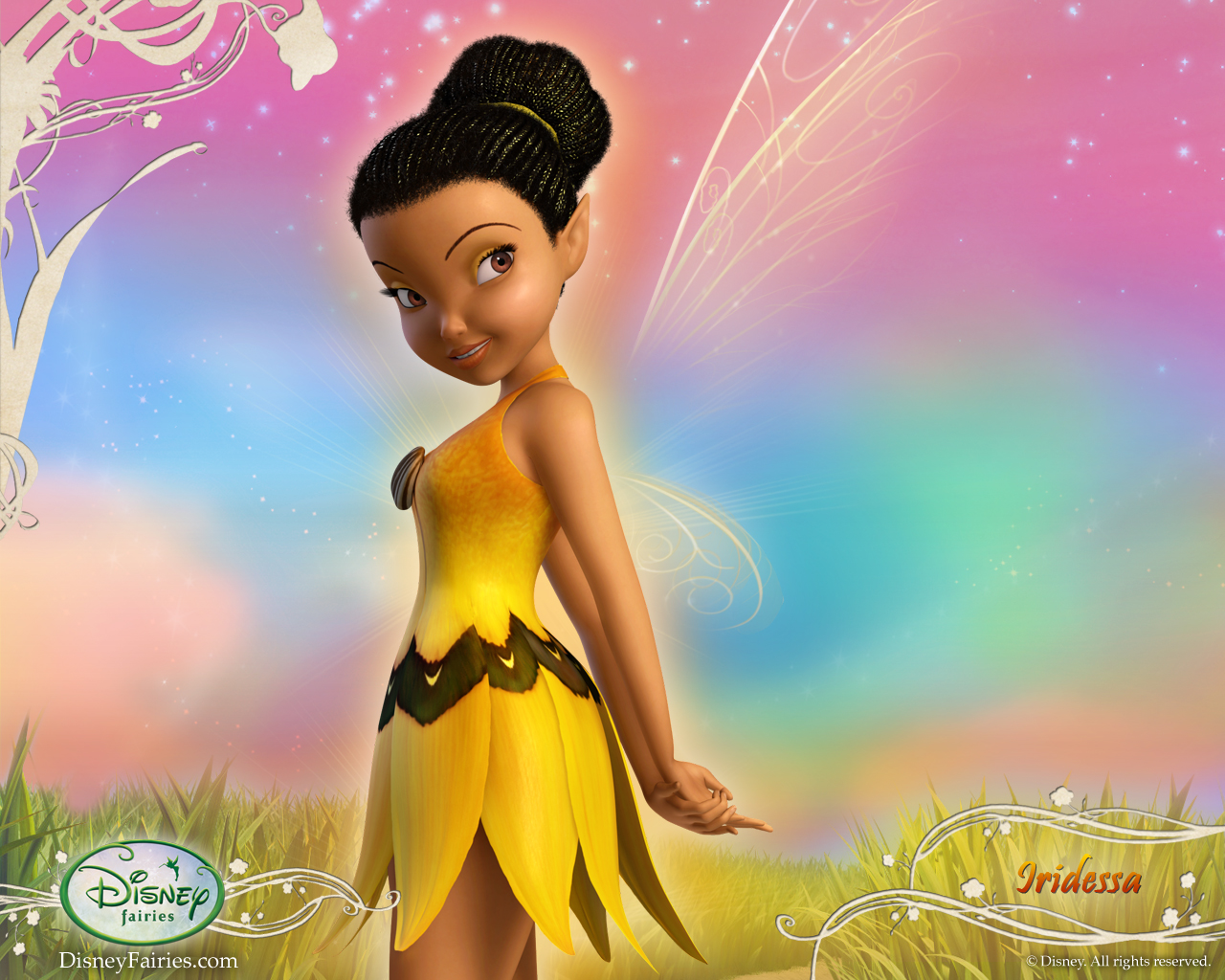
Iridessa

Iridessa is the name of one of the fairies in the Disney Fairies franchise. Her talent is working with light, and she wears a yellow dress, lives in a sunflower, and has clear fairy wings. In the movies, she is voiced by Raven-Symoné. Iridessa is a perfectionist and a worrier; she likes to look on the bright side of things, but can usually sense trouble approaching. When disaster strikes, she rushes in to save the day, and brings sunshine, light and brightness to every situation. The name Iridessa seems to be based on the word iridescent, meaning “producing rainbow-like colours; brilliant, lustrous, prismatic”. The word is derived from Iris, the name of the goddess of the rainbow, so you could see Iridessa as a modern spin on the older name. I have seen a baby with this name, and it’s been frequently Googled, so it seems that people find the name of this fairy intriguing. It’s not surprising, with such an attractive namesake associated with light. Looking for a nickname? Iridessa goes by Dess.

Khaleesi

Khaleesi is extremely unusual as an invented name, because it is not the name of a fictional character, but rather her title. In George R.R. Martin’s fantasy series, A Song of Ice and Fire, khaleesi is the word for the wife of a khal or ruler, in the Dothraki language from the novels. The Dothraki are a nomadic indigenous people without a written language, so the spelling of khaleesi in the novels must come from another culture. In Martin’s novel series, shy Daenerys Targaryen adopts the title of Khaleesi when she weds powerful Dothraki warlord Khal Drogo, and as his queen, grows in strength and confidence, becoming a leader in her own right known as “the Mother of Dragons”. In the television series based on the books, A Game of Thrones, the role of Daenerys is played by Emilia Clarke. Since the television series began airing in Australia, there has been a spike of interest in the name, with about 25 baby girls called Khaleesi born this year. For some reason, the name is far more popular in Queensland than elsewhere – possibly because of the connection with queens.

Lorelei

The Lorelei is the name of a famous rock on the River Rhine in Germany, and also the name of a beautiful water sprite or siren associated with the rock, who is supposed to lure men to their doom. More prosaically, the current of the river is very strong here, which explains the many accidents which have occurred in the area. The character of the Lorelei comes from a 19th century German ballad which poet Heinrich Heine turned into a poem called Die Lorelei, where a golden-haired siren unwittingly distracts men with her beauty so they crash onto the rocks. The poem has often been set to music and turned into songs, and is part of German popular culture. The name Lorelei is a combination of German dialect and Celtic, and means “murmuring rock”. Lorelei is the name of the alluring blonde in Gentlemen Prefer Blondes; in the film she is played by Marilyn Monroe. The name also features in garrulous gabfest Gilmore Girls, where both mother and teen daughter share the name Lorelei (the younger goes by Rory). Comedienne Kat Davidson named her daughter Lorelei “Rory” this year. Said LOR-uh-lie, this is better known in the US, where it is #531.

Pollyanna

Pollyanna Whittier is the title character of the Pollyanna books by Eleanor H. Porter; the series was continued by a number of writers. Pollyanna is an eleven-year-old orphan who is sent to live with her Aunt Polly in New England, and her sunny disposition soon teaches her stern relative, and the whole town, how to play the “Glad Game” – where you always look for something to feel glad about. While many are charmed by the heroine’s upbeat view of life, cynics find her too syrupy and her philosophy simplistic. Because of this, the word Pollyanna has entered our language to mean someone optimistic to the point of naivety or refusal to face facts. Pollyanna is a combination of Polly and Anna – Polly is a medieval variant of Molly, a pet form of Mary. This would be a difficult name to give a child in many ways, but would make a sunshiney middle, and easily shortens to Polly.

Rogue

Rogue is a character from the X-Men Marvel comic books created by Stan Lee and Jack Kirby. She is one of the team of mutant superheroes under the auspices of Professor Xavier, who recruits and trains young mutants to use their powers for the benefit of humanity. Rogue considers her special ability something of a curse, as she involuntarily absorbs, and sometimes removes, the memories, strength, and superpowers of anyone who touches her. For most of her life, she limited her physical contact with others, even loved ones, until after many years she was able to gain full control of her abilities. It was eventually revealed that Rogue was a code name, and her real name Anna Marie. In the movies, she is played by Anna Paquin. A rogue is a scoundrel or rascal. More to the point, a rogue animal is one which separates itself from the herd, and in horticulture the word rogue is used to describe a plant which has an undesirable mutation and must be destroyed. Anna Marie seems to have chosen Rogue as her code name to express her bitterness at the biological difference she had been lumbered with. This name can be used for both sexes; I saw it on a baby girl last year.

Scarlett

Scarlett O’Hara is the protagonist of Margaret Mitchell’s best-selling Civil War novel, Gone with the Wind; in the film version she was played by Vivien Leigh. Slender and attractive, Scarlett is flirtatious and charming, but doesn’t fit the mould of a typical Southern Belle. Smart, feisty, stubborn and very strong-willed, she nevertheless is inwardly insecure. What makes Scarlett such an interesting character are her many flaws – she is vain, selfish, spoiled, unscrupulous and manipulative, but hard as nails, with an overpowering survival instinct. Scarlett is an English surname from Norman French, referring to someone who dyed or sold brightly-coloured cloth, which was often red. It has been used as a unisex name since the 17th century, but is now usually thought of as feminine. The character’s full name is Katie Scarlett O’Hara, and she was named after her grandmother. Margaret Mitchell originally planned to call her heroine Pansy, and changed it to Scarlett just before the novel went to print. Scarlett first ranked in the 1990s at #467, the decade in which American actress Scarlett Johansson made her film debut. It climbed precipitately to join the Top 100 in the mid-2000s, and is currently #25 nationally, #23 in New South Wales, #17 in Victoria, #33 in Queensland, #17 in South Australia, #22 in Western Australia, #21 in Tasmania, and #26 in the Australian Capital Territory.

Velvet

Velvet Brown is the heroine of Enid Bagnold’s novel, National Velvet, about a teenager who rides to victory in the brutally difficult Grand National Steeplechase, the most valuable jump race in Europe. The story is about the ability of ordinary people to achieve great things – Velvet is a plain, rather sickly girl from a working-class family, and the horse she wins on is a piebald. The movie version chucks most of this inspiring message aside so they can show a radiantly pretty pre-teen Elizabeth Taylor galloping about on a chestnut thoroughbred. Velvet is a fabric which was originally very expensive to make, and therefore associated with nobility and royalty. The word is from Old French, and comes from the Latin for “tuft, down”, because of velvet’s distinctive texture. It has been used as a name since the 19th century, and has been given to both genders, but mostly to girls. This unusual fabric name is warm and luxurious, perhaps even rather sensual.

POLL RESULT: People’s favourite names were Lorelei, Arrietty, and Scarlett, and their least favourite were Rogue, Pollyanna, and Khaleesi.

(Picture is of Iridessa, from Disney website)
Famous Name: Winsome

30 Wednesday Oct 2013

Posted by A.O. in Famous Names

≈ Comments Off on Famous Name: Winsome

Tags

Abby Sandel, American names, english names, famous namesakes, historical records, locational names, modern names, name history, name meaning, Nameberry, Nameberry Nine, nicknames, rare names, surname names, virtue names, vocabulary names

giovanni_boccaccio_women_playing

If you were in Sydney in early October, you could have attended the Royal Australian Navy International Fleet Review, celebrating one hundred years of our navy. Or, if you were of a more musical bent, you could have been there for The Renaissance Player’s 35th Runnymede Pop Festival. Held at Sydney University in its Gothic-style Great Hall, this is a unique concert of music, mime and poetry from medieval Europe, performed in brightly-coloured costumes.

The Runnymede Pop Festival has been going since 1973, and from the beginning has featured early music specialist Winsome Evans. Winsome is the director of the Renaissance Players, Australia’s oldest early music ensemble, and she is a professional harpsichordist, composer, and arranger. She conducted the first Renaissance Players concert while still a student.

Winsome is a recipient of the British Empire Medal in the Queen’s Birthday Honours List, The Order of Australia, and a NSW Jaycees Award for services to music.

Winsome is an English word meaning “charming in an innocent manner”. A winsome person is cheerful and open-hearted, engaging, and perhaps slightly naive, in a completely delightful way. The word comes from the Old English for “joy”, and is ultimately from an ancient root meaning “wish, love”.

Winsome is also an English surname, coming from the village of Winchcombe in Gloucester, or from Winscomb in Somerset. In either case, the name is Old English, and means “remote valley”. However, in some cases, the surname may have come directly from the Old English word winsom, meaning “attractive, lovely”, used as a personal name. If so, it means that the first name Winsome could date back to medieval times.

The first name Winsome can be found in records from the middle of the 19th century in North America, and seems to have been especially associated with Ontario, Canada. The reason for this may be Winsome Lake, which is one of the many thousands of smaller lakes in the Great Lakes region of Ontario, but why it inspired baby names is something of a mystery to me. I have been unable to discover how Winsome Lake received its name, because it is relatively obscure.

There are over one hundred women named Winsome in Australian records, most of them born around the turn of the twentieth century. There is another famous Winsome in Australia – Winsome McCaughey, who was Lord Mayor of Melbourne in the late 1980s. And another Australian musical connection too – Peggy Winsome Glanville-Hicks was a Melbourne-born opera composer and music critic who flourished in the middle of the 20th century.

Other successful Winsomes include British playwright Winsome Pinnock, and US Republican politician Winsome Sears. Interestingly, Sears was born in Jamaica and Pinnock’s parents were Jamaican, so there seems to be a West Indian connection. There was a grassroots playwright in Jamaica who wrote under the code name “Winsome” about 20-30 years ago. You can still find the name Winsome in use in Jamaica today, including singer Winsome Benjamin, and prize-winning cook Winsome Murphy.

Although Winsome is a secular virtue name like Felicity or Honour, the word winsome has come to have a particular meaning for evangelical Christians. The book Winsome Christianity by Henry Durbanville was published in 1952, and Winsome Evangelism by Ponder W. Gilliland came out in 1973.

I can’t pretend to be an expert on the subject, but my understanding is that the general message is to be winsome in your Christianity in order to attract more converts, and that some evangelists even use the word winsome to mean “capable of winning souls to Christ”. Author Neil Gaiman is apparently a big fan of the meaning of language changing over time, so I expect this example would be of great pleasure to him. It does give the name Winsome a special meaning for some Christians, so that it could become a religious virtue name in this context.

Winsome is a name I find very intriguing – the meaning of the word winsome seems very feminine to me, and Winsome is overwhelmingly used as a female name. Yet the name itself isn’t frilly in the least, having a similar sound to the male name Winston (which also comes from the Old English for “joy”). It’s a strong-sounding name for a girl, but with a dainty meaning.

Winsome isn’t a name I’ve ever seen on a baby or a child, and its heyday (if it can ever be said to have had one) was over many years ago. However, Winnie is becoming hip once more, and Winsome would be a rare and unusual way to reach it.

POSTSCRIPT: Abby Sandel mentioned Winsome in her Nameberry Nine column, and I was surprised and pleased at how many Berries liked or even loved the name Winsome.

POLL RESULT: Winsome received an approval rating of 61%. 21% of people thought it was an interesting modern virtue name, while 19% loved the idea of Winnie as the short form. However, 18% were reminded too strongly of the phrase win some, lose some. Only one person thought the name Winsome was too cutesy.

Famous Names: Henry and Navy

23 Wednesday Oct 2013

Posted by A.O. in Famous Names

≈ 3 Comments

Tags

American names, classic names, colour names, english names, famous namesakes, germanic names, historical records, honouring, military terms, name history, name meaning, name popularity, nicknames, patriotic names, popular names, royal names, saints names, unisex names, vocabulary names

5000830-3x2-940x627

Early in October, the Royal Australian Navy International Fleet Review was held, celebrating the 100th anniversary of the first Royal Australian Navy fleet in Sydney Harbour, on October 4 1913. Around 40 warships from twenty countries, and 16 tall ships took part, with seven RAN ships symbolising the 1913 entry itself. A stunning fireworks display on the Harbour used huge projections on the Sydney Opera House to tell the story of our century-old navy.

Although the Governor General Quentin Bryce reviewed the Fleet as the Queen’s Representative, it is traditional to have a member of the royal family in attendance for the Review, and Prince Henry of England, otherwise known as Captain Wales, or Prince Harry, got the gig. It was his first official visit to Australia, and although only here for 36 hours, he made himself immensely popular.

The famous names this week are in honour of the Royal Australian Navy, and our royal visitor.

Henry is from the Germanic name Heimrich, meaning “home ruler”. It has been commonly used amongst European royalty, and there are many rulers of Germany, France, Spain and Portugal named Henry, or one of its equivalents. There have also been six Holy Roman Emperors named Henry, one of them a saint. Other saints named Henry include a legendary bishop of Sweden, and Henry of Coquet, a Danish hermit who lived on an island off the coast of Northumberland.

Henry is a traditional name in the British royal family, and there have been eight English kings named Henry. Henry I was the son of William the Conqueror, and probably named after his great-uncle, King Henry I of France. The last king named Henry was Henry VIII, who is best remembered for his six wives, and for the English Reformation, which saw the Church of England break away from the Roman Catholic Church and the pope’s authority. In his prime handsome and powerful, he is considered to be one of the most charismatic of English rulers.

There have been a few British princes named Henry, and Prince Harry may have been named after his great-uncle Prince Henry, the Duke of Gloucester, who was Governor-General of Australia, and married to Princess Alice, whose middle name was covered in Rare Royal Names for Girls.

Some people find it hard to understand why Harry is a short form of Henry. In the Middle Ages, Herry or Harry was how the name Henry was pronounced in England, so anyone named Henry was automatically a Harry once their name was said aloud. Today the medieval Harry is used as a pet form of Henry.

It is sometimes forgotten that Prince Harry’s official name is Henry, so that when he was introduced as an ambassador of the 2012 Olympic Games, some viewers wondered who this “Prince Henry” chap was. Bizarrely, one online news source (now removed) even reported that Prince Harry and Prince Henry of England attended the closing ceremony together (well, I guess they did, in a way).

Henry is a classic name in Australia which has never left the charts. It was #11 in the 1900s, and gradually fell until the left the Top 100 in the 1950s, hitting its lowest point in the 1970s at #265. Since then, it has gradually climbed, and was back on the Top 100 by the 1990s, where it has continued to increase in popularity. It isn’t shooting up dramatically, but making steady gains.

Currently it is #33 nationally, #27 in New South Wales, #23 in Victoria, #35 in Queensland, #17 in South Australia, #33 in Western Australia, #15 in Tasmania, #19 in the Northern Territory, and #10 in the Australian Capital Territory.

Henry is a handsome classic that seems intelligent and solidly unpretentious. It’s a popular name, and rising in popularity, but in a sensible, steady way. It seems unlikely at this point to match Prince Harry’s brother’s name, William, in the popularity stakes, and get to #1.

Navy is an English vocabulary name; the word navy refers to a fleet of military watercraft. Although navies have been used since ancient Greek and Roman times, navy is quite a modern word in English, dating back to around the 17th century, it is from the Old French meaning “fleet of ships” – ultimately from the ancient Greek for “ship”.

You can also see Navy as a colour name, since navy blue or navy is the very dark blue named after the traditional colour of naval uniforms.

Navy has been used as a personal name since the very late 18th century, and is first found in the United States, more specifically New England. The births of the first babies named Navy coincide with the establishment of the US Navy in 1794, so it seems to be a very patriotic name, and likely to be given to children of people connected with the navy itself.

Navy is much more common in the US than anywhere else, although rare in America too, and overall it has been given to boys and girls in fairly equal numbers. It is an extremely rare name in Australian historical records, and seems to be slightly more common as a girls name here; I have only ever seen Navy on girls, but so infrequently that it seems an entirely unisex name.

Rare, unisex, and rather modern, the name Navy would honour a naval connection in the family, or a family naval tradition.

POLL RESULTS: Henry received an astonishing approval rating of 95%. Navy received a more modest approval rating of 25%.

Brisbane Suburbs That Could Be Used as Boys Names

13 Sunday Oct 2013

Posted by A.O. in Name Themes and Lists

≈ 7 Comments

Tags

aristocratic names, Biblical names, english names, famous namesakes, fictional namesakes, French names, Gaelic names, hebrew names, Irish names, Latin names, locational names, middle names, name history, name meaning, name popularity, names from films, names from television, nicknames, Old English names, Old Norse names, popular names, rare names, Roman names, saints names, Scottish names, surname names, unisex names, US name popularity, Welsh names

857092-121013-wap-hamilton

Augustine

Augustine Heights is a new suburb of Ipswich, and gained its name from St Augustine’s Catholic Church and College. The name Augustine is from the Roman name Augustinus, derived from Augustus, meaning “great, venerable”. Its most famous namesake is the theologian Saint Augustine of Hippo, considered one of the most important Church Fathers. He describes his conversion to Christianity in his Confessions, which has become a classic of Christian literature. The name became popular in England in the Middle Ages because of Saint Augustine of Canterbury, a 6th century founder of the English church known as the Apostle to the English. It is probably because of him that there is an English form of Augustine – the popular Austin. In France, Augustine is a girls name, the feminine form of Augustinus.

Bowen

Bowen Hills is an inner-city suburb of Brisbane. It is named after Sir George Bowen, an Irishman who was the first Governor of Queensland. Tactful and democratic, with a great love of the outdoors, he made himself popular enough to be invited to serve two more years when his term had expired. There are a few places in Queensland named after Sir Bowen, including Bowen Park, a pleasure garden in Bowen Hills. The surname Bowen can be Welsh, meaning “son of Owen“, or it can be Irish, in which case it is an Anglicised form of the Gaelic O’Buadhachain, meaning “son of Buadhach”. The name Buadhach means “victory, triumph”. This name reminds me of the Bowen Technique, an alternative massage treatment developed by Australian Tom Bowen, although Bowen is a knight and dragon-slayer in the movie Dragonheart. Rarely seen here, Bowen is in the Top 1000 and rising for boys in the US. It gives the unisex nickname Bo, and for some reason I see this as a girls name just as much as a boys.

Chandler

Chandler is a semi-rural outer suburb of Brisbane. It is named after Sir John Beals Chandler, a successful businessman with a chain of electrical goods stores, and who owned several radio stations. He was elected to the Queensland Parliament in the 1940s, and Lord Mayor of Brisbane in the 1940s and early ’50s. Chandler is an English occupational surname, which denoted someone who made and sold candles, or someone who was responsible for the wax, soap, candles and lighting in a medieval great house. This name will remind many of Chandler Bing, from popular sit-com, Friends.

Crosby

Mount Crosby is an outer suburb of Brisbane adjoining the state forest. It is named after its dominant natural feature, Mount Crosby. The first settlers to this area were from the village of Crosby-on-Eden, near the Scottish border, and it seems likely that they named their new home after their original one. The surname Crosby is after the place name, a common one in northern England and southern Scotland. The name is of Old Norse origin, and means “settlement by the cross”; as we learned from Cruz, these stone crosses were often used as markers. Famous Crosbys include entertainer Bing Crosby and musician David Crosby. The name has recently begun charting in the US, after drama series Parenthood was shown on television there. The show has a character called Crosby Braverman, played by Dax Shephard, and the name must have resonated, because it went up 69 places last year. Crosby is rare in Australia (I’ve only seen it on a child once), but maybe Parenthood will have an effect here too.

Ebenezer

Ebenezer is a suburb of Ipswich. It had been a preaching place on the Methodist Church circuit since 1863, and by 1882 a church had been built named the Wesleyan Ebenezer Church. It is from this church that the suburb gets its name. In the Old Testament, Eben-Ezer is a place mentioned as the scene of battles between the Israelites and the Philistines; its modern day location is not known, but it is probably in Palestine or Arabic Israel. Eben-Ezer is from the Hebrew for “stone of help”, and it is theorised that a stone dedicated to Yahweh may have been located here to give it its name. Its most famous namesake must be Ebenezer Scrooge from Charles Dicken’s A Christmas Carol, the cold-hearted miser redeemed by three spirits of Christmas. I think the name Ebenezer sounds pretty hip now, and an Old Testament boys name which has been overlooked for too long. Eben and Ben would make good nicknames.

Hamilton

Hamilton is a hilly inner-city suburb of Brisbane on the Brisbane River which was built by convict labour. It soon became known for its upper-class country houses and estates, ornamental shade trees, picturesque location and fine views of the city. Hamilton is associated with “old money”, and has the highest mean income of any suburb in Queensland. It is named after the Hamilton Hotel, built in 1865 by Gustav Hamilton, a wealthy solicitor who owned most of the land in the area. It soon became known as a meeting place for the horse racing world, as the Turf Club is nearby, and is still popular today. Hamilton is an English and Scottish surname after the village of Hamilton in Leicestershire; its name means “crooked hill” in Old English. The aristocratic Hamilton family gained lands in Lanarkshire, Scotland, and gave their name to the town of Hamilton there. The Hamiltons married into the Scottish royal family, and the Duke of Hamilton and Brandon is the highest peer in Scotland. A famous person with the name is Hamilton Hume, an early Australian explorer of New South Wales who was a top-notch bushman and formed friendly relationship with Aboriginal peoples. This is a name with an impressive pedigree.

Logan

The city of Logan is halfway between Brisbane and the Gold Coast. It began as a penal settlement, and farming soon followed; it was developed for housing in the 1960s due to its laissez-faire planning laws. Logan is named after Captain Patrick Logan, the Scottish commandant of the original penal settlement, who had a reputation for being strict to the point of cruelty. He was a great explorer and was killed on one of his expeditions, most likely by Aborigines who had repeatedly told him to get off their land. News of his death was met with wild joy from the convicts. Logan is a Scottish surname; the Clan Logan comes from the “lands of Logan” in Ayrshire, which may be from the Gaelic for “hollow”, or even of Norman origin. In Ireland, it is considered to come from the Gaelic O’Leoghain, meaning “grandson of the warrior”. This name has many namesakes from popular culture, including the dystopian sci-fi film Logan’s Run, where Logan is played by Michael Yorke, and Logan aka Wolverine from the X-Men films, played by Hugh Jackman. Logan has charted since the 1970s (when Logan’s Run first screened), and ranked in the 1980s at #344. It climbed steeply through the 1990s and made the Top 100 by the 2000s. It is currently #38 nationally, #36 in New South Wales, #33 in Victoria, #65 in Queensland, #46 in South Australia, #28 in Western Australia, #17 in Tasmania, and #50 in the Australian Capital Territory.

Sherwood

Sherwood is a suburb on Oxley Creek. Its name comes from a farm which was named after Sherwood Forest in Nottinghamshire, England. A Royal Forest, and remnant of an older and much larger royal hunting forest, it is one of England’s most ancient, having survived since the end of the last Ice Age. It is famous for its association with legendary folk hero Robin Hood, who is supposed to have lived in Sherwood, according to some sources. Sherwood in Brisbane even made its own Sherwood Forest Park, which is now, less romantically, the Sherwood Arboretum. The name Sherwood means “shire wood”. A famous person with the name is American author Sherwood Anderson.

Tennyson

Tennyson is a riverside suburb named in honour of Alfred, Lord Tennyson. Tennyson was Poet Laureate of Great Britain and Ireland during Queen Victoria’s reign, and has the record for length of tenure as a Laureate at 42 years. Revered in his own time, he remains one of the popular English poets. One of his much-loved works is the Idylls of the King, a cycle of blank verse poems inspired by the legends of King Arthur; many of the streets in Tennyson have Arthurian names in compliment of the Idylls. For those amused by these coincidences, the Queensland Tennis Centre is located in Tennyson, and was once the Tennyson Tennis Centre. The English surname Tennyson means “son of Tenney”, with Tenney a pet form of the name Denis. Actor Russell Crowe has a son named Tennyson, after his favourite poet. This is a handsome and unusual name, with a great namesake, and would make an excellent middle name too.

Windsor

Windsor is an inner-city suburb of Brisbane, with many old homes, and containing several heritage-listed sites. It was named Windsor in 1887, most likely after Windsor Castle in Berkshire, England, as it was Queen Victoria’s Golden Jubilee Year. Windsor Castle was built by William the Conqueror, and was originally a fortification to protect the outskirts of London, with strategic views of the River Thames and access to the royal hunting forest of Windsor. Since the rule of Henry I, William’s son, it has been a royal residence, and is the largest inhabited castle and longest-occupied palace in Europe. Today it is a royal palace and weekend retreat for Elizabeth II, and state banquets and official entertainments are often held there – it is also a major tourist attraction. The castle is named after the nearby village of Windsor, once the site of a palace for the Saxon kings. Its name means “winding shores, winch shores” in Old English, because boats were pulled by windlass up the river. Famously, Windsor is the surname of the British royal family: the name was changed from Saxe-Coburg and Gotha by George V in 1917, due to anti-German sentiment during World War I. The final straw was when Germany used the Gotha G. IV aircraft to bomb London – just four months later, the Saxe-Coburg-Gothas had become the Windsors, the name taken from the royal palace. A famous person named Windsor is British actor Windsor Davies, best known as the sergeant on It Ain’t Half Hot Mum. Royal names are all the rage, and you can’t get any more royal than Windsor.

POLL RESULT: People’s favourite names were Tennyson, Augustine, and Windsor, and their least favourite were Sherwood, Hamilton, and Ebenezer.

(Photo shows the suburb of Hamilton)

Brisbane Suburbs That Could be Used as Girls Names

06 Sunday Oct 2013

Posted by A.O. in Name Themes and Lists

≈ 9 Comments

Tags

animal names, Aramaic names, Australian Aboriginal names, Biblical names, birth notices, english names, fabric names, famous namesakes, fictional namesakes, Gaelic names, Gaulish names, German names, Greek names, historical records, Latin names, locational names, name history, name meaning, name popularity, names of farms, names of ships, names of spices, nicknames, Norman-French names, saints names, Sanskrit names, Scottish names, surname names, unisex names, virtue names, vocabulary names

15517831

Amity

Amity Point is a small town on North Stradbroke Island, 30 km south-east of Brisbane. The town is named after the Amity, a brig which carried the first European settlers to Queensland in 1824. The Amity was later wrecked near Tasmania, and today you can visit a full-size replica of the brig in Albany, because the Amity also took colonists to Western Australia. Amity is an English word which means “friendship”; it comes from the same Latin root as names such as Amy and Amabel, and has been used as a girls name since the 17th century. Amity is #551 in Victoria, and I often see it in birth notices: I think this pretty virtue name is gaining in popularity, and may become a replacement for Amy.

Bethania

Bethania is in Logan City, halfway between Brisbane and the Gold Coast. The suburb was founded by Germans in the 19th century, and has a large hobby farm area. The name Bethania comes from Bethanien, the German name for the town of Bethany near Jerusalem. In the New Testament, Bethany is mentioned as the home of siblings Mary, Martha, and Lazarus, and is said to be near the place where Lazarus was raised from the dead. The Biblical Bethany may be the same place as the city of al-Eizariya in Palestine – its name means “place of Lazarus”, although others say that the original village of Bethany was slightly higher up on the Mount of Olives, and that al-Eizariya sprung up around the traditional site of Lazarus’ resurrection. The meaning of Bethany has been much debated, but it is thought the most likely derivation is from the Aramaic beth anya, meaning “house of affliction, house of suffering”, with the conclusion being that it was a place for care of the sick and destitute. Although Bethania doesn’t have any connection to Elizabeth or Anne, it might seem like a way to connect these two names, and does give both Beth and Anya as nicknames.

Cashmere

Cashmere is an outer suburb of Brisbane in the foothills of a mountain range surrounded by dense forest, with a nearby lake. Cashmere is named after an early settler, James Cash, famous for his hospitality to passing travellers. Although Cash was not wealthy and lived in a simple shanty, no tramp ever passed his door without receiving a meal or a pot of tea. Because mere means “lake”, and James Cash’s farm was near Lake Samsonvale, the suburb’s name can be understood as “Cash’s land by the lake”. Cashmere is also a fine, high quality fibre taken from Cashmere goats. The name is after the Kashmir region of India, which has been making cashmere shawls for thousands of years. Kashmir’s name comes from the great sage Kashyapa, a legendary wise man whose name is from the Sanskrit for “tortoise”. With Cash a fashionable choice for boys, luxurious Cashmere seems like a way for girls to get the nickname Cash as well. In Australian records, both men and women named Cashmere can be found.

Corinda

Corinda is an older suburb of Brisbane, first settled in the 1860s as a farming community, and with many of its homes dating back to the colonial period. The name Corinda is believed to come from a local cattle station, which was named after a pastoral station in outback Queensland. The name is of Aboriginal origin, but its meaning is not known. Corinda has been used as an English girls name since the 18th century – perhaps based on the Greek name Kore, meaning “maiden”, with an elaborated ending common in 18th century poetic names like Melinda and Dorinda. This name seems elegant and literary, and not so different from familiar names such as Lucinda.

Inala

Inala is a suburb of Brisbane near the industrial estates. It was built in the post-war period to help with the housing shortage that followed World War II, and was one of the earliest and biggest Housing Commission projects in Queensland. Young architects such as Robin Boyd helped design the housing, which features simplicity and lack of ornamentation. In other words, it isn’t pretty, but cheap and efficient to install and maintain. It has an ethnically diverse community, with many migrants from Vietnam, New Zealand, and the Pacific Islands, amongst other places, settling there. The name Inala is believed to come from an Aboriginal expression meaning “peaceful place, happy place”, but it’s possible it actually means “place of the wind”. I saw a baby girl named Inala in a birth notice early this year, and ever since have been itching to cover this as a name – said ih-NAHL-ah, it fits in with names such as Ayla, Nyla, and even Isla.

Karalee

Karalee is a suburb of Ipswich; originally dairy and farm country, it began to be developed for residential purposes in the 1970s. It is thought that Karalee comes from an Aboriginal expressing meaning “grass around a waterhole”, although the City of Ipswich prefers the translation, “pretty hill beside the water”. This looks like a portmanteau of Kara and Lee, but has its own integrity, and is said KAR-a-lee, like an elaboration of Carol.

Lacey

Laceys Creek is a rural area in the outer suburbs of Brisbane, and was first settled as timber country, soon followed by dairy farming, pineapples, bananas, and bee-keeping. Lacey is an English surname of Norman-French origin. It comes from the village of Lassy in Normandy, which means “Lascius’ place”. The meaning of the Gaulish name Lascius is of unknown meaning. The de Laci family came to England with William the Conqueror, and one of their descendants was amongst the barons who forced King John to sign the Magna Carta. Lacey has been used as a girls name since the 17th century, and part of its feminine charm is that it sounds like the word lacy. Lacey is #234 in Victoria, and I believe this is another pretty girls name which is growing in popularity.

Lucia

St Lucia is an exclusive green and leafy inner-city suburb of Brisbane. It is focused around the University of Queensland, with the university itself, and residential colleges for students, taking up a large proportion of the suburb. There are many wealthy people living in St Lucia, with riverfront houses here costing in the millions. The area was first settled in the 1860s as sugar plantations, and was given its name by William Wilson, who bought and developed one of the plantations for housing in the 1880s. Wilson was born in St Lucia in the West Indies, and he named the housing estate St Lucia because the sugar plantations reminded him of his birthplace. The island of St Lucia is in the Caribbean, part of the Lesser Antilles group. It was named in honour of Saint Lucy by the French, who were the first European settlers to the region. Saint Lucy was a 4th century martyr, and she has become a popular saint, partly because her feast day of December 13 is near Christmas and originally coincided with the (northern hemisphere) Winter Solstice. Her name’s meaning of “light”, from the Latin lux, became a very appropriate one for a Festival of Light, heralding the Light of the World. Lucia has charted since the 1940s and had a minor peak in the 1960s at #283 before dropping to #808 in the 1990s. Since then it has climbed steeply, and peaked in 2010 at #115. Currently it is #122 in New South Wales and #177 in Victoria. This is an alternative to Lucy that has never become popular, although on the charts since the end of World War II.

Ripley

Ripley is a suburb of Ipswich, which currently has only 1000 residents. However, big things are planned for Ripley’s future, and once fully developed it is expected to be a city of 120 000 – one of the country’s largest pre-planned communities. It is named after the Ripley Valley where it is located; I am not sure if this is after someone named Ripley, or one of the towns named Ripley in England. The surname Ripley is from Ripley in Yorkshire – the town’s name means “farm whose land cuts a strip through the forest”, with the forest in question being the forest of Knaresborough. One of the most famous Ripleys must be Robert Ripley, who created Ripleys Believe It or Not! trivia series for newspapers, radio and television. The name may also remind you of tough Lieutenant Ellen Ripley from the Alien film series, played by Sigourney Weaver, or suave con artist Tom Ripley, from the crime novels, turned into a film, The Talented Mr. Ripley, played by Matt Damon. I have seen this name on both sexes.

Sinnamon

Sinnamon Park is an older suburb with some heritage-listed sites; the suburb is named for the pioneering Sinnamon family who settled in the district. Sinnamon is a Scottish surname; the Clan originated in Fife, and their name comes from their seat at Kinnimonth, which was granted to them by King William of Scotland. The name Kinnimonth comes from the Gaelic for “head of the hill”. Sinnamon sounds like the sweet spice Cinnamon, but has its own meaning and history – although the Sin- at the start may be problematic for some. I did find someone named Sinnamon from Queensland in the records, but can’t be sure whether they were male or female.

POLL RESULT: People’s favourite names were Amity, Lucia, and Bethania, and their least favourite were Inala, Sinnamon, and Karalee. Not one person liked the name Karalee.

(Photo shows the University of Queensland in St Lucia)

Names Spotted at Home and Abroad: Winter Edition

02 Wednesday Oct 2013

Posted by A.O. in Names Spotted at Home and Abroad

≈ 6 Comments

Tags

Anglo-Saxon names, birth notices, english names, family history, famous namesakes, fictional namesakes, honouring, locational names, middle names, mythological names, name image, name meanings, name trends, Nameberry, Near Eastern names, retro names, surname names, twin sets

084532-baby-couture

A new trend at the moment is for a baby’s christening gown to be modelled on its mother’s wedding dress (hands up anyone who thinks it’s weird for a baby to wear a wedding dress). Mum Annie [pictured] loved her pink tulle and silk wedding dress so much that it seemed the obvious choice for a mini-me christening gown for her seven-month old daughter – and at $1200 a pop, dress designers are happy to replicate their creations in teeny-tiny mode. I know people are interested in what names the wealthy and fashionable choose for their children, and Annie’s daughter is named Pierra – which looks like a feminine form of Pierre, although it also looks like Sierra with a P.

I featured Sassafras on the blog as a girls name last year, but admit to feeling a bit doubtful at the time because I’d only ever seen the name used once – in a birth notice four or five years ago. Was it too out there to suggest as a baby name? Then after seeing a Sass Winnie in a birth announcement in August, regular commenter Sophia said that she knew a little girl named Sassafras, nn Sass. I idly asked an interstate friend over the phone if she knew a Sassafras (not thinking she would) – answer: yes, there’s a Sassafras at her son’s primary school. Now I see a toddler named Sassafras in the local paper from Bellingen on the mid-north coast of New South Wales. If nothing else, my mind has been eased about including Sassafras. It’s clearly less daring, and a lot less rare, than I thought.

A baby boy from Queensland was born very unexpectedly while his mother was taking a nap. He was born in July, on the night of the NRL State of Origin decider between Queensland and New South Wales, just as his father had left for the game. He was named Benji, after his dad’s favourite NRL player, Benji Marshall, from the Wests Tigers, who has recently changed codes and countries and gone to rugby union in New Zealand. I have noticed a lot of baby boys named Benji in the past year or so, and wonder how many of them were named after Benji Marshall – and if the numbers will dry up now that he has gone.

This website has photos of twins from around the world. WARNING: MAJOR CUTENESS ALERT! Name nerd theory states that twin names must not be “matchy”, but here’s proof tons of parents think the matchier the better. Here we have Zoe and Chloe, Jaqi and Jaqari, Xander and Xavier, Evan and Ivan, Jake and Jimi, Ruby and Rose, Jack and Daniel. I did like Reef and Eden, and Gwendoline and Jasper.

This mother of a gorgeous baby boy has the name Oriana, a medieval literary name which may mean “sunrise” or “gold”, or possibly something else. The name might remind you of the famous cruise liners, or more recently, the Bratz doll. It’s certainly a stunning name which seems very usable, with Ariana and Aurelia so fashionable at present. Oriana has a heartbreaking struggle ahead of her, so we wish a speedy recovery to her son Luca.

A story on postnatal depression, and how worryingly few people take it seriously enough, interviewed a mum, now recovered from her PND, named Cybele. Cybele is a Phrygian mother goddess whose ancient Near Eastern name possibly means “mountain”, to suggest “born from stone, born from the earth”. It is said SIB-uh-lee. I think that’s a gorgeous name, and with Sybilla so trendy, seems like a great choice for parents who want something a bit different.

Lavington Fisher of South Australia recently passed his 100th birthday, and looks absolutely amazing for his age. Lavington is a surname from place names in England meaning “Lafa’s people”; the Anglo-Saxon name Lafa may be understood as “survivor, treasure, heirloom, remnant”. Lavington is a good name for someone who has lived for more than a century! There is a place in New South Wales called Lavington, named after the English towns. It reminds me of both lavender, and lamington cakes.

The Great Australian Bake Off on Channel Nine included a contestant in her twenties named Bliss. I’ve noticed quite a few people on name forums who love the idea of Bliss, but worry that it won’t seem “name-like” enough. Having seen Bliss on a real person, I can assure them it doesn’t seem much different to Joy as a name. The trouble is that to me Bliss always seemed like a very flakey name, and the real life Bliss was actually quite ditzy and flakey, so it was rather annoying to have my name prejudice confirmed so readily.

The winner of the show was named Nancy, and I was delighted to see this name on an intelligent, attractive engineering student. I featured this name on the blog, and was pleased how well Nancy works as a young person’s name (apart from on girl detective Nancy Drew, who must be getting on a bit by now). It’s such a smart, spunky name.

Abby from Appellation Mountain did a Nameberry post about some interesting names from her family history. Most of the names from my family tree aren’t too exciting. However, when I looked way, way, way, way back, I did find a Hercules in the 17th century, a great-uncle many times over. Now I wouldn’t name a son Hercules, but it could be usable as a middle name. The thing is, is a connection from the 17th century, not even a direct ancestor, too much of a stretch as a “family name”? At what point does a name from your family tree cease to become a family name (considering that all people are related to each other at some point)?

I was chatting to some friends about the surge in popularity for retro names from the 1900s to the 1930s, such as Olive, Hazel and Florence. The general consensus was that they were over it – it’s been done to death, and so, so boring. They thought to have an interesting retro name now, you had to turn to the 1940s and ’50s – something like Linda or Valerie would seem much more hip. What staggered me is that Olive has only has just started to become popular, while Hazel and Florence aren’t even in the Top 100 yet! Yet they are already “boring”. At this rate, we will have revisited all the name trends of the 20th century by the next decade.

Famous Name: Thorn

25 Wednesday Sep 2013

Posted by A.O. in Famous Names

≈ 3 Comments

Tags

botanical names, craft names, english names, famous namesakes, historical records, name history, name meaning, names of runes, nature names, Old Norse words, plant names, rare names, surname names, unisex names, vocabulary names

4978915726_62d35a67eb_o

October 2 will be the 96th birthday of Rosaleen Norton. She was originally from New Zealand, born into a middle-class English family; the Norton family emigrated to Sydney when Rosaleen was eight. She was an unconventional child who disliked other children and all authority figures, including her mother; she slept in a tent in the garden, and preferred the company of her many pets, which included a spider named Horatius. Later in life, she claimed that she had been born a witch, and bore physical proofs of this, including pointed ears and blue markings on her left knee.

From early in life, her favourite time was the night, and while still very young, she began to experience strange fantasies of mystical ghouls and spirits. She liked to draw, and the pictures she drew were inspired by her nightly fantasies. This got her into trouble, because teachers and classmates alike were disturbed by her drawings of demons and vampires, and when she was 14, she was expelled from her private Church of England girl’s school in the belief that she was a corrupting influence. It was not the last time she was to be condemned for her art.

Rosaleen went to art college, where her talent for drawing was more appreciated, and gained work here and there as a writer and illustrator. She lived at the Ship and Mermaid Inn in The Rocks, a run-down pub that attracted artistic types – Joseph Conrad and Jack London both stayed there while visiting Sydney (not together, I presume). It was here that she began reading books on Greek mythology, psychology, magic, occultism, demonology, and the Quabalah.

Rosaleen began experimenting with self-hypnosis and automatic writing as techniques to heighten her artistic perception; these methods were popular with surrealist artists like Salvador Dali and Andrew Breton. During her experiments, she received visions of supernatural figures, and from her occult studies, believed she had not merely accessed her subconscious, but an “astral plane”. She came to see the spiritual entities as having an independent reality of their own, and was able to communicate with them.

Rosaleen turned her symbolic visions into art, but attempts to exhibit or publish her work led to court cases where she was charged with obscenity, and attempting to corrupt public morals. It turned out the adult world still thought like the headmistress of a girl’s school. Rosaleen defended her work as pagan archetypes based on Greek mythology, but even when she won her case, the result was that the exhibition was cancelled, or the book censored. If you think Australia was peculiarly backward in the 1950s, her treatment was even more severe in America, where her book was banned entirely, and copies burned.

Already a notorious figure, Rosaleen settled in King’s Cross, the red light district of Sydney, which attracted many bohemians, artists, writers and poets. She became well known in the area and some of her artwork was displayed in local cafes. Curious visitors came to see the “Witch of King Cross”, who had decorated her house with occult murals, and put up a placard on the door which read: Welcome to the house of ghosts, goblins, werewolves, vampires, witches, wizards and poltergeists.

The police had her arrested for “vagrancy”, which in those days could be used against anyone not in steady employment, and a mentally ill homeless woman claimed that her life had fallen apart after taking part in a Satanic “black mass” with Rosaleen. Being a pagan, Rosaleen didn’t believe in Satan, and eventually the woman admitted she had made the whole thing up. However the tabloids went crazy and she was accused in their pages of doing everything from drinking blood to animal sacrifice – a practice she found abhorrent, for she had a very strong bond with animals.

Rosaleen had her own style of pantheistic witchcraft, based on worshipping Pan as the embodiment of natural forces, and rituals inspired by the works of Aleister Crowley. She was a practitioner of sex magic, and due to a couple of high-profile court cases where this led to further charges of obscenity by her coven, there is a public record of her religious beliefs and practices, given by herself, which make for fascinating reading for the student of comparative religion. You get the distinct impression that the courts were just slightly more interested in the sexual aspects of her magic rituals than strictly necessary.

Interestingly, Rosaleen herself said that her style of magic, called The Goat Fold Path, was not of her own devising, but what she thought was an old Welsh tradition which had existed in inner Sydney from the city’s earliest days, brought here by convicts. There is no way of proving or disproving this, but if correct, it means that European pagans have been in Australia from the beginning, along with Christians, Jews, and atheists.

Rosaleen estimated that she was in personal contact with hundreds of witches, which means that even in the socially repressive 1940s and ’50s, witchcraft was alive and well in Australia before the arrival of contemporary Wicca in the late 1960s. Witchcraft was illegal in Australia until 1971; one of the few religions to be banned in Australia. On the 2011 census, about 32 000 Australians identified themselves as Neopagan, and of those, over 8 000 identified their religion as either Wicca or Witchcraft.

Rosaleen Norton’s craft name was Thorn, perhaps a counterpoint to the Rose suggested by her birth name. The sharp name suited her, because she found spiritual energy in a dark approach to her religion, apparent in her artwork. By no means was she a “fluffy bunny” witch, and was keen on hexing people, and selling curses. She asserted the need to explore the dark parts of her psyche, and embrace them, rather than denying their power.

I think that by taking the name Thorn, she was indicating a willingness to face the pain of life unflinchingly. Even while dying from colon cancer, she said to a friend: I came into the world bravely; I’ll go out bravely.

Thorn is a nature nature which is seldom used, but one which I find very strong and attractive. In botany, a thorn is a branch or stem which ends in a sharp point; their function seems to be to protect a plant from being eaten, and also to provide shade or insulation. The English word thorn may be from an ancient root meaning “stiff”.

In Genesis, thorns are said to be one of Adam and Eve’s punishments, with the earth producing thorns and thistles in order to make food gathering more difficult, and generally ruin their day. In the New Testament, Christ was forced to wear a crown of thorns as a mocking punishment, seemingly a parody of the crown worn by the Roman emperor. In Christian tradition a crown of thorns is a symbol of great humility.

Thorn or thorn tree is also one of the many names by which hawthorn is known (see May). Hawthorn bushes are often used as hedging plants, so that their spiny thorns may protect livestock. The English surname Thorn probably denoted someone who lived near a prominent hawthorn.

Thorn is also a rune letter; despite the way it sounds, it is from the Old Norse for “giants”. However, the Anglo-Saxons do seem to have connected it to thorns, and it is often seen as a rune of warning or even misfortune, although others say that the power it represents can serve as protection – if you dare to grasp the thorn.

In the records, most people named Thorn are male, but I can imagine a girl named Thorn as well – the flipside of Rose (although strictly speaking roses don’t have thorns but prickles). I only found a couple of people named Thorn in Australian records, and they were both male, but as a middle name it was well used by both sexes.

The many associations of this name are double-edged, and some may think of pain and punishment, while others reminded of its protection and power. After all, from a plant’s point of view, thorns are healthy and necessary. It’s a glass half-full situation. Do you weep because roses have thorns, or rejoice that thorn bushes are laden with flowers?

POLL RESULT: Thorn received an approval rating of 44%. 20% of people couldn’t see the name Thorn on a real person, while 16% were reminded of the word prick, or the phrase thorn in my side. However, 15% thought it was an attractive and original nature name, and 11% saw it as strong and protective.

(Photo of thorn from Flickr)

Rare Royal Names for Boys

08 Sunday Sep 2013

Posted by A.O. in Name Themes and Lists

≈ 11 Comments

Tags

alphanumeric names, anagram names, Anglo-Saxon names, Arthurian names, Biblical names, birth notices, classic names, Danish names, english names, famous namesakes, fictional namesakes, German names, germanic names, Greek names, hebrew names, Latin names, middle names, mythological names, name history, name meaning, name popularity, names of months, nicknames, Old English names, popular names, rare names, Roman names, royal names, saints names, Scottish names, stage names, surname names, unisex names

Franz_Xaver_Winterhalter_Family_of_Queen_Victoria

Alastair

Alastair Windsor was a great-grandson of Queen Victoria through his father, and a great-great-grandson of Victoria through his mother. Although born a prince, he was stripped of his royal titles while still a toddler, after the regulations were tightened up. Alastair went into the army, and died during World War II on active service, in unconventional circumstances. He had been sent to Canada as aide-de-camp to the Governor General, who was a relation of his. Both his regiment and the Governor General had rejected him as incompetent, and he fell out of a window while drunk. It can get very cold in Canada, and Alastair succumbed to hypothermia overnight. Alastair is the Anglicised form of Alasdair, a Scottish form of Alexander. Alasdair Mòr Mac Dòmhnaill is the ancestor of the Clan MacAlister. I think Alastair very handsome, and in a country where Lachlan and Hamish are common, it doesn’t seem out of place. If the alas at the start bothers you, it can also be spelled the more common Alistair.

Athelstan

Although there had been many English kings before him, Athelstan the Glorious was the first ruler of all England, and the first who can be called king of the English. He was the grandson of Alfred the Great, and like his grandfather, had a reputation as a man of great intelligence and justice. His household was a centre for learning, he created the most centralised government England had yet had, maintained social order, encouraged literature, was an unbeaten military leader, and a key player in international affairs. He gets rave reviews from medieval historians, and even foreign writers of his time were eager to sing his praises. He is a king worthy of admiration, yet while the name Alfred was successfully revived and is still used now, Athelstan went out of use after the Norman Conquest, and remains extremely rare. Just doesn’t seem fair, does it? Athelstan is the modern form of the Anglo-Saxon name Æþelstan, meaning “noble stone”; it was very common amongst Anglo-Saxon royalty and nobility, and there are quite a few other kings with the name. I admit it does seem a little unwieldy, but it comes with the nickname Stan.

August

August was the second name of Prince Ernst August, a great-great grandson of George III and cousin of George V. As a member of the Hanoverian family, he was born a prince of Britain and Ireland, but during World War I, anti-German sentiment convinced the British royal family to strip the titles from their German relatives. However, the Hanoverians didn’t consider themselves bound by British rules, and continued to call themselves princes and princesses. To this day, the Hanoverians ask the British monarch for permission to marry, like other royals. It’s a bit of an odd situation. Prince Ernst was the last reigning monarch of the House of Hanover, and his marriage to Princess Victoria of Prussia the last large gathering of European royals before World War I broke out – he was very much the end of an era. August is the German form of Augustus, a traditional middle name in the Hanoverian royal family which continues to be handed down. You can also see August as after the month, in which case it can be given to both sexes.

Axel

Axel was the final middle name of Prince Georg Wilhelm Ernst August Friedrich Axel, the son of Prince Ernst August. He married Princess Sophie of Greece and Denmark, who was Prince Philip’s sister. The name Axel is the medieval Danish form of the Hebrew name Absalom. In the Old Testament, Absalom was a son of King David, staggeringly handsome and extremely charming. He rebelled against his father; it’s a pretty awful story involving incest, rape and murder, and not one of the most uplifting parts of the Bible. Absalom was killed when he got his head stuck in a tree, which is meant to be very ironic for some reason. To me the ironic part is his name means “my father is peace”, and he went to war against his father. Axel is not a popular name in Australia, but I feel as if it will be in a few years, based on how frequently I see it in birth notices – it is #164 in Victoria. Its use seems to be influenced by singer Axl Rose, whose stage name is famously an anagram.

Edmund

Edmund the Magnificent was half-brother to Athelstan the Glorious, and his successor to the throne. He only ruled for a few years before he was murdered, but in that short time he had important military victories in the north, established peace with Scotland, began reviving the monasteries and helped restore Louis IV to the throne of France. His great-grandson Edmund Ironsides fought valiantly against the Danes, and although ultimately defeated by King Canute, was a skilled and inspiring leader. Edmund is an Old English name meaning “rich protector”, and it was common amongst Anglo-Saxon royalty and nobility. Saint Edmund the Martyr was a King of East Anglia killed by the Danes, and was the patron saint of England until Saint George got the gig – there is a movement in East Anglia to reinstate him. Unlike many other Anglo-Saxon names, Edmund remained in use after the Conquest (probably because of the saint), and was even used in the royal family. It’s surprising how rare this name is compared to classic, popular Edward, but it’s a very handsome and noble one. Narnia fans will know it as the name of the treacherous Pevensie brother, who redeems himself and becomes a king of Narnia. Edmund “Ted” Gyngell is a recent celebrity baby, sometimes called Edmund the Magnificent after his namesake.

Emmanuel

Emmanuel was the final middle name of Francis Albert Augustus Charles Emmanuel of Saxe-Coburg and Gotha, otherwise known as Prince Albert. He married his cousin Victoria, who was the heir to the British throne at the time. Victoria had the choice of two cousins to wed, and chose Albert as the most handsome and charming. Queen Victoria was devoted to Albert, and he was a great support to her, holding quite a bit of power behind the throne. A progressive and liberal thinker, he helped bring in many reforms, set the example that monarchy must be above politics, and made a huge success of the Great Exhibition of 1851. He died while only in his early 40s, and Queen Victoria was devastated. She wore mourning for the rest of her days and withdrew from public life. Emmanuel is a Hebrew name meaning “God is with us”; the Old Testament gives the name in a prophecy, and the New Testament attached it to Jesus Christ as the Messiah. The name was common amongst European royalty, but less often used in Britain. In Australia it’s possibly best known as a surname, from guitarist Tommy Emmanuel.

Eustace

Eustace was the eldest son of King Stephen, and a great-grandson of William the Conqueror. Stephen had become king of England in a rather controversial way. After the heir to the throne had drowned in a disastrous shipwreck, Stephen had himself declared king by popular acclaim and was speedily crowned before anyone knew what was happening. The Empress Matilda had been next in line, but she was only a woman, and Stephen thought he should rule instead. Matilda didn’t agree, and their subsequent battle for power threw England into a state of anarchy for nearly two decades. Stephen had Eustace declared his co-king, but the church refused to ratify this, and nearly everyone was greatly relieved when the teenaged Eustace unexpectedly died. Generally perceived as rather a blot, his welcome demise allowed peace negotiations to go ahead. Even more conveniently, Stephen died the following year leaving Matilda’s son, Henry II, as ruler. Eustace is the English form of Greek Eustachios, meaning “rich crop”, a name chosen for himself by a 2nd century Roman general and martyr who had been born Placidus, and is known as Saint Eustace; because of him, the name was common during the Middle Ages. This is another name from The Narnia Chronicles, because Eustace Scrubb was a rather annoying character who, like the saint, was converted from his previous beliefs. Hardly anybody seems to like the name Eustace, and even C.S. Lewis made fun of Eustace Scrubb’s name.

Leopold

Prince Leopold was a son of Queen Victoria, named after his great-uncle, Leopold I of Belgium, who had helped arrange the marriage of Victoria and Albert. Leopold’s birth is famous because his mother used chloroform during labour, giving the royal seal of approval for women to seek pain relief during childbirth. Prince Leopold inherited the family condition of haemophilia and also had mild epilepsy; he became a patron of the arts, literature and chess. He knew Alice Liddell, famous as the inspiration for Lewis Carroll’s Alice books (one of which revolves around chess), and some believe he considered marrying her, although others say it was her older sister Edith who was his intended wife. Queen Victoria arranged for him to marry Princess Helena of Waldeck and Pyrmont, a distant cousin. Leopold’s marriage was happy, and he and Helena had a daughter named Alice, but he died as a result of haemophilia after only a few years. He passed away just before his son Charles was born. Alice inherited the haemophilia gene, and passed it on to her son Rupert, who also died young. Leopold is a Germanic name meaning “bold people”; it was common amongst German royalty. This rather grandiose name has popular Leo as the nickname.

Magnus

Magnus was a son of King Harold II and Edith the Fair, or Edith the Gentle Swan, sometimes (wrongly) called Edith Swan-neck. Harold and Edith were married in a traditional manner known as handfasting, and although Edith was regarded as Harold’s wife by regular people, and their children as princes and princesses, the clergy saw her only as his mistress because they hadn’t wed in a Christian ceremony. Harold did have another wife, also called Edith, but this was a marriage of political convenience, and not a love match as it was with Edith the Fair. According to legend, after Harold was killed at the Battle of Hastings, only Edith the Fair could identify his body by markings she knew, so Harold was able to have a Christian burial. Magnus is a Latin name meaning “great”; Magnus Maximus was a 4th century Western Roman Emperor who became important in British folklore and Welsh legend, and is part of the mythology of King Arthur. There are several saints named Magnus, and it was a traditional name in the royal families of Norway and Sweden. The name is often thought of as Scottish, and one of the Saints Magnus was from Scotland. This is a great name, rich in history and legend, strong and interesting, and a good alternative to Max.

Octavius

Prince Octavius was the thirteenth child of King George III, and doted upon by his adoring parents. At the age of four, he was inoculated against the smallpox virus, and as vaccination was still in its experimental stages, became ill and died, the last member of the British royal family to suffer from smallpox. The sudden death of the tiny prince caused his family immense grief, and during his later bouts of madness, King George even had hallucinations about Octavius. What made it harder for them was they had lost Octavius’ younger brother Alfred in exactly the same way six months previously. Octavius is a Roman name coming from the Latin for “eight”; Octavius was the eighth son of King George III. Octavius seems very hip – fresher than Atticus and Orlando, with a distinct feel of its own. It would be a good choice for an eighth child or grandchild, or someone born in August (the 8th month) or October.

POLL RESULT: People’s favourite names were August, Magnus, and Alastair, and their least favourite were Octavius, Athelstan and Eustace.

(Picture shows a portrait of Prince Albert and his royal family by Franz Xaver Winterhalter)

Rare Royal Names for Girls

01 Sunday Sep 2013

Posted by A.O. in Name Themes and Lists

≈ 11 Comments

Tags

Anglo-Saxon names, Christmas names, Danish names, english names, famous namesakes, fictional namesakes, French names, germanic names, Greek names, honouring, Latin names, locational names, middle names, mythological names, name history, name meaning, names from television, nicknames, Old English names, Old Norse names, rare names, Roman names, royal names, saints names, scandinavian names, Star Trek

Berengaria

Royal babies have been on everyone’s mind lately, and we recently saw two babies born in the royal family within less than a month of each other.

Not only have been people been doing web searches for Prince George and Maud Windsor, they’ve been searching for royal baby names in general, uncommon royal names, and royal names that nobody else is using.

So here is a list of queens and princesses connected to English royal houses by either birth or marriage, whose names aren’t popular or common in Australia (although I can’t promise nobody else will use them).

Adeliza

Adeliza of Louvain married Henry I, and became queen of England. She was considered pretty, but didn’t manage to produce any royal heirs. However, after Henry’s death she re-married, and had seven children; she is an ancestor of many of the noble English families. William the Conqueror had a daughter called Adeliza, named after his sister – the name wasn’t uncommon amongst Norman-French aristocracy. Adeliza is a medieval English form of Adelais, a short form of Adelheidis, the original old Germanic form of Adelaide. It’s pronounced ad-uh-LEE-za. Although it doesn’t have any connection to the name Elizabeth, it looks like a combination of Adele and Eliza, and might feel like a way to honour relatives who have variants of these names. It’s rare, but doesn’t seem unfamiliar.

Berengaria

Berengaria of Navarre was Queen of England through her marriage to Richard I, “the Lionheart”. She is the only English queen never to set foot in the country, since she only visited England after her husband’s death, when she was no longer queen. Richard himself spent only a few months in England during his marriage, as he was busy Crusading. Richard and Berengaria never had any children, and it is not known if their marriage was ever consummated, as they spent so much time apart. Richard’s family seem to have liked her, and there are a few other royal English Berengarias, perhaps named after her. Berengaria was a traditional name amongst Spanish royalty, and is the feminine form of Berengar, an ancient Germanic name meaning “bear spear”. It is pronounced behr-en-GAR-ee-uh, and the name has been bestowed upon a planet in the Star Trek universe inhabited by dragon-like creatures. This doesn’t sound like any currently popular names, and the nickname Berry is appealing.

Christabel

Christabel was the middle name of Princess Alice, wife of Prince Henry, Duke of Gloucester, a son of George V. Princess Alice was born into the aristocracy on both sides of her family, and was a direct descendant of Charles II, through an illegitimate line. She is related to Sarah, Duchess of York, the wife of Alice’s great-nephew, Prince Andrew. Just after the Second World War, Prince Henry was appointed Governor-General of Australia, and he and Princess Alice lived in Canberra for two years. The name Christabel is a combination of Christina with a -bel suffix, but Princess Alice was given this name because was born on December 25, and the name suggests Christmas bells. Her niece Princess Alexandra was also born on Christmas Day, and shares the middle name Christabel. Apart from the Christmas connection, this pretty name might seem like a good way to honour a Christine and an Isobel (for example) simultaneously.

Elfreda

Elfreda was one of the wives of Edgar I, and she was the first king’s wife to be crowned and anointed as Queen of England. Beautiful and powerful, she was unfortunately linked with the murder of her stepson Saint Edward the Martyr, and ever after appears in medieval history in the role of evil stepmother. Her own son, replacement to the martyred Edward, was Ethelred the Unready, only a child when he took the throne. Elfreda was a traditional name amongst Anglo-Saxon royalty, and Alfred the Great of Wessex had a daughter named Elfreda, an ancestor of Queen Matilda, the wife of William the Conqueror; through Matilda, the monarchs of England are descendants of the House of Wessex. There is a Saint Elfreda, an Anglo-Saxon princess. Elfreda is a modern spelling of the Anglo-Saxon name Ælfþryð, meaning “elf strength”. The name went out of use after the Norman Conquest, but was revived in the 19th century, although it never became popular. Freda would make a good nickname – unfortunately, sweet Elfie would probably be misheard as Alfie, leading to confusion.

Eugenie

Eugenie was the second name of Victoria Eugenie, a grand-daughter of Queen Victoria who married Alfonso XIII and became Queen of Spain. Her grandson Juan Carlos I is the current king of Spain. Unfortunately, her marriage to Alfonso wasn’t particularly happy, and she didn’t enjoy great popularity with the Spanish people – she was greeted with an assassination attempt on her wedding day. After the Republicans gained power, Victoria Eugenie went into exile with the rest of the Spanish royal family. Queen Victoria Eugenie’s middle name was in honour of her godmother, Maria Eugenia “Eugénie” de Montijo, empress consort to Napoleon III. Eugénie was a member of the Spanish nobility, and after the defeat of the Second French Empire, she lived in England, where she became friendly with the British royal family. The name remains well-known because of Princess Eugenie of York, daughter of Prince Andrew, who was named after Victoria Eugenie. Eugenie is the Anglicisation of Eugénie, the French form of Eugenia, which is the feminine form of Greek Eugenius, meaning “well born, of noble birth”. This elegant name is said yoo-JEE-nee, and Gina or Genie could be used as nicknames.

Marina

Princess Marina of Greece and Denmark was a cousin of Prince Philip. Like her cousin, she married into the British royal family when she wed Prince George, the Duke of Kent, an uncle of Queen Elizabeth II; she was the last foreign-born princess to marry into the British royal family. Princess Marina was attractive and stylish, earning her a place in the International Best Dressed List Hall of Fame, and her favourite shade of blue-green became known as “Marina blue”. Princess Marina’s mother was the grand-daughter of Tsar Alexander II of Russia, and Marina may have been named after Princess Marina of Russia. Princess Marina and the Duke of Kent were married in 1934, and a year later, Swiss water-ski champ Marina Doria was born, which looks more than coincidental. Oddly enough, Marina Doria also became Princess Marina, when she married a prince of Naples. Marina’s name has been passed down to her grand-daughter, Maud Elizabeth Daphne Marina Windsor, and I have seen a birth announcement for a Scarlett Marina this week. Marina is the feminine form of the Roman name Marinus, which may be from the Latin for “of the sea”. There are two saints named Marina, and it’s also the name Saint Margaret is known by in the Orthodox church. Marina is a very beautiful name, and familiar in Australia due to entertainer Marina Prior.

Melita

Princess Victoria Melita was a grand-daughter of both Queen Victoria and Tsar Alexander II, making her Princess Marina’s great-aunt. Her love life was one of great turmoil, because she fell in love with her cousin Kirill, Grand Duke of Russia, but was forced to marry her cousin Ernest, Grand Duke of Hesse instead. The marriage wasn’t a success, as Victoria Melita preferred Kirill, and Ernest preferred young boys. Soon after Victoria and Ernest ‘s divorce, Kirill was almost killed during the Russo-Japanese War, and this brush with death made him realise that nothing was more important than being with his true love. He defied his family, and married Victoria Melita, much to his parents’ rage and disgust. Although their marriage and family life was happy, the Russian Revolution and subsequent exile was a setback, and the couple rather naively supported the Nazi Party. More emotional pain followed for Victoria when Kirill was unfaithful to her, which she never got over. Her life contained some bitterness, but Victoria Melita’s middle name has a sweet meaning. Melita is the Latin name for the island of Malta, thought to come from its Greek name, Melite, meaning “sweet as honey”; Malta was famous for its honey production. This doesn’t sound out of place next to popular names like Mila and Layla, and would be a great way to honour Maltese ancestry; you could use Millie or Lita as nicknames.

Sibylla

Princess Sibylla (born Sibylle) was a great-granddaughter of Queen Victoria who married her second-cousin Prince Gustaf Adolf (known as “Edmund”) of Sweden; her son Carl XVI Gustaf is the current king of Sweden. The couple don’t seem to have been very popular in Sweden, being plagued by rumours of Nazi sympathising, of which there is no proof. Unfortunately, Sibylla did have quite a few relatives in the Nazi Party in Germany, who threw her a big fat Nazi wedding, and this can’t have been a help at soothing suspicions. The name Sibylla (or Sybilla) has been used amongst European royalty and nobility since the Middle Ages, and has been connected with the British royal family from early on. William the Conqueror’s son Robert was married to a Sybilla, and Henry I had an illegitimate daughter named Sybilla, who married Alexander I of Scotland. Sibylla is from the Greek word for a female prophet of the ancient world who uttered divine revelations in a state of frenzy; the word became sibyl in English. During the Middle Ages, it was thought that the Greek and Romans sybils had been precursors to Christian prophecy, and therefore gained respectability as a Christian concept and name. This name (and its variants), though uncommon, is quite trendy in Australia, being known from actress Sibylla Budd, and the heroine of My Brilliant Career, Sybylla Melvyn, whose name inspired feminist publishing house, Sybylla Press.

Sigrid

The splendidly-named Sigrid the Haughty was supposedly the wife of Sweyn Forkbeard, who ruled England before the Conquest, in the days when the Danish royal house held the throne. It’s not clear if Sigrid was her real name, because it seems that Sweyn’s wife was actually Polish rather than Scandinavian, and in fact we can’t be sure if “Sigrid the Haughty” even existed. She may well be a fictional character, but her story is compelling. Beautiful and proud, Sigrid was a woman of great political power, who tended to wreak terrible revenge on those who annoyed her, and is supposed to have burned two of her suitors to death to discourage others. It could be that this fascinating lady of legend was tacked on to a real Polish woman who married Sweyn, and became the mother of King Canute the Great. Sigrid is from the Old Norse name Sigríðr, meaning “beautiful victory”. This is another name familiar in Australia because of an actress – the very famous Sigrid Thornton. The usual nicknames are Siri and Sigi.

Thyra

Thyra was the daughter of Sigrid and Sweyn Forkbeard, the sister of Canute the Great. She was married to Godwin, the first Earl of Essex, the father of King Harold who fell at the Battle of Hastings. She didn’t live very long, and she and Godwin didn’t have any children together, so she’s rather a footnote in the history books. She may have been named after Thyra, the wife of King Gorm the Old of Denmark; they were the parents of Harald Bluetooth, the father of Sweyn Forkbeard. According to at least one source, Queen Thyra was English, the daughter of King Ethelred of Wessex. She was said to be a smart and sensible woman who led an army against the Germans, and was described as the “pride of Denmark”. According to legend, one of Thyra’s daughters was captured by trolls and carried off to their kingdom in the far north. Thyra is from the Old Norse name Þýri, derived from the name of the god Thor, and possibly meaning “Thor’s war”. The name is pronounced TEE-rah, and I think it’s attractive and contemporary-sounding, although pronunciation may be an issue, with people trying to say it THY-rah.

POLL RESULT: People’s favourite names were Marina, Adeliza, and Christabel, and their least favourite were Elfreda, Thyra, and Berengaria.

(Picture is a drawing of Queen Berengaria)

Famous Name: North West

28 Wednesday Aug 2013

Posted by A.O. in Famous Names

≈ 4 Comments

Tags

Ancient Germanic names, aristocratic surnames, celebrity baby names, english names, famous namesakes, historical records, locational names, middle names, name history, name meaning, names of compass directions, names of railway lines, nature names, surname names, unisex names, vocabulary names, Wikipedia

1

The Hills Shire is in the north-west region of Sydney. Big news in The Hills at the moment is the North West Rail Link, which will connect Rouse Hill to Epping, and involve the construction of eight new railway stations. To assist with the necessary disruptions, The Hills Shire council has put out a pamphlet: Is your business north-west rail ready? The pamphlet suggests you may want to stagger your work times, or work from home until the North West Rail Link is complete.

The North West Rail Link is the “baby” of the Hills Shire council, and as often happens, their baby name was “stolen” when Kanye West and Kim Kardashian called their daughter North West. However, in this case New South Wales has precedence, because they came up with the name North West in 1998. Why it takes 15 years between the proposal and sending out pamphlets is a question only local government can explain. (If you’re really curious, Wiki it). There is no date set for ending the project, which may not occur until 2020. Hope you’re north-west rail ready!

North is one of the four major compass points, and in Western culture, it is considered the primary direction, and the one from which all other directions are taken. By convention, north is placed at the top of globes and maps, although the word comes from an ancient Germanic root which means “down, under”. This may come from an ancient root meaning “left, below”, because north is to the left when you face the rising sun.

For people in the northern hemisphere, north is the direction towards the Arctic, and when they think of “northern lands”, they probably envisage ice and snow, or at least cooler temperatures. In many fantasy tales, dangerous or evil creatures come out of the north, such as Hans Anderson’s Snow Queen, and the dragon in Tolkien’s The Hobbit. However, the ancient Greeks believed that in the far north lay the country of the happy Hypoboreans, who lived in a land of eternal sunshine (kind of on the right track due to the Midnight Sun).

In the southern hemisphere, north is the direction of the Equator, and we may think of northern places as hot and dry, or steamy and tropical. In Australia, the northern part of the country Australia has a certain mystique as vast, hot, empty of people, and rich in natural resources.

North is also an English surname. The aristocratic North family hold the title of Earls of Guildford, and Frederick North, the second Earl, was Prime Minister of Great Britain during the American War of Independence. Frederic Dudley North, descended from the British Prime Minister, emigrated to Western Australia in the 19th century and undertook several important posts, including representing the state during Queen Victoria’s Jubilee.

The origin of the surname is unclear – it could refer to someone who lived to the north of a particular town, or possibly someone with Norse ancestry, or who looked as if they might have.

West is another major compass point, conventionally placed on the left side of maps, and lying in the direction of the setting sun. It seems to be from an ancient root which means “downward”, referring to sundown, and is closely related to the word evening.

Because the west points toward the sunset, in many cultures it represents death (to go west, means “to die”). The ancient Celts imagined the Otherworld could be found far out in the western sea, while the ancient Greeks believed the paradisaical Fortunate Isles were located in the western ocean. The island of Atlantis was also thought of as being to the west, far out in the Atlantic.

In Britain, the West End is the posh part of London, while Westminster is the seat of power, and the West Country the land of legends and fairy tales. Westward Ho!, by Charles Kingsley, is set in the West Country and deals with adventures in the West Indies. Its title is the same as a Jacobean satire by Dekker and Webster on west London, taken from the call of Thames watermen. The playwrights later wrote Northward Ho!, set in north London.

In the United States, the western frontier lands in the 19th century symbolised freedom, adventure, opportunity and progress, as in the famous phrase, Go west young man. The Old West is not so much a time and a place as part of the American psyche, and the American West helped inspire imaginative works as diverse as Little House on the Prairie, Star Wars, The Great Gatsby, On The Road, Breaking Bad, and The Wizard of Oz (which has a Wicked Witch of the West).

The iconic Wild West played a major role in the development of the Australian myth of The Bush, and there is much we can identify with, as we have our own frontier country, the Outback. Here the west is Western Australia, the largest state, and the most geologically ancient part of the country, at over 4 billion years old. The oldest life forms on Earth, the stromatolites, can be found in Shark Bay, and the world’s oldest fossil, 3.4 billion year old bacteria, was discovered in Port Hedland.

The West also refers to Western civilisation, an idea which goes back to the ancient Greeks. Today it has political connotations, with people believing that “the West” stands for any number of values they might like or dislike. It is political rather than geographic, because “western” countries are all over the world.

The English surname West denotes someone who lived to the west of a town, or someone who had moved to the area from the west. It turns up early on in Essex, the most easterly part of England. This is another aristocratic surname, for the Wests were an old family originally from Devon, in the West Country.

North and West have both been used as personal names since at least the 16th century, with West much more common overall. Most Norths and Wests have been male, although the first North I can find in the records was a girl, and there are many female examples of both names. A larger proportion of Wests have been female, compared to Norths. There are thousands of Norths and Wests of both sexes in Australian records, although most of these are middle names.

North and West are names which sound a little out of the ordinary, and yet are straightforward and instantly recognisable. Everyone can spell and pronounce them, and they’re easy to explain: “North, like the North Pole”, “West, like the Wild West”.

They seem modern, but have surprisingly long histories, and layers of meanings, of which you are free to choose the ones which appeal to you the most. Kanye and Kim reportedly chose North because they saw it as meaning “the furthest up”, and therefore the pinnacle of their relationship, which strikes me as very northern-centric, and making a second child’s name problematic. If the first child’s name marks the pinnacle of your relationship, what’s left for Number 2?

POLL RESULTS: North received an approval rating of 40%, and West a rating of 35%. Most people preferred the names North and West on a boy rather than a girl. 98% of people thought the name North West was more suitable for a railway than a human.

(Picture shows an artist’s impression of a station on the North West Rail Link)

← Older posts
Newer posts →

Enter your email address to follow this blog

Categories

Archives

Recent Comments

A.O.'s avatarwaltzingmorethanmati… on Zarah Zaynab and Wolfgang…
Madelyn's avatarMadelyn on Zarah Zaynab and Wolfgang…
JD's avatardrperegrine on Can Phoebe Complete This …
A.O.'s avatarwaltzingmorethanmati… on Rua and Rhoa
redrover23's avatarredrover23 on Rua and Rhoa

Blogroll

  • Appellation Mountain
  • Baby Name Pondering
  • Babynamelover's Blog
  • British Baby Names
  • Clare's Name News
  • For Real Baby Names
  • Geek Baby Names
  • Name Candy
  • Nameberry
  • Nancy's Baby Names
  • Ren's Baby Name Blog
  • Sancta Nomina
  • Swistle: Baby Names
  • The Art of Naming
  • The Baby Name Wizard
  • The Beauty of Names
  • Tulip By Any Name

RSS Feed

  • RSS - Posts

RSS Posts

  • Celebrity Baby News: Melanie Vallejo and Matt Kingston
  • Names from the TV Show “Cleverman”
  • Can Phoebe Complete This Sibset?
  • Zarah Zaynab and Wolfgang Winter
  • Baby, How Did You Get That Name?
  • Celebrity Baby News: Media Babies
  • Celebrity Baby News: Adelaide Crows Babies
  • Celebrity Baby News: Chris and Rebecca Judd
  • Names at Work: Name News From the World of Business and Employment
  • Celebrity Baby News: Sporting Round Up

Currently Popular

  • Celebrity Baby News: Toby Allen and Darren Weller
  • Girls Names From Native Australian Flowers
  • Girls Names of Australian Aboriginal Origin
  • Celebrity Baby News: Katie Underwood and Darren McCoy
  • Celebrity Baby News: Victoria Samba and Mitch Hoare

Tags

celebrity baby names celebrity sibsets english names famous namesakes fictional namesakes honouring locational names middle names name combinations name history name meaning name popularity name trends nicknames popular names saints names sibsets surname names twin sets unisex names

Create a free website or blog at WordPress.com.

Privacy & Cookies: This site uses cookies. By continuing to use this website, you agree to their use.
To find out more, including how to control cookies, see here: Cookie Policy
  • Subscribe Subscribed
    • Waltzing More Than Matilda
    • Join 517 other subscribers
    • Already have a WordPress.com account? Log in now.
    • Waltzing More Than Matilda
    • Subscribe Subscribed
    • Sign up
    • Log in
    • Report this content
    • View site in Reader
    • Manage subscriptions
    • Collapse this bar
 

Loading Comments...