• About
  • Best Baby Names
  • Celebrity Baby Names
  • Celebrity Baby Names – Current
  • Celebrity Baby Names – Past
  • Featured Boys Names
  • Featured Girls Names
  • Featured Unisex Names
  • Links to Name Data
  • Waltzing on the Web

Waltzing More Than Matilda

~ Names with an Australian Bias of Democratic Temper

Waltzing More Than Matilda

Tag Archives: created names

Names of Australian Female Olympic Medalists

12 Sunday Aug 2012

Posted by A.O. in Name Themes and Lists

≈ 11 Comments

Tags

American names, Appellation Mountain, astronomical names, Australian names, celebrity baby names, created names, english names, famous namesakes, fictional namesakes, flower names, folklore, French names, Hindi names, idioms, Indian names, Latin names, locational names, middle names, modern names, mythological names, name history, name meaning, name popularity, national symbols, Native American names, nature names, nicknames, plant names, portmanteau names, Roman names, Russian names, Sabine names, saints names, Sanskrit names, scandinavian names, Scottish names, surname names, unisex names, US name popularity, vocabulary names

Chantal (Meek)

Chantal Meek is originally from Britain, and won a bronze medal in 2008 for sprint canoeing. The name Chantal was originally given in honour of Saint Jane Frances de Chantal (her non-saint name was Jeanne-Françoise Frémiot, Baronne de Chantal). Jeanne-Françoise was of the nobility, and married a baron; she devoted herself to prayer and charity, and later in life founded a religious order. Not only kind and sensible, she was known for her great sense of humour. The place name Chantal is from Old Provençal cantal, meaning “stony”, but people often imagine it is from the French word chant, meaning “song”. Chantal was first used as a personal name in France in the 1920s, and was most popular there during the 1940s-60s. The name entered the US Top 100 in 1968, the same year Marie-Chantal Miller was born to American millionaire and socialite, Robert Warren Miller (Marie-Chantal later became Crown Princess of Greece). Chantal (shan-TAHL) has never charted in Australia, with the preference here being for the variant Chantelle (shan-TEL).

Clover (Maitland)

Clover Maitland has won gold twice for hockey, in 1996 and 2000. Although usually thought of as a nature name, Clover was originally from the surname. It was an occupational name given to an official mace-bearer (a mace was called a clavia), or to a timber-worker, with the origin being from the word cleave. This accounts for boys named Clover. The plant of this name plays a role in folklore, for it is said that to find a four-leafed clover is lucky. The shamrock is a clover variety which is one of the symbols of Ireland, and proudly displayed on Saint Patrick’s Day. The word clover ultimately goes back to a Proto-Indo-European word meaning “sticky” – quite apt, as white clover flowers make excellent honey. Clover is also used in farming and gardening to enrich the soil, and so good for stock to eat that we say someone is living in clover if their life is one of ease and prosperity. So many positive things attached to this fresh green plant – another one is that it contains the word love. Clo, Cloey, Clove and Lola could all be used as nicknames.

Maree (Fish)

Maree Fish is a hockey player who won gold at the 1988 Olympics. The name Maree is typically Australasian, and so little known elsewhere that Abby at Appellation Mountain even asked about it, as she was puzzled why so many baby girls in Australian birth announcements had Maree in their names. There are several possibilities. The original pronunciation of Maree was MAH-ree, so it could be an Anglicisation of the Scottish Màiri, which is a form of Mary, and can be pronounced the same way. On the other hand, MAH-ree is how the name Marie was pronounced in England until the early twentieth century, and is also a common Gaelic and Irish pronunciation of the name. There is a Loch Maree in the Scottish Highlands, named after Saint Maree – however, he was a man, and his name is the Anglicised form of Máel Ruba, which roughly means “red haired monk” (sometimes it’s Anglicised as Rufus). These days, Maree is usually pronounced muh-REE, as a variant spelling of Marie. Maree entered the charts in the 1920s and was Top 100 by the 1940s. It peaked in the 1960s at #62, and left the Top 100 the following decade. It hasn’t charted since 2009. Like Marie, it’s much more common as a middle name.

Nova (Peris-Kneebone)

Nova Peris began her sporting career in hockey, becoming the first Indigenous Australian to win an Olympic gold medal when the Australian team won at the 1996 Olympics. She then switched to athletics, and although she won gold twice at the Commonwealth Games as a runner, she never received another Olympic medal. The name Nova is from the Latin word for “new”, and the word nova is well known in astronomy to describe a nuclear explosion in a white dwarf star. This makes it another “star” name. Although a rare name here, it has been on the US Top 1000 since the 1880s, and last year returned at #882, after not being seen there since before World War II. It now seems very usable, with its fashionable O and V sounds – it fits right in with popular girls’ names such as Ava and Eva, and can also be seen as an unusual nature name. It may remind some Australians of the radio station, Nova FM, but I’m unsure whether that would bother anyone.

Rohanee (Cox)

Rohanee Cox is a basketball player with the national women’s team who won silver at the 2008 Olympics. She is the first Indigenous Australian to win an Olympic medal in basketball. She has been awarded many sporting honours, including NAIDOC Sportsperson of the Year in 2010. Rohanee, pronounced ro-HAH-nee, is an Indian girl’s name which is a variant of Rohane, based on Rohana, meaning “sandalwood”. Sandalwood trees are native to southern India, and incense made from the tree is used in Hindu ceremonies, while devotees wear a paste made from it on their bodies, so the name has spiritual connotations. Another person with the name is Rohanee Walters, the sister of actor Brandon Walters, who served as his stand-in during the making of Baz Luhrmann’s Australia. Like Ms Cox, Miss Walters is from Broome in Western Australia, and I think is young enough to have been named after local sports star Rohanee Cox – although I don’t know if that’s what happened.

Shirley (Strickland)

Shirley Strickland is one of our most famous athletes, gaining more Olympic medals than any other Australian woman in track and field. She won silver and two bronze at the 1948 London Olympics, gold and bronze at the 1952 Olympics, and two gold at the Melbourne Olympics in 1956. Shirley is a surname from a common English place name meaning “bright clearing”. It was a rare male name until Charlotte Brontë’s 1848 novel Shirley was published. In the story, the lively young heiress Shirley Keeldar has been given a boy’s name, because her parents had no son to pass the family name on to. The US Top 1000 shows Shirley as a unisex name from the 1880s onwards, with 1957 being the last year it appears as a male name. The name began steadily rising just before World War I, coinciding with the 1908 publication of L.M. Montgomery’s novel, Anne of Green Gables, with its imaginative red-haired heroine, Anne Shirley (in a later book, Anne calls her youngest son Shirley). In Australia, Shirley was in rare use in the 1900s, and skyrocketed in popularity to be #10 for the 1920s. It peaked in the 1930s at #3, and had left the Top 100 by the 1960s. It hasn’t charted since 2009.

Taryn (Woods)

Taryn Woods was a member of the women’s water polo team which won gold a the 2000 Sydney Olympics. Taryn is a name popularised by Hollywood matinee idol, Tyrone Power, and his second wife, Linda Christian. They gave the name to their second daughter in 1953, and the name Taryn first appears on the US Top 1000 in 1955. Her name is presumed to be a feminised form of the name Tyrone, which is the name of an Irish county. Taryn is found in ultra-ultra-rare use before that as a unisex name, and similar-sounding names such as Taren, Terrian, Toreen and Torunn were common in the 1940s and ’50s, so the Powers did seem to be tapping into a mid-century zeitgeist. Many of these names look to be inspired by Scandinavian links to the Norse god of thunder, Thor, or perhaps combinations of names, such as Terri and Karen. Taryn first entered the Australian charts in the 1960s, and peaked in the 1980s, at #230. It hasn’t charted since 2009. The name seems to have been more popular in Australia than anywhere else, although its only tenuous Aussie connection is that Linda Christian was one of Erroll Flynn’s lovers.

Tatiana (Grigorieva)

Tatiana Grigorieva was a national hurdler in Russia, but when she migrated to Australia in 1997 she took up pole vaulting. Within a year of picking up a pole for the first time, she won a medal at an international competition. After winning silver at the 2000 Sydney Olympics, she became a household name, and her blonde good looks made her very marketable. Tatiana is the feminine form of Tatianus, derived from the Roman family name Tatius. The name may be of Sabine origin, and the meaning is unknown. Saint Tatiana is supposed to have been a 3rd century Roman Christian who was martyred for her faith. She was venerated in Orthodox Christianity, and her name has been commonly used in Russia and surrounding areas. Although Tatiana is unusual in Australia, its forms Tania and Tanya both peaked in the 1970s in the Top 100. Last year, NRL star Akuila Uate welcomed a baby girl named Tatianna, and its short form Tiana peaked in the early 2000s.

Virginia (Lee)

Virginia Lee is a rower who won bronze at the 1996 Olympics. The name Virginia is the feminine form of the Roman family Verginius; the meaning may be “bend, turn toward”, but modern writers often spell it Virginius, to make it seem as if it is derived from virgo, Latin for “virgin”. According to legend, Verginia was a beautiful Roman girl murdered by her father to protect her honour. Virginia was the name of the first English colony in North America. In 1584, Sir Walter Raleigh’s expedition to what is now North Carolina brought word of a Native American chief named Wingina. The first Native American leader to meet English settlers, he died by their hand soon after, setting an unhappy precedent for future cultural relations. Queen Elizabeth I called the new colony Virginia in her own honour, due to her status as Virgin Queen; it is thought that Wingina’s name may have helped inspire her choice. The original colony stretched from North Carolina into Canada, but the modern American state of Virginia is of more modest proportions. The first child born in the Americas to English parents was Virginia Dare, named after the colony, and her fate is a mystery, for all the colonists disappeared a few years later. Because of its origins, Virginia has been more popular in the United States than elsewhere. In Australia, it first charted in the 1920s, and peaked in the 1950s at #94 – the decade when Virginia McKenna starred in A Town Like Alice. It hasn’t ranked since the early 2000s.

Wendy (Schaeffer)

Wendy Schaeffer is an equestrian who won gold in eventing at the 1996 Olympics. The early history of the name Wendy is rather murky, and it’s usually suggested that it began as a pet form of Gwendoline or Wanda. Unfortunately for this theory, the first Wendy I can find was born in 1615 in Cambridgeshire, and was male. He may have been named after the Cambridgeshire hamlet of Wendy, meaning “island on the river bend”. In fact, boys named Wendy in 18th century England did tend to come from Cambridgeshire. The earliest woman named Wendy I can find died in Essex, and is estimated to have been born around 1711. Wendy is also a surname which is most commonly found in Essex – as this county is next to Cambridgeshire, could it be inspired by the place name? Leaving aside this mysterious origin, the name’s popularity is due to author J.M. Barrie. He knew a wee lass called Margaret Henley, and she called Barrie “fwendy”, as a childish way of saying “friend”. Margaret died aged five, and Barrie named the heroine of his 1904 play, Peter Pan, Wendy Darling; the novelisation of the play was published in 1911. In Australia, Wendy first entered the charts in the 1920s, and was Top 100 by the following decade. It peaked in the 1950s at #15, and left the Top 100 in the 1980s. It is still in rare use.

(Photo shows Tatiana Grigorieva after winning silver at the Sydney Olympics in 2000)

Waltzing With … Olivia

22 Sunday Jul 2012

Posted by A.O. in Waltzing with ...

≈ 5 Comments

Tags

anagram names, created names, english names, European name popularity, famous namesakes, fictional namesakes, Latin names, locational names, name combinations, name history, name meaning, name popularity, New Zealand name popularity, popular names, saints names, Shakespearean names, sibsets, tree names, UK name popularity, US name popularity

This blog post was first published on July 22 2012, and substantially revised and re-posted on May 4 2016.

This Friday, July 27, it is Schools Tree Day. I always think this is a great way to start off the Spring Term, as it gets students out of the classroom and connecting with nature. This year there will be an emphasis on programs where children plant and care for trees in public bushland, teaching them about the environment and community responsibility.

National Tree Day (on Sunday July 29), and its “junior partner”, Schools Tree Day, are Australia’s biggest tree-planting events. National Tree Day was co-founded by pop singer Olivia Newton-John and Australian environmental group Planet Ark in 1996; since then more than 3.8 million people have planted over 22 million trees and shrubs.

Olivia Newton-John is an ambassador to the United Nations Environmental Program, and has won awards for her efforts on behalf of the environment from the Environmental Media Association and the Rainforest Alliance. This year she was named one of Australia’s Living Treasures by the National Trust. In honour of Ms Newton-John’s achievements and charity work, I am taking a closer look at her first name.

Name Information
Olivia is a name invented by William Shakespeare for his play Twelfth Night. It is generally believed that Shakespeare based it on the Latin name Oliva, meaning “olive” and pronounced oh-LEEV-ah.

Oliva of Brescia was a Roman saint martyred in the 2nd century. Interestingly, the saint is now often known as Saint Olivia, to distinguish her from a legendary saint from the 9th century called Oliva of Palermo, and known as Blessed Olive.

Blessed Olive was a beautiful thirteen year old girl of noble family who was kidnapped by Muslims and martyred by them after the usual imprisonment and torture. It’s clearly a piece of propaganda, but she is still a patron saint of music. Confusingly, sometimes she is also known as Saint Olivia, to distinguish her from Saint Oliva of Brescia.

Shakespeare chose the name Olivia for a beautiful countess of Illyria, an ancient land in the Balkans on the Adriatic Coast, where Slovenia, Croatia, Montenegro and Albania are now. As its name suggests, Twelfth Night was written as an entertainment for the end of the Christmas season; its first performance was after Candlemas in 1602.

The eve of Epiphany was supposed to be a time when all the usual rules were turned topsy-turvy, so it is not surprising that cross-dressing plays a big part in the plot. The countess Olivia falls in love with a woman named Viola (an anagram of Oliva, while Olivia is an anagram of I, Viola) believing her to be a man named Cesario. The joke in Shakespeare’s day, when only males were permitted on stage, was that the role of Viola was played by a boy pretending to be a woman pretending to be man.

Olivia is such a stunning beauty that Viola’s twin brother Sebastian marries her virtually on sight, in an almost dreamlike state, while she thinks he is “Cesario”. They both marry under false pretences, but it is less illegal than Olivia marrying Viola. It’s a comedy, so everything works out.

The name Olivia was too good not be used by other writers, so a character named Olivia is in William Wycherley’s 1676 play The Plain Dealer, cleverly utilising a similar plot to Twelfth Night. In Oliver Goldsmith’s 1766 novel The Vicar of Wakefield, Olivia is the vicar’s strikingly beautiful daughter. In an impetuous rush of passion, she is tricked into a fake marriage with a womanising squire; luckily, it turns out the squire himself was tricked and the marriage is real.

A real marriage to an evil womaniser doesn’t sound like much of a happy ending for Olivia, but it’s happier than not being married at all, it seems. Arresting beauty and dodgy weddings seem the hallmark of the literary Olivia.

Olivia has been in use as an English name since the 17th century, and became more common in the 19th. An early famous namesake was the English socialite Olivia Devenish, who married Thomas Raffles, the vice-governor of Java.

Olivia Miss Newton-John emigrated to Australia from Britain in the 1950s, and during the 1960s was a regular on Australian radio and television before becoming a successful country-pop singer overseas. The name Olivia first appeared on the Top 100 in 1978 at #64, the same year that Olivia starred as Sandy in the hit musical film Grease.

The name Olivia was only on the Top 100 sporadically in the 1980s, never getting any higher than its initial position (Newton-John’s “sexy” image in this decade probably wasn’t a help). It began rising in the 1990s after Olivia’s career quietened down and she put away the spandex, shooting up to #46 in 1990. By 1998 it was in the Top 10 at #5, and it peaked at #1 in 2005, and then again in 2014.

Currently Olivia is #2 nationally, #2 in New South Wales, #1 in Victoria, #2 in Queensland, #3 in South Australia, #1 in Western Australia, #26 in Tasmania, #6 in the Northern Territory, and #4 in the Australian Capital Territory.

In the US, the name Olivia has charted consistently in the Top 1000 since the 19th century, rarely leaving the Top 500. It has been in the Top 100 since the 1990s, and is currently at its peak position of #2. In the UK it has been in the Top 100 since the 1990s, and peaked at #1 in 2008-2010. It is currently #2. Olivia is also #2 in New Zealand, and is popular across the English-speaking world as well as East and West Europe, and Scandinavia. Olivia is a name that travels very well.

Coincidentally or not, the rise and stability of Olivia looks similar to the trajectory of the name Oliver, which is now at #1 – in fact, the two names were #1 together in 2014. Olivia’s success may have helped her twin sister Olive rise through the ranks, for this retro charmer began zooming up the charts in the 2000s, and is now in the Top 100.

Other famous namesakes include Hollywood star Olivia de Havilland; author Olivia Manning; George Harrison’s widow, Olivia Harrison; and actresses Olivia Wilde and Olivia Williams. Although there are many fictional Olivias, one of the most famous is the adorable pig from the children’s book and TV series, named after the author’s niece (I’ve noticed many baby Olivias seem to get toy pigs as gifts).

Lovely Olivia has become one of our modern classics, currently at the peak of its success and still stable after 17 years in the Top 10. I think, like that other Shakespearean coinage Jessica, it will be with us for some time to come.

POLL RESULT
Olivia scored an approval rating of 89%, making it the most popular girl’s name of 2012 in this category. 35% of people thought the name Olivia was okay, while only 4% hated it.

(Picture shows old olive trees in Albania).

Melbourne Suburbs That Could Be Used as Girl’s Names

08 Sunday Jul 2012

Posted by A.O. in Name Themes and Lists

≈ 12 Comments

Tags

astronomical names, Australian Aboriginal names, bird names, Brazilian names, Bunurong names, created names, english names, famous namesakes, Gaelic names, gemstone names, germanic names, Greek names, Irish names, Latin names, literary namesakes, locational names, mythological names, name history, name meaning, name popularity, nature names, Old Norse names, Palawa names, plant names flower names, popular culture, Portuguese names, Scottish names, Spanish names, tree names, unisex names, Visigothic names, vocabulary names

Cardinia

Cardinia is an outer suburb of Melbourne, in the shire of the same name. The name Cardinia is taken from the local Bunurong phrase Kar Din Yarr, meaning “to look towards the rising sun”. I’ve always thought this would make a great girl’s name, with an interesting sound and an inspiring meaning. To me it sounds like a cross between Caroline and Gardenia, and is a native alternative to Dawn and Aurora.

Clematis

Clematis is another outer suburb in the Shire of Cardinia, leading into the Dandenong Ranges. It’s a tiny village dating to the turn of the century, with a few basic amenities. Its fire brigade formed in 1936, takes about 100 emergency calls per year, and has fought many major blazes in Victoria and New South Wales. The suburb is named after the climbing plant, which looks wonderful in the garden and has large, beautiful flowers. The plant’s name is Ancient Greek, and probably referred originally to the periwinkle (the plant we call clematis is from Asia, and related to the buttercup). Clematis is an elegant name filled with Edwardian charm; it’s more unexpected and alluring than Clementine.

Doreen

The name Doreen looks like an elaboration of the name Dora, perhaps influenced by Kathleen, and is said to have been invented by English author Edna Lyall, who published a novel called Doreen in 1894. The Doreen in her story was an Irish singer, and possibly Lyall had heard of the Irish name Dáiríne, which is pronounced daw-REEN-uh, and means “fertile”. Although this outer suburb of Melbourne had been settled since 1844, it was renamed Doreen in 1895, just a year after Lyall’s novel. Perhaps someone was a big fan of the book? Doreen plays a role in Australian literature too, for poet C.J. Dennis wrote a famous verse-novel called Songs of a Sentimental Bloke (1915), in which larrikin Bill meets, courts and marries his sweetheart. This is a girl who works in a pickle factory called Doreen, and she turns Bill from a Melbourne gang-member into a contented husband and father. It’s been made into two movies, a musical, a TV show and a ballet. Doreen was #83 in the 1900s, and peaked in the 1920s at #21, no doubt influenced by the rhymes of C.J. Dennis. It hasn’t charted since the 1970s.

Emerald

Emerald is a town and semi-rural area in the Shire of Cardinia, and its post office first opened in 1899. It’s a popular tourist destination, because it has the Puffing Billy steam train railway which opened in 1900, and enjoyed its heyday in the 1920s. The town also holds a number of festivals through the year. Emeralds have been mined on a small scale in New South Wales and Western Australia; there is a town in Queensland named Emerald; and David Williamson’s play Emerald City is a classic of modern theatre – the title a reference to The Wizard of Oz. Emerald is a name that I’ve seen in occasional use, and the popularity of Ruby is almost certainly making other gemstone names for girls seem more usable. It also has a connection to Ireland, because this country is known as The Emerald Isle. The name is ultimately from the Greek, meaning “green gem”. Perhaps the town got its name because it is set in the forest like a green jewel – although Gembrook is just up the road.

Iona

Iona is a rural area in the Shire of Cardinia; its post office opened in 1898, and it received its current name in 1905. It is named after an island in the Hebrides, off the coast of Scotland. According to tradition, Saint Columba founded a monastery there in the 6th century, and it played a vital role in converting the Picts of Scotland and the Anglo-Saxons of northern England to Celtic Christianity. A renowned centre of learning for four hundred years, Viking raiders plundered it, and the monastery was abandoned. Today it has an ecumenical Christian community, active since the 1930s; they worship in the restored medieval Iona Abbey. The island’s name is thought to come from the Gaelic for “place of yew trees”, but may also be from the Old Norse for “island of the bear cave, island of the animal den”. It is still a popular name in Scotland, and seems like a good alternative to the popular Isla with the fashionable OH sound in it (it’s said ie-OH-na).

Jacana

The suburb of Jacana was originally farmland owned by Duncan Kennedy in the 1840s, and its streets were laid out in 1923 after the land was sold. During the 1950s to 1970s, the land was developed by the government Housing Commission, who built most of the houses. They also re-named some of the early streets, which had been given jocular names such as Emu Parade and Sunset Boulevard. Being developed as a Housing Commission suburb, it is a lower-middle and working-class area with good amenities. The suburb is apparently named after Jacana Avenue, which is in the next suburb of Broadmeadows; other streets nearby also have bird names, such as Ortolan and Dacelo. Jacanas are tropical birds that live on lily lakes in wetlands and found world-wide; in Australia we have the Comb-Crested Jacana. Its name is Brazilian-Portuguese, and pronunciation is very diverse around the globe. The Australian way to pronounce it is juh-KAH-nuh, although the original is more like ZHAH-suh-NUH. I think this is a pretty and unusual bird name that sounds similar to Jacqueline, Jana and Jacinta, but with its own “feel”.

Kallista

Kallista is in the outer suburbs, and the first European inhabitants were loggers in the 1850s; gradually farmers began settling in the area as the forest was cleared. From early on, the government preserved a section of it as state forest, and once the roads were completed, Melburnians began using it for weekenders and holiday homes. During the Depression, many people could not afford the luxury of a second home for holidays, and they were bought up cheaply by those hoping to support themselves by living off the land. The suburb gained its name in 1925, from the Ancient Greek Kalliste, meaning “most beautiful”. In Greek mythology, Callisto or Kallisto was one of the nymphs of Artemis, although Kalliste was one of the epithets of the goddess herself, and the stories of the nymph were probably originally about Artemis. Callisto was seduced by Zeus, and gave birth to a son named Arcas, who became the king of Arcadia. Jealous Hera turned Callisto into a bear, and when a teenaged Arcas was hunting in the woods, he almost shot his own bear-mother. Zeus placed them in the sky as the constellations Ursa Major and Ursa Minor to protect them. A very pretty “star” name.

Olinda

The outer suburb of Olinda began as a logging settlement, but began growing in the early 1900s as land became available for market gardening. It is famous as the home of artist Sir Arthur Streeton, and today is an artsy-craftsy sort of suburb, studded with antique shops and galleries. Olinda is named after Olinda Creek, which has its source in the suburb, and the creek was named after Alice Olinda Hodgkinson, the daughter of Victoria’s acting surveyor-general in 1859. Her unusual middle name is something of a mystery to me – I have seen it defined as a German name meaning “defender of the land”, which became used in Spain thanks to the Visigoths. However in English, this name is said to be derived from the place Olynthus in Greece, meaning “fruit of the wild fig tree”. Olinda’s Adventures was the first novel of a precocious teenage writer in the 17th century called Catherine Trotter. It fits in with other literary names of that period, such as Orinda and Belinda. It sounds like retro Linda, dressed up with the fashionable OH sound, and still seems exotic and poetic.

Sassafras

Sassafras is in the outer suburbs, and lies between Olinda and Kallista. It was opened to farming in the 1890s, and a small township developed. Around the turn of the 20th century, it began to attract tourists, and still caters for them, with boutique stores, cafes serving Devonshire teas, and garden nurseries. Sassafras has very fertile volcanic soil, which makes it ideal for growing plants. Aptly enough, it is named after the sassafras tree, found growing there in profusion. These are not true sassafras, which are native to North America and Asia, but Southern Sassafras, an ancient tree from the southern hemisphere, with several species native to Australia. The one in Victoria is Atherosperma moschatum, and it grows in cool temperate rainforest. An evergreen, it flowers in winter with white petals, and its springy timber is in demand for speciality woodwork. The word sassafras is thought to be a corruption of saxifrage, an unrelated genus of tough alpine plants; their name is from the Latin for “stone breaker”. I have seen this once in a birth notice for a baby girl; it’s an unusual plant name which gives the nicknames Sass and Sassy.

Sunshine

This inner-city suburb has been a township since the late 19th century, and is an important part of our industrial history, because the Sunshine Harvester Works were moved here in 1906 by H.V. McKay, and became the largest manufacturing plant in Australia. It was after this that the suburb was given its present name; it is believed that McKay chose Sunshine for the name of his business after hearing a sermon by visiting American evangelist Rev. Thomas de Witt Talmage. The word sunshine seems to have been frequently used in Talmage’s writings, as a symbol of happiness and God’s blessings. McKay planned Sunshine on Garden City principles, and workers flocked there to live. The manufacturing plant was demolished in the early 1990s, but there is still plenty of industry, and it has attracted many migrants, especially from Malta and Vietnam. Skier Lydia Lassila grew up here, as did singer Bon Scott; Prince Philip lived here briefly. This cheerful, friendly name isn’t just from nature – it’s one connected to our manufacturing history, and also has idealistic Christian roots. Although unisex, the film Little Miss Sunshine helps give it a feminine edge. Sunny makes a cute nickname.

Truganina

This suburb is named after Truganini, considered to be the last “full blood” Palawa (Tasmanian Aborigine). Truganini was a chieftain’s daughter born in 1812 on Bruny Island, described as a vivacious and intelligent woman by contemporary sources. Her mother was killed by whalers, her two sisters were abducted and taken as slaves, her fiance died saving her from being abducted herself. Efforts at conciliation meant that Truganini and the last surviving Palawa people were moved around, including a short time in Melbourne, which is how the suburb received its name. By 1873, Truganini was the last Palawa left, and she died three years later. Her final request, that her ashes be scattered in the D’Entrecasteaux Channel near her island home, was ignored; she was buried in a convict workhouse in Hobart. Two years later, her skeleton was exhumed, and put on display by the Royal Society of Tasmania. In 1976, a century after her death, her last wish was finally fulfilled. Her name is the Palawa word for the tough plant we call grey saltbush (Atriplex cinerea), and can be spelled a number of ways. This could make an interesting heritage choice, although its namesake is a tragic symbol of Indigenous genocide. The correct pronunciation is not known, but Truganina could be said to give the nicknames True and Nina.

(Picture shows the Puffing Billy steam railway in Emerald)

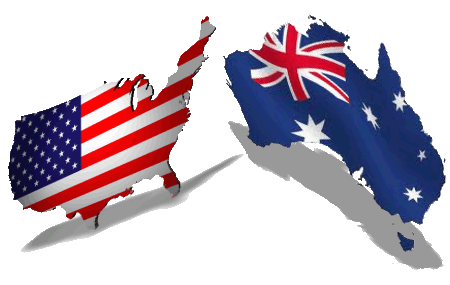
MYTH: Australian Baby Names are Becoming Increasingly Influenced by American Trends

01 Sunday Jul 2012

Posted by A.O. in Baby Name Mythbusters

≈ 20 Comments

Tags

Australian names, Biblical names, classic names, created names, famous namesakes, fictional namesakes, flower names, French names, germanic names, Greek names, Irish names, Italian names, Mer de Noms, name data, name popularity, name trends, nicknames, Old English names, popular names, saints names, Scottish names, Spanish names, surname names, unisex names, US name trends, US popularity, Welsh names

Since I last went mythbusting, the 2011 name data from the United States has been released, and this week it’s American Independence Day. To celebrate both events, I decided to compare Australian and US name data. (Lou at Mer de Noms brought out her own comparison of the data for the United States and England/Wales in May, and did something pretty interesting with it.)

That Australians are becoming increasingly Americanised, including their choice of baby names, is something not debated, but accepted as a truism. It is often mourned by older generations that Australians used to call their children good solid Aussie names like Barry and Sheila, and now give them sleek American-style names like Logan and Scarlett.

It’s a myth which sounds very plausible – I certainly know far more children named Logan and Scarlett than I do Barry and Sheila (actually I don’t know any children called Barry or Sheila). But I thought we should try to get some numbers to back the myth up.

So I decided to look at the Top 100 names from both countries, in the years 1930, 1950, 1970, 1990 and 2011. If the number of names shared by both countries went steadily up, that could help support the theory that Australian names were becoming increasingly “American”. By no means conclusive proof, but it would be a start, and frankly I couldn’t think of any other way of doing it.

As I went through calculating the number of shared names, I also took note of those trends at work in Australia and the United States, where they were the same and where they differed. This gave me a picture of changing trends through the years. (The data is from Victoria, because theirs go back to 1929).

1930

MALE – 65% shared with US Top 100

1930 marked the highest percentage of shared names between the countries. This wasn’t because Australians were more “American” in 1930, but because in every year, the common denominator for both countries were classic names like John, Thomas and William, and these sort of names took up more space of both countries’ Top 100.

Trends noticeable on the Australian Top 100 were names from Ireland, Scotland and Wales, such as Kevin, Malcolm and Trevor, and aristocratic English surnames, such as Neville. Americans preferred prominent surnames of their own citizens, such as Elmer and Lee. Popular names from America we didn’t share were “cowboy” names – Wayne, Earl and Jesse. In America, nicknames for boys were all the rage, including Billy, Bob and Jimmie.

FEMALE – 51% shared with US Top 100

Popular girls names in both countries were homespun names such as Margaret and Dorothy, as well as plant names like Hazel and Rose.

Australian trends for girls included names from Ireland and Wales, such as Sheila and Gweneth, saints names such as Carmel and Veronica, and literary inventions like Doreen and Mavis. American trends were for Germanic names such as Emma and Clara, and the clunky Old English Mildred and Bertha. America’s Hispanic population meant that Delores and Juanita were Top 100 there.

1950

MALE – 59% shared with US Top 100 (down 6%)

American trends for boys we had picked up by 1950 include Gary, after Hollywood star Gary Cooper, and that supposed Australian favourite, Bruce, also popular in the US.

America continued its love of nicknames, with Bobby, Joe and Fred all Top 100. Several of the Irish boys names such as Kevin and Barry were now on the US Top 100 as well, but new Irish-style names such as Shane were still to gain American acceptance. Already in the US you can see a reluctance to use “feminine sounding” or unisex names such as Lindsay and Noel, which were Top 100 in Australia. In Australia, that same 1950s gender-anxiety produced the opposite result, with some unisex names like Leslie becoming male-only.

FEMALE – 47% shared with US Top 100 (down 4%)

The most noticeable shared trends for girls were those glamorous Hollywood names such as Marilyn (Monroe) and Rita (Hayworth). Even when Australians did take a name from America, such as Jennifer from Hollywood star Jennifer Jones, it didn’t always follow that Americans would embrace it as rapidly themselves. Jennifer was a 1950s name in Australia, but didn’t peak in the US until the 1970s.

Australian girls were being given French names like Annette and Jeanette, while Americans girls had Jacqueline. Another popular Australian “French” name was Lorraine, given in honour of St Joan of Arc, sometimes called The Maid of Lorraine. The American love of the nickname meant that names such as Judy and Peggy were Top 100 for girls.

1970

MALE – 56% shared with US Top 100 (down 3%)

Popular 1970 names which we think of as “American style” were in evidence on both charts, such as Bradley, Jason, Glenn, Darren and Craig.

Australian boys names not picked up in the US included Scottish-style names such as Ross, Graham, Stuart and Gavin, and the “feminine sounding” Ashley and Jamie. Differing ethnicities also made their mark, with Spanish Carlos in the US Top 100, and Italian and Greek names like Giovanni and Giorgio in the Australian Top 100. American nicknames powered on, with Larry, Terry and Jerry amongst them.

FEMALE – 51% shared with US Top 100 (up 4%, return to 1930 level)

It was the decade of those 1970s names Sharon and Tracey, although Sharon in particular had been popular in America for some time and we’d only just caught up.

Names such as Samantha and Amanda were already popular in Australia in 1970, but would have to wait until the 1980s to make it big in the US. Conversely, Amy was popular in the US, but wouldn’t be here until the 1980s. French Nicole was in vogue in both countries, and we’d caught up with Jacqueline; however Australia also had Danielle, Louise, Justine, Natalie, Simone and Josephine – typical 1970s girls names that were underused in the US. Scottish and Welsh names like Fiona, Megan and Bronwyn were popular here but didn’t get a look-in in the US. We were proudly using names of Australian origin, like Kylie and Narelle; naturally these were unknown in the US.

1990

MALE – 56% shared with US Top 100 (no change)

Trends from the US we were embracing were Old Testament names, such as Jacob and Zachary; and the new surname names, such as Ryan and Mitchell.

A new generation of “too feminine” boys names that were popular in Australia were ignored in the US, such as Shannon, Tristan and Leigh, as were more Scottish, Welsh and Irish-ish names, such as Lachlan, Rhys and Kane. Hayden and Jayden were already Top 100 in Australia, but not in the US. America had finally gone off nickname names, while Australia now had Jack, Jake and Ricky. American names Beau, Jackson and Tyson were popular then, as now, in Australia; of the three, only Jackson has hit the US Top 100 so far.

FEMALE – 56% the same as the US Top 100 (up 5%)

Names that both countries had in common were those typical 1990s names, like Tiffany, Brittany, Kayla and Caitlin.

Americana we were still to discover included unisex names for girls like Ariel, Shelby and Paige. Although the US had Danielle and Natalie by now, French names such as Monique, Elise, Renee and Madeleine which were popular here had apparently failed to make an impression. Although Welsh Caitlin was all the rage, the US were not on board with Tegan and Rhiannon, as we were. Most notably, Emma, Amelia, Charlotte, Sophie, Chloe and Zoe were missing from the US Top 100 – while American parents who chose these names in 1990 were ahead of the trends, in Australia, parents choosing these names in 1990 were just following the trends.

2011

MALE – 59% shared with US Top 100 (up 3%, return to 1950 level)

Congruence in popularity between the two nations has risen to 1950 levels, with many name trends in common, mostly a fresh crop of Biblical names, such as Elijah, and surname names, such as Mason.

American parents are now avoiding a new generation of Scottish names, such as Angus and Hamish, while Irish names like Declan and Flynn are also neglected in the US. Oddly enough, Kevin is still Top 100 in the US, while it’s considered a bit dated here. The scunner against nicknames continues as Americans shun Australian populars Charlie, Harry, Archie, Sam and Nate. No longer merely  shying away from “feminine sounding” names for boys like Bailey and Riley, parents in the US have actually given these names to their daughters in such numbers that they are now Top 100 for girls, while Top 100 for boys here. Several names we have taken from the US, such as Jett, Hudson and Jasper, are still not popular in America.

FEMALE – 47% shared with US Top 100 (down 9%, return to 1950 level)

Girls names have also returned to 1950s levels. Many names are shared because America has caught up with our popular names from 1990, but Australian parents have also begun to use unisex names for girls like Madison and Addison.

America has abandoned many names as “outdated” such as Amy, Jessica, Holly and Amber that have taken on “modern classic” status here. While America has accepted Lily, it is less keen on our popular plant names Daisy, Ivy, Violet, Willow, Olive and Rose. British-style names such as Isla and Imogen cut no mustard in the States. Meanwhile, popular American virtue names like Genesis, Serenity, Trinity, Nevaeh and Destiny do not resonate here. Perhaps they will in the future.

CONCLUSIONS

I did not manage to bust this myth, but neither did I find much evidence to support it, so I will give its status as MYTH UNCONFIRMED.

As I compared popularity charts from the two countries, I realised more and more that it was a case of apples and oranges. Names took longer to gain popularity in the US, and it was harder for them to stay in the Top 100; name popularity was a competitive environment there. Australia has a much smaller population size, which means that name trends show up faster here. We’re also more likely to hold onto our favourite names once we’ve found them, sometimes for generations.

I don’t think it’s an exaggeration to say that American parents are absolutely obsessed with getting ahead of the current trends, and can watch the slowly rising popularity of their chosen names with almost comical anxiety. This makes some sense, because trending names can take so long to reach the Top 100 that they have a good chance of having ten to twenty years before that happens. In Australia, this behaviour makes no sense at all, because as soon as a name begins to show up in the data, it’s basically already quite popular. As we keep names around for longer, there’s no real rush to “catch” a name on the way up either; we can always wait until it’s a cosy, familiar “classic”.

In any given year, Australia and the US will share around half the names on their respective Tops 100s, and this has not changed across time. We share many name trends, and since at least 1950, Australia has been drawn to names from America. Sometimes it took us a long time to get onto a particular trend from America, and other times we took to it with greater enthusiasm than Americans did themselves.

Both countries also have their own styles of naming. Australia has always been fond of Irish-inspired names, and although Barry and Sheila have fallen by the wayside, we now have Finn and Molly. Scottish names continue to be a growth area, with Angus, Hamish, Callum and Isla seeming rather stylish to us. Through the years, there were many names unique to the Australian popularity charts. Names that I thought of as typical of their period, such as Dulcie in 1930, Glenys in 1950, and Jacinta in 1970 seemed to be unknown in the US.

Americans are slow to adopt Irish names, but often touchingly faithful to them, and are wary of Scottish and Welsh names. They have a deep suspicion of unisex names for boys or anything that even sounds remotely feminine, while comfortable with briskly masculine names for girls. Flower names are not popular there; perhaps they seem too girlish even for girls.

Due to going overboard on nicknames in the past, America has developed almost a horror of them, much in the same way I can no longer stomach gingerbread after overindulging on it a few Christmases ago. As nicknames are currently internationally popular, this has seen them unfairly branded as a bit stuffy on the issue, when they’re really just over the whole thing.

We don’t have to try to follow American trends, and in fact a couple of them would be downright foolish for us to imitate. But the United States has proved a rich source of name inspiration for many decades, and I know it will continue to be so for many decades to come.

Interesting Names Spotted in Print, on Radio and on TV – Autumn Edition

05 Tuesday Jun 2012

Posted by A.O. in Names Spotted at Home and Abroad

≈ 7 Comments

Tags

animal names, astronomical names, Australian Aboriginal names, Chinese names, Cornish names, created names, english names, famous namesakes, Fijian names, Greek names, honouring, Indian names, Latin names, literary namesakes, locational names, mythological names, name history, name meaning, nature names, popular culture, Scottish names, sibsets, unisex names, vocabulary names, Welsh names

This celebrates the fourth birthday of a little boy who was the first baby born at Saltwater in New South Wales in over a century. The beachside area is the traditional place of the Worimi-Biripi people, and is now in a national park. Dawn Morcombe gained special permission to give birth at this spiritually significant location, and she named her son Yarramundi John Michael Hollis. Yarramundi was a famous Indigenous leader of the colonial era; his son was Colebee, who was featured on the blog last year. His name is said to mean “deep water”. Fantastic story, namesake, and meaning, especially for a baby born at Saltwater!

Debbie Bell from South Australia has had a rough life and been through more than her fair share of heartache. However, after a great deal of physical and emotional suffering, she and her husband Ian were at last able to have a baby through a donated embryo, and named their son Derlerean. I think Debbie and Ian may have created this name themselves. It reminds me of the car, the Delorean.

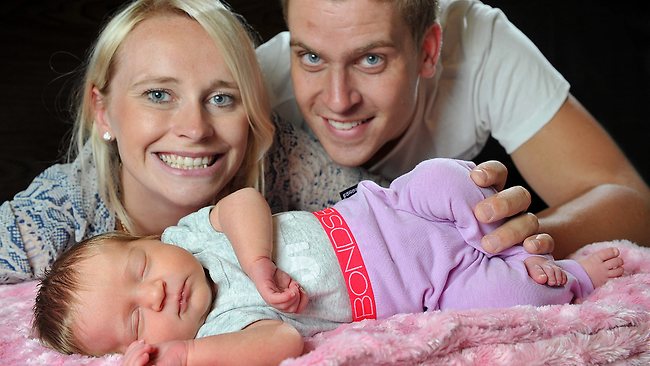
Victorian couple Charlotte Gernandt and Dale Hynes called their first baby Tinkabell Darling [pictured]. Now this sounds like a name straight out of Peter Pan, but Charlotte and Dale say she is not named after the fairy. Um, okay … must be inspired by some other Tinkerbell … She’s called Tinka for short.

Emma Preston was so crippled by endometriosis that she was confined to a wheelchair, and had little hope of ever having a baby. But then Sydney fertility specialist Dr Geoff Reid not only got her out of her wheelchair, he helped her to conceive through embryo transfer. Emma was so grateful, she named her baby after him. No, the baby’s not called Geoff; her name is Reid Louise. Nice gesture and name story.

It’s not often a baby ends up in the paper just because of his name, but this one is quite striking. Kate Anderson and Lance Walshe, from the Yarra Ranges just outside Melbourne, named their son Viper. His name was inspired by Lance’s love of snakes, and the couple wanted an original name that nobody else had. They considered Wolfgang, but rejected it because they thought it might lead to teasing. Viper Walshe doesn’t have a middle name, and if he’d been a girl, his name would have been Ruby Joanne. Kate says his name has met with mixed reactions.

A story from Port Macquarie on the ever-rising prices on electricity bills featured a struggling single mum named Bek Latimore. Bek’s baby girl is named Arizona; although I generally don’t go for American-states-as-names, this one always puts a smile on my face. I’m not sure I can ever imagine using it myself though. Arizona’s older brother is named Nick, which made me think – could Nick be short for Phoenix? Hmm?

This story about a midwifery programme at Canterbury Hospital in Sydney showed a mother with an elegant name: Eglantine Jalicot. Eglantine’s son has an equally stylish name – Lysander. His ancient Greek name means “release of a man”, and belonged to a famous military general of ancient Sparta. Eglantine is another name for the sweetbriar, and is first found as a personal name in Chaucer’s Canterbury Tales.

Two interesting and pretty girls’ names from a story on sleep and babies: Luna and Reya. Luna is of course Latin for “the moon”, and Reya is an Indian name which means (I think) “wealth”.

A story on a new breech birth clinic at Westmead Hospital in Sydney showed mum Mallissa Tulfua with her son Tevita. His name is the Fijian form of David.

A Brisbane columnist covers a naming dilemma from real life when two of her friends cannot agree what to name their baby. Readers are invited to help name their sprog, but as we’re not told what names they’ve come up with already, it seemed a rather futile exercise (although apparently the mother had rejected Luke as “not masculine”, which seemed odd). The columnist notes some of the baby names from her own extended family are Echo, Theo, Roarke, Ziad, Ingrid and Rudi.

Alana Mahadik had a very difficult childbirth with her first son, Avighna. With her second, she opted for hypnobirthing at Caboolture Hospital in Queensland on Anzac Day, and found the whole experience very quick and stress-free. Her new baby son’s name is Rudra, which is an Indian name meaning, aptly enough, “remover of pain”. Avighna’s name means “remover of obstacles”.

A rather adorable little baby girl was sadly abandoned at Canterbury Hospital early this year. The baby has been named Li-Ye, which means “beautiful child” in Chinese. Only a few babies have been abandoned this way in New South Wales in recent years: two others were named Adam and Sunday April. All of these babies were eventually adopted after their birth mothers failed to come forward.

Interesting Names of Adults

An ABC radio podcast on parenting featured a Melbourne child psychologist named Angharad Candlin. This Welsh name meaning “greatly loved” is one I have admired since childhood, yet never before seen on a real person (although I didn’t actually see her, as it was radio).

This travel writer, enjoying the Sicilian sun, has the name Dugald Jellie. There’s quite a few Australians with this Scottish form of Douglas as their name, but Dugald Jellie seemed just a bit more interesting and storybook-character somehow.

The junk mail of one April morning produced a community newsletter about a new medical centre opening in the area. One of the doctors was named Demelza – a Cornish place name from the Poldark books and TV series. I briefly thought about changing doctors just to have a GP named Demelza, but couldn’t face all the paperwork.

I read One Way or Another: The Story of a Girl Who Loved Rock Gods, the memoirs of Gold Coast rock star groupie Nikki McWatters. Eventually she sees the error of her ways, and settles down by sensibly marrying a schoolteacher. Her husband’s name? The very rockstar-sounding Zeus. As well as teaching school, Zeus is a trained opera singer, so she obviously never lost her thing for male vocalists.

Channel 7 have resurrected The Price is Right, which I find keeps the troops quietly occupied while I make dinner. As I stir and chop, I keep an ear out for names: so far I have seen a pair of sisters named Jalila and Janita (late teens to early twenties), a woman named Feda, pronounced like “feeder” (twenties), and a grandmother named Dixie (around sixtyish).

Less Commonly Used Girls Names

03 Sunday Jun 2012

Posted by A.O. in Name Themes and Lists

≈ 20 Comments

Tags

Abby Sandel, alphanumeric names, Arabic names, Baby Name Wizard, Bonds Baby Search, celebrity baby names, Celtic names, created names, english names, famous namesakes, fictional namesakes, French names, Greek names, hebrew names, Italian names, locational names, Mer de Noms, modern names, mythological names, name data, name history, name meaning, name popularity, Nameberry, Names from the Dustbin, nicknames, popular culture, pseudonyms, rare names, Scottish names, Semitic names, Shakespearean names, stage names, surname names, The Nameberry Nine, Turkish names, unisex names, vocabulary names

When all the name data for the most popular names was released, there were also several articles which looked at some of the names closer to the bottom of the popularity lists than the top. Dorcas at Names from the Dustbin calls these names Bottom of the Barrel – not meaning that they are necessarily of poor quality, but just low in the rankings.

Most names at the bottom of the lists are just re-spellings of common names, or short forms of names that are usually kept as nicknames rather than a full name. However, if you sift through these, there’s some interesting finds at the “bottom of the barrel”, and even some neglected gems.

These names are from the popularity charts of New South Wales, Victoria, Queensland, and Tasmania. Nearly all of them are taken from the very rarest names in their state.

Adeline

This is a pet form of the French name Adele; the French pronunciation is a-de-LEEN, but the English is AD-uh-line. The name is well known from the American ballad Sweet Adeline, which was a standard for Australian folk band, The Seekers. There’s also the piece, Ballade pour Adeline, written for the composer’s baby girl, which I had to thump out tunelessly with my chubby fingers during many a childhood music lesson. However, Adeline has got considerably cooler since then; Kasey Chambers has a song called Adeline, Green Day’s Adeline Records handles indie rock bands, and Elliot Smith released his own darker version of Sweet Adeline. I read at Abby’s Nameberry Nine that Simon Helberg from The Big Bang Theory welcomed a daughter named Adeline last month, making it an up-to-the minute celebrity baby name. Adeline has never been on the Top 100; it was #162 for the 1900s, and then sank until it was out of regular use by the 1940s. Today it fits in well with Adelaide, Addison, Madison and Madeline; however it may be difficult for short form Addie to stand out amongst the sea of Maddies and Abbies.

Allegra

Allegra means “cheerful, lively” in Italian, related to the musical term allegro, and has a long history as a celebrity baby name. Romantic poet Lord Byron re-named his illegitimate daughter Clara Allegra Byron (called by her middle name, and originally named Alba by her mother). Despite poor little Allegras’s life being brief and marked by neglect, the name seems to have been an apt one, because she was described as a vivacious child. Her story didn’t stop American poet Henry Longfellow from using it as his daughter’s middle name; in his poem The Children’s Hour, he describes her as “laughing Allegra”. The American inventor and designer, Buckminster Fuller, also gave this name to his daughter. Allegra Versace is the daughter of Italian designer Donatella Versace, and Allegra Kurer is the daughter of British radio host Vanessa Feltz. In Australia, news presenter Jessica Rowe chose it for her eldest daughter in 2007, and last year it was chosen for the daughter of Emmy Kubainski. Frothy and elegant, with a positive meaning, this fashionable favourite would also make a good Italian heritage choice.

Bonnie

Bonnie is taken from the Scottish word bonnie, meaning “pretty, beautiful”; it’s derived from the French bon, meaning “good”. Bonnie has been used as a personal name since the 19th century, and was even sometimes given to boys, but received a huge boost when it was used in Margaret Mitchell’s popular romance, Gone with the Wind. Bonnie Blue Butler is the daughter of Scarlett and Rhett, and receives her name because she has eyes the colour of the Bonnie Blue Flag – the banner of the Confederate States in the American Civil War. British rocker Billy Idol, who sang Rebel Yell, named his daughter Bonnie Blue, and we had a Bonnie Blue competing in the Bonds Baby Search. Another famous Bonnie is Bonnie Parker, one half of notorious crime duo Bonnie and Clyde. Bonnie has been on the charts almost continuously, albeit in rare use in the 1950s and ’60s. It had a peak in the 1920s at #172, then peaked again in the 1990s at #157; it’s currently climbing in the mid-100s in New South Wales, but is obviously rarer in other states. It’s a sweet old-fashioned name which is also linked to rebellion, giving it a spunkier image.

Cleopatra

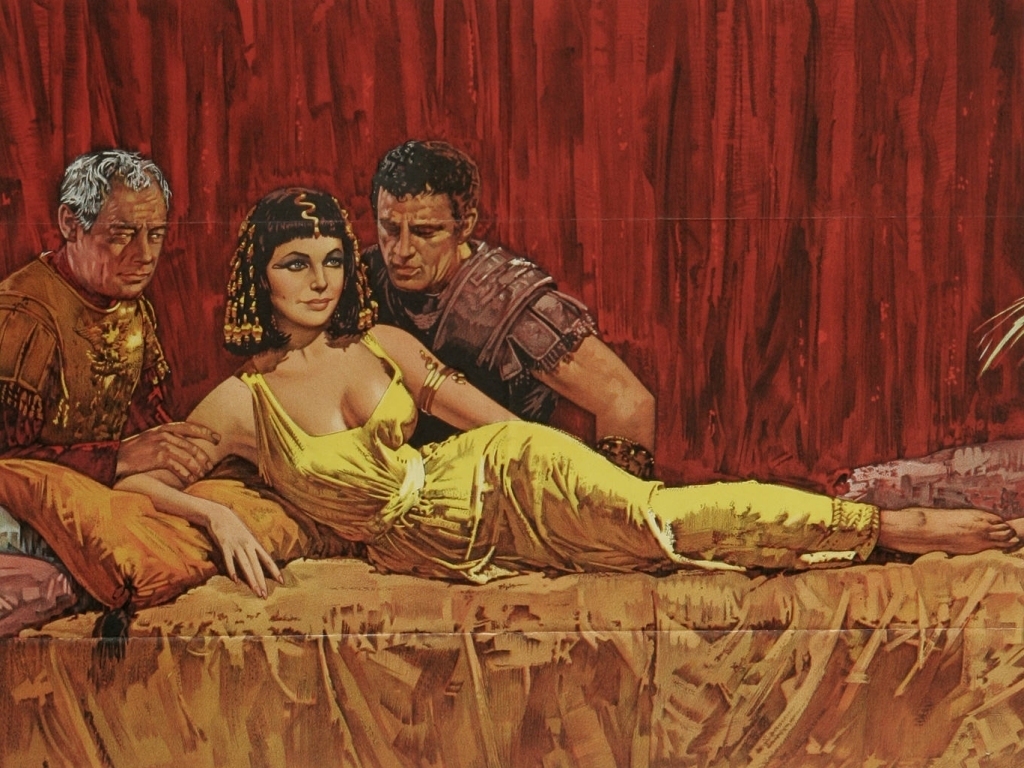
This Greek name means “glory of the father”, and is almost impossible for us to disassociate from the famous Queen of Egypt. From a dangerously inbred family of Macedonian Greek origin, she ruled Egypt alongside her father, and then her brothers (who were also her husbands), but then seized control and reigned alone for many years. She was able to align herself with Rome as both ally and lover to both Julius Caesar and Mark Antony, but after Mark Antony’s death, is said to have poisoned herself before she could be captured and humiliated. According to tradition, she killed herself with an asp. Her story captured the imagination of William Shakespeare, who based his play Antony and Cleopatra on the last part of her life, and her story has been made into several films, including the lavishly dreadful one starring Elizabeth Taylor and Richard Burton. Cleopatra is always depicted as a woman of great beauty, although early traditions suggest her attractiveness was based more on enormous charm and sex appeal. This ancient, glamorous name carries a lot of weight, but with short form Cleo becoming fashionable, some parents may wish for a long form of the name.

Elif

This Turkish name is after Alif, the first letter of the Arabic alphabet, and has connotations of “tall and slender”, as if the person is shaped like the letter, which is a long vertical line. It is pronounced ay-LEEF. You probably recall that Natalie Portman had a son named Aleph last year; Aleph is the Hebrew form of the same letter. The meaning of the letter goes back to the West Semitic word for “ox”, as the cuneiform originally represented the shape of an ox’s head. In Arabic, the word is connected via folk etymology to the word for “coy, tamed”, giving it a subtly demure feeling. It’s a common girl’s name in Turkey, and there are several Turkish celebrities with this name. There’s also a town in Turkey called Elif. I’m not sure a non-Turkish person would ever use it, but it’s certainly an attractive name that is easy enough for an English-speaker to understand and pronounce, once they’ve learned how it’s said.

Harlow

This name is inspired by Jean Harlow, a Hollywood superstar of the 1930s. With her platinum hair and vampish image, she was the forerunner to many blonde bombshells of the movies. Despite her beauty and success, Harlow’s life contained much tragedy, and she died of kidney failure while only in her twenties. Harlow took her mother’s maiden name as her stage name; her birth name was Harlean Carpenter. The surname Harlow is from several places in England. Harlow in Yorkshire means “hill of rocks” in Old English, while the meaning of Harlow in Essex is disputed. One theory is that it means “army hill”, with the idea being that local landmark Mulberry Hill was a meeting place for the local people. Another is that it means “temple mound”, as there is an Iron Age burial mound in the area which later had a Roman temple built on the site. Harlow is a unisex name, but more common for girls; the name came to public attention when Nicole Richie named her daughter Harlow in 2008. There were 20 babies named Harlow in Queensland last year, up from 12 the year before. Although numbers are still low, that’s a significant jump.

Pixie

This name is after the small mythological being of English folklore, tales of which come from Cornwall and Devon. They are usually depicted as small sprites who could be mischievous, but were often helpful to humans. A famous Australian with this name was the prolific illustrator and artist Pixie O’Harris (aunt of singer-artist Rolf Harris). Her real name was Rhona Olive Harris, but when she migrated to Australia from Wales she changed her name to Pixie because she was nicknamed “the Welsh pixie” on the boat over. A printer’s error changed her name from Pixie O. Harris to Pixie O’Harris, and she stuck with it as her pseudonym. Last year, businesswoman Roxy Jacenko named her new baby Pixie-Rose. I think some people will find the name Pixie adorably cute, and others impossibly twee; it’s bound to get some interesting reactions, and does have the fashionable X in it.

Sippie

The only person I know of named Sippie is the blues singer Sippie Wallace, who was born Beulah Thomas. Her career spanned seven decades, and although she found fame as a young woman in the 1920s, she was rediscovered in the 1960s and ’70s and was a big influence on Bonnie Raitt, who went on tour with her. Her album Sippie won the Blues Album of the Year in 1983, so her comeback was a definite success. The name Sippie is one that she gained in childhood because the gap in her teeth meant that she had to “sip” all her food and drink. Coincidentally, there is a place on the Gold Coast called Sippy Downs; its name is a corruption of an Aboriginal word meaning “winged creatures”, and interpreted as meaning “birds”. As Sippie Wallace was billed as “The Texas Nightingale”, I find this juxtaposition very charming. Sippie is an unusual name, but what a wonderful namesake. This would be very suitable for a family who loves music, especially jazz and blues.

Torah

In Australia, this name is well known as belonging to snowboarder Torah Bright, who won gold at the 2010 Winter Olympics. Her parents named her after the Torah, which is the Jewish word for the first five books of the Old Testament. The word is from the Hebrew, meaning “teaching, instruction”, however, Torah Bright’s mother believed that it meant “bearer of a great message”. Torah Bright is a member of the Church of Latter Day Saints (Mormon), and lives in Salt Lake City, Utah. There was slight disbelief at this name on The Baby Name Wizard, with a couple of people feeling that it seemed rather offensive, or at least strange. Torah’s name was reported on in Washington Jewish Week; there was no mention of it being offensive to Jews, but they did appear to find it slightly amusing. Like calling your child Bible or Gospel, many will find this name a head-scratcher. It would be given in honour of our Olympic champion, but the religious ramifications may be lost on some people. The fact that it sounds as if it could be short for Victoria is probably a help.

Zahlia

This name is pronounced ZAH-lee-uh, and as far as I’m aware, it’s a modern invention. It seems to be an elaboration of the name Zali; Zali Steggall is Australia’s most internationally successful alpine skier (now retired). Her name has proven a great success here, and spawned many variants, such as Zarly, Zahlee, Zalie etc. It’s unclear where the Stegalls got the name Zali from, and to the best of my knowledge, it’s made up. Zahlia does well in Australia, because it sounds rather exotic, while also being similar to popular names such as Zara and Tahlia (it even looks like a combination of those names). Despite being listed as a rare name, I have seen some parents dismiss Zahlia as being “too common”; perhaps it’s not rare enough to seem “unique”, or perhaps the many variants and sound-alike names make it appear to be one of the pack.

(Picture is from one of the posters for the 1963 movie Cleopatra)

Harvey Norman Photocentre Baby and Toddler Moment Contest

03 Thursday May 2012

Posted by A.O. in Baby Contests

≈ 7 Comments

Tags

created names, Sanskrit names, Star Wars names

FINALISTS

Alex

Archie

Astrud

Brendan

Brooke

Caleb

Cooper

Cruz (winner)

Darshan (a Sanskrit word meaning “sight, vision (of the Divine)”

Draedan (a species of sentient amphibian in the Stars Wars universe)

Ella

Gabriela

Gia

Grace

Henry

Joshua

Levi

Lucas

Mackenzie

Maddox

Matthew

Mia

Nathaniel

Parker

River

Scarlett


Other entrants (from newspaper stories)

Amelia

Chayse

Corban

Hayden

Koby

Natalie

Noah

Rohan

Popular Names for Girls

29 Sunday Apr 2012

Posted by A.O. in Name Themes and Lists

≈ 29 Comments

Tags

acronyms, Appellation Mountain, band names, Biblical names, celebrity baby names, created names, english names, Etruscan names, famous namesakes, fictional namesakes, flower names, French names, gemstone names, germanic names, Greek names, Italian names, Latin names, Linda Rosenkrantz, locational names, mythological names, name data, name history, name meaning, name popularity, name trends, Nameberry, nature names, nicknames, Norman names, popular culture, popular names, retro names, royal names, Shakespearean names, ship names, tribal names, vocabulary names

In honour of the name data being released, I thought I’d do lists of the most popular names in Australia for last year. I admit this was something of a last-minute decision, but it seemed like a good opportunity to cover some of the best-loved names.

People often ask how popular names got to be popular. I’m not sure there’s really a good answer to that – clearly people like the sound of them, and they fit in with current trends. Yet there must be many names, equally as nice-sounding and trend-friendly, that lurk around the 200s and don’t seem as if they are going anywhere much.

Although I cannot tell you what events caused these names to become popular, I can tell you some of the events which accompanied their rise. I’m definitely not trying to say that they were the cause of a name’s popularity, just that they coincide with it (and really sometimes it seems more than merely coincidental). Feel free to add other events you can think of, or any theories of your own!

Note: I’ve used data from New South Wales, but it must be broadly accurate for the rest of the nation too.

Lily

Lily seems to have begun as a pet form of Lilian, but must soon have become thought of as a flower name. The lily is sacred to the Virgin Mary, and Jesus urged his followers to “consider the lilies of the field” as a model in trusting Divine Providence. Lily has been almost continuously in the charts, only dropping out during the 1960s. It began rising in the 1980s – a decade when Princess Lily was the main female character in fantasy film Legend, and when Phil Collins and Kevin Costner welcomed daughters named Lily. A Top 100 name in the 1990s, it continued climbing, as Kate Beckinsale welcomed a daughter named Lily, while Johnny Depp named his baby girl Lily-Rose. By the early 2000s, Lily was already a Top 20 name, and during this decade, Lilly was the main character’s best friend in The Princess Diaries movie, Lily Potter was Harry’s mum in the Harry Potter movies, and pop singer Lily Allen released her first hit. Last year Lily was the most popular name for girls, once combined with the spelling Lilly. Delicate and pure, yet with several spunky namesakes, pretty Lily became a favourite.

Ruby

Ruby is named after the precious gemstone, whose name from Latin simply means “red”. Retro Ruby was popular during the 1900s, then dropped out completely during the 1960s and ’70s, despite being a popular name in songs; notably Ruby Tuesday and Ruby Don’t Take Your Love to Town. It began rising in the 1980s, as comedienne Ruby Wax barged her way onto our TV screens, and singer Rod Stewart welcomed a daughter named Ruby. The name climbed steeply during the 1990s, and turned up in more songs: Ruby Soho by Rancid, Thru’ the Eyes of Ruby, by The Smashing Pumpkins, and Ruby Wednesday by Eskimo Joe. By the early 2000s, Ruby was a Top 50 name, and by the late 2000s, it was Top 20. During this decade, the song Ruby was a hit for The Kaiser Chiefs, Renee Zellweger played Ruby in the movie Cold Mountain, and Ruby Buckton was a free spirited teen on popular soap, Home and Away. Charlotte Church, Tobey Maguire, and Harry Kewell all welcomed daughters named Ruby. Last year it was #2 for girls, once combined with the spelling Rubi. Flaunting Ruby sparkles, and is a name worth singing about.

Chloe

Chloe means “young green shoot” in Greek, and was one of the epithets of the earth goddess Demeter. From early on, it was a favoured literary name; Chloe is the heroine of the pastoral romance Daphne and Chloe, by the Ancient Greek writer Longus. The name was also considered suitable for use by the Puritans, because Chloe is an early Christian mentioned in the New Testament. Chloe first appeared on the charts in the 1970s; a decade when an arty French film, re-titled Chloe in the Afternoon, was released to English-speaking audiences. Chloe stormed up the charts and was Top 100 by the 1980s. During this decade, actress Candice Bergen and singer Olivia Newton-John both welcomed daughters named Chloe, and Chloe Jones was one of the characters in long-running soap, A Country Practice. By the 1990s it was Top 20, and Logie-winning actress Kristy Wright played the tragically troubled Chloe Richards on popular soap, Home and Away. Chloe was Top 5 by the early 2000s; it reached #1 in 2006. Fresh and spring-like, Chloe has been recommended at Appellation Mountain, and Linda Rosenkrantz from Nameberry named her daughter Chloe – some serious name-guru approval.

Mia

Mia seems to have become popularly known through actress Mia Farrow, the daughter of Australian film director John Farrow, and Irish actress Maureen O’Sullivan. Mia is short for Ms Farrow’s real name, Maria. Mia first appeared on the charts in the 1960s, after Mia Farrow began her career, but rose in popularity very gradually. An interesting link with another name on the list is that Princess Lily in Legend was played by actress Mia Sara; is it a coincidence that both names began climbing at the same time? It started making significant gains in the 1990s, a decade when Uma Thurman played Mia Wallace in Pulp Fiction. Although not yet Top 100 in the 1990s, by the early 2000s it was already Top 20. In this decade, we met Amelia “Mia” Thermopolis, heroine of The Princess Diaries movie, and Mia Toretto from The Fast and the Furious films. It was chosen as the name for their daughter by actress Bec Cartwright and tennis champion Lleyton Hewitt. Top 10 by the late 2000s, it reached #1 in 2008. Simple and cute, Mia has another Australian connection – it is an acronym for Made in Australia.

Olivia

Olivia is a name invented by William Shakespeare for a character in Twelfth Night. Olivia is a beautiful noble lady in mourning for her brother; through an amusing misunderstanding, she falls in love with a woman named Viola disguised as a man. Through another amusing misunderstanding, she marries Viola’s twin brother Sebastian by mistake, but fortunately he is so much like his sister in looks and personality that she is happy with the outcome. Famous Olivias include actress Olivia de Havilland and Olivia Arias, the widow of Beatle George Harrison. Olivia first appeared on the charts in the 1960s, just as singer Olivia Newton-John began her career, and rose steadily. Her popularity took off in the 1980s (perhaps by coincidence, the era when Ms Newton-John enjoyed her greatest success), and by the 1990s she was already a Top 20 name. During the 1990s, Denzel Washington and Lance Armstrong welcomed daughters named Olivia. In the early 2000s, Mariska Hargitay was playing Olivia Benson on Law and Order: SVU, and by 2005 Olivia had reached #1. Shakespeare had a knack with names, and this one is elegant; I picked it to be the Jessica of our time, and equally resilient.

Isabella

Isabella is a Latinate form of the name Isabel; it was a favourite amongst European royalty from the Middle Ages onwards. Isabella is a stock character in the Italian commedia dell’arte, the flirtatious and alluring female lover that men make fools of themselves over. She is named in honour of the actress, playwright and poet Isabella Andreini, who became famous in the role. Isabella has been on the charts almost continuously, although her last time in the Top 100 was in the 1900s. She dropped out completely during the 1950s, and then again in the 1970s. She made a recovery in the 1980s just as Italian actress Isabella Rosselini became internationally known, and then skyrocketed. Nicole Kidman and Tom Cruise adopted a daughter in the early 1990s and named her Isabella, and the name was comfortably Top 50 for that decade. When Stephenie Meyer’s novel Twilight was published in 2005, its heroine named Isabella “Bella” Swan, Isabella was already #7; Isabella reached #1 in 2009, the year after the Twilight film was released. Ornate and ultra-feminine, it is an Australian royal baby name, as Prince Frederik and Princess Mary of Denmark named their first daughter Isabella.

Charlotte

Charlotte is a French feminine form of Charles; a common name amongst European royalty, it was introduced to Britain in the 17th century by the Hanoverians. The Charlotte was one of the ships of the First Fleet, who reached Australia in 1788. Charlotte has been almost continuously on the charts, only disappearing in the 1950s. She began climbing gradually in the 1960s, a decade when English actress Charlotte Rampling’s film career began. The name grew steeply in the 1980s, a decade in which Charlotte “Charlie” Blackwood, played by Kelly McGillis, is the love interest to Tom Cruise’s Maverick in the movie Top Gun. It made the Top 100 by the 1990s, when actress Sigourney Weaver welcomed a daughter named Charlotte, and when the band Good Charlotte began their career. It was Top 20 in the early 2000s, while we got to know the romantically optimistic Charlotte York in Sex and the City, played by Kristin Davis; by the end of the decade it was Top 10, as as singer Charlotte Church progressed her career from classical to pop. Sophisticated yet sensible, with the option of a tomboy nickname, Charlotte has yet to make #1.

Sophie

Sophie is the French form of Sophia; the name was used in several European royal families. Sophie first entered the charts in the 1950s, and through steady growth, made the Top 100 by the 1980s. It was during this decade that William Styron’s Sophie’s Choice was made into a film; Meryl Streep won an Oscar for her performance as Zofia “Sophie” Zawistowski, the beautiful Polish immigrant with a tragic secret. The same year the film came out, Roald Dahl‘s book, The Big Friendly Giant was published; the heroine is called Sophie, named after Roald Dahl’s grand-daughter (later fashion model Sophie Dahl). During the 1990s Sophie took off, and was a Top 20 name during that decade. It was during the ’90s that the best-selling novel, Sophie’s World, was published, and actress Sophie Lee and singer-actress Sophie Monk both began their careers this decade. At the end of the 1990s, Sophie Rhys-Jones joined the British Royal Family when she married Prince Edward. Sophie was Top 10 by the early 2000s, and many are tipping sweet and simple Sophie to become the #1 name within the next few years.

Sienna

Sienna is the English name for the Italian city of Siena,in Tuscany. As a word, it refers to a type of clay used to make oil paints, and a shade of yellow-brown, after the hue of said clay. The city’s name comes from the Etruscan tribe who originally inhabited the area, the Saina, but the Romans derived it from the Latin for “old” (the same Latin root which gives us the word senile). Sienna first entered the charts in the 1980s, and climbed steeply during the ’90s. I think the name suited the aspirational nature of that era. Italy was very “big”; pizza was becoming a mainstream food, and the adults around me were guzzling Chianti and buying time-shares in Tuscan villas. British model-actress Sienna Miller is not responsible for the name’s popularity, because it had been climbing for some time, but can it be purely coincidental that it first joined the NSW Top 100 in 2002, the year after Ms Miller’s career began? From that point, its climb was so vertiginous that it was Top 10 by 2006. Smooth, modern Sienna seems certain to go higher still.

Ella

Ella is the Norman form of the Germanic name Alia, a short form of names with the element ali, meaning “other”. However, it can also be used as a short form for Eleanor, Ellen, Elizabeth or any name starting with El, and also the many names ending with -ella. It’s hard not to connect this name with jazz great, Ella Fitzgerald. Ella has been on the charts almost continuously, with her last time in the Top 100 in the 1900-10s. She was soon in rare use, although she only disappeared completely during the 1960s. She climbed slowly during the 1980s, and steeply during the 1990s. It was during the ’90s that Ella got a new singing namesake – Ella Hooper from rock band Killing Heidi. Ella was Top 20 by the early 2000s. She received several boosts around this time, for the movie Ella Enchanted was released, a re-telling of the Cinderella story. Warren Beatty, John Travolta, Mark Wahlberg and Ben Stiller all welcomed daughters named Ella, giving the name a distinct celebrity flavour. Top 5 in the second half of last decade, Ella feels as if she may have peaked, and is possibly on her way down again.

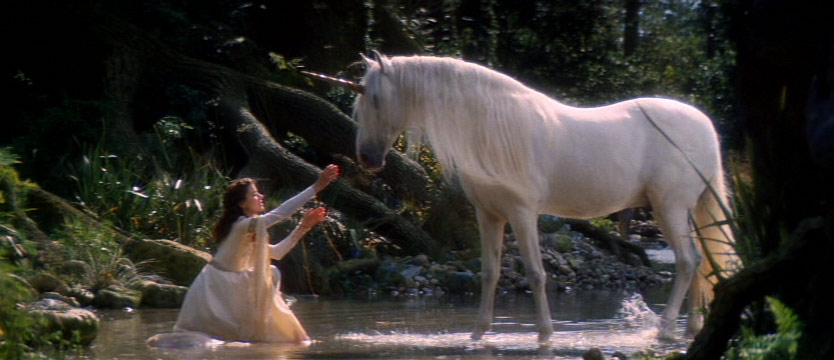
(Picture shows Princess Lily and unicorn, from Ridley Scott’s 1985 cult fantasy film Legend)

Names That Reach Beyond the Worldly from the Bonds Baby Search

05 Thursday Apr 2012

Posted by A.O. in Baby Contests

≈ 1 Comment

Tags

created names, english names, hebrew names, Indian names, mythological names, virtue names, vocabulary names

I’ve included names of Gods and Goddesses, mythological beings, religious and spiritual terms, and virtue names. I’m sure there are many I have missed, but please attribute this to my ignorance, and not to any wish to offend.

GIRLS

Amity

Angel

Aurora

Avalon

Bliss

Carmen

Chai

Charity

Cherish

Destiny

Durga

Eden

Ever

Faith

Felicity

Fidelia

Halo

Haroseta

Honor

Hope

Isis

Juno

Kali

Lorelei

Lucina

Luna

Nevaeh

Nirvana

Patience

Piata

Pixie

Selena

Serana

Serenity

Shiloh

Soham

Taufa

Temperance

Torah

Trinity

Uma

Veda

Venus

Verity

Vrinda

Zaria


BOYS

Apollo

Ares

Bodhi

Creed

Daemon

Deacon

Dios

Gryphon

Infinity

Justice

Kesh

Loki

Maxim

Odin

Orion

Phoenix

Soul

Thor

Talisyn

Tao

Titan

Zen

Zephyr

Zeus

Zion

Those Mysterious Modern Monikers from the Bonds Baby Search

04 Wednesday Apr 2012

Posted by A.O. in Baby Contests

≈ 6 Comments

Tags

created names, Google, modern names, portmanteau names

Yesterday we had old school names, comforting and familiar. Today we have those names from our own era that are hard to pin down. They aren’t always included in baby name books. When you search for them, Google insists you must mean some other name. Baby name sites say the name might be Irish … then again, perhaps it’s Hawaiian. It might be a cross between these two names – or three completely different names. Often the answer just seems to be “modern”. But when you show them side by side, they sometimes show a remarkable similarity.

Wave of the future or flash in the pan? Only time can tell.

GIRLS

Acelyn

Adrielle

Ahrna

Ameeka

Amilea

Amoi

Arley

Arnika

Ataaliyah

Avalina

Brylee

Calleigh

Cartia

Daja

Donnicha

D’Chaeylyn

Heckayla

Helayla

Ilandea

Ileeyah

Indeaka

Indica

Jacey

Jaileigh

Jakayla

Jayneesha

Jazlyn

Jezaya

Jettika

Kaylee

Kiani

Kianna

Kristabella

Laahlee

La’Teesha

Lujayn

Makeely

Mirrah

Nimella

Oceanna

Rhianna

Santaysha

Serannah

Sevilo

Shahkeia

Shakiylah

Shandara

Sharleah

Shiola

Suvannah

Tahnee

Twyla

Uvoncka

Zailee

Zarayah


BOYS
Alyrik

Baiden

Baylin

Danyon

Deondre

Desean

Djakai

Dujah

Havarley

Jahvius

Jaren

Jahsean

Jermaine

Jettah

Juhsean

Kaivin

Kalden

Kayle

Kaylis

Kaysen

Keandre

Keontei

Khoder

Khotori

Kyan

Laiken

Lakey

Lebron

Maxx

Raice

Tarkyn

Taye

Ti

Trey

Tynuka

Zaikeb

Zarley

Zayden

← Older posts
Newer posts →

Enter your email address to follow this blog

Categories

Archives

Recent Comments

A.O.'s avatarwaltzingmorethanmati… on Zarah Zaynab and Wolfgang…
Madelyn's avatarMadelyn on Zarah Zaynab and Wolfgang…
JD's avatardrperegrine on Can Phoebe Complete This …
A.O.'s avatarwaltzingmorethanmati… on Rua and Rhoa
redrover23's avatarredrover23 on Rua and Rhoa

Blogroll

  • Appellation Mountain
  • Baby Name Pondering
  • Babynamelover's Blog
  • British Baby Names
  • Clare's Name News
  • For Real Baby Names
  • Geek Baby Names
  • Name Candy
  • Nameberry
  • Nancy's Baby Names
  • Ren's Baby Name Blog
  • Sancta Nomina
  • Swistle: Baby Names
  • The Art of Naming
  • The Baby Name Wizard
  • The Beauty of Names
  • Tulip By Any Name

RSS Feed

  • RSS - Posts

RSS Posts

  • Celebrity Baby News: Melanie Vallejo and Matt Kingston
  • Names from the TV Show “Cleverman”
  • Can Phoebe Complete This Sibset?
  • Zarah Zaynab and Wolfgang Winter
  • Baby, How Did You Get That Name?
  • Celebrity Baby News: Media Babies
  • Celebrity Baby News: Adelaide Crows Babies
  • Celebrity Baby News: Chris and Rebecca Judd
  • Names at Work: Name News From the World of Business and Employment
  • Celebrity Baby News: Sporting Round Up

Currently Popular

  • Celebrity Baby News: Alisa Camplin and Oliver Warner
  • Rare Boys Names From the 1950s
  • Sad Celebrity Baby News (contents may cause distress)
  • Celebrity Baby News: Jacinta Allan and Yorick Piper
  • Celebrity Baby News: Nicki Gemmell and Andrew Sholl

Tags

celebrity baby names celebrity sibsets english names famous namesakes fictional namesakes honouring locational names middle names name combinations name history name meaning name popularity name trends nicknames popular names saints names sibsets surname names twin sets unisex names

Create a free website or blog at WordPress.com.

Privacy & Cookies: This site uses cookies. By continuing to use this website, you agree to their use.
To find out more, including how to control cookies, see here: Cookie Policy
  • Subscribe Subscribed
    • Waltzing More Than Matilda
    • Join 517 other subscribers
    • Already have a WordPress.com account? Log in now.
    • Waltzing More Than Matilda
    • Subscribe Subscribed
    • Sign up
    • Log in
    • Report this content
    • View site in Reader
    • Manage subscriptions
    • Collapse this bar
 

Loading Comments...