• About
  • Best Baby Names
  • Celebrity Baby Names
  • Celebrity Baby Names – Current
  • Celebrity Baby Names – Past
  • Featured Boys Names
  • Featured Girls Names
  • Featured Unisex Names
  • Links to Name Data
  • Waltzing on the Web

Waltzing More Than Matilda

~ Names with an Australian Bias of Democratic Temper

Waltzing More Than Matilda

Tag Archives: American names

Famous Name: Winsome

30 Wednesday Oct 2013

Posted by A.O. in Famous Names

≈ Comments Off on Famous Name: Winsome

Tags

Abby Sandel, American names, english names, famous namesakes, historical records, locational names, modern names, name history, name meaning, Nameberry, Nameberry Nine, nicknames, rare names, surname names, virtue names, vocabulary names
giovanni_boccaccio_women_playing

If you were in Sydney in early October, you could have attended the Royal Australian Navy International Fleet Review, celebrating one hundred years of our navy. Or, if you were of a more musical bent, you could have been there for The Renaissance Player’s 35th Runnymede Pop Festival. Held at Sydney University in its Gothic-style Great Hall, this is a unique concert of music, mime and poetry from medieval Europe, performed in brightly-coloured costumes.

The Runnymede Pop Festival has been going since 1973, and from the beginning has featured early music specialist Winsome Evans. Winsome is the director of the Renaissance Players, Australia’s oldest early music ensemble, and she is a professional harpsichordist, composer, and arranger. She conducted the first Renaissance Players concert while still a student.

Winsome is a recipient of the British Empire Medal in the Queen’s Birthday Honours List, The Order of Australia, and a NSW Jaycees Award for services to music.

Winsome is an English word meaning “charming in an innocent manner”. A winsome person is cheerful and open-hearted, engaging, and perhaps slightly naive, in a completely delightful way. The word comes from the Old English for “joy”, and is ultimately from an ancient root meaning “wish, love”.

Winsome is also an English surname, coming from the village of Winchcombe in Gloucester, or from Winscomb in Somerset. In either case, the name is Old English, and means “remote valley”. However, in some cases, the surname may have come directly from the Old English word winsom, meaning “attractive, lovely”, used as a personal name. If so, it means that the first name Winsome could date back to medieval times.

The first name Winsome can be found in records from the middle of the 19th century in North America, and seems to have been especially associated with Ontario, Canada. The reason for this may be Winsome Lake, which is one of the many thousands of smaller lakes in the Great Lakes region of Ontario, but why it inspired baby names is something of a mystery to me. I have been unable to discover how Winsome Lake received its name, because it is relatively obscure.

There are over one hundred women named Winsome in Australian records, most of them born around the turn of the twentieth century. There is another famous Winsome in Australia – Winsome McCaughey, who was Lord Mayor of Melbourne in the late 1980s. And another Australian musical connection too – Peggy Winsome Glanville-Hicks was a Melbourne-born opera composer and music critic who flourished in the middle of the 20th century.

Other successful Winsomes include British playwright Winsome Pinnock, and US Republican politician Winsome Sears. Interestingly, Sears was born in Jamaica and Pinnock’s parents were Jamaican, so there seems to be a West Indian connection. There was a grassroots playwright in Jamaica who wrote under the code name “Winsome” about 20-30 years ago. You can still find the name Winsome in use in Jamaica today, including singer Winsome Benjamin, and prize-winning cook Winsome Murphy.

Although Winsome is a secular virtue name like Felicity or Honour, the word winsome has come to have a particular meaning for evangelical Christians. The book Winsome Christianity by Henry Durbanville was published in 1952, and Winsome Evangelism by Ponder W. Gilliland came out in 1973.

I can’t pretend to be an expert on the subject, but my understanding is that the general message is to be winsome in your Christianity in order to attract more converts, and that some evangelists even use the word winsome to mean “capable of winning souls to Christ”. Author Neil Gaiman is apparently a big fan of the meaning of language changing over time, so I expect this example would be of great pleasure to him. It does give the name Winsome a special meaning for some Christians, so that it could become a religious virtue name in this context.

Winsome is a name I find very intriguing – the meaning of the word winsome seems very feminine to me, and Winsome is overwhelmingly used as a female name. Yet the name itself isn’t frilly in the least, having a similar sound to the male name Winston (which also comes from the Old English for “joy”). It’s a strong-sounding name for a girl, but with a dainty meaning.

Winsome isn’t a name I’ve ever seen on a baby or a child, and its heyday (if it can ever be said to have had one) was over many years ago. However, Winnie is becoming hip once more, and Winsome would be a rare and unusual way to reach it.

POSTSCRIPT: Abby Sandel mentioned Winsome in her Nameberry Nine column, and I was surprised and pleased at how many Berries liked or even loved the name Winsome.

POLL RESULT: Winsome received an approval rating of 61%. 21% of people thought it was an interesting modern virtue name, while 19% loved the idea of Winnie as the short form. However, 18% were reminded too strongly of the phrase win some, lose some. Only one person thought the name Winsome was too cutesy.

Famous Names: Henry and Navy

23 Wednesday Oct 2013

Posted by A.O. in Famous Names

≈ 3 Comments

Tags

American names, classic names, colour names, english names, famous namesakes, germanic names, historical records, honouring, military terms, name history, name meaning, name popularity, nicknames, patriotic names, popular names, royal names, saints names, unisex names, vocabulary names

5000830-3x2-940x627

Early in October, the Royal Australian Navy International Fleet Review was held, celebrating the 100th anniversary of the first Royal Australian Navy fleet in Sydney Harbour, on October 4 1913. Around 40 warships from twenty countries, and 16 tall ships took part, with seven RAN ships symbolising the 1913 entry itself. A stunning fireworks display on the Harbour used huge projections on the Sydney Opera House to tell the story of our century-old navy.

Although the Governor General Quentin Bryce reviewed the Fleet as the Queen’s Representative, it is traditional to have a member of the royal family in attendance for the Review, and Prince Henry of England, otherwise known as Captain Wales, or Prince Harry, got the gig. It was his first official visit to Australia, and although only here for 36 hours, he made himself immensely popular.

The famous names this week are in honour of the Royal Australian Navy, and our royal visitor.

Henry is from the Germanic name Heimrich, meaning “home ruler”. It has been commonly used amongst European royalty, and there are many rulers of Germany, France, Spain and Portugal named Henry, or one of its equivalents. There have also been six Holy Roman Emperors named Henry, one of them a saint. Other saints named Henry include a legendary bishop of Sweden, and Henry of Coquet, a Danish hermit who lived on an island off the coast of Northumberland.

Henry is a traditional name in the British royal family, and there have been eight English kings named Henry. Henry I was the son of William the Conqueror, and probably named after his great-uncle, King Henry I of France. The last king named Henry was Henry VIII, who is best remembered for his six wives, and for the English Reformation, which saw the Church of England break away from the Roman Catholic Church and the pope’s authority. In his prime handsome and powerful, he is considered to be one of the most charismatic of English rulers.

There have been a few British princes named Henry, and Prince Harry may have been named after his great-uncle Prince Henry, the Duke of Gloucester, who was Governor-General of Australia, and married to Princess Alice, whose middle name was covered in Rare Royal Names for Girls.

Some people find it hard to understand why Harry is a short form of Henry. In the Middle Ages, Herry or Harry was how the name Henry was pronounced in England, so anyone named Henry was automatically a Harry once their name was said aloud. Today the medieval Harry is used as a pet form of Henry.

It is sometimes forgotten that Prince Harry’s official name is Henry, so that when he was introduced as an ambassador of the 2012 Olympic Games, some viewers wondered who this “Prince Henry” chap was. Bizarrely, one online news source (now removed) even reported that Prince Harry and Prince Henry of England attended the closing ceremony together (well, I guess they did, in a way).

Henry is a classic name in Australia which has never left the charts. It was #11 in the 1900s, and gradually fell until the left the Top 100 in the 1950s, hitting its lowest point in the 1970s at #265. Since then, it has gradually climbed, and was back on the Top 100 by the 1990s, where it has continued to increase in popularity. It isn’t shooting up dramatically, but making steady gains.

Currently it is #33 nationally, #27 in New South Wales, #23 in Victoria, #35 in Queensland, #17 in South Australia, #33 in Western Australia, #15 in Tasmania, #19 in the Northern Territory, and #10 in the Australian Capital Territory.

Henry is a handsome classic that seems intelligent and solidly unpretentious. It’s a popular name, and rising in popularity, but in a sensible, steady way. It seems unlikely at this point to match Prince Harry’s brother’s name, William, in the popularity stakes, and get to #1.

Navy is an English vocabulary name; the word navy refers to a fleet of military watercraft. Although navies have been used since ancient Greek and Roman times, navy is quite a modern word in English, dating back to around the 17th century, it is from the Old French meaning “fleet of ships” – ultimately from the ancient Greek for “ship”.

You can also see Navy as a colour name, since navy blue or navy is the very dark blue named after the traditional colour of naval uniforms.

Navy has been used as a personal name since the very late 18th century, and is first found in the United States, more specifically New England. The births of the first babies named Navy coincide with the establishment of the US Navy in 1794, so it seems to be a very patriotic name, and likely to be given to children of people connected with the navy itself.

Navy is much more common in the US than anywhere else, although rare in America too, and overall it has been given to boys and girls in fairly equal numbers. It is an extremely rare name in Australian historical records, and seems to be slightly more common as a girls name here; I have only ever seen Navy on girls, but so infrequently that it seems an entirely unisex name.

Rare, unisex, and rather modern, the name Navy would honour a naval connection in the family, or a family naval tradition.

POLL RESULTS: Henry received an astonishing approval rating of 95%. Navy received a more modest approval rating of 25%.

Famous Name: Chelsea

22 Wednesday May 2013

Posted by A.O. in Famous Names

≈ 4 Comments

Tags

American names, celebrity baby names, english names, locational names, military events, modern classics, name history, name meaning, name popularity, names from songs, Old English names, popular names, UK name popularity, unisex names, US name popularity

article-2327391-19E40B7A000005DC-627_964x610Australian horticultural team, Flemings, have made history by taking out the top prize at the prestigious Chelsea Flower Show this year. It is the first time anyone from Australia has ever won Best in Show.

The winning garden is a landscape showing a gorge with giant boulders, ferns, wildflowers, and a billabong fed by a series of waterfalls. Overlooking it is a studio in the shape of a giant waratah flower, and the accompanying soundtrack is a chorus of Australian frogs. The garden promotes sustainability by collecting rainwater run-off and being powered by solar panels.

The judges were unanimous in voting for Flemings’ Trailfinders Australian Garden, designed by Phillip Johnson, and it was praised for its lush greenery, exuberant spirit and environmental message. Flemings will go out on a high, as this is their last year at Chelsea.

2013 is the centenary year of the Royal Horticultural Society Chelsea Flower Show (although the Society have been holding spring flower shows since the 1830s). More than a hundred thousand people visit the Chelsea Flower Show each year, with many chances of celebrity-spotting, and royal-spotting, as the royal family are patrons of the Show.

Chelsea is a district of West London which began as a Saxon village some miles from the town of London. The name of the area is from the Old English for “chalk wharf”, indicating a landing place for boats on the River Thames, and suggesting that it was used for the shipment of chalk.

The Manor of Chelsea is first mentioned in the Domesday Book as being a gift to the Abbot of Westminster during Anglo-Saxon times. King Henry VIII acquired the manor, and two of his wives lived at the manor house, as well as his daughter Elizabeth, destined to be Queen Elizabeth I. By the 17th century, it was a popular locale for the ultra-wealthy, and called “a village of palaces”, but still rural in nature, serving London as a market garden until the 19th century.

Chelsea gained a bohemian reputation in the 19th century, when it was an artist’s colony for painters such as Dante Gabriel Rossetti and poets such as Leigh Hunt. The area around around Cheyne Walk was the heart of the Pre-Raphaelite movement. Right into the first decades of the twentieth century, it was a place for radicals, artists, poets and bohemians.

Oscar Wilde began his career living in an artistic boarding house in Chelsea and feminist activist Sylvia Pankhurst had a house on Cheyne Walk. The occult Order of the Golden Dawn had members active in the area, including Pamela Colman Smith, who painted the designs for the Rider-Waite tarot cards.

However, it was the era of Swinging London in the 1960s and 1970s that really put Chelsea in the public consciousness as a cool place to be. This was centred around the King’s Road, where you could find groovy psychedelic fashion boutiques that catered to super-slim model Twiggy and the Rolling Stones.

The Chelsea Drugstore was a hip hangout that combined a pharmacy with a record store and a soda fountain; it features in the lyrics of Rolling Stones hit, You Can’t Always Get What You Want. In the 1970s, Vivienne Westwood and Malcolm McLaren ran their boutique SEX, which became a focal point for the punk movement; habitués of the store were formed by McLaren into punk band The Sex Pistols.

The hipness of Chelsea rapidly faded. Today it is inhabited by more investment bankers than avant-garde painters, you’re more likely to shop at The Gap in the King’s Road than a crazy boutique, and The Chelsea Drugstore has been replaced by a McDonalds.

Chelsea is first found as a personal name in the United States during the late 18th century, and was given equally to boys and girls. There is a city near Boston named Chelsea (named after the place in London), and the Battle of Chelsea Creek was fought here in 1775 during the American Revolution. American forces made one of their first captures of a British ship, which was a great boost to their morale. Perhaps Chelsea was originally given as a name in honour of this battle.

During the 19th century, Chelsea was much more commonly given to boys and in the first half of the 20th century, numbers of boys and girls named Chelsea became more even. It was in the 1960s, at the height of (London) Chelsea’s chicness, that the pendulum swung and Chelsea became overwhelmingly feminine.

In 1969, Chelsea made the US charts, debuting at #707. This was the same year that Joni Mitchell released Chelsea Morning – this time inspired by Chelsea in New York City, also named after Chelsea in London.

The song describes Mitchell’s room in Chelsea, with light filtering through a stained glass mobile. As the song has the phrase Wake up pretty baby in it, it probably helped cement Chelsea as feminine, although the name had been heading there anyway. Bill and Hillary Clinton named their daughter Chelsea after Mitchell’s song.

Chelsea first charted in Australia in the 1970s, debuting at #337. By the 1990s it was in the Top 100, where it remains to this day. Chelsea peaked in 2009 at #26, and since then has been gradually declining. Currently it is #34 in New South Wales, #47 in Victoria, #29 in Queensland, #42 in South Australia, #33 in Western Australia, #42 in Tasmania and #48 in the Australian Capital Territory, so it has yet to move out of the Top 50 in any state.

Australians have had an enduring affection for Chelsea unmatched by any other country, for it left the US Top 100 in 1999, and the UK Top 100 in 2005. (In both countries, it quickly fell, and is now around the #200 mark).

I’m not sure why, but for some reason, Chelsea seems to suit Australian conditions. Perhaps the -sea on the end subconsciously reminds us of the beach? There is a Chelsea in Australia too – a seaside suburb of Melbourne which does happen to have a beach.

Like the district of London, the name Chelsea has moved firmly into the mainstream and become a modern classic. It’s a simple, friendly and unpretentious choice which isn’t frilly or fussy.

POLL RESULT: Chelsea received an approval rating of 41%. People saw Chelsea as downmarket (21%), but also pretty or cute (15%). 13% of people could not shake the association with Chelsea Football Club and/or Chelsea buns. Only one person thought Chelsea could still be used as a boys name.

(Picture shows the winning garden at the Chelsea Flower Show; photo from The Daily Mail)

Names of Australian Male Olympic Swimmers

02 Sunday Dec 2012

Posted by A.O. in Name Themes and Lists

≈ 19 Comments

Tags

American names, animal names, Arthurian legends, Arthurian names, bird names, Celtic names, created names, english names, famous namesakes, fictional namesakes, French names, Gaelic names, Gone With The Wind, holiday names, Idylls of the King, Irish names, Italian names, locational names, Lord Tennyson, middle names, modern names, mythological names, name history, name meaning, name popularity, nature names, nicknames, Old French names, Old Provencal names, plant names, popular culture, popular names, saints names, Scottish names, Shakespearean names, soap opera names, surname names, unisex names, vocabulary names, Welsh names, William Shakespeare

kpAshley (Callus)

Ashley Callus won gold in 2000 and bronze in 2008. Ashley is an English surname from a common place name meaning “ash tree clearing”. It’s been used as a personal name since the 17th century, and was originally given to boys. It only became popular in Australia after the release of the 1939 movie Gone with the Wind, with the character of Ashley Wilkes (actually George Wilkes – Ashley is his middle name). Played by Leslie Howard, Ashley is a true Southern gentleman, and the one man Scarlett cannot get. The name Ashley first charted in the 1940s, and by the 1950s was #160; it made the Top 100 for the 1970s, and peaked in the 1980s at #62. It was during the 1980s that Ashley became a unisex name, making an impressive female debut at #55 – higher than the peak for boys. Coincidentally or not, it was in 1982 that the popular character Ashley Abbott joined soapie The Young and the Restless, first portrayed by Eileen Davidson. Ashley peaked for girls in the 1990s at #33, and although it left the Top 100 in 2009, it rose again and is now #93. As a boy’s name, Ashley left the Top 100 in the 1990s, and no longer ranked by 2010. However, last year Ashley increased for boys as well as girls, reaching #466. The usual nicknames is Ash.

Francis (Gailey)

Francis “Frank” Gailey won three silvers and a bronze at the 1904 Olympics. Born in Australia, Frank emigrated to the United States, and his medals are credited to the US. However, as he was an Australian citizen when he won them, we claim them toward our own medal count. This doesn’t seem to be accepted internationally. Francis is the English form of the Italian name Francesco. This began life as a nickname, because the 12th century Giovanni di Bernardone was known as Francesco, “the Frenchman”. This may have been because his father was on business in France when he was born, or because the young Giovanni quickly became fluent in French. While still a young man, Francesco began to turn away from the pleasures available to him as the son of a wealthy man, and to live a life of poverty and simplicity. Known as Saint Francis of Assisi, he is the patron saint of Italy, and also the environment. Many stories about him reflect on his deep love for animals, and his sense of kinship with all life. Francis charts as a unisex name from 1900, but by the 1950s was male-only, and in the Top 100. It left the Top 100 the following decade and remained stable for decades before falling out of use in 2010. However, last year Francis was back in the charts at #388.

Garrick (Agnew)

Sir Robert David Garrick Agnew, always known by the second of his middle names, attended the 1948 and 1952 Olympics. A graduate of Harvard, Sir Garrick became a very wealthy businessman, and also a champion fisherman. He died of a heart attack after going swimming in a pool. Garrick is an English surname which is the Anglicisation of two slightly different French surnames of Old Provencal origin. Garric means “kermes oak tree”, a small evergreen oak; Garrique means “grove of kermes oaks” – both names denoted someone who lived near such trees. The surname was introduced to Britain in the 17th century by French Huguenots, Protestants who fled persecution in France. The great 18th century English actor David Garrick was from a Huguenot family; his grandfather changed the name from Garric. Garrick has been used as a personal name since the 18th century, and first appears amongst British Huguenot families. It’s been reasonably well used in Australasia, and I think it still sounds rather distinguished and gentlemanly.

Jayden (Hadler)

Jayden Hadler is a young swimmer who attended his first Olympics this year. Jayden is a modern name of uncertain origin. It’s first found in the United States in the 19th century, and turns up around the same time as other J-D-N names then in vogue, including Jadin. Jadin is a French occupational surname for someone who made bowls, derived from the French word for bowl, jatte, and it’s hard not to wonder if Jayden began as a variant of this name, influenced by Jay, a surname after the bird, whose name means “joyful, lively”. Jaidan, Jadan and Jaden were also in use around this time – some of the variants we see today date back over a century. Jayden became popular in Australia earlier than other countries, and first charts in the 1970s. You can see that it fit perfectly with popular or fashionable names of that era such as Jason, Hayden and Aidan. By the 1980s it was #307, then zoomed up the charts to make #47 for the 1990s. It peaked in 2003 at #14, and by 2010 had fallen to #28. Last year it rose again to #21, and could be considered a modern classic. The question is – is Jayden from the 1970s “the same name” as Jayden from the 19th century?

Kieren (Perkins)

Kieren Perkins was considered one of the world’s best long-distance swimmers, specialising in the 1500 metre freestyle. He won gold and silver at the 1992 Olympics, gold in 1996, and silver in 2000. Since retiring from swimming, he has gained success in the media and the corporate world. Kieren is an Anglicised form of the Irish name Ciarán, a diminutive of the name Ciar, meaning “black, dark”. There are six Irish saints called Ciarán, the eldest of which is known as the first Irish-born saint. Although an educated man of noble birth, according to tradition he was a hermit, who lived like a wild man dressed in skins. Many legends describe him as having a love for and power over wild animals. Kieren is pronounced KEE-ren. Kieren has never charted in Australia, with parents preferring the variant Kieran, currently #240.

Leith (Brodie)

Leith Brodie won two bronzes at the 2008 Olympics. Leith is the port area in the city of Edinburgh; its name comes from the Gaelic word lìte, meaning “wet”. This makes sense when you realise that Leith is at the mouth of a river. Leith has played an important role in Scottish history and been the scene of many battles, as well as a major industrial centre. Leith is an aristocratic surname; the Leith family are of Scottish origin, and descend from William Leith, who was Lord Provost of Aberdeen in the 14th century. Leith has been reasonably well-used in Australia, and from the available records, seems to have been used almost equally on males and females. For boys, it probably seemed like a cross between Lee and Keith, and for girls, maybe a cross between Lee and Beth. This name still seems a bit “mum and dad” to me, but maybe it’s ready for an early retro-revival.

Moss (Christie)

Maurice “Moss” Christie won silver at the 1924 Olympics. Moss can be a nickname for names such as Moses, Mostyn or Maurice, or it can be from the surname. The surname Moss has several possible sources. As an Irish name, it is usually translated as “son of the follower of Saint Munnu”. Munnu was the nickname of Saint Fintán of Taghmon; his nickname means “teacher”. As an English surname, Moss can mean “swamp, peat bog”, given to someone who lived near one, or it can be taken from the name Moses. Although many of these sources are male, the swamp one is obviously unisex, and you could also see Moss as a nature name, directly after the soft springy green plant. This could be used on both boys and girls.

Noel (Ryan)

Noel Ryan was an international swimming champion who attended the 1932 Olympic Games. Noel is another word for Christmas which was introduced by the Normans and comes from the Old French. Ultimately it is from Latin, meaning “birth”, referring to the birth of Jesus Christ. It’s been used for both boys and girls in England since the Middle Ages, originally given to those who were born at Christmas time. Later on, it may have been influenced by the surname, which could be from the personal name, given as a nickname to someone born at Christmas, or to someone who played an important role in Yuletide celebrations. In Australia, Noel has only ever charted as a male name. It was #76 for the 1900s, and peaked in the 1930s at #21. It was out of the Top 100 by the 1970s, and hasn’t charted since the 1990s. This is another 1930s name I would like to see make a comeback, and think it works equally well for girls.

Percival (Oliver)

Percival “Percy” Oliver won thirteen Australian freestyle and backstroke titles, and attended the 1936 Olympics. After retiring from swimming, he became a teacher and was responsible for the administration of the Education Department’s swimming programme. He died last year aged 92. In Arthurian legend, Percival is one of King Arthur’s knights, and connected to the quest for the Holy Grail. In the romance Perceval by Chretien de Troyes, Perceval meets the crippled Fisher King in a mysterious castle, and sees a grail (in this poem, a wide deep dish with a communion wafer which feeds the king), but does not understood its importance. Brought up not to chatter too much, Perceval fails to ask the question that would have healed the king, and once he realises the mistake he’s made, vows to find the castle again and complete the quest. At this point, Chretien abandons his poem, and it was left to other writers to finish the story. In doing so, the role of Percival became much diminished. The name Perceval seems to have been created by Chretien de Troyes from the Old French meaning “pierce valley”. What he was trying to get across I have little idea. This is another Arthurian name which was revived by the Victorians due to Tennyson’s Idylls of the King, which depicts Sir Percival as a spiritual knight better suited to holy quests than the average warrior. Percival was #77 in the 1900s, and left the Top 100 by the 1920s; it hasn’t charted since the 1950s. This is a vintage name which seems very usable, especially with its cute nickname Percy.

Regan (Harrison)

Regan Harrison won silver at the 2000 Olympics. Regan (pronounced REE-guhn) is an Anglicised form of the Irish surname O’Riagain or O’Raogain, meaning “son of Riagain”. Riagain is a Gaelic name of uncertain meaning; one suggestion is that it comes from the Gaelic word for “impulsive, angry”; another that it means “little king”. There was a medieval Irish prince called Riagain; he may have given his name to the town of Ballyregan in Northern Ireland. Regan is also found as a female name in Shakespeare’s King Lear, where Regan is the middle of the king’s three daughters. She is a vile creature full of false flattery, who throws her elderly father out of her home in the middle of a storm. To nobody’s disappointment, she is poisoned by her older sister, who is even more horrible. This revolting namesake doesn’t seem to have put parents off using the name for their daughters. The meaning of it is unknown; Shakespeare got the story and characters from earlier British legends, and Regan is presumed to be Celtic. A popular notion is that (female) Regan is derived from the name of the Celtic goddess Rigantona, who we also know as Welsh Rhiannon. It makes the name slightly more appealing, but I can’t confirm if it’s true or not. Rigantona means “great queen”.

(Photo is of Kieren Perkins after winning gold at the Atlanta Olympics, becoming the only Australian since Dawn Fraser to successfully defend an individual Olympic championship)

Famous Names: Ned Kelly

29 Wednesday Aug 2012

Posted by A.O. in Famous Names

≈ 12 Comments

Tags

African names, African-American names, American names, Anglo-Saxon names, Australian idioms, banned names, birth announcements, British Baby Names, Cornish names, English name trends, english names, famous namesakes, folk etymology, Google, Irish names, locational names, middle names, name history, name meaning, name popularity, nicknames, popular culture, Scottish slang, surname names, unisex names, US name popularity

On August 2 this year, it was reported that the descendants of notorious bushranger Edward “Ned” Kelly were about to receive his remains, 132 years after he was hanged for murder. At that time, the bodies of executed prisoners were buried in unmarked graves in Melbourne Gaol, and Kelly was one of them. In 1929, he and several others were re-buried in Pentridge Prison during renovations to Melbourne Gaol, and last year scientists were able to identify Ned Kelly’s skeleton from a group of twenty-four at Pentridge, by comparing his DNA to that of living members of the Kelly family. The Kellys can now give Ned a private burial.

Ned Kelly was the son of an Irish convict, and gained notoriety as a horse thief and cattle rustler before being convicted of bank robbing and murder. He was hanged on November 11 1880. He looms large in the Australian imagination, and is widely seen as a folk hero, and a symbol of Irish-Australian resistance against the ruling classes and police corruption. There is in the Ned Kelly legend a particular type of Australian masculinity which is admired: physically powerful, ballsy, defiant, daring, anti-authority, and an under-dog. The phrase, As game as Ned Kelly, is the ultimate praise for bravery, and his legend has spawned countless folk stories and ballads – not to mention a few films.

The name Ned is a pet form of names starting with Ed-, such as Edward and Edmund. It has been used as a nickname since at least the 14th century, and as an independent name since the 17th century. One theory is that it began life as a contraction of the affectionate “mine Ed“, which became understood as “my Ned”. Although this can’t be verified (and Elea at British Baby Names remains slightly sceptical), the story does add a layer of sweetness to the name.

It is among the first names that crossed the pond, because a baby named Ned was born in the English colony of Virginia, so it became a British and American name almost simultaneously. It has often appeared in American popular culture, such as Ned Flanders on The Simpsons and Ned Dorsey from 1990s sit-com Ned and Stacey. All-American girl detective Nancy Drew even had a boyfriend named Ned Nickerson. (Ned and Nancy! Adorable!). Ned was on the US Top 1000 until the mid-1970s.

Like Kevin in England and Bevan in Australia, it’s a name with a bad rep elsewhere, because in Scotland ned is slang for a hooligan or petty criminal. Given our own history with the name, this seems unlikely to put Australian parents off. Here solid unpretentious Ned will always be associated with folk hero Ned Kelly, but as it’s currently fashionable as an upper-class name in England, this makes it seem quite chic as well.

Kelly is an Anglicisation of the Irish surname Ó Ceallaigh, meaning “son of Ceallach”. Ceallach is often interpreted as meaning “bright headed”, but it may mean “church-going”, as the Irish word for church is ceall. It can also be seen as an Anglicisation of Ó Cadhla, meaning “son of Cadhla”, with the male name Cadhla meaning “attractive, graceful”.

Outside Ireland, the surname Kelly can be from place names in Scotland (in this case, probably from the Anglo-Saxon meaning “calf hill”) and in Devon, the latter derived from the Cornish word for “grove”. However, it is much more common as an Irish surname.

Kelly has been used as a first name since at least the late 17th century, and is another name which seems to have been used in Britain and America almost at the same time. It appears to have quickly become far more common in America as an Irish heritage name.

Although the name was first given to boys, in a relatively brief space of time the name seems to have been accepted as unisex, with roughly even numbers of males and females named Kelly in colonial America. Quite a few of the early American Kellys arrived directly from Ireland itself, and these were just as likely to be female, if not more so.

I don’t know why, but the name seems to have been commonly given to the sons and daughters of Christianised black African indentured servants in early colonial America. I would be fascinated to know the reason for this, and wonder if there is an African name Keli that seemed familiar to both cultures. Or perhaps working alongside Irish indentured servants gave them a fondness for the name.

Kelly first shows up on the US Top 1000 in 1880 as a male name, and first appears there for females in 1944. It grew in popularity for both sexes, but really took off as a girl’s name in the 1950s with the fame of glamorous Hollywood actress Grace Kelly (of Irish background). After she became Princess Grace of Monaco, the name simply bounded up the popularity charts.

Kelly peaked for both boys and girls in the late 1960s, but then lost ground as a boy’s name, while maintaining a female presence; it even managed to peak again for girls in the 1970s. Kelly hasn’t ranked as a boy’s name in the US for ten years, while it is now #335 for girls, and falling.

In Australia, the history of the name is much shorter, and it only ever charted for girls. It first appears in the charts in the 1950s at #560 (about one Kelly per year). By the following decade, it was already in the Top 100, and peaked in the 1970s at #13. It left the Top 100 in the early 2000s, and last year just ten baby girls named Kelly were born in New South Wales, giving it a ranking of #641.

Amongst the most common Google searches used to reach my blog are those enquiring about using Kelly as a boy’s name, and many of these are from Australia. With Kelly becoming rare as a name for girls, and the fame of American world surfing champion Kelly Slater (of Irish background) lifting its profile internationally as a male name, this seems the perfect time for Kelly to step up and gain more use for boys in Australia.

I hope that these assiduous Googlers are giving serious thought to choosing Kelly as their son’s name. I scan the birth notices for Kelly, and this year I have only seen it used as a middle name for boys. However, Kelly Slater himself uses his middle name (his first name is Robert), so these babies do have the choice to go by the name Kelly when they get older.

NOTE: Although you are free to call your child Ned, or Kelly, it is, bizarrely, forbidden in New South Wales to name a baby Ned Kelly. This makes Ned Kelly one of Australia’s rare illegal names.

(The picture is from Sidney Nolan’s series of paintings of Ned Kelly in his armour 1946-47. These images are some of the most iconic and recognisable of Australian artworks. Taken from ABC News).

Names of Australian Female Olympic Medalists

12 Sunday Aug 2012

Posted by A.O. in Name Themes and Lists

≈ 11 Comments

Tags

American names, Appellation Mountain, astronomical names, Australian names, celebrity baby names, created names, english names, famous namesakes, fictional namesakes, flower names, folklore, French names, Hindi names, idioms, Indian names, Latin names, locational names, middle names, modern names, mythological names, name history, name meaning, name popularity, national symbols, Native American names, nature names, nicknames, plant names, portmanteau names, Roman names, Russian names, Sabine names, saints names, Sanskrit names, scandinavian names, Scottish names, surname names, unisex names, US name popularity, vocabulary names

Chantal (Meek)

Chantal Meek is originally from Britain, and won a bronze medal in 2008 for sprint canoeing. The name Chantal was originally given in honour of Saint Jane Frances de Chantal (her non-saint name was Jeanne-Françoise Frémiot, Baronne de Chantal). Jeanne-Françoise was of the nobility, and married a baron; she devoted herself to prayer and charity, and later in life founded a religious order. Not only kind and sensible, she was known for her great sense of humour. The place name Chantal is from Old Provençal cantal, meaning “stony”, but people often imagine it is from the French word chant, meaning “song”. Chantal was first used as a personal name in France in the 1920s, and was most popular there during the 1940s-60s. The name entered the US Top 100 in 1968, the same year Marie-Chantal Miller was born to American millionaire and socialite, Robert Warren Miller (Marie-Chantal later became Crown Princess of Greece). Chantal (shan-TAHL) has never charted in Australia, with the preference here being for the variant Chantelle (shan-TEL).

Clover (Maitland)

Clover Maitland has won gold twice for hockey, in 1996 and 2000. Although usually thought of as a nature name, Clover was originally from the surname. It was an occupational name given to an official mace-bearer (a mace was called a clavia), or to a timber-worker, with the origin being from the word cleave. This accounts for boys named Clover. The plant of this name plays a role in folklore, for it is said that to find a four-leafed clover is lucky. The shamrock is a clover variety which is one of the symbols of Ireland, and proudly displayed on Saint Patrick’s Day. The word clover ultimately goes back to a Proto-Indo-European word meaning “sticky” – quite apt, as white clover flowers make excellent honey. Clover is also used in farming and gardening to enrich the soil, and so good for stock to eat that we say someone is living in clover if their life is one of ease and prosperity. So many positive things attached to this fresh green plant – another one is that it contains the word love. Clo, Cloey, Clove and Lola could all be used as nicknames.

Maree (Fish)

Maree Fish is a hockey player who won gold at the 1988 Olympics. The name Maree is typically Australasian, and so little known elsewhere that Abby at Appellation Mountain even asked about it, as she was puzzled why so many baby girls in Australian birth announcements had Maree in their names. There are several possibilities. The original pronunciation of Maree was MAH-ree, so it could be an Anglicisation of the Scottish Màiri, which is a form of Mary, and can be pronounced the same way. On the other hand, MAH-ree is how the name Marie was pronounced in England until the early twentieth century, and is also a common Gaelic and Irish pronunciation of the name. There is a Loch Maree in the Scottish Highlands, named after Saint Maree – however, he was a man, and his name is the Anglicised form of Máel Ruba, which roughly means “red haired monk” (sometimes it’s Anglicised as Rufus). These days, Maree is usually pronounced muh-REE, as a variant spelling of Marie. Maree entered the charts in the 1920s and was Top 100 by the 1940s. It peaked in the 1960s at #62, and left the Top 100 the following decade. It hasn’t charted since 2009. Like Marie, it’s much more common as a middle name.

Nova (Peris-Kneebone)

Nova Peris began her sporting career in hockey, becoming the first Indigenous Australian to win an Olympic gold medal when the Australian team won at the 1996 Olympics. She then switched to athletics, and although she won gold twice at the Commonwealth Games as a runner, she never received another Olympic medal. The name Nova is from the Latin word for “new”, and the word nova is well known in astronomy to describe a nuclear explosion in a white dwarf star. This makes it another “star” name. Although a rare name here, it has been on the US Top 1000 since the 1880s, and last year returned at #882, after not being seen there since before World War II. It now seems very usable, with its fashionable O and V sounds – it fits right in with popular girls’ names such as Ava and Eva, and can also be seen as an unusual nature name. It may remind some Australians of the radio station, Nova FM, but I’m unsure whether that would bother anyone.

Rohanee (Cox)

Rohanee Cox is a basketball player with the national women’s team who won silver at the 2008 Olympics. She is the first Indigenous Australian to win an Olympic medal in basketball. She has been awarded many sporting honours, including NAIDOC Sportsperson of the Year in 2010. Rohanee, pronounced ro-HAH-nee, is an Indian girl’s name which is a variant of Rohane, based on Rohana, meaning “sandalwood”. Sandalwood trees are native to southern India, and incense made from the tree is used in Hindu ceremonies, while devotees wear a paste made from it on their bodies, so the name has spiritual connotations. Another person with the name is Rohanee Walters, the sister of actor Brandon Walters, who served as his stand-in during the making of Baz Luhrmann’s Australia. Like Ms Cox, Miss Walters is from Broome in Western Australia, and I think is young enough to have been named after local sports star Rohanee Cox – although I don’t know if that’s what happened.

Shirley (Strickland)

Shirley Strickland is one of our most famous athletes, gaining more Olympic medals than any other Australian woman in track and field. She won silver and two bronze at the 1948 London Olympics, gold and bronze at the 1952 Olympics, and two gold at the Melbourne Olympics in 1956. Shirley is a surname from a common English place name meaning “bright clearing”. It was a rare male name until Charlotte Brontë’s 1848 novel Shirley was published. In the story, the lively young heiress Shirley Keeldar has been given a boy’s name, because her parents had no son to pass the family name on to. The US Top 1000 shows Shirley as a unisex name from the 1880s onwards, with 1957 being the last year it appears as a male name. The name began steadily rising just before World War I, coinciding with the 1908 publication of L.M. Montgomery’s novel, Anne of Green Gables, with its imaginative red-haired heroine, Anne Shirley (in a later book, Anne calls her youngest son Shirley). In Australia, Shirley was in rare use in the 1900s, and skyrocketed in popularity to be #10 for the 1920s. It peaked in the 1930s at #3, and had left the Top 100 by the 1960s. It hasn’t charted since 2009.

Taryn (Woods)

Taryn Woods was a member of the women’s water polo team which won gold a the 2000 Sydney Olympics. Taryn is a name popularised by Hollywood matinee idol, Tyrone Power, and his second wife, Linda Christian. They gave the name to their second daughter in 1953, and the name Taryn first appears on the US Top 1000 in 1955. Her name is presumed to be a feminised form of the name Tyrone, which is the name of an Irish county. Taryn is found in ultra-ultra-rare use before that as a unisex name, and similar-sounding names such as Taren, Terrian, Toreen and Torunn were common in the 1940s and ’50s, so the Powers did seem to be tapping into a mid-century zeitgeist. Many of these names look to be inspired by Scandinavian links to the Norse god of thunder, Thor, or perhaps combinations of names, such as Terri and Karen. Taryn first entered the Australian charts in the 1960s, and peaked in the 1980s, at #230. It hasn’t charted since 2009. The name seems to have been more popular in Australia than anywhere else, although its only tenuous Aussie connection is that Linda Christian was one of Erroll Flynn’s lovers.

Tatiana (Grigorieva)

Tatiana Grigorieva was a national hurdler in Russia, but when she migrated to Australia in 1997 she took up pole vaulting. Within a year of picking up a pole for the first time, she won a medal at an international competition. After winning silver at the 2000 Sydney Olympics, she became a household name, and her blonde good looks made her very marketable. Tatiana is the feminine form of Tatianus, derived from the Roman family name Tatius. The name may be of Sabine origin, and the meaning is unknown. Saint Tatiana is supposed to have been a 3rd century Roman Christian who was martyred for her faith. She was venerated in Orthodox Christianity, and her name has been commonly used in Russia and surrounding areas. Although Tatiana is unusual in Australia, its forms Tania and Tanya both peaked in the 1970s in the Top 100. Last year, NRL star Akuila Uate welcomed a baby girl named Tatianna, and its short form Tiana peaked in the early 2000s.

Virginia (Lee)

Virginia Lee is a rower who won bronze at the 1996 Olympics. The name Virginia is the feminine form of the Roman family Verginius; the meaning may be “bend, turn toward”, but modern writers often spell it Virginius, to make it seem as if it is derived from virgo, Latin for “virgin”. According to legend, Verginia was a beautiful Roman girl murdered by her father to protect her honour. Virginia was the name of the first English colony in North America. In 1584, Sir Walter Raleigh’s expedition to what is now North Carolina brought word of a Native American chief named Wingina. The first Native American leader to meet English settlers, he died by their hand soon after, setting an unhappy precedent for future cultural relations. Queen Elizabeth I called the new colony Virginia in her own honour, due to her status as Virgin Queen; it is thought that Wingina’s name may have helped inspire her choice. The original colony stretched from North Carolina into Canada, but the modern American state of Virginia is of more modest proportions. The first child born in the Americas to English parents was Virginia Dare, named after the colony, and her fate is a mystery, for all the colonists disappeared a few years later. Because of its origins, Virginia has been more popular in the United States than elsewhere. In Australia, it first charted in the 1920s, and peaked in the 1950s at #94 – the decade when Virginia McKenna starred in A Town Like Alice. It hasn’t ranked since the early 2000s.

Wendy (Schaeffer)

Wendy Schaeffer is an equestrian who won gold in eventing at the 1996 Olympics. The early history of the name Wendy is rather murky, and it’s usually suggested that it began as a pet form of Gwendoline or Wanda. Unfortunately for this theory, the first Wendy I can find was born in 1615 in Cambridgeshire, and was male. He may have been named after the Cambridgeshire hamlet of Wendy, meaning “island on the river bend”. In fact, boys named Wendy in 18th century England did tend to come from Cambridgeshire. The earliest woman named Wendy I can find died in Essex, and is estimated to have been born around 1711. Wendy is also a surname which is most commonly found in Essex – as this county is next to Cambridgeshire, could it be inspired by the place name? Leaving aside this mysterious origin, the name’s popularity is due to author J.M. Barrie. He knew a wee lass called Margaret Henley, and she called Barrie “fwendy”, as a childish way of saying “friend”. Margaret died aged five, and Barrie named the heroine of his 1904 play, Peter Pan, Wendy Darling; the novelisation of the play was published in 1911. In Australia, Wendy first entered the charts in the 1920s, and was Top 100 by the following decade. It peaked in the 1950s at #15, and left the Top 100 in the 1980s. It is still in rare use.

(Photo shows Tatiana Grigorieva after winning silver at the Sydney Olympics in 2000)

Waltzing with … Skyler

29 Sunday Jan 2012

Posted by A.O. in Waltzing with ...

≈ 5 Comments

Tags

American names, celebrity baby names, Dutch names, famous namesakes, fictional namesakes, name combinations, name history, name meaning, name popularity, name trends, nicknames, sibsets, surname names, UK name popularity, unisex names, US name popularity, US name trends

4c86fe452cad39ae2f1075e407eda5e1

This post was first published on January 29 2012, and heavily revised on February 10 2016.

Tomorrow school goes back in three different states and territories (Queensland has already been back a week), which means that the summer holidays are drawing to a close. I chose this name as suitable for the start of term, thanks to its educational meaning.

Name Information
Skyler is a variant of Schuyler; a Dutch surname of German origin meaning “scholar”, said SKIE-luh. This name was brought to what is now the United States by Dutch colonists, who settled in the east during the 17th century.

The Schuylers were a prominent New York family. Pieter Schuyler was the first mayor of Albany in New York, and a commander of the British forces at the Battle of La Prairie, near Montreal. His descendants were numerous and distinguished, including his grand-nephew Philip Schuyler, who was a general in the American Revolution and Senator for the state of New York. It is said that the first use of the names Schuyler and Skyler was in honour of this family.

Schuyler has only appeared on the US Top 1000 a smattering of times. It shows up first at the beginning of the twentieth century, and then again between the mid 1980s and mid 1990s, only charting as a male name, and never getting higher than the bottom of the Top 1000. Currently Schuyler is almost equally given to both sexes in the US – 17 girls and 15 boys last year.

Famous people with the name include Schuyler Colefax, the 17th US Vice-President, who was a distant cousin of Philip Schuyler, and Schuyler Wheeler, inventor of the electric fan. Schuyler has been chosen as a baby name by actors Michael J. Fox and Sissy Spacek – both times for daughters. The name is barely used outside the United States, and pronunciation would be a puzzle to most.

During the 1940s and 1950s there was a popular American radio and television series called Sky King, about an Arizona rancher and pilot called Schuyler “Sky” King. During the 1950s, the spelling variant Skyler begins showing up in the data. It’s tempting to imagine that people tuned into the show, and began spelling the name as it sounded, or in such a way as to make the nickname Sky more obvious.

Skyler joined the US Top 1000 in 1981 for boys, and for girls in 1990 – it began showing up in data as a girls name in the late 1970s, so it had a brisk rise as a girls name. Skyler peaked for boys in 1996 at #217, and is currently #351. For girls, it peaked in 2000 at #250, and is currently #302.

Famous Skylers include Skyler Green, a footballer who played for the Dallas Cowboys in the NFL, and actress Skyler Samuels, who played Gigi on Wizards of Waverley Place. A fictional Skyler is Skyler White from the TV series Breaking Bad, played by Anna Gunn. Fashion stylist Rachel Zoe has a son named Skyler.

In the UK, Skyler has charted for boys and girls since the late 1990s. Currently it is #406 for girls, while in 2014, there were 13 boys named Skyler. It is rising rapidly for both sexes.

Rising alongside Skyler is the variant Skylar. While it has never been higher for boys in the US than the 300s, and is currently #635, it is Top 100 for girls, being #48 and rising. A famous namesake is American singer and songwriter Skylar Grey, born Holly Hafermann – her stage name a reference to mysterious “grey skies”.

In the UK, Skylar is #212 for girls and rising steeply. It is occasionally used for boys, and in 2014 there were 5 baby boys named Skylar.

There are also spelling variants of Skyler/Skylar which are specifically feminine. Skyla is #531 in the US, #156 and rising in the UK, and in 2012 made the Top 100 in New Zealand. It is much more popular than Skylah, but that is rising rapidly as well.

Skyla and Skylah are much more common in Australia than any other spellings of Skyler, and the numbers in the UK and New Zealand suggest that this spelling makes the most sense for someone with a British/Commonwealth accent. I estimate that if Skyla and Skylah were added together, the name would be in the Australian Top 100 by now, or very close to it, while other spelling variants are extremely rare for either sex.

You can see that if all the different spellings of Skyler were added up, it would be an extremely common name in the English speaking world. So Skyla or Skylah may not be an original choice for girl, but a boy named Skyler would stand out in Australia. Some of the other spelling variants would be worth considering, although I think Schuyler will cause more problems than it is worth.

By now this name has become almost completely divorced from its true meaning, and we now connect it with such things as clear or cloudy skies, free-wheeling flight, and the wild blue yonder. The obvious nicknames are Sky and Skye, and it fits in with names like Shyla, Myla, Kayla, Kai, and Tyler. Its sound is at least part of the reason for its success.

POLL RESULTS
As a girl’s name Skyler received an approval rating of 52%. 38% of people thought it seemed okay, although only 5% of people actually loved it.

Skyler had a lower approval rating as a boy’s name, at 46%. 28% disliked Skyler on a boy, and only 4% loved it.

The favoured spelling of the name was Skyler, with 37% of the vote, although Schuyler was not far behind on 33%. The least popular was Skyla, which only one person voted for.

(Photo is of the NSW Schoolhouse Museum of Education in Sydney)

Famous Name: Beyoncé

21 Saturday Jan 2012

Posted by A.O. in Famous Names

≈ 1 Comment

Tags

American names, celebrity baby names, created names, Creole names, French names, honouring, Louisiana names, popular culture, surname names, UK name popularity, unique names, US name popularity, virtue names

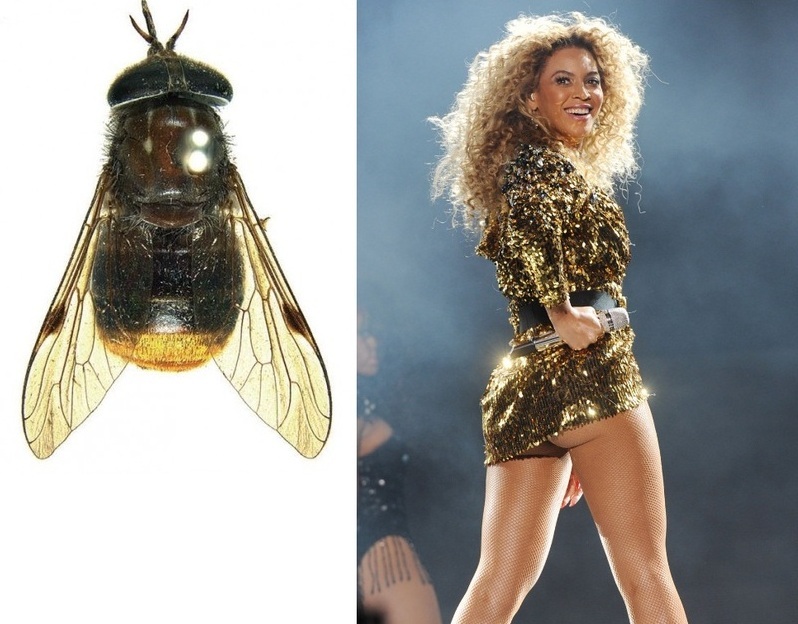
Pop diva Beyoncé has been in the news a lot recently, since the birth of her first child, Blue Ivy Carter. However, her name has hit the headlines for a different reason, after inspiring an Australian taxonomist to name a horse fly after her.

Bryan Lessard, from the CSIRO’s Australian National Insect Collection in Canberra, named the fly Scaptia (Plinthina) beyonceae because it has a prominent golden lower abdomen. To Bryan, who admits to being something of a fan, the unique dense gold hairs on the fly reminded him of Beyoncé’s flashy golden stage outfits.

The rare fly was collected in 1981, the same year Beyoncé was born, from eucalypt forests in the Atherton Tablelands of Queensland.

I’m not sure whether this is the most flattering thing that’s ever happened to Beyoncé, but I love that it shows scientists are just normal people who listen to R&B in their labs while they work, and find themselves as captivated by a gold frock as the next person. And perhaps are human enough to want to see their names in the gossip magazines, and maybe even get a personal response from their idol (she hasn’t made one).

BEYONCE

Beyoncé’s name is as unique as the horse fly, being created especially for her. Her mother Tina’s maiden name is Beyincé, a Creole surname from Louisiana. When she discovered that the Beyincé name was dying out, Tina decided to call her daughter Beyoncé, her own version of the surname. Apparently Tina’s parents were not impressed at first, because “that’s a last name”.

Beyincé is a form of the French surname Boyancé, related to the Old French word for “wood”. It’s an equivalent of English surnames such as Woodward or Forrester.

While the names of celebrities often become popular baby names (think Scarlett and Ashton, for example), Beyoncé’s name remains in very rare use. It belongs so completely to herself, and no other.

DESTINY

Destiny’s Child was the successful girl group of which Beyoncé was a founding member, prior to her embarking on her solo career.

The English word destiny comes from French, and ultimately from the Latin destino, the source of the word destination, meaning “appoint, establish”. It comes from an ancient root meaning “to stand, to place” (also the source of the word obstinate). Destiny is used as a synonym for the word fate, although technically fate is the divine agency or power which brings about the predetermined future events which are our destiny.

Destiny has been used as a girl’s name since the 19th century, and originated in the United States. It has been on the US Top 1000 since 1975, and reached the Top 100 in 1994, leaving it in 2012. It is currently #203.

In the UK, Destiny peaked in 2001 at #211 , and is currently #412. It is also in use in The Netherlands, and is a fairly uncommon name in Australia, although certainly not unknown.

Apart from Destiny’s Child, the name may remind you of Destiny Cyrus, the birth name of actress and singer Miley Cyrus (born just after the name reached the Top 100). It’s a slightly dated virtue name which still has a spiritual or philosophical feel to it, but also suggests the strength to forge your own path in life, to make your own destiny.

POLL RESULTS

Beyoncé gained an approval rating of 15% from the public. Only one person liked the name Beyoncé, while 68% thought it was terrible.

Destiny did rather better, with an approval rating of 32%. However, once again only one person liked the name, and 48% thought it was terrible.


Waltzing With … Autumn

20 Sunday Mar 2011

Posted by A.O. in Waltzing with ...

≈ 4 Comments

Tags

American names, birth notices, Canadian name popularity, english names, famous namesakes, name combinations, name history, name meaning, name popularity, nature names, royal names, season names, UK name popularity, US name popularity, US name trends, vocabulary names

This post was originally published on March 20 2011, and almost entirely rewritten on March 26 2015.

Tomorrow is the Autumn Equinox, ushering in my favourite season of the year. The searing heat of summer finally retreats, leaving us with a long stretch of sunny days with blue skies, white fluffy clouds, and invigorating fresh breezes, coupled with cool nights where we can finally turn off the fan and pull the covers over us for a deep, refreshing sleep at last.

After a blazing heatwave or a devastating cyclone season, the cool air of autumn comes as a relief. Following a dry summer, autumn rain can be a blessing. I love watching the leaves of the deciduous trees turn red and gold, the clear blue skies and mellow warm days followed by crisp doona-snuggling nights. And then later, the thick grey mists, sparkling frosts, and drifts of brown leaves brought down by the cold wind.

Not all of Australia experiences autumn, with the tropics having just a Wet Season and a Dry, and only a small portion of south-eastern Australia having the classic picture postcard four seasons, crisply demarcated from each other.

Indigenous Australians had their own seasons, which differed from region to region, and which began and ended, not with a particular date on the calendar, but according to observations of the natural world. In the area which is now the Greater Sydney Basin, the Illawarra, and the Southern Highlands, the D’harawal people (who had seven seasons in all) marked the beginning of Marrai’gang around this time of year when the marrai’gang (quoll) began mating and the lilly-pilly fruit started to ripen on the trees.

Other countries may have more spectacular autumns than Australia, with more brilliant colours, but so often there is a melancholy that goes with it, a feeling that the natural world is winding down for the year, and corresponding brooding thoughts of our own mortality.

Here there is no tinge of sadness, and far from the woods bearing “bare ruined choirs”, our native trees almost never lose their leaves. Many native plants begin flowering in the autumn, so that the bush is filled with the bright colours of banksia, grevillea, and correa, as well as the purple lilly-pilly. Some species of bird migrate from the mountains to the coast during autumn, with flocks of thousands making an amazing sight. The loveliness of an Australian autumn is quiet and subtle.

While other seasons have their own beauty, they also seem to have their drawbacks. Winter – too cold! Summer – too hot! Spring – too changeable! Only autumn seems perfectly balanced, with the right amount of warm days and cool days, delightfully dry days and welcome wet days, each marching smoothly and evenly from the blues and golds of March, through the browns and yellows of April, to the greys and greens of May.

Name Information
The word autumn is from the French automne, taken from the Latin autumnus. This is derived from the Etruscan, relating to the passing of the year, ultimately from an ancient root meaning “cold”.

North Americans have two words for the season – autumn and fall. The reason is because the words autumn and fall both came into common use in the 16th and 17th centuries, and as English people began successfully migrating to North America in the early 17th century, they took both words with them. While the word fall for the season aptly fell out of use in Britain, it became the dominant word in the United States.

While autumn is from French, fall is from Old English, and refers to the falling of leaves, as well as the year falling away. It’s a word that makes a lot of linguistic sense, because it’s the exact opposite of spring in meaning (thus North Americans get the handy little mnemonic for the start and end of daylight saving time – spring forward and fall back an hour).

North Americans use autumn and fall interchangeably, and can do so even within the same sentence. However, although personal preference plays a part, in general they seem to use fall in a more practical way, while autumn is literary and formal. So children go back to school in the fall, but fashions come in autumn tones; TV networks bring out their fall schedules, but beloved grandfathers enter their autumn years. In other words, autumn is not just the word for the season, but a poetic or elegant description of the season.

The interesting thing is why there are two words for autumn anyway – it’s not as if winter and summer have other names. The truth is, autumn is a modern concept. In the medieval period, the year was divided into just two seasons, winter and summer. The time of year closest to what we call autumn was known as harvest, and it seems to have corresponded with late summer/early autumn.

By the 16th century, people had begun moving away from a rural way of life, and harvest was no longer an appropriate name for the time of year. I guess people felt awkward clattering up the cobbled streets of London, dodging carriages and chamber pots, telling each other that they would catch up next harvest. Both autumn and fall were tried out as descriptions of the transition from the heat of summer to the cold of winter, and by the 18th century they had both superseded the rustic word harvest. However, by the 19th, fall was no longer used in Britain, and it became seen as American usage only.

(This explains why fall never became part of the Australian vocabulary – as we weren’t settled by the British until the late 18th century, autumn was already the accepted word for the season. It would have been a very inappropriate name on this continent anyway, as there are few native trees here whose leaves fall in the autumn, or ever.)

So even though we might think of the season of autumn as ancient, timeless, and natural, it is in fact not just a modern construct, but a specifically urban one.

Knowing the history of the word autumn, it will not come as any surprise that use of Autumn as a personal name for girls is quite recent, dating back only to the 19th century. Nor will it seem at all strange that its use was in the beginning almost entirely North American, because on that continent autumn was not the standard word for the season, but one imbued with a certain archaic charm.

This trend continues, because in the US, Autumn has been in the Top 1000 since 1969, giving it a “hippie name” vibe. Currently it is in the Top 100 and gently rising, being #69 in 2011 and #65 in 2013. It is also a Top 100 name in some Canadian provinces.

In England/Wales, Autumn was in the 500s until Princess Anne’s son Peter Phillips began dating a Canadian named Autumn Kelly in 2002, upon which the name Autumn began climbing in the UK, with a steeper ascent after Autumn and Peter’s wedding in 2008. After peaking at #179 in 2011, just after Autumn Phillips had given birth to her first child Savannah, the name has since levelled off and is now #197.

In Australia, the name Autumn is rarely found in historical records, and it has never charted here. In 2013, 3 baby girls were named Autumn in South Australia, in 2012, 9 baby girls were given the name Autumn in Victoria, and in Tasmania in 2010 there was only one baby called Autumn. The royal connection does not seem to have helped it here, as it has in the UK, and I only see it occasionally in Australian birth notices.

Autumn is a modern nature name for girls that is pretty without being frilly, and may appeal to some Australian parents by dint of being underused here. It celebrates a beautiful time of year, and could suit a child born in autumn, or with autumn-toned colouring. With Autumn, you get that attractive combination of a name that is completely “normal” and familiar, while not being at all common. That alone makes Autumn seem like a pretty awesome choice!

POLL RESULT
Autumn received an extraordinary approval rating of 92%, making it one of the highest rated names of the year. 38% of people loved the name Autumn, while not a single person hated it.

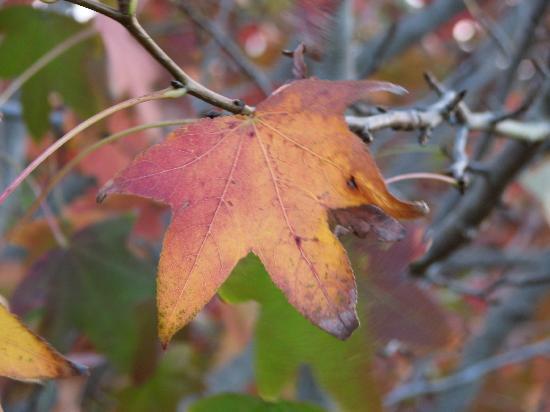
(Photo shows an autumn leaf in the Aurora Valley of Bangalow, New South Wales)

Girls Names from Songs

06 Sunday Mar 2011

Posted by A.O. in Name Themes and Lists

≈ 39 Comments

Tags

American names, aristocratic names, Australian slang terms, British name trends, created names, famous namesakes, fictional namesakes, food names, French names, fruit names, gemstone names, germanic names, Hawaiian names, hebrew names, Latin names, name history, name meaning, name trends, names from films, names from songs, nature names, nicknames, Old Norse names, patriotic names, plant names, polynesian names, popular names, retro names, royal names, saints names, scandinavian names, Turkish names, UK name popularity, unisex names, vintage names, Yiddish slang


This list was first published on March 6 2011, and substantially revised and updated on March 12 2015.

Astrid
Goodbye (Astrid Goodbye) was a 1979 single for popular rock band Cold Chisel, written as an energetic set finisher. Songwriter Don Walker didn’t know anyone named Astrid, and thinks he probably heard of the name because of Bill Wyman’s partner, Astrid Lundstrom. Astrid is the modern form of Ástríðr, an Old Norse name which can be translated as “beloved of God”, or more freely as “divine beauty”. A traditional name amongst Scandinavian royalty since medieval times, it was the name of Canute the Great’s sister, giving it a slender English connection. It became well known in the English-speaking world because of popular Swedish children’s novelist Astrid Lindgren, the author of the Pippi Longstocking books, and has received fresh attention from Astrid Hofferson in the film How to Train Your Dragon. The name is often understood as being related to the word “star”, because it sounds like the Greek aster, which was exploited in a Dr Who special where Kylie Minogue played star-loving Astrid Peth. This attractive name is currently around the 500s.

Ayla
Ayla was a 1987 single for New Wave duo Flash and the Pan, comprised of music industry powerhouses and ex-Easybeats, Harry Vanda and George Young. The name Ayla has several possible origins. It can be a variant of the Hebrew name Elah, meaning “terebinth tree”, pronounced eh-LAH, or a Turkish name meaning “halo of light around the moon”, and often translated as “moonlight”. In Turkey, it is pronounced to sound like the name Isla. The name Ayla was also used for a beautiful, inventive, and spiritually gifted palaeolithic superwoman in the popular Earth Children  novel series by Jean M. Auel. In the books, Ayla is a Neanderthal attempt at the character’s real name, which isn’t given, but much longer; it is said like Kayla without the K. The name Ayla first joined the US Top 1000 in 1987, a year after Auel’s Clan of the Cave Bear was made into a film, starring Daryl Hannah. Despite being a flop, it seems to have catapulted Ayla to #593, and to have helped inspire the Flash and the Pan song. In Australia, Ayla joined the Top 100 in 2013, fitting in with popular names like Layla and Ava.

Clementine
Col Joye’s 1959 #1 hit single (Rockin’ Rollin’) Clementine is a hip retelling of the folk ballad, My Darling Clementine. In this version, the miner’s daughter Clementine is a jeep-driving “real down chick” who meets up with a “cat from the city” in a jumping joint where she hops, bops, and “digs that crazy rhythm”. Clementine is a French form of Clementina, the feminine form of Clement, from the Latin name Clemens, meaning “merciful, gentle”. Clement is a saint’s name, so Clementine would originally have been given with this in mind, and the name dates to the Middle Ages. It has a rather aristocratic image, with several French princesses named Clémentine, and Sir Winston Churchill’s wife was also called Clementine. A clementine is a small citrus fruit, but that isn’t an issue in Australia, where they are nearly always sold as mandarins. Clementine was quite a popular name in Australia in the 19th century, but has never been in the charts since Federation. There has been renewed interest in the name recently, with the quirky Clementine children’s book series by Sara Pennypacker, Clementine the moral compass in The Walking Dead video game, and free spirit Clementine in the film, Eternal Sunshine of the Spotless Mind. Expect to see more of this elegant vintage name in the future.

Evie
Stevie Wright is the former lead singer of legendary 1960s rock band The Easybeats. Australia’s first international pop star, he was the first forced to deal with the pressures of being famous and beautiful at a very young age, and the first to blaze, burn out, and come crashing down in spectacular fashion. Evie is his 1974 rock ballad of young love and new life blossoming, blooming, and then going appallingly wrong, and is the only 11-minute song to become a #1 hit. Evie is a pet form of Eve, or a short form of names like Evelyn. It’s been used as an independent name since the 18th century in America, and may have a Dutch influence. Evie first joined the charts in the early 2000s, after the song was covered by one-off supergroup The Wrights in 2004. It climbed so steeply that it was in the Top 100 by the late 2000s, and was #22 in 2013. It’s even more popular in the UK, so you can see this as part of the British nicknamey trend, as much as a tribute to an Australian classic.

Georgy
The Seekers were a folk group, and the first Australian band to achieve major success in the UK and US. Georgy Girl was the title song to the 1966 British movie of the same name, a Swinging Sixties coming-of-age tale about a naïve, frumpy young girl and her unconventional love affairs. The song went to #1 in Australia, and was The Seekers’ highest-charting single in the US, where it got to #2 and was used to advertise mineral water. Georgy can be used as a pet form of either the male name George, or the female names Georgia, Georgette, or Georgiana – the “Georgy Girl”in the song is named Georgina. Although Georgy has a long history of use for both sexes, it is far less common that the variant Georgie, which has charted for girls since the 1990s and is rising steeply in the 200s.

Leilani
Leilani, released 1982, was the début single by quirky rock group Le Hoodoo Gurus (later Hoodoo Gurus). The song’s narrative is loosely based on the plot of 1951 B-grade movie Bird of Paradise, and combines an exotic South Pacific setting with an oddly suburban mindset, and a fun faux-Polynesian chorus filled with Australian place names. Leilani is a Hawaiian name meaning “heavenly garland of flowers”, but often understood as “heavenly child”, pronounced lay-LAH-nee. It fits in with the trend for L-l names, such as Lillian, and is currently around the 300s. A very pretty Polynesian heritage choice which has the fashionable nickname Lani.

Matilda
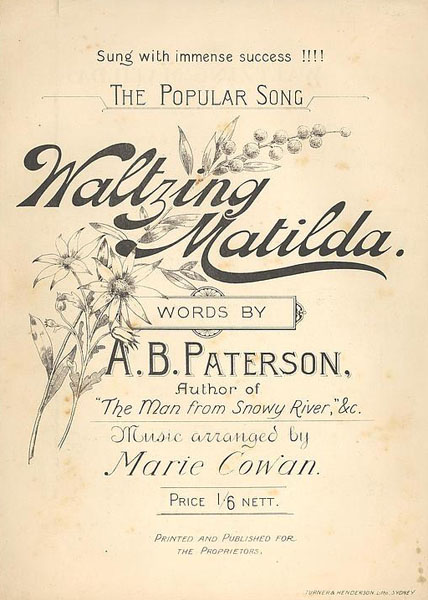
Waltzing Matilda was written by Banjo Paterson in 1895. The Matilda in the song isn’t a dancing girl, but is what swagmen called the bundle that they carried; to “waltz Matilda” is to walk while carrying a bundle. It is said that the swagman in the song was a real person called Samuel Hoffmeister who was involved in the Shearer’s Strike of that year, so it’s a political protest song (unintentionally). Waltzing Matilda is our unofficial national song and the lyrics are written on every Australian passport. Matilda is a Germanic name meaning “mighty in battle”. A traditional name amongst European royalty, it was literally brought over with the Conqueror to England, as it was the name of William I’s wife, the mother of William II and Henry I. Her grand-daughter was named after her, and she was married to a Holy Roman Emperor, so was the Empress Matilda. She tried to claim the throne of England as her father’s heir, but was never crowned queen, being named Lady of the English – her son instead became King Henry II. Saint Matilda was a medieval German queen whose son became a Holy Roman Emperor; she is the patron saint of large families. Matilda was #144 in the 1900s, and disappeared from the charts in the 1930s. It made a comeback in the 1980s, after Matilda the Kangaroo was chosen as the mascot for the 1982 Commonwealth Games, held in Brisbane and won by Australia. Matilda joined the Top 100 in the early 2000s, peaked in 2009 at #16, and by 2013 had only fallen to #18. A patriotic retro name choice that is extremely stable in the charts.

Rosie
Founded by the brothers of one of the Easybeats, AC/DC is Australia’s most successful rock band, and one of the most successful world-wide. Whole Lotta Rosie is their cheeky 1978 single, allegedly based on Bon Scott’s real life encounter with an obese Tasmanian woman. Rosie is a pet form of Rose which has a long history as an independent name; it can be used as a short form of any Rose- name, such as Rosalie, Rosamund, Rosetta, or Rosemary. Rosie was #229 in the 1900s, and left the charts in the 1930s. It made a come-back in the 1980s, reaching #749 and climbing steeply. It was in the mid-100s in Victoria in 2012. A sweet, fresh-faced retro name that is already Top 100 in Britain.

Ruby
Ruby Wednesday is an early song by rock band Eskimo Joe, released in 1999. A whimsical re-take on the Rolling Stones’ Ruby Tuesday, it made the Triple J Hottest 100 the year it came out. Ruby is a precious gemstone, whose name comes from the Latin for “red”. It’s been used as a girl’s name since the 17th century, but became popular in the 19th, when gemstone names became fashionable. Ruby was #21 in the 1900s, and had left the Top 100 by the 1930s. It disappeared from the charts in the 1950s, but came back in the 1980s at #548. It reached the Top 100 in 1996, peaked at #1 in 2012, and and by 2013 was #2. A spunky retro choice which has already reached maximum popularity, and is therefore expected to gradually fall.

Sadie
Sadie (The Cleaning Lady) was a 1967 novelty song and the first solo single for pop idol Johnny Farnham; it hit #1 and was the biggest-selling single by an Australian artist in the 1960s. Sadie is a pet form of Sarah, which seems to have originated in 18th century America. The name gained an especially Jewish image in 19th century England, where in Yiddish slang, a Sadie was a low status Jewish girl, sometimes with connotations of prostitution. It’s interesting how often Sadie is linked with that profession, such as Sadie Thompson in the W. Somerset Maughan’s Rain, while The Beatles’ Sadie adds another “sexy” image to the name. Sadie was #145 in the 1900s, and left the charts in the 1940s. It returned in the late 2000s at #566, and in Victoria is in the mid-100s, a similar popularity to that in the UK, while it is already a Top 100 name in the US. This sassy retro name looks set to go places.

POLL RESULTS
People’s favourite names were Evie, Matilda, and Clementine, and their least favourite were Ayla, Leilani, and Georgy.

Newer posts →

Enter your email address to follow this blog

Categories

Archives

Recent Comments

A.O.'s avatarwaltzingmorethanmati… on Zarah Zaynab and Wolfgang…
Madelyn's avatarMadelyn on Zarah Zaynab and Wolfgang…
JD's avatardrperegrine on Can Phoebe Complete This …
A.O.'s avatarwaltzingmorethanmati… on Rua and Rhoa
redrover23's avatarredrover23 on Rua and Rhoa

Blogroll

  • Appellation Mountain
  • Baby Name Pondering
  • Babynamelover's Blog
  • British Baby Names
  • Clare's Name News
  • For Real Baby Names
  • Geek Baby Names
  • Name Candy
  • Nameberry
  • Nancy's Baby Names
  • Ren's Baby Name Blog
  • Sancta Nomina
  • Swistle: Baby Names
  • The Art of Naming
  • The Baby Name Wizard
  • The Beauty of Names
  • Tulip By Any Name

RSS Feed

  • RSS - Posts

RSS Posts

  • Celebrity Baby News: Melanie Vallejo and Matt Kingston
  • Names from the TV Show “Cleverman”
  • Can Phoebe Complete This Sibset?
  • Zarah Zaynab and Wolfgang Winter
  • Baby, How Did You Get That Name?
  • Celebrity Baby News: Media Babies
  • Celebrity Baby News: Adelaide Crows Babies
  • Celebrity Baby News: Chris and Rebecca Judd
  • Names at Work: Name News From the World of Business and Employment
  • Celebrity Baby News: Sporting Round Up

Currently Popular

  • Celebrity Baby News: Jacinta Allan and Yorick Piper
  • Celebrity Baby News: Jacinta Allan and Yorick Piper
  • Celebrity Baby News: Craig Thomson and Zoe Arnold
  • The Top 100 Names of the 1940s in New South Wales
  • Celebrity Baby News: Ed Husic and Bridget Tilley

Tags

celebrity baby names celebrity sibsets english names famous namesakes fictional namesakes honouring locational names middle names name combinations name history name meaning name popularity name trends nicknames popular names saints names sibsets surname names twin sets unisex names

Blog at WordPress.com.

Privacy & Cookies: This site uses cookies. By continuing to use this website, you agree to their use.
To find out more, including how to control cookies, see here: Cookie Policy
  • Subscribe Subscribed
    • Waltzing More Than Matilda
    • Join 517 other subscribers
    • Already have a WordPress.com account? Log in now.
    • Waltzing More Than Matilda
    • Subscribe Subscribed
    • Sign up
    • Log in
    • Report this content
    • View site in Reader
    • Manage subscriptions
    • Collapse this bar
 

Loading Comments...