Names of Australian Male Olympic Swimmers

Tags

, , , , , , , , , , , , , , , , , , , , , , , , , , , , , , , , , , , , , , , ,

kpAshley (Callus)

Ashley Callus won gold in 2000 and bronze in 2008. Ashley is an English surname from a common place name meaning “ash tree clearing”. It’s been used as a personal name since the 17th century, and was originally given to boys. It only became popular in Australia after the release of the 1939 movie Gone with the Wind, with the character of Ashley Wilkes (actually George Wilkes – Ashley is his middle name). Played by Leslie Howard, Ashley is a true Southern gentleman, and the one man Scarlett cannot get. The name Ashley first charted in the 1940s, and by the 1950s was #160; it made the Top 100 for the 1970s, and peaked in the 1980s at #62. It was during the 1980s that Ashley became a unisex name, making an impressive female debut at #55 – higher than the peak for boys. Coincidentally or not, it was in 1982 that the popular character Ashley Abbott joined soapie The Young and the Restless, first portrayed by Eileen Davidson. Ashley peaked for girls in the 1990s at #33, and although it left the Top 100 in 2009, it rose again and is now #93. As a boy’s name, Ashley left the Top 100 in the 1990s, and no longer ranked by 2010. However, last year Ashley increased for boys as well as girls, reaching #466. The usual nicknames is Ash.

Francis (Gailey)

Francis “Frank” Gailey won three silvers and a bronze at the 1904 Olympics. Born in Australia, Frank emigrated to the United States, and his medals are credited to the US. However, as he was an Australian citizen when he won them, we claim them toward our own medal count. This doesn’t seem to be accepted internationally. Francis is the English form of the Italian name Francesco. This began life as a nickname, because the 12th century Giovanni di Bernardone was known as Francesco, “the Frenchman”. This may have been because his father was on business in France when he was born, or because the young Giovanni quickly became fluent in French. While still a young man, Francesco began to turn away from the pleasures available to him as the son of a wealthy man, and to live a life of poverty and simplicity. Known as Saint Francis of Assisi, he is the patron saint of Italy, and also the environment. Many stories about him reflect on his deep love for animals, and his sense of kinship with all life. Francis charts as a unisex name from 1900, but by the 1950s was male-only, and in the Top 100. It left the Top 100 the following decade and remained stable for decades before falling out of use in 2010. However, last year Francis was back in the charts at #388.

Garrick (Agnew)

Sir Robert David Garrick Agnew, always known by the second of his middle names, attended the 1948 and 1952 Olympics. A graduate of Harvard, Sir Garrick became a very wealthy businessman, and also a champion fisherman. He died of a heart attack after going swimming in a pool. Garrick is an English surname which is the Anglicisation of two slightly different French surnames of Old Provencal origin. Garric means “kermes oak tree”, a small evergreen oak; Garrique means “grove of kermes oaks” – both names denoted someone who lived near such trees. The surname was introduced to Britain in the 17th century by French Huguenots, Protestants who fled persecution in France. The great 18th century English actor David Garrick was from a Huguenot family; his grandfather changed the name from Garric. Garrick has been used as a personal name since the 18th century, and first appears amongst British Huguenot families. It’s been reasonably well used in Australasia, and I think it still sounds rather distinguished and gentlemanly.

Jayden (Hadler)

Jayden Hadler is a young swimmer who attended his first Olympics this year. Jayden is a modern name of uncertain origin. It’s first found in the United States in the 19th century, and turns up around the same time as other J-D-N names then in vogue, including Jadin. Jadin is a French occupational surname for someone who made bowls, derived from the French word for bowl, jatte, and it’s hard not to wonder if Jayden began as a variant of this name, influenced by Jay, a surname after the bird, whose name means “joyful, lively”. Jaidan, Jadan and Jaden were also in use around this time – some of the variants we see today date back over a century. Jayden became popular in Australia earlier than other countries, and first charts in the 1970s. You can see that it fit perfectly with popular or fashionable names of that era such as Jason, Hayden and Aidan. By the 1980s it was #307, then zoomed up the charts to make #47 for the 1990s. It peaked in 2003 at #14, and by 2010 had fallen to #28. Last year it rose again to #21, and could be considered a modern classic. The question is – is Jayden from the 1970s “the same name” as Jayden from the 19th century?

Kieren (Perkins)

Kieren Perkins was considered one of the world’s best long-distance swimmers, specialising in the 1500 metre freestyle. He won gold and silver at the 1992 Olympics, gold in 1996, and silver in 2000. Since retiring from swimming, he has gained success in the media and the corporate world. Kieren is an Anglicised form of the Irish name Ciarán, a diminutive of the name Ciar, meaning “black, dark”. There are six Irish saints called Ciarán, the eldest of which is known as the first Irish-born saint. Although an educated man of noble birth, according to tradition he was a hermit, who lived like a wild man dressed in skins. Many legends describe him as having a love for and power over wild animals. Kieren is pronounced KEE-ren. Kieren has never charted in Australia, with parents preferring the variant Kieran, currently #240.

Leith (Brodie)

Leith Brodie won two bronzes at the 2008 Olympics. Leith is the port area in the city of Edinburgh; its name comes from the Gaelic word lìte, meaning “wet”. This makes sense when you realise that Leith is at the mouth of a river. Leith has played an important role in Scottish history and been the scene of many battles, as well as a major industrial centre. Leith is an aristocratic surname; the Leith family are of Scottish origin, and descend from William Leith, who was Lord Provost of Aberdeen in the 14th century. Leith has been reasonably well-used in Australia, and from the available records, seems to have been used almost equally on males and females. For boys, it probably seemed like a cross between Lee and Keith, and for girls, maybe a cross between Lee and Beth. This name still seems a bit “mum and dad” to me, but maybe it’s ready for an early retro-revival.

Moss (Christie)

Maurice “Moss” Christie won silver at the 1924 Olympics. Moss can be a nickname for names such as Moses, Mostyn or Maurice, or it can be from the surname. The surname Moss has several possible sources. As an Irish name, it is usually translated as “son of the follower of Saint Munnu”. Munnu was the nickname of Saint Fintán of Taghmon; his nickname means “teacher”. As an English surname, Moss can mean “swamp, peat bog”, given to someone who lived near one, or it can be taken from the name Moses. Although many of these sources are male, the swamp one is obviously unisex, and you could also see Moss as a nature name, directly after the soft springy green plant. This could be used on both boys and girls.

Noel (Ryan)

Noel Ryan was an international swimming champion who attended the 1932 Olympic Games. Noel is another word for Christmas which was introduced by the Normans and comes from the Old French. Ultimately it is from Latin, meaning “birth”, referring to the birth of Jesus Christ. It’s been used for both boys and girls in England since the Middle Ages, originally given to those who were born at Christmas time. Later on, it may have been influenced by the surname, which could be from the personal name, given as a nickname to someone born at Christmas, or to someone who played an important role in Yuletide celebrations. In Australia, Noel has only ever charted as a male name. It was #76 for the 1900s, and peaked in the 1930s at #21. It was out of the Top 100 by the 1970s, and hasn’t charted since the 1990s. This is another 1930s name I would like to see make a comeback, and think it works equally well for girls.

Percival (Oliver)

Percival “Percy” Oliver won thirteen Australian freestyle and backstroke titles, and attended the 1936 Olympics. After retiring from swimming, he became a teacher and was responsible for the administration of the Education Department’s swimming programme. He died last year aged 92. In Arthurian legend, Percival is one of King Arthur’s knights, and connected to the quest for the Holy Grail. In the romance Perceval by Chretien de Troyes, Perceval meets the crippled Fisher King in a mysterious castle, and sees a grail (in this poem, a wide deep dish with a communion wafer which feeds the king), but does not understood its importance. Brought up not to chatter too much, Perceval fails to ask the question that would have healed the king, and once he realises the mistake he’s made, vows to find the castle again and complete the quest. At this point, Chretien abandons his poem, and it was left to other writers to finish the story. In doing so, the role of Percival became much diminished. The name Perceval seems to have been created by Chretien de Troyes from the Old French meaning “pierce valley”. What he was trying to get across I have little idea. This is another Arthurian name which was revived by the Victorians due to Tennyson’s Idylls of the King, which depicts Sir Percival as a spiritual knight better suited to holy quests than the average warrior. Percival was #77 in the 1900s, and left the Top 100 by the 1920s; it hasn’t charted since the 1950s. This is a vintage name which seems very usable, especially with its cute nickname Percy.

Regan (Harrison)

Regan Harrison won silver at the 2000 Olympics. Regan (pronounced REE-guhn) is an Anglicised form of the Irish surname O’Riagain or O’Raogain, meaning “son of Riagain”. Riagain is a Gaelic name of uncertain meaning; one suggestion is that it comes from the Gaelic word for “impulsive, angry”; another that it means “little king”. There was a medieval Irish prince called Riagain; he may have given his name to the town of Ballyregan in Northern Ireland. Regan is also found as a female name in Shakespeare’s King Lear, where Regan is the middle of the king’s three daughters. She is a vile creature full of false flattery, who throws her elderly father out of her home in the middle of a storm. To nobody’s disappointment, she is poisoned by her older sister, who is even more horrible. This revolting namesake doesn’t seem to have put parents off using the name for their daughters. The meaning of it is unknown; Shakespeare got the story and characters from earlier British legends, and Regan is presumed to be Celtic. A popular notion is that (female) Regan is derived from the name of the Celtic goddess Rigantona, who we also know as Welsh Rhiannon. It makes the name slightly more appealing, but I can’t confirm if it’s true or not. Rigantona means “great queen”.

(Photo is of Kieren Perkins after winning gold at the Atlanta Olympics, becoming the only Australian since Dawn Fraser to successfully defend an individual Olympic championship)

Saturday Celebrity Sibsets: Clare Bowditch and Katie Noonan – Songstress Sibsets

Tags

, ,

clareClare Bowditch and Katie Noonan are two of Australia’s most respected contemporary female singers. Both began their careers as teenagers in the late 1990s, both have won awards for their work, both have collaborated with other performers, and both of them sing with more than one band as well as pursuing solo projects.

They have sung together on the Broad Festival Project in 2005, which for several years toured annually with showcase the talents of female singers. Each line-up of artists would perform their own and each other’s work.

Both Clare and Katie have married fellow musicians who they perform with.

Clare is married to Marty Brown, the drummer from her band The New Slang; Marty also drums for indie rock band Art of Fighting. Clare and Marty have three children:

Asha (born 2004)

Oscar and Eli – identical twins (born 2006)

Katie is married to Isaac “Zac” Hurren, who plays saxophone as a member of jazz trio Elixir with Katie, and has a successful career as both a composer and performer. Katie and Isaac have two young sons:

Dexter Reed (born around 2005)

Jonah Atticus Roc (born around 2007)

katie

Celebrity Baby News: Ky Hurst and Katie Lander

Tags

urlSwimmer and Ironman champion Ky Hurst, and his partner Katie Lander, welcomed their first child on November 17 and have named their son Koa.

Ky has two silver medals in the World Swimming Championships, and has competed at two Olympics in marathon swimming. He has won four Australian Ironman titles, and is a member of the Surf Life Saving Australia Hall of Fame. He has also been a competitor on Dancing with the Stars.

Koa is a name which was featured on the blog this year at popular request, and seems a perfect fit with Ky and Katie.

Arkie and Sapphire: Birth Announcements from Rural and Regional Areas (October)

Tags

, ,

681x454Twins

Aleisha Kate and Paige Anne (Shania)

John Patrick and Thomas Ronan

Oliver Aiden and Emmett John

Ryan Trent and Travis Luke (Hayley)

Theodore Ean and Henry Ronald (Elizabeth, George)


Girls

Airlie Laykyn

Arkie Mayumi Ivory (Minami)

Aurelia Joan

Cassidy Estelle

Celeste Frances

Ciara Rose (Rylea)

Eadie Hope (Grace-Louise, Ella)

Elsie Victoria May

Emjay

Frankie Jean-Louise

Harriet Kay (Jude)

Hazel Josephine

Isoebella Glenna Lisbeth (Lukas)

Juliette Florence (Charlton)

Kailin Charli

Laura George

Logan (Kobee, Pacee)

Lottie Olive (Mabel)

Miriam Ruth

Morgan Hayley Melissa Jane

Priya Jane (Rohan)

Ruby Deborah Anne (Zadian)

Sapphire Elizabeth (Hannah, Ezekiel, Sophia, Esther)

Scarlett Ruby

Vaydah Louise (Sharnie, Georgia, Madalyn)


Boys

Archer Robin (Lilyana, Jensen)

Austin Sean Harrold

Braxton Ross Kingsley (Ryder, Lacey)

Bryn Alan

Chaz Harrison (Ava, Izzy)

Corbin James Gugil

Crawford Ash

Dash Thomas (Scarlett)

Dayne Stirling James (Akaysha)

Diesel James

Ernest William (James)

Harrison Charles Patrick (Josh, Nick, Jordy, Riley)

Jacob John Edward

Jesse Chance (Dusty, Ella, Tex)

Kolt Sydney

Lincoln Kane (Royce)

Nate Davey Ross (Elyssa)

Samson Leo (Dahlia, Riahni, Amy)

Talis Connor (Lane, Riley)

Tim Dazzling

Toby Karsten (Ella, Ben, Lucy)

Ty Reece Leigh (Jayden)

Walker Zane (Mali, Laikin)

William Arthur (Cordelia, Eleanor)

Zebastian Joseph

(Picture shows the Whitsunday Islands in Queensland; photo from Lonely Planet)

Celebrity Baby News: Aaron and Jenny Sandilands

Tags

,

AFL footballer Aaron Sandilands, and his wife Jenny, welcomed their first child on November 26, and have named their daughter Sloane Ellie. At 211 cm (6 foot 11) and a peak weight of 122 kg (270lb), Aaron is the current tallest and heaviest ever player in the AFL, leading to wild speculation that his baby would be of massive proportions. However, Sloane Sandilands was right in the middle range at 50 cm long and 3.2 kg (7lb).

Aaron has been playing for the Fremantle Dockers since 2003. He won the Ross Glendinning Medal in 2009 and 2010, the Geoff Christian Medal in 2009, and Fremantle’s Fairest and Best in 2009.

Jenny (nee Hofsink) and Aaron met through mutual friends at the Left Bank Hotel, and were married in 2010.

I note that baby Sloane is right on trend for the expected rise in names starting with S!

Famous Names: Sandy and Sable

Tags

, , , , , , , , , , , , , , , , , , , , , , , , , , , ,

A group of Australian scientists from the University of Sydney have undiscovered an island that was supposed to be in between Australia and New Caledonia.

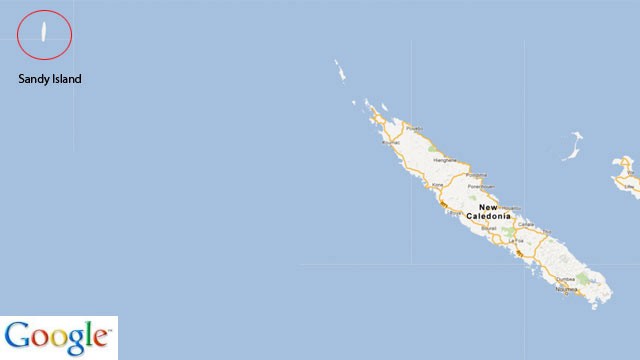
Sandy Island showed up on Google Earth and Google Maps, as well as marine and scientific maps all over the world, including the US National Geophysical Data Center. According to the maps, Sandy Island was about 16 miles long and 3 miles wide – just slightly bigger than Manhattan.

Geologists on the Southern Surveyor, an Australian maritime research vessel, were puzzled by the island which appeared on their weather maps, yet navigation charts showed that the water in that area was very deep – 1400 metres (4620 feet). They decided that they had to go check it out, and found nothing there except sea. The scientists recorded the information so that maps can be changed.

According to the Wikipedia article on Sandy Island, the island was erased from Google Maps on November 26, but although the name Sandy Island doesn’t show up in the search bar, when I looked in the Coral Sea I found the phantom island quite easily, but there was no name attached to it.

If I zoomed in on the island, it simply disappeared, and if I switched to satellite, the island showed up as a black streak surrounded by blue streaks, looking remarkably like someone had scribbled on it with two different felt-tip pens.

Interestingly, if Sandy Island had existed, it would have been in French territorial waters – and the island is not on any recent French government charts. Perhaps because of this, the Times Atlas of the World deleted Sandy Island from its maps after 1999.

The history of the discovery of Australia involved – indeed, was dependent onfaulty maps, necessitating voyages to check out what was here or not, so it makes a strange sort of sense that now Australians must voyage forth to check faulty maps for themselves.

The episode shows that this part of the world is still not well known, and incompletely charted. It’s not quite a matter of Here be dragons, but the reply from most of the map-providers when the error was pointed out was along the lines of, Well it is in the middle of nowhere

Tens of thousands of years of human occupation, and centuries since the first mapping, and we’re still close to the middle of nowhere. Which is rather exciting – what else in our region is still waiting to be discovered, or undiscovered?

Apart from the Pythonesque nuttiness of this story (no wonder the geologists got the giggles as they sailed through the invisible island), the thing that got my attention was the name Sandy, which has been in the news internationally since Hurricane Sandy hit the north-east coast of the United States in late October, after devastating the Caribbean.

According to this article in The New York Times, names of hurricanes can help to influence the way we name our babies. It’s not as simple as everyone suddenly choosing Sandy as a baby name, but it seems that once we hear a word or a name many times, we instinctively like names that sound similar to it. So experts are expecting a spike in the numbers of babies of 2012 whose names begin with an S, as well as those with an and sound in them, and ones that end in -ee.

There was a story in the Australian press, about an expat couple in New York, whose baby arrived at the height of Sandy’s fury. The parents did consider calling their new daughter Sandy, but in the end chose Sophie. The analysts would be rubbing their hands, because they chose a two-syllable name that starts with S and ends with an -ee sound, just like Sandy.

Sandy is a unisex name which is short for Alexander or Alexandra, but also for any name related to them, such as Alistair, Sander, Alessandra, Sanette, Sandrine, or Sandra. You could use it as a short form of Cassandra, Santos, Sanford, Sandon, Santiago or any similar name. Sandy is a traditional pet name for people with reddish or sandy-blonde hair, and you could see it as a vocabulary, colour, and nature name meaning “sand-coloured, like sand, covered in sand”.

However, another possibility occurred to me while reading about The Case of the Non-Existent Island. On a French chart from 1875, the island is called Île de Sables, which is French for Sandy Island. Because of this, The Times Atlas of the World partly Anglicised the name back again to Sable Island.

While in French, sable means “sand”, the same word in English means something quite different. (I feel that I must be channelling Lou from Mer de Noms, who quite often finds name inspiration in French words). I should point out that the two words are said differently: in French, SAH-bluh; in English, SAY-buhl.

A sable is a species of marten (a relative of minks, weasels and ferrets) which is found mostly in Eurasia and still hunted in Russia. The pelt of the animal has been highly valued since medieval times, because the fur of the sable feels soft whichever way you stroke you; it’s not possible to “go against the grain”.

Because of the animal’s colour, the word sable is also a literary way to say “black”, such as when John Milton refers to “a sable cloud” in Paradise Lost. It amuses me that sandy and sable are opposites as colours, with one signifying a pale shade and the other one that is very dark.

Sable can also be used as a personal name, with the first one I can find in the records dating to the 17th century. It’s used for both boys and girls, although from the beginning more often a female name – maybe because it seems like it could be short for names such as Isabel or Sabella.

Sable is more common in the United States, where it has sometimes been used amongst African-Americans as a positive and beautiful word to denote darkness (similar to the name Ebony, which doesn’t have that connotation here).

In Australia, it appears rarely in the records, nearly always as a female name. One of my favourite combinations for this name was Brightie Sable. It also belonged to a 1900s French immigrant to Australia, who had the French form – Sablé.

So if you feel subconsciously influenced to use a name similar to Sandy, or would like to be part of a name trend, then Sable or Sablé seem like possibilities to choose from, and may please trend analysts immensely.

(Satellite image from Google Maps)

Celebrity Baby News: Daniel Kerr and Natasha Pozo

Tags

,

AFL star Daniel Kerr, and his wife Natasha Pozo, welcomed their daughter Ruby June on November 26. Ruby Kerr weighed 3.16 kg (6lb 15oz). She joins big sister Lola, aged 1, whose birth was announced on the blog last year.

People were quite fond of big sis’ name, Lola Violet – how do you like Ruby June as a match for it?

(Photo of Daniel and Lola from Perth Now)

Celebrity Baby News: Ryan and Brooke Hinchcliffe

Tags

NRL footballer Ryan Hinchcliffe, and his wife Brooke, welcomed their first child earlier this month, and have named their daughter Ivy. Ivy Hinchcliffe is cousin to Ava McCrone, daughter of Josh McCrone; Ava and Ivy were born around the same time.

Ryan started out playing for the Canberra Raiders in 2007, and since 2009 has been with the Melbourne Storm. In 2010 he was named the team’s Player of the Year. He has also played for Country Origin both this season and last season.

Brooke (nee O’Connor) and Ryan are childhood sweethearts who have been together since primary school – Brooke has it written down in her diary since Year Three. The couple were married in January this year.

(Photo of Ryan from the Brisbane Courier)

Names of Australian Female Olympic Swimmers

Tags

, , , , , , , , , , , , , , , , , , , , , , , , , , , , , , , , ,

During the winter, I compiled lists of names from Olympic medalists, and perhaps you noticed that no swimmers were included. That’s because swimmers are such a big part of our team, and historically the big medal winners, so that they really needed lists all to themselves. Now that it’s hot again, maybe they will inspire you to hit the pool!

Alva (Colquohuon)

Alva Colquhuon won silver at the 1960 Olympics. Alva is the feminine form of the Scandinavian name Alf, from the Old Norse for “elf”. Alva is also a male name, a variant of the Hebrew name Alvah, meaning “his highness”. As a male name, it is best known as the middle name of American inventor Thomas Alva Edison. Today it almost seems like a cross between Ava and Alba.

Brittany (Elmslie)

Brittany Elmslie is a young swimmer who attended her first Olympics this year, where she won a gold and two silvers. Brittany is the name of a region in north-west France, which in French is known as Bretagne. It was once known as Little Britain in order to distinguish it from Great Britain, hence its name. The Breton language is Celtic, related to Welsh and Cornish, and the history of the land and its people is intimately connected to Great Britain. Even today, Brittany retains its own identity and culture within France. Brittany has been used as an English girl’s name since the late 18th century – perhaps originally because Brittany was known for its resistance to the French Revolution. The name first entered the charts in the 1970s, making #245 by the 1980s. It peaked in the 1990s at #31, then sharply dropped, leaving the Top 100 in the early 2000s. It hasn’t charted at all since 2009 (the year actress Brittany Murphy died), and this is a good example of a name which reaches popularity very quickly, then becomes just as rapidly dated.

Dawn (Fraser)

Dawn Fraser is one of our most famous swimmers, who has received many honours; she is considered the greatest sprint swimmer of all time. She won two golds and a silver at the 1956 Olympics, a gold and two silvers in 1960, and a gold and a silver at the 1964 Games, setting two world records and two Olympic records. She is well known for her blunt speech and larrikin character, and one of the ferries on Sydney Harbour is named after her. Dawn is the period just before sunrise, where there is pale sunlight, but the sun itself is still below the horizon. The word comes from the Old English for “to become day”. The name is found from the 16th century onwards, and must at least sometimes have been given to girls born at daybreak. Dawn first entered the Australian charts in the 1910s, reaching #103 for the 1920s. It peaked in the 1930s at #32, and left the Top 100 in the 1950s. It hasn’t ranked since the 1980s, and the 1970s song Delta Dawn, about a crazy middle-aged woman, probably didn’t do its image any good – although covering it gave Australian singer Helen Reddy her first #1 hit. I wonder whether it might be time for a revival of this 1930s name? Apart from the fragile beauty of dawn, the word is filled with hope and optimism, and a sense of renewal.

Emily (Seebohm)

Emily Seebohm has been a champion swimmer since 14 and is now 20. She won gold at the 2008 Olympics, and a gold and two silvers at the London Games. Emily is the English form of the Roman name Aemilia, the female form of the family name Aemilius. The Aemilii were one of the noblest and most ancient patrician houses of Rome, and were probably of Sabine origin. They interpreted their name as meaning “persuasive”, and others derived it from Latin aemulus, meaning “rival”, but most likely these are both false etymologies. The English form is first found in Chaucer’s Canterbury Tales; he adapted it from a character named Emilia in a poem by Giovanni Boccaccio, where two men are rivals for the affections of the same woman. Although in use from early on, it didn’t become popular until the Hanoverians came to the throne in the 18th century, as Princess Amelia, daughter of George II, was called Emily by her family. Emily was #36 for the 1900s, but fell until it had left the Top 100 by the 1930s. It reached its lowest point in the 1950s at #455, then climbed steeply; it skyrocketed to make #26 for the 1980s. Emily peaked at #1 in 1998, and remained there for most of the early 2000s. Currently this pretty classic is #12.

Hayley (Lewis)

Hayley Lewis was at her peak during the 1990s, when she won many medals internationally, but although she attended three Olympics, only won silver and bronze at the 1992 Games. Hayley is now the host of Channel Ten’s weight-loss show, The Biggest Loser. Hayley is an English surname from a common English place name meaning “hay clearing” in Old English; the surname dates from the 13th century and is especially associated with Yorkshire. It’s been used as a personal name for both boys and girls since the early 18th century, but only became popular in the 20th century, and only as a girl’s name. This was because of English actress Hayley Mills, who was the most popular child star of the 1960s, and made several Disney films as a teenager. Hayley first entered in the charts in the 1960s, when Mills began her career, debuting at #489. It climbed steeply during the 1970s, and was Top 100 by the 1980s. Hayley peaked in 2005 at #21, and is currently #50. It dropped just one place in 2011, and looks set to maintain a graceful decline that could see it in the Top 100 for several more years.

Jacinta (van Lint)

Jacinta van Lint won silver at the 2000 Olympics. Jacinta is the feminine form of the name Jacinto, a Spanish/Portuguese name meaning “hyacinth”. The Spanish pronunciation is something like ha-SEEN-tah, but in English we say it juh-SIN-tah. It is best known as the name of Blessed Jacinta Marto, who was one of the three children of Fátima in Portugal, who reported witnessing visions of an angel and the Virgin Mary in 1916-17. Jacinta has been rather a favourite in Australasia, first entering the charts in the 1950s, and climbing until it peaked at #101 for the early 2000s. It fell to #197 in 2009, and since then has picked up slightly, to make #189 last year. The fact that it entered the charts in the 1950s makes me wonder if use of the name was originally inspired by the 1952 Hollywood movie, The Miracle of Our Lady of Fatima, which starred Sherry Jackson as Jacinta (the name had the English pronunciation in the film). It’s a pretty name which has had steady use without ever becoming highly popular in New South Wales – although more common in Victoria.

Lisbeth (Trickett)

Lisbeth “Libby” Trickett won gold and bronze at the 2004 Olympics, two golds, a silver and a bronze in 2008 while setting a world record, and gold at the London Games this year. Lisbeth is a variant spelling of Lisbet, a Scandinavian short form of Elisabeth. The name has recently become well-known due to Lisbeth Salander, the antiheroine of Swedish author Stieg Larsson’s crime thriller Millennium series. The first novel, The Girl with the Dragon Tattoo, was turned into a Hollywood movie last year, with Rooney Mara as Lisbeth. Lisbeth Salander is a disturbed computer hacker with a punk-Goth style, and a victim who refuses to lie down, but instead turns vigilante. It’s definitely given sweet Lisbeth a far more dangerous and edgy image.

Marilyn (Wilson)

Marilyn Wilson won silver at the 1960 Olympics. Marilyn is a portmanteau name combining Mary and Lynn. It can be found from the late 18th century, and seems to have sprung up in several countries almost simultaneously, so that an origin for the name isn’t obvious. Its most famous namesake is Hollywood sex symbol Marilyn Monroe, and thanks to Elton John’s Candle in the Wind, nearly everyone knows her birth name was Norma Jeane. The name Marilyn was chosen for her by a studio executive because she reminded him of Broadway beauty Marilyn Miller (oddly enough, Marilyn later married writer Arthur Miller). Marilyn Miller was born Mary, and combined her name with her mother’s middle name to create her stage name. Marilyn first entered the charts in the 1920s, when Marilyn Miller began her career, and by the 1930s was #146. It skyrocketed to make the Top 100 in the 1940s, and peaked in the 1950s, the era in which Monroe enjoyed her greatest success, at #44. It then plummeted into the 200s during the 1960s after Monroe’s death, and hasn’t ranked at all since the 1980s. This is a dated name, yet still possesses some of the lustre of its two glamorous namesakes.

Nadine (Neumann)

Nadine Neumann had to battle against the odds, first recovering from chronic fatigue syndrome as a teenager, then breaking her neck before she could attend the 1992 Olympics. She made it to the 1996 Games, but failed to win a medal. After retiring, Nadine became an educator and writer. Nadine is the French form of the Russian name Nadia, a short form of Nadezdha, meaning “hope”. The French pronunciation is na-DEEN, but in Australia we usually say it nay-DEEN. Its most famous namesake is South African novelist and political activist Nadine Gordimer, who won the Nobel Prize for Literature in 1991. In the 1960s, the name got its own popular song when Chuck Berry released Nadine, describing his object of desire as moving “like a wayward summer breeze”. Nadine first charted in the 1950s, the decade that Nadine Gordimer published her first novel; it debuted at #535. The name peaked in the 1970s at #145, and by 2009 no longer charted at all. However, Nadine recently made a minor comeback, reaching #573 last year. Irish singer Nadine Coyle, from pop group Girls Aloud, may have been a help; her first solo album was released at the end of 2010.

Sarah (Ryan)

Sarah Ryan won silver at the 1996 Olympics, silver in 2000 and gold in 2004. In the Bible, Sarah was the wife of the prophet Abraham, and a woman of surpassing beauty; she is honoured in Judaism, Christianity and Islam. She was barren until extreme old age, when God blessed her and Abraham with a son named Isaac. Her name was originally Sarai (said suh-RYE), but when she and Abraham made their covenant with God, her name was changed to Sarah. As both names have the same meaning (“woman of high rank, female ruler of the court”, translated as “princess”), it is unclear what the purpose of the change was. It’s possible the ah sound in Sarah suggested the name of Yahweh more closely, as if to demonstrate she was now a woman of the Lord, not of the world. In fact, Sarah is the only prophetess in the Bible who is spoken to directly by God. Although Sarah is a Hebrew name, its origins are Babylonian, and some scholars identify the Biblical Sarah with the goddess Ishtar. This vaguely fits with the Old Testament story, which says Abraham and his wife were originally pagans from Sumeria. Sarah was #43 in the 1900s, but had left the Top 100 by the 1920s, and reached its lowest point in the 1940s at #284. By the 1960s it was Top 100 again, and peaked in the 1980s at the #1 name. Currently it is #31, and remains a lovely classic.

(Picture is of Dawn Fraser at the 1956 Olympics in Melbourne; photo from Wikimedia Commons)

Celebrity Baby News: Darren and Alicia Glass

Tags

, ,

AFL star Darren Glass, captain of the West Coast Eagles, and his wife Alicia, welcomed their son Nixon John at the start of the month. Nixon Glass joins big sisters Mila and Zara, who have been previously mentioned on the blog.

I remember this sibset was quite a hit with blog readers, and wonder what you think about the addition of baby Nixon?

This is the second celebrity baby named Nixon this year, and it’s a name I have often seen in birth notices. Can anyone tell me why Nixon is suddenly the new Jaxon?

(Photo from Eating WA website)