• About
  • Best Baby Names
  • Celebrity Baby Names
  • Celebrity Baby Names – Current
  • Celebrity Baby Names – Past
  • Featured Boys Names
  • Featured Girls Names
  • Featured Unisex Names
  • Links to Name Data
  • Waltzing on the Web

Waltzing More Than Matilda

~ Names with an Australian Bias of Democratic Temper

Waltzing More Than Matilda

Tag Archives: famous namesakes

Famous Name: Grace

21 Wednesday May 2014

Posted by A.O. in Famous Names

≈ 6 Comments

Tags

British name popularity, classic names, colour names, contemporary classics, english names, famous namesakes, germanic names, Latin names, middle names, mythological names, name history, name meaning, name popularity, New Zealand name popularity, nicknames, popular names, royal names, saints names, theological names, virtue names, vocabulary names

Thumbnail_320

Last month it was the 121st birthday of Grace Cossington Smith, one of the most important Australian artists of the 20th century, and a contemporary of Clarice Beckett.

Grace was born in Sydney, and studied under Antonio Dattilo Rubbo, an inspiring and extremely supportive art teacher who encouraged his students to experiment; he affectionately called Grace “Mrs Van Gogh”. Her painting The Sock Knitter, showing her sister knitting socks for the war effort, is considered to be Australia’s first post-Impressionist painting, and she exhibited in galleries from 1915.

Her paintings are notable for their bright patterns and vibrant energy, using careful square brushstrokes to create images of colour shimmering through sunlight. She painted scenes of Sydney, and is famous for her iconic representations of the Harbour Bridge, showing the bridge’s construction. Grace’s Sydney was bustling, busy, exciting; filled with crowds, colour and sunshine. Later in life, she became known for her still lifes and interiors.

Art museums began buying Grace’s work in the 1940s, but she did not become famous until the 1960s, and in 1973 was appointed an Order of the British Empire as an exhibition of her work toured with the Art Gallery of New South Wales. Grace was 81, and let it be known that she would have welcomed recognition a little earlier. She received her OBE while in a nursing home, and by then was too frail to paint any more.

Grace is an English word which can be understood in several different ways. We might think of grace in terms of physical elegance and poise, but there is also social grace, where a person is charming and well-mannered.

The theological concept of Divine Grace is present in several religions. In Christianity, it means the undeserved love and mercy given to us by God – a gift that allows us a share in divinity. Although there are many theological disagreements, nearly all Christians believe that the grace of God is necessary for salvation, and that it is through divine grace that we are able to resist sin.

The word grace comes from the Latin gratia, meaning “kindness, favour, esteem”, ultimately from an ancient root which means “praise, welcome”. The word is related to grateful. Both the secular and spiritual senses of the word grace have connotations of effortlessness – no matter how many lessons in physical movement or etiquette you might have, you can only appear graceful if it seems natural and easy for you. And the grace of God comes not through our own efforts, but is a gift that we are freely given without earning it.

The English name Grace was not originally linked to either of these meanings, but from a Germanic name Grece, meaning “grey”, and pronounced like Grace. However, it quickly became associated with the Latin Gratia or Gracia, to suggest “charming, pleasant”, and it is thought that women with these names would have been known as Grece or Grace in everyday life.

St Gracia of Lerida may have been an influence on the name’s development; she was the daughter of a Spanish Muslim caliph who converted to Christianity and was martyred in the 12th century. Born Zaida, she took Gracia as her Christian name, and is sometimes known as St Grace. There is also an obscure pre-Norman English saint named Grace connected with St Probus of Cornwall; some speculate that she was his wife, and others that she was a great lady who supported him in his ministry. There doesn’t seem to be any evidence that she ever existed.

In Greek mythology, the Graces are goddesses of charm, beauty, nature, creativity, and fertility, patronesses of amusements and festivities. Despite this seemingly frivolous purview, in some mysterious way they were connected to the Underworld and the secrets of the afterlife – perhaps a taste of the joys which might await us on the other side. In Renaissance art, they are usually depicted as three beautiful young women who are either naked or lightly draped in diaphanous garments, and often embracing each other or clasping hands.

These attractive figures might have influenced the choice of the name Grace from the late Middle Ages, but it is usually thought that after the Reformation, Grace would have been given by Puritans as a virtue name, with the religious meaning in mind.

Grace is a classic name which has never left the charts. It was #29 in the 1900s, left the Top 100 in the 1940s, and reached its lowest point in the 1970s at #373. It then began climbing steeply, around the time of Princess Grace of Monaco’s death, and reached the Top 100 in 1988 at #89.

By 1991, Grace was in the Top 50 at #45, and in the Top 20 by 1998 at #13 – the highest point it had ever gained historically. Grace reached the Top 10 in 2002 at #9, however it did not stay there long, and stabilised just outside the Top 10, where it remains today.

Currently Grace is #12 nationally, #11 in Victoria, #14 in New South Wales, #12 in Queensland, #11 in Western Australia, #9 in Tasmania, #11 in the Northern Territory and #10 in the Australian Capital Territory. Highly popular in all states and territories, it is also a Top 100 name in other English-speaking countries, and is most popular in Northern Ireland and Ireland at #3 and #4 respectively. Its popularity in Britain and New Zealand is much the same as here.

Grace is a true timeless classic; a solid choice as an English name which has never gone out of fashion or fallen into disuse in nearly a thousand years. Yet it is more popular now that it has been at any other time in Australia’s history, making it a contemporary classic which feels both traditional and up-to-date.

Grace is a beautiful name with simple elegance; sophisticated and unpretentious, and even more popular as a middle name. It’s a saint, a princess, a goddess, and millions upon millions of ordinary women throughout the ages. There may be many little girls named Grace, but that’s no reason why your daughter cannot join their ranks. Gracie is a common pet form, and quite a few parents are choosing this as the name on the birth certificate.

POLL RESULT
Grace received an excellent approval rating of 83%, making it one of the highest-rated names of 2014. People saw the name Grace as a beautiful timeless classic (29%), simple yet sophisticated (18%), suitable for all ages (18%), and intelligent and professional (11%). However, 6% thought it was too popular. Nobody thought the name Grace was harsh or ugly.

(Picture shows Church Interior by Grace Cossington Smith, c 1941)


Waltzing with … Forrest

18 Sunday May 2014

Posted by A.O. in Waltzing with ...

≈ 3 Comments

Tags

english names, famous namesakes, fictional namesakes, name history, name meaning, nature names, rare names, Scottish names, surname names

OLYMPUS DIGITAL CAMERA

The name Forrest has been so often in the newspapers lately that I thought it must be time to cover it. The reason it’s in the papers is because of mining magnate Andrew “Twiggy” Forrest, the 9th richest person in the country, with a fortune of $3.66 billion.

The head of the Fortescue Metals Group, Andrew has recently bought massive pastoral holdings in the Pilbara, making him one of Western Australia’s biggest landowners. He also recently bought Harvey Beef, the biggest beef exporter in Western Australia, and the only one which exports to China.

Andrew is a prominent philanthropist; he and his wife Nicola are the first Australians to pledge half their wealth to charity while living. He has made large contributions to Indigenous employment, charities for children and the homeless, disaster relief, and his alma mater Hale School – the oldest private boy’s school in Western Australia, whose Forrest Library is named in Andrew’s honour.

Last October, Andrew announced he would donate $65 million towards higher education in Western Australia – one of the nation’s highest philanthropic donations. He has also become known for his fight against modern slavery, launching a global campaign with the support of the Pope, Archbishop of Canterbury, and Grand Imam of al-Azhar.

Andrew likes to be seen as apolitical, but has friends on both sides of politics, and has made donations to the WA Labor Party. He has also been vehement in his opposition to the mining tax, and urged the Federal Government to strip welfare payments from teenagers if they are not in school, work, or training. This week’s budget demonstrated the power of his political influence.

Andrew Forrest is the great-great nephew of Sir John Forrest, an explorer and who became the first premier of Western Australia; he was the first professional politician in Western Australia and never lost an election. Sir John has many sites named after him, including John Forrest National Park, Western Australia’s oldest national park. This must be a rare example of a forested area named after someone named Forrest.

John’s brother Alexander was also an explorer and politician, with significant investments in land and mining. Their brother David was Andrew Forrest’s great-grandfather. David was the first manager of Minderoo Station in the Pilbara, which was bought by the Forrest brothers in 1878, and owned by them until it was sold by Andrew’s father Donald in 1998 due to drought and debt. Andrew, who had once worked as a jackaroo at the station, bought back the family property in 2009.

Forrest is a surname which is easy to translate, as it comes from the Old French word forest. Today we might see Forest as a tranquil nature name, perhaps even slightly hippy. In a time when national forests are protected, they seem a haven where we can all enjoy their natural beauty.

However, the original meaning of forest in Norman England was quite different. The word referred to large tracts of heath and woodland reserved for the sole use of the king and, by invitation, the aristocracy. At the height of afforestation in the Middle Ages, a third of southern England was set aside, with a certain amount of ordinary people getting booted out of their homes to make way for these forests.

Forests were not for communing with nature and tree-hugging, they were for royals and nobles to hunt wild animals, and there could be harsh penalties for anyone else who entered them, especially if they were there to poach game. The word forest comes from the Latin for “outside” – not because forests are outdoors, but because they were outside the laws of the land, and the law offered you no protection if you were caught in one. That’s why outlaws (such as fictional Robin Hood) lived in the forest, and why they were taking such a daring risk in doing so.

The surname Forrest would have been held by someone who lived near a royal forest, or someone who worked in one, perhaps as a gamekeeper or warden (a lot of security staff was needed to protect the game). Although widely used in Britain, the surname became particularly associated with Scotland because of the Clan Forrester, which originated in the Edinburgh region. Sir John Forrests’ parents were emigrants from Scotland, who came to Australia as servants of a prominent colonial physician.

Forrest has been used as a first name as early as the 16th century, and originated in England rather than Scotland. It has been most used in the United States, but the name isn’t uncommon in Australian records, and Forrests from Western Australia may have been named after (or been part of) the famous Forrest family.

The most famous fictional Forrest is surely Forrest Gump, from the book and movie of the same name. In the story, Gump is named after his ancestor Nathan Bedford Forrest, a popular yet highly controversial Confederate General who was accused of war crimes and became one of the early members of the Ku Klux Klan. Unlike his rather wily and unscrupulous ancestor, Forrest Gump is naive and good-hearted.

Forrest has never charted in Australia, but its meaning and history almost make it seem traditional: this is a good example of a name that is very unusual, yet not in the slightest bit strange or confusing. The Forrest dynasty gives it depth and dignity, while the modern understanding of forests resonates with Australians, thanks to our mythology of the bush.

Forests may remind us of freedom and toughness, and the literal meaning of “outside the law” of wild bushrangers. They might also remind us of the fight to save our native forests, a struggle which seems more vital now than ever.

POLL RESULT
Forrest received an extremely good approval rating of 78%. 31% of people said they didn’t mind it, while 25% thought it was a good name. Less than 10% of people hated the name.

(Photo shows a view through wandoo trees in John Forrest National Park, overlooking Perth)

Boys Names from the Top 100 of the 1920s

11 Sunday May 2014

Posted by A.O. in Name Themes and Lists

≈ 7 Comments

Tags

Anglo-Saxon names, aristocratic surnames, classic names, dated names, english names, epithets, famous namesakes, Gaelic names, germanic names, Irish names, locational names, middle names, name history, name meaning, name popularity, name trends, nicknames, Norman-French names, Old English names, Old Norse names, retro names, Roman names, royal names, saints names, Scottish names, surname names, unisex names, Welsh names

161695_medium

Happy Mother’s Day! One of my mum’s favourite hobbies is browsing in antique shops and vintage stores: sometimes you find the most wonderful items in these places, and marvel that we ever stopped making such beauties. On the other hand, sometimes there’s nothing but junk in them. But either way, you get to lose yourself in the past for a while. Here are ten boys names from the 1920s, and I will let you decide whether I have dug up something worthwhile, or whether they should be allowed to lie under dust sheets for a few years longer. 

Athol
Based on the place name Atholl, a district of the Scottish Highlands which means “New Ireland” in Gaelic. One of its towns is named Blair Atholl, and the Duke of Atholl is a member of the Scottish peerage – the only person in Europe legally commanding his own private army, the Atholl Highlanders. Both Sydney and Adelaide have suburbs named Blair Athol; the one in Sydney is named after a historic house. A famous Australian namesake is Athol Guy, from folk group The Seekers – he’s the one with glasses. Athol has been used as a first name since the 18th century, and originates from the Atholl region of Scotland. Athol was #86 in the 1900s, and peaked in the 1910s at #70; by the 1920s it was #72. It left the Top 100 in the 1940s, and hasn’t ranked since the 1950s. Athol unfortunately sounds a lot like the female name Ethel, and can be mispronounced to sound like a rude word (I went to primary school with an Athol, and can testify to this). It might be better suited as a middle name.

Bernard
Germanic name translated as “brave as a bear”. It was brought to England by the Normans, where it replaced the Old English equivalent, Beornheard. There are several saints named Bernard, including St Bernard of Mentone, founder of a famous refuge for pilgrims in the French Alps; the St Bernard dogs used to rescue people are named after him. Another is St Bernard of Clairvaux, who founded the Cistercian Order and is a Doctor of the Church, famed for his eloquence. Two Australian celebrities demonstrate the different ways this name can be pronounced: Bernard Fanning from Powderfinger says his name with the accent on the first syllable, while tennis player Bernard Tomic has his name pronounced with the emphasis on the second. Bernard was #62 in the 1900s, and peaked in the 1920s at #53. It didn’t leave the Top 100 until the 1970s, and last ranked in the 1990s. With more than sixty years in the Top 100, yet never in the Top 50, Bernard seems very usable. It’s a strong, masculine name that is quite funky, and comes with cute nicknames like Bernie, Barney, and Bear.

Herbert
Germanic name translated as “bright army”, and found very early in the form Charibert, who was King of the Franks in the 6th century; his daughter married a king of Kent. The Anglo-Saxons had their own form of the name, Hereberht, and there is a 7th century saint with this name, as well as an obscure French St Herbert. When the Normans conquered England, they brought the name with them, and it replaced the Old English form. Unlike many other medieval names, Herbert managed to remain in use because it is an aristocratic surname – the Herbert family have been Earls of Pembroke in an unbroken line since 1501. The first Earl of Pembroke was a courtier married to the sister of Catherine Parr, one of Henry VIII’s wives, and the present Earl still lives on the estate built by the first Earl. The name Herbert became popular during the 19th century, when Sidney Herbert, the 14th Earl, was a distinguished politician famous for being the most handsome MP of his day. Herbert was #23 in the1900s, and #48 by the 1920s. It left the Top 100 in the 1940s, and hasn’t ranked since the 1960s. I have seen one or two small children named Herbert, and this is one for the serious lover of vintage names, with the nicknames Herb, Herbie, and Bertie.

Ian
Anglicised form of Iain, a modern Scottish Gaelic form of John, derived from the medieval Irish name Eoin. Both Iain and Ian date from the 19th century, and it is not impossible that Iain was an attempt to Gaelicise English Ian. Ian was #128 in the 1900s, and joined the Top 100 the following decade. It was #57 in the 1920s, and peaked in the 1950s at #10. It didn’t leave the Top 100 until the 1990s, and is currently stable in the mid-200s. This makes Ian a very safe choice – it’s a classic which was popular for eighty years, and is still in reasonable use.

Lloyd
English form of the Welsh Llwyd, commonly translated as “grey”, which in practice referred to various shades of brown in different contexts, and white, in the sense of grey hair being white. Although Llwyd was sometimes used as a personal name, it became better known as an epithet, which came to describe someone with mouse-brown hair, and then developed into a surname. By this stage, the original meaning of “grey” was pretty much lost, and it was understood as “brown-haired”. The word llwyd could also be understood as meaning “holy, blessed”, although this doesn’t seem to have contributed to the surname. In Britain, Lloyd has some heavy-duty business clout, due to Lloyds Bank, and the insurance market Lloyd’s of London. Use of the name may have been boosted by David Lloyd George, Britain’s only Welsh Prime Minister. Lloyd was #148 in the 1900s, and peaked in the 1910s at #80. By the 1920s it was #91, and it left the Top 100 the following decade. However, the name Lloyd continued to chart until the late 2000s. It’s still in occasional use, and I see it quite often as a middle name in birth notices. Lloyd may be a little clunky, but it’s not an outrageous choice.

Ross
A region in north-west Scotland, said to mean “headland” in Gaelic, perhaps referring to the Black Isle, a peninsula in the Scottish Highlands. Another possibility is that it means “horse island” in Old Norse, in reference to the island of Orkney. The Scottish surname Ross originates from this area. However, the surname has English roots too, because there are places in England named Ross, with the meaning “headland”, and Rozzo was an Anglo-Saxon name meaning “fame” (related to the name Rose). The Rosses were a large Yorkshire family who came over with William the Conqueror from the village of Ros in Normandy (the name means “red’); in the Middle Ages they bought up large tracts of Ayrshire, so their surname also became Scottish. Ross has been used as a personal name since at least the 16th century, and first used in England rather than Scotland. Ross was #203 for the 1900s, and hit the Top 100 in the 1920s at #75. It peaked in the 1950s at #37, didn’t leave the Top 100 until the 1980s, and still ranked in the late 2000s. Ross is fairly common in the middle, and wouldn’t be too surprising up front.

Roy
Anglicised form of Ruadh, a Gaelic name meaning “red”, often used as a nickname for someone with red hair. One of the most famous bearers is Scottish outlaw Raibeart Ruadh MacGriogair, known in English as Rob Roy MacGregor. His story was turned into a best-selling novel by Sir Walter Scott, and Liam Neeson starred in a film about him. The name can also be derived from the surname, which can be from Ruadh, but also from Norman-French Roi, meaning “king”. This could be used as a nickname, but was a medieval personal name as well. Roy was #25 in the 1900s, and #34 by the 1920s. It left the Top 100 in the 1950s, and reached its lowest point in 2010 with a ranking of 0. Since then, Roy has begun to pick up steam, and has become rather fashionable, along with similar names like Royce, Elroy and Leroy. This classic is once again on trend.

Sidney
Aristocratic surname which probably comes from a place name meaning “at the water-meadows” in Old English. However, folk etymology derives it from the French Saint-Denis, a suburb of Paris named after the city’s first bishop. The Sidney family became prominent during the Tudor period; Sir William Sidney was squire to Henry VIII. Sir William’s grandson was poet Sir Philip Sidney, famous for creating the name Stella. The story goes he had a noble and gallant death, for as he lay dying in battle, he gave his water to another wounded soldier, with the words, “Thy necessity is yet greater than mine”. Sir Philip’s great-nephew was Algernon Sidney, a 17th century republican executed for treason, and afterwards revered as a heroic patriot and martyr. Although Sidney had been used as a first name since the 16th century, it became much more popular in the United States during the 18th and 19th, because Algernon Sidney’s anti-monarchist views were highly influential to the American conception of liberty. Although it has charted for both sexes in the US, in Australia Sidney has only charted as a male name. Sidney was #48 in the 1900s, and peaked in the 1910s at #47; by the 1920s it was #63. It left the Top 100 in the 1940s, and dropped from the charts in the 1980s. However, it ranked again in the late 2000s at #450, and has been gently increasing. This retro name is back in style, along with its short form, Sid.

Terence
English form of the Roman family name Terentius, of unknown meaning. The Roman comic playwright we call Terence was named Publius Terentius Afer, and he was a slave (probably from Libya) of a Roman senator from the Terentius family, who educated him, and later freed him; he adopted the name Terentius after gaining his freedom. There are several saints we call Terence, although most of them were named things like Terentianus, Terentian, or Tertius. Terence has been used as an English name since the 17th century, and in Ireland was used to Anglicise the name Toirdhealbhach, meaning “instigator”. Terence was #141 for the 1900s, and joined the Top 100 in the 1920s at #71. It peaked in the 1940s at #30, and left the Top 100 in the 1960s. It hasn’t ranked since the 1990s, but Terence still seems usable, and could be seen as either a “posh” choice or an Irish one.

Wallace
English surname derived from the Norman French waleis, meaning “foreigner”. Although often translated as “Welsh”, the word waleis could refer to someone from Wales, or from the English counties bordering Wales, or to Cornish Celts, or to Bretons who came to England after the Norman Conquest and settled in East Anglia. The surname became associated with Scotland because of the early medieval Kingdom of Strathclyde, which straddled northern England and southern Scotland. The people of Strathclyde spoke Cumbric, a British language closely related to Old Welsh, and were known as walensis. Even after becoming part of Scotland, it remained a distinctive area into the 12th century. The surname is famous because of Sir William Wallace, a commander during the 13th century Wars of Scottish Independence who has become an iconic Scottish national hero. There have been many books and poems written about Wallace’s exploits, and he features in the film Braveheart, played by Mel Gibson. Wallace has been used as a first name since the 17th century, and originates from Scotland. Wallace was #74 for the 1900s, and peaked in the 1920s at #68. It left the Top 100 in the 1940s, and hasn’t ranked since the 1950s. Wallace really deserves to make a comeback, and the nicknames Wally and Wal are cute.

POLL RESULTS
The public’s favourite names were Sidney, Wallace and Ian, and their least favourite were Terence, Athol and Herbert.

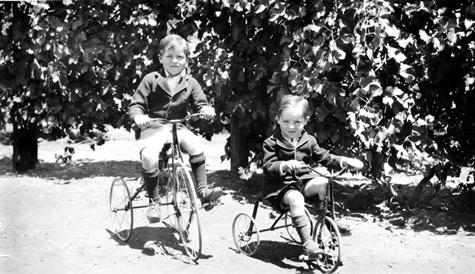
(Picture shows two boys riding their tricycles amongst grape vines in Mildura, Victoria in the 1920s; photo from Museum Victoria)

Famous Names: Barry and Gladys

07 Wednesday May 2014

Posted by A.O. in Famous Names

≈ 4 Comments

Tags

birth notices, British names, dated names, famous namesakes, fictional namesakes, Irish names, locational names, name history, name meaning, name popularity, names from comics, names from films, nicknames, Norman names, royal names, saints names, Scottish names, surname names, Welsh names

art-barry6-620x349

Last month, New South Wales Liberal Premier Barry O’Farrell resigned from his position during a NSW Independent Commission Against Corruption investigation into Australian Water Holdings. Barry denied receiving a $3000 bottle of Grange Hermitage from a AWH executive and failing to declare it, but a thank you note in his handwriting, even mentioning the 1959 vintage of wine (the year of Barry’s birth), was presented to ICAC as evidence.

Minister for Transport Gladys Berejiklian was Barry O’Farrell’s choice for his successor, but in the end she settled for Deputy to Premier Mike Baird, and was rewarded by being made Minister for the Hunter region.

New South Wales is not unaccustomed to these political scandals. The former Labor Premier resigned from his shadow ministry roles due to a personal affair, and a former Liberal Party leader resigned in tragic circumstances several years ago. The new Premier is now watching his ministry become engulfed in a cash-for favours scandal which has also damaged the NSW Labor Party, and is creating anxiety for the Federal government as well. Expect more scalps.

Barry can be seen as an Anglicised form of the Irish name Bairre, a short form of Finnbarr or Barrfind, meaning “fair hair”. It can also be an Anglicised form of the Irish name Berach, derived from a Gaelic word meaning “sharp”, and often glossed as “spear”.

There are five Irish saints named Finnbarr, with the best known being a 6th century monk who created a centre of learning in the city of Cork. Saint Barrfind (known by a confusing variety of spellings of his name) is a 6th century Irish saint who legend says was a disciple of Saint Columba, and said to have voyaged to North America, serving as an inspiration for Saint Brendan the Navigator. Saint Berach was a 6th century Irish saint who was a disciple of Saint Kevin.

The Barry surname can be derived from these names, such as O’Baire, meaning “son of the fair haired one”. But most Irish Barry families got their surname from the Normans, because de Barri was a knight who came over during the Norman Conquest of Ireland. The name comes from the village of LaBarre in Normandy, whose name may mean “gateway, barrier”.

However, the aristocratic de Barry family, Normans settled in Wales, received their name from ownership of Barry Island, whose name seems to come from the Welsh for “hill”, although it’s often said to be named after Saint Baroc, a British saint who had a chapel on the island. The Scottish Barrys take their name from a place name in Angus which also means “hill”.

Barry has been used as a first name in Ireland and England (and more rarely, Wales and Scotland) since at least the 18th century, and due to immigration from Ireland, became known in the Americas and Australia as well.

A famous Australian namesake is comedian Barry Humphries, who created the character of naively ocker Barry McKenzie for a Private Eye comic strip in the 1960s. In the 1970s films, Barry McKenzie is the nephew of Humphries creation Edna Everage, and played by Australian singer Barry Crocker. Perhaps due to this trio of Barrys, and Barry McKenzie’s rich Australian slang (mostly made up), Barry is often perceived as a very Aussie name. This does have some validity, because Barry peaked higher in popularity here than elsewhere.

Barry was #121 in the 1910s, and joined the Top 100 in the 1920s at #84. It peaked in the 1940s at #10, and left the Top 100 in the 1970s – perhaps the Barry Mackenzie films weren’t a help to it? Barry last ranked in the 1990s, but just two years ago I saw a birth notice for a baby Barry, so it is still in occasional use. Bazza or Baz are the traditional nicknames, although Baz Luhrman is not a Barry.

Gladys is a modern form of the medieval Welsh name Gwladus, traditionally identified as a Welsh form of Claudia, although it may come from the Old Welsh word for “country, nation, realm”, with connotations of sovereignty and rulership over the land.

The name Gwladus was used amongst royalty and nobility in medieval Wales, and Saint Gwladys (often called Saint Gladys) was the beautiful daughter of a legendary Welsh king who married another king, also a saint (somehow he managed to fit raiding and robbery onto his CV). The saintly couple had a number of children who were saints as well. According to legend, Gwladys and her family knew King Arthur, and lived in the woods as hermits, with a strict regimen of vegetarianism, cold baths, and chastity.

The name Gladys became well known outside Wales in the 19th century, when English author Ouida used it for a character in her novel Puck. In the book, Gladys is a farm girl who becomes a gifted actress; angelically beautiful, she manages to be both pure and passionate. Apart from this attractive namesake, the nickname Glad seems cheerful, and Gladys may have reminded some parents of gladiolus flowers (the familiar “gladdies” so beloved of Dame Edna Everage).

Gladys was #8 in the 1900s, left the Top 100 in the 1940s, and hasn’t ranked since the 1950s. There was a very famous Australian singer named Gladys Moncrieff, an absolute superstar for decades, known as “Australia’s Queen of Song”, and “Our Glad”. She started her career as “Gladys the Wonder Child” in the 1900s, and was still holding farewell concerts in the 1960s, laden with awards and honours on every side. The name Gladys disappeared from the charts around the same time she retired, but must have remained in some use, for Gladys Berejiklian was born in 1970.

Gladys was very popular once – as popular as Ava is now. In its day it was fashionable, and must have been seen as fresh, pretty, and charming. It is now generally viewed as an “ugly old lady name”, and often cited as an example of a name that can never be brought back, like an unlovely corpse with DO NOT REVIVE scrawled across its chest.

I think most of us are realistic enough to know that our daughters’ names – so popular, fashionable, fresh, pretty, and charming at present – will probably become “old lady names”, given enough time. We know there will be wrinkled Madisons, widows-humped Khaleesis, Willows with hip replacements, and Arias doting over their great-grandchildren, and their names’ image will change to match their senior status.

But names like Gladys are a looming spectre – what if our daughters’ names don’t just become old lady names, but ugly old lady names? Names that people hate, shudder with horror to think they were ever used, and vow will never be used again? And what popular names of today will be the “ugly old lady names” of the next century, I wonder?

POLL RESULT
Barry received an approval rating of 17%, making it the lowest-rated boys’ name of 2014, and the lowest-rated name overall. 45% of people thought that Barry was a terrible name, and only one person loved it. Gladys did slightly better, with an approval rating of 25%, but 46% of people hated the name.

(Photo of Barry O’Farrell and Gladys Berejiklian from The Sydney Morning Herald)


The Fastest Rising Top 100 Names of 2013

20 Sunday Apr 2014

Posted by A.O. in Naming Issues

≈ 7 Comments

Tags

Baby Center, Babynameobsessed, celebrity baby names, classic names, famous namesakes, fictional namesakes, Google, Italian names, middle names, name popularity, name trends, names from television, nicknames, popular names, royal names

Aria and Louis

GIRLS

Aria
In 2012 Aria was a newcomer to the national Top 100, and one of its highest-risers. In 2013 its success continued as the #1 rising name in Australia and Queensland, and a top rising name in New South Wales and Victoria. Aria is one of the main characters in the Pretty Little Liars book and television series, and also sounds similar to Arya from Game of Thrones. Its Italian origins make this a good cross-cultural choice too.

Evelyn
Classic Evelyn was the #1 rising name in the Northern Territory, and one of the top rising names nationally, as well as in New South Wales, Victoria, and Tasmania. In 2012 it was a top rising name nationally, and last year increased the speed at it which it rose. Ivy was the fastest-rising girls’ name of 2012, and here’s another name with a V, following hard on the heels of Evie, Eva and Ava.

Penelope
I suspect Penelope’s entrance into the Top 100 has caused some dismay. It’s certainly made me eat humble pie, as I was foolish enough last year to reassure parents that Penelope was not too popular when you had a careful look at the available data. I began to get an inkling I had made a boo-boo when day after day, I saw that the search term popularity of penelope in australia had come up yet again. I couldn’t help worrying that if all these people trustingly chose the name Penelope, its popularity was sure to increase dramatically. My fears were not unfounded, as Penelope rose more than 100 places to be the #1 rising name in Victoria, and was a top rising name nationally and in New South Wales. A slew of celebrity babies named Penelope has helped this name become hot property, and it’s back on the Top 100 for the first time since the 1970s.

Samantha
Perenially popular Samantha had been gradually sliding down the Top 100 for over a decade, but last year got a boost, going up 15 places nationally and 58 places in Victoria, as well as being a top rising name in the Australian Capital Territory, and joining the Western Australian Top 50. Perth-born model and singer, Samantha Jade, who won The X-Factor in 2012, and recently had a starring role in the hit INXS mini-series, Never Tear Us Apart, probably has something to do with it. Popular breakfast television presenter Samantha Armytage may be another factor.

Lola
Lola was the #1 name rising in New South Wales and a top rising name in Queensland. Short forms such as Maggie and Elsie did well in the charts in 2013, and although Lola is part of this movement, it seems much cheekier and flirtier than its retro sisters. Could it be the next Ruby?

BOYS

Louis
Even though classic Louis has charted since the 1900s, it was a newcomer to the Top 100 last year. It rose at least 27 places to become the #1 rising name in the country for 2013, as well as a top rising name in New South Wales and Victoria. Louis has been rising steeply for several years now, and it was only a matter of time before it made the Top 100 – but being chosen as a royal middle name can’t have done any harm.

Hudson
Hudson was one of the fastest-rising names of 2012, and continues to power up the charts. It was the #1 rising name in New South Wales, and a top rising name nationally, as well as in Victoria, Queensland, Western Australia and Tasmania. This name has been doing very well since being chosen as a baby name by two celebrities – TV chef Curtis Stone in 2011, and pop star Guy Sebastian in 2012.

Nathaniel
Nathaniel is another newcomer to the Top 100 charts, having charted in the 1900s then dropped off the charts until the 1960s. It was the #1 rising name in Victoria, and a top rising name nationally, and in New South Wales, Queensland, and Tasmania. This retro name has been making smooth and steady progress up the charts for decades, and its entry into the Top 100 coincides with the release of the first successful singles of pop singer Nathaniel (thanks to Ebony at Babynameobsessed for this tip). Another famous Australian namesake is Nathaniel Buzolic from The Vampire Diaries. This provides another way to get the popular short form Nate.

George
Remember those reports from Baby Center that Prince George hadn’t had any effect on the popularity of the name George? And how they said that before any official data had been released? Well now some has, and the name George was a top rising name nationally, and in Queensland and Western Australia (our most monarchist states?). George rose 11 places to #60; its highest ranking since the 1970s. As well as the little Prince currently gracing our shores, there is a baby George in Downton Abbey, the heir to an earldom. The Duke and Duchess of Cambridge are fans of the show, making their choice of George a possible subconscious small-screen homage. It’s interesting to note that George, Alexander and Louis all became more popular last year.

Lincoln
Lincoln was a fast-rising name of 2012, and before all the data had come in, I predicted that it would make the national Top 50 for 2013. It rose 17 places and just scraped in at #50, so a close call! Lincoln was also a top rising name in Victoria and Western Australia. Lincoln Younes plays “River Boy” Casey Braxton on Home and Away, and the name Lincoln has been increasing in popularity ever since he joined the show in 2011.

Other Names That Rose

  • Lillian – top riser nationally and in New South Wales
  • Eloise – top riser nationally and in Victoria
  • Olive – top riser nationally and in Victoria
  • Violet – #1 rising name in Western Australia and Tasmania
  • Indigo – top riser in Victoria and Queensland
  • Felix – top riser nationally and in New South Wales
  • Ryder – top riser nationally and in Tasmania
  • Lewis – top riser in Victoria and Tasmania
  • Hugo – top riser in Queensland and the Australian Capital Territory
  • Finn – top riser in Western Australia and the Australian Capital Territory

NOTE: I have chosen those names which increased in popularity in the most number of states and territories, making their popularity widest across the board in Australia. For the positions of each name in individual states and territories, please refer to the Name Data category for more information.

POLL RESULTS: People’s favourite fastest-rising names were Penelope and Louis.

Waltzing With … Sunday

13 Sunday Apr 2014

Posted by A.O. in Waltzing with ...

≈ 2 Comments

Tags

baby name stealing, celebrity baby names, celebrity sibsets, days of the week names, Easter names, english names, famous namesakes, holiday names, name history, name meaning, name popularity, nicknames, Old English names, rare names, slave names, unisex names

Heide_1_at_Heide_Gallery

In a week it will be Easter, which is always on the first Sunday after the full moon following March 21. This computation was agreed upon in the 4th century, although it was apparently already an old tradition in Rome. The Gospels tell us that the Resurrection of Christ took place on a Sunday, and from then on the day had special significance for Christians.

In the New Testament Sunday is called the Lord’s Day, and early Christians gathered for worship then. This was formalised in the 4th century, and may have been easier to implement because Sunday was already a public holiday in the Roman Empire. It is because of Christianity, and in particular because of Easter, that Sunday is regarded as a holiday – technically every Sunday of the Christian year is “Easter”, because it commemorates the Resurrection.

The English word Sunday comes from Old English, and simply means “sun’s day”. It is derived from the Germanic translation of the Latin term dies solis, meaning “day of the sun”, and in turn, this translates the Ancient Greek, heméra helíou.

The Ancient Greeks named each day of the week after the sun, the moon, and the five known planets, which were associated with gods; an idea they got from the Egyptians. The Romans followed this pattern, as did the Germanic peoples. It seems to be an Indo-European custom, because in most Indian languages, the word for Sunday is also linked with sun gods. So although Sunday has strong Christian associations, the English word has a long pagan history.

Sunday has been used as a personal name since at least the 18th century, and was possibly used for babies born on a Sunday. The first American named Sunday I can find was African-American, and in her case it may have been a slave name. The name Sunday was originally given fairly evenly to boys and girls, although today Sunday is usually thought of as a female name. Its unisex status is still active – in 2012 we had a celebrity baby boy called Sunday.

Sunday has become a celebrity baby name in Australia, since radio host Kate Langbroek chose it for her eldest daughter, Sunday Lil Lewis, in 2005. Kate’s daughter was named after celebrated art patron Sunday Reed, born Lelda Sunday Baillieau. She was from a wealthy and privileged background, and her second husband was John Reed. Together the couple gave both friendship and financial support to modern artists such as Sidney Nolan and Charles Blackman. Sidney Nolan became Sunday’s lover, and he painted his famous Ned Kelly series in the Reeds’ dining room.

The Reeds’ home near Heidelberg was named Heide, and it later became the Heide Museum of Modern Art. There was a kitchen garden at Heide, and many years later, Kate Langbroek ate from a rockmelon which Sunday Reed had planted there. It seems to have been something of an epiphanous moment for Kate, and served as the inspiration for her daughter’s name.

In 2008, actress Nicole Kidman and her husband, country music star Keith Urban, named their eldest daughter Sunday Rose. This caused Kate Langbroek a certain amount of consternation, who declared that the Kidman-Urbans had “stolen” her baby name.

What may have made it more irritating for Kate was that news sources reported that Sunday Rose had also been named after Sunday Reed. Nicole’s father Dr Antony Kidman was quoted as saying that he and Nicole’s mother had suggested the name Sunday after reading about Sunday Reed.

Meanwhile, baby name conspiracy theorists believed that the name Sunday had been chosen for its Christian significance. They saw the choice of the name Sunday as a declaration of Nicole Kidman’s Catholic faith, and a public rejection of her ex-husband’s devotion to the Church of Scientology.

By Nicole Kidman’s testimony, neither of these stories was correct, and they simply liked the name Sunday. Furthermore, what made the name special to them was that Sunday was the couple’s day to spend together – it was a name that symbolised love and the end of loneliness. It was also the day of the week they got married.

Although some people still see Sunday as a religious name, it’s important to remember that Sundays have secular significance too. Sunday is a holiday, a day of freedom from work, a day for sports and games, for beaches and barbecues, for friends and family. A great day for visiting art museums, too!

When the name of Nicole and Keith’s daughter was announced, I was surprised to see how many people online thought of it as a “wacky celebrity baby name”, like Audio Science or Pilot Inspektor. There often seemed to be disdain or even hostility towards it. In Australia, most people seem to like the name, except those who think that Sunday Rose sounds too much like “Sunday roast”.

Now Canadian comedian Mike Myers has a daughter named Sunday – Sunday Molly. However, Mike’s son is named Spike, which may just cement the idea that Sunday is the sort of crazy baby name that parents who like the name Spike might choose.

The name Sunday has only been on the US Top 1000 once, in the 1960s, and is extremely rare in the UK. Sunday has never charted in Australia, and between 2002 and 2007 there were 36 babies named Sunday born in Victoria. While Kate Langbroek hasn’t managed to keep the name to herself, her fear was that after the birth of Sunday Rose, the popularity of the name would snowball and there would be a “plague of Sundays”. Her baby name nightmare hasn’t eventuated – yet it does feel as if the name Sunday is slowly gathering momentum.

Sunday is a rare name, but still in occasional use, and you must not expect to be the only parent in the world, or even the state, with a little Sunday. It’s a day of the week with a simple meaning, and many layers of associations that are pagan, Christian and secular, but overall tied to the light and life from the sun – a name of warmth and happiness. Sunny or Sunnie is the obvious nickname, which brings the name right back to its origins.

POLL RESULT
Sunday received an excellent approval rating of 80%. 31% of people thought it was a good name, while 28% thought it was a great name. Less than 5% of people hated the name Sunday.

(Photo shows the original 19th farmhouse at the Heide Museum of Modern Art in Melbourne, which became a focal point for progressive art and culture: the Reeds made it their home from 1935 to 1967)

Famous Names: Gatsby and Catherine

09 Wednesday Apr 2014

Posted by A.O. in Famous Names

≈ 8 Comments

Tags

adult name changes, aliases, classic names, english names, famous namesakes, fictional namesakes, German names, Greek names, locational names, name history, name meaning, name popularity, names from movies, nicknames, Old French names, Old Norse names, rare names, royal names, saints names, surname names, unisex names

The-Great-Gatsby-Movie-2013

Baz Luhrman’s The Great Gatsby won Best Film at this year’s Australian Academy of Cinema and Television Arts Awards, and scooped the pool with thirteen AACTA Awards. It was slightly controversial, because the AACTAs are for Australian films, and The Great Gatsby is an adapation of an American novel financed by Warner Brothers. It does call into question what makes a film “Australian”, but if Cate Blanchett can win an Oscar, surely Leo DiCaprio can win an AACTA?

The Great Gatsby is based on F. Scott Fitzgerald’s novel of the Roaring Twenties, with the mysteriously wealthy Jay Gatsby at its centre. Gatsby is famous for his lavish parties and grand mansion, yet this decadence is only to attract the woman he yearns for. The Greek tragedy of their summer romance provides an opportunity for lyrical musings on the illusory nature of the Great American Dream.

It was probably always going to be controversial to have an Australian direct a movie based on a classic of American literature. Furthermore, while Fitzgerald’s novel is spare and subtle, Baz Luhrman’s films are about as spare and subtle as the Sydney Mardi Gras. However, while critics were underwhelmed, audiences were more receptive to its ornateness and fidelity to the text; the film is Baz Luhrman’s highest-grossing to date, at more than $350 million.

The Great Gatsby won Best Production Design and Best Costume Design at the Oscars, both awards going to Baz Luhrman’s wife, Catherine Martin, who also won two Academy Awards for Moulin Rouge! in 2002. Having now won four Oscars, this makes her Australia’s greatest Academy Award winner of all time, taking the top spot from costume designer Orry-Kelly.

The English surname Gatsby is after the village of Gaddesby in Leicestershire, which comes from the Old Norse personal name Gaddr, meaning “spike, sting, goad”. It therefore means “Gaddr’s homestead”, and from the name we can tell it dates from the Danish Occupation of the 9th and 10th centuries. Gaddr is the basis for the word gadfly, which refers to any biting fly, and gaddr was also used to refer to hard packed snow.

Jay Gatsby’s name is a self-chosen one: he was born James “Jimmy” Gatz. In fiction, it seems whenever a character goes by a different name, they are not all that they seem. Whether it is Strider from Lord of the Rings travelling under a nom de guerre, or James Bond villain Le Chiffre going by a criminal alias, some deception is taking place, whether it be gold not glistering or something more sinister. In the case of Jay Gatsby, his name change seems like that of Cate Blanchett’s character in Blue Jasmine – an attempt to escape the past.

In real life, it’s quite normal for people to change their names, for all kinds of reasons. Baz Luhrman was named Mark by his parents, and legally changed his name to his childhood nickname (technically his “tease name”, as his schoolmates said his hair looked like vulpine puppet Basil Brush).

Gatsby has had rare use in the United States as a first name for both sexes, well before Fitzgerald’s 1925 novel. There was a small spike after the 1974 movie starring Robert Redford as Gatsby, and these were boys. Likewise, a few boys have been named Gatsby recently. Although Gatsby as a baby name seems problematic (Nancy from Nancy’s Baby Names specifically warns against it), it’s the name of an iconic Great American Dreamer who now has an Australian connection too.

Catherine is a variant of the name Katherine, from the Old French Caterine. Katherine comes from the Greek name Aikaterine, of debated meaning. The name became well known due to Saint Catherine of Alexandria, a legendary saint whose tradition states she was a 4th century princess and scholar of exceptional beauty and intelligence who converted to Christianity as a young teenager, and refused to marry. She was tortured on a spiked wheel (the “Catherine wheel”) and martyred for her faith by beheading. There is no evidence she ever existed, and most likely is a composite figure of several women martyred in Alexandria at the time, with a few romantic touches added.

Christian writers connected her name with the Greek katharos, meaning “pure”, to reflect the saint’s virgin status, and the spelling of the Latin name was changed from Katerina to Katharina because of this false etymology. It’s not clear to me whether the original Greek Aikaterine was a name already in use, or made up by Christian authors. If invented, you would expect it to have Christian significance, but if so its origin has been lost.

Saint Catherine was one of the most popular saints of the Middle Ages. There were shrines to her throughout France and England, and Saint Catharine’s College at Cambridge may have been founded in her honour as a patron of learning. She was especially venerated by young girls, who prayed for good husbands on her feast day of November 25. In France, women who hadn’t married by age twenty-five were called Catherinettes, and in English an unmarried woman was called a spinster, because Saint Catherine is a patron of spinners.

There have been several Queen Catherines in English history. One of the most popular was Catherine of Aragon, the first wife of King Henry VIII. This Spanish-born queen was descended from an English royal house and named after her English great-grandmother; Catherine was considered very beautiful, with fair skin, blue eyes and reddish hair. She was learned, with a love of literature, and because of her, it became fashionable for women to gain an education. She was also pious, and won widespread admiration for her efforts to assist the poor.

There was great public sympathy for Queen Catherine; first for not being able to provide an heir, then because she was put aside by her husband (who went on to have five more wives). Catherine of Aragon sounds like a Saint Catherine come to life – paintings of the saint often depict her with red hair, and rich clothing suitable for royalty. The queen and the saint seem to have become entwined in the popular imagination, because some of Queen Catherine’s charitable works were attributed to Saint Catherine.

There could well be another Queen Catherine one day, because the Duchess of Cambridge will become queen consort when Prince William becomes king. As the Duke and Duchess are about to visit Australia, her name has been constantly in the news.

Catherine is a classic name which has never left the charts. It was #25 in the 1900s, and peaked in the 1960s at #12. It left the Top 100 in the early 2000s, and reached its lowest point in 2010 at #268. It received a small boost in 2011 when William and Catherine were married, and in Victoria it is not far out of Top 100.

Catherine is a pretty, feminine name whose peak in the 1960s probably make it seem slightly dated, when in fact it is a timeless classic steeped in history, and still getting plenty of use without being popular. There’s something refined and regal about Catherine, yet it is unpretentious enough to sound like the girl next door. Catherine looks smart and professional on a CV, but has lots of cute nicknames, including Cathy, Cat, Catie and Cate.

POLL RESULT
Gatsby received an approval rating of 35%, while Catherine received a far warmer reception with a 74% approval rating.

Requested Name: Eva

02 Wednesday Apr 2014

Posted by A.O. in Requested Names

≈ 9 Comments

Tags

Biblical names, classic names, European name popularity, famous namesakes, fictional namesakes, hebrew names, historical events, honouring, Irish names, Latinate names, name history, name meaning, name popularity, name trends, names of aeroplanes, New Zealand name popularity, nicknames, popular names, saints names, UK name popularity


Front1Eva is the Latinate form of Eve, a Hebrew name translated as “breath, life”. Eve is famous as the first woman in the Bible, and the companion of the first man, Adam. She shared Adam’s fate of being cast out of the Garden of Eden, and is regarded in the Bible as the mother of all humanity. Apart from the biblical figure, there is also a saint named Blessed Eva of Liege, a medieval holy recluse.

Eva is the most usual form of the name Eve in many countries around the world, and in Ireland and Scotland, can be used to Anglicise the Irish name Aoife, meaning “beauty”. In Australia, Eva has historically been often used by European immigrants, particularly amongst Catholics and Jews. This gives it considerable scope as a potential heritage choice.

Amongst English-speakers, the name received a boost of popularity in the 19th century after the publication of Harriet Beecher Stowe’s 1852 anti-slavery novel, Uncle Tom’s Cabin. In the book, Evangeline St. Clare, or “Little Eva” is an angelic little girl who inspires love in even the most heart-hardened, and in her final throes, converts all the slaves to Christianity with some locks of her hair. It is the pure goodness of Little Eva which changes the lives of all around her.

Uncle Tom’s Cabin created a wave of pro-slavery novels to combat its views, and one of them was Little Eva: the Flower of the South, in 1853. Quick to cash in on the Little Eva phenomenon, it features yet another angelic little girl called Little Eva, equally loving and lacking in prejudice – only in this book, Eva is so kind-hearted that when the slaves are set free, they elect to remain with her of their own free will. This idealistic dream of voluntary slavery never came to pass on a large scale.

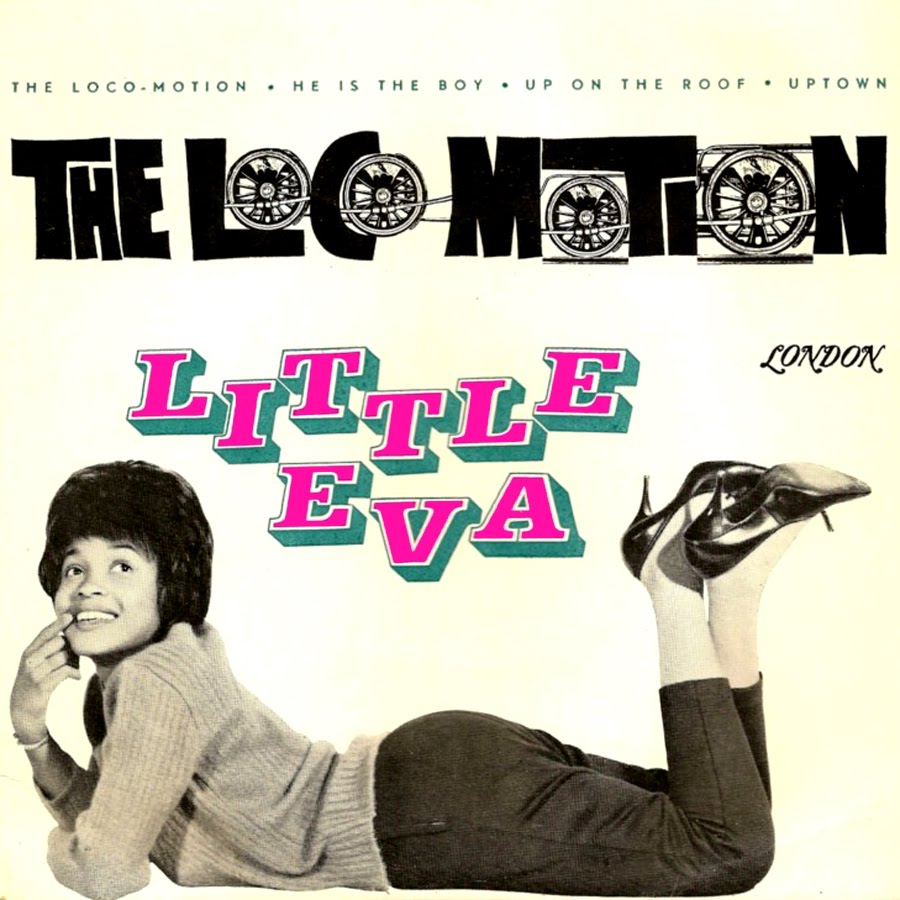
A real life Little Eva was the 1960s pop singer, born Eva Narcissus Boyd. She didn’t receive her moniker from either of these literary characters, but was called Little Eva by her family to distinguish her from her aunt, also named Eva. Little Eva is most famous for singing The Locomotion, later covered by Australian pop star Kylie Minogue. Little Eva apparently wasn’t too impressed by Kylie’s version.

Another Australian connection to Little Eva comes from World War II, when an American Air Force plane named the Little Eva got lost and crashed after a bombing mission in an isolated region of the Gulf of Carpentaria in Queensland. What happened to the survivors of the crash, and their desperate struggle against the dangers of the Australian outback, was made into a documentary called Aeroplane Dance, and is being developed into a feature film scheduled for release this year.

Eva is a classic name in Australia which has never left the charts. It was #37 in the 1900s, sinking until it left the Top 100 in the 1930s. It reached its lowest point in the 1980s at #425, then rose steeply during the 1990s to make the Top 100 for the late 2000s. Currently it is #24 nationally, #26 in New South Wales, #30 in Victoria, #31 in Queensland, #66 in Tasmania, and #27 in the Australian Capital Territory.

Eva is a very international name, being popular in all English-speaking countries, and all over Europe, including Eastern Europe and Scandinavia. It is most popular in Slovenia, at #2, and its popularity in Britain and New Zealand is almost identical to that in Australia.

Eva’s position in the Top 100 is stable, and it is now at its highest level of popularity ever. This makes it a Contemporary Classic – a traditional classic name which manages to feel modern and up-to-date. Because it is still rising, albeit gradually, it is also an Up and Coming Classic, so that it still seems rather fresh and stylish.

This all helps to make Eva an attractive choice. Furthermore, it fits in with the trend for short names ending in -a, such as Isla and Ella, and the V names, such as Ava, Ivy, Evie and Evelyn. This means that while Eva doesn’t stand out amongst its peers, neither does it sound particularly distinctive.

However, for those who care about such things, Eva has the advantage of being a classic, unlike Isla, Ella, Ava, Ivy and Evie, and also began rising before them, so that it cannot be accused of being a copycat. Eva is closest to the name Evelyn, which is also a classic that began rising in the 1990s – although Evelyn has yet to reach the popularity it enjoyed in the 1900s.

Eva is a beautiful classic name that is feminine without being frilly. Eva sounds intelligent as well as pretty, and it’s a name which ages well. It is easy to spell and pronounce, and is popular without being either extremely common or faddish. That makes it a baby name which might tick a lot of boxes on many people’s lists. The usual nicknames are Eve or Evie, but it is so short and simple that it doesn’t really need a nickname.

POLL RESULT
Eva received an excellent approval rating of 83%, making it one of the highest-rated names of 2014. People saw the name Eva as a stylish classic (23%), feminine yet not frilly (19%), beautiful or pretty (18%), and easy to spell and pronounce (17%). However, 6% thought it was too popular. Nobody thought the name Eva sounded too much like the word evil.

Thank you to Brooke for suggesting the name Eva be featured on Waltzing More Than Matilda

Famous Name: Clarice

26 Wednesday Mar 2014

Posted by A.O. in Famous Names

≈ 5 Comments

Tags

famous namesakes, fictional namesakes, Latin names, name history, name meaning, names from movies, Old French names, Roman names

Clarice_Beckett_-_Punt_Road_Bridge,_Yarra_River

As we move into misty autumn, we will look at an Australian artist who worked in obscurity, and whose 127th birthday was on this year’s Equinox, March 21. Clarice Beckett was born into a comfortably-off Victorian family – her grandfather was the master builder who designed and built Como House.

Her father’s only ambition for his daughter seems to have been that she would marry into wealth, but her mother, a hobbyist painter, encouraged her artistic talents. Clarice studied art in Melbourne, including three years under Frederick McCubbin, and was a student of the controversial artist Max Meldrum, who argued that painting was a pure science, most reliant on tone, and with colour the least important component.

In 1918, Clarice’s father retired, moving his family to the Melbourne bayside suburb of Beaumaris. Her parents were ill and demanding, so that Clarice took responsibility for most of the household chores. Mr Beckett seems to have been disappointed in his career, and to have been a very difficult man. He wouldn’t allow Clarice to have a studio, telling her that the kitchen table was good enough.

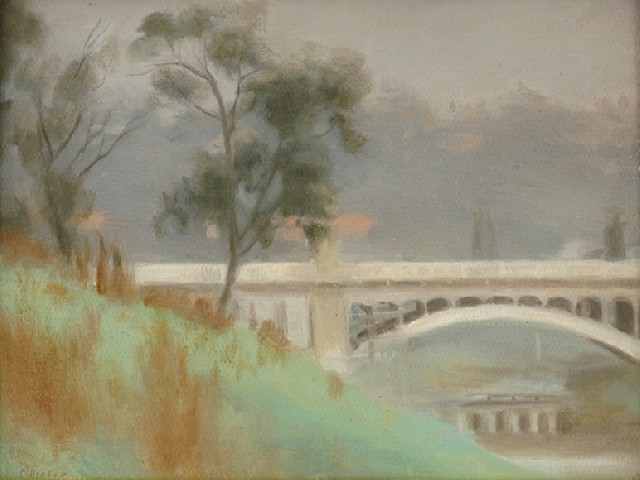
Clarice built herself a little cart filled with painting equipment, which she used as a portable studio. She tended to go out very early and late, the only times she was free from domestic duties, to paint scenes from her local area, finding endless inspiration in the sea, beaches and suburban streets, bathed in the soft light of dawn and dusk. Her style was simple and original, and her paintings strongly atmospheric, often set on misty days.

Clarice was never taken seriously as an artist in her lifetime, with critics occasionally sneering at her “continual state of fog”, but most ignoring her completely. Sales of her work were pitifully small. Even her mentor Max Meldrum, who was supportive of her work, made it known that there would never be a great female artist, as women lacked the necessary capacity to be alone. Yet he praised Clarice for “working like a man”, and defended her fiercely. Her artist friends saw her as beautiful, unassuming and intelligent; sharply witty, but with the aloofness of extreme shyness.

In 1934, Mrs Beckett died from a stroke, and Clarice was severely affected by her mother’s death. The two had become very close, and Clarice was left alone with her invalid father, who became jealous of anything which might take his daughter away from him. She stopped attending art classes or social events, and when friends came to the house, Mr Beckett ordered them to leave. Clarice was now completely isolated, and she admitted to feeling a failure.

Clarice still painted whenever she could and one night, a year after her mother’s death, she continued working outdoors even though a storm had set in. She caught a chill which developed into pneumonia; her heart was already weak, and she died five days later, aged 48. The doctor believed that she might have survived, had her will to live been stronger.

It was not until 1971 that an exhibition of Clarice Beckett’s paintings were held, after more than 2000 of her canvases were found rotting away in a country barn. A leading critic hailed her as “a remarkable modernist”, and the Australian National Gallery purchased 14 of her paintings. The public were so enthusiastic that viewing hours were extended and the exhibition sold out. Since then, there have been several more public exhibitions of her work; she is regarded as one of Australia’s finest artists, and it is promised that she will never be forgotten again.

Clarice is a medieval form of the name Clara, a Roman name which comes from the Latin meaning “clear, bright”. Clarice is thought to be based on the Old French form, Claritia – just as the medieval name Lettice was based on Letitia. It was brought over by the Norman aristocracy, who were big fans of “Clare” names, and it can be found by the early 12th century, sometimes spelled Claris. Clara itself doesn’t seem to have been used in Britain until slightly later.

The name Clarice became well known in 1991 with the release of the Oscar-winning movie, The Silence of the Lambs, whose heroine is the beautifully named Clarice Starling, an FBI trainee on the trail of a serial killer. Clarice Starling was listed by the American Film Institute as one of the Top 100 movie heroes, and is the highest female on the list.

A rather different fictional Clarice is the equally delightfully named Clarice Bean Tuesday, from the children’s books by English author Lauren Child, who also penned the popular Charlie and Lola series. Clarice Bean is the middle child in her family, who longs for space and privacy, but instead finds herself in all kinds of amusingly chaotic situations.

If you like a name that has a song attached to it, you can sing along to Clarice, by Transatlantic folk-rockers, America. Like all songs by this band, I find it pleasant enough, but have little idea what it is about, although the lyrics don’t seem negative at all.

There are two pronunciations of Clarice. It can be said KLA-ris, to rhyme with Paris, which is a more British pronunciation, or it can be said kluh-REES, to rhyme with Denise, which is far more common in the United States. You’re welcome to choose either pronunciation, but to my mind, the first one sounds far more stylish and contemporary, while the second one reminds me of those pseudo-French names like Shanice and Fonice, which seem a bit daggy and dated.

Clarice is a strong yet elegant name which seems intelligent and dignified. It’s a very old name, but to me doesn’t seem “old-fashioned”. I can imagine it sounding adorable on a little girl, like Clarice Bean, but also perfect for an adult, like Clarice Beckett. It would make a great alternative to popular-yet-falling Claire, or fashionable-and-rising Clara for anyone who would like a traditional name which is still a little out of the ordinary.

POLL RESULT
Clarice received an approval rating of 54%. The name reminded 23% of people too strongly of Silence of the Lambs, but 15% thought the name was pretty and feminine. Nobody thought the name Clarice was tacky and tasteless.

(Picture is Punt Road Bridge, Yarra River by Clarice Beckett)

Names Spotted at Home and Abroad (Summer 2013/14)

15 Saturday Mar 2014

Posted by A.O. in Names Spotted at Home and Abroad

≈ 1 Comment

Tags

American names, Arabic names, Christmas names, colour names, famous namesakes, fictional namesakes, names from television, names from video games, names of businesses, nicknames, pet names, rare names, sibsets, virtue names

434407-32707c74-6464-11e3-be16-1445237cc09f

Stories in the papers on the most popular names often have a look at the other end, and tell us which names were least common in 2013. Some of them included:

BOYS: Clinchy, Jetta, Kayos, Magick, Rampage, Shanakee, Xenophon

GIRLS: Asterix, Blendin, Bonniebell, Euphemia, Lingo, Passion, Shiny, Tiger Lily, Vogue, Zipporah

A story from Ballarat focused on mothers who had “bonus babies” long after they thought their families were complete. One of the mums was named Peace, which I thought was a lovely serene virtue name. Another was parenting author Pinky McKay, who has a very colourful name (her hair matches).

‘Tis the Season

The first baby born in Wollongong Hospital on Christmas Day was Fenix Cooper Brudenell. Fenix has a very pop culture name: his first name is after Marcus Fenix from the Gears of War video games, while his second is after Sheldon Cooper, from The Big Bang Theory. Fenix’s siblings are Megan and Austin.

Jonathan Butler and Tahani Curtis, from the Tweed Heads region of New South Wales, were expecting a child on Christmas Day, and seriously considered calling him Jesus if they had a boy. Is this the ultimate Christmas name? They had a girl instead, and named her Matilda.

Saint James the Great church in Melbourne invited people to bring their pets to celebrate Christmas Mass, because baby Jesus was born in a stable amongst animals. Nick Haines and Michelle Nichol brought their three poodles, because as Nick says, “these are our children”. The poodles are named George, Poppy and Lilly – surely some are giving their “fur babies” the names they would have given human children, as this sounds like an adorable sibset … er, pupset.

Fighting Fit Families

Bec Hyatt from Brisbane took up cage fighting in order to lose 80 kg of baby weight. She is now set to become the first Australian woman in the UFC, earning more than $100 000 per fight. Bec’s two sons are Enson and Zake – Enson may be named after American MMA champ Enson Inoue, while Zake is a variant of the Arabic name Zaki, meaning “pure”. It sounds like a cousin of Jake, Zac and Zeke.

Still on the subject of competitive fighting: the children of the Metcalf family from Sutherland Shire are all boxers. Raised by a single dad, and with their trainer as a second father, three of them have fought their way to champion status, with the youngest a promising up-and-comer. Their names are Marizza, aged 18, Axx, aged 16, Lolli, aged 14, and Electra-Shenika, aged 11. If you’ve ever wondered what a sibset that can beat your kids up would sound like, this is it.

Expat Americana

Adam Preston lived in New York City for seven years, with his first apartment over a hot dog joint called Crif Dogs in the East Village [pictured], which calls itself “NYC’s  #1 Weiner”. When he married his Canadian wife Jessica two years ago, they eloped to New York, which has so many memories for Adam. Of course he took her to Crif Dogs, and when they had a baby boy soon after, they named him Crif Benjamin Klaver Preston. The name Crif Dogs came about when owner Brian Shebairo tried to say Chris, his former business partner’s name, while chewing a hot dog. Crif sounds more up-to-date as a baby name than Chris, and even a hot dog place can evoke sentimental memories to be commemorated as a baby name.

Yvette Aubusson-Foley, a former journalist from Dubbo, has been living in the US for more than 18 months, and uneasily watching her three children adapt to local conditions in Tucson, Arizona. They dress up as little pilgrims, develop a slight American accent, and (to Yvette’s horror) happily recite the Pledge of Allegiance – although one defiantly wears an Australian flag for Spirit of America Day. Yvette’s children are daughter Jett, and her sons Phoenix and Dash; names which somehow seem ready to assimilate. Would an Indi, Banjo and Taj remain more stubbornly Aussie, I wonder?

Television

Have you ever watched an episode of Australian reality television show Real Housewives of Melbourne? It tends to get people a little excitable, mostly because the women taking part in the show aren’t actually housewives, don’t have much left of themselves that’s real, and only live in a very limited part of Melbourne. One of the women, Andrea, who runs a plastic surgery clinic and is originally from New York, has three children named Budd, Kiff and Buster (who somehow require five nannies). Their names have caused predictable Internet outrage – especially Kiff, with many demanding to know “what culture” Kiff is from: it’s a short form of Christopher, and therefore a linguistic relation to Crif.

Children’s quiz show Pyramid featured a team consisting of two girls named Eugenie and Prudence. Isn’t that a fantastic pairing of gal-pal names?

← Older posts
Newer posts →

Enter your email address to follow this blog

Categories

Archives

Recent Comments

A.O.'s avatarwaltzingmorethanmati… on Zarah Zaynab and Wolfgang…
Madelyn's avatarMadelyn on Zarah Zaynab and Wolfgang…
JD's avatardrperegrine on Can Phoebe Complete This …
A.O.'s avatarwaltzingmorethanmati… on Rua and Rhoa
redrover23's avatarredrover23 on Rua and Rhoa

Blogroll

  • Appellation Mountain
  • Baby Name Pondering
  • Babynamelover's Blog
  • British Baby Names
  • Clare's Name News
  • For Real Baby Names
  • Geek Baby Names
  • Name Candy
  • Nameberry
  • Nancy's Baby Names
  • Ren's Baby Name Blog
  • Sancta Nomina
  • Swistle: Baby Names
  • The Art of Naming
  • The Baby Name Wizard
  • The Beauty of Names
  • Tulip By Any Name

RSS Feed

  • RSS - Posts

RSS Posts

  • Celebrity Baby News: Melanie Vallejo and Matt Kingston
  • Names from the TV Show “Cleverman”
  • Can Phoebe Complete This Sibset?
  • Zarah Zaynab and Wolfgang Winter
  • Baby, How Did You Get That Name?
  • Celebrity Baby News: Media Babies
  • Celebrity Baby News: Adelaide Crows Babies
  • Celebrity Baby News: Chris and Rebecca Judd
  • Names at Work: Name News From the World of Business and Employment
  • Celebrity Baby News: Sporting Round Up

Currently Popular

  • The Top 100 Names of the 1920s in New South Wales
  • Girls Names From Stars and Constellations
  • Rare Boys Names From the 1950s
  • Celebrity Baby News: Mick and Angie Molloy
  • Celebrity Baby News: Holly Valance and Nick Candy

Tags

celebrity baby names celebrity sibsets english names famous namesakes fictional namesakes honouring locational names middle names name combinations name history name meaning name popularity name trends nicknames popular names saints names sibsets surname names twin sets unisex names

Create a free website or blog at WordPress.com.

Privacy & Cookies: This site uses cookies. By continuing to use this website, you agree to their use.
To find out more, including how to control cookies, see here: Cookie Policy
  • Subscribe Subscribed
    • Waltzing More Than Matilda
    • Join 517 other subscribers
    • Already have a WordPress.com account? Log in now.
    • Waltzing More Than Matilda
    • Subscribe Subscribed
    • Sign up
    • Log in
    • Report this content
    • View site in Reader
    • Manage subscriptions
    • Collapse this bar
 

Loading Comments...