• About
  • Best Baby Names
  • Celebrity Baby Names
  • Celebrity Baby Names – Current
  • Celebrity Baby Names – Past
  • Featured Boys Names
  • Featured Girls Names
  • Featured Unisex Names
  • Links to Name Data
  • Waltzing on the Web

Waltzing More Than Matilda

~ Names with an Australian Bias of Democratic Temper

Waltzing More Than Matilda

Tag Archives: classic names

Rare Royal Names for Boys

08 Sunday Sep 2013

Posted by A.O. in Name Themes and Lists

≈ 11 Comments

Tags

alphanumeric names, anagram names, Anglo-Saxon names, Arthurian names, Biblical names, birth notices, classic names, Danish names, english names, famous namesakes, fictional namesakes, German names, germanic names, Greek names, hebrew names, Latin names, middle names, mythological names, name history, name meaning, name popularity, names of months, nicknames, Old English names, popular names, rare names, Roman names, royal names, saints names, Scottish names, stage names, surname names, unisex names

Franz_Xaver_Winterhalter_Family_of_Queen_Victoria

Alastair

Alastair Windsor was a great-grandson of Queen Victoria through his father, and a great-great-grandson of Victoria through his mother. Although born a prince, he was stripped of his royal titles while still a toddler, after the regulations were tightened up. Alastair went into the army, and died during World War II on active service, in unconventional circumstances. He had been sent to Canada as aide-de-camp to the Governor General, who was a relation of his. Both his regiment and the Governor General had rejected him as incompetent, and he fell out of a window while drunk. It can get very cold in Canada, and Alastair succumbed to hypothermia overnight. Alastair is the Anglicised form of Alasdair, a Scottish form of Alexander. Alasdair Mòr Mac Dòmhnaill is the ancestor of the Clan MacAlister. I think Alastair very handsome, and in a country where Lachlan and Hamish are common, it doesn’t seem out of place. If the alas at the start bothers you, it can also be spelled the more common Alistair.

Athelstan

Although there had been many English kings before him, Athelstan the Glorious was the first ruler of all England, and the first who can be called king of the English. He was the grandson of Alfred the Great, and like his grandfather, had a reputation as a man of great intelligence and justice. His household was a centre for learning, he created the most centralised government England had yet had, maintained social order, encouraged literature, was an unbeaten military leader, and a key player in international affairs. He gets rave reviews from medieval historians, and even foreign writers of his time were eager to sing his praises. He is a king worthy of admiration, yet while the name Alfred was successfully revived and is still used now, Athelstan went out of use after the Norman Conquest, and remains extremely rare. Just doesn’t seem fair, does it? Athelstan is the modern form of the Anglo-Saxon name Æþelstan, meaning “noble stone”; it was very common amongst Anglo-Saxon royalty and nobility, and there are quite a few other kings with the name. I admit it does seem a little unwieldy, but it comes with the nickname Stan.

August

August was the second name of Prince Ernst August, a great-great grandson of George III and cousin of George V. As a member of the Hanoverian family, he was born a prince of Britain and Ireland, but during World War I, anti-German sentiment convinced the British royal family to strip the titles from their German relatives. However, the Hanoverians didn’t consider themselves bound by British rules, and continued to call themselves princes and princesses. To this day, the Hanoverians ask the British monarch for permission to marry, like other royals. It’s a bit of an odd situation. Prince Ernst was the last reigning monarch of the House of Hanover, and his marriage to Princess Victoria of Prussia the last large gathering of European royals before World War I broke out – he was very much the end of an era. August is the German form of Augustus, a traditional middle name in the Hanoverian royal family which continues to be handed down. You can also see August as after the month, in which case it can be given to both sexes.

Axel

Axel was the final middle name of Prince Georg Wilhelm Ernst August Friedrich Axel, the son of Prince Ernst August. He married Princess Sophie of Greece and Denmark, who was Prince Philip’s sister. The name Axel is the medieval Danish form of the Hebrew name Absalom. In the Old Testament, Absalom was a son of King David, staggeringly handsome and extremely charming. He rebelled against his father; it’s a pretty awful story involving incest, rape and murder, and not one of the most uplifting parts of the Bible. Absalom was killed when he got his head stuck in a tree, which is meant to be very ironic for some reason. To me the ironic part is his name means “my father is peace”, and he went to war against his father. Axel is not a popular name in Australia, but I feel as if it will be in a few years, based on how frequently I see it in birth notices – it is #164 in Victoria. Its use seems to be influenced by singer Axl Rose, whose stage name is famously an anagram.

Edmund

Edmund the Magnificent was half-brother to Athelstan the Glorious, and his successor to the throne. He only ruled for a few years before he was murdered, but in that short time he had important military victories in the north, established peace with Scotland, began reviving the monasteries and helped restore Louis IV to the throne of France. His great-grandson Edmund Ironsides fought valiantly against the Danes, and although ultimately defeated by King Canute, was a skilled and inspiring leader. Edmund is an Old English name meaning “rich protector”, and it was common amongst Anglo-Saxon royalty and nobility. Saint Edmund the Martyr was a King of East Anglia killed by the Danes, and was the patron saint of England until Saint George got the gig – there is a movement in East Anglia to reinstate him. Unlike many other Anglo-Saxon names, Edmund remained in use after the Conquest (probably because of the saint), and was even used in the royal family. It’s surprising how rare this name is compared to classic, popular Edward, but it’s a very handsome and noble one. Narnia fans will know it as the name of the treacherous Pevensie brother, who redeems himself and becomes a king of Narnia. Edmund “Ted” Gyngell is a recent celebrity baby, sometimes called Edmund the Magnificent after his namesake.

Emmanuel

Emmanuel was the final middle name of Francis Albert Augustus Charles Emmanuel of Saxe-Coburg and Gotha, otherwise known as Prince Albert. He married his cousin Victoria, who was the heir to the British throne at the time. Victoria had the choice of two cousins to wed, and chose Albert as the most handsome and charming. Queen Victoria was devoted to Albert, and he was a great support to her, holding quite a bit of power behind the throne. A progressive and liberal thinker, he helped bring in many reforms, set the example that monarchy must be above politics, and made a huge success of the Great Exhibition of 1851. He died while only in his early 40s, and Queen Victoria was devastated. She wore mourning for the rest of her days and withdrew from public life. Emmanuel is a Hebrew name meaning “God is with us”; the Old Testament gives the name in a prophecy, and the New Testament attached it to Jesus Christ as the Messiah. The name was common amongst European royalty, but less often used in Britain. In Australia it’s possibly best known as a surname, from guitarist Tommy Emmanuel.

Eustace

Eustace was the eldest son of King Stephen, and a great-grandson of William the Conqueror. Stephen had become king of England in a rather controversial way. After the heir to the throne had drowned in a disastrous shipwreck, Stephen had himself declared king by popular acclaim and was speedily crowned before anyone knew what was happening. The Empress Matilda had been next in line, but she was only a woman, and Stephen thought he should rule instead. Matilda didn’t agree, and their subsequent battle for power threw England into a state of anarchy for nearly two decades. Stephen had Eustace declared his co-king, but the church refused to ratify this, and nearly everyone was greatly relieved when the teenaged Eustace unexpectedly died. Generally perceived as rather a blot, his welcome demise allowed peace negotiations to go ahead. Even more conveniently, Stephen died the following year leaving Matilda’s son, Henry II, as ruler. Eustace is the English form of Greek Eustachios, meaning “rich crop”, a name chosen for himself by a 2nd century Roman general and martyr who had been born Placidus, and is known as Saint Eustace; because of him, the name was common during the Middle Ages. This is another name from The Narnia Chronicles, because Eustace Scrubb was a rather annoying character who, like the saint, was converted from his previous beliefs. Hardly anybody seems to like the name Eustace, and even C.S. Lewis made fun of Eustace Scrubb’s name.

Leopold

Prince Leopold was a son of Queen Victoria, named after his great-uncle, Leopold I of Belgium, who had helped arrange the marriage of Victoria and Albert. Leopold’s birth is famous because his mother used chloroform during labour, giving the royal seal of approval for women to seek pain relief during childbirth. Prince Leopold inherited the family condition of haemophilia and also had mild epilepsy; he became a patron of the arts, literature and chess. He knew Alice Liddell, famous as the inspiration for Lewis Carroll’s Alice books (one of which revolves around chess), and some believe he considered marrying her, although others say it was her older sister Edith who was his intended wife. Queen Victoria arranged for him to marry Princess Helena of Waldeck and Pyrmont, a distant cousin. Leopold’s marriage was happy, and he and Helena had a daughter named Alice, but he died as a result of haemophilia after only a few years. He passed away just before his son Charles was born. Alice inherited the haemophilia gene, and passed it on to her son Rupert, who also died young. Leopold is a Germanic name meaning “bold people”; it was common amongst German royalty. This rather grandiose name has popular Leo as the nickname.

Magnus

Magnus was a son of King Harold II and Edith the Fair, or Edith the Gentle Swan, sometimes (wrongly) called Edith Swan-neck. Harold and Edith were married in a traditional manner known as handfasting, and although Edith was regarded as Harold’s wife by regular people, and their children as princes and princesses, the clergy saw her only as his mistress because they hadn’t wed in a Christian ceremony. Harold did have another wife, also called Edith, but this was a marriage of political convenience, and not a love match as it was with Edith the Fair. According to legend, after Harold was killed at the Battle of Hastings, only Edith the Fair could identify his body by markings she knew, so Harold was able to have a Christian burial. Magnus is a Latin name meaning “great”; Magnus Maximus was a 4th century Western Roman Emperor who became important in British folklore and Welsh legend, and is part of the mythology of King Arthur. There are several saints named Magnus, and it was a traditional name in the royal families of Norway and Sweden. The name is often thought of as Scottish, and one of the Saints Magnus was from Scotland. This is a great name, rich in history and legend, strong and interesting, and a good alternative to Max.

Octavius

Prince Octavius was the thirteenth child of King George III, and doted upon by his adoring parents. At the age of four, he was inoculated against the smallpox virus, and as vaccination was still in its experimental stages, became ill and died, the last member of the British royal family to suffer from smallpox. The sudden death of the tiny prince caused his family immense grief, and during his later bouts of madness, King George even had hallucinations about Octavius. What made it harder for them was they had lost Octavius’ younger brother Alfred in exactly the same way six months previously. Octavius is a Roman name coming from the Latin for “eight”; Octavius was the eighth son of King George III. Octavius seems very hip – fresher than Atticus and Orlando, with a distinct feel of its own. It would be a good choice for an eighth child or grandchild, or someone born in August (the 8th month) or October.

POLL RESULT: People’s favourite names were August, Magnus, and Alastair, and their least favourite were Octavius, Athelstan and Eustace.

(Picture shows a portrait of Prince Albert and his royal family by Franz Xaver Winterhalter)

Upper Class Baby Names

18 Sunday Aug 2013

Posted by A.O. in Your Questions Answered

≈ 17 Comments

Tags

Anglo-Saxon names, birth registries, classic names, dog names, famous namesakes, fictional namesakes, flower names, Google, Greek names, hyphenated names, Latin names, Latinate names, middle names, name image, nature names, nicknames, popular names, rare names, retro names, royal baby names, royal names, Scottish names, surname names, underused classics, unisex names, vintage names

aristocrats-600x525

Class, baby names, and judgement thereof seems to be a topic under discussion everywhere at the moment. BRW magazine told us how to name our babies like a rich person, Wendy Harmer set high, perhaps unattainable standards for baby names, an American blogger told us how names are done in Old Blighty’s class system, and a random Devonian reality television contestant decided nobody’s baby names were good enough, not even hers. Perhaps the royal baby is the catalyst for all this reflection – he didn’t escape the scrutiny either; the reality TV contestant decided he had a “dog name”.

And then I checked my search engine stats this week, and found that someone had Googled what baby names do upper class australians use.

Strictly speaking, Australia doesn’t have an upper class, because we don’t have a hereditary aristocracy. It’s usual to consider the richest people of a country the de facto upper class, but when we talk of someone being “upper class”, it has connotations of more than mere possession of a large disposable income. Some of the richest families in Australia are from traditionally working class or middle class backgrounds – they’re just regular people with vast fortunes.

While Australia does have a class system, it’s a flattened-out one, with fewer social divisions, and a large middle ground. Class is more fluid and less structured here than some other places. Of course, that doesn’t mean we are free of all status markers and snobbery – including name snobbery.

So if we don’t have an upper class, do we have upper class baby names? I don’t think so, because any particular name is used by a wider variety of people than you might suppose. Although in our imaginations, poor people have children named Jaidyn and Tayylah, and rich people send Agatha and Lucius off to St Barnaby’s or the Kindergarten of Higher Consciousness, in real life it is a lot less stereotypical.

When you register your baby name, the registry doesn’t ask for your family tree or your bank balance. They won’t ever say, Look, I think Peregrine is out of your price range. Might I suggest something more affordable, like Cooper? All names are equal, because they cost the same amount to register. No matter how humble your circumstances, you can give your baby any name you want – elegant, serious, trendy, sassy, bold, or eye-raising.

And because all names are equal, they won’t make any difference to your own social position, or to your child’s. A poverty-stricken family won’t receive an invitation to join the Yacht Club just because their daughter is named Agatha, and a Jaidyn born into wealth will have just as privileged a life as if his name had been Lucius, and will be just as welcome at St Barnaby’s.

Although some people fret that their baby’s name needs to sound like a doctor, a judge, a professor, or a prime minister for them to succeed, in real life surgeons are named Kellee, chief justices are named Wayne, academics are named Tiffany and Brandy, and prime ministers are named Kevin. Not only does your name not indicate where you came from, it doesn’t indicate where you are going either.

However, it’s fair to say that some names have an upper class image. I don’t think Australia is significantly different from other English-speaking countries when it comes to what names may be perceived as upper class.

Names Which May Be Seen as Upper Class

Please note: This is by no means an exhaustive list, just a few ideas as to what I think sounds “upper class”, what others may perceive as upper class, or that I have noticed upper-middle class people choosing. I am not recommending these styles of name, or suggesting you use them.

  • Classic English-style names eg Thomas and Lucy
  • Anglo-Saxon type names eg Alfred and Edith
  • Names from European royalty eg Leopold and Adelaide
  • Latin and Latinate names eg Rufus and Aurelia; Hugo and Miranda
  • Classical names eg Leander and Hermione
  • Retro names eg Arthur and Florence
  • So old-fashioned that they’re hip eg Reginald and Gertrude
  • Vintage-style nicknames as full names eg Monty and Lottie
  • Names that have remained in use while never becoming popular eg Theodore and Susannah
  • Uncommon Scottish-style names for boys eg Cormac and Fergus
  • Uncommon flower names for girls eg Dahlia and Saffron
  • Historical surname names for boys eg Forbes and Monash
  • Whimsical names eg Huckleberry and Tuppence (while putting the whimsical name in the middle is the prudently middle class thing to do)
  • Fashionable “arty” names eg Ziggy and Coco (strike me as more aspirational middle class for some reason)
  • Literary names eg Caspian and Evangeline (these definitely seem middle class, as the middle class is keenest on reading)

How Middle to Upper-Middle Class Australian People Tend to Judge Names

Please note: I am not suggesting you follow any of this advice. It is for information only.

  • They like names that are spelled the more commonly accepted way. People are really fussy about this for some reason, and even slight changes to a name can bring on eye-rolling.
  • Any name that looks or sounds recently “made up” is frowned upon (although it’s fine if it was created a long time ago and therefore has a history behind it).
  • If a name has several variations, the simpler one is usually considered more upper class than the more elaborate eg Isabel rather than Isabella, Alice rather than Alicia, Sophie rather than Sophia.
  • Classic and retro names are usually considered more upper class than modern classics. However, Sophia is a classic name and Sophie is a modern classic, yet Sophie is more upper class than Sophia – so this does have exceptions, or can be overwritten by another rule.
  • Hyphenated names for girls, like Emma-Rose or Ruby-Lee, are often viewed with suspicion. This could be because “double” names are elaborations by their very nature.
  • Masculine or unisex names on girls are generally considered downmarket, while a unisex or feminine-sounding name on a boy often has quite a bit of cachet. So Mackenzie on a girl = thumbs down, Mackenzie on a boy = thumbs up.
  • It is fashionable to show pride in your cultural heritage, so Lorenzo, Agnieszka, Tevita, Silka and Johannes can be more stylish than Laurence, Agnes, David, Cecilia and John.
  • Conversely, many people seem to think that using names from a culture that you don’t have any immediate tie to looks distasteful. I think it’s silly, but it seems to be a widespread idea.
  • One or two middle names are fine, but once you reach three or more middle names (and you’re not royalty), you are considered to have gone beyond the bounds of good taste. It’s a little arbitrary, but it does seem to be the rule.

Names Not Obviously One Class or Another

  • Many names that have been highly popular for a length of time – by their nature, popular names are “of the people”; it’s easier for a name to remain very popular if many groups of people use them. Names like Charlotte, William, Chloe and Lachlan could belong to almost anyone, and do.
  • Hickster names – those that are fashionable-sounding yet slightly countrified, like Mayella and Elroy. Even after reading the birth notices carefully, looking for clues as to which kind of families choose these names, I still don’t know.
  • Uncommon nature names – names like Leaf or Snow are hard to place, I think. I have seen these names on children from absolutely everywhere on the social spectrum.
  • Extremely rare or obscure but genuine names – due to the fact they are almost never heard of, they don’t have any social context to put them into. You may only meet one Harmon in your whole life – so how can you generalise about the name?

What names do you think have an upper class image? And do you think there is any such thing as an upper class name? 

Celebrity Sibset: Wendy Harmer

17 Saturday Aug 2013

Posted by A.O. in Sibsets in the News

≈ 4 Comments

Tags

baby name advice, celebrity baby names, celebrity sibsets, choosing baby names, classic names, famous namesakes, fictional namesakes, honouring, Irish names, locational names, name popularity, popular names, products with human names, surname names

8487-1_n

Wendy Harmer is a highly successful comedian, who for many years has entertained on stage, television and radio. She was the first woman in Australia to host her own comedy show, The Big Gig, in 1989, and for more than a decade she was co-host of a top-rating breakfast show on 2-Day FM, when she became one of the nation’s highest paid entertainers.

Wendy is a prolific and successful author, having written humour for adults, chick lit novels, teen fiction, kid’s books, two plays, and the libretto for an opera. Her best-selling children’s series, Pearlie the Fairy, has been turned into an animated TV show. She is also editor of The Hoopla, a women’s news and opinion site.

Wendy is married to Brendan Donohoe, and has two children. Her son is named Marley (aged about 15), and her daughter is named Maeve (aged about 13).

Wendy appears to be yet another star of radio with a bee-lined bonnet in regard to baby names, because she has written an article about them for The Hoopla. It’s one of those “names not to call your baby” lists, which I must admit I don’t usually care for, because they don’t seem to really be helpful to parents so much as bullying anyone who happens to have different tastes and opinions from yourself.

Interestingly, Rule Number 2 on the list states that you shouldn’t use a famous person’s surname as your child’s name. Her son is named after Bob Marley. Okaaaay. Number 4 is that you musn’t name all your children with same letter. Mmmmm.

This article is an “update” of an earlier one, where one of the pieces of advice was that the pronunciation of your child’s name should be clear from the way it is spelled. Even now, when the name is quite well-known, some people don’t know how to pronounce Maeve from its spelling, and think that it must be MAY-vee or mah-EEV.

I do notice that so often when parents criticise baby names, the same criticisms could be levelled at their own children’s names. The most obvious example is that rather ghastly woman who said that place names as baby names were lower-class, when her own daughter was named after a country in Asia. I guess we all have mother-blindness about our baby names, and I have been guilty of the same thing myself – it’s an easy trap to fall into, but luckily I didn’t do it on TV or anything.

When we come up with rules on naming babies which we ourselves cannot stick to, it may be a sign that the rules aren’t all that useful. Just a thought!

Wendy doesn’t like her own name, which peaked at #15 in the 1950s, when Wendy was born. Part of her disappointment is that her mother chose the name out of a knitting pattern book, when the layette she was knitting was called the “Wendy”. She imagined that she had been named after Wendy Darling from Peter Pan, so being named after a knitting pattern didn’t seem so special.

Wendy much prefers her father’s choice for her name, which was Claire, the name of her beloved great-aunt. In the 1950s, Claire was #224; it rose steeply in popularity during the 1960s and ’70s, and has been in the Top 100 since the 1980s.

Now I think that’s really useful naming advice taken from real life. It may not be the best idea to choose a baby name peaking in popularity and about to fall and become dated, or select one virtually at random.

A better choice could be a classic which is lower in popularity and about to start rising, to become very popular in the long-term future. And it’s probably preferable to honour a beloved family member than to name your baby after a product – it’s nice to have a name which has some significance.

Think about the name story you are going to pass on to your child – a knitting pattern clearly doesn’t cut it. And sometimes dad knows best.

PS Wendy did manage to give the name Claire to one of her characters, the heroine of her novel, Farewell My Ovaries.

(Picture of Wendy and her family taken some years ago at Uluru; photo from Body + Soul)

Rich List Baby Names

15 Thursday Aug 2013

Posted by A.O. in Names in the News

≈ 4 Comments

Tags

classic names, famous namesakes, name popularity, name studies, popular names, rare names

0dfda646-ffc9-11e2-82b3-338937740ac4_556245252--646x363

BRW magazine puts out the Rich 200 list of the top 200 richest people in Australia each year, and has looked through all the names on their Rich List since the magazine was founded in 1984, to see which names are most common for rich people. They then suggest that parents may like to choose these names for their babies, in hopes that they will then become rich, or at least not look out of place just in case they ever do become rich.

You probably won’t be staggered to learn that the most common name on the Rich Lists was John, with fifty men of this name being included since 1984.

Top Ten Rich List Names for Boys

  • John
  • Peter
  • David
  • Michael
  • Robert
  • William
  • Ian
  • Paul
  • George
  • Andrew

Girls names were rather more problematic, since only 7% of the Rich List have been women, and only two female names have turned up more than once – Rose and Christina, of which there are just two examples of each. Despite having virtually no data to work with, they still manage to come up with a Top Ten for girls names as well. It seems to be based on simply putting the rest of them in alphabetical order.

Top Ten Rich List Names for Girls

  • Rose
  • Christina
  • Andrea
  • Angela
  • Charlotte
  • Elizabeth
  • Gina (short for Georgina)
  • Nicole
  • Penelope
  • Therese

You can probably see a major flaw in their name-your-baby-the-rich-way plan, in that the names on the boys list are classic names which have retained high levels of popularity over time.

John has never been off the Top 100, and was the #1 name from 1910 to 1940; it didn’t leave the Top Ten until the 1970s. So there are lots of rich men named John, but there are also lots of high school teachers, auto mechanics, scientists, discharged bankrupts, and murderers named John as well. It’s not so much a “rich man name” as an “everyman” name.

Even BRW admits that an unusual name will not disqualify you from wealth, because there are people on the Rich List named Ranald, Sinclair, Wolf, Brettney, and Merlin as well. (They also include Iris for some reason, although Iris is not particularly unusual even now, and was Top 100 from 1900-1940.)

John and Rose are nice names, well worth choosing if you like them, but they won’t make a difference to your child’s bank account. A name cannot magically bring wealth, and if you look at the Top Ten of the Rich 200, you can see that at least half of them inherited all, or the bulk of, their fortune.

The richest person in Australia is Gina Rinehart, who got her money, not because was named Georgina, but because her wealthy father died and left her his fortune. In other words, if you would like your children to be rich, the best thing to do is become rich yourself, and leave them all your money in your will. They will be able to inherit from you no matter what their first name is.

How did most people on the Top Ten get rich? Mining and property development. So go buy a mine, and turn it into a block of flats, and your child is well on its way to financial security.

Name Update: His Name is Henry

01 Thursday Aug 2013

Posted by A.O. in Name Updates

≈ 2 Comments

Tags

choosing baby names, classic names, name combinations, sibsets

henrytop

Hannah and James contacted the blog a couple of months ago; although they are from the United States, they were willing to let me have a look at their name list for their third son. Hannah and James liked both classic names, and newer names as well, and in the end they decided upon

HENRY MICHAEL

brother to William and Griffin.

Henry is such a handsome name, and a classic like William, while the sibset of William, Griffin and Henry sounds very masculine and even noble.

They are completely happy with the choice they have made, and the name fits their son perfectly. Hannah has written to say that she does feel that writing in to the blog was helpful in their search for the right name, and wishes to thank both me and the blog readers for assistance. I seem to recall that Henry was rather a favourite in the polls.

Congratulations Hannah and James, and welcome Henry!

Famous Name: George Alexander Louis

31 Wednesday Jul 2013

Posted by A.O. in Famous Names

≈ 16 Comments

Tags

Biblical names, classic names, epithets, famous namesakes, French names, German names, germanic names, Greek names, honouring, middle names, name combinations, name history, name meaning, name popularity, royal names, saints names, sturdy classics, underused classics

18388_662259277118346_1655646202_n

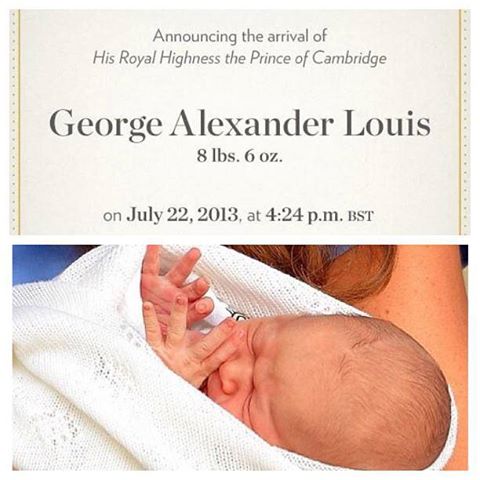
The Prince of Cambridge was born more than a week ago, and he is still big news around the globe. As future kings are born only once in a generation or so, this makes Prince George the most famous baby in the world, and it seems like an opportune time to take a look at his names.

George is derived from the Greek name Georgios, translated as “farmer”. Because it literally means “worker of the earth”, it specifically refers to the cultivation of crops.

The name George became known throughout Europe because of Saint George. According to tradition, he was a 3rd century Roman soldier from a noble Christian Greek family in Palestine. His military career went swimmingly until he was asked to sacrifice to the Roman gods, and when he refused, he was tortured and beheaded. He is venerated by Christians as a martyr.

Much later, the legend of Saint George saving a princess from a dragon was tacked on to the story. This medieval legend came from the Eastern church, and seems to be an attempt to Christianise pagan myths such as Perseus. It was brought to Europe by the Crusaders, and became a medieval romance. Saint George is the patron saint of England, and his flag, a red cross on a white background, forms part of the Union Jack.

Despite Saint George being the patron of England, his name did not become particularly common there until George I, who was German-born, took the throne of Great Britain in 1714. The name became a traditional one in the royal family, and there have been six British kings named George; the most recent the father of the present queen; he was born Albert Frederick Arthur George, and reigned under his last middle name.

George is a common name amongst many of the royal houses of Europe, and Prince Philip’s grandfather was George I of Greece, with Prince Charles having George as his last middle name. There has only been one other Prince of Cambridge, and the first one was also named George.

The name George is a sturdy classic in Australia which has never left the Top 100. It was at its peak in the 1900s and 1910s at #4, and has never been lower than #72, which it reached in the early 2000s. Currently it is #71 nationally, #64 in New South Wales,#69 in Victoria, #79 in Queensland, #48 in Tasmania and #50 in the Australian Capital Territory.

Alexander is the Romanised form of the Greek name Alexandros, translated as “defender of men, protector of men”. It first turns up in Greek mythology as the epithet of Paris, prince of Troy, who gained it while only a child, rescuing cattle from thieves while working as a cow-herd. There was a slightly earlier real life ruler of Troy named Alexander, and it’s possible the fictional Paris ended up with his name.

Just as George is a traditional name in the British royal family, Alexander was traditional in the Macedonian royal family, and the man who made the name famous for all time was Alexander III of Macedon, otherwise known as Alexander the Great. A young man of boundless ambition, Alexander conquered much of the known world, including Persia and Egypt, and invaded India before being turned back by his own men, who were getting pretty sick of his let’s-conquer-the-whole-world attitude.

Alexander was a history-maker, a great commander who never lost a battle, a role model for the empire-building Romans, and whose military strategy is still used today. He was a figure of romance, with legends being written about him even in his own lifetime. And he took power while still a teenager, dying in his early thirties, so he is always remembered as youthful, vaunting and energetic.

The name Alexander, and its many variants, spread throughout the world. There are early Christians named Alexander mentioned in the New Testament, several saints named Alexander, and many popes.

Alexander I of Scotland was named after Pope Alexander II, who gave his blessing for the Norman Conquest, and there were two more Alexanders after him in the Scottish royal family. There has never been an English king named Alexander, but the name isn’t uncommon in the royal family, and it’s especially seen use as a middle name.

In Australia, Alexander is another sturdy classic which has never left the Top 100. It was #29 in the 1900s, and sunk to its lowest level in the 1950s and ’60s at #89. It is currently enjoying some of its highest levels of popularity, being #16 nationally, #14 in New South Wales, #9 in Victoria, #20 in Queensland, #21 in South Australia, #21 in Western Australia, #26 in Tasmania and #17 in the Australian Capital Territory.

Louis is the French form of the old Germanic name Chlodowech, Latinised as Clovis, and whose modern German form is Ludwig. It means “famous warrior”. The 5th century Clovis I was the first king of the Franks to unite all the Frankish tribes under one ruler, so that they were now ruled by a single king, with kingship descending onto his heirs. He was also the first Christian ruler of Gaul.

Having created the Frankish monarchy, it’s little wonder that his name was such a big hit with French rulers, with 19 kings of France bearing the name Louis (the last one only managed a few minutes before he abdicated). The first one was Louis the Pious, son of Charlemagne, who was not only king of France but also co-ruler of the Holy Roman Empire – Louis was a traditional name amongst the Emperors as well.

Louis IX, or Saint Louis, is the only French monarch to be canonised, and Louis XIV was known as Louis the Great, or the Sun King, one of the most powerful monarchs to ever rule France. It all went wrong for Louis XVI, who was executed during the French Revolution. The other Louis the Somethings were kings in name only, as the throne had been abolished and France was no longer a monarchy.

Although so strongly associated with the French crown, Louis has been well-used as a middle name in the British royal family – in fact George I’s full name was Georg Ludwig, or George Louis. Louis is the final middle name of Prince Edward, who may have gained it from one of his godfathers, Louis, Prince of Hesse and Rhine, and Prince William, who is said to bear it in honour of Louis, Lord Mountbatten, a mentor to Prince Charles.

Louis has several pronunciations, for in French it is said loo-EE, and in English it can either be pronounced LOO-ee or LOO-is. The royal family use the LOO-ee pronunciation. Somebody recently wrote into the blog, worrying that if she called her son Louis, people might say it LOO-is by mistake, which doesn’t seem unlikely.

The name Louis is an underused classic in Australia which has never left the charts, yet never become popular. It was #101 for the 1900s, and reached its lowest point in the 1970s at #290. Since then it has continued climbing, and is currently #113 and still going strong.

George, Alexander and Louis are excellent names for a king-to-be, and great names for any boy. All classics, these are names which have stood the test of time, and been borne by men who were not just part of history, but changed history. They are names of kings and warriors and saints, defenders of the realm, and those who sought new worlds to conquer. Yet they have been borne by so many ordinary people as well that no particular expectations come with them.

These are names perfect for a prince – are any of them perfect for your little prince?

POLL RESULTS: George received an approval rating of 66% , Alexander of 88%, and Louis of 69%.

(Photo of Prince George from Facebook)

Royal Baby News: Prince William and Catherine, Duchess of Cambridge

25 Thursday Jul 2013

Posted by A.O. in Celebrity Baby News

≈ 3 Comments

Tags

celebrity baby names, classic names, honouring, middle names, popular names, royal baby names, royal names, royal titles

068841-royal-baby-kate-wills

Prince William, the Duke of Cambridge, and his wife Catherine, the Duchess of Cambridge, welcomed their first child on July 22, and have named their son George Alexander Louis, Prince of Cambridge.

Prince George was born at 4.24 pm, weighing 8 lb 6 oz (3.8 kg) in the Lindo Wing of St. Mary’s Hospital in London – the same hospital where Prince William and his brother Prince Harry were born. His birth was celebrated with illuminations of blue light, gun salutes, and the ringing of the bells of Westminster Abbey, where his parents were married on April 29 2011.

Prince George is the grandson of Prince Charles, Prince of Wales, and the great-grandson of Queen Elizabeth II, and he is third in line to the throne after his father and grandfather. We now have three generations of direct royal heirs living at the same time, which last occurred at the end of the 19th century, in the last years of Queen Victoria’s reign.

Prince George’s name was revealed on the evening of July 24 – a mercifully brief wait, because it took a week to announce Prince Wiliam’s name, and a month to announce Prince Charles. Although all three of his names are traditionally royal ones, the Duke and Duchess have confirmed that they chose the names because they liked them.

George is a traditional name in the British royal family. There have been six kings of Britain named George, and, if you count middle names as well, it is the most commonly used name in the royal family. George was the regnal name of Queen Elizabeth’s father (born Albert), and it is thought that the choice of name must please Her Majesty greatly.

George also comes from William’s mother’s side of the family, because one of his cousins from the Spencer family is named George. In addition, Saint George is the patron saint of England and the city of London, and also a classic name, very popular in Britain, where it is currently #12 – and probably destined to climb higher still. Prince George will share his name with many of his subjects, making it an “everyman” name, free of snobbery.

Little wonder that George was the name which everyone had picked out for the prince!

Alexander is another family name from the Spencer side, because Prince William has a cousin named Alexander Fellowes, reportedly a close friend. In addition, it is an appropriately Scottish choice, because Alexander was a traditional royal name in the Scottish royal family. The British monarchy has close ties to Scotland, and Prince William and Catherine met while studying at St Andrews, in Scotland. Many royal watchers had tipped a Scottish name to be chosen for a middle name for this reason.

Louis is one of William’s own middle names, and may be a tribute to Lord Louis Mountbatten, uncle of Prince Philip, and close friend and mentor to Prince Charles. Lord Mountbatten was assassinated in 1979. Louis Spencer, Viscount Althorp, is a cousin of William, so whether by chance or design, all three of the prince’s names are those of cousins on the Spencer side of the family.

All three names were my first three suggestions that I speculated could be used for the prince, based on royal naming patterns.

(Photo shows Prince George leaving hospital with his parents, wrapped in a shawl made from Australian merino wool. The Prince was swaddled in a blanket from aden + anais, designed by Australian-born founder, Raegan Moya-Jones).

Can You Suggest an Old-Fashioned Sibling Name That’s Nickname-proof?

06 Saturday Jul 2013

Posted by A.O. in Naming Assistance

≈ 7 Comments

Tags

choosing baby names, classic names, honouring, middle names, nickname-proof names, nicknames, popular names, rare names, retro names, sibsets, vintage names

a0a4d2ce42332c0a1d4e469c79ec8a71Jodie and Drew are expecting their second child next month, and don’t know what the sex will be. They have a daughter named Audrey, and would like a name which sounds good with that. Jodie really likes vintage style names, and prefers ones that can’t be shortened into a nickname. They have lists of names for both boys and girls, but each possible name seems to have its own issues to think about.

Jodie and Drew’s Boy List

  • Archer (not sure about nickname Archie, or whether it goes with Audrey)
  • Emerson (maybe too out there?)
  • Hugo (too common?)
  • Spencer (too preppy?)
  • Louis (people might pronounce it like Lewis, instead of LOO-ee)
  • Edmund (don’t want it shortened to Ed)

Jodie and Drew’s Girl List

  • Florence (Drew isn’t keen, and it might get shortened to Flo)
  • Gwendoline (a family name – will get shortened to Gwen)
  • Sadie (Drew loves it, but it almost seems too nicknamey already)
  • Mabel (too common-sounding and undignified next to Audrey?)
  • Madeline (it will be shortened to Maddie)
  • Hilary (it might get shortened to Hil)
  • Clementine (Jodie likes it, Drew doesn’t; it could get shortened to Clem)

Names Jodie and Drew Have Rejected

  • Boys – Arthur, Ashton, Byron, Clarence, Clement, Darcy, Elliot, Ernest, Erroll, Fletcher, Floyd, Flynn, Harvey, Hector, Henry, Hugh, Jarvis, Lenny, Miles, Miller, Morgan, Noah, Rupert, Willis
  • Girls – Abigail, Agatha, Agnes, Amber, Amelie, Avery, Beatrice, Charlotte, Iris, Grace, Harriet, Hazel, Juliet, Louisa, Marion, Miranda, Miriam, Olive, Paige, Piper, Rosalind, Ruby, Scarlett, Sybil, Vera, Vivienne

Middle Names

  • Boys – they are thinking of using Alistair, which is a family name, but it’s not decided yet.
  • Girl – Jodie would like to use Ann, which is a very important family name, but Drew isn’t keen on the idea.
  • In either case, the second middle name would be Jodie’s surname, which is a one syllable name.

Jodie is hoping to find a classic, old-fashioned name which doesn’t seem strange, but isn’t in the Top 50, and if possible, not in the Top 100. She doesn’t mind if the name becomes more popular later, but doesn’t like the idea of a name which is falling in popularity, in case it quickly dates.

The surname begins with B and ends with T, for example, Barrett, and they don’t want a name which starts with B. Ideally, the name would be one that can’t be turned into a nickname, and doesn’t sound too nicknamey either. They especially need help with boy’s names.

~ ~ ~ ~ ~ ~ ~ ~ ~ ~

I can understand wanting to limit what nicknames others can use from your child’s name, but I don’t think it’s possible to completely control it, or even predict what nicknames will be bestowed. There are Elizabeths who are never called anything but their full name, and there are boys named Max who are called Maxy, Max Kersplatz, Mini-Max, and Sir Maxalot.

People can be quite creative in bestowing nicknames, and your baby will soon become a little person with their own ideas. They could be happy to accept a nickname from their family and friends, and may even feel sad and left out if they don’t have one.

Rather than worrying about whether Louis will be Lou or Spencer called Spence, you can at least never use a nickname for your child yourself, and, up to a certain age, you can politely correct people who try to give them one. However, at some point you will have to let go and allow them to decide for themself.

With the middle names, I love Alistair as the middle name for a boy, and it would sound okay with all the names you are considering.

I understand that Ann is a special family name, and it’s also your daughter’s middle name (as well as other family members). I get the appeal of that – it’s like they’re all in this secret family Ann club. I am wondering though why Drew isn’t keen on the idea? Is there a family name from his side that he’d like to use? Or does he think that two sisters should have their own individual names and identities?

The children will be sharing a second middle name anyway, so perhaps sharing both middle names isn’t really necessary. If it’s extremely important to that Ann is used as the middle name, perhaps you could allow Drew to pick his favourite name for a girl, as a concession. And maybe if he convinces you to not use Ann, you could use a middle name from his side of the family instead.

YOUR NAME LISTS

Boys

  • Archer: I think it sounds nice with Audrey, but a nickname of Arch or Archie does seem likely.
  • Emerson: It doesn’t seem too out there, although it is more common for girls.
  • Hugo: I think Hugo is dashing, sounds really good with your surname and chosen middle name, and Audrey and Hugo is an adorable sibset.
  • Spencer: I guess Spencer might be a little preppy. I think only you can decide if it’s too preppy. I do like Audrey and Spencer.
  • Louis: I think this would be a fantastic choice, if you can cope with people sometimes saying his name LOO-is, which I agree could easily happen.
  • Edmund: I absolutely love this name, and I think it is utterly perfect as a match for Audrey. I feel as if people would only call him Ed if that was a nickname he liked himself.

Girls

  • Florence: I don’t think it would be shortened to Flo, which seems pretty old-fashioned. However, as Drew doesn’t care for it, I think it’s off the list anyway.
  • Gwendoline: Gwen does seem a fairly likely nickname for Gwendoline. If you decided not to go with Ann in the middle, I think Gwendoline would make a wonderful and meaningful middle name.
  • Sadie: If you insist on Ann in the middle, then it would be nice to let Drew choose this one. Sadie Ann is cute.
  • Mabel: I don’t think Mabel sounds undignified at all, and I like Audrey and Mabel a lot. To me they are rather similar, in that they can both sound cute for a little girl, but suitable for an adult too.
  • Madeline: I agree – this will get shortened to Maddie. And it’s also falling in popularity, which is one of the things you didn’t want.
  • Hilary: I don’t think it would automatically become Hil, but I’m not sure how much I love this name with Audrey.
  • Clementine: I think this is a very pretty name, and unlikely to be shortened to Clem, but as Drew doesn’t like it, I don’t think it’s a possibility.

BOYS

These are boys names I thought of that don’t have an obvious nickname. Some of them are on the Top 100, but lower than Archer.

  • Arlo
  • Drake
  • Elias
  • Felix
  • Jasper
  • Jude
  • Rex
  • Rufus
  • Stirling
  • Winston

GIRLS

These are girls names that didn’t seem straightforward to turn into nicknames. None of them are on the Top 100, and they are all vintage or retro style.

  • Cecilia
  • Celia
  • Clara
  • Cora
  • Eloise
  • Esme
  • Helena
  • Lydia
  • May
  • Pearl

~ ~ ~ ~ ~ ~ ~ ~ ~ ~

Out of the names you’ve chosen I like Mabel best for a girl, and Mabel Ann sounds sweet, if you convince Drew that Ann in the middle really is a good idea. For a boy, Edmund makes me swoon, but if you can’t get over the thought of someone calling him Ed one day, then Hugo Alistair is gorgeous.

Out of the names I came up with, I think Winston is the best match with Audrey, and Rex is the only name on the list which is old-fashioned, uncommon, gaining in popularity, and can’t be shortened into a nickname. It’s not a classic, but it’s not far off. For girls I love Clara as a sister to Audrey, and Celia Gwendoline is lovely. Several of the girls names are classics, and a couple are so rare they don’t chart at all.

Good luck Jodie and Drew – you picked an absolute winner with Audrey, and I’m sure you’ll do just as well second-time around. Let us know whether you have a boy or a girl, and what name you decide upon for him or her!

NAME UPDATE: The baby was a boy, and his name is Archer!

POLL RESULTS
The public’s choice for the baby’s name was Mabel for a girl and Hugo for a boy.

(Photo of vintage-style nursery from Spearmint Baby)

Famous Name: Julia

03 Wednesday Jul 2013

Posted by A.O. in Famous Names

≈ 5 Comments

Tags

Biblical names, classic names, famous namesakes, Latin names, mythological names, name history, name meaning, name popularity, names of months, Old Latin names, Roman names, saints names, Shakespearean names, surname names

349237-julia-gillardJulia Gillard, who became Australia’s first female prime minister in 2010, is our prime minister no longer. Just as she became prime minister by ousting Kevin Rudd, so she was deposed in her turn when Kevin staged his long-threatened comeback and was reinstated.

Her name deserves to be covered as a “famous name” because she made Australian history by dint of her sex. As well as being the first woman prime minister, she is the first Australian PM to never be married; she is in a domestic relationship with her partner, Tim Mathieson. She is the first prime minister since Billy Hughes (1915-23) to be born overseas, because she is originally from Wales; Welsh politician Aneurin Bevan is one of her political heroes.

Much has been made of the fact that Ms Gillard is childless by choice, and an atheist, but that isn’t too unusual for an Australian prime minister. Stanley Bruce, James Scullin, Ben Chifley and John McEwen didn’t have children either, and Gough Whitlam, John Curtin, John Gorton and Bob Hawke all identified as either atheists or agnostics. She isn’t even the first redheaded prime minister – James Scullin had red hair.

Kevin Rudd also made history by returning as prime minister, because he is the first to do so since Robert Menzies in 1949, and is only the second Labor prime minister to ever do so – Andrew Fisher was the last, in 1914.

Even for those who do not agree with Julia Gillard’s politics or policies, it is admirable how hard she has worked, and what she has managed to achieve. Operating from a minority government which was tipped to do very little, she managed to get almost 500 pieces of legislation through parliament during her time in office, requiring great diplomacy and bipartisan support. (Here’s another history factoid: the last hung parliament was in 1940).

Throughout her term in office, Julia Gillard was often pilloried and treated vilely by opposition supporters. She proved to be extremely courageous and tough in the face of it, and always remained graceful under  fire. Unfortunately, her strength and dignity was probably misread by the electorate as coldness and formality, and her government failed to sell its many successes to the public.

Nevertheless, Julia Gillard has left an impressive legacy behind, including a model for other women to reach for high political office in Australia. A pity her opponents have made it unlikely any of them will want it.

The Iulia or Julia was one of the most ancient and noble families of ancient Rome, and their most famous member is Gaius Julius Caesar, the dictator who ruled the Roman Republic and helped bring about the Roman Empire. Julius Caesar gave his name to July, which makes Julia a suitable name to cover this month.

The Julii came from one of the leading houses of the Alban Hills near Rome, and gained their name from a mythical ancestor named Iulus. When it became fashionable in Rome to claim a divine origin for your noble family, the Julii decided that they were descended from Ascanius, the son of Aeneas, who according to legend founded the ancient city of Alba Longa. Aeneas was the son of a prince named Anchises, from a kingdon near Troy, and the goddess Venus. To make things easier, their ancestor Iulus was identified as being the same person as Ascanius.

The meaning of Iulus can’t be known for sure, due to its great antiquity, but it is possibly related to the name of the god Jupiter, identified as meaning “O father sky-god” in Old Latin. On the top of Monte Cavo, the dominant peak of the Alban Hills, was a very ancient shrine to Jupiter, suggesting that he had been their most important deity since time immemorial.

There are several famous women named Julia who were members of the Julia family. One was the mother of Mark Antony, another the aunt of Julius Caesar, while Julius Caesar had two older sisters named Julia, and also called his only daughter Julia, a lady renowned for great beauty and virtue.

The name Julia wasn’t uncommon in the Roman Empire, and there were many first century queens and princesses bearing the name. Saint Paul mentions an early Christian named Julia living in Rome, and there are at least two saints named Julia, who were martyrs. Julia is a character in William Shakespeare’s Two Gentlemen of Verona, another of his cross-dressing girls, and this time with a very fickle lover.

Julia is a classic name in Australia, which has never left the charts. It was #119 in the 1900s, and got as low as #205 in the 1920s before rising. It reached the top 100 in 1995 at #99, and peaked in 2000 at #64 before suddenly dropping out of the Top 100 the following year.

Since then, it has been on the decline (with a small upward blip in 2010, when Julia Gillard became the first female Prime Minister), and is currently #211, the lowest point it has ever reached. It is #153 in Victoria, the state where Julia Gillard launched her political career, and in Queensland, Mr Rudd’s home state, there are fewer babies called Julia than Kevin.

Politics rarely seems to do baby names any favours, and the name Julia appears to be rapidly losing popularity. Yet it is a classic which has never been out of the 200s, so it doesn’t seem dated. Simple and elegant, Julia travels well internationally, and on the right person, this can be a jewel of a name.

POLL RESULT: Julia received an approval rating of 72%. People saw the name Julia as classy and elegant (34%), and simple and understated (15%). However, 12% thought it was frumpy and middle-aged. 2% of people were put off the name because of Julia Gillard.

(Photo of Julia Gillard from news.com.au)

Shortened Names for Boys

30 Sunday Jun 2013

Posted by A.O. in Name Themes and Lists

≈ 13 Comments

Tags

African names, Arthurian names, birth notices, celebrity baby names, Chinese names, classic names, English idioms, famous namesakes, fictional namesakes, Finnish names, Frisian names, German names, Greek names, Irish names, Japanese names, Latin names, locational names, name history, name meaning, name popularity, names from movies, names from songs, names from television, nicknames, Old Norse names, polynesian names, popular names, scandinavian names, Shakespearean names, Swahili names, Swedish names, unisex names, US name popularity, vintage names, vocabulary words

mad-max-01-01Alfie

Alfie is a nickname for Alfred. It is most famous from the award-winning (and still emotionally shocking) 1966 movie Alfie, starring Michael Caine as the predatory Alfred “Alfie” Elkins. The theme song was sung by Cilla Black, who objected that Alfie sounded like a “dog name”, and suggested Tarquin instead. As it was too late to remake the entire movie, her views were dismissed. Alfred Elkins was the grandfather of the British “Lad”, and until recently, Alfie was a name we thought of as one that could stay on grandfather. It has been Top 100 in the UK since the late 1990s, one of the old geezer names rehabilitated as cute and cool. The insipid 2004 remake of Alfie, starring handsome Jude Law as the charming Cockney, gave Alfie a new image, and Alfie Allen plays cocky Theon in Game of Thrones (big sis Lily Allen wrote a song about him). Alfie follows on the heels of popular Archie, and is #201 in Victoria.

Bastian

Bastian is a German short form of Sebastian. The name became well known from Bastian Balthazar Bux, the main character in the fantasy novel, The Neverending Story, by Michael Ende. Translated into English in the 1980s, it has been adapted into several films. In the story, Bastian is a lonely, neglected little boy who loves reading; he steals a book called The Neverending Story, and is gradually drawn into a world where make-believe becomes reality. Along the way, he not only has many adventures, but learns valuable lessons about life and love, and manages to rewrite his own story. Although he is the protagonist, he isn’t exactly its hero, which might explain why this name hasn’t taken off. It’s not only handsome, but sounds like the English word bastion – part of a castle’s defence structure, and figuratively, a person who defends a particular position.

Gus

Gus can be used as a short form of Augustus, August, Angus, Fergus, and even the Greek name Kostas, although in practice it often seems to be a nickname based on a person’s surname. The name might remind you of film director Gus Van Sant (who was named after his dad), or astronaut Virgil “Gus” Grissom, the second American in space, or of NRL expert Phil “Gus” Gould. You might think of Gus as a cowboy name, due to Texas Ranger Augustus “Gus” McCrae from Lonesome Dove, or as slightly geeky, due to Burton “Gus” Guster in Psych. The name seems to be often used for fictional animals, such as Walt Disney’s Gus Goose, and the mouse Octavius “Gus” in Cinderella (both these Guses are fat). Gus the Theatre Cat is a character from T.S. Eliot’s Old Possum’s Book of Practical Cats; he is frail and elderly, and his nickname is short for Asparagus. This vintage nickname is now very fashionable, and is #241 in Victoria.

Jonty

Jonty is a nickname for Jonathan, which seems to have originated as a full name in the United States during the 19th century, but is now more common in Britain and some Commonwealth countries. You may know the name from retired South African Test cricketer Jonathan “Jonty” Rhodes. Oddly enough, Jonty does not appear in the US data at all now, so if any babies were named Jonty last year, there were less than five of them. Jonty is #315 for boys in Victoria. Although Jonathan is a boy’s name without a feminine form, girls are sometimes called Jonty too, but not enough to show up in the data.

Kai

Kai is Scandinavian name which may be a Frisian short form of Gerhard, Nikolaus or Cornelius. It could also be a short form of the Frisian name Kaimbe, meaning “warrior”. Another possibility is that it could be short for the Latin name Caius, a variant of Gaius, whose meaning is not known. If so, it would be the Scandinavian equivalent of the English male name Kay, as in Sir Kay, who was the foster-brother of King Arthur. Or it could be a variant of the Frisian male name Kaye, which is said to come from the Old Norse word for “hen, chicken”. Or perhaps it is short for Kajetan, which comes from the Latin name Caietanus, meaning “from the town of Gaeta” (Gaeta is in central Italy). Kai can also be a girl’s name in Scandinavia, and this case it is a variant of Kaj, which is a Swedish pet form of Karin (short for either Katrina or Karolina) – to complicate things, Kaj is also a Finnish form of male Kai. That’s a lot of names Kai can be short for! Kai can be a full name in its own right, because it is also a unisex Polynesian name meaning “ocean”, and Kai has the same meaning in Japanese. Kai is a Chinese boy’s name which means “victory” in Mandarin, and in Swahili, it is a girl’s name meaning “loveable”, but this is pronounced KY-yee, and not the more familiar KY. Kai first joined the charts in the 1970s, debuting at #498. It has climbed steeply and fairly steadily, and is currently #61 nationally, #60 in New South Wales, #78 in Victoria, #64 in Queensland, #35 in Western Australia and #62 in the Australian Capital Territory. This is a fantastic little cross-cultural name which can be used for either sex, although it has only ever charted for boys in Australia.

Liam

Liam is short for Uilliam, the Irish form of William. Famous people named Liam include Irish actor Liam Neeson, actor Liam Hemsworth, brother to Chris, musician Liam Finn, son of Neil, journalist Liam Bartlett, AFL footballer Liam Picken, and Liam Payne from One Direction, credited with much of the name’s international success last year. Liam first charted in the 1950s, and first ranks in the 1960s, when it debuted at #318. I don’t know if this was a factor, but it was in the 1950s that popular Irish folk band the Clancy Brothers began their career, with Liam Clancy their best singer. By the 1980s, Liam was in the Top 100, making #82 for that decade. Liam really took off in the 1990s, when Liam Gallagher kept grabbing headlines for controversial reasons, and was #26 for the decade. Stable for years, it is currently #11 nationally, #13 in New South Wales, #15 in Victoria, #9 in Queensland, #15 in South Australia, #8 in Western Australia, #24 in Tasmania, #14 in the Northern Territory and #8 in the Australian Capital Territory.

Max

Max can be short for Maxmilian, Maximus, Maxwell, Malcolm, or any name starting with Max-. Although we think of Max as a male name, it could also be short for female names such as Maxine or Maximilienne, and just this year Perth businessman Zhenya Tsvetnenko welcomed a daughter named Max Alice. It is perhaps best known from the Mad Max films, where Mel Gibson originally played Max Rockatansky, a vigilante in a dystopian Australian future. One of Australia’s most successful movie franchises, it kick-started a national film industry and created an enduring Australian icon. Max is a classic name in Australia which has never left the charts. It was #188 in the 1900s, and arrived in the Top 100 in the 1930s, before promptly leaving it again the following decade. It reached its lowest point in the 1970s, at #411, and then skyrocketed during the 1980s – this was the period when the Mad Max films were released. Max made the Top 100 in the 1990s. By 2003 it was in the Top 50 at #24, and by 2008 it was in the Top 20, where it has stabilised. It is #16 nationally, #18 in New South Wales, #14 in Victoria, #22 in Queensland, #18 in South Australia, #15 in Western Australia, #4 in Tasmania, and #46 in the Australian Capital Territory.

Ted

Ted can either be short for Theodore, or for Edward and other Ed- names. Teds seem to be very popular in comedy, including Father Ted Crilly from Father Ted, Ted Mosby from How I Met Your Mother, Ted from the Bill and Ted movies, Ted Bullpit in Kingswood Country, and the eponymous bear from the movie Ted. Ted became a celebrity baby name last year, when Leila McKinnon welcomed her son Edmund “Ted” Gyngell, and this year Livinia Nixon called her son Ted as his full name. Ted is #282 in Victoria, so it’s unclear whether Leila started a name trend, or simply joined one. I do see a fair amount of Teds in birth notices though.

Toby

Toby is a medieval contracted form of Tobias; you can see it as either a nickname for Tobias, or the English form of it. The name Toby is one prominent in traditional British popular culture, because of the Toby jug, originally a Staffordshire pottery jug in the shape of a stout seated man, drinking and smoking, dating to the 18th century. There are at least two theories as why it has been given the name Toby. One is that it is after Sir Toby Belch, from William Shakespeare’s Twelfth Night, a suitably jovial and carousing namesake. Another is that after Henry Elwes, a famous drinker from the 18th century who was nicknamed Toby Philpot, after a character in the drinking song, The Brown Jug. Another British Toby is Mr Punch’s dog in Punch and Judy puppet shows, traditionally a bull terrier; often in the past, Toby would be a a real trained dog, not just a puppet. Interestingly, The Brown Jug mentions Toby Philpot as enjoying a drink in “the dog days (of high summer)” – maybe one reason why the puppeteer’s dog was named Toby. Toby has charted since the 1960s, when it debuted at #427, and has been in the Top 100 since 2001. It is #78 nationally, #71 in New South Wales, #94 in Victoria, #85 in Queensland, #50 in Tasmania, and #46 in the Australian Capital Territory.

Xander

Xander is short for Alexander. Xander seems to have become common as a full name in Germany, the Netherlands and Scandinavian before it caught on in the English-speaking world, and as a nickname was used more in Britain than other Anglophone countries. Xander became popularised by the character of Alexander “Xander” Harris in the TV series Buffy the Vampire Slayer, the alter ego of his creator, Joss Whedon. It may not be a coincidence that Whedon attended school in England for a couple of years. Xander is Buffy’s best male friend, and gradually matures from geeky, insecure sidekick into a smart, effective warrior, who makes a place for himself in the “real world” and is quite successful with the ladies. It was only after the show began in the late 1990s that Xander joined the US Top 1000, or charted at all in the UK. Xander is #159 in Victoria.

POLL RESULT: People’s favourite names were Gus, Toby, and Ted, and their least favourite were Bastian, Xander, and Jonty.

(Picture shows a movie poster for Mad Max)


← Older posts
Newer posts →

Enter your email address to follow this blog

Categories

Archives

Recent Comments

A.O.'s avatarwaltzingmorethanmati… on Zarah Zaynab and Wolfgang…
Madelyn's avatarMadelyn on Zarah Zaynab and Wolfgang…
JD's avatardrperegrine on Can Phoebe Complete This …
A.O.'s avatarwaltzingmorethanmati… on Rua and Rhoa
redrover23's avatarredrover23 on Rua and Rhoa

Blogroll

  • Appellation Mountain
  • Baby Name Pondering
  • Babynamelover's Blog
  • British Baby Names
  • Clare's Name News
  • For Real Baby Names
  • Geek Baby Names
  • Name Candy
  • Nameberry
  • Nancy's Baby Names
  • Ren's Baby Name Blog
  • Sancta Nomina
  • Swistle: Baby Names
  • The Art of Naming
  • The Baby Name Wizard
  • The Beauty of Names
  • Tulip By Any Name

RSS Feed

  • RSS - Posts

RSS Posts

  • Celebrity Baby News: Melanie Vallejo and Matt Kingston
  • Names from the TV Show “Cleverman”
  • Can Phoebe Complete This Sibset?
  • Zarah Zaynab and Wolfgang Winter
  • Baby, How Did You Get That Name?
  • Celebrity Baby News: Media Babies
  • Celebrity Baby News: Adelaide Crows Babies
  • Celebrity Baby News: Chris and Rebecca Judd
  • Names at Work: Name News From the World of Business and Employment
  • Celebrity Baby News: Sporting Round Up

Currently Popular

  • Celebrity Baby News: Alisa Camplin and Oliver Warner
  • Rare Boys Names From the 1950s
  • Sad Celebrity Baby News (contents may cause distress)
  • Girls Names From Stars and Constellations
  • The Top 100 Names of the 1930s in New South Wales

Tags

celebrity baby names celebrity sibsets english names famous namesakes fictional namesakes honouring locational names middle names name combinations name history name meaning name popularity name trends nicknames popular names saints names sibsets surname names twin sets unisex names

Create a free website or blog at WordPress.com.

Privacy & Cookies: This site uses cookies. By continuing to use this website, you agree to their use.
To find out more, including how to control cookies, see here: Cookie Policy
  • Subscribe Subscribed
    • Waltzing More Than Matilda
    • Join 517 other subscribers
    • Already have a WordPress.com account? Log in now.
    • Waltzing More Than Matilda
    • Subscribe Subscribed
    • Sign up
    • Log in
    • Report this content
    • View site in Reader
    • Manage subscriptions
    • Collapse this bar
 

Loading Comments...