• About
  • Best Baby Names
  • Celebrity Baby Names
  • Celebrity Baby Names – Current
  • Celebrity Baby Names – Past
  • Featured Boys Names
  • Featured Girls Names
  • Featured Unisex Names
  • Links to Name Data
  • Waltzing on the Web

Waltzing More Than Matilda

~ Names with an Australian Bias of Democratic Temper

Waltzing More Than Matilda

Tag Archives: Biblical names

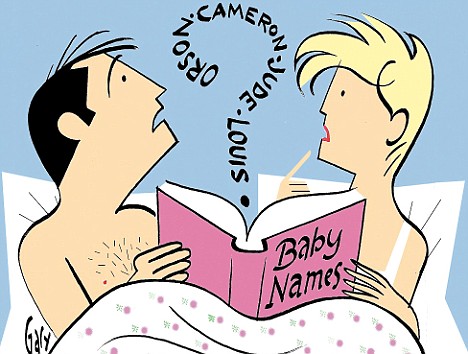
The Gentle Art of Discussing Baby Names

16 Sunday Nov 2014

Posted by A.O. in Naming Issues

≈ 14 Comments

Tags

Biblical names, choosing baby names, famous namesakes, fictional namesakes, Italian names, name disagreements, name meaning, Old Norse names, saints names, Spanish names
article-1047463-025C436E00000578-505_468x354

Being a life-long name-nerd, I spent a lot of my younger years dreaming up names for future children. In these daydreams, I was joined at the hip with someone who agreed enthusiastically with my name choices, or responded joyously : “But my darling! That has always been my favourite name, too!”. At the very worst, I hoped my future other half would be the type who said, “Honestly, I’m not very interested in baby names. Anything you pick you out will be fine, sweetie pie”.

These dreams did not eventuate. My husband turned out not to be the easygoing “whatever you say dear” sort of bloke, and it seemed as if every name I suggested was greeted with: No, Nope, Not that one, I don’t think so, and the occasional Absolutely not. I had a long list of names, and every single one got shot down without explanation. What was most frustrating was that he never suggested any names, so I had no idea what was wrong with all these names, or what names he would prefer.

After lots of arguments that never went anywhere, I came up with a new set of rules. He had to at least tell me what was wrong with the suggested name, or it stayed on the list. And just saying “I don’t like it” wasn’t good enough – he had to explain exactly why he didn’t like it. If his answer was something silly, like “I once worked with someone called that and I didn’t like them”, then the name stayed on the list.

There were a few false starts, as he feared as I would jump down his throat the minute he said anything. But I insisted I’d rather hear the truth, and told him I would hear him out without arguing. He started to elaborate on his Nos, and boy, did the flood gates open.

Sometimes it was hard to hear (some of these were names I loved after all), and sometimes I did break my promise and argued back, but as time went on it got easier and easier. The best part was that we were no longer deadlocked, and as he explained what was wrong with every single name I suggested, I started to get a feel for his tastes. That meant that rather than thrash out every name, I could automatically cross off those similar to ones he disliked.

Here are some of the highlights (?) of the process.

BOYS

Alistair
Him: Too posh. People will think he has a country estate and a trust fund, but instead he’ll have a swing set and a piggy bank.
Me: Perhaps that will teach people not to stereotype names.
Him: There’s breaking stereotypes, and then there’s committing fraud. This is more the second one.

Ari
Him (surprised): Oh … I like that one! What language is it from?
Me: It’s Old Norse.
Him: Awsome, I love Scandinavian names. What does it mean?
Me: Eagle.
Him (outraged): What kind of sick meaning is that? How could anyone be so twisted as to call their child evil?
Me: Not evil … eagle. Like the bird.
Him: Well, now all I can think of is evil when I hear it.
(This ended in a heated discussion about people who don’t listen versus people who don’t speak clearly enough).

Angus
Our surname starts with Wil-, so any name ending with an S sound will end up having SWILL in it. This one sounds like “Anger Swill”.
(I cross off all names ending in an S sound).

Bede
Sounds like bidet.

Dante
We’re not Italian!

Digby
Sounds like a dog’s name.

Edmund
Me: I thought maybe with Teddy as the nickname, but is it too close to Eddie?
Him: It’s too close to Narnia, if you ask me.
Me: But you said yes to Lucy!
Him: Lucy sounds sweet – Edmund sounds like a little creep who will sell you out to the White Witch for a block of Turkish Delight.

Ezekiel
It’s like someone throwing crockery down a flight of stairs. No weird Old Testament names – they’re ugly.

Felix
Too catty. And we can’t have any names ending in X, because it sounds the same as something ending in S.
(I cross off all names ending in X).

Gabriel
Too girly.

Hamish
Him: I really hate Scottish names – they’re ugly and pretentious.
Me: But Scottish names are traditional in your family.
Him: Yeah well this is one tradition coming to an end now because I hate them!
(I cross off all Scottish names, gloomily knowing my parents-in-law will blame me).

Hugo
It’s a cartoon villain name.

Jago
It will get twisted around into Gay Joe.

James
Him: That’s the most boring boy’s name in existence.
Me (enraged): It – is – my – father’s – name!
Him (aghast): What? No! Your dad’s name is Fred!
Me: His name is James – his nickname is Fred!
(This ended in a heated discussion about people who don’t bother to learn their own father-in-law’s name versus people who cause confusion because their nicknames are nothing like their actual name).

Jasper
Him: Yuk, sounds evil.
Me: It doesn’t – Jasper is a saint who brought gifts to baby Jesus.
Him: No, Jasper is a crook who stole Dalmatian puppies so a demon hag could turn them into coats!

Jarvis
“Jar of swill” – don’t you remember the whole discussion we had about Angus?
(Oops, forgot to cross it off).

Jude
Hey Jude, na na na na – aargh that song is an earworm, now I’ll never get it out of my head.

Leander
Him: For a boy or a girl?
Me: It’s a boy’s name.
Him: Well it sounds like a mix of Leanne and Miranda.
Me: What if you think of it more as a mix of Leo and Alexander?
Him: I hate Leo and Alexander.
(I secretly cross Leo and Alexander off the list).

Monty
Monty Python.

Oscar
Too grouchy.

Owen
Sounds as if he will always be owin’ money.

Rafael
We’re not Spanish!

GIRLS

Allegra
Him: What would we call her – Leggy? Where does it come from, anyway?
Me (evasively): Well, Lord Byron had a daughter named Allegra.
Him: What happened to her – did she end up famous, like that other daughter?
Me: Um, no … he took her from her mother and stuck her in a convent, and she died.
Him: That’s horrible! This name should be banned!

Clementine
She drowned!

Cordelia
Him: Her senile father didn’t love her! Why are all these names after girls abused by their dads?
Me: Clementine wasn’t abused.
Him: No, her father committed suicide!

Cressida
Him: Wasn’t she a prostitute?
Me: No.
Him: Well it reminds me of watercress anyway.

Harriet
I only like pretty girls’ names.

Esther
Me: This was my favourite teacher’s name.
Him: Too chemical-y.

Jemima
Him: Would she be named after the rag-doll, or the duck?
Me: Maybe after the beautiful daughter of Job in the Bible.
Him: So we’d be naming our daughter after a woman whose father was tortured for no reason? Can we not have any names from stories where the father has a terrible time, please?
(I cross off Keziah).

Lyra
Sounds like liar.

Madeleine
Me: I’m not sure about this one, what do you think?
Him: Nothing that starts with the word mad.

Saskia
Sounds like a snake hissing.

Sylvia
Him: No names starting with S, because look at the initial.
Me: You mean SW, south-west?
Him: No, S. Wil-, swill!
Me: Oh not this again.

Ursula
Him: Don’t you realise the joke on Friends was that Phoebe had a nice name while her evil twin Ursula had an awful one?
Me: So you like the name Phoebe?
Him: Yes.
Me: Me too, let’s add it to the list.
(Partial success!)

Virginia
It looks like virgin and sounds like vagina.

Zara
I hate names that start with Z.

As we worked through the process, it was apparent what names had to go – apart from anything Scottish, Old Testament, starting with Z, ending with X, or starting or ending with S. He didn’t like names that had negative meanings or associations, especially ones from childhood, and was exquisitely sensitive towards anything which sounded even vaguely negative or ridiculous.

Fussy and over-sensitive about names? Now that’s something a name nerd can understand. We weren’t so different after all.

POLL RESULTS
People thought the names that were most unfairly rejected by my husband were James and Harriet. However, there seemed to be sympathy for his views on Bede and Jarvis, as they received no votes to “save” them.

(Cartoon from the Daily Mail)

What Do You Think of Arrow as a Baby Name?

01 Saturday Nov 2014

Posted by A.O. in Naming Assistance

≈ 3 Comments

Tags

Biblical names, celebrity baby names, choosing baby names, famous namesakes, fictional namesakes, historical records, locational names, middle names, name history, names from television, rare names, sibsets, vocabulary names

Arrow-Flying-Through-Air

Courtney and Joel are expecting a baby next month, and although they have agreed on a girl’s name together, are having more difficulty deciding on a name for a boy.

Courtney thinks of her name as “typically 1980s”, and has often had to share her name with someone in her classroom or workplace, so she likes the idea of her child having something a bit more unusual so they can have their name to themselves. However, Joel thinks that unusual names can be a burden for a child, and would prefer something reasonably common.

Meaning is extremely important to Courtney, and she wants the name to be relevant to their lives: they already have a son named Israel, which has a strong meaning, and reflects their faith.

Should they have another boy, Courtney’s choice for their son’s name is Arrow. She likes that it’s a unique name, and has connotations of strength; there are several Bible verses she likes about arrows, so that it would seem to be another name with a religious meaning. Joel worries that Arrow is just too different.

Courtney wants to know if Arrow is too unusual, and whether people think Israel and Arrow would work as a brotherly sibset?

* * * * * * * * * *

It’s the age old debate on baby names – should our children’s names make them stand out, or fit in? Most of us want something in the middle, and agonise over finding a name that manages to both stand out and fit in simultaneously.

And of course everyone has their own opinion on what makes a baby name “too unusual”. Some people think even Top 100 names are a little out there, while others think almost any name they’ve ever seen on a real person is “too common”.

Although you say that you and Joel are at odds when it comes to unusual names, it seems to me Joel must be fairly open-minded. You have a son named Israel, and that is not a common name in Australia – although it’s not unheard of, and famous people like Israel Folau give it plenty of publicity, I estimate there would be less than six Israels born in any state per year. That’s quite a low amount.

Perhaps Joel liked Israel because it’s a name from the Bible, with a history of many thousands of years, so that everyone has heard of Israel, even if they don’t know anyone with the name. Maybe it hit a sweet spot, so that Israel was neither too common for you, nor too strange for Joel.

Arrow is even less common than Israel, but it’s not unheard of as a baby name. I have seen a few children named Arrow, and it’s getting some use as a middle name – including Bobby Arrow, the son of radio host Tim Ross. The name does have some history, being used since the 18th century, and can be found in Australian historical records from the 19th century, although mostly as a middle name – there are only a couple of people with the first name Arrow.

To me, a name that is very rare is not necessarily a “weird” name. A couple of weeks ago, a blog reader named Michelle asked about two rare girls’ names her partner was keen on, Maida and Maeva. I have seen even less children with these names than those called Arrow (in fact, I’ve seen exactly zero babies named Maida or Maeva), but they fit in really well with current trends in girls names, and would not seem strange amongst classmates named Maeve, Mia, Maya, and Mae.

That’s a good way to get a baby name that’s both uncommon but not too strange – find one that is in rare use, but fits in with contemporary name trends. It may get attention for being out of the ordinary, but hopefully most people will find it refreshing rather than confronting. Could Arrow be one of those rare-yet-on-trend names?

I think Arrow fits in with the trends rather well. From the bounding popularity of Archer, and solid performance of Fletcher (maybe even Beau, which sounds like Bow), it would seem that names connected with archery are on the rise. Furthermore names connected with weaponry in general are doing extremely well, because I regularly see boys (and occasionally girls) with names like Hunter, Gunner, Colt, Blade, Gauge, Bowie, Sabre, and Steele.

I’m a bit skittish about the trend for “weapons as baby names”, but Arrow seems much more than just a weapon. It’s connected to tales of derring-do, like Robin Hood and William Tell, and romance, because of Cupid’s arrows of love. It’s also a superhero name because of the Green Arrow – another hot baby name trend, and in the public consciousness because of the television series, Arrow.

And you are drawn to Arrow for reasons of faith, because arrows are mentioned in the Bible, where it describes “the Lord’s arrow of victory”, which “will flash like lightning”. In the Bible, arrows often symbolise the judgement of God. Arrows also symbolise having a clear direction to follow, swiftness and protection, and also mental alertness and toughness.

The name Arrow is on trend because of its sound too – names starting with Ar- are very fashionable, as witnessed by Archer, Ari, Ariel, Aria, Ariana, Aryan, Arthur, and Arlo. Names ending with an O sound are fashionable too, like Hugo, Indigo, Django, Marlowe, and Arlo again. Arrow doesn’t sound that much different to Arlo, when you think about it.

One of the reasons that makes simple English vocabulary names easy to bear is that everyone knows how to spell and pronounce them; unless you fiddle around with the spelling, there’s no headache involved. People might be surprised by the name Arrow, but there’s no cumbersome explanations necessary.

I think Israel and Arrow work really well as brothers. They’re both unusual names that are still very familiar, at least as a nation and a noun. They’re strong and meaningful, and Arrow really takes Israel is an interesting direction, while Israel possibly makes it clearer that Arrow has been chosen for biblical reasons.

So to me Arrow is not too strange as a name, and I briefly mentioned it on the blog as a name which seemed as if it had a lot of potential. But what about Joel – could Arrow ever hit his sweet spot the way that Israel did?

UPDATE: The baby’s name was Gabriel!

POLL RESULTS
84% of people polled believed that Arrow wasn’t too unusual a name to use on a baby. 34% thought it was a bit unusual, but people would soon get used to it, while 19% admitted the name was too unusual for them to use, but that they would find it interesting on someone else’s child. 10% thought it was a very unusual name, but they considered that positive, as it made the name cool and different, and another 10% didn’t think it was really that unusual, as it fitted in so well with current name trends. 11% didn’t think Arrow was unusual in the least. 10% thought that Arrow probably was too unusual, as they couldn’t imagine it on a real person, while 6% thought it was a really weird name.

81% of people polled were in favour of Israel and Arrow as a sibset. 37% thought it was okay, 26% thought it was a good choice that worked well, while 18% saw it as a perfect match. 14% thought it wasn’t so good, and might need a rethink, while 5% considered it a complete mismatch.

Waltzing With … Lucius

05 Sunday Oct 2014

Posted by A.O. in Waltzing with ...

≈ 3 Comments

Tags

aristocratic names, Arthurian names, Biblical names, Etruscan names, famous namesakes, fictional namesakes, Harry Potter names, imperial names, Latin names, name history, name meaning, name popularity, papal names, rare names, Roman names, royal names, royal titles, saints names, Shakespearean names, UK name popularity, US name popularity

y_Daybreak

Today is the start of Daylight Saving Time in New South Wales, Victoria, South Australia, Tasmania, and the Australian Capital Territory. Clocks went forward at 2 am this morning, so if you forgot, you are now an hour behind.

Because daylight saving becomes more pointless the closer you are to the equator, states which have tropical regions do not have daylight saving, and this means Queensland, Western Australia, and the Northern Territory. For everyone else, it’s a reminder we are moving towards summer and increasing hours of daylight, so it seems the perfect opportunity to look at a name connected with light.

Lucius was the most common name in ancient Rome times across all classes; it is usually said to be derived from the Latin word lux, meaning “light”. One theory is that it was given to children who were born at dawn, but the sheer number of people called Lucius makes this untenable. Another theory connects it to loukus, which originally meant “bright, shining”, although by the classical period it had come to mean “a cleared grove”.

Lucius is the name ascribed to an early Roman king, but it is probably a misunderstanding of Lucumo, the Etruscan word for “king”, which would be his title; the name Lucius was traditional in his family, suggesting another origin for the name. The Roman dictator Sulla, who served as an inspiration for Julius Caesar, was named Lucius Cornelius Sulla Felix. There were at least two Roman Emperors named Lucius: Lucius Dominitius Aurelianus (called Aurelian), and Lucius Aurelius Commodus (called Commodus).

Commodus was the son of the emperor Marcus Aurelius, and grandson of an emperor: he was the first emperor to be “born in the purple” (during his father’s reign). He is probably best known to us as the wicked emperor in the movie Gladiator, killed by Russell Crowe in the role of Maximus: although a fictional story, the real Commodus was eccentric and cruel, and assassinated by his wrestling partner, Narcissus.

The name Lucius was a favourite choice amongst early Christians because of the meaning of “light”, and there are several saints with the name. Saint Lucius of Cyrene is mentioned in the New Testament as a founder of the church in Antioch. There have been three popes named Lucius, and Pope Lucius I is also a saint.

Another Saint Lucius is a legendary 2nd century King of the Britons, who tradition credits with introducing Christianity to Britain by writing to the pope asking to be converted. His story became well known after it was included in the histories of Venerable Bede, and embellished by Geoffrey of Monmouth. For centuries it was an important myth of British Christianity, and although there’s no solid evidence he existed, some feel there must be a grain of truth to the legend. The church of St Peter Under Cornhill in London claims St Lucius as its founder.

The Roman philosopher and statesman known to us as Seneca had the full name Lucius Annaeus Seneca. He wrote many of his famous works while in exile, and later became an advisor to the Emperor Nero. This didn’t end well for him, as he was (probably wrongly) implicated in a plot against Nero, and forced to commit suicide. Early Christians greatly approved of him, and virtually hailed him as a humanist saint. According to medieval legend, he was converted to Christianity by Saint Paul, and is mentioned by writers such as Dante and Chaucer.

Despite all this heavy-duty Christian background, and even a British connection, Lucius has never been a common English name. It does seem to have had some history of use in Yorkshire, which has strong ties to the legendary Saint Lucius.

The name Lucius is a traditional one in the aristocratic Cary family, who bear the title Viscount Falkland. The 2nd Viscount fought on the Royalist side in the English Civil War and was killed in action. The current Viscount Falkland is named Lucius, and so is his son (a writer who goes by his middle name, Alexander), and his grandson.

Lucius has probably been used more often in America, and there are a number of famous politicians from the United States bearing this name. It’s also known from American writer and bon vivant, Lucius Beebe, and American sci-fi author Lucius Shepard.

Lucius isn’t too unusual a name in Australian historic records. Dr William Harvey, who was featured on the blog earlier this year, had a father named Lucius who was also a doctor, and it was his father’s death from tuberculosis which led Dr Harvey into specialising in thoracic medicine. A famous Australian with the name is musician Lucius Borich, the son of Kevin Borich, who was in the band The Party Boys.

Lucius doesn’t chart in Australia. 14 baby boys were named Lucius in England/Wales last year, while in the US (where Lucius peaked at #257 in the 19th century), 125 boys were named Lucius in 2013 – the same number as those called Hollis and Zephaniah.

If there seems a lack of real life Luciuses, fiction has stepped into the breach, for they abound in books, movies, TV programs, and video games. It’s no new phenomenon, for Lucius is the narrator of The Golden Ass by African author Apuleius; written in Latin in the 1st century, this comedy is sometimes regarded as the world’s first novel. Lucius is also in Arthurian legend, a fictional Emperor of Rome who King Arthur defeats, thus becoming not just King of Britain, but Emperor over all the West.

Lucius has been used as a character name twice by William Shakespeare, in Titus Andronicus and Julius Caesar. In fact, pretty much anyone who writes a story set in Roman times will include a Lucius somewhere, as it was the #1 name.

One of the best known fictional Luciuses of contemporary times is the slippery Lucius Malfoy from the Harry Potter series. Upper crust, corrupt, bigoted, and ready to slip over to the Dark Side whenever convenient, Lucius is a dyed-in-the-wool villain and general Mr Nastypants for most of the series. Only towards the end does he receive a lukewarm redemption.

His name, although suitably aristocratic, brings to mind Lucius from The Golden Ass, which is a book about witchcraft and magic – not to mention someone (literally) making an ass of themselves. However, just as Malfoy’s son’s name, Draco, means “serpent” and reminds us of the Devil, Lucius’ name is reminiscent of Lucifer, a name related to Lucius, meaning “light-bringer”, and which is often understood by Christianity as Satan’s name before his fall.

Unfortunately, some people think Lucius and Lucifer sound too similar for comfort. Stories that make the connection don’t help, such as the video game Lucius, Son of Lucifer, or the horror novel The Haunting of Sister Mary Francis, which has a character named Lucius Lucifer. On the plus side, that gives Lucius a bit of a “bad boy” edge.

An alternative is Lucian, which is derived from Lucius. Lucian is more popular in Australia than Lucius, being around the 500s, and fits in with the trend for boy’s names ending in N – Lucian almost seems like a fancier version of Lachlan.

Lucius can be pronounced either LOO-see-us, or LOO-shus. The ancient Romans said it more like LOO-ki-us, which perhaps suggests the three syllable pronunciation is more “correct”. Obvious nicknames are Lucky, Luke, Luc, Luca, Luce, Loosh, Lou, and Louie. I have seen a baby Lucius nicknamed Luci or Lucy by his family, which startled me, even though it makes perfect sense.

Handsome, intelligent, and with a rather upper-class image, Lucius does have a few issues, but seems like a name that someone could really fall in love with. It’s quite seductive – even luscious! I’ve noticed this name is often favoured by dads, suggesting that many guys appreciate the richness and power that stand behind it.

This is a rare boy’s name that is perfectly balanced between elegance and strength, brightness and darkness, history and magic, with lashings of Ancient Roman street cred and a bit of sex appeal to boot. Lucius could well be the name that lights up your life.

POLL RESULT
Lucius received a very good approval rating of 77%. 37% of people loved the name Lucius, while 25% of people didn’t mind it. Only around 5% of people hated the name.

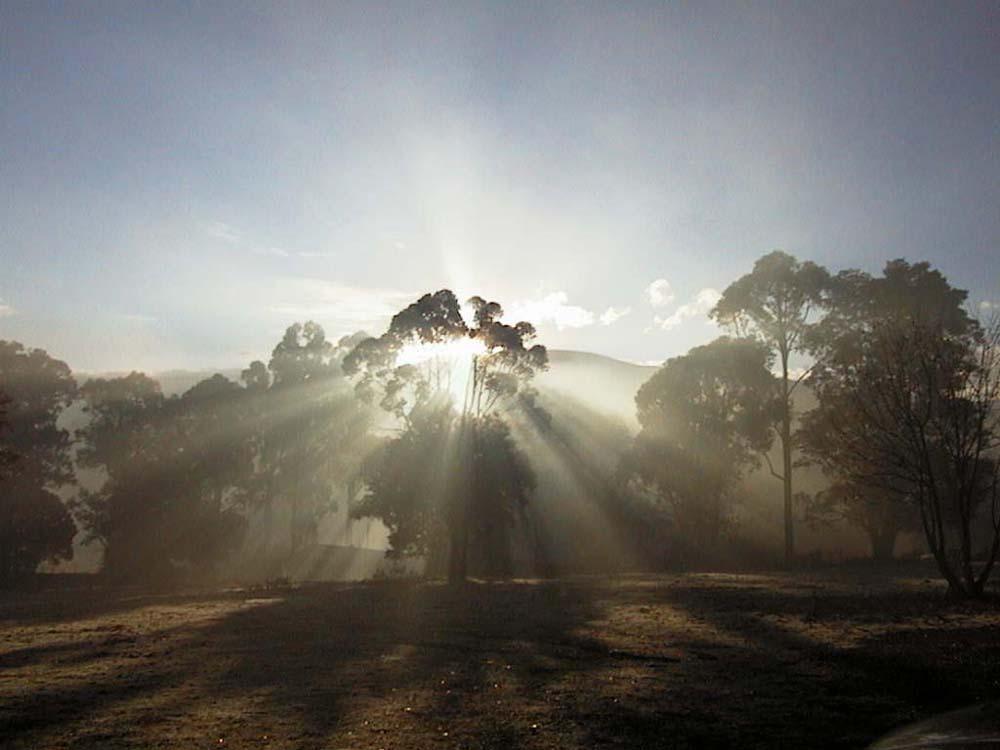
(Photo shows daybreak at Delderfield, Marysville, in country Victoria)


Famous Name: Abigail

27 Wednesday Aug 2014

Posted by A.O. in Famous Names

≈ 2 Comments

Tags

Baby Center Australia, Biblical names, famous namesakes, hebrew names, modern classics, name history, name meaning, name popularity, name trends, nicknames, popular names

240445686_2a7e0eaeb7

This month marks 37 years since the soap opera Number 96 left Australian television. It was wildly popular in the 1970s, and one of the country’s most controversial TV shows, featuring nudity and sex scenes, and covering topics such as racism, drug use, rape, adultery, and homosexuality. It was the world’s first TV show to depict a long-term gay male relationship as normal and a “non-issue”.

All the cast of Number 96 became household names, and one of its biggest drawcards was actress Abigail Rogan, who was originally from England, and always known by just her first name. Sultry, blonde, and curvaceous, she was Australia’s #1 sex symbol of the 1970s. She left the show in 1973, and although her acting career lasted another twenty years, she was never again the big star that Number 96 made her.

Having recently covered the classic children’s novel Playing Beatie Bow in the Girls Name from Australian Children’s Literature list, you might remember the main character was named Lynette, but chose a new name for herself. Because her grandmother says she looks like “a little witch”, she asks her mother to suggest “an old witch name” for her, and eventually her mum says Abigail, which is accepted. Her mother reacts with horror, saying Abigail is “so plain, so knobbly, so … so awful”.

Playing Beatie Bow was published in 1980, and the story takes place in 1973, so it seems strange Abigail is seen as a plain, knobbly, awful name suitable for an old witch. Presumably the “witch” comment is because of Abigail Williams in Arthur Miller’s play The Crucible, but the actress Abigail, in the top-rating TV show of the day, had given it a sex kitten image by 1973. Even today, I sometimes hear older people say that Abigail is “too sexy” a name for a little girl.

In the Old Testament, Abigail was the beautiful wife of Nabal, a wealthy but surly man who owned land and livestock around the town of Carmel in Judea. At the time, David, who was destined to be king, was living in the wilderness with a band of men. They had all been outlawed by King Saul, and provided protection to the local shepherds.

During the festivities surrounding the sheep shearing season, David sent a small group of men to Nabal to remind him that his profits from the wool trade were so great partly because of the protection they had been giving his shepherds, along with many fine compliments as to Nabal’s nobility and high lineage, and asking for provisions. Nabal didn’t feel like ponying up the protection food to the Outlaw Mafia, and sent back an extremely rude reply.

Uh oh. Nobody insults Don David, the Sheep Father! Seeing things were going to get sticky, one of David’s men privately saw Nabal’s wife Abigail, telling her of the situation, and explaining what a great job they’d been doing protecting the shepherds (for food out of the kindness of their hearts ). Being not only beautiful, but also intelligent, Abigail saw what a stupendous goof Nabal had made.

While David was on the march with 400 armed men, ready to give Nabal what for, Abigail went to meet him with a retinue of servants laden with provisions. She pleaded with David to accept the gifts she had brought with her, asking that there be no bloodshed, offering to take the blame for Nabal’s actions on herself, and telling David that God would make his dynasty long-lasting, and that David was both sinless, and divinely protected.

Because of her intervention, David realised he was about to commit a terrible deed, and sent Abigail home with many blessings for her advice. Abigail did not tell Nabal what she had done until the following day, as Nabal had been carousing a little too heavily at the sheep-shearing festival to be able to listen. When she did tell him the news, the shock (or the carousing) gave him a heart attack or a stroke, and he died ten days later.

When David heard about Nabal’s death, he realised that God had struck him dead in punishment, and asked Abigail to marry him. She replied by bowing to him with her face on the floor and saying, “Let your handmaid be a servant to wash the feet of the servants of my lord”. Let’s hope he didn’t take that literally; I feel a simple “Yes please that will be lovely” would have sufficed. Because she called herself a handmaid, abigail became a common term for a waiting woman, in use from around the 17th century to the early 20th century.

The Bible praises Abigail for her beauty and brains, and she is seen as a prophet because she recognised David as a future king. She was certainly very brave in confronting a vengeful man leading his own personal army, and a skilled diplomat who had a way with words (a necessary knack for the wife of a grouch like Nabal). Abigail’s name also has a beautiful meaning: it’s from the Hebrew avi (“father”), and gil (“joy”), and can be translated as “father’s joy”.

Abigail first joined the Australian charts in the 1960s, debuting at #652. It rose in the 1970s (a boost from the actress?), then fell to #686 in the 1980s, its lowest point. It began rising steeply in the 1990s, and joined the Top 100 in 2001 at #88. By 2007 it was in the Top 50 at #48, and peaked in 2010 at #24. Currently it is #28 nationally, #28 in New South Wales, #27 in Victoria, #24 in Queensland, #27 in Western Australia, #74 in Tasmania, and #23 in the Australian Capital Territory.

Gail, a short form of Abigail, was on the charts from the 1930s to the 1980s, peaking in the 1950s at #26. However, it is the Ab- shortenings which have been successful more recently, as Abby, Abbie, and Abbey all began charting in the 1980s. Abbey reached highest, rising steeply to peak in the early 2000s at #39, while Abby peaked at the same time at the more modest #75 (but Abby is now the more popular). Abbie peaked at #144 in 2009, and if all spellings were added together, Abigail short forms would be in the Top 50, so a lot more popular than they might otherwise seem.

A while back, I picked Abigail as having the potential to eventually reach #1 – with the data I now have at hand, I can see that probably isn’t going to happen, as it has already peaked. Just to confuse things though, Abigail was one of the fastest-rising names at Baby Center Australia last year, so if you’re in that demographic, you may indeed feel there are more baby Abigails around lately.

But isn’t it interesting that Abigail is popular at all? So many of the popular girls names now are soft and fluid, and yet Abigail is quite strong-sounding, perhaps even harsh to some ears, while Abigail is few people’s chosen Bible heroine.

Strangely enough, in some ways Roxanne, which was covered last week and doesn’t chart at all, seems more like the currently fashionable girl’s names than Abigail! Although Abigail is a beautiful and sophisticated choice, I suspect it’s mostly because of Abigail’s cute short forms that it’s managed to become such a favourite.

POLL RESULTS
Abigail received an excellent approval rating of 75%, making it one of the highest-rated names of 2014. People saw the name Abigail as beautiful or pretty (24%), strong and wholesome (18%), and intelligent and professional (17%). However, 8% of people thought it was harsh and ugly. Nobody thought the name Abigail was “too sexy”.

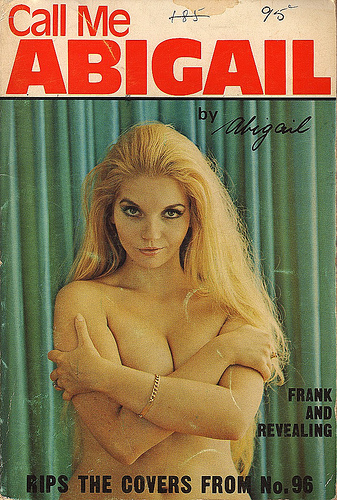
(Picture shows cover of Abigail’s 1973 best-selling “scandalous” autobiography, Call Me Abigail; copies can now sell for hundreds of dollars to collectors)

Boys Names From Australian Children’s Literature

24 Sunday Aug 2014

Posted by A.O. in Name Themes and Lists

≈ 10 Comments

Tags

aristocratic names, aristocratic surnames, Australian slang terms, Biblical names, classic names, colour names, english names, famous namesakes, fictional namesakes, Gaelic names, German names, germanic names, Greek names, hebrew names, Irish names, Latin names, locational names, modern classics, mythological names, name history, name meaning, name popularity, names from songs, names from television, names of businesses, nature names, nicknames, Old Gaelic names, Persian names, plant names, popular names, retro names, royal names, saints names, Scottish names, surname names, tree names, underused classics, unisex names

Cyan Magenta Yellow Black

Darius
Odo Hirsch’s Darius Bell and the Glitter Pool (2009) tells the story of the Bells, a proud family fallen on hard times; plucky youngest son Darius must save the family’s estate. (Name nerd bonus info: Odo is the older form of the German name Otto). Darius is the Latin form of Dareios, the Greek form of the Persian name Dārayavahush, meaning “holding on to goodness”. This name was traditional amongst the Persian kings, and Darius I was known as Darius the Great, as he ruled over the Achaemenid Empire at the height of its power. Darius III was defeated by Alexander the Great, and there are a number of minor princes with the name. Darius is mentioned several times in the Old Testament, so it is a Biblical name as well (nobody is sure which historical Darius it means). Although rare, this name is known in Australia from NRL star Darius Boyd, while there is also a Darius in The Hunger Games trilogy. Darius is a cool-sounding name that might appeal to a broad range of people.

Felix
Terry Denton’s first picture book was Felix and Alexander (1985), about a little boy named Alexander who gets lost, and his toy dog Felix must find him. Felix is a Latin name meaning “fortunate”. It was first given as a nickname to the Roman general and statesman Lucius Cornelius Sulla, a free translation of the Greek nickname he acquired during his military campaigns – Epaphroditos, meaning “beloved of Aphrodite”. The Roman procurator Felix is mentioned in the New Testament, although not in a positive way – he imprisoned St Paul. Felix was a favourite name amongst early Christians, and there are heaps of saints named Felix, including the 7th century Felix of Burgundy, who introduced Christianity to East Anglia, and three popes. Two Australian connections are Felix the Cat, and Australia Felix, the name given to the lush farmland of western Victoria by explorer Sir Thomas Mitchell. Felix was #172 in the 1900s, and left the charts in the 1920s. It returned in the 1980s at #396 and climbed steadily; it’s been on and off the Top 100 since 2011. It’s now #86, and was one of the fastest-rising names last year. A hip retro favourite growing in recognition.

Harley
Sleepy Harley (2011), written by Karen Treanor and illustrated by Kelly Iveson, is a picture book about a cat named Harley who tries to find a place to nap in a Perth suburb. Harley is a surname which comes from a place name meaning “hare meadow” in Old English. The de Harley family were nobles whose history can be traced before the Conquest, and Sir Robert Harley, first Earl of Oxford, was from a prominent political family. One of them, William Cavendish-Bentinck, became British Prime Minister in the 18th and 19th centuries; he was the maternal great-great-great grandfather of Queen Elizabeth. The name will remind many of Harley-Davidson motorycles, giving Harley a pretty cool image. Harley was #212 in the 1900s, and went up and down before dropping off the charts in the 1950s. It returned in the 1970s at #462, and rose before peaking at #70 in 1992. It dropped again before starting to rise in the early 2000s, and is not far out of the Top 100. You could see Harley as an underused classic – in use for many years, but never very popular. I have occasionally seen Harley on girls as well.

Jude
Me and Jeshua (1984) by award-winning author Eleanor Spence is a historical novel about the childhood of Jesus of Nazareth, as seen through the eyes of his cousin Jude. Jude is a variant of the name Judas, Greek form of the Hebrew name Judah, meaning “praised”. In the New Testament, Jude is used for the Apostle whose name was Judas, to distinguish him from Judas Iscariot. Jude is also listed in the New Testament as one of the brothers of Jesus (Eleanor Spence follows a tradition they were cousins), but it is not clear if Jude the Apostle was Jesus’ brother. The Apostle Jude is usually connected with the Apostle Simon the Zealot, and according to tradition they were both martyred in Beirut. Jude is well known as the patron saint of lost causes, and this has made him one of the most venerated saints. Contemporary associations are the actor Jude Law, and the Beatles song Hey Jude. Jude can also be used as a girl’s name, short for Judith, as in the YA novel by Maureen McCarthy, Queen Kat, Carmel, and St. Jude Get a Life (1995). This attractive name has quietly been gaining in popularity, and last year joined the Top 100 in Victoria.

Leonard
The Lockie Leonard series by Tim Winton (1990-97) stars a surf rat named Lachlan “Lockie” Leonard who moves to the Western Australian town of Angelus (based on Albany). Leonard is a Germanic name which can be translated as “brave lion” or “brave as a lion”. St Leonard is a legendary 6th century saint, a Frankish nobleman at the court of Clovis I who could liberate prisoners from their chains when invoked. The Normans brought the name to England, although it didn’t become particularly common until the 19th century. Famous Australians with the name include distinguished chemist Leonard Lindoy, and hard-hitting post-war cricketer Leonard “Jock” Livingston, also a talented rugby league footballer. Leonard has been a popular name amongst Jews in the past, including Jock Livingston: other examples are Canadian folk singer Leonard Cohen and actor Leonard Nimoy. Leonard was #39 in the 1900s, and peaked in the 1910s at #35. It didn’t leave the Top 100 until the 1960s, and remained in steady but low use until getting a little boost after The Big Bang Theory, with main character Leonard Hofstadter, began airing in the late 2000s. Clunky cool, this underused classic provides a way to get the popular nickname Lenny.

Nathaniel
In Isobelle Carmody’s YA novel The Gathering (1993), Nathaniel Delaney is a teenager who moves to a grim seaside town and finds himself locked in a battle between the forces of Light and Dark. Nathaniel is a variant of Nathanael, the Greek form of Hebrew Netan’el, meaning “God has given”, nearly always understood as “gift of God”. In the Bible, Nathaniel is usually identified with the Apostle Bartholomew; as Bartholomew means “son of Talmai”, it is taken to be Nathaniel’s surname. Nathaniel was in use as an English name by the 16th century, and became more common after the Protestant Reformation. It was used amongst the aristocracy, and also became a favourite in America, with author Nathaniel Hawthorne a notable bearer. Nathaniel was #179 in the 1900s, and left the charts the following decade. It returned in the 1970s at #296, and climbed steadily until it reached the Top 100 last year at #79, making it one of the fastest-rising names of 2013. A handsome retro name that gives the popular nickname Nate, it’s well known from Australian actor Nathaniel Buzolic, from The Vampire Diaries, and Australian singer-songwriter Nathaniel Willemse, who was on The X-Factor.

Rafferty
The Rafferty series by Joan Woodberry (1959-62) are the adventures of an English boy named Rafferty who moves to a fishing village on the Queensland coast. Rafferty is a common Irish surname, an Anglicised form of O’Raithbheartaigh, meaning “son of Rabhartach”. The Old Gaelic personal name Rabhartach means “wielder of prosperity”. The name has a particular Australian resonance, due to iconic Australian actor John “Chips” Rafferty. He was seen as the quintessential Australian, and took part in a marketing campaign convincing British people to migrate to Australia in the 1950s – this might explain the choice of Rafferty’s name in Woodberry’s books. Another Australian reference is the slang term Rafferty’s rules, meaning “no rules at all”. It gives the name Rafferty a pleasantly raffish, lawless feel. This name is around the 200s in Australia, and although it is rising in the UK, is more popular here than anywher else. I have also begun to see a few girls named Rafferty.

Rowan
The Rowan of Rin fantasy series by Emily Rodda (1993-2003) takes place in a fictional world. Rowan is the unlikely hero, considered a bit of a wimpy weakling by the sturdy villagers of Rin, but when danger strikes, his resourcefulness and courage saves the day. Rowan is a Scottish name that’s an Anglicised form of Ruadhán, a pet form of Ruadh, Gaelic for “red”, often given as a nickname to a man with red hair. You may remember that the red-headed Scottish outlaw Raibeart “Ruadh” MacGregor is known as Rob Roy by the English. Rowan can also be unisex when named after the rowan tree; its English name comes from the Germanic for “to redden”, because of the tree’s red berries, so either way the meaning has a connection with the colour. A pleasant association with the tree is that according to folklore it has the power to ward off evil. The name Rowan has charted for boys since the 1940s, debuting at #205, and climbing until it peaked in the 1980s at #164. It’s now around the 300s-400s. Rowan is an underused modern classic which alludes to a vibrant colour, and a magical tree.

Silvander
Norman Lindsay is famous for writing and illustrating The Magic Pudding (1918), a comic fantasy deservedly recognised as a classic. For some reason, his other children’s book, The Flyaway Highway (1936), is neglected, even though it’s just as funny and fantastical. I loved this story, which relates how Egbert and Muriel Jane meet a “bloke with horns and cows’ hooves” named Silvander Dan, who take them on a journey down the Flyaway Highway. As a child, I thought that the name Silvander was made up for the book (although I’m afraid I was already junior name nerd enough to know what it meant). However, I’ve since found that Silvander was a literary name in the 18th century, and in most of the sources I’ve read, characters named Silvander are untrustworthy bounders! The name is derived from Silvanus, the Roman god of woods and fields, from the Latin silva, meaning “wood, forest”. Although an extremely rare name, it is just enough like Silas and Alexander to not be completely outrageous, and has an agreeably silvery sound. For those who like Leander and Evander, here is another to consider.

Theodore
I told myself I would not choose more than one book from a single author, but was forced to make an exception for Odo Hirsch, from whose oeuvre I could happily fill two lists. Antonio S and the Mystery of Theodore Guzman (1997) is his first novel, a charming story about a boy who lives in a grand old house, and is fascinated by a reclusive actor. (Name nerd bonus info: Odo Hirsch is the pen name of Dr David Kausman). Theodore is from the Greek name Theodorus, meaning “God’s gift”. Theodorus wasn’t uncommon in ancient times; ironically one of its famous bearers was the 4th century BC philosopher Theodorus the Atheist. Because of its meaning, the name was a popular choice for early Christians, and saints named Theodore are numerous, including a 7th century Archbishop of Canterbury and two popes. Theodore was also traditional mongst the Byzantine Emperors, and the Russian Tsars. Theodore was #116 in the 1900s, and reached its lowest point in the 1970s at #383. It began rising steeply in the 1990s, and last year joined the Queensland Top 100 at #79, making it one of the state’s highest-rising names. A sophisticated classic name which comes with cool short forms Theo and Ted, I’d call this underused except I’m not sure how long it will stay that way.

POLL RESULTS
The public’s favourite names were Theodore, Jude and Felix, and their least favourite were Leonard, Darius and Harley.

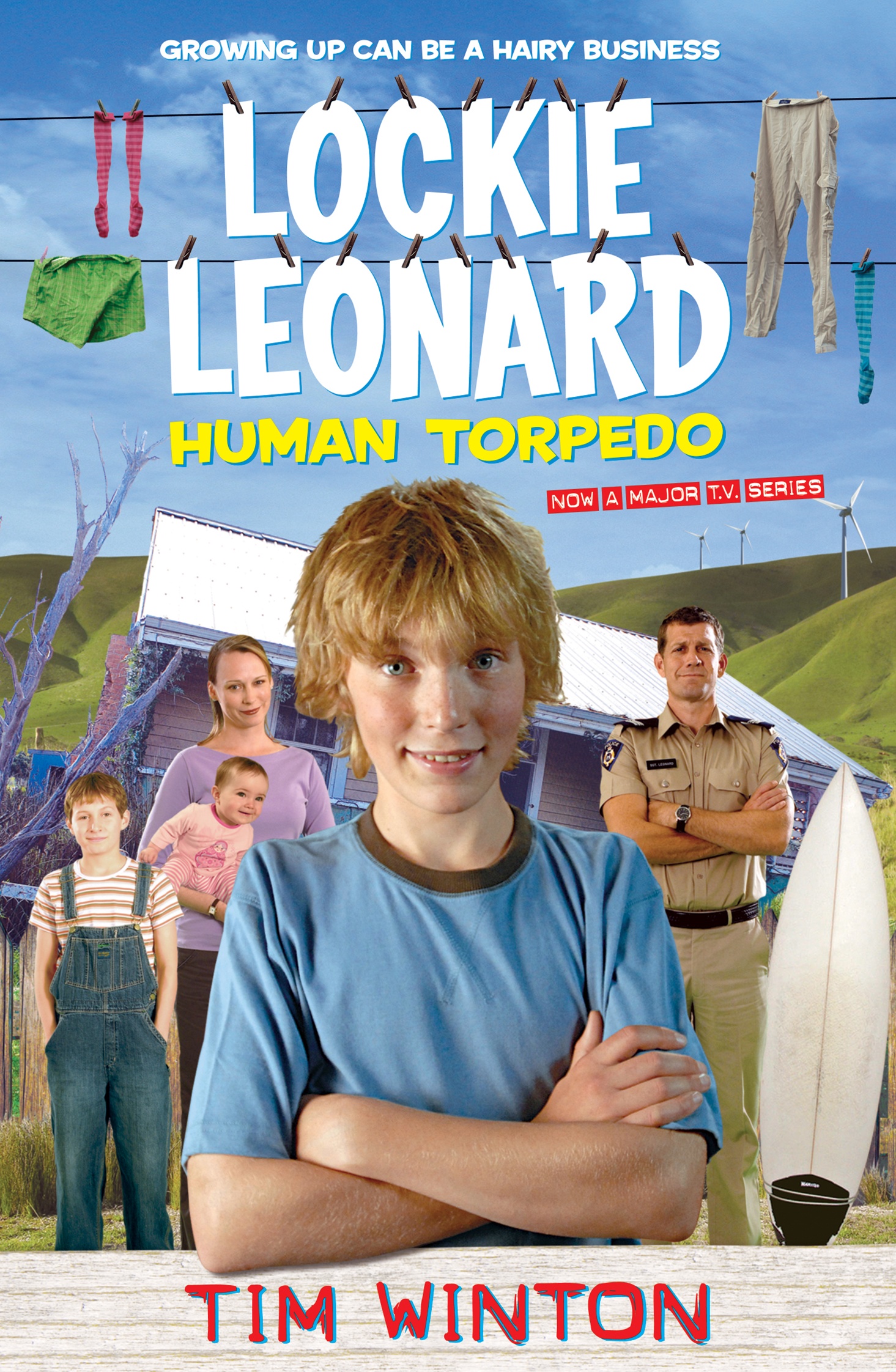
(Picture shows cover of Lockie Leonard – Human Torpedo by Tim Winton)

Girls Names from Australian Children’s Literature

17 Sunday Aug 2014

Posted by A.O. in Name Themes and Lists, Requested Names

≈ 10 Comments

Tags

astronomical names, Babylonian names, Biblical names, classic names, english names, Etruscan names, fictional namesakes, flower names, French names, Greek names, hebrew names, Irish names, Italian names, Latin names, Median names, middle names, month names, mythological names, name history, name meaning, name popularity, name trends, names from television, nature names, nicknames, plant names, popular names, retro names, Roman names, royal names, Semitic names, Shakespearean names, underused classics, underused names, unisex names

HarrietYoullDriveMeWild01

This week it is Children’s Book Week, which is run by the Children’s Book Council of Australia. Librarians and teachers everywhere will be thinking up exciting new ways to encourage children to read, while the CBC has awarded prizes to the best new Australian children’s books. I thought it would be fun to join in the celebrations, and many of the books chosen are classics and award winners.

Amaryllis
I know two characters with this name. One is Amaryllis “Ryl” Mereweather, from H.F. Brinsmead’s Pastures of the Blue Crane (1964), about a teenage girl who inherits an old shack in northern New South Wales. (Name nerd bonus info: H.F. Brinsmead stands for Hesba Fay – Hesba is derived from the Greek hesperus, meaning “western”). The other is in Sally Odger’s fantasy Amy Amaryllis (1992), about an ordinary Australian girl named Amy Day who switches identities with a girl named Amaryllis Loveday, from a magical world named Ankoor. Amaryllis is a Greek name meaning “to sparkle”, perhaps to suggest sparkling eyes. In Virgil’s pastoral poems, The Eclogues, Amaryllis is a beautiful shepherdess, and the poet makes a play on words to suggest that her name comes from Latin amor, “love”. The amaryllis flower is often known as “Easter lily” in Australia; it is named after the literary character, so this is not just a simple flower name. Unusual and lovely, Amaryllis comes with a host of possible nicknames, including Amy, Ryl, Rylla, Lily, Lissy, and Mary.

Beatrice
In Playing Beatie Bow (1980) by Ruth Park, Beatie Bow is a local legend, a game that children play to frighten each other. But when teenage loner Abigail watches the game, she is brought to the Sydney of one hundred years earlier by a strange girl named Beatrice “Beatie” Bow. This classic is a YA time-travel historical mystery adventure with a dash of romance, and so firmly grounded in The Rocks area of Sydney that you can follow every step of Abigail’s journey. (Name nerd bonus info: Abigail’s parents named her Lynette, but when her parents separate, she chooses Abigail for herself, because it’s an “old witch” name). Beatrice is the Italian form of Beatrix, very famous because of the beautiful muse in Dante’s Divine Comedy. The name has been used in England since the Middle Ages, including by royalty; Princess Beatrice of York was named after a daughter of Queen Victoria, but itwas used in the royal family long before. It’s also a Shakespearean name, because in the comedy Much Ado About Nothing, Beatrice is the witty heroine. Beatrice was #50 in the 1900s, and left the Top 100 in the 1930s; by the 1960s it had left the charts. It made a modest comeback in the 1990s, after the birth of Princess Beatrice, and has remained around the 500-600 level. This is an elegant retro name which has long remained underused. Bea is the usual nickname, although Beatrice Prior from the Divergent series goes by Tris.

Blossom
Little Ragged Blossom is one of the main characters in May Gibbs‘ Snugglepot and Cuddlepie series (1918-40), featuring her plump “gum nut babies”. Blossom is a poor little gum-blossom girl, alone in the world until she gains the friendship and protection of gum-nut boys Snugglepot and Cuddlepie. From then on, she is part and parcel of their adventures, and not infrequently plays the role of damsel in distress, such as when she needs rescuing from the wicked Banskia Men. Even now, I cannot see a gum tree in bloom without imagining the flowers as little blossom girls … The word blossom is used for flowers that grow in masses and clusters, especially on trees, and evokes spring and freshness. Blossom has been used as a girl’s name since the 18th century, and is probably more common as a nickname, such as aviation engineer Maxine “Blossom” Miles, or a middle name, such as jazz singer (Margrethe) Blossom Dearie. On television, Blossom was one of the Powerpuff Girls, and Blossom Rosso the floppy-hatted heroine of sitcom Blossom. Ultra-feminine, quirky and cool, could Blossom be the ultimate flower name?

Celia
Feeling Sorry for Celia (2000) is Jaclyn Moriarty’s side-splittingly comic début epistolary YA novel. Private school girl Elizabeth spends most of her time fretting over her best friend Celia, whose life is one self-caused drama after another. However, a pen-pal programme with the local public school teaches Elizabeth how real friendship works. Celia is the feminine form of Caelius, a Roman family name traditionally derived from caelum, Latin for “heaven”. However, the Caelii traced their ancestry to the Etruscan hero Caeles Vibenna, so the name probably isn’t Latin in origin. It may come from Cel, the Etruscan earth goddess who is the equivalent of Gaia; her name means “honoured”, and the Etruscans named the month of Celi (September) after her. I like the idea of an earthy goddess becoming connected with heaven. Shakespeare used the name for an attractive, serious character in As You Like It, and Ben Jonson wrote the poem Song to Celia, which became Drink To Me Only With Thine Eyes. These writers sparked interest in Celia as an English name in the 17th century. This literary name is both rare and traditional, and doesn’t seem out of place next to popular names like Olivia and Sienna.

Dot
Ethel C. Pedley’s posthumous novel Dot and the Kangaroo (1899) is about a five-year-old girl named Dot who wanders off into the bush and gets lost. She is befriended by a kangaroo who has lost her joey, and gives Dot some magic berries that allow her to understand the speech of animals. It has a strong conservationist message in regard to our native flora and fauna, which is still very much needed. The book was the first to show Australian animals in a genuine Australian setting, and became an immediate favourite. Dot is a short form of Dorothy which dates to medieval times, and has been used as an independent name at least since the 17th century. This adorably pert little name could honour a Dorothy, and also works well in the middle.

Esther
Ethel Turner’s Seven Little Australians (1894) is the only Australian book to be continuously in print for more than a century. Featuring a family of mischievous, lovable army brats who live in Sydney’s outer suburbs, it is surprising how little it has dated. Blended families, teen rebellion, obsession with body image, schoolgirl crushes, and discipline problems … all topics of interest more than a hundred years ago too. The seven little Australians are Meg, Pip, Judy, Nell, Bunty, Baby, and The General; their father is stern Captain Woolcot and stepmother (The General’s mother) is Esther. Esther is beautiful and sweet, but barely older than her eldest step-children, and incapable of really mothering them. Hilarious, heart-warming, and tragic, this is one of Australia’s best-loved children’s books. In the Bible, Esther was a Jewish queen of a Persian king; her story is the basis for the Jewish holiday of Purim. The meaning of Esther is much debated. It may be from a Semitic word meaning “star, morning star”, or a Median word meaning “myrtle” (the translation of her Hebrew name, Hadassah). Another theory is that it comes from the Babylonian fertility goddess Ishtar (Ishtar also represents the morning star, Venus). Esther was #73 in the 1900s, and left the charts in the 1920s. It reached its lowest point in the 1950s and ’60s at #379, but has climbed since then, and isn’t far outside the Top 100 in Victoria. This underused classic is very much on trend at present.

Harriet
Harriet, You’ll Drive Me Wild (2000) is a picture book written by kidlit doyenne Mem Fox, illustrated by Marla Frazee. Harriet Harris is a toddler who doesn’t mean to be naughty, but trouble follows in her wake without her even trying. Harriet’s mother is a calm woman who doesn’t like to yell, but Harriet pushes her to breaking point. The book helps explain to littlies why parents lose their cool. (Name nerd bonus info: Mem Fox’s full name is Merrion, but she has always gone by Mem). Harriet is the English form of Henriette, the feminine form of French Henri, and thus a feminine form of Harry. Harriet was #122 in the 1900s, and left the charts in the 1930s. It returned in the 1970s, and has been climbing ever since. Last year it was one of the fastest rising names of 2013, and joined the Top 100 at #89. Cute and spunky, it can be shortened to Hallie or Hattie – Hattie is a hen in Mem Fox’s Hattie and the Fox (1986).

Josie
Josephine Alibrandi, known as Josie to her friends, features in Melina Marchetta’s breakthrough YA novel, Looking for Alibrandi (1992). A coming of age story, its smart-mouth heroine is in her last year of school, dealing with boys, family, exams, mean girls, and her father, who left when she was a baby and has suddenly reappeared in her life. Looking for Alibrandi was an instant success upon publication, and has been called “the most stolen library book”. Josie is a short form of Josephine, used as an independent name since the 16th century. It has sometimes been given to boys, as a short form of Joseph or Josiah. Josie first ranked in the 1920s at #291, and left the charts in the 1940s. It returned in the 1970s, and climbed before peaking in 2009 at #175. This is an underused retro name which doesn’t sound old-fashioned, but sassy and stylish.

Liesel
Liesel Meminger is the young girl in Markus Zusak’s The Book Thief (2005), set in Nazi Germany during World War II, and narrated by Death himself. Liesel is illiterate at the start of the story, but through learning to read, discovers a lifelong love of words, and finds solace in stealing books to share with others. Against a backdrop of fear and horror, the story shows that books can feed the soul even in our darkest hours. The story does end up having an Australian connection, and a specific Australian setting is used in a very unexpected way. Liesel is a German pet form of Elisabeth, pronounced LEE-zel. Although it’s never charted in Australia, this charming name is very familiar because of Liesl from The Sound of Music, and swimmer Leisel Jones.

Norah
Norah Linton is the heroine of Mary Grant Bruce’s Billabong series (1910-42). Making her début in A Little Bush Maid at the age of twelve, Norah lives at Billabong Station in northern Victoria. She’s a hardy, spirited tomboy who loves horse-riding, camping, and fishing, and is a total daddy’s girl. The books haven’t aged too well, but Norah is an ancestor of other feisty, independent Australian heroines, such as Ryl Merewether and Josie Alibrandi. Norah is a variant of Nora, a pet form of names such as Honoria and Eleanor. It’s often thought of as particularly Irish, and records show many Norahs of the 18th century were born in Ireland. Hip and arty, Norah is fast growing in popularity in both the UK and US, and already popular in Europe, but almost unknown in Australia. It deserves serious consideration by those keen to get ahead of the trends.

Thank you to Manday for suggesting the name Liesel be featured on Waltzing More Than Matilda, and for recommending The Book Thief be added to this list.

POLL RESULTS
The public’s favourite names were Beatrice, Harriet and Norah, and their least favourite were Josie, Blossom and Dot.

(Picture shows cover of Harriet, You’ll Drive Me Wild, from Mem Fox’s website)

What Makes a Baby Name Trendy?

03 Sunday Aug 2014

Posted by A.O. in Your Questions Answered

≈ 3 Comments

Tags

Baby Name Explorer, Biblical names, classic names, modern classic names, name data, name popularity, name trends, names from popular culture, popular names, saints names, trendy names

trendy baby

Trendy baby names are a hot topic that’s leaving parents feeling anxious. Parents write in to the blog to say they don’t want a trendy name, or are worried that their favourite baby name might be too trendy.

Yet what exactly is a trendy baby name? Even the authors of articles on trendy baby names disagree on the subject, or are vague as to what “trendy” actually means (many seem to think it just means popular, although parents often say popularity doesn’t bother them, as long as the name isn’t trendy).

We could fall back on that old chestnut, “I know it when I see it”, but I thought we might try for something a little more concrete. So instead we’ll look at the factors which might be linked with a name being considered “trendy”.

Going up rapidly in popularity …

This is the one which nearly everyone first thinks of – a name which is going up steeply in popularity, so that its progress through the charts looks like a mountainside or a cliff; even more so, a name which suddenly jumps in popularity in a single year.

This gets some parents so worried that even a modest increase can have them fretting because a name went up seven or eight places, but I think a name has to go up at least twenty places before it really draws attention to itself. Names in this category from last year include Aria, Penelope, Louis, and Nathaniel.

Nathaniel rising

But here’s the good news: often after a huge boost in the charts, a name will settle down and continue rising at a steadier pace, or even stabilise. Names such as Harper, Flynn, Ivy, and Sienna have had a big jump in previous years, but are now just comfortably trundling along.

… only to come down just as rapidly …

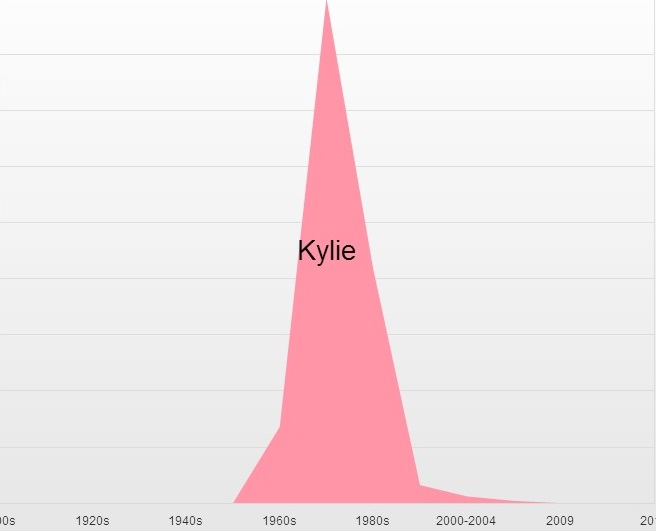
This really is a classic sign of a trendy name – it not only goes up the charts steeply, it comes down again at a similar rate, so that its progress through the charts has a cone shape; the skinnier the cone, the less years it was popular, and the more spectacular has been the name’s rise and fall. Kylie‘s cone, for example, looks quite thin.

kylie trendy

The trouble is that this isn’t very helpful for predicting whether a particular name will be trendy. It’s strictly a post mortem technique, so by the time you realise you chose a trendy name, it’s too late – your child is thirty six years old and nobody cares anyway.

Some people fear that any name going up steeply in popularity is sure to come down steeply as well, but this isn’t necessarily the case. For example, imagine you chose the name Jennifer for your daughter in the 1930s. It jumped straight into the Top 100 from nowhere, which seems very alarming, but it remained in the Top 100 for seven more decades. Your little Jenny would have collected her old age pension before her name stopped being popular, and even today Jennifer is only around the 200-300s and fairly stable. It never fell as dramatically as it rose.

Jennifer

For this reason, it seems a bit silly to avoid a name that’s trending upwards. If anything, the message seems to be to jump on a trend as early as possible, because it’s cooler to be a Jennifer born in 1935 than one born in 2000, even though the popularity was around the same in those two years.

… and has reached a certain level of popularity

Even though trendiness and popularity are not the same thing, it’s only once a name becomes reasonably popular that most people start to call it trendy, even if it’s been zooming up the charts for several years. It needs to be used by enough people that it can have those impressive rises in rank, as well as enough visibility to be considered trendy.

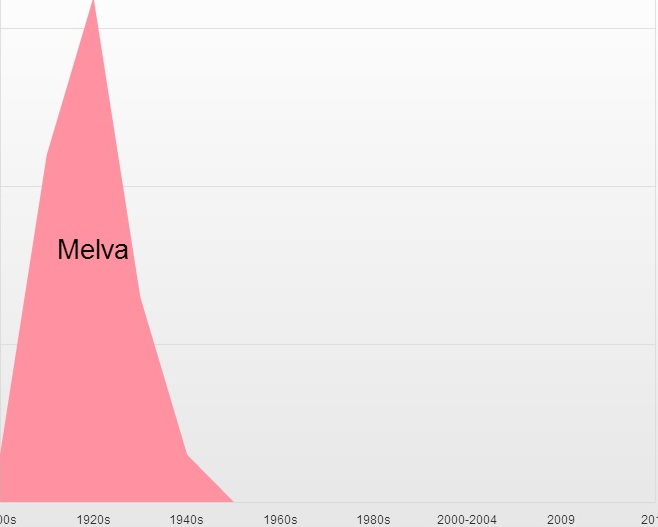
So Melva might have a steep rise and descent, but as it never reached the Top 100, it doesn’t get mentioned as a past trendy name. Persistently low usage does help protect a name against a charge of trendiness from most people (not all).

melva

New to the charts

I know many will disagree with this one, but I believe that no matter how rapidly a name is rising, it’s not trendy if it has previously been on the charts. Otherwise you get comments like “Leo is both classic and trendy“. Which is absurd when you think about it – like describing someone as an extremely tiny giant, or a colour as a very pale shade of black – because classic and trendy are opposing terms. I would say Leo is a rising contemporary classic, not a trendy classic.

Leo rising classic

Names that have been on the charts previously and disappeared before returning again are retro names. No matter how much Nathaniel may be zooming up the charts at present, I don’t consider it to be trendy, as it already has a history as a traditional name.

Inspired or boosted by popular culture

Any name that has suddenly got a boost in the charts (or even just in the public consciousness) due to a popular song, movie, TV show, celebrity, or celebrity baby is liable to be labelled “trendy”, whether it’s Elsa, Khaleesi, Penelope, Jagger, George, or Banjo.

I think that’s very unfair, because if you look through the history of naming, people have always named their children after the celebrities and culture of their day. By this standard, familiar names such as William, Eleanor, Alexander, Cordelia, Stanley, Fiona, Eric, and Rosamund have all been “trendy”. In fact, you could include all the Bible names and saints’ names in that group as well, since saints were the celebrities of the Middle Ages, and the Bible everyone’s favourite book.

Fitting in with one or more name trends

Another thing that can get a name labelled trendy, even if it’s in rare use, is if it fits in with current naming trends, especially with multiple trends. So you might claim that Liliana is a trendy name, because it fits in with the trend for L-L names for girls, like Lila, and with the trend for elaborate names for girls, like Isabella.

The trouble is that by this logic, practically every name being used today could be labelled as “trendy” – it’s very difficult to avoid ALL name trends.

This article mentions some of the current baby name trends in Australia: patriotic names, surnames as first names, place names as first names, nicknames as first names, and biblical names. Remove all those, and the choices dwindle significantly. And this isn’t even touching on mythological names, vintage names, unisex names, rare names, uniquely spelled names, literary names, virtue names, nature names, vocabulary names, and boys’ names ending with N.

* * * * * * * * * *

There you have it: six things might get your baby name labelled trendy. And the more categories it fits into, the more likely that it will seem trendy to somebody. So the current most “trendy” name in the Top 100 is Aria – it’s climbing fast, quite popular, new to the charts, inspired by popular culture, and fitting in with current trends, such as the AR sound in names.

Of course, in the 1970s there was a name which rocketed into the Top 100 from nowhere, had never been on the charts before, with use boosted by a popular singer, and whose sound fit in with other popular girls’ names such as Emily and Felicity. That name was Olivia, and although it may have been trendy in 1978, it isn’t any more. Aria could become equally as established, or even a modern classic, so there’s no guarantee that a trendy name will stay trendy.

Olivia

The big question is: what exactly is so terrible about a trendy baby name anyway? We’re always being told to avoid trendy baby names, and rarely are we given a reason. It’s just taken for granted that of course you don’t want to give your child a trendy name, in the same way that of course you don’t want them to put their hand on a hot stove.

About the only thing I can come up is that trendy names tend to become dated, except that a) sometimes they don’t eg William and b) most names date eventually anyway, even classics eg Susan.

And even if your name doesn’t become dated, it isn’t going to make your life especially wonderful. I have a non-trendy classic name which is still reasonably popular, and not only has it failed to provide me with a magically charmed life where nothing ever went wrong, its impact has been minimal at best. Meanwhile, my peers with the trendy names of our generation, such as Jodi and Jason, don’t seem to have had their lives ruined by their names.

* * * * * * * * * *

So there you have it – trendy names are something to be avoided, even though there’s no compelling evidence they’re particularly awful, or that a trendy name will remain trendy; there’s not even any real proof that trendy names actually exist as an objective phenomenon. And the criteria as to what is trendy is so broad that almost any name you can think of can be labelled as such.

Perhaps it’s time to put this baby name bogeyman behind us.

POLL RESULTS
The things that most people thought made a name trendy were:

* destined to fall as quickly as it rose – 23%
* rapidly rising in popularity – 13%
* boosted by popular culture – 12%

26% of people thought a name had to fulfil at least two or more of the stated requirements before being considered trendy, while 7% thought that it had to fulfil all six of the requirements to be a trendy name.

Just 1% of people thought that being new to the charts made a name trendy.

2% of people did not think there was any such thing as a “trendy” name.

(Popularity charts from Baby Names Explorer)

Perth Suburbs That Could Be Used As Boys Names

20 Sunday Jul 2014

Posted by A.O. in Name Themes and Lists

≈ 4 Comments

Tags

animal names, aristocratic names, aristocratic titles, Australian slang terms, Biblical names, bird names, birth notices, British names, car names, celebrity baby names, Celtic names, english names, famous namesakes, fictional namesakes, Gaelic names, germanic names, hebrew names, historical records, Latin names, locational names, middle names, mythological names, name history, name meaning, name popularity, names from television, names of boats, nature names, nicknames, Puritan names, saints names, Scottish names, surname names, unisex names, US name popularity, US name trends

2725210-01

Ashby
Ashby is a residential northern suburb, first developed in the late 1990s. It is named after the original landowner, Mr E.E. Ashby, who lived here before World War I. Ashby is a surname which means “farm among the ash trees” in a mixture of Old English and Old Norse; it is more common in Lincolnshire, Leicestershire and the East Midlands, which have a history of Scandinavian influence. Ashby has been used as a name for boys since the 17th century, and seems to have been especially popular amongst Puritan families. The town of Ashby-de-la-Zouch in Leicestershire was an important centre for Puritan preaching and education, which may be an inspiration for the name. Ashby isn’t rare in Australian records, although more common as a middle name, and has occasionally been given to girls. I saw this is a boy’s middle name in a birth notice, and thought this might make an appealing Ash- name for boys, which seems more obviously masculine than Ashley. Unfortunately, it could easily be confused with Ashley too.

Bentley
Bentley is 8 km south of the city, and is the location of the main campus of Curtin University. The area has been settled since 1830, and was developed in the post-war period with government housing, including homes for returned servicemen. Today Bentley is very varied: it has a light industrial area, but part of it is still used for grazing. The suburb is named after John Bentley, a veteran of the Crimean War who arrived in the Swan River Colony as a pensioner guard, and supervised convicts building what is now the Albany Highway. Bentley is a surname after the common English place name, meaning “bent-grass meadow”; bent-grass refers to rushes or reeds. Bentley has been used as a boy’s name since the 17th century, and has recently leaped up the charts in the United States to become a Top 100 name. Its jump in popularity is attributed to a baby named Bentley on reality show 16 and Pregnant. In Australia, Bentley is around the high 100s, which is still a lot more popular than it is in the UK. People often connect the name to the luxury car company, founded in 1919 by W.O. Bentley.

Bertram
Bertram is a new suburb of the City of Kwinana, in Perth’s south (for more information, see Leda in Perth Suburbs That Could Be Used As Girls Names). It is named after an assisted migrant from the 1920s, who came here under the group settlement scheme. Bertram is a Germanic name which means “bright raven”; it was introduced to Britain by the Normans. A famous Australian namesake is Sir Bertram Stevens, who was Premier of New South Wales in the years before the Second World War. Bertram has been quite a popular name in fiction, including the main character of Shakespeare’s All’s Well That Ends Well. Unfortunately, Bertram is not, on the face of it, a very sympathetic character, although he gets his regulation happy ending anyway. Another fictional Bertram is Bertie Wooster, from P.G. Wodehouse’s Jeeves books; a good-natured idler, this Bertram is not without charm, although perhaps not the most sturdy namesake. The short form Bertie would be very cute though.

Carlisle
Carlisle is south of the CBD, and close enough to offer views of the city. Originally farmland, it was developed in the late 19th century, and is a fairly typical older suburb. The name Carlisle was chosen by the suburb’s ratepayers, who called it after the northern English city of Carlisle in Cumbria. Their logic was that just as Cumbrian Carlisle is famously near the border between England and Scotland, so was Australian Carlisle right on the border between the city of Perth and its suburbs. However, it is interesting to note that one of the landowners at the time was named Carlisle; it is possible his surname put the idea in the ratepayers’ minds. Carlisle is an ancient city which was one of the most heavily fortified towns of pre-Roman Briton: its name means “stronghold of the god Lugus”. Lugus was one of the most prominent of the Celtic gods, and the Romans identified him with Mercury, as he was known as a god of trade and skill. Carlisle has been used as a boy’s name since the 18th century, and was originally used most often in Cumbria. It has recently received some interest since the name was chosen for one of the more sympathetic vampires in the Twilight series.

Falcon
Falcon is one of the suburbs of Mandurah, a coastal city 45 km from Perth, within the metropolitan area. It is popular with tourists and retirees, making it the least affordable city in Australia. Falcon has a number of beaches, and is named after Falcon Bay, which is pronounced FAWL-kin, rather than FAL-kin – an earlier English pronunciation of the word. Falcon was a yacht whose crew won a silver medal at the 1956 Olympics in Melbourne, and many of Falcon’s streets are named for yachts. Falcon has been used as a boy’s name since medieval times – there is even an obscure St. Falcon, and Falcon was the middle name of Antarctic explorer Robert Scott. The name may be from the Latin Falco, meaning “falcon”, or derived from the Germanic name Fulco, meaning “people”. I did find a few Falcons born in Australia, and for some reason they were nearly all South Australian. In Australia, this name will remind people strongly of the car, the Ford Falcon, and perhaps also the slang term in rugby league for being accidentally hit in the head by the ball. I’m not sure whether the pronunciation will make any difference.

Murdoch
Murdoch is in the south, and the home of Murdoch University. The university is named in honour of Sir Walter Murdoch, a former chancellor of the University of Western Australia, and its founding Professor of English. Sir Walter was a essayist famous for his wit and intelligence, and an active proponent of international peace and justice, political freedom, women’s rights, and affordable childcare. His great-nephew is the media mogul Rupert Murdoch. The surname Murdoch is the Anglicised form of two Gaelic personal names that became conflated with one another, and were written as Muireadhach. One name was Muiredach, meaning “mariner”, and the other was Murchad, meaning “sea warrior”. Muireadhach was a traditional name amongst the Earls of Monteith, and Murdoch has seen particular use in their seat of Perthshire. Murdoch is commonly found in Australian records amongst Scottish families, but although we have enthusiastically embraced Lachlan, Murdoch has been less successful. Fun fact: Murdoch was an early name crush for a particular Australian blogger, which makes you wonder if this could have been a contender without the prominent Murdoch family.

Samson
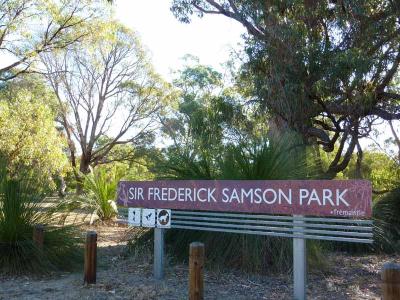
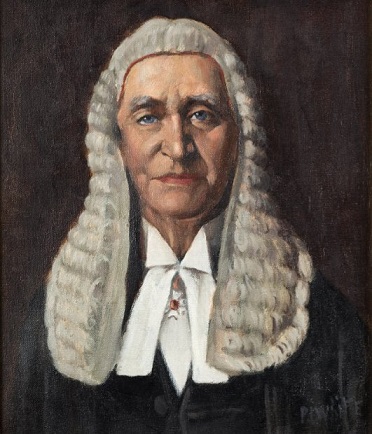
Samson is a small suburb of Fremantle, a southern port city in the Perth metropolitan area. The suburb was only developed in the 1970s, as before this it had belonged to the army, and was a military camp during World War II. The suburb is named after the Samson family, who have been prominent in the Fremantle area for nearly two centuries. Sir Frederick Samson was mayor of Fremantle for twenty years, from the 1950s to the 1970s, and his home, Samson House, is one of Fremantle’s landmarks. The suburb of Samson contains Sir Frederick Samson Park, Fremantle’s only bush reserve. Sir Frederick was the grandson of Lionel Samson, a wealthy Jewish merchant who settled in the Swan River Colony in 1829 and became one of its most successful pioneers. Popular for his charm and wit, respected for his integrity, the business he founded is still run by the Samson family, making it Western Australia’s oldest family business. Samson is one of the most famous characters in the Old Testament, a judge of the Israelites known for his superhuman strength. His name is from the Hebrew for “man of the sun”, leading some scholars to suspect he was originally a sun god, or demi-god. Samson was in use as an English name during the Middle Ages, and there is a Welsh St Samson, one of the Apostles of Brittany. This is a very masculine name which provides another way to get the popular short form Sam.

Sawyer
Sawyers Valley is on the eastern fringe of Perth’s outer suburbs, and 40 km from the city. Its name came about because it was originally a saw mill and timber processing area. It’s now a semi-rural suburb in the bush-covered hills surrounding Perth. Sawyer is an occupational surname for someone who sawed wood for a living – and in the days when most things were made of wood, an important trade. Sawyer has been used as a personal name since the 17th century, mostly as a male name. In Australian records, I can only find it as a man’s first name, although not unusual as a female middle name. Sawyer doesn’t chart in Australia, but has been in the US Top since 1991; it had a huge jump up the charts after Steven Spielberg chose the name for his son in 1992. In America, it is a unisex name, but more common for boys. Although it is in rare use here, I have seen it a few times, on both sexes. Its most famous namesake is Tom Sawyer, the young scamp from the stories by Mark Twain, while it has also been alias for Josh Holloway’s character on Lost.

Stirling
Stirling is a residential suburb 10 km north of the city. The area has a multicultural history, because in the 1920s it attracted retired Chinese miners from the goldfields, returned servicemen from the First World War, and many Italian migrant. It became a successful market gardening region producing almost every vegetable possible, some for export. Even after development in the 1960s and ’70s, the suburb remains one of Perth’s most ethnically diverse, with a third of the population having Italian heritage, and many from Macedonian, Greek and Asian backgrounds. The suburb is named after James Stirling, who was the first governor of Western Australia, and who lobbied for a colony to be founded on the Swan River. Stirling is a Scottish Clan name which comes from the city of that name in central Scotland; it is known as the “Gateway to the Highlands”. The meaning of its name is not known, although folk etymology says that it is from the Gaelic for “place of battle”. Another theory is that it is British, and means “dwelling place of Melyn”; the name Melyn is said to mean “yellow-skinned, sallow-skinned”. Stirling has been used as a boy’s name since the 18th century, and was first used this way in Stirlingshire. I have seen this name quite a few times in birth notices, and it’s one with a great deal of dignity.

Warwick
Warwick is in the northern suburbs of Perth, and a large section of it is still native bushland. It originally belonged to a railway company, and is named after Warwick Road, the major road which goes through it, and pre-dates the suburb’s development. It may have been inspired by Warwick Road in London. The name Warwick comes from the English city of Warwick in the Midlands; its name means “dwellings by the weir” in Old English, as the River Avon flows through it. It’s pronounced WOR-ik. The Earl of Warwick is one of the most prestigious titles in the British peerage, and Guy of Warwick a legendary English hero, which may help explain why Warwick has been used as a boy’s name since at least the 16th century. However, it seems to have originated in Devon, in the seat of a family named Warwick who belonged to the minor nobility. Warwick first charted in the 1910s at #203, joining the Top 100 in the 1940s, where it peaked at #80. It left the Top 100 in the 1960s, and hasn’t charted since the 1990s. Famous Australians with this name include the racing driver Warwick Brown, and flamboyant former AFL star, Warwick Capper.

POLL RESULTS
The public’s favourite names were Sawyer, Samson and Ashby, and their least favourite were Stirling, Warwick and Murdoch.

(Photo shows the entrance to Sir Frederick Samson Park, in Samson)

Famous Name: June

25 Wednesday Jun 2014

Posted by A.O. in Famous Names

≈ 1 Comment

Tags

Biblical names, english names, famous namesakes, Latin names, middle names, mythological names, name history, name meaning, name organisations, name popularity, names from songs, names of months, nicknames, Roman names, saints names, unisex names, US name popularity, US name trends

art-353-june-300x0

Here we are at the end of June, and our last chance to cover the name of this month. On Sunday, I covered the winter solstice, where I said how mild it was – June was all blue skies and sunshine then. Little did I know the very next day a blizzard would hit, with massive snowfalls in the mountains, and freezing, gale-force winds and heavy rain elsewhere. So winter has definitely started now.

June Wright was once Australia’s queen of crime fiction; her first novel, Murder in the Telephone Exchange, was the best-selling mystery novel of 1948 in Australia, outselling the latest Agatha Christie. It featured feisty telephonist-turned-amateur-detective Maggie Byrnes, and was set during a blazing hot February in post-war Melbourne. These were the days when young working ladies lived in boarding houses where gentleman callers were not permitted, and leaving your bedroom clad only in pyjamas and dressing gown was an absolute no-no.

June went on to write five more novels, including a second Maggie Byrne mystery where the post-war housing shortage leads her into another interesting case to solve. The Devil’s Caress, which has a female doctor as the detective, was described as making Murder in the Telephone Exchange look like a bedtime story, and her last three novels featured Mother Mary St. Paul, an unassuming yet strong-willed Catholic nun detective that June Wright based on the head of the maternity ward where she gave birth to twins.

While June’s wartime experience as a telephone operator was the inspiration for Murder in the Telephone Exchange, it was her career as housewife and mother to six children, one severely intellectually disabled, that was seized upon by the women’s magazines of the day, who brought out articles with titles like “Wrote Thriller With Baby on Her Knee” and “Books Between Babies”. The writer of dark, gory murder mysteries with strong female protagonists was careful to present herself as charming and and feminine, and pointed out that both housewives and writers had to be practical, disciplined, and used to monotony.

June’s last novel was published in 1966. Her husband had a nervous breakdown, and June went back to work as a telephonist to support the family, before she and her husband started a cleaning business together. Although there are no hints she regretted having to abandon her literary career, she lived a long life (she only passed away recently), and it’s hard not to think of the many years she could have kept writing under different circumstances.

June lapsed into literary obscurity, and her works have been out of print for many years. However, in February this year Murder in the Telephone Exchange was re-issued by Dark Passage, an imprint of US publisher Verse Chorus Press. They will be bringing out all her novels, including previously unpublished Duck Season Death.

I haven’t bought my own copy yet, but this is welcome news for lovers of vintage fiction, women’s fiction, and Australian crime fiction. I think the books would be especially interesting for Melburnians from a historical perspective.

The name June is after the sixth month of the year. The Romans called the month Junius, commonly believed to be named in honour of the goddess Juno, the wife of Jupiter and queen of the gods. Do you remember the Happy June group, who celebrated June Day on June 1 every day? Well, on the first day of June, the ancient Romans had a festival dedicated to Juno’s “birthday”, in her role as goddess of war and protector of the state. So in a way, there is a “June Day” just as much as a “May Day”.

Because Juno was the goddess of marriage, the month of June was thought an auspicious time for weddings. This makes a lot of sense in the northern hemisphere, where it is early summer: in the United States, June is the most popular month for weddings, and in Italy, June is still a popular month to be married. In Australia, November is the most popular month for weddings (just to confuse things, in the United Kingdom August is the traditional wedding month – in Italy this is considered incredibly bad luck and very unhealthy).

As June is the start of summer in the northern hemisphere, there the name June may seem ripe and womanly, full of vitality and promise – as the song says, June is Bustin’ Out All Over. Here June is the start of winter, and to me it seems cool and fresh as a mountain breeze, and pure as snow.

June has been commonly used as a girl’s name since the 19th century, and part of its appeal must have been that it sounded similar to popular names such as Joan and Jane. It would have also seemed like a “real name” because of Latin names such as Junia – Saint Junia is venerated in the Orthodox tradition, and is mentioned in the New Testament as having a leadership role in the early Christian church. In the US, June has also been used as a male name, derived from Junius.

In Australia, June began charting in the 1910s, debuting at #162, and climbing so steeply that it was #15 for the 1920s. It peaked in the 1930s at #10, fell until it left the Top 100 in the 1950s, and last charted in the 1970s.

June does not chart in either Australia or the UK, but in the US June is already in the 300s and rising very briskly after only re-joining the Top 1000 in 2008. The United States is leading the way, and I think this is an American name trend well worth considering.

June is sweet and charming, and has the fashionable OO sound in it, like Ruby and Lulu. This is a hip vintage choice, and also a simple nature name, like Wren or Rain. Not only can it be used to honour a relative named June, or for cases where June is a special month for you, this would make a great name for someone who wanted something that was traditional and “old-fashioned”, while still seeming fresh and underused.

June could be used as a short form of names such as Juniper, Junia or Juno, and is getting some use as a middle name, but it would be lovely to see it up front as the full name. Junie is the usual pet form.

POLL RESULTS
June received an excellent approval rating of 80%, making it one of the highest-rated names of 2014. People saw the name June as vintage and hip (26%), sweet and charming (23%), traditional yet fresh (15%), and pretty or cute (10%). However, 9% saw it as only a middle name. Only one person thought the name June was too trendy.

Famous Name: Isaac

18 Wednesday Jun 2014

Posted by A.O. in Famous Names

≈ 8 Comments

Tags

Biblical names, famous namesakes, hebrew names, name history, name meaning, name popularity, nicknames, popular names, retro names, saints names, slang terms

SirIsaacIsaacs

On June 6 it was the 159th birthday of Sir Isaac Isaacs, who is famous for being the first Australian-born Governor-General of Australia. He is also our first Jewish Governor-General.

The appointment of Sir Isaac Isaacs in 1930 by Prime Minister James Scullin was a controversial one at the time, because it was fiercely opposed by the British government. They didn’t have anything much against Sir Isaacs personally (apart from being a bit old and unknown to them), but were greatly offended by the idea of an Australian representing the British monarch. However, Scullin stuck to his guns and eventually King George V agreed to the appointment with great reluctance.

This landmark moment led to the Statute of Westminster 1931 and the formal separation of the Crowns of the Dominions. From now on, the monarch would be bound by constitutional convention to accept the advice of the Australian Prime Minister on Australian constitutional matters.

Despite the stain of his Australianness, Sir Isaac Isaacs did everything he could to make himself agreeable. He was an ardent monarchist and, although very proud to be an Australian, a strong supporter of the British Empire. He agreed to accept a lower salary, and conducted himself very frugally, which went down well during the Great Depression. He was the first Governor-General to live permanently at Government House in Canberra, and the public approved of this, as well as his general air of austere dignity, while following his duties with obvious enjoyment.

I’d like to be able to say that after Sir Isaacs, all Governor-Generals were Australian, but conservative governments immediately reverted to appointing British Governor-Generals. There was only one more Australian-born Governor-General until 1965 – since then, they have all been Australian-born, except Sir Ninian Stephen, who emigrated here as a child.

Isaac has one of the better known name stories in the Bible, and is one of the few characters in the Bible to be named directly by God.

When the patriarch and prophet Abraham was ninety-nine years old, God made a covenant with him, that he would be a “father of many nations”, and that his descendants would possess the land of Canaan forever. As Abraham and his wife Sarah did not have any children, God promised he would bless them, so that Sarah would soon bear a son.

Abraham laughed when he heard that, for by the time the baby was due to be born, he would be one hundred years old, and Sarah would be ninety. Sarah secretly listened to this prophecy, and had a good chuckle to herself at the idea that a very old couple would be able to conceive a child together, and a woman long past her child-bearing years could give birth.

Despite their scepticism, the prophecy was fulfilled, and Abraham and Sarah had a son together. They gave him the name that God had chosen, which was Yitzhak, meaning “laughter” in Hebrew. In English the name is Isaac.

The other key story about Isaac is that during his childhood, God commanded Abraham to build an altar in the wilderness and sacrifice his son on it. However, just at the point the knife was raised above Isaac, an angel appeared and told Abraham that it had just been a test of his faith, and that he should sacrifice a ram which happened to be around at the time instead. Because of Abraham’s show of faith, and Isaac’s obedient willingness to be sacrificed, God blessed them both many times over.

Christians have tended to see Isaac as a forerunner of Christ, and both Jews and Christians see him as a model for the martyr, who goes willingly to the slaughter for his faith. Isaac is venerated as a saint in Catholicism, and revered by Muslims as a prophet of Islam.

The story of Abraham and Isaac has made Biblical commentators uncomfortable enough that they feel it needed to be explained. Some Jewish writers felt that human sacrifice was so revolting that God couldn’t possibly have requested it even as a test, and suggested that it must have been a delusion of Abraham’s imagination, or even some trickery by Satan. Others thought that Isaac was in fact sacrificed, but that God had resurrected him straight away.

Modern philosophers don’t seem to feel that the story shows God in a very attractive light. Some scholars believe that it preserves an ancient memory of a tradition of child sacrifice, with the “happy ending” tacked on later, when such sacrifice was viewed with abhorrence and needed to be explained away.

Isaac has been used as an English name in the Middle Ages, and became more common after the Protestant Reformation. One of its most famous namesakes is Sir Isaac Newton, the mathematician and scientific genius. This gives Isaac a rather brainy image – and Sir Isaac Isaacs was very intelligent too.

For many years, the name Isaac was particularly associated with Jewish people – to such an extent that even in the twentieth century, Jews were referred to in a derogatory way as ike or ikey (short for Isaac), in the same way that Catholics were called micks (short for Michael).

Isaac was #147 in the 1900s, and left the charts in the 1920s. It didn’t return until the 1970s, when its position was #326. It climbed very steeply in the 1980s, and joined the Top 100 in 1991 at #86. After pottering along in the bottom third of the Top 100, it suddenly gave a massive jump in 1997, when it made #25. Is it a coincidence that the teen pop band Hanson, with singer Isaac Hanson as the singer, had their biggest success in 1997? Hmm! Or should I say MMMBop?

After this Hanson-led surge of popularity, Isaac settled down, but remained in the Top 50; it has been fairly steadily climbing since 2005. It is currently #19 nationally, #14 in New South Wales, #28 in Victoria, #34 in Queensland, #23 in Western Australia, #41 in Tasmania, #17 in the Northern Territory, and #31 in the Australian Capital Territory.

In a rather cheeky post, I suggested that if Isaac kept climbing, it could be the #1 name by 2028. I’m not sure if it will, but it is a good strong name, and many people find the meaning of “laughter” attractive. In the Bible, Isaac was a true “miracle baby”, born to two people very late in life who never expected to be parents, making it an excellent choice for couples blessed with a surprise or against-the-odds baby. As well as the traditional Ike or Ikey, you could also use Iggy or Zac as the nickname, should you want one.

POLL RESULT
Isaac received an excellent approval rating of 84%, making it one of the highest-rated names of 2014. People saw the name Isaac as cute on a boy, but solid on a man (29%), strong and handsome (20%), intelligent and professional (16%), and having a very attractive meaning (12%). However, 8% were put off the name by the Bible story of Abraham and Isaac. Nobody thought the name Isaac sounded creepy or evil.

(Picture shows a portrait of Sir Isaac Isaacs from the Victorian Bar’s collection)

← Older posts
Newer posts →

Enter your email address to follow this blog

Categories

Archives

Recent Comments

A.O.'s avatarwaltzingmorethanmati… on Zarah Zaynab and Wolfgang…
Madelyn's avatarMadelyn on Zarah Zaynab and Wolfgang…
JD's avatardrperegrine on Can Phoebe Complete This …
A.O.'s avatarwaltzingmorethanmati… on Rua and Rhoa
redrover23's avatarredrover23 on Rua and Rhoa

Blogroll

  • Appellation Mountain
  • Baby Name Pondering
  • Babynamelover's Blog
  • British Baby Names
  • Clare's Name News
  • For Real Baby Names
  • Geek Baby Names
  • Name Candy
  • Nameberry
  • Nancy's Baby Names
  • Ren's Baby Name Blog
  • Sancta Nomina
  • Swistle: Baby Names
  • The Art of Naming
  • The Baby Name Wizard
  • The Beauty of Names
  • Tulip By Any Name

RSS Feed

  • RSS - Posts

RSS Posts

  • Celebrity Baby News: Melanie Vallejo and Matt Kingston
  • Names from the TV Show “Cleverman”
  • Can Phoebe Complete This Sibset?
  • Zarah Zaynab and Wolfgang Winter
  • Baby, How Did You Get That Name?
  • Celebrity Baby News: Media Babies
  • Celebrity Baby News: Adelaide Crows Babies
  • Celebrity Baby News: Chris and Rebecca Judd
  • Names at Work: Name News From the World of Business and Employment
  • Celebrity Baby News: Sporting Round Up

Currently Popular

  • Celebrity Baby News: Alisa Camplin and Oliver Warner
  • Rare Boys Names From the 1950s
  • Sad Celebrity Baby News (contents may cause distress)
  • Celebrity Baby News: Jacinta Allan and Yorick Piper
  • Celebrity Baby News: Nicki Gemmell and Andrew Sholl

Tags

celebrity baby names celebrity sibsets english names famous namesakes fictional namesakes honouring locational names middle names name combinations name history name meaning name popularity name trends nicknames popular names saints names sibsets surname names twin sets unisex names

Blog at WordPress.com.

Privacy & Cookies: This site uses cookies. By continuing to use this website, you agree to their use.
To find out more, including how to control cookies, see here: Cookie Policy
  • Subscribe Subscribed
    • Waltzing More Than Matilda
    • Join 517 other subscribers
    • Already have a WordPress.com account? Log in now.
    • Waltzing More Than Matilda
    • Subscribe Subscribed
    • Sign up
    • Log in
    • Report this content
    • View site in Reader
    • Manage subscriptions
    • Collapse this bar
 

Loading Comments...