• About
  • Best Baby Names
  • Celebrity Baby Names
  • Celebrity Baby Names – Current
  • Celebrity Baby Names – Past
  • Featured Boys Names
  • Featured Girls Names
  • Featured Unisex Names
  • Links to Name Data
  • Waltzing on the Web

Waltzing More Than Matilda

~ Names with an Australian Bias of Democratic Temper

Waltzing More Than Matilda

Tag Archives: locational names

Boys Names from the National Rugby League

04 Sunday Sep 2011

Posted by A.O. in Name Themes and Lists

≈ 14 Comments

Tags

Arabic names, astronomical names, celebrity baby names, english names, famous namesakes, French names, Gaelic names, germanic names, Hungarian names, Indian names, Irish names, Latin names, locational names, mythological names, name history, name meaning, nicknames, polynesian names, saints names, Sanskrit names, surname names, Tongan names, unisex names, Welsh names
Bodene (Thompson) – Gold Coast Titans

Bodene Thompson was born in New Zealand, and began playing rugby league in high school after his family moved to Australia. He made his début with the Titans in 2009, and last year he played for the New Zealand Maori team against England. His name is something of a mystery to me. It may be a variant of the Germanic surname Boden, taken from the Frisian for “messenger”. On the other hand, I have seen some people using Bodene as a form of the surname Beaudoin, a French form of Baldwin. It’s also hard not to wonder if it’s been chosen as a portmanteau of Beau and Dean – which make the obvious nicknames for this country-sounding name.

Braith (Anasta) – Sydney Roosters

Braith Anasta was born in Sydney, and is of Greek-Australian heritage (his surname was originally Anastasakis). He made his début in 2000, and first played for the Roosters in 2005. He is currently captain of his team. He is eligible to play for Greece internationally, but has done so only once, playing for Australia four times. He has played for New South Wales nine times, and for City six. He won the Dally M Rookie of the Year medal in 2001, the Jack Gibson Medal, and the Supporters Club Player of the Year in 2007, the Players Player of the Year in 2008, and last year won the Dally M Captain of the Year. Braith is a unisex Welsh name meaning “speckled”; however I’m not clear on the Welsh pronunciation. Braith pronounces his name BRAYTH. Braith can also come from the Gaelic word for “British” and the Old Norse for “broad”; both these words appear in various English surnames and place names, such as Braithwaite and Gilbraith, and these are exactly as Anasta’s name is said. Brief and brusque, this seems a name born to command, although it does sound a touch lispy.

Bronx (Goodwin) – St George Illawarra Dragons

Bronx Goodwin was born in the country town of Parkes in New South Wales. He made his début in 2007, and joined the St George Illawarra Dragons last year. He played for the New Zealand Maori side in 2008. The Goodwin family are well known for their involvement in, and success at, rugby league over several generations in the Illawarra region. Bronx’s name is taken from the borough of New York City called The Bronx. It receives its name from the Bronx River, which was named for an early settler from Sweden called Jonas Bronck. His surname is a variant of Brink, from the Low German meaning “edge, slope, waterside grazing land”, and would have been given to someone who lived on the edge of a waterway (rather appropriate for a river). The Bronx is an area known for its cultural diversity, and has a tough image. The name Bronx is blunt and masculine and sounds very sturdy; it has the X at the end which has become such a name trend. Bronx was born many years before Pete Wentz and Ashlee Simpson named their son Bronx Mowgli, so the Goodwins were obviously ahead of their time.

Constantine (Mika) – Newcastle Knights

Constantine Mika is a New Zealander of Samoan descent. He didn’t have any luck at getting into the New Zealand first grade team, so moved to Australia and joined the Knights in 2009. The name Constantine is well known from history due to Constantine the Great, famously the first Roman Emperor to convert to Christianity. Although historians are divided as to just how “Christian” Constantine was, and whether he had a dramatic conversion or not, there is no doubt that his rule was a significant turning point in history. He also moved the capital of the empire from Rome to Byzantium, in the east; the city was renamed Constantinople in his honour (today it is known as Istanbul, in Turkey). Constantine is venerated as a saint in Eastern Orthodoxy and the Eastern rites of the Roman Catholic church. His name is from the Latin for “constant, steadfast”. This is a very rich and indeed, imperial-sounding name, redolent of Byzantine marble and gold. Constantine Mika uses the usual Con as the short form, but Stan would also work well.

Drury (Low) – Canberra Raiders

Drury Low is originally from New Zealand and grew up in Melbourne. He made his début in 2010 with the Canberra Raiders, and was also chosen for the Junior Kiwis (New Zealand’s second national team) the same year. His name is an English surname from an Old French word meaning “love, friendship”; by the 12th century it meant a love token or a sweetheart. Sir William Drury was an English statesman and soldier in the time of Elizabeth I, and his house in London gave its name to the famous street, Drury Lane. It has theatrical associations, for the name of the street is often used to refer to The Theatre Royal, which has been located in Drury Lane since the 17th century; it’s shown popular works from Shakespeare to Monty Python, and currently showcases West End musicals. You may also know this street as the home of The Muffin Man in the nursery rhyme, which was made familiar in the Shrek movies, but also makes an appearance in Jane Austen’s Persuasion. Drury is a small town near Auckland in New Zealand, but I don’t know whether this was the inspiration for Low’s name.

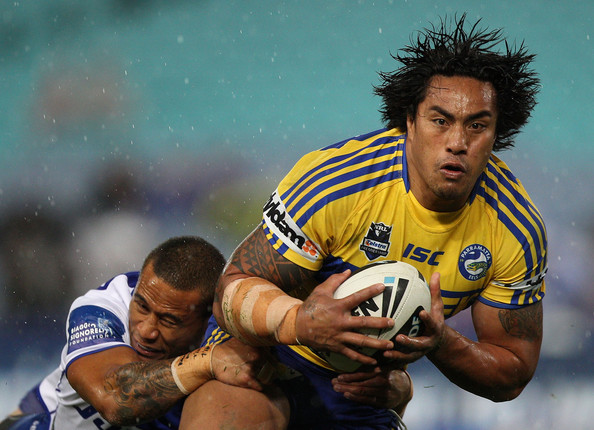
Fuifui (Moimoi) – Parramatta Eels

Fuifui Moimoi was born in Tonga and grew up in New Zealand (pictured). He made his début for Parramatta Eels in 2004, and has proved himself a valuable player. He is eligible to play rugby league for Tonga, Australia, New Zealand, the United States and Samoa, but so far has only played for Tonga and New Zealand. While watching a game recently, I heard the commentator explain that Fuifui’s name means “love love” in the Tongan language (as if to say, doubly loved). Not only is this a fantastic meaning for a name, but Fuifui Moimoi is without doubt the funnest name to say I have ever heard. Fuifui’s name is pronounced FOO-EE FOO-EE MOY MOY; you say it quickly and all the syllables have equal emphasis. It’s a name that you can’t help but smile as you say it. Fuifui goes by Fui in everyday life.

Krisnan (Inu) – New Zealand Warriors

Krisnan Inu was born in Auckland, New Zealand, to Samoan parents, and grew up in the western suburbs of Sydney. He made his debut in 2007, and began playing for the Warriors this season. He also plays for the New Zealand national team. A devout Mormon, he decided to forgo becoming a missionary, believing he can accomplish more for the church as a role model by remaining in the NRL. Krisnan is a variant of the Indian name Krishna, which means “black, dark, dark blue” in Sanskrit. Krishna is a central figure in Hinduism, believed to be the earthly manifestation of the supreme deity, Vishnu. He is said to have written the Hindu scriptures, the Bhagavad Gītā. Krisnan Inu calls himself Kris, and he has an interesting middle name too – Nevada!

Sandor (Earl) – Penrith Panthers

Sandor Earl was raised in the eastern suburbs of Sydney, and attended St Gregory’s College, a famous “nursery” for rugby league, where it is the dominant sport. Sandor made his début in 2009, and went to the Panthers last year, where he was named the club’s top rookie player. In 2010 he was part of the New Zealand Maori team which played against England, and is also reportedly eligible to play for Russia. Off the field, he works part-time as an underwear model. Sandor’s name is a Hungarian form of Alexander, and is pronounced SHAHN-dor. This is a form of the popular Alexander you don’t hear every day; it sounds like an exotic alternative to Xander to me.

Shea (Moylan) – Brisbane Broncos

Shea Moylan just made his début for the Brisbane Broncos this season. Shea is an Anglicised form of the Irish name Seaghdha, said to mean “hawk-like” in Old Gaelic, with connotations of being brave and fierce, and is pronounced SHAY. Although Seaghdha is a masculine name, the Anglicised form must sound slightly feminine to some people, as it is listed as a unisex name. However, I have personally only ever seen this name on boys, with Australian parents usually opting to use feminised creations such as Shaylie or Shayla for girls. I have also witnessed a wide range of variant spellings, including Shae, Shay, Shaye, Sheye and Shai. Although this has been a reasonably well-known name here, I get the impression it’s not being used as much as it was. It’s an attractive name, pleasantly soft, and sounds enough like Shane and Sean to seem familiar to most people.

Tariq Sims – North Queensland Cowboys

Tariq Sims is from Gerringong, in the Illawarra area of New South Wales, and is of part-Fijian descent. He made his début with the North Queensland Cowboys this season; his brothers Ashton and Korbin also play rugby league. Tariq is an Arabic name translated as “he who knocks on the door”, related to the Arabic word for “nightcomer” (in the sense that someone who comes by night will need to knock on the door to wake you up). Tariq is also the name given to the Morning Star, because it comes at the end of the night, but this star (planet) is also used as a metaphor for a great man or chieftain. In the Qur’an, the Morning Star is used to refer to the Prophet Mohammad. Tariq ibn-Ziyad was a military leader who conquered Spain for the Moors; Gibralter is named after him, for it is the Spanish derivation of “mountain of Tariq”. Tariq Sims pronounces his name tuh-REEK. This name has a mysterious meaning with positive associations and interesting namesakes; it’s exotic, but not difficult to spell or say. The Sims were ahead of the curve with Ashton and Korbin – Tariq may be next to become popular.

A very happy Father’s Day to all the dads! Here’s hoping you get spoiled rotten, and may your name suggestions always be taken seriously.

Boys Names That Only Chart in Australia

31 Sunday Jul 2011

Posted by A.O. in Name Themes and Lists

≈ 28 Comments

Tags

Arabic names, Biblical names, celebrity baby names, english names, famous namesakes, Gaelic names, hebrew names, honouring, Irish names, literary namesakes, locational names, name data, name history, name meaning, name popularity, nicknames, popular names, Scottish names, surname names

Campbell

This is a Scottish surname, which was originally a Gaelic nickname, Caimbeul, meaning “wry, twisted or crooked mouth”. A p was later added to the spelling in the belief the name was from the French for “beautiful field”. I suppose that meaning seemed a lot more appealing. The Clan Campbell was one of the largest and most powerful of the Highland clans, and the chief of the clan became Duke of Argyll. There are many prominent Australians with this surname. Campbell is #60 in Tasmania, which is very proud of its Scottish heritage, and has a historic town called Campbell. Campbell is on the US Top Top 1000, but only as a girl’s name. As a boy’s name, it has appeared only sporadically, peaked in 1885 at #700, and hasn’t been seen there since 2005.

Darcy

An English surname, from a French place name meaning “town of the bear”, which was introduced by the Normans as the surname of one of William the Conqueror’s barons. It can also be interpreted as an anglicised form of a Gaelic surname meaning “son of the dark one”, and this is a more likely origin in Australia. Although romantics cannot help connecting this to Mr Fitzwilliam Darcy from Jane Austen’s Pride and Prejudice, the most famous Australian with this surname is probably Les Darcy, the folk hero boxer. There are a number of notable Australian men called Darcy, including D’Arcy Niland, the roving novelist, Darcy Ward, the motorcyclist, Darcy Lussick, the rugby league player, and Darcy Dugan, the notorious bank robber. As you can see, although Darcy is unisex, it’s a very manly name here, and only Top 100 for boys. It’s #94 in New South Wales, #57 in Victoria, #97 in South Australia, #75 in Tasmania and #54 in the ACT. Darcy as a male name hasn’t been on the US Top 1000 since 1970, and it peaked in 1968 at #868.

Eamon

The Irish form of Edmund, this is pronounced AY-muhn. It’s use today is probably influenced by the sprint swimmer Eamon Sullivan (pictured). An Olympic athlete, Eamon is not only a good-looking underwear model, he also proved he was a fantastic cook by winning Celebrity Master Chef. Little wonder that he then went on to claim Cleo‘s Bachelor of the Year Contest. It’s #71 in the ACT, and has never charted in another country.

Flynn

An Irish surname meaning “son of Flann”; the name Flann means “red” and was the name of a 9th century Irish king. In Australia, it’s most strongly associated with the Tasmanian-born Hollywood film legend, Erroll Flynn. His name was bestowed upon Disney prince Flynn Rider in honour of Erroll Flynn, as the character has much in common with the actor. As this name has been given to Miranda Kerr and Orlando’s Bloom’s son, Flynn Christopher Bloom, I can see it gaining further in popularity. It’s #94 in Victoria, #79 in Tasmania and #80 in the ACT. It’s never charted in another country.

Hamish

This is the anglicised form of Seumas, which is the Scottish form of James; it’s pronounced HAY-mish. Its current popularity is almost certainly due to a well-known comedian who stars on both radio and television, called Hamish Blake. Multi-award winning, he was recently voted the most recognisable celebrity, and will be included in this year’s issue of Who’s Who. The name is #60 in New South Wales, #49 in Victoria, #45 in South Australia, #28 in Tasmania and #34 in the ACT. Hamish only just made it onto the list – it’s only recently left the Top 100 for Scotland.

Jai

A Hindi name which means “victory”, it can apparently be pronounced either JAY or JY. Jai has been in use in Australia since the 1970s. Jai Abberton is a former pro surfer who is a member of the notorious Bra Boys Gang. Jai Koutrae is an actor who’s appeared in several popular soap operas. Jai Ayoub plays rugby for Western Harbour. Jai Larkan is the lead singer of folk-rock band, The Wishing Well. Jai Taurima is a retired athlete who won silver at the 1998 Commonwealth Games. Lots of guys called Jai! It’s currently #98 in Victoria and #95 in South Australia. It only ever seems to have charted in Australia.

Jed

The short form of the Hebrew name Jedidiah, which means “beloved of Yahweh”. In the Bible, this was a term of endearment given to King Solomon by the prophet Nathan. In use in Australia since the 1980s, there are a number of athletes with this name, including AFL player Jed Adcock (who this year welcomed a daughter named Lily Rose). There’s also some rock singers with the name Jed, including Jed Kurzel, who did the music for the film Snowtown. It’s #99 in Tasmania, whose rural population seems suited to the rustic charms of this name. Jed was on the US Top 1000 from 1947-1989; it peaked in 1978 at #481.

Lachlan

This is a Highland Scottish name from the Gaelic Lochlann, which was used as a nickname for someone from Norway – “the land of the lochs (lakes)”. It’s pronounced LOHK-luhn. There was a strong relationship between the neighbouring lands of Norway and Scotland during the Middle Ages, as both battled for control of the Western Isles of Scotland. There were diplomatic missions between the two nations, and even intermarriage between the royal houses. The name Lachlan has a long history in Australia, owing much to Lachlan Macquarie, a British military officer from the Hebrides who served as Governor of New South Wales from 1810-21, in the period when it was transitioning from a penal colony to a free settlement. He therefore played a major role in the shaping of Australian society, and his liberal views toward ex-convicts and lavish expenditure on public works had a great impact on New South Wales. There are 30 places in Australia named after him, and 6 named after his wife, Elizabeth; on his tomb in Scotland he is called “The Father of Australia”. (American readers may be interested to know that he fought very successfully during the American War of Independence – on the British side of course). When media magnate Rupert Murdoch chose Lachlan as his eldest son’s name, he was perhaps drawing on his own Scottish heritage and honouring a great man from Australian history. Forty years later, this name is still going strong, and there is another generation of well-known Lachlans giving it new impetus, such as soap actor Lachlan Buchanan, and fullback for the Penrith panthers, Lachlan Coote. The name is #6 in New South Wales, #13 in Victoria, #5 in South Australia, #5 in Queensland, #12 in Tasmania and #3 in the ACT. It’s never charted in any other country.

Nate

A short form of Nathan, which is a Hebrew name from the verb “to give”; it can be interpreted as “given”, in the sense that God has given a child. Less persnickety baby name sites often interpret it as meaning “gift”, or “gift from God”, which is a more user-friendly way of putting it. The short form has proved very popular here recently, and I can’t help wondering if that’s partly because Australian baby name sites sometimes list Nate as meaning “little gift”, which I think is taking looseness of interpretation a bit far! Nate has a similar level of popularity to Nathan, and if you’re wondering why I don’t mention Nathaniel as a source of Nate, that’s because it’s not well enough known here to have a nickname yet. A famous Nate is Nate Myles, who plays for the Sydney Roosters in the NRL. It’s #60 in Victoria, #52 in South Australia, #44 in Western Australia, #58 in Tasmania and #50 in the ACT. It’s never charted in any other country.

Taj

An Arabic name meaning “crown”, it’s probably best known from the Taj Mahal in India, the name meaning “crown of buildings”. Taj Burrow is an Australian surfer, and as he’s from Western Australia, it’s not surprising that the name is #42 in that state. Taj has only been on the US Top 1000 twice, in 1976 and 1998, and never got higher than #951.

Zac

The short form of Zachary, the English form of Hebrew name Zechariah, meaning “Yahweh remembers”. In the New Testament, Zechariah is the father of John the Baptist. This seems to have done particularly well as a full name here. It’s been around long enough to have some famous Zacs already, such as Zac Dawson, who plays for St Kilda in the AFL, and Zac Drayson, an actor on the popular soap opera, Home and Away. American actor Zac Efron probably isn’t doing it any harm either. Early this year, V8 ute racer Craig Dontas named his second son Zac Michael. It’s #76 in New South Wales, #52 in Victoria, #77 in South Australia and #80 in Tasmania. It hasn’t charted in any other country.

Close But No Cigar

These names don’t make the top 1000 in the United States, but do chart in countries besides Australia

Angus – #75 in Scotland

Archie – #24 in England/Wales, #43 in Scotland

Reuben – #67 in N. Ireland, #71 in England/Wales

Tom – #10 in France, #18 in Belgium, #38 in Netherlands, #62 in Ireland, #93 in N Ireland

Harvey – #47 in England/Wales

NOTE

Please also read Girls Names That Only Chart in Australia, as it contains information relevant to this blog entry. Since then, the 2010 list for England/Wales has been released.

Girls Names That Only Chart in Australia

24 Sunday Jul 2011

Posted by A.O. in Name Themes and Lists

≈ 29 Comments

Tags

African names, Arabic names, Australian Aboriginal names, celebrity baby names, colour names, created names, english names, famous namesakes, fictional namesakes, Greek names, hebrew names, holiday names, Indian names, Irish names, Latin names, locational names, Mer de Noms, mythological names, name data, name history, name meaning, name popularity, nature names, nicknames, plant names, popular culture, popular names, saints names, Sanskrit names, surname names, Swahili names, unisex names, vocabulary names

Recently, Lou at Mer de Noms has had a couple of articles on names that are in the UK Top 150, but fail to make the US Top 500. It’s an interesting look at differences in name popularity between the two countries. I thought about doing the same thing from an Australian perspective, but found the list became too long for my purposes. So I made my conditions a bit tighter – these are names that are on a Top 100 list in Australia, but don’t make the Top 100 in any other country, and aren’t on the US Top 1000.

Asha

Asha has two different origins and meanings. It can be seen as an Indian name from the Sanskrit for “hope, wish, desire”, or an East African name from the Swahili word for “life”. Either way it has a beautiful meaning, and both Indian and Swahili names are becoming fashionable in Australia. It fits in well with other popular Ash- names, such as Ashley, Ash, Asher and Ashton. There’s an attractive TV presenter in Australia called Asha Kuerten (pictured), which has probably helped it gain momentum here. Asha is currently #89 in Victoria, #77 in South Australia, and #68 in the ACT. It’s never been higher than #794 on the US Top 1000 (in 1989), and hasn’t charted there since 2003.

Bridie

This is a pet form of the Irish name Brighid or its anglicised form, Bridget, which means “exalted one”. In Irish mythology, Brighid was the goddess of fire, poetry and wisdom. There was a 5th century Irish saint called Brigid, who is the patron saint of Ireland, and whose feast day on February 1 coincides with the pagan festival of Imbolc (possibly this day was sacred to the goddess of the same name). As around 30% of Australians claim Irish heritage, the name Bridie isn’t too unusual here, and there are several well-known women with this name, including Bridie Carter, a popular soap actress. Bridie is #70 in Tasmania, which has a particularly strong Irish community. It doesn’t chart in any other country.

Ebony

This is from the English word for the valuable black wood which comes from the ebony tree; different species are native to India, Sri Lanka, Indonesia, Mauritius, and West Africa. Although Ebony is often said to be used mostly by African-Americans in the United States, in Australia it is not connected to a person’s skin tone and is just seen as another colour name, like Ruby, Jade or Amber, or a plant name, like Rose or Holly. The exoticism of this name seems to have possessed a strange fascination for Australian parents, and it has been a Top 100 name since the early 1980s. Perhaps popular songs from that decade, such as Ebony Eyes and Ebony and Ivory, helped give it a boost. It’s #63 in South Australia and #55 in Tasmania. In the United States, Ebony got as high as #132 in 1982, and hasn’t been on the Top 1000 since 2005.

Indiana

The name of an American state, it means “land of the Indians”, because of the high Native American population in the area at the beginning of the 19th century (unfortunately, not to last). Indiana was used as a girl’s name (at least in fiction) before the American state was founded: Fanny Burney’s 1795 classic novel, Camilla, features a beautiful but shallow character called Indiana Lynmere. Possibly the name was intended as an elaboration of India, then part of the British Empire. French author George Sand also gave a character this name in her first novel, Indiana (1832). In this book, Indiana is a beautiful, romantic Creole from Reunion, of part-Indian descent. Here, there is a young TV actress called Indiana Rose Evans, and early this year, former NRL player Glenn Hall had a daughter named Indiana Maree. This name has only been Top 100 since last year, and it’s #98 in Victoria. Indiana has not been on the US Top 1000 since the late 19th century.

Jorja

The name Georgia, also an American state name (the state is named after King George II), is more popular in Australia than anywhere else in the world, hovering around the #20 mark on most lists, and Top 100 since the early 1980s. The phonetic spelling Jorja has also proved popular here. It’s currently #88 in Tasmania. Jorja has only been on the US Top 1000 once, in 2006, when it was at #976.

Lucinda

This is an elaboration of the Latin name Lucia, meaning “light”. Always a rather literary name, it was created by Miguel de Cervantes for his 1605 novel, Don Quixote for a character in a farcical romantic subplot. The 17th century Spanish poet Lope de Vega wrote love sonnets to a woman he called “Lucinda” to protect her identity. In more recent fiction, Lucinda is the rather silly fairy godmother in the children’s novel Ella Enchanted, later made into a movie. Australian novelist Peter Carey’s Oscar and Lucinda won the 1988 Booker Prize, and was made into a film directed by Gillian Anderson. Another Australian connection is that Lucinda is the name of a small coastal town in Queensland. As Lucy is so popular, Lucinda seems like a pretty alternative which will allow Lucy/Lucie as a nickname. It was chosen for the name of lifesaver and reality TV star Dean Gladstone’s daughter Lucinda May. It’s # 67 in Tasmania. Lucinda hasn’t been on the US Top 1000 since 1987, and peaked in 1881 at #153.

Tahlia

The name Talia can come from a range of origins. It’s a variant of the Hebrew name Talya, which means “dew from God”; it’s the Italian form of Greek Thalia, which means “to blossom” (Thalia was one of the nine Muses); and it can also be a short form of Natalia, a Latin name which means “Christmas Day”. However, In Australia, Talia is often taken as coming from an Aboriginal word meaning “near water”. Talia has become hugely popular in many parts of Australia; it has a certain patriotic flavour, and is pleasingly multicultural, suiting a variety of backgrounds. Yet it is not found consistently on the Top 100 because it has so many variant spellings. Tahlia is the most common of these variants, and is beginning to overtake Talia because it makes the favoured pronunciation more clear. It’s #47 in New South Wales, #41 in Victoria, #39 in South Australia, #35 in Western Australia, #84 in Tasmania, and #52 in the ACT. Tahlia has never charted in any other country.

Tayla

A specifically feminine form of the popular unisex name Taylor, this may have been coined in imitation of Kayla and related names. However, I can’t help thinking it’s taking off in Australia partly because it looks similar to Talia and Tahlia. It’s #68 in South Australia, #40 in Western Australia, and #94 in Tasmania. Tayla has only been on the US Top 1000 twice – in 1998 and 2006, and was never higher than #924.

Zahra

This is an Arabic name usually translated as “radiance”. The meaning is gorgeous, and Arabic names are becoming increasingly fashionable here with our growing Islamic population. However, almost certainly the reason for its popularity in Australia is due to its similarity to the name Zara. Zara has been used in Britain since the 18th century, where it is the English form of the French name Zaïre, created by the author Voltaire in 1732 for his hugely successful play of the same name, and possibly based on the name Zahra. The drama was soon translated as Zara: A Tragedy, and proved a big hit with English audiences too, being staged well into the 19th century. For some reason, Zara has been a favourite in Australia for over a century, and there are several famous women from Australian history called Zara, including the glamorous wife of former Prime Minister Harold Holt. Zara is more popular in Australia than in any other country, and Zahra is rising on the basis of its success. It’s #82 in the ACT. Zahra has never charted in the United States.

Also Qualifying

Bronte and Lara, which were covered on earlier Name Lists – Bronte in Sydney Suburbs That Can Be Used as Girls Names, and Lara in Girls Names from Video Games. Bronte is #68 in Tasmania. Lara is #43 in New South Wales, #80 in Victoria, #79 in Tasmania and #52 in the ACT. Neither has ever charted in another country.

Close But No Cigar

These names don’t make the top 1000 in the United States, but do chart in countries besides Australia

Freya – #19 in Scotland, #21 in England/Wales, #68 in Ireland, #70 in N. Ireland

Harriet – #89 in England/Wales

Imogen – #32 in England/Wales, #77 in Scotland

Maisie – #34 in England/Wales, #36 in Scotland

Milla – #48 in Norway

Poppy – #22 in England/Wales, #47 in Scotland, #60 in N. Ireland

NOTE

There are some serious statistical issues facing anyone doing comparisons between countries. Australia doesn’t produce a national Top 100, states and territories have different population sizes, not all states and territories provide their Top 100, and one has refused to divulge any of its name data. Countries don’t all release their popularity charts for the year at the same time, so we are still waiting for the ones from England/Wales, for example, and I had to use the one for 2009. I used popularity charts from Behind the Name, and sometimes they are slow in updating their data as well. Not only that, but there is no data available for many countries.

So rather than getting into a mathematical tangle, this is only intended to be of general interest and show a few broad trends.

Bonds Baby Search 2011 – Names from the Shortlist

22 Friday Jul 2011

Posted by A.O. in Baby Contests

≈ 16 Comments

Tags

Arabic names, Celtic names, famous namesakes, French names, Gaelic names, germanic names, Hawaiian names, Irish names, Japanese names, locational names, name combinations, nicknames, Persian names, polynesian names, Roman names, saints names, Sanskrit names, scandinavian names, surname names, Swedish names, unisex names

Girls

Alexandra

Alira

Annabella

Anika

Ava Lily

Brooke

Claire

Daisy

Drisana

Grace

Gwyneth Chloe

Harvey

Ke’ala

Keela

Isabella

Mia

Mikayla

Montanna

Paige

Tully Belle

Boys

Beau

Bodie

Chace Tyler

Charles

Eskander

Isaac

James

Jensen

Jeremiah

Kooper

Leo

Maximus

Mekai

Oliver

Oscar

Remy

Riley

Sandon

Shaun

Taj

Tommy

Tyler

Zachariah/Zakkariah

Not sure (hard to tell on a bub!)

Marley (boy?)

Milan (girl?)

Osh (boy?)

Midweek Sibset: The Frugal Family

20 Wednesday Jul 2011

Posted by A.O. in Sibsets in the News

≈ 3 Comments

Tags

famous namesakes, Greek names, Latin names, locational names, name history, name meanings, sibsets

It’s been reported in the news a lot recently that Australians, after years of going crazy on credit, have finally started saving money.

Morning television show, Sunrise, featured a story July 15  on a Brisbane family who went on a “financial fast”. Worried by their spiralling credit card debt, Michelle Taylor and her husband, John Tweedy, decided not to use their credit card for a year, and only spent money on essential items, such as food and health needs. During that year they didn’t buy anything new, and by the end of the 12 months, had saved $12 000, which they plan to spend on a backyard swimming pool in order to enjoy more family time together.

Michelle and John have picked our rather interesting names for their three daughters. Lily, aged 12; Scotia, aged 9; and Sappho, aged 3.

While we’re all familiar with popular Lily, the names Scotia and Sappho are more unusual.

Scotia, pronounced SKOH-sha, is the Latin name for Scotland; probably best known from the name of the Canadian province Nova Scotia (Latin for “New Scotland”). It comes from the name that the Romans gave a particular Gaelic tribe who emigrated from Ireland to Scotland, the Scoti. It’s not known what the name means, but “renegade, breakaway, outcast” has been one suggestion. Another is that it comes from the Greek word for “darkness”.

Sappho, pronounced SAFF-oh, is the name of a famous lyric poet from Ancient Greece, born on the island of Lesbos. Most of her poetry has been lost, but it was greatly admired during her own time, and enough survives that her reputation as a brilliant poet continues. She wrote many poems to gods and goddesses for religious purposes, and also wedding poems and love poems which still manage to stun us with their clarity and passion. It’s possible that her name comes from the Greek for “sapphire”.

I find all three names rather beautiful in their different ways, and think this sibset sounds great. Scotia and Sappho both start with the same letter and have a strong OH sound in them, and I think Lily is just one of those names that sounds good with almost any type of sibset.

Whether you want something that sounds old-fashioned (Arthur, Lily and Constance), classic (Henry, Charles and Lily), modern (Lily, Sierra, Jett and Chase), nature-themed (River, Lily and Autumn), cutesy (Beau, Lily, Bella and Toby), or offbeat (Cosette, Blaze, Lily and Phadra), Lily just seems to naturally mix and match. She’s the Universal Sibling.

You can see a video of the family here – just click this link and then press play when the video comes up.


Midweek Sibset: The Gender-Neutral Sibset

06 Wednesday Jul 2011

Posted by A.O. in Sibsets in the News

≈ 5 Comments

Tags

english names, Estonian names, famous namesakes, fictional namesakes, locational names, mythological names, name history, name meaning, Nigerian names, surname names, unisex names

There has been an international brouhaha over the decision by Canadian couple Kathy Witterick and David Stocker not to reveal the sex of their baby, Storm. As brother Jazz enjoys wearing pink dresses and pigtails, Kathy and David decided it would be better if their child’s sex remained private to their family to avoid any more societal gender issues.

This story got plenty of media time in Australia, as in other countries, and mostly people were very much against the idea of raising a “genderless baby”. This opinion piece in the The Age says that the parents are selfishly putting their own ideological agenda before their child’s welfare, while more forthright articles suggested the parents’ idea was just absurd.

However, Emma Jane in The Australian was one of those who took a more sympathetic view. She believes that gender stereotyping of babies and toddlers has reached a ridiculous level, where even new-born infants are dressed in either pink frills or solid workmanlike blue.

She dressed her daughter Alice in boy’s clothes and gender-neutral primary colours as a baby, which was declared to be “child abuse” by a concerned onlooker. Now 4 years old, Alice can make her own choices, which, it turns out, means a wardrobe full of pink and girly outfits.

Sydney couple Jay Black and Scott Collins are supporters of Witterick and Stocker’s choice to raise a “genderless child”. (I think Jay and Scott are a female-male couple). Jay and Scott are trying to raise their sons, Poe, 4, and Ilo, 22 months, without gender stereotypes. Their boys have ambiguous haircuts, play with dolls, and are supported if they choose to wear skirts and dresses.

In line with this lack of gender demarcation, Poe and Ilo have been given unusual unisex names.

Poe is a surname, most famous as that of the American Gothic writer, Edgar Allen Poe. His surname is a variant of the early English name Peacock, which began as a nickname for someone who was vain or dandified, or from someone who bred peacocks. In a few cases, it may have come from a house distinguished by the sign of a peacock. Poe Ballantine is an American novelist, while Poe is the stage name of American rock singer Anne Danielewski. Poe is also a raven character in the TV series Ruby Gloom.

Ilo is such a rare name that information on it is scarce, and I have turned to Appellation Mountain to discover that it’s the name of an Estonian goddess dedicated to feasting whose name may mean “pleasure”, and possibly a Nigerian boy’s name meaning “joy”. Sylvia Plath’s teenage diaries rather fervently describe a blonde Estonian refugee called Ilo Pill; he was male, so even in Estonia the name of the goddess seems to have been used for both boys and girls. In addition, Ilo is a lake in North Dakota, USA, and a port town in Peru, so you may take it as a geographic name as well. It’s so neutral that you can’t even tell which country the name is from, or what it means! It can either be pronounced EYE-low, or EE-loh (I believe).

The Baby Who Came with a Song

05 Tuesday Jul 2011

Posted by A.O. in Babies in the News

≈ 6 Comments

Tags

Australian Aboriginal names, locational names, unisex names

It was Territory Day on July 1, which celebrates the day that the Northern Territory commenced self-government in 1978. This year, the centenary of the territory’s foundation, the Northern Territory government and Music NT offered a $10 000 prize to the person who wrote the best Territory Anthem.

The winner was musician and music teacher Stephanie Harrison, from Alice Springs. Stephanie was in the early stages of labour on June 29 when she was told that her song, Stand As One, had won the contest our of 120 entries. And 48 hours later she and her partner Jack Batty had something else to celebrate – the birth of their son Tanami Batty.

Stephanie says that the song “came out of nowhere”, and that “I just couldn’t get the bloody song out of my head”.

The prize money means that she can stay home with Tanami without financial worries, and will also be used to fund some family road trips.

Her song was performed by the Darwin Symphony Orchestra and Darwin Chorale at Parliament House as part of the Territory Day celebrations.

Tanami is named after the Tanami Desert in the Northern Territory. It is pronounced tan-uh-my.

Although it’s rare, this isn’t the first time I have seen Tanami used as a name, but it’s the first time I have seen it on a boy. It seems like a brilliant name for a baby born on, or near, Territory Day.

Girls Names from the Top 100 of the 1930s

19 Sunday Jun 2011

Posted by A.O. in Name Themes and Lists

≈ 37 Comments

Tags

Anglo-Saxon names, Biblical names, celebrity baby names, Christmas names, classic names, english names, European name popularity, famous namesakes, fictional namesakes, flower names, French names, Greek names, honouring, Italian names, Latin names, locational names, middle names, military events, mythological names, name history, name meaning, name popularity, name trends, names from movies, names from songs, nature names, nicknames, plant names, popular names, retro names, Roman names, royal names, saints names, Scottish names, Shakespearean names, Tatar names, unisex names, virtue names, vocabulary names

This blog post was first published on June 19 2011, and revised and updated on June 12 2015.

Alma
May be derived from the Latin almus, meaning “nourishing” – an epithet given to several Roman goddesses, including Ceres. Alma mater, meaning “nurturing mother”, is a Latin term often used to refer to one’s college or university: it was originally a title given to mother goddesses, and later to the Virgin Mary. The obscure 4th century Romano-British saint Alma Pompea, married to the semi-legendary King Hoel of Brittany, is an early example of the name. The name was given a boost after being used in Sir Edmund Spenser’s 1590 poem, The Faerie Queen; he seems to have been influenced by the Renaissance Italian word alma, meaning “soul”. The name became popular in the 19th century, after the Crimean War began with the Battle of Alma, when Anglo-French forces defeated the Russians near the River Alma – the river’s name is from a Tatar word meaning “wild apple”. After this date, babies of both sexes (but mostly girls) were named Alma in honour of the military victory. Alma was #24 in the 1900s, and #97 in the 1930s, leaving the Top 100 the following decade, and the charts in the 1960s. Alma made a mild comeback in 2011, and seems very contemporary, as it has been used in Brokeback Mountain and The Hunger Games. Already popular in Europe, Alma would make an interesting alternative to names such as Amelia, Anna, or Emma.

Audrey
Pet form of the Anglo-Saxon name Etheldreda, meaning “noble strength”; it was the name of a 7th century English princess and saint whose feast day is June 23. It became less common after the Middle Ages, because St Audrey Day Fairs sold low-quality necklaces that were disparagingly called tawdries – which is where we get the word for something cheap and tacky from. Audrey was revived in the 19th century when the Victorians rediscovered many Anglo-Saxon names. The name was already familiar, as Audrey is the simple but honest country girl in Shakespeare’s As You Like It. The Victorians were also in the middle of a Shakespeare revival, so Audrey was a dead cert for a comeback. Audrey was #156 in the 1900s, and peaked in the 1920s at #32. The name was #36 in the 1930s, but plummeted so that it was off the Top 100 by the following decade. It fell to a low of 0 in the 1980s, but climbed after the death of Audrey Hepburn until it reached the Top 100 again in 2008. Once tawdry Audrey now seems charming and stylish, and is currently #44 and climbing.

Elsie
Often said to be a pet form of Elizabeth, but technically a pet form of Elspeth, the Scottish form of the name, and was originally Elspie. The name Elsie can be found in songs and poems dating to the 17th century, and became a 19th century favourite. Elsie was #7 in the 1900s, #59 in the 1930s, and left the Top 100 in the 1940s. Elsie left the charts in the 1970s, but returned in the early 2000s at #731. It joined the Top 100 in 2013 at #91, and last year rose 26 places to #65 – an impressive performance. Sweet and unpretentious, Elsie is very much back in the game.

Hazel
Named for the hedgerow tree or shrub which produces edible nuts; the Celts equated hazelnuts with wisdom and poetic inspiration, and the Druids made staffs from hazel branches. It was considered to be one of the trees belonging to the fairies, and folk tales tell of its ability to protect from evil. Hazel has been used as a personal name since the 17th century, mostly for girls, and became popular in the 19th century when plant names were fashionable. Hazel was #45 in the 1900s, and peaked in the 1910s at #18; by the 1930s it was #55. Hazel left the Top 100 in the 1940s, and the charts by the 1970s, making a return in the late 2000s at #477, after Julia Roberts named her daughter Hazel. Last year Hazel had an outstanding debut as the fastest-rising name of 2014, rising #63 places to #88. One factor must surely be the romantic film The Fault in Our Stars, with its heartbreaking heroine Hazel Lancaster, although there have also been Hazels in the Heroes of Olympus series, and Gossip Girl.

Iris
Greek personification of the rainbow who served as messenger to the gods, and linked them to humanity. The name literally means “rainbow”, which is where the colourful iris flower got its name from – and the colourful irises in our eyes. Irises were used in the Middle Ages as a symbol of monarchy, as the fleur-de-lis pattern depicts. Religious pictures from the medieval period show the Virgin Mary holding an iris to symbolise purity and chastity. Filled with meaning and associations, the name was used by the 19th century British aristocracy for both females and males (because the Greeks called the iris flower a “hyacinth”, and Hyacinth was a male name), but quickly became used by all classes, and nearly always for girls. Iris was #62 in the 1900s, and peaked in the 1910s at #31; it was #72 by the 1930s. Iris left the Top 100 in the 1940s, and left the charts in the 1970s, although it returned in the 1980s at #748. Off the charts in the 1990s, Iris came back in the early 2000s at #551, and is now around the mid-200s and apparently stable. Almost always on the charts, Iris manages to be a “normal” name that is still underused. Hip and artistic, it has slightly dark or even punk undertones. It’s a floral name with a bit of bite.

Josephine
Anglicised form of Joséphine, a pet form of Joséphe, a French feminine form of Joseph; by the 19th century Joséphine had become the standard form of the name. It has been used by several of the royal houses of Europe, and is famous as the first wife of Napoleon Bonaparte, and thus the first Empress of the French. Joséphine was born Marie Joséphe, so it was the pet form of her middle name. Classic Josephine has always been on the charts. It was #86 in the 1900s, peaked in the 1910s at #76, and by the 1930s was #78. It left the Top 100 in the 1940s, and sunk to its lowest level in 2011 at #199, so it has never been out of the 200s. In 2012 it made an appearance again in the Top 100 at #93 after the birth of Princess Josephine, the daughter of Australian-born Princess Mary of Denmark, but has since stabilised into its usual place around the mid-100s. Josephine is a solid stayer with royal blood whose nicknames range from the sensible Jo to the cute Josie to the tomboy Joey to the froufrou Fifi to the cool Joss.

Joy
Refers to the emotion of extreme happiness and gladness. It was originally a Puritan virtue name dating from the 16th century, referring to rejoicing for the salvation of God – perhaps most famous from the hymn, Joy to the World, now often used as a Christmas carol. In fact, joy and Christmas have become so entwined that you could even see Joy as a name suitable for a baby born around late December. However, the name Joy has become secularised, and often linked to the joyful experience of welcoming a child into the world: babies have even been called “bundles of joy”. Joy entered the charts in the 1910s at #205, and was in the Top 100 by the following decade. It peaked in the 1930s and ’40s at #60, and left the Top 100 in the 1960s. Joy reached its lowest point in the 1990s at #802, but then increased slightly in popularity, and was stable in the 500s for some time. Its current position is not known for sure, but is in at least occasional use. Quite common in the middle position, Joy is a strong, simple name with a beautiful meaning, and the current trend for virtue names mean that it would be refreshing to see it up front.

Lillian
Most likely a pet form of Elizabeth dating to the Middle Ages: there is a medieval Scottish ballad about a lady named Lillian. The name became greatly more popular in the 19th century, to the point where it could be seen as another Victorian revival of a medieval name, and may have been understood as an elaboration of Lily, which also became fashionable in the 19th century as a flower name. Lillian is a classic name which has never left the charts. It was #35 in the 1900s, reached #86 by the 1930s, and left the Top 100 in the 1940s. It reached its lowest point in the 1970s at #562, and then climbed steeply, following in the footsteps of Lily, until it reached the Top 100 again in 2008 at #81. It is currently #86, so its position is stable. However, the high number of Lilys and Lillys (not to mention the Laylas and Lolas) mean that lovely Lillian may feel almost too on trend for some.

Marie
French form of Maria: in France it has sometimes used for males, especially as a middle name, but in English-speaking countries is almost always feminine. The name often reminds people of Queen Marie Antoinette, whose first two baptismal names were Maria Antonia – she was Austrian by birth. In the Middle Ages, Marie was commonly used in England, and predates the use of Mary. The medieval poet Marie de France lived and worked in England, possibly at the court of King Henry II – it is even thought that she may have been Henry’s own half-sister. The traditional English pronunciation of the name was MAH-ree (still used in the 20th century), but it is now usually said muh-REE. A name never out of common use for centuries, Marie was #71 in the 1900s, and peaked in the 1930s at #11 – perhaps Irving Berling’s hit song Marie, sung by Rudy Vallee, was an influence on its success at this time. Marie left the Top 100 in the 1960s, and fell off the charts in 2011. It is now only in occasional use, although a common middle name. Marie is still popular in Europe, and this is a pretty, traditional name that still seems very wearable.

Olive
English form of the Roman name Oliva, which refers to both the olive tree and its fruit. There is a legendary Italian martyr called Saint Oliva, known as Blessed Olive. The Crusaders introduced the name Olive to England in the 12th century; returning from the Holy Land, they often gave their children names of Biblical import in honour of their religious duty. Olives play a major role in the Bible, from the dove bringing an olive branch to Noah after the Flood, to Christ ascending to Heaven from the Mount of Olives. It was a name used for both males and females, and in fact I have seen a baby boy named Olive in the past few years – but overall Olive has been more common for girls. Olive became popular in the 19th century, along with other plant names. Olive was #26 in the 1900s, and was #73 by the 1930s. It left the Top 100 in the 1940s, and was off the charts by the 1960s. It returned in the late 2000s, after Australian actress Isla Fisher chose the name Olive for her eldest daughter. After a smooth rise, Olive joined the Top 100 in 2012, debuting at #94. It is currently #76, so rising sedately rather than steeply. Buoyed by the success of Olivia and Oliver, and with a V in the middle like other popular names, Olive should continue to do well.

POLL RESULTS
People’s favourite names were Hazel, Iris and Josephine, and their least favourites were Joy, Marie and Alma.

(Painting is Moira Madden, later Moira Hallenstein by Arthur Challen (1937); from the State Library of Victoria.

Arlo Robert Galafassi: A Son for Toni Collette and Dave Galafassi, a Brother for Sage Florence

12 Sunday Jun 2011

Posted by A.O. in Celebrity Baby Names

≈ 2 Comments

Tags

celebrity baby names, created names, famous namesakes, fictional namesakes, Gaelic names, germanic names, honouring, Irish names, Italian names, locational names, Old English names, surname names, unisex names


Toni Collette is that rare creature – a born actress. At the age of 11 she faked appendicitis so convincingly that doctors performed surgery on her, even though medical tests all showed there was nothing wrong. She has a face which effortlessly transmits emotion to an audience, and the instinctive ability to inhabit a character so completely that few people actually know what Toni looks like in real life. (Much prettier than on camera, is the general verdict).

Born and raised in working class Blacktown, Sydney, she dropped out of the National Institute of the Dramatic Arts to work in film and theatre. At 21 she stole our hearts as the plump, naïve, ABBA-loving Muriel Heslop from Porpoise Spit, in P.J. Hogan’s cult film Muriel’s Wedding, and was then catapulted into the world of Hollywood, Broadway, fame, wealth and awards. She went on to star in films such as The Sixth Sense, About a Boy, and Little Miss Sunshine, and since 2009 has played the title role in the Spielberg-produced TV show, The United States of Tara.

In 2002, she met Dave Galafassi, the drummer for Sydney indie band Gelbison, at a barbeque. She describes him as “balanced, patient, and beautiful,” and says she knew straight away that he was “the one”. In January 2003, Toni and Dave were married at her country house in south-coast Broughton, near Berry. They had a Buddhist ceremony which lasted an entire weekend, and featured dancing monks, vegetarian banquets, and a fireworks display.

Their first child, Sage Florence, was born in Sydney on January 9 2008. When she announced her pregnancy the previous July, Toni noted, “It is strange that in the last three films I’ve done [my character has] been pregnant. I’m just like, what is the universe trying to tell me?”

In October last year, Toni and Dave announced they were happy to be expecting a second child, and Arlo Robert Galafassi arrived this Good Friday, April 22. Arlo made it “the greatest Friday”, was the statement from Toni and Dave. Like his sister, he was born in Sydney, where Toni was filming Mental with P.J. Hogan.

I never knew where the name Arlo came from, and after doing a little digging, I found out that nobody else really knows either! Behind the Name lists it as “meaning uncertain”, but notes that it may come from the fictional place name Arlo Hill in Sir Edmund Spenser’s 1590 poem, The Faerie Queen. It is theorised that Spenser created the name from the Irish place name Aherlow, which is Gaelic for “between two hills”. Wikipedia says that it is either a variation of the English surname Harlow, a variant of Harley or Arlene, or an Italian variant of Carlo. It seems to be a name which originated in America.

Toni Collette has confirmed that her son Arlo was named after the folksinger Arlo Guthrie, son of Woody Guthrie, of whom she and Dave are fans. The middle name Robert is after Toni’s father, Bob.

Toni Collette is very popular in Australia – an amazing feat in a country which enjoys despising its famous people. I think it’s because Toni has always seemed like a hard working actress, rather than a glamorous celebrity. She has lived all over the world, but chose to make her home in her native Sydney instead of relocating to Hollywood. Despite the Buddhism, meditation and astrology, she is always described as “down-to-earth”. Although she has had her share of personal problems, such as eating disorders and panic attacks, she doesn’t hawk them around the chat show circuit, or bring out tearfully brave books on “My Battle With X”. In fact, she’d rather not talk about them. She went to therapy, she got over it. End of story. She doesn’t analyse things, yap about herself, or witter on Twitter, and she seems to have a perpetually sunny attitude and toothy grin. You have to admit, that’s pretty refreshing.

Everyone appears to be completely enamored with her baby name choices as well – nearly every article on baby Arlo is followed by enthusiastic comments praising Arlo as a gorgeous name. Many people were quick to point out that they too, had a little Arlo (one female), and a couple said their Arlo was inspired by the character Arlo Glass on TV show 24. Clearly it’s a name doing well at the moment, and no doubt climbing up the charts. Just as Toni Collette manages to be the celebrity who seems like she could be just like you if talent hadn’t driven her determinedly in another direction, she’s won further esteem by choosing a baby name that’s just what everyone else would have chosen.

I don’t know if I’m quite so in love with the name Arlo; I’m not a huge fan of either folk music or 24, and I must confess I have a perverse side to me that quickly goes off names greeted with universal acclaim. However, I think it’s great with the middle name Robert, a brilliant match with sister Sage, and Arlo Galafassi just sounds wonderful. I also find myself intrigued by the possible connection to Edmund Spenser’s Faerie Queen. As context is everything, I hereby award Arlo Robert Galafassi a thumbs up!

Further Reading:

See the entry on Arlo at Appellation Mountain for more information on the name.

Check out Mer de Noms’ blog entry on The Faerie Queen for more Spenserian names.

Waltzing With … Florence

29 Sunday May 2011

Posted by A.O. in Waltzing with ...

≈ 15 Comments

Tags

celebrity sibsets, english names, famous namesakes, French names, Latin names, locational names, name history, name meaning, name popularity, New Zealand name popularity, nicknames, retro names, saints names, UK name popularity, unisex names, US name popularity

This blog post was first published on May 29 2011, and almost completely rewritten on May 28 2015.

Famous Namesake
Autumn is the traditional time of year for farm produce fairs, and on the last Sunday in May is held the Goomeri Pumpkin Festival. Goomeri is a small country town in southern Queensland; quiet and pleasant, it is known for its gourmet food industries.

The highlight of the Goomeri calendar is its Pumpkin Festival, in which they do almost everything to pumpkins, including eat them. There is the pumpkin shot-put, a pumpkin beer brewing competition, pumpkin judging contests, and the Great Australian Pumpkin Roll, in which up to 1000 pumpkins are rolled down Policeman’s Hill. There will of course be cooking demonstrations, food stalls, and all kinds of pumpkin-related culinary delights, including that old favourite, pumpkin scones.

Wen you see “pumpkin scones” and “Queensland” in the same paragraph, the name of only one person can come to mind – Florence Bjelke-Petersen. The widow of Queensland’s longest-serving Premier, Lady Florence Bjelke-Petersen has been a force in conservative politics, a part of Queensland history, and an Australian icon.

Florence was the wife of peanut farmer and Country Party member Johannes “Joh” Bjelke-Petersen, and after Joh became Premier of Queensland in 1968, Florence began to take on a bigger public role. The Queensland National Party increasingly promoted a Bjelke-Petersen “personality cult”, and Florence was a vital part of that.

Her down-to-earth sayings and common-sense attitudes became widely quoted by the media, and she published a cookbook which contained a recipe for her famous pumpkin scones. She was a Senator from 1981-1993; she worked for issues that affected Queensland and was popular with both sides of politics. When Joh Bjelke-Petersen was knighted in 1984, she became Lady Bjelke-Petersen – affectionately known as Lady Flo.

Lady Bjelke-Petersen is now in her nineties and still going strong. Although she no longer makes pumpkin scones, she reads the newspapers every day and has strong opinions on politics, as well as attending church every Sunday, and playing the organ each week for a local nursing home. In her youth, she always vowed she would be known by her full name, Florence, as she hated the short name Flo, but history intervened, and as often happens, she didn’t get much say in it.

Name Information
Florence began as the medieval English form of the Latin name Florentius, from florens, “flowering, flourishing, prospering”. There are several saints named Florentius, with the earliest being a 3rd century Roman soldier who was martyred in Italy. Florence could also be used as a French form of the female name Florentia; St Florentia was a 4th century hermit who was martyred in France.

In the Middle Ages, Florence was used as a name for both males and females, but by the 16th century had become overwhelmingly feminine in usage. Its connection with “flowering”, and similarity to the female name Flora were probably responsible.

Although the name Florence was already in reasonable use, it received a huge boost in the mid nineteenth century because of Florence Nightingale, the founder of modern nursing. Florence Nightingale came to prominence during the Crimean War of 1853-56, when she was hailed as a ministering angel, and called The Lady with the Lamp. It is notable that during the 1850s, the name Florence, which was steadily increasing in popularity at the time, suddenly skyrocketed, and continued rising for the rest of the century.

Florence Nightingale was born in the city of Florence, in Italy, and named after her birthplace. It was something of a family pattern, because her older sister, Frances Parthenope, was similarly named after the place of her birth, Parthenopolis, now part of Naples.

The city of Florence was established by the Romans, and originally named Fluentia, meaning “flowing” in Latin, because it was situated between two rivers – the Arno and the Greve. Later its name was corrupted to Florentia, meaning, as we already know, “flowering, flourishing”. Its new name suited it, because the city did indeed flourish and prosper, and by the 15th century was one of the largest and wealthiest cities of Europe. It is considered to be the birthplace of the Renaissance, and called “The Athens of the Middle Ages”; a beautiful city rich in history and culture, famous for its Renaissance art and architecture.

The name Florence was #5 in the 1900s, and fell until it left the Top 100 in the 1940s. It disappeared from the charts in the 1960s, making a minor comeback in the 1990s at #800, before dropping off the charts again in the early 2000s. In the late 2000s, Florence returned at #528 – this was the time that British indie band Florence + the Machine began its career, headed by flame-haired lead vocalist Florence Welch (Florence’s mother is a Professor of Renaissance Studies, so perhaps she was named with the Italian city in mind).

Since then, Florence has continued to rise, and is now in the 100s, almost certainly headed for the Top 100; it joined the New Zealand Top 100 in 2013. In the UK, Florence is even more popular, rising steadily through the 1990s to join the Top 100 in 2008, and is currently #29 and still rising. In the US, Florence hasn’t charted since the early 1980s; however the name is steadily rising, and last year 182 baby girls were given the name Florence.

Fashionable Florence is rising under the influence of British trends, and making friends everywhere – even people who profess to detest place names on people will forgivingly make an exception for Florence. As lovely as a Renaissance statue and as wholesome as pumpkin scones fresh from the oven, this retro name makes a stylish choice, and little wonder parents are eagerly snapping it up while it’s still hot.

POLL RESULTS
Florence received an approval rating of 80% from the public, making it one of the highest-rated names of the year. 40% of people loved the name Florence, while only 6% hated it.

(Photo of pumpkin scones from The Daily Telegraph)

← Older posts
Newer posts →

Enter your email address to follow this blog

Categories

Archives

Recent Comments

A.O.'s avatarwaltzingmorethanmati… on Zarah Zaynab and Wolfgang…
Madelyn's avatarMadelyn on Zarah Zaynab and Wolfgang…
JD's avatardrperegrine on Can Phoebe Complete This …
A.O.'s avatarwaltzingmorethanmati… on Rua and Rhoa
redrover23's avatarredrover23 on Rua and Rhoa

Blogroll

  • Appellation Mountain
  • Baby Name Pondering
  • Babynamelover's Blog
  • British Baby Names
  • Clare's Name News
  • For Real Baby Names
  • Geek Baby Names
  • Name Candy
  • Nameberry
  • Nancy's Baby Names
  • Ren's Baby Name Blog
  • Sancta Nomina
  • Swistle: Baby Names
  • The Art of Naming
  • The Baby Name Wizard
  • The Beauty of Names
  • Tulip By Any Name

RSS Feed

  • RSS - Posts

RSS Posts

  • Celebrity Baby News: Melanie Vallejo and Matt Kingston
  • Names from the TV Show “Cleverman”
  • Can Phoebe Complete This Sibset?
  • Zarah Zaynab and Wolfgang Winter
  • Baby, How Did You Get That Name?
  • Celebrity Baby News: Media Babies
  • Celebrity Baby News: Adelaide Crows Babies
  • Celebrity Baby News: Chris and Rebecca Judd
  • Names at Work: Name News From the World of Business and Employment
  • Celebrity Baby News: Sporting Round Up

Currently Popular

  • Celebrity Baby News: Nicki Gemmell and Andrew Sholl
  • Girls Names From Stars and Constellations
  • Celebrity Baby News: Alicia Molik and Tim Sullivan
  • Rare Boys Names From the 1950s
  • The Top 100 Names of the 1940s in New South Wales

Tags

celebrity baby names celebrity sibsets english names famous namesakes fictional namesakes honouring locational names middle names name combinations name history name meaning name popularity name trends nicknames popular names saints names sibsets surname names twin sets unisex names

Blog at WordPress.com.

Privacy & Cookies: This site uses cookies. By continuing to use this website, you agree to their use.
To find out more, including how to control cookies, see here: Cookie Policy
  • Subscribe Subscribed
    • Waltzing More Than Matilda
    • Join 517 other subscribers
    • Already have a WordPress.com account? Log in now.
    • Waltzing More Than Matilda
    • Subscribe Subscribed
    • Sign up
    • Log in
    • Report this content
    • View site in Reader
    • Manage subscriptions
    • Collapse this bar
 

Loading Comments...