• About
  • Best Baby Names
  • Celebrity Baby Names
  • Celebrity Baby Names – Current
  • Celebrity Baby Names – Past
  • Featured Boys Names
  • Featured Girls Names
  • Featured Unisex Names
  • Links to Name Data
  • Waltzing on the Web

Waltzing More Than Matilda

~ Names with an Australian Bias of Democratic Temper

Waltzing More Than Matilda

Tag Archives: hebrew names

Famous Name: Edna

28 Saturday Jan 2012

Posted by A.O. in Famous Names

≈ 14 Comments

Tags

Biblical names, famous namesakes, fictional namesakes, hebrew names, Irish names, mythological names, name history, name meaning, name popularity, saints names

Each year on Australia Day, an Australian of the Year is chosen from amongst our highest achievers. The United Kingdom also chooses its own Australian of the Year, and we seem to send them so many people that there are plenty to choose from.

This year the winner was Barry Humphries, who, at the age of 77, accepted his award with the words, “It’s about time, really”.

Barry Humphries has created many comedy characters: vulgar Sir Les Patterson; gentle Sandy Stone; underground film-maker Martin Agrippa; sleazy trade unionist Lance Boyle; and failed tycoon Owen Steele, amongst others. But the most famous and successful is Dame Edna Everage.

Edna began in the 1950s as the average Melbourne housewife, and if she had stayed that way, would soon have become as quaint and irrelevant as a comic char or a music hall “turn”. The genius of Dame Edna is that she has continued to re-invent and update herself, whilst never losing the integrity of the character or even the back-story which accompanies her.

From her humble beginnings, she has evolved into a glamorous Gigastar, icon and diva in an ever-more extravagant wardrobe , while retaining the trademark wisteria-coloured hair, cats-eye spectacles, bunches of gladioli and cheery “Hello, possums!” greeting.

I feel her evolution owes a certain debt to Lady Thatcher at the the height of the powers – in particular the almost limitless self-confidence and meaningless charm, combined with an iron determination to remain “nice”.

Edna is a vehicle for Humphries to utilise his powers of satire against the cult of celebrity and modern vapidity, but also to make sly jests at the expense of his friends, and take gentle stabs at his enemies; sometimes, perhaps, even to slip in his real opinions on issues that he only dares to offer in the guise of Edna. As a result, you are never quite sure what Edna will say, and this glittering unpredictability is part of her fascination. It goes without saying that many of her sharpest barbs are aimed accurately at Australia.

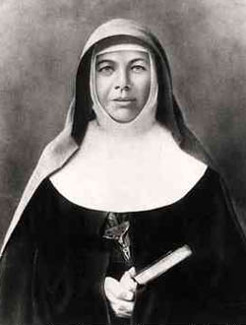
Barry Humphries called his creation Edna after his childhood nanny, and Everage of course is the word average said in an Australian accent (or at least an Australian accent of the 1950s). Edna peaked in the 1910s in Australia, so in the 1950s she was supposed to be middle-aged, although by now the name sounds elderly – in fact, Edna must be nearing a century by now.

Edna is the name of several women in the Biblical apocrypha, including the wife of Methusaleh. It’s a Hebrew name translated as “pleasure”, and some believe the name for Eden comes from the same source, as if it was one of the “pleasure gardens” of the ancient Middle East.

However, in Ireland it has been used to Anglicise the name Edana; St Edana is an obscure saint from the west of Ireland. She may be linked to or named after a goddess called Eadaoin (AY-deen), and although it’s not at all certain, this name may be a feminine linguistic relative of Aidan.

In Australia, the Edana connection is far more likely as a source for Edna, as obscure Irish names are more common here than obscure Biblical ones.

Call me crazy, but I think if it wasn’t for La Grand Dame, Edna could be coming into vogue now, as others from her era have. It’s not too different from Edith, Edie and Eden, which are getting quite fashionable, it may be related to popular Aidan, and could ride on the back of Ed- male names, such as Edward and Eddie.

I won’t try to suggest Edna, but could I interest anyone in an Edana?

Names of Convicts on the Second Fleet

22 Sunday Jan 2012

Posted by A.O. in Name Themes and Lists

≈ 8 Comments

Tags

angel names, astronomical names, Biblical names, celebrity baby names, famous namesakes, germanic names, Greek names, hebrew names, Irish names, Italian names, literary namesakes, mythological names, name history, name meaning, name popularity, popular names, Provencal names, Roman names, royal names, saints names, Shakespearean names, surname names, virtue names, vocabulary names

The Second Fleet arrived in Sydney in June 1790, and proved something of a disaster. The colony founded by the First Fleet was already struggling and in the grip of starvation, and the Second Fleet was sent partly to aid them with further supplies. The first ship to arrive was the Lady Juliana, which contained female convicts. It took such a leisurely route that although it left months before the other ships, it arrived only a couple of weeks before them.

The convicts on the Lady Juliana provided Australia with its first sex scandal, because the women and ship’s crew consorted freely together, some of the women sold themselves for money or alcohol, and whenever the ship made a port of call, the women entertained men from other ships. Several gave birth on the ship, and many were pregnant by the time they reached Australia.

The women were well treated on board, but on arriving in Sydney, the Lady Juliana was called “a floating brothel”, and its female occupants “damned whores”. A cargo of more than 200 women when provisions were wanted, the ladies couldn’t have been more unwelcome.

Worse was to follow. While the First Fleet had been an effort of the British government, and generally well-organised, the Second had been handed over to private contractors. They had little concern for the convicts’ welfare, and although only a small number died on the first voyage (the unfortunate Ishmael Colman being the exception rather than the rule), the mortality rate on the second was 40%. The ship carrying the majority of the supplies, such as livestock, hit an iceberg en route and was wrecked.

When the remaining convicts reached Sydney, the colonists were horrified to see that the new batch was in terrible condition – starved, filthy, sick with scurvy, covered in lice, and bearing the marks of cruelty on their emaciated bodies. Instead of being the saviours of the colony, the people of the Second Fleet were instead a great drain on its resources. A Third Fleet had to be sent (amazingly, they chose to use the same private contractors again).

More than 165 000 convicts were sent to Australia over eighty years. This is a tiny number compared to the number of free settlers. For many years, convict ancestry was something of which people were deeply ashamed, and it was hidden from the family histories. These days, people are proud of their convict ancestors, and there’s a wealth of information available to them.

WOMEN

Dorcas (Talbot)

At the age of 39, Dorcas was convicted at the Old Bailey of stealing sixty yards of material from a shop, and sentenced to seven years transportation. Dorcas was sent to the penal colony on Norfolk Island, a place of untold horror and abject misery. In 1804 she married John Hatcher, who had arrived on the First Fleet. She died on Norfolk Island in 1811. The name Dorcas is a Greek translation of the Aramaic name Tabitha, meaning “gazelle”. In the New Testament, Dorcas (or Tabitha) was one of the disciples of Jesus; the Bible makes her seem important, and she may have been a leader in the early church. It is said that she was a widow who did charitable works, and Dorcas Aid International is an organisation which raises money for the poor and needy. Dorcas is regarded as a saint in some denominations. Often used in fiction, Dorcas is a shepherdess in Shakespeare’s The Winter’s Tale. She has also given her name to a species of gazelle – the dorcas gazelle, meaning “gazelle gazelle”.

Isabella (Manson, aka Isabella Smith)

At the age of 28, Isabella was convicted at the Old Bailey for stealing clothes and sentenced to 7 years transportation; she seemed to have a male partner, but took full responsibility for the crime. She married John Rowe in Sydney in 1790. John had arrived on the First Fleet, and there was a scheme of marrying off the “best” Second Fleet convict women to the “best” remaining First Fleet men and giving them farmland to work. John and Isabella ran a farm together without much success, and had three children named John, Joseph and Sarah, and possibly another named Mary. They have many living descendants. Isabella died a widow in Gosford in 1847. The name Isabella is the Latinate form of Isabel, a medieval Provencal form of Elizabeth. It was commonly used by royalty, and is the name of Princess Mary of Denmark’s eldest daughter. Isabella has been on the charts since 1900, dropping from it in the 1950s and ’70s. In 1900 it was #75, and today it is #1; its big jump in popularity occurred in the 1990s, although rising since the 1980s. Nicole Kidman and Tom Cruise naming their daughter Isabella in 1992 may have assisted.

Phoebe (Williams)

At the age of 41, Phoebe was convicted at the Old Bailey of stealing 5 yards of cloth and sentenced to seven years transportation. She married Edward MacLean, a First Fleeter, in 1790, and they ran a farm together in Parramatta. Edward died in 1794 and Phoebe died in Parramatta in 1798. The name Phoebe is from the Greek for “bright, shining”. In mythology, Phoebe is one of the Titans, a moon goddess who was the grandmother of Artemis; her name was given to one of the moons of Saturn. Phoebe was also one of Artemis’ titles, and there are several Phoebes in legend, including an Amazon, and the sister of the beautiful Helen of Troy. In the New Testament, Phoebe was a deacon in the early church regarded as a saint by several denominations. It was used by Shakespeare for another of his shepherdesses in As You Like It. Phoebe was #148 in the 1900s and by the 1930s was off the charts altogether. It made a comeback in the 1960s, and climbed at such a rate that it was in the Top 100 by the 2000s. It is maintaining its position around the #50 mark.

Rosamond (Dale, aka Rosina Dale, aka Mary Woods)

At the age of 22, Rosamond was convicted at the court in Lincoln, and sentenced to seven years transportation. She married James Davis from the First Fleet, and they were sent to the penal colony on Norfolk Island, where she died. The name Rosamond is a variant of Rosamund, a Germanic name meaning “horse protection” which was introduced to England by the Normans. From early on, the name was associated with the Latin phrases rosa munda (“pure rose”) and rosa mundi (“rose of the world”), referring to the Virgin Mary. Rosa mundi was transferred from the cult of the goddess Isis who was worshipped throughout the Roman Empire; roses were sacred to her, as they became for Mary as well. There is a heritage rose called the Rosa Mundi which has existed since the 1500s. One of the old Gallica roses, it has red and white striped petals.

Violetta (Atkins)

Violetta was a servant. She was convicted of stealing from her employer at the Old Bailey and sentenced to seven years transportation. I think Violetta must have either died on the voyage, or soon after her arrival in Sydney. Violetta is the Italian form of Violet. Violetta Valéry is the main character in Verdi’s 1853 opera La Traviata, based on the play adapted from the novel La Dame aux camélias by Alexandre Dumas, fils. It’s a romantic and emotionally wrought tale of a courtesan who finds true love, but tragically dies of tuberculosis.

MEN

Ephraim (Lindsay)

Ephraim was convicted by the court in Northampton and sentenced to seven years transportation. In the Old Testament, Ephraim was a son of Joseph, born during his years in Egypt. Ephraim’s mother was a priest’s daughter named Asenath; their marriage was arranged by the Pharaoh. A Christian story is that she converted from paganism to the worship of Yahweh; it’s a fanciful tale involving an angel and some magical bees. According to Jewish tradition, she was actually Joseph’s half-niece, conceived in rape. How she got to Egypt involves yet another angel who leaves her under a bush wearing a necklace inscribed with an explanation of her origins; the priest finds and adopts her. You can see there is some discomfort with the idea of Joseph’s bloodline being “besmirched” by an Egyptian. Ephraim can be pronounced several ways, including EE-free-im and EE-fruhm. It seems like a good alternative to popular Ethan.

Janus (Everard)

Janus was convicted at the Middlesex Guild Hall and sentenced to transportation for life. Janus was the Roman god of beginnings, and thus all points of transition, such as gates and doors. He is famously depicted as having two faces, to indicate that he looks forward to the future and backward to the past simultaneously – a rather neat visualisation of the flow of time, which Janus oversees. The Latin name for “door”, janua, is named after him, and thus doorkeepers and caretakers of building are sometimes known as janitors. Janus was an important deity, and when the Roman calendar was regulated, the first month of the year was called Januarius in his honour. We still start the year off in January, making Janus suited to this month.

Ormond (Burcham)

Ormond was convicted of stealing five bushels of barley and sentenced to death by the court of Norfolk. This was commuted to seven years transportation. Ormond is an Irish surname named after the ancient Irish kingdom in Munster. It simply means “east Munster”, and was a hereditary title within the Irish aristocracy. It may also have become (perhaps deliberately) confused with the Irish surname O’Ruadh, meaning “son of the red one”. Francis Ormond was a philanthropist who founded the college which later became the Royal Melbourne Institute of Technology, as well as endowing Ormond College at the University of Melbourne. There is a 6th century French abbot named Saint Ormond, however, this is an Anglicisation of Armand, the French form of Herman.

Traverse (Spileye)

Traverse was convicted of attempting to steal five dozen tallow candles by the court in Nottingham and sentenced to seven years transportation. This may be a Puritan virtue name, very interesting if so, because they are rarely found in Australia compared to the United States. As the word traverse means to travel, it could refer to pilgrimage, or the soul’s journey through life, or perhaps even the Israelites traversing the desert for forty years. However, I can’t help wondering if it is just a variant of the surname Travers, coming from the French for “to cross”; it was an occupational name for someone who collected tolls at crossing places such as city gates and river fords. There is a Puritan connection with this surname, because Walter Travers was an English Puritan theologian.

Uriel (Barrah, aka Uziel Baruch)

Uriel was a Jewish butcher with a long history of being convicted for debt and theft, although he had also been a constable. His wife’s name was Judith. He was convicted of theft by the Old Bailey and sentenced to seven years transportation. He was originally going to be sent to a penal colony in Africa, an idea the British tried which didn’t work out, so he was sent to Australia instead. When he completed his sentence he returned to England; a relative seems to have taken over his butcher shop during his absence. Uriel is one of the archangels in Jewish and Christian tradition; he isn’t mentioned in the scriptures. He is given several interesting roles, one of which is to guard the gates of Eden with a flaming sword so that none living may enter; he is said to have buried Adam and Abel there. In Jewish mystical tradition, he is called the Angel of Poetry. Uriel appears several times in literature, including Milton’s Paradise Lost. His name means “light of God”.

Names of Convicts on the First Fleet

15 Sunday Jan 2012

Posted by A.O. in Name Themes and Lists

≈ 31 Comments

Tags

Aramaic names, Biblical names, english names, famous namesakes, fictional namesakes, germanic names, Greek names, hebrew names, Latin names, locational names, mythological names, name history, name meaning, name popularity, popular names, royal names, saints names, Shakespearean names, Spanish names, surname names

It is Australia Day next week, and so my name lists for January are names of convicts from the First and Second Fleets.

Convicts were the prisoners who filled overcrowded British prisons in the 18th and early 19th centuries. Because the death penalty was applied even to what we would consider minor offences, people were sent to prison for what we would consider to be misdemeanours, such as petty theft, or not crimes at all, such as being in debt.

Many convicts were disposed of by sending them to the colonies as cheap labour – nearly always North America – until the term is now understood as those prisoners sent to the colonies. The American War of Independence putting an end to America as a colony, another place had to be thought up to send convicts, and the east coast of Australia seemed a likely spot.

The First Fleet sailed from Portsmouth, Hampshire on May 13 1787, and consisted of eleven ships, led by Captain Arthur Phillips. Aboard were around 1487 people, including 778 convicts (192 women, 586 men). They travelled 24 000 km (15 000 miles) across the sea for 252 days.

On January 26 1788, the ships sailed into Port Jackson, which Phillips called “the finest harbour in the world” – an opinion many have shared since. They anchored in a sheltered place they called Sydney Cove, after British Home Secretary, Lord Sydney.

Life was very difficult in the new colony, and punishments could be extremely harsh. Convicts were basically slaves, mostly used on public works, but also assigned to individuals as a personal labour force.

The names of the convicts were those common in Britain in the 18th century, with names from the Bible being often used. Rather than cover historically famous convicts, I chose people for their names, giving a rather random selection of ordinary people and their unremarkable fates.

[All convicts’ names can be found here. Information on convicts from the First Fleet Database].

WOMEN

Deborah (Elam/Ellam/Elias)

At the age of 20, Deborah was found guilty of stealing 36 shillings worth of clothing, and sentenced by the court in Chester to seven years transportation. She sailed to Australia on the Prince of Wales. She married a fellow convict and brought a complaint against him; it was judged to be “trivial” and she received 25 lashes in punishment. The couple had seven children and have many descendants. Deborah died in 1819, “universally respected by her numerous friends and acquaintances”. The name Deborah means “bee” in Hebrew, and in the Old Testament Deborah was a prophetess, judge, advisor and warrior. The Song of Deborah, which she is said to have composed, may be the earliest Hebrew poetry we know of. Deborah didn’t rank in Australia until the 1940s, and peaked in the 1960s at #12. It left the Top 100 in the 1980s and hasn’t ranked since the 1990s.

Dorothy (Handland aka Dorothy Gray)

Dorothy made her living as a dealer in old clothes. In her early 60s, she was found guilty of perjury at the Old Bailey and sentenced to 7 years transportation. She sailed to Australia on the Lady Penrhyn. Dorothy is believed to be the oldest convict, and despite her age, she survived the voyage and returned to England when she had completed her sentence. Dorothy is the English form of Dorothea, from the Greek meaning “gift of God”. There are three saints named Dorothea, one of whom we call Saint Dorothy. A legendary virgin martyr of the 4th century, said to be of surpassing beauty, her cult spread across Europe in the Middle Ages. The name Dorothy was #2 in the 1900s and 1910s, and remained Top 100 until the 1950s. It has been unranked since the 1980s.

Flora (Lara/Larah, aka Laura Zarah)

Flora is thought to have been Jewish. She was found guilty of stealing a mahogany tea chest and money to the value of 5 shillings, and sentenced by the court in Westminster to seven years transportation. She sailed to Australia on the Prince of Wales. She was described in the court records as being of an evil disposition; she married in Australia and left the colony in 1801. Flora was the Roman goddess of spring, married to the west wind, Zephyr; her name is from the Latin for “flower”. Flora is the scientific term for all plant life. Flora was first used as a personal name in France, and it’s especially famous in Scotland, because of Jacobite heroine Flora MacDonald. Flora has never been Top 100 in Australia – it peaked at #112 in the 1900s, and left the charts in the 1950s.

Lydia (Munro, aka Letitia Munro)

At the age of 17 Lydia was found guilty of stealing material to the value of 20 shillings. She was sentenced to death by the court in Kingston-upon-Thames, which was later commuted to 14 years transportation. She sailed to Australia on the Prince of Wales. The convict records show that she was the victim of a sexual assault and attempted rape by another convict. She married, and she and her husband went to Tasmania where they raised a family of eleven children; they have numerous descendants. She died in 1856. Lydia of Thyatira is a character in the New Testament, regarded as the first convert to Christianity in Europe. She was a successful merchant who was baptised by St Paul and became a deacon in the early church; she is considered a saint by several denominations. Her Greek name is after the place name Lydia, an area of the ancient world now part of modern Turkey. Lydia has charted almost continually without ever hitting the Top 100. It peaked in the 1900s at #137, disappeared from the rankings in the 1930s and ’40s, and is currently #322.

Rachel (Earley/Early/HurleyHarley/Arrly)

At the age of 25 Rachel was found guilty of stealing tea and silk worth 3 shillings, and sentenced by the court in Reading to seven years transportation. She sailed to Australia on The Friendship, and spent time in irons onboard, for the twin crimes of “theft and dirtyness”. As a convict, she once received 10 lashes for not obeying orders. She married twice, and had a daughter, but was left by both husbands; she has living descendants. She died in Tasmania in 1842. In the Old Testament, Rachel was one of the wives of Jacob. Her name is Hebrew for “ewe”, perhaps with connotations of purity and submissiveness, although in the Bible Rachel did literally take care of her father’s sheep. Rachel is said to have been of overwhelming beauty, and Jacob loved her best of his wives. She was plagued by infertility issues, but managed to give birth to Joseph and Benjamin, her husband’s favourite children. Unfortunately, she died in childbirth, and her tomb is still a place of pilgrimage. The name Rachel has charted almost continually since 1900, dropping from the rankings during the 1940s. It peaked in the 1970s at #19, and is currently #118.

MEN

Barnaby (Denison/Dennison/Deneson)

At the age of 28 Barnaby was found guilty of “intent to rob”, and sentenced by the court in Bristol to seven years transportation. He sailed to Australia on the Alexander. According to the convict records, he was once sentenced to 50 lashes for “singing loudly at an improper time”, and became a night watchman. He died in 1811. The name Barnaby is a medieval English form of Barnabas. In the New Testament, Barnabas was a companion of St Paul and fellow missionary. His name was Joseph, but when he converted from Judaism to Christianity he was given the name Barnabas, which is a Greek form of Aramaic, and can be translated as “son of prophecy” or “son of encouragement”. There are many literary characters named Barnaby, most notably Dickens’ eponymous Barnaby Rudge.

Cooper (Handy/Handley/Henley)

Cooper made his living as a weaver. At the age of 33 he was found guilty of assault and highway robbery to the value of 20 shillings and sentenced to death by the court in Salisbury. This was commuted to seven years transportation, and he sailed to Australia on the Friendship. Cooper was held in a hulk at Dunkirk before he left, and at one point managed to escape during an uprising, but was recaptured. His report says that he behaved “remarkably well” otherwise. Not long after his arrival in Australia, Cooper was killed by Aborigines while gathering greens. Cooper is an English surname referring to someone who makes barrels as their occupation. Apart from being a popular name, Cooper is well known in Australia as the surname of the family who owns Cooper’s Brewery in South Australia. The name Cooper first joined the charts in the 1990s and peaked in 2009 at #4. It’s currently #7.

Ferdinand (Dowland/Dowlan/Doolan)

Ferdinand was a dustman. At the age of 32 he was found guilty of stealing a horse worth 30 shillings. He was sentenced to death at the Old Bailey, commuted to seven year’s transportation, and sailed to Australia on the Scarborough. He died in 1827. The name Ferdinand is from the Spanish form of a Germanic name meaning “daring journey”. Brought to Spain by the Visigoths, it was used amongst the royal houses of Spain and Portugal, and through them became common in the Hapsburg family, rulers of the Holy Roman Empire. One of its most famous namesakes is Ferdinand Magellan, a Portuguese explorer whose expedition was the first to circumnavigate the globe (although Ferdinand himself did not survive the voyage). Ferdinand is also a character in Shakespeare’s play The Tempest; a prince who is shipwrecked on Propsero’s island, and falls in love with his daughter Miranda.

Ishmael (Colman)

At the age of 32 Ishmael was found guilty of stealing woollen blankets worth 14 shillings, and sentenced to seven years transportation by the court in Dorchester. Ishmael was held in a hulk at Dunkirk before sailing, where he was described as “decent and orderly”. He died after only 16 days at sea on the Charlotte; the report from the ship’s doctor says that his death was brought about through his long confinement before the trip, which had brought about “low spirits and debility”. Ishmael is a name from the Bible which is translated as “God has heard”. In the Old Testament, Ishmael was the son of Abraham and his wife’s handmaiden, Hagar; Ishmael and his mother are two Biblical characters who get a raw deal, being cast into the wilderness to fend for themselves and not receiving any inheritance from Abraham. According to tradition, he is the father of the Arabic people, and is considered such in Islam, Judaism and Christianity, although this isn’t historically accurate. The prophet Muhammad traced his bloodline from Ishmael, and he is one of the prophets of Islam. In literature, Ishmael is the brooding narrator of Herman Melville’s famous novel, Moby Dick.

Job (Hollister)

At the age of 21 Job was found guilty of stealing tobacco and sentenced to seven years transportation by the court in Gloucester. He sailed to Australia on the Alexander. When he completed his sentence, Job left the colony and migrated to Vancouver Island in Canada. Job is another Old Testament character who has a miserable time. A righteous man, God allows Satan to take away his wealth, his children and his health in an effort to tempt him to curse his Creator. He never does so, although he is aggrieved by the process, and spends a lot of time wondering why all these dreadful things keep happening to him. The story ends happily, with God rewarding him many times over, but with no reasonable explanation for his treatment. Although the tale bears all the hallmarks of an allegory on the human condition, Job is regarded as a prophet in Judaism and Islam, and is given a saint’s day in several Christian denominations. In line with the narrative, Job’s name is translated as “hated, persecuted”.

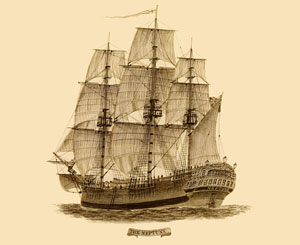
Image is of The First Fleet in Sydney Cove, January 27, 1788 by John Allcott (1938). Painting held by the National Library of Australia.

The Nativity Play Baby

19 Monday Dec 2011

Posted by A.O. in Babies in the News

≈ 4 Comments

Tags

Biblical names, english names, hebrew names, name combinations, virtue names, vocabulary names

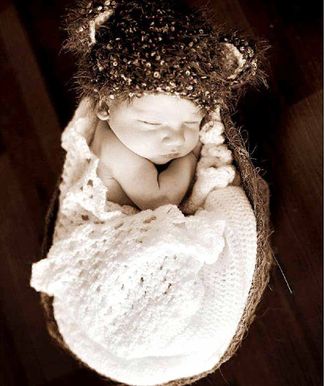
Last Saturday, the Christmas in the Park celebrations were held in Coolum, on the Sunshine Coast. They had a real live baby playing baby Jesus in the nativity play, with the baby’s real life parents, Luke and Sarah Quinn, playing the roles of Joseph and Mary, and his grandfather Gary Quinn providing music in the band.

The baby’s name is Hosea Courage Quinn. Hosea is from a Hebrew name meaning “salvation”; it is the name of one of the Biblical prophets. The Quinns chose it for its meaning.

The middle name Courage was chosen by Hosea’s father, because “it’s good to have something to live up to”. Virtue names are very much back in vogue, and this one sounds strong and quite masculine.

I think Hosea Courage Quinn is a very striking name, with a neo-Puritan ring to it. It’s one that sticks in my mind.

(Story and photo from Coolum and North Shore News, December 16 2011)

Famous Names: Barack

19 Saturday Nov 2011

Posted by A.O. in Famous Names

≈ 11 Comments

Tags

African names, Arabic names, Australian Aboriginal names, famous namesakes, hebrew names, name history, name meaning, name popularity, names of horses, rare names, surname names, Swahili names, UK name popularity, US name popularity


3675434-3x2-940x627

This blog post was first published on November 19 2011, and substantially rewritten and re-posted on November 19 2015.

Famous Namesake
This year is the sixtieth anniversary of the ANZUS Treaty, the military alliance which binds Australia to the United States. Partly to commemorate this occasion, the President of the United States, Mr Barack Obama, made a brief two-day stopover trip to Australia on his way to Bali. He is the fifth American president to visit Australia since Lyndon Johnson arrived in 1966.

Spending two days in Canberra and Darwin, capital cities of our two Territories, he made an address to Parliament, laid a wreath on the Tomb of the Unknown Soldier and paid his respects to the 89 US sailors who perished aboard the USS Peary after being bombed by the Japanese in Darwin Harbour in 1942. It was also announced that a US military base would be stationed in Darwin.

Handsome and charismatic, with a constant friendly smile, the President could not help but make himself popular. Mr Obama has the charm and good manners that we tend to think of as very American, and he made lots of pleasant jokes about Australian slang and the Australian accent, while expressing his fondness for the nation and its people (and no fondness at all for Vegemite, which is an acquired taste).

While in Canberra, he made a visit to a high school and hugged an excited young girl. “He’s so kind … and warm,” she exclaimed. That’s how Barack Obama came across – kind, warm, genuine, funny, and very charming.

Note: President Obama made another visit to Australia in 2014, when he attended the G-20 summit in Brisbane. He gave a speech to students at the University of Queensland, which received thunderous applause from a young audience unused to hearing political leaders talk about climate change and gender equality.

Name Information
Barack is a Swahili variant of the Arabic word barak meaning “blessed”. The name comes from a Semitic root meaning “to kneel down”, with connotations of someone receiving a benediction while on bended knee. In Islam, the related term barakah (“blessing”) means a continuous spiritual presence and revelation providing a flow of blessings and grace to those close to God, such as saints and holy people.

The name is sometimes confused with the Hebrew name Barak, meaning “shining, lightning”. In the Old Testament, Barak was a military commander. In Arabic the equivalent word for “lightning” is buraq – you can see it in the name Al-Buraq, the mystical horse who took the prophet Muhammad on his Night Journey to the heavens on a journey between Jerusalem and Mecca and back.

The Hebrew equivalent of Barack is Baruch, meaning “blessed”. It is related to the Hebrew word berakhah, meaning “benediction, blessing”. In Judaism, berakhah is a blessing or thanksgiving given before enjoying or performing certain acts; for example, before eating: it acknowledges God as the source of all blessings. Baruch can be Latinised as the name Benedict, which is why the Dutch philosopher Baruch Spinoza, who was Jewish, is often known to us as Benedict Spinoza.

As both Arabic and Hebrew are Semitic languages, it is easy to see how such confusion arises over similar or even identical-looking names.

By coincidence, Barak is also an Australian name. The famous Aboriginal spokesman William Barak (sometimes known as King Billy) took his surname from his tribal name of Beruk, meaning “white grub in gum tree”.

President Obama was named after his father, Barack Obama Sr, who was a senior economist in the Kenyan government during the 1960s. Mr Obama Sr was raised in a Muslim family, but was converted to Christianity at the age of six while attending a missionary school.

Apparently his original name was Baraka (from the Islamic term for spiritual blessings and grace), but he changed his name to Barack to avoid the overtly religious connotations of his name. I’m not sure how valid a conversion is in such a young child (it sounds almost coerced), but in any case it didn’t take, and Mr Obama became an atheist. His son did become a Christian, however.

The name Barack has never charted in the United States. Last year 11 babies were named Barack, a number which has decreased since 69 being born in 2009 – the year that Barack Obama Jr became President of the United States. In the year before President Obama’s presidential campaign, just 5 babies were named Barack.

Barack can only be found in British data between 2008 and 2010, peaking in 2009 at 17 births. I haven’t found any Baracks in Australian data, but based on international trends, it may have had a small spike in 2009.

Barack must be the most interesting of the American presidents’ names, and has at least busted the myth that you need a “presidential-style” name to become president of the United States (something like Ulysses or Grover, I presume).

One of its biggest issues as a baby name must be that it is so closely tied to the current US president, and may feel like a “one person name” – especially considering the name’s unique family history.

It could also be confused with similar names, and the pronunciation is something of an issue: although I understand it as buh-RAHK, I have heard it said it in a variety of ways by overseas commentators, including Burrock and Barrack. However, this is a strong handsome name with a nice meaning that will certainly stand out from the crowd.

NAME POLL RESULTS: Barack received an approval rating of 60%. 25% of people thought it was too closely tied to the American president, making it a one person name. However, 14% saw it as strong and commanding, and a further 14% thought it was a name unusual enough to stand out from the crowd. Only one person thought it was too rare, while 3% of people were put off the name because of President Obama.

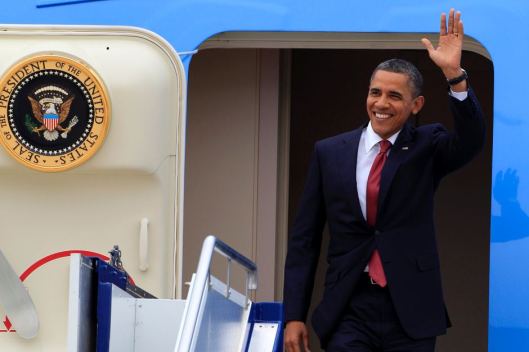
(Picture shows President Obama arriving in Canberra in 2011; photo from the ABC)

Names of Australian Fashion Designers

13 Sunday Nov 2011

Posted by A.O. in Name Themes and Lists

≈ 19 Comments

Tags

African names, Australian Aboriginal names, Biblical names, created names, Etruscan names, famous namesakes, French names, Gaelic names, Greek names, hebrew names, Korean names, Latin names, literary names, locational names, Maori names, mythological names, name history, name meaning, nicknames, Scottish names, surname names, unisex names, Zulu names

Last week we began our gender re-balancing with the names of some beautiful Australian models. Yet without the clever and creative designers, models would have nothing to wear. Here are ten female fashion designers whose names I found interesting in some way.

Arabella (Ramsay)

Arabella Ramsay grew up on a sheep farm in country Victoria; her family are all very creative, and she was encouraged to become a fashion designer. She did a course in textile design at RMIT, then spent a year in Paris studying fashion before opening her first store in Melbourne in 2006. This year, Arabella welcomed her first child, a daughter named Marlowe. The name Arabella originated in medieval Scotland, and it is thought that it is probably a variant of Annabel, meaning “lovable”. However, it is found in old documents in the forms Orable and Orabella, and from early on seems to have been influenced by the Latin word orabilis (also used as a name in the Middle Ages). This means “invokeable”, in the sense that a saint can be invoked by prayer. Arabella has never been a common name in Australia, despite our love of names from Scotland; I think it has seemed too old-fashioned or perhaps too upper-class. However, with -bella names all the rage, this looks like the perfect time for Arabella to shine.

Camilla (Franks)

Camilla Franks was a theatre actress who loved to design and make her own costumes, and formed her own fashion label in 2004. She is known as the “kaftan queen” because of her signature flowing lines in colourful prints, and hosts her own fashion shows in exotic locations around the world. Camilla sells internationally, and her designs are worn by celebrities such as Kate Hudson, Lily Allen, Beyonce and Oprah. In Roman mythology, Camilla was a virgin warrior queen of the Volscian tribe who was bound to be a votary of the goddess Diana since infancy. It is said that she was so fleet of foot that she could race across a field without bending a blade of grass, and could even run across water without getting her feet wet. We are told by the Romans that she was named Camilla because this is what the Etruscans called all their young priestesses (the male form is Camillus); if so, it seems to be more a title than a personal name. Queen Camilla’s mother’s name was Casmilla, and this seems significant. Once a favourite in literature, it’s best known today as the name of the Duchess of Cornwall. Milla and Millie are so popular at the moment that this may give Camilla more of a chance.

Collette (Dinnigan)

Collette Dinnigan was born in South Africa and moved to New Zealand as a child. After studying fashion design at Wellington Polytechnic, she moved to Sydney and worked for the Australian Broadcasting Corporation’s costume department. She opened her first store in 1992 and exported her fashions to New York, London and Hong Kong; she was the first Australian to launch a ready-to-wear collection in Paris. Her clothing lines sell in major department stores, and many Australian women will have at least one Collette Dinnigan piece in their wardrobes. The Australian government sent a Collette Dinnigan cardigan as their gift to French president Nicolas Sarkozy’s baby daughter, Giulia. Collette is a variant spelling of Colette, a French pet form of the name Nicole. The name Collette is well known as Australia as the stage name of lycra bike shorts-wearing pop singer Collette Roberts, who sang Ring My Bell, as well as the surname of actress Toni Collette. French names are very fashionable at the moment, but I wonder whether Collette is still sounding a bit dated. I think Nicollette might do better, maybe with Collette as the nickname.

Clea (Garrick)

Clea Garrick is originally from the Northern Territory, studied design in Brisbane, then moved to Melbourne where she set up the Limedrop label in 2005 with Nathan Price, who handles the marketing side of things. Limedrop has won a major award, sells around the world, and recently broke into the Tokyo market. Clea is a Greek name meaning “glorious”, and was the name of one of the Delphic oracles, who held the title of Pythia. These priestesses foretold the future at the town of Delphi in a temple dedicated to the god Apollo; it seems that some kind of shamanistic trance was used to foresee the future, and it has been speculated that hallucinogenic gases were involved. We are told by the ancients that these predictions tended to be ambiguously phrased, but usually gave good advice, and that the prophetic process was physically demanding on the Pythia – sometimes to the point where it killed her. We don’t know whether Clea was this priestess’ real name, or a name she adopted. I think Clea has a lot of potential – it’s underused, sounds similar to Claire and Leah, and is perhaps more feminine than its sister Cleo.

Elke (Kramer)

Elke Kramer is a Sydney-based jewellery designer known for her bold, chunky pendants and bracelets. She launched her label in 2004, and has a range of other creative pursuits, including art and illustration. Elke is the feminine form of the Hebrew name Elkanah, which is translated as “God has purchased”, and often interpreted as “belonging to God”, or “in God’s possession”. There are several men named Elkanah in the Old Testament, most notably the husband of Hannah, the father of the prophet Samuel. (Elkanah had another wife called Penninah, meaning “pearl”, but she was mean and jealous, so he didn’t like her as much as Hannah, even though Penninah gave him more children.) Elke is said EL-kuh, and it fits with popular names like Ella and the trend for EL sounds in girl’s names, but may possibly remind people of that large deer, the elk.

Jolet (Ucchino)

Jolet Ucchino is an independent fashion designer from Melbourne who launched her own label in 2008. She is committed to supporting local industry and using high-quality natural fabrics. It has been suggested that Jolet was originally a male name, derived from the French word joli, meaning “attractive”. It’s more common as a surname, but is still used as a personal name by both genders. Jolet Ucchino pronounces her name yo-LET. This is an unusual French name that’s a little like Yolande and a little like Juliet, and a fresh alternative to the name Jolie.

Kirrily (Johnston)

Kirrily Johnston studied at the Melbourne Institute of Textiles, and began her career in 1999 before moving to Sydney. She founded her own label in 2004, and was immediately met by rave reviews. Kirrily Johnston clothes sell in boutiques and department stores in Australia, the USA, UK, Asia and New Zealand, and are worn by stars such as Miranda Kerr, Nicole Kidman, Reese Witherspoon and Diane Kruger. This year Kirrily became a judge on Project Runway Australia. Kirrily is a much liked name here, and seems to be uniquely Australian. The origin is very uncertain. It could be a variant of the Maori name Kiri, which means “fruit skin, bark”, and is well known as the name of opera star Dame Kiri Te Tanawa. Kirri is the Maori word for “wild dog” and the South African word for “stick”, and also looks similar to kirra, an Aboriginal word meaning “leaf”, and Kirribilli, a Sydney suburb meaning “good fishing spot” in the local language. Most likely it came into use because it sounded similar to popular names of the 1960s and 1970s, such as Kylie, Kerry and Kelly. It has helped influence a new generation of soundalike names, such as Kirra-Lee, Keira-Leigh, Kirri-Li and Kyralee, of which you can find many examples given to recent babies and toddlers.

Lorna (Clarkson)

Lorna Jane Clarkson began her career as a dental therapist, but moved into fitness instruction. Finding the existing range of women’s activewear limited, she started making her own line of fashionable gym clothing. In 1990 she opened her own store, and today there are 122 Lorna Jane stores. The name Lorna was created by novelist R.D. Blackmore for his historical romance, Lorna Doone (1869). He may have based it on the Scottish place name Lorne, which is in a region once named Lorna, and is possibly based on the male name Loarn – Loarn mac Eirc was a legendary king who was one of the sons of the first Gael to arrive in Scotland from Ireland. Loarn may be from the Gaelic word latharn, meaning “fox”; perhaps a tribal totem. Lorna Doone is an exciting tale of a long-lost heiress, forbidden marriages, unexpected changes in fortune, and all manner of adventures. It was the favourite novel of Australian bushranger Ned Kelly, and he may even have got the idea of wearing armour from the book, as the outlaw Doone family are said to wear “iron plates on breast and head”. Lorna was an “old grandma” name when I was a little girl, which means another generation has gone by and maybe now it seems more usable. It really doesn’t sound much different to currently popular names such as Laura and Lauren, and has a surprisingly Australian significance.

Thulie (Ellis)

Thulie Ellis is an emerging fashion designer who was born in the Transkei Zulu region of South Africa, raised in New Zealand, and educated in Australia, studying at Sydney’s premier fashion school FBI. She debuted her first collection in 2009 and opened her online store the same year. Thulie is pleased that many of her clients are from the United States, as she has been in love with America since a trip there as a teenager. She hopes to expand further into the US market. Thulie’s name may be a pet form of Nokuthula, a common Zulu name meaning “peace and tranquillity”, although the word Thula (“peace”) is also used as a name, with Thuli or Thulie as the short form. Thulie is pronounced TYOO-lee; the first syllable is said like the word tulle, or the beginning of tulip. Exotic, yet simple, I can imagine many people being drawn to this pretty name.

Yeojin (Bae)

Yeojin Bae was born in Korea, and wanted to be a fashion designer when she was two years old; her grandfather was a designer, and both her parents worked in the industry. With their full support, she attended art school from the age of 4, and became the youngest student at the Whitehouse Institute of Fashion in Melbourne at the age of 14; she graduated when she was 17. She has done internships in New York with Marc Jacobs and Anna Sui, won the 2007 Tiffany and Co Young Designer of the Year Award, and in 2009 was nominated for the Prix de Marie Claire Designer of the Year Award. Her collections sell in major department stores in Australia, the UK, the USA and the UAE. Yeojin’s name means “beautiful treasure” in Korean. Her name is pronounced yo-jhin – at least in an Australian accent. I’ve included a short interview with Yeojin so you can hear her name said aloud.

(Photo of Thulie Ellis with one of her garments at Rosemount Fashion Week from Southern Courier, May 10 2010)

Names of Australian Models

06 Sunday Nov 2011

Posted by A.O. in Name Themes and Lists

≈ 27 Comments

Tags

Cornish names, created names, famous namesakes, fictional namesakes, French names, hebrew names, Indian names, Italian names, Latin names, Maori names, mythological names, name history, name meaning, Native American names, nicknames, Shakespearean names, Tamil names, Welsh names

Because we had two sets of male names for Boys Names from the Australian Football League and Boys Names from the National Rugby League, we need to have two sets of female names to keep the numbers even. As the spring fashion collections are out now, and ladies are getting frocked up for the spring racing season, it seemed a good time of year to feature women’s names from the world of Australian fashion.

Bambi (Northwood-Blyth)

Bambi Northwood-Blyth is a young up and coming model from Melbourne. She became known once her photo started being seen in tabloids partying with her surfer boyfriend who owns a fashion label, and soon became an internationally known “it” girl. At 5 foot 7, Bambi is unusually short for a fashion model, has a very distinctive look with heavy dark eyebrows, and sports tattoos and facial piercings. Bambi is a diminutive of the Italian word bambina, meaning “girl child”; English equivalents of Bambi might be Babe or Lassie. A girl named Bambi (real name Francesca) is the heroine of 1914 novel, Bambi, by Marjorie Benton Cooke. It recounts the romantic adventures of a lively young society girl in New York, and seems an entertaining enough read. However, it’s been overtaken in the public consciousness by a male deer called Bambi, hero of a novel by Felix Salten which was made into an animated Disney movie. Since then, Bambi has taken on connotations of being doe-eyed, long-limbed and generally adorable, like a baby deer. Bambi is usually a nickname or stage name in real life, and this case is no exception: Bambi Northwood-Blyth’s real name is Stephanie.

Cheyenne (Tozzi)

Cheyenne Tozzi was raised in Sydney, and is the type of blonde bikini babe which makes her suitable to be the face of Mambo Goddess and Just Jeans. She’s been hailed as “the next Elle McPherson”, and seems to be dating someone new every time you open a gossip magazine, from Kanye West to Mickey Rourke to Brandon Davis to our own Taj Burrow. Cheyenne is the name of a Native American people from the Great Plains region. Their name is what the Dakota Sioux called them, and means something like “the people of an alien language” (literally, “red-talkers”). One of their most famous members was the chief Black Kettle, who tried to make peace with the American settlers, and was killed by General George Custer. It’s pronounced shy-AN, and seems to be have been first used as a name in 1950s TV western, Cheyenne, about a cowboy called Cheyenne Bodie. It’s now seen as a primarily feminine name, and you should be aware that many Native Americans find using tribal names as personal names culturally insensitive or even offensive.

Demelza (Reveley)

Demelza Reveley is from Wollongong, and won the fourth series of Australia’s Next Top Model. Despite winning the show, judges said she lacked the sophistication to be a top model, and was just young and pretty. She has posed for Cosmopolitan and Vogue, and is currently the face of Sydney’s fashionable Strand Arcade shopping centre. Demelza is the name of a Cornish village said to mean “fort of Maeldaf”. The name Demelza was used for a character in the Winston Graham’s Poldark novels, and it became well known after the novels were turned into a TV series in the 1970s; the part of Demelza Poldark was played by Angharad Rees. Part of the success of the name at the time may be because, in the story, Demelza is told that her name means “thy sweetness”. Demelza Reveley’s parents obviously like unusual names – her sister’s name is Tanith.

Elle (Macpherson)

Elle Macpherson (pictured) was born in Sydney, and first modelled in New York as a teenager to raise money for her law degree (soon abandoned). She became known for her girl next door looks and magnificent figure, which earned her the sobriquet of “The Body”. Elle became part of the generation of supermodels in the 1980s, and went on to control many business interests. Today she is a multimillionaire businesswoman with her own fashion label, and is the face of Revlon cosmetics. She lives in Britain with her two sons. Elle’s name is short for her real name of Eleanor. Elle is the name of the world’s largest fashion magazine, founded in Paris in 1945. At one time, Elle Macpherson appeared in every issue of the magazine for six years in a row, and at the age of 21, married its creative director, Gilles Bensimon. The magazine’s name is the French word for “she”.

Miranda (Kerr)

Miranda Kerr was raised in the country town of Gunnedah in New South Wales before her family moved to Brisbane. She won the 1997 Dolly magazine contest at the age of 13, became a swimwear model, and relocated to New York. She is the first Australian to become a Victoria’s Secret lingerie model. She is married to actor Orlando Bloom, and is the mother of Flynn Christopher Blanchard Copeland Bloom. The name Miranda was created by William Shakespeare for his play, The Tempest; Miranda is the teenage daughter of the duke Prospero, and the two of them have been exiled on a remote island since Miranda was a toddler. Miranda’s name is derived from Latin for “admirable, miraculous” – Prospero is a magician, and perhaps chose a rather magical sounding name for his daughter. Miranda seems to be a popular name in Australia, at least in fiction; there seems to be a lot of Mirandas in films and television shows, including the beautiful schoolgirl Miranda in Picnic at Hanging Rock, based on the novel by Joan Lindsay. As this movie is very mysterious, it adds up to Miranda being a remarkably magical and mystical name.

Myfanwy (Shepherd)

Myfanwy Shepherd is from Cairns; she auditioned for the fourth series of Australia’s Next Top Model, but was rejected, as judges didn’t believe she had what it takes. A few months later, she was on the runways of New York, London, Paris and Milan. Myfanwy is a medieval Welsh name revived in the 19th century. It is often translated as “my fine one” or “my rare one”, but this seems to be an imaginative gloss, as it is more likely from the Welsh for “beloved”. A 14th-century legend tells of Myfanwy Fychan, who was said to be the most beautiful woman in Powys, and vain enough to love nothing more than hearing her appearance praised. She took a fancy to a penniless bard because he could compose poems extolling her loveliness. Fickle as well as vain, she soon dumped him for someone richer and better looking, and the bard was left to wander around sadly composing poetry to his lost love. This rather unpleasant character’s story was turned into a popular song by Joseph Parry in the 19th century. The name is pronounced muh-VAHN-wee, however Australian Myfanwys have a range of pronunciations, including like Tiffany with an M at the front. Like Myfanwy Shepherd, they all seem to use Myf (said MIFF) as the nickname.

Pania (Rose)

Pania Rose is from Perth in Western Australia; she was discovered during a national teen covergirl contest. She’s posed for Marie Claire and Spanish Vogue, and is most famous for her 2006 Sports Illustrated Swimsuit Edition appearance. The name Pania is one from Maori mythology; Pania of the Reef was a beautiful sea maiden. She fell in love with a handsome son of a chieftain, and the pair became secretly married. These mortal-to-sea creature love affairs always seem to go horribly wrong in tales, and this one is no exception. Pania stayed with her husband every night, but during the day she needed to be in the sea in order to survive. Her frustrated husband got tired of not having a wife around during the day, and tried to force her to remain on land against her will. Horrified that he would risk her life, she fled from him into the ocean. There is a statue of Pania on the city of Napier’s Marine Parade that is sometimes compared to that of The Little Mermaid in Copenhagen. The name is said PAH-NEE-AH, and it may mean “polished”.

Tabrett (Bethell)

Tabrett Bethell was born in Sydney, and was a teenage model and cheerleader for the NRL Cronulla Sharks. After this she trained as an actress, has been in several films, and played a key role in the US fantasy TV show, Legend of the Seeker, where she gained a fan following. Tabrett’s unusual name came about because of an argument her parents had about what to name her. Her mother had chosen the name Siobhan, but her father preferred the name Murray. Her dad left the hospital and went for a drive, where he saw a sign for Tabrett Street. He drove back to the hospital, and suggested Tabrett instead, which her mother proved equally enthusiastic about. Tabrett is pronounced with the emphasis on the first syllable, and for many years, Tabrett was told her name was Welsh. I have read that it is derived from the Hebrew word tofe, for the hand drum that is used to praise Yahweh, and is interpreted as meaning “celebration”. Although Tabrett’s surname is Welsh, meaning “son of Ithel”, by coincidence it looks similar to the Hebrew for “house of God”, so there is some odd Welsh-yet-Hebrew/Hebrew-yet-Welsh theme to her name, I think.

Tahnee (Atkinson)

Tahnee Atkinson is from Perth, and is the winner of the fifth series of Australia’s Next Top Model. Tahnee has a curvaceous figure, and her weight was sometimes an issue during the course of the show. As part of her prize, she received a contract with Maybelline and a spread in Harper’s Bazaar, which retained exclusive rights to her for six months. Tahnee is a name that has long been a favourite in Australia; the oldest Tahnee I know is in her late fifties, and the youngest was born last year. The meaning of the name is uncertain, but Australians often fondly believe it to be Aboriginal or Maori in origin. Most likely, it just a variant of Tania; it is pronounced TAH-nee (like tardy with an N in it instead of a D).

Valli (Kemp)

Valli Kemp was born in Kenya to British parents, moved to London when she was seven and to Sydney when she was twelve. She was chosen Miss World Australia in 1970, and seen as the epitome of early ’70s glamour, with bedroom eyes and full lips. After moving to London for the Miss World finals (Grenada won), she became part of the “beautiful people” scene, and appeared in a few films, most notably cult horror flick Dr Phibes Rises Again, opposite Vincent Price. After moving back to Australia in the 1980s, she became a full-time artist and art teacher. The name Valli means “creeping plant” in Tamil, which refers to either a sweet potato or a yam; both of these grow on vines. Valli is a Hindu goddess in the mythology of South India and Sri Lanka. In the stories, a chieftain and his wife prayed for a child, and found a baby girl amongst the vines in the forest; they raised her as their own and she grew up to be princess of her tribe. She became the wife of Lord Murugan, the most loved deity in Sri Lanka – a brave warrior who protects even the most humble.

Unique Boys Names from Tasmania, 2010

09 Sunday Oct 2011

Posted by A.O. in Name Themes and Lists

≈ 12 Comments

Tags

astronomical names, Australian Aboriginal names, celebrity baby names, created names, Danish names, famous namesakes, fictional namesakes, German names, Greek names, hebrew names, Irish names, Latin names, Maori names, mythological names, name history, name meaning, nature names, Old English names, place names, popular culture, saints names, surname names, Tibetan names, unique names, vocabulary names

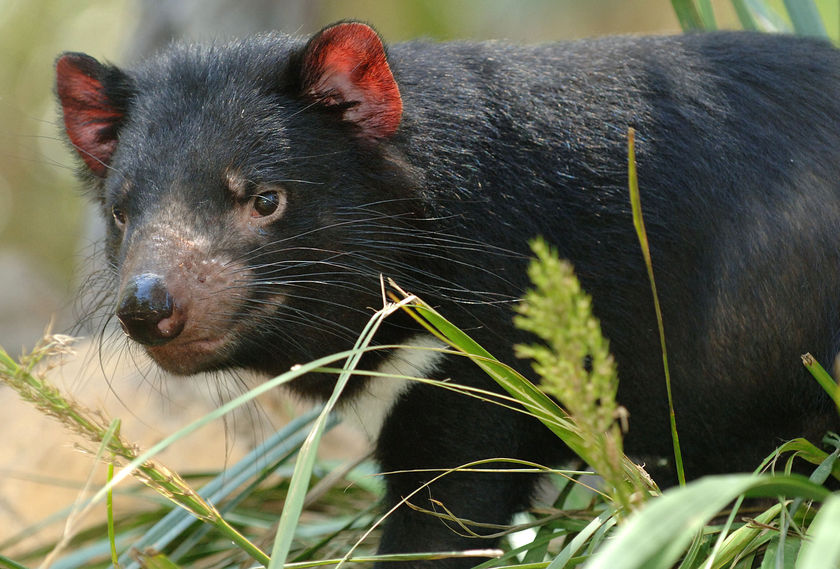
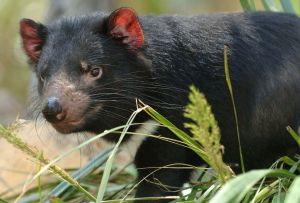
This follows on the previous list, Unique Girls Names from Tasmania, 2010. Please read the notes attached to that to see how names were chosen. Although there were fewer unique names for boys, they were much more likely to be genuine names, and not just variant spellings of common names. Whether you like these names or not, it’s nice to know that not everyone calls their children by names from the Top 100. There’s a lot of variety out there once you start looking. (If you are unsure what the animal in the photo is, it is a Tasmanian devil). 

Ambrose

This is the English form of a Latin name derived from the Greek, meaning “immortal”. It is connected linguistically to ambrosia, the food or drink of the gods in mythology, and is said to not only taste delicious, but to have a delightful aroma. In fact, it has been argued that ambrosia means “fragrant”, rather than “immortal”. If ambrosia had any basis in reality, it may be describing a honey product, although another theory is that it refers to the hallucinogenic mushroom, Amanita muscaria. The most famous namesake is probably Saint Ambrose of Milan, a 4th century Doctor of the Church who converted Saint Augustine. Interestingly, according to legend, bees swarmed on Ambrose’s face as a baby, leaving behind a drop of honey; this does seem to link the saint with the mythical ambrosia. An old-fashioned name, this fits in with the antique name revival, and the S/Z-ending for boys names. The meaning, and its associations with divine sweetness, is also hard to resist.

Other Latin names: Adrian, Augustus, Cassius, Ignatius, Maxmilian, Roman, Rufus, Silas, Sylvester

Anakin

This is the name of a Jedi knight in the Star Wars movies, father of Luke and Leia Skywalker, who crossed over to the Dark Side, and went on to become the heavy-breathing evil villain known as Darth Vader. Annikkin Starkiller was the name that George Lucas has originally chosen for Luke Skywalker, and when there was a major plot change and Darth Vader became Luke’s dad, a slight change of spelling meant that Darthy could have Luke’s old name. It’s sometimes claimed that George Lucas took Anakin’s name from his friend, Brtish film director Ken Annakin, but Lucas denies this. Although it’s tempting to give this name all number of foreboding meanings, we should remember it was originally planned as the hero’s name. It wasn’t clear in the beginning what kind of person the protagonist was going to be, and in one version it was an old man, and in another, a woman, so the name predates the character and the plot. Most likely, George Lucas just made it up.

Other sci-fi names: Auron, Draven, Grayson, Jango, Lex, Navi, Neo, Obi, Quillam

Bon

This is the name of the Scottish-born Australian rock musician, Bon Scott, who was the lyricist and lead singer for AC/DC, until his death in 1980, aged 34. AC/DC dedicated their next album, Back in Black, to him, which is the best-selling rock album of all time. Bon Scott is regarded as one of the greatest lead vocalists, has been inducted posthumously into the Rock and Roll Hall of Fame, and been honoured in both his home town of Fremantle, Western Australia, and his birthplace of Kirriemuir, Scotland. Bon was born Ronald Belford Scott, and his nickname was given to him in primary school. As there was already a classmate called Ronald, and as Scott had recently emigrated from “Bonnie Scotland”, he was dubbed Bon. The Scottish word bonnie means “beautiful, fair, fine”, and is taken from the French word bon, meaning “good”. Not only honouring a rock legend, this name seems similar to Beau in meaning and origin.

Other celebrity names: Cadel, Cassidy, Denzel, Dre, Elvis, Hammond, Joaquin, Keanu, Leland, Maddox, Makaveli, Orlando, Otis, Sylvain, Tander, Tex, Ziggie Other Scottish names: Dougal, Jock

Clancy

This is from an Irish surname meaning “son of Flannchadh”, with Flannchadh being a Gaelic name meaning “red warrior”. The name is well known in Australia, because of the poem Clancy of The Overflow, by Banjo Paterson; The Overflow is the name of a station where Clancy, a drover, works. It’s based on the true story of Paterson, a lawyer, sending a letter to Thomas Gerald Clancy of The Overflow, and imagining Clancy’s enviable life in the bush, under the “glory of the everlasting stars”. The reply that he received to his letter – “Clancy’s gone to Queensland droving and we don’t know where he are” – delighted Paterson, and was included in the poem. Clancy also appears briefly in The Man from Snowy River, and when that poem was made into a movie, the role of Clancy was played by Jack Thompson. Clancy of the Overflow is a romanticised image of bush life as dreamed of by the city dweller, and probably seems a patriotic choice as a name.

Other Irish names: Fionbharr, Niall, Rafferty, Ronan, Sullivan

Diesel

This is the name for the fuel used in diesel engines, which are named after their inventor, French-born Rudolf Diesel. His German surname is said to be based on a short form of either Matthias or Dietrich. As it sounds quite tough and butch, and has connotations of being able to keep going like a mechanical engine, it’s been a popular nickname or assumed name, for celebrities such as American actor Vin Diesel, Australian rock singer Diesel, American basketball player Shaquille “The Diesel” O’Neill, and AFL player Greg “Diesel” Williams. Diesel is also a popular name for dogs, and with “dog names” for boys in style, Diesel seems very usable. US Olympian softabller, Jennie Finch, called her second son Diesel Dean Daigle, so now it’s a celebrity baby name as well.

Other vocabulary names: Ace, Buddy, Gray, Spike Other car-related names: Holden, Jag

Esmond

An Old English name meaning “gracious protection”, this fell out of use after the Norman Conquest, and became best known as a surname. Thackery’s History of Henry Esmond is a historical novel set in the time of Queen Anne, where the hero spends the whole book in love with his foster-sister and cousin, but marries his foster-mother instead (also his cousin). This surname is part of Australian history, because James Esmond was an Irish-Australian who was one of the first people to find gold during the Victorian goldrush. He was also politically prominent in the miner’s organisation, and commanded a section of miners in the Eureka Stockade rebellion. It’s tempting to wonder if baby Esmond is a descendant of James, or whether the name was chosen in honour of this famous rebel.

Other Old English names: Bede, Edgar, Edwin, Winston

Iluka

This is a small coastal town on the Clarence River in New South Wales, and its name is derived from an Aboriginal word meaning “by the sea”. It is pronounced eye-LOO-ka. Iluka is a popular tourist destination, blessed with beaches and rainforest, and people who live in the chilly southern parts of Australia may enjoy spending their winters here. Maybe the parents of Iluka spent a happy holiday in the town? It’s easy to see the appeal of it as a name, because it is so similiar to the popular Luka, but has a distinctive Australian meaning.

Other place names: Carlisle, Clyde, Griffith, Hamilton, Maitland, Memphis, Meredith, Nelson, Preston, Ripley, Weston, Wilson, Windsor Other Aboriginal names: Wirra

Manuka

This is the name of a small tree or shrub native to New Zealand and south-east Australia – including, of course, Tasmania. It’s scientific name is Leptospermum scoparium, and it’s also called tea tree (not the same tea tree that tea tree oil is made from). The name manuka is Maori, and comes from history, where one of the sea-going canoes that brought the Maoris to New Zealand is said to have been called Mānuka. It’s pronounced mahn-OO-ka. Manuka honey is not only delicious, but recently it’s been discovered to have powerful antibacterial properties, and you can now buy medical-grade manuka honey to apply to wounds. There is a town in Tasmania near Hobart called Tea Tree, which may be named after this useful plant.

Other nature names: Aspen, Brae, Nullah, Reef, Stone, Sunny, Tiger Other Polynesian names: Loti, Kalani, Tavita

Namkha

Meaning “sky, heaven” in Tibetan, a namkha is a yarn or thread cross used in Buddhism as a sacred weaving, used in ritual or placed on an altar. “Thread” is the literal translation of the word tantra, and the threads of the mankha symbolise the warp and weft of time and space. A famous bearer is Tibetan Buddhist teacher, Rigdzin Namkha Gyatso Rinpoche.

Other Asian names: Anshuman, Arjuna, Ba, Dravid, Khan, Omita, Yang, Yasir, Zusong

Shem

One of Noah’s sons in the Old Testament, Shem is Hebrew for “name”. It can refer to someone’s fame and reputation, and also to their essential nature and being. While Noah is one of the most popular boy’s names, the names of his sons, Shem, Ham and Japeth, have had only occasional use. This may be because from early on, these three men were seen as the progenitors of the various races (as that vague and inaccurate word was understood at the time). Different writers have claimed Shem as the source of either the “Semitic” peoples, all Europeans, Germans, Greeks, Persians, or Indians; some texts even say that God made Shem brown skinned, Japeth fair skinned and Ham dark skinned. These ideas on race and ethnicity now look rather embarrassing, or even offensive; at the very least, we know them to be scientifically wrong. In the Bible, Shem is said to be an ancestor of Abram, who founded the Abrahamic religions. The name is pronounced SHAYM, and although uncommon, sounds not unlike familiar names such as Sean, Sheamus and Shane.

Other Biblical names: Abel, Amos, Elihu, Gideon, Hezekiah, Jairus, Jotham, Matthias, Raphael, Simeon

Soren

This is an anglicised form of the Danish name Søren, which is a form of the Roman name family Severinus, derived from the personal name Severus, meaning “stern” in Latin. Certain Harry Potter fans may see this as a way of using the name of grim Potions Master, Professor Snape, without actually calling their son Severus. The name has been used several times in recent popular culture; most notably the vampire Soren in the Underworld films. In the Charlie and Lola books and TV series, Soren Lorensen is little Lola’s imaginary friend. If these namesakes seem a bit lightweight, Søren Kierkegaard was a 19th century philosopher and theologian who has been enormously influential in shaping our ideas of the self and subjectivity. It’s pronounced SOH-ren.

Other Scandinavian names: Anders, Thor

Titan

According to Greek mythology, the Titans were a race of gods that ruled in the legendary Golden Age. They were the Elder Gods who were overthrown by the Olympians; this myth of a “war in heaven”, where one group of gods replaces another, exists in many cultures across Europe and the Middle East. The meaning of their name is uncertain, but is often intepreteted as “to stretch”; the Greek poet Hesiod refers to them as “the Stretchers”, because they stretched out their power. Other scholars believe it comes from the Greek for “white earth, white clay, gypsum”; they believe that this white dust was used in ancient shamanistic rituals, and it is from these almost-forgotten rites that the myth of the Titans grew. The name has been given to a moon of Saturn, and inspired the name of the element, titanium. The Titans, often imagined as gigantic figures, are part of popular culture, and you may find Titans in comic books, science fiction movies, and video games, as well as sports teams – including the Gold Coast Titans. Although the name may seem too big for a little boy, it sounds similar to names such as Tate, Tyrone and Titus.

Other Greek names: Constandinos, Eugene, Leonidas, Orion

Boys Names from the Australian Football League

28 Sunday Aug 2011

Posted by A.O. in Name Themes and Lists

≈ 13 Comments

Tags

Biblical names, Egyptian names, english names, famous namesakes, fictional namesakes, German names, hebrew names, Irish names, mythological names, name history, name meaning, nicknames, popular culture, surname names, vocabulary names, Welsh names

Writer, critic and broadcaster, Clive James, wrote in his “Unreliable Memoirs” that Australian boys tend to be named after athletes. Although much has changed since his birth during World War II, and naming practices have considerably broadened, plenty of baby boys are named after sportsmen in Australia even now. In the period leading up until Father’s Day, we’re going to have lists of boys names from the two main (rival?) football codes to look at some of the less common names found amongst the players. (Don’t worry – at some point we’ll have two lists of girls names to balance it).

Alwyn (Davey) – Essendon Bombers

Alwyn Davey is from Darwin in the Northern Territory, and his tribal ancestry can be traced to the Kokatha Mula people from the Eyre Peninsula in South Australia. He was a late starter to professional football, being considered a bit short. He was picked up by Essendon in 2007, and at 22, was thought to be a little old to make of a success of it. He quickly gained a cult following due to his explosive speed, and won the AFL Army Award (for bravery) in the year of his debut. Alwyn was named after his father, and surely must have a connection with Wales, for his full name looks very Welsh. Alwyn is said to be derived from the name of the River Alwen, which may mean “winding and fair”, but could also be influenced by the name of a Celtic god of healing and prophecy, Alaunos. The meaning of the god’s name is extremely unsure, and may mean “pale, faded”, “brilliant white”, “dark grey”, or possibly “treasure”. A soft and lilting name, this sounds a bit like Alan and Alvin, and is easily shortened to Al or Ally, although personally I like Wyn.

Amon (Buchanan) – Brisbane Lions

Amon Buchanan is from the country town of Colac, west of Melbourne, and his brother Liam plays cricket for the state team. He made his debut in 2002, and was traded to the Lions in 2009. In Egyptian mythology, Amon is a fertility god who was believed to be father of all the Pharoahs. So popular was he that he became combined with the sun god Re into the supreme solar deity Amon-Re, and was worshipped devotedly as a protector of the poor and weak. His name means “the hidden one”, and is pronounced AH-mun. Amon is also the Greek form of a Hebrew name meaning “skilled workman”. In the Old Testament, Amon was one of the kings of Judah, and gets a bad rap for idolatry and general depravity. However, in the New Testament he is listed as one of the ancestors of Jesus. Amon has a bit of baggage, and might seem slightly overweening, but it’s a nice simple name that doesn’t sound too different from Harmon, Eamon or Aidan.

Chance (Bateman) – Hawthorn Hawks

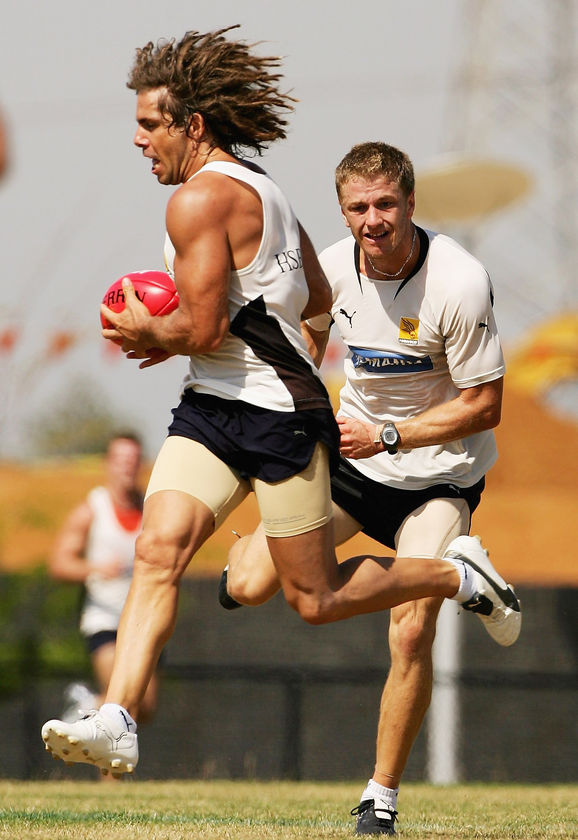
Chance Bateman is from Perth in Western Australia (pictured). He was Hawthorn’s first indigenous player to play 100 games, the first Aboriginal life member, and the club’s longest-serving recruit from WA. He is one of Hawthorn’s most valuable players because of his speed and hardness. He is notable for his dreadlocks, which he once cut off for charity and donated to the Rioli Fund for Aboriginal health. Chance is a surname of Old French origin, derived from a nickname given to someone blessed with good fortune. The English word “chance” can mean a stroke of luck or good opportunity, but now also has connotations of accident or randomness. This is one of those names that people tend to either love or hate, find cool or ridiculous. Nearly always the name is given meaningfully, and boys called Chance often have a story attached to how their name was chosen.

Maverick (Weller) – Gold Coast Suns

Maverick Weller is a young player from Burnie in Tasmania, and made his debut this season. The word “maverick” refers to someone unconventional, independent or even controversial in their thinking; someone who follows their own rules. The word comes from the name of Samuel Maverick, a Texas lawyer who refused to brand his cattle. (In reality, Samuel wasn’t so much an independent thinker as uninterested in ranching). His surname may be Welsh, and derived from the Gaelic name Muirgheas, meaning “seafarer”, or from the Welsh Mawr-rwyce, meaning “valiant hero”. It’s been used as the title of both a Western TV series starring James Garner and a Western movie starring Mel Gibson, so still has rather a “cowboy” image. Maverick Weller seems to have been named after Tom Cruise’s callsign in the movie Top Gun, as he has a tattoo of his namesake. It’s another vocabulary name that can draw strong opinions from people – no doubt, just like the original Mister Maverick!

Kade (Simpson) – Carlton Blues

Kade Simpson is from Melbourne, and was drafted by Carlton in 2002. He has the club record for most consecutive games played, and won the Jim Stynes Medal in 2008 for best player on the Australian national team. His name is a variant of Cade, a surname which began as a form of the personal name Cada, coming from the Germanic for “swelling, lump”. This slightly unflattering name may have begun life as a nickname for someone overly plump, but to me it almost sounds like a “womb name” – the sort of epithet you might fondly give the baby swelling your belly out (“my little lumpkin”). The surname has another source, the Old French word cade meaning “barrel”; although this also has connotations of stoutness, it’s an occupational name for someone who made barrels, and thus is the same as Cooper. There is another meaning which parents might find more appealing: a cade is a baby farm animal reared by hand; these pet lambs and calves tend to be cossetted and well-fed little darlings. It’s a name filled with cute, cuddly, childish and chubby connotations; however I’m guessing most people will assume it’s a short form of Kaden.

Kepler (Bradley) – Fremantle Dockers

Kepler Bradley is from West Australia, was drafted in 2003, and began playing for Fremantle in 2007. Tall and agile, he won the Lark Medal for players 18 and under in 2003. Kepler is a German surname meaning “hooded cloak”; it’s an occupational name for someone who made such garments. The name is given in honour of Johannes Kepler, a mathematician, astronomer and astrologer. A key figure in the 17th century scientific revolution, his laws of planetary motion helped set the stage for Isaac’s Newton’s laws on gravity. A devout Lutheran who had considered becoming a church minister before his obvious talent for mathematics pushed him into an academic career, he was banished from Graz for refusing to convert to Catholicism, but found refuge in tolerant Linz. His mother was a herbalist who was imprisoned as a witch, but Kepler’s extensive defense got her released, adding “legal mastermind” to his already impressive list of accomplishments. This is a strong, unusual name that celebrates a hardworking polymath of powerful imagination, known for his cheerful and affectionate nature. Kip is the obvious nickname.

Marlon (Motlop) – Port Adelaide Power

Marlon Motlop is from the Northern Territory, and traces his tribal ancestry to the Larrakia people, from the Darwin area. He was drafted in 2007 and is the youngest player drafted to Port Adelaide. He won the Allan McLean Medal for players under 16 in 2006. The name Marlon is another surname, this time coming from place names called Moreland, common in the north of England and southern Scotland, meaning “moor land”. The name is strongly associated with American screen legend Marlon Brando, who starred in movies such as A Streetcar Named Desire and On the Waterfront. Actor Marlon Brando was named after his father; of German-Dutch origins, the family surname was originally Brandeau. It’s also the name of Michael Jackson’s older brother, singer Marlon Jackson, who gave the name Marlon to his youngest son, Marlon Jackson Jnr. This name may seem almost too famous to use, but it’s a name that’s been good enough to be handed down from father to son at least twice, and you can also use Marley as a nickname, thus honouring another famous singer.

Sharrod (Wellingham) – Collingwood Magpies

Sharrod Wellingham is from Western Australia, and was selected for the 2006 rookie draft. Since 2008, he has become a valuable asset for Collingwood. Sharrod looks like a cross between Sharon and Jarrod, but is yet another surname. This could be a variant of either of two different surnames. One is Sherrard, which has been found in Ireland from the 17th century onwards. The meaning is unknown, but has been interpreted as a combination of English and French meaning “bright, fair”. Another possibility is Sherrod, based on the French surname Cherot, meaning “wagoner”. Sherrard, Sherrod and Sharrod have all been used in the past as personal names, but mostly in the United States. In fact, there is an American basketball player called Sharrod Ford only a few years older than Sharrod Wellingham, so the name seems to have floating around in the public consciousness during the 1980s.

Tadhg (Kennelly) – Sydney Swans

Tadhg Kennelly is from County Kerry in Ireland, and already had a background in Gaelic football when he signed with the Sydney Swans in 1999. He made his debut in 2001, and became a high-profile player, writing articles for the Swans’ website entitled Talking with Tadhg. After the death of his father, Tadhg returned to Ireland in 2009 where he won a National Football League medal, but came back to Australia in the 2010 season. Tadhg is an Irish name that means “poet”; Tadhg was a medieval king of Connacht. The name does have pronunciation issues in Australia, where people tend to want to say it to sound like the word tie, or the name Ty. However, it is pronounced TIEG, like the first syllable in the word tiger. Australia has a great fondness for Irish names and Irish culture, and I think this name would be accepted and admired once people understood the pronunciation. It has a romantic meaning, yet sounds masculine, and it’s short without being cute.

Zephaniah (Skinner) – Western Bulldogs

Zephaniah Skinner is a young player from the Kimberley region of Western Australia who moved to Darwin, and was drafted last year. Zephaniah is a Hebrew name that means “Yahweh has hidden, Yahweh has concealed”, or slightly more ominously, “Yahweh lies in wait”. There are several people of this name in the Old Testament, the best known being a minor prophet who features in the very brief Book of Zephaniah. These three chapters give the teachings of Zephaniah, who seemed pretty keen on a universal Judgement Day, and as is usual with prophets, warned that widespread repentence is necessary to avoid this catastrophe. Another famous namesake is British Rastafarian poet, Benjamin Zephaniah. He supports veganism, animal rights, anti-racism, a British Republic, a change to the first-past-the-post voting system, and the UK Green Party. Boys names from the Old Testament are very popular at the moment, and although Zephaniah is quite rare, it isn’t any more unusual-sounding than Zachariah. Zeph or Zeff seems like a pretty cool nickname as well.

Waltzing With … Mary

07 Sunday Aug 2011

Posted by A.O. in Waltzing with ...

≈ 10 Comments

Tags

Biblical names, classic names, Egyptian names, famous namesakes, fictional namesakes, French names, hebrew names, Irish name popularity, Latin names, name history, name meaning, name popularity, royal names, saints names, UK name popularity, US name popularity

A050199_246x550This blog post was first published on August 7 2011, and revised and updated on August 13 2015.

Famous Namesake
Tomorrow is the solemnity of Saint Mary of the Cross, otherwise known as Saint Mary MacKillop. It’s a special day for Australian Catholics, because Mary MacKillop is the only Australian to have ever been canonised as a saint.

Born in 1842, she was a nun who founded the order of the Sisters of Saint Joseph of the Sacred Heart, as well as several schools and welfare organisations across South Australia, Queensland and New South Wales. She had a special interest in educating the poor, especially in rural areas, but the Josephites also cared for parentless and neglected children, unmarried mothers, women escaping domestic violence, the elderly, and the dying, as well as prisoners and juvenile delinquents. The Josephites did not live in convents, but amongst the community, living as they did, and sharing their hard lives. The brown habits they wore gave them the very Australian nickname, “The Brown Joeys”.

Church politics often caused her stress, including a period of a few months when she was excommunicated for speaking out against child sex abuse within the church. During this time, she lived with a Jewish family and was sheltered by Jesuit priests. There was also an ugly smear campaign against her, including accusations that she was a drunkard. In fact, in an age where pain medication options were limited, she took alcohol on doctor’s orders for severe menstrual pain that left her bedridden for days each month.

Even during her lifetime, Mary MacKillop was regarded as a saint for her holiness and charitable works, and after she died on August 8 1909, people took earth from around her grave as a relic, until her remains were placed in a vault in a memorial chapel in Sydney, paid for by an admiring Presbyterian friend.

In 1925 the long process of having Mary MacKillop declared a saint was begun; she was beatified in 1995, and canonised on October 17 2010. She is the patron saint of Australia, and of the city of Brisbane.

Whatever your beliefs, it’s hard not to admire Mary MacKillop for her altruism and determination. She was greatly beloved by the poor, and accepted by the Aboriginal community as one of themselves. She was a fiery-tempered yet affectionate Scottish redhead with big blue eyes who believed in social justice and equality for all, and whose catchphrase was, “Never see a need without doing something about it”.

Name Information
Mary has long been a favourite for girls, due to it being the name of the mother of Jesus. In fact, there are a confusing number of women named Mary in the New Testament, because it was a name used in the royal family of Judea at the time, and extremely common. Mary is an English translation of the Latin and Greek forms of the Hebrew name Miryam.

The original Miryam was the older sister of Moses and Aaron in the Old Testament. It was she who hid Moses in the bullrushes when he was a baby to save his life, and then watched the Pharaoh’s daughter discover and adopt him. She cleverly suggested to this adoptive mother that she hire Miryam’s mother as a nurse, so that Moses was raised within his own family.

As Miryam was born in Egypt, it’s been suggested that her name comes from the Egyptian word for “love” or “beloved”, or even possibly from the Egyptian name Meritamen, meaning “beloved of Amun” – Amun being the chief god of the Egyptians. So this name, now seen as very Christian, may have ancient pagan roots.

Although Mary is a traditional English name, it didn’t become widely used in Britain until after the Conquest, when the Normans introduced the idea of using names of saints as personal names; before that, they were seen as too holy for an ordinary person to bear. It was introduced in the Latin form Maria and the French form Marie; only as the Middle Ages came to an end did Mary became standard.

The name gained royal credentials, with Mary I the first woman to successfully claim the throne of England, and rule as a king as well as queen – she was known as Bloody Mary for her brutal persecution of Protestants. Several kings had queens named Mary, and Mary, Queen of Scots, was an attractive and romantic figure who earns admiration for the brave manner she faced imprisonment and execution. Queen Mary II, of William and Mary fame, was named after her. Australia has its own royal Mary – Mary, Crown Princess of Denmark, born Mary Donaldson in Hobart.

Mary was the #1 name of the 1900s and 1910s, and remained in the Top 10 until the 1940s. It left the Top 50 in 1971, and the Top 100 in 1995. Since then, it has remained relatively stable, and is apparently not far out of the Top 100. That makes Mary a very safe choice – a classic name still in common and regular use without being popular.

Mary was even more popular in the US, remaining at #1 from the late 19th century to the early 1960s – a really staggering run of hypersuccess. It left the Top 10 in the 1970s, and the Top 50 in the early 2000s, dropping off the Top 100 in 2009. It is currently #120 and stable, a similar popularity to here.

In the UK, Mary was the #1 name from the middle of the 19th century to the 1920s, and remained in the Top 10 until the 1960s. It left the Top 50 during the 1970s, and was out of the Top 100 by the middle of the 1990s. Mary has fallen slightly faster in the UK than here or in the US, and is now #244, although still relatively stable. The only country where Mary is still popular is Ireland, where it is #81 and falling steadily.

Mary is gracious enough to be at ease in every level of society, as suitable for a saint or a princess as it is for a scientist or a politician, a soprano or a photographer, a sportswoman or a pilot. While it’s unlikely that your daughter will ever be a saint or a princess, it’s nice to think that if she does, her name will sound just fine with either title in front of it.

This is a timeless classic which sounds wonderful whatever your age, from wee baby Mary to great-grandma Mary. It’s short and simple without seeming cutesy or insubstantial, and is strong, wholesome, dignified, and completely unpretentious. As Australian author P.L. Travers taught us in Mary Poppins, it’s a name that carries just a hint of magic and mystery, and is practically perfect in every way!

POLL RESULT
Mary received an excellent approval rating of 85%, making it one of the highest-rated names of 2011. 34% of people loved the name Mary, and only 5% hated it.

← Older posts
Newer posts →

Enter your email address to follow this blog

Categories

Archives

Recent Comments

A.O.'s avatarwaltzingmorethanmati… on Zarah Zaynab and Wolfgang…
Madelyn's avatarMadelyn on Zarah Zaynab and Wolfgang…
JD's avatardrperegrine on Can Phoebe Complete This …
A.O.'s avatarwaltzingmorethanmati… on Rua and Rhoa
redrover23's avatarredrover23 on Rua and Rhoa

Blogroll

  • Appellation Mountain
  • Baby Name Pondering
  • Babynamelover's Blog
  • British Baby Names
  • Clare's Name News
  • For Real Baby Names
  • Geek Baby Names
  • Name Candy
  • Nameberry
  • Nancy's Baby Names
  • Ren's Baby Name Blog
  • Sancta Nomina
  • Swistle: Baby Names
  • The Art of Naming
  • The Baby Name Wizard
  • The Beauty of Names
  • Tulip By Any Name

RSS Feed

  • RSS - Posts

RSS Posts

  • Celebrity Baby News: Melanie Vallejo and Matt Kingston
  • Names from the TV Show “Cleverman”
  • Can Phoebe Complete This Sibset?
  • Zarah Zaynab and Wolfgang Winter
  • Baby, How Did You Get That Name?
  • Celebrity Baby News: Media Babies
  • Celebrity Baby News: Adelaide Crows Babies
  • Celebrity Baby News: Chris and Rebecca Judd
  • Names at Work: Name News From the World of Business and Employment
  • Celebrity Baby News: Sporting Round Up

Currently Popular

  • Rare Boys Names From the 1950s
  • Girls Names From Stars and Constellations
  • Celebrity Baby News: Nicki Gemmell and Andrew Sholl
  • Kai Erik Lassila: A Son for Lydia and Lauri Lassila
  • Girls Names of Australian Aboriginal Origin

Tags

celebrity baby names celebrity sibsets english names famous namesakes fictional namesakes honouring locational names middle names name combinations name history name meaning name popularity name trends nicknames popular names saints names sibsets surname names twin sets unisex names

Create a free website or blog at WordPress.com.

Privacy & Cookies: This site uses cookies. By continuing to use this website, you agree to their use.
To find out more, including how to control cookies, see here: Cookie Policy
  • Subscribe Subscribed
    • Waltzing More Than Matilda
    • Join 517 other subscribers
    • Already have a WordPress.com account? Log in now.
    • Waltzing More Than Matilda
    • Subscribe Subscribed
    • Sign up
    • Log in
    • Report this content
    • View site in Reader
    • Manage subscriptions
    • Collapse this bar
 

Loading Comments...