• About
  • Best Baby Names
  • Celebrity Baby Names
  • Celebrity Baby Names – Current
  • Celebrity Baby Names – Past
  • Featured Boys Names
  • Featured Girls Names
  • Featured Unisex Names
  • Links to Name Data
  • Waltzing on the Web

Waltzing More Than Matilda

~ Names with an Australian Bias of Democratic Temper

Waltzing More Than Matilda

Monthly Archives: January 2012

Top 31 Names for Girls and Boys in Queensland for 2011

25 Wednesday Jan 2012

Posted by A.O. in Name Data

≈ Comments Off on Top 31 Names for Girls and Boys in Queensland for 2011

Tags

name data, name popularity, popular names

GIRLS

  1. Sophie
  2. Ruby
  3. Chloe
  4. Isabella
  5. Mia
  6. Emily
  7. Charlotte
  8. Sienna
  9. Ava
  10. Olivia
  11. Ella
  12. Grace
  13. Amelia
  14. Lily
  15. Sophia
  16. Emma
  17. Lucy
  18. Hannah
  19. Georgia
  20. Zoe
  21. Summer
  22. Matilda
  23. Lilly
  24. Madison
  25. Abigail
  26. Savannah
  27. Chelsea
  28. Maddison
  29. Isla
  30. Isabelle
  31. Jessica

BOYS

  1. Cooper
  2. William
  3. Jack
  4. Ethan
  5. Lachlan
  6. Oliver
  7. Noah
  8. Riley
  9. Thomas
  10. Samuel
  11. Jacob
  12. Joshua
  13. Lucas
  14. Liam
  15. Benjamin
  16. Tyler
  17. James
  18. Charlie
  19. Levi
  20. Max
  21. Alexander
  22. Harrison
  23. Mason
  24. Eli
  25. Ryan
  26. Hunter
  27. Xavier
  28. Nate
  29. Jake
  30. Isaac
  31. Hayden

Source: Queensland Registry of Births, Deaths and Marriages

Celebrity Baby News: Leigh Sales and Phil Willis

23 Monday Jan 2012

Posted by A.O. in Celebrity Baby News

≈ 1 Comment

Tags

celebrity baby names

ABC journalist Leigh Sales, and her husband, animator Phil Willis, welcomed their first child on January 20. Their son Daniel Oscar was born in Sydney at 12.50 am, weighing 4 kg (nearly 9 pounds), and 55 cm long.

Leigh joined the ABC in 1995, and became foreign correspondent to the United States in 2001, arriving in Washington shortly after 9/11. She covered stories such as the Iraq War, the 2004 presidential election, and Hurricane Katrina. She won a Walkley Award for her report on Guantanamo Bay, and wrote a book about Guantanamo Bay detainee David Hicks, Detainee 002. It won the George Munster Award for Independent Journalism. In 2008 she became the presenter of late night current affairs show, Lateline, and last year was chosen as co-host of the ABC’s flagship news and current events programme, the 7.30 Report. She has a blog called Well Redhead, where she recommends interesting articles.

Phil was a software engineer for fourteen years before a career change in 2010 saw him become an animator. He worked on the film Happy Feet 2. Phil also has his own blog.

Leigh and Phil met at Queensland University of Technology, where they were both students. They have been married more than 15 years.

Names of Convicts on the Second Fleet

22 Sunday Jan 2012

Posted by A.O. in Name Themes and Lists

≈ 8 Comments

Tags

angel names, astronomical names, Biblical names, celebrity baby names, famous namesakes, germanic names, Greek names, hebrew names, Irish names, Italian names, literary namesakes, mythological names, name history, name meaning, name popularity, popular names, Provencal names, Roman names, royal names, saints names, Shakespearean names, surname names, virtue names, vocabulary names

The Second Fleet arrived in Sydney in June 1790, and proved something of a disaster. The colony founded by the First Fleet was already struggling and in the grip of starvation, and the Second Fleet was sent partly to aid them with further supplies. The first ship to arrive was the Lady Juliana, which contained female convicts. It took such a leisurely route that although it left months before the other ships, it arrived only a couple of weeks before them.

The convicts on the Lady Juliana provided Australia with its first sex scandal, because the women and ship’s crew consorted freely together, some of the women sold themselves for money or alcohol, and whenever the ship made a port of call, the women entertained men from other ships. Several gave birth on the ship, and many were pregnant by the time they reached Australia.

The women were well treated on board, but on arriving in Sydney, the Lady Juliana was called “a floating brothel”, and its female occupants “damned whores”. A cargo of more than 200 women when provisions were wanted, the ladies couldn’t have been more unwelcome.

Worse was to follow. While the First Fleet had been an effort of the British government, and generally well-organised, the Second had been handed over to private contractors. They had little concern for the convicts’ welfare, and although only a small number died on the first voyage (the unfortunate Ishmael Colman being the exception rather than the rule), the mortality rate on the second was 40%. The ship carrying the majority of the supplies, such as livestock, hit an iceberg en route and was wrecked.

When the remaining convicts reached Sydney, the colonists were horrified to see that the new batch was in terrible condition – starved, filthy, sick with scurvy, covered in lice, and bearing the marks of cruelty on their emaciated bodies. Instead of being the saviours of the colony, the people of the Second Fleet were instead a great drain on its resources. A Third Fleet had to be sent (amazingly, they chose to use the same private contractors again).

More than 165 000 convicts were sent to Australia over eighty years. This is a tiny number compared to the number of free settlers. For many years, convict ancestry was something of which people were deeply ashamed, and it was hidden from the family histories. These days, people are proud of their convict ancestors, and there’s a wealth of information available to them.

WOMEN

Dorcas (Talbot)

At the age of 39, Dorcas was convicted at the Old Bailey of stealing sixty yards of material from a shop, and sentenced to seven years transportation. Dorcas was sent to the penal colony on Norfolk Island, a place of untold horror and abject misery. In 1804 she married John Hatcher, who had arrived on the First Fleet. She died on Norfolk Island in 1811. The name Dorcas is a Greek translation of the Aramaic name Tabitha, meaning “gazelle”. In the New Testament, Dorcas (or Tabitha) was one of the disciples of Jesus; the Bible makes her seem important, and she may have been a leader in the early church. It is said that she was a widow who did charitable works, and Dorcas Aid International is an organisation which raises money for the poor and needy. Dorcas is regarded as a saint in some denominations. Often used in fiction, Dorcas is a shepherdess in Shakespeare’s The Winter’s Tale. She has also given her name to a species of gazelle – the dorcas gazelle, meaning “gazelle gazelle”.

Isabella (Manson, aka Isabella Smith)

At the age of 28, Isabella was convicted at the Old Bailey for stealing clothes and sentenced to 7 years transportation; she seemed to have a male partner, but took full responsibility for the crime. She married John Rowe in Sydney in 1790. John had arrived on the First Fleet, and there was a scheme of marrying off the “best” Second Fleet convict women to the “best” remaining First Fleet men and giving them farmland to work. John and Isabella ran a farm together without much success, and had three children named John, Joseph and Sarah, and possibly another named Mary. They have many living descendants. Isabella died a widow in Gosford in 1847. The name Isabella is the Latinate form of Isabel, a medieval Provencal form of Elizabeth. It was commonly used by royalty, and is the name of Princess Mary of Denmark’s eldest daughter. Isabella has been on the charts since 1900, dropping from it in the 1950s and ’70s. In 1900 it was #75, and today it is #1; its big jump in popularity occurred in the 1990s, although rising since the 1980s. Nicole Kidman and Tom Cruise naming their daughter Isabella in 1992 may have assisted.

Phoebe (Williams)

At the age of 41, Phoebe was convicted at the Old Bailey of stealing 5 yards of cloth and sentenced to seven years transportation. She married Edward MacLean, a First Fleeter, in 1790, and they ran a farm together in Parramatta. Edward died in 1794 and Phoebe died in Parramatta in 1798. The name Phoebe is from the Greek for “bright, shining”. In mythology, Phoebe is one of the Titans, a moon goddess who was the grandmother of Artemis; her name was given to one of the moons of Saturn. Phoebe was also one of Artemis’ titles, and there are several Phoebes in legend, including an Amazon, and the sister of the beautiful Helen of Troy. In the New Testament, Phoebe was a deacon in the early church regarded as a saint by several denominations. It was used by Shakespeare for another of his shepherdesses in As You Like It. Phoebe was #148 in the 1900s and by the 1930s was off the charts altogether. It made a comeback in the 1960s, and climbed at such a rate that it was in the Top 100 by the 2000s. It is maintaining its position around the #50 mark.

Rosamond (Dale, aka Rosina Dale, aka Mary Woods)

At the age of 22, Rosamond was convicted at the court in Lincoln, and sentenced to seven years transportation. She married James Davis from the First Fleet, and they were sent to the penal colony on Norfolk Island, where she died. The name Rosamond is a variant of Rosamund, a Germanic name meaning “horse protection” which was introduced to England by the Normans. From early on, the name was associated with the Latin phrases rosa munda (“pure rose”) and rosa mundi (“rose of the world”), referring to the Virgin Mary. Rosa mundi was transferred from the cult of the goddess Isis who was worshipped throughout the Roman Empire; roses were sacred to her, as they became for Mary as well. There is a heritage rose called the Rosa Mundi which has existed since the 1500s. One of the old Gallica roses, it has red and white striped petals.

Violetta (Atkins)

Violetta was a servant. She was convicted of stealing from her employer at the Old Bailey and sentenced to seven years transportation. I think Violetta must have either died on the voyage, or soon after her arrival in Sydney. Violetta is the Italian form of Violet. Violetta Valéry is the main character in Verdi’s 1853 opera La Traviata, based on the play adapted from the novel La Dame aux camélias by Alexandre Dumas, fils. It’s a romantic and emotionally wrought tale of a courtesan who finds true love, but tragically dies of tuberculosis.

MEN

Ephraim (Lindsay)

Ephraim was convicted by the court in Northampton and sentenced to seven years transportation. In the Old Testament, Ephraim was a son of Joseph, born during his years in Egypt. Ephraim’s mother was a priest’s daughter named Asenath; their marriage was arranged by the Pharaoh. A Christian story is that she converted from paganism to the worship of Yahweh; it’s a fanciful tale involving an angel and some magical bees. According to Jewish tradition, she was actually Joseph’s half-niece, conceived in rape. How she got to Egypt involves yet another angel who leaves her under a bush wearing a necklace inscribed with an explanation of her origins; the priest finds and adopts her. You can see there is some discomfort with the idea of Joseph’s bloodline being “besmirched” by an Egyptian. Ephraim can be pronounced several ways, including EE-free-im and EE-fruhm. It seems like a good alternative to popular Ethan.

Janus (Everard)

Janus was convicted at the Middlesex Guild Hall and sentenced to transportation for life. Janus was the Roman god of beginnings, and thus all points of transition, such as gates and doors. He is famously depicted as having two faces, to indicate that he looks forward to the future and backward to the past simultaneously – a rather neat visualisation of the flow of time, which Janus oversees. The Latin name for “door”, janua, is named after him, and thus doorkeepers and caretakers of building are sometimes known as janitors. Janus was an important deity, and when the Roman calendar was regulated, the first month of the year was called Januarius in his honour. We still start the year off in January, making Janus suited to this month.

Ormond (Burcham)

Ormond was convicted of stealing five bushels of barley and sentenced to death by the court of Norfolk. This was commuted to seven years transportation. Ormond is an Irish surname named after the ancient Irish kingdom in Munster. It simply means “east Munster”, and was a hereditary title within the Irish aristocracy. It may also have become (perhaps deliberately) confused with the Irish surname O’Ruadh, meaning “son of the red one”. Francis Ormond was a philanthropist who founded the college which later became the Royal Melbourne Institute of Technology, as well as endowing Ormond College at the University of Melbourne. There is a 6th century French abbot named Saint Ormond, however, this is an Anglicisation of Armand, the French form of Herman.

Traverse (Spileye)

Traverse was convicted of attempting to steal five dozen tallow candles by the court in Nottingham and sentenced to seven years transportation. This may be a Puritan virtue name, very interesting if so, because they are rarely found in Australia compared to the United States. As the word traverse means to travel, it could refer to pilgrimage, or the soul’s journey through life, or perhaps even the Israelites traversing the desert for forty years. However, I can’t help wondering if it is just a variant of the surname Travers, coming from the French for “to cross”; it was an occupational name for someone who collected tolls at crossing places such as city gates and river fords. There is a Puritan connection with this surname, because Walter Travers was an English Puritan theologian.

Uriel (Barrah, aka Uziel Baruch)

Uriel was a Jewish butcher with a long history of being convicted for debt and theft, although he had also been a constable. His wife’s name was Judith. He was convicted of theft by the Old Bailey and sentenced to seven years transportation. He was originally going to be sent to a penal colony in Africa, an idea the British tried which didn’t work out, so he was sent to Australia instead. When he completed his sentence he returned to England; a relative seems to have taken over his butcher shop during his absence. Uriel is one of the archangels in Jewish and Christian tradition; he isn’t mentioned in the scriptures. He is given several interesting roles, one of which is to guard the gates of Eden with a flaming sword so that none living may enter; he is said to have buried Adam and Abel there. In Jewish mystical tradition, he is called the Angel of Poetry. Uriel appears several times in literature, including Milton’s Paradise Lost. His name means “light of God”.

Famous Name: Beyoncé

21 Saturday Jan 2012

Posted by A.O. in Famous Names

≈ 1 Comment

Tags

American names, celebrity baby names, created names, Creole names, French names, honouring, Louisiana names, popular culture, surname names, UK name popularity, unique names, US name popularity, virtue names

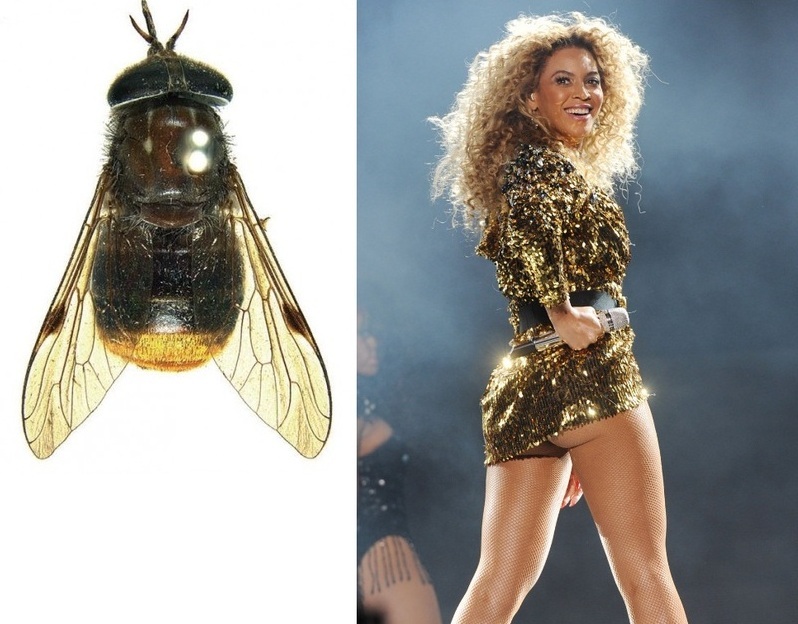
Pop diva Beyoncé has been in the news a lot recently, since the birth of her first child, Blue Ivy Carter. However, her name has hit the headlines for a different reason, after inspiring an Australian taxonomist to name a horse fly after her.

Bryan Lessard, from the CSIRO’s Australian National Insect Collection in Canberra, named the fly Scaptia (Plinthina) beyonceae because it has a prominent golden lower abdomen. To Bryan, who admits to being something of a fan, the unique dense gold hairs on the fly reminded him of Beyoncé’s flashy golden stage outfits.

The rare fly was collected in 1981, the same year Beyoncé was born, from eucalypt forests in the Atherton Tablelands of Queensland.

I’m not sure whether this is the most flattering thing that’s ever happened to Beyoncé, but I love that it shows scientists are just normal people who listen to R&B in their labs while they work, and find themselves as captivated by a gold frock as the next person. And perhaps are human enough to want to see their names in the gossip magazines, and maybe even get a personal response from their idol (she hasn’t made one).

BEYONCE

Beyoncé’s name is as unique as the horse fly, being created especially for her. Her mother Tina’s maiden name is Beyincé, a Creole surname from Louisiana. When she discovered that the Beyincé name was dying out, Tina decided to call her daughter Beyoncé, her own version of the surname. Apparently Tina’s parents were not impressed at first, because “that’s a last name”.

Beyincé is a form of the French surname Boyancé, related to the Old French word for “wood”. It’s an equivalent of English surnames such as Woodward or Forrester.

While the names of celebrities often become popular baby names (think Scarlett and Ashton, for example), Beyoncé’s name remains in very rare use. It belongs so completely to herself, and no other.

DESTINY

Destiny’s Child was the successful girl group of which Beyoncé was a founding member, prior to her embarking on her solo career.

The English word destiny comes from French, and ultimately from the Latin destino, the source of the word destination, meaning “appoint, establish”. It comes from an ancient root meaning “to stand, to place” (also the source of the word obstinate). Destiny is used as a synonym for the word fate, although technically fate is the divine agency or power which brings about the predetermined future events which are our destiny.

Destiny has been used as a girl’s name since the 19th century, and originated in the United States. It has been on the US Top 1000 since 1975, and reached the Top 100 in 1994, leaving it in 2012. It is currently #203.

In the UK, Destiny peaked in 2001 at #211 , and is currently #412. It is also in use in The Netherlands, and is a fairly uncommon name in Australia, although certainly not unknown.

Apart from Destiny’s Child, the name may remind you of Destiny Cyrus, the birth name of actress and singer Miley Cyrus (born just after the name reached the Top 100). It’s a slightly dated virtue name which still has a spiritual or philosophical feel to it, but also suggests the strength to forge your own path in life, to make your own destiny.

POLL RESULTS

Beyoncé gained an approval rating of 15% from the public. Only one person liked the name Beyoncé, while 68% thought it was terrible.

Destiny did rather better, with an approval rating of 32%. However, once again only one person liked the name, and 48% thought it was terrible.


Cedar Kate and Bon Zeev: Birth Announcements from the “Adelaide Advertiser” (December)

20 Friday Jan 2012

Posted by A.O. in Birth Announcements

≈ 5 Comments

Tags

name combinations, sibsets, twin sets

Victoria-Square-Fountain-Adelaide-australia-23340375-1600-1200Twins

Adam Jack and Amelia Anna

Alexander Xen and Nicholas Luka

Andy and Riley

Emma Rose and Sam Henry

Jacob Thomas and Grace Isabella

Jaxon and Blake

Kristian and Alex (Thomas, Joachim)

Olivia Lenore and Elsie Brooke

Rachael Elizabeth Ann and Sarah Adelaide Jane


Girls

Aaliyah Elizabeth

Amity Em Dora (Indi)

April Dawn

Cedar Kate (Thiele)

Chloe Jade Bird (Amy, Lachlan)

Ebony Elva

Edel Ebony

Elizabeth Anne Jennifer (Adam, Janelle, Sarah)

Ella May McKenzie (James)

Hazel Anne (Mia, Zoe)

Ivy Malin (Saffron, Homer)

Kari Phynix

Mercedes Judeen (Xander, Jeidan)

Olivia Summer Jane

Peyton Aida

Pippa Jane (Max, Sadie)

Poppy Eliza (Lu Lu, Zali)

Scarlet Bonny (Rhett, Elyse)

Silvie Mai (Kai, Finn)

Sofia Mae Rita (Charlie)


Boys

Alexander Gerald Jack (Stephanie, Lucy)

Ashton James Oakley (Kayla, Ella, Brayden)

Bon Zeev

Cooper Harry

Ezekial Roy (Maddy)

Felix Zane

Harley Jake (Campbell, Will)

Harrison Brien Westley (Theodore)

Hudson Joc (Georgia, Jackson)

Jaxon Albert Shane (Isabella)

Jethro Tait (India, Sapphire, Sage)

Louie Axel

Nate Angelo (Zak)

Robert James Lee (Rachel, Madeline)

Rowan Douglas (Hamish)

Sione Valentino (Tapinisi, Eleanora)

Sunni Michael Jeffery (Nara)

Willoughby Strong (Sterling, Crawford)

Wyatt Christian Tyler (Calin)

Zachary William John (Alicia, Isabella)

Harriet and Gus: Birth Announcements from the Melbourne “Age” (December)

20 Friday Jan 2012

Posted by A.O. in Birth Announcements

≈ Comments Off on Harriet and Gus: Birth Announcements from the Melbourne “Age” (December)

Tags

name combinations, sibsets

Girls

Alexandra Poppy (Gus)

Alice Raphaelle

Amelie Rose

Eleanor Jennifer

Ella Bailey

Emily Violet (Ben)

Harriet Joy (Flynn)

Imogen Felicity (Ryan, Aidan)

Mia Isabelle

Nina Joan (Ruby)

Sophie Grace LePoer (Anabel)

Summer Mae (Imogen, Andrew)


Boys

Alfred Peter “Alfie”

Angus Gordon

Connor James Morgan (Samuel, Olivia, Aidan)

Edward James “Ted” (Hollie)

Felix Stanley (Cordelia)

Frederick Albert

Gus Tano (Maggie)

Jack George Simon

Oliver Jack “Ollie”

Robert Darcy (Niamh)

Theodore Henry (Elliot, Linton, Claire)

William Richard (Sam, Nicholas)

Celebrity Baby News: Alicia Molik and Tim Sullivan

19 Thursday Jan 2012

Posted by A.O. in Celebrity Baby News

≈ Comments Off on Celebrity Baby News: Alicia Molik and Tim Sullivan

Tags

celebrity baby names

Tennis champion Alicia Molik, and her husband, financial consultant Tim Sullivan, have welcomed their first child. Their son Yannick Jude was born last week in Perth.

Alicia has had an impressive career which includes five WTA singles and seven doubles titles, (including two Grand Slams), 13 ITF singles and nine doubles titles, an Olympic medal and a career-high ranking of eight in the world.

Alicia and Tim met in 2008, and were married in February last year.

Celebrity Baby News: Harry Kewell and Sheree Murphy

16 Monday Jan 2012

Posted by A.O. in Celebrity Baby News

≈ 4 Comments

Tags

celebrity baby names, celebrity sibsets

Soccer star Harry Kewell, and his wife, actress Sheree Murphy, welcomed their fourth child and third daughter on January 14, naming her Dolly. She was born just before 6 pm, weighing 3.59 kg (7 pounds 15 ounces). Dolly joins big brother Taylor, aged 11, and sisters Ruby, 9, and Matilda, 4, who are all very excited to have a new baby sister.

Harry has been a member of the men’s national team, the Socceroos, since 1995, in which he has scored 16 goals – most notably one against Croatia which took Australia through to the knockout stages of the 2006 World Cup. An exceptional player, he has been called Australia’s finest football export. He has played for Leeds United and Liverpool in the English football league, and also spent two years playing for Turkish club Galatasaray SK. Last year he relocated his family to Australia so that he could play for Melbourne Victory.

Sheree is an English actress who became famous on soap opera Emmerdale. She was runner up on the fifth series of I’m a Celebrity … Get Me Out of Here, where she won fans over with her sweet personality. She has also hosted several TV programmes, and been the face of Gala Bingo. Rumours abound that Sheree will be offered a role on Neighbours, which Sheree says is flattering if true, as she is a massive fan of Australian soaps Neighbours and Home and Away.

Harry and Sheree met at a Leeds nightclub in 2000, and married in Las Vegas in May 2002.

Celebrity Baby News: Graham and Alyce Polak

16 Monday Jan 2012

Posted by A.O. in Celebrity Baby News

≈ 1 Comment

Tags

celebrity baby names

Former AFL player Graham Polak, and his wife Alyce, welcomed their first child in Perth on January 11. They have named their daughter London Joy.

Graham and Alyce chose her name in tribute to both their fathers, whom they have lost. Alyce’s dad grew up in London, and Graham’s dad is named Don. Joy is the middle name of Alyce’s mother.

Graham began his career playing for Fremantle Dockers, and was traded to Richmond Tigers in 2006. He suffered severe brain damage when he was hit by a tram on a Melbourne street in 2008. It took more than a month for Graham to recover his memory. He played football 14 months after his accident, but after getting concussion during a game, retired due to ongoing health concerns.

Alyce Polak, nee Oksuz, is a former model. She and Graham were married in October 2010.

London Polak is now the third celebrity baby announced as born on January 11, getting the year off to a flying start.

(Story and photo from the Sunday Herald Sun, January 15 2012)

Names of Convicts on the First Fleet

15 Sunday Jan 2012

Posted by A.O. in Name Themes and Lists

≈ 31 Comments

Tags

Aramaic names, Biblical names, english names, famous namesakes, fictional namesakes, germanic names, Greek names, hebrew names, Latin names, locational names, mythological names, name history, name meaning, name popularity, popular names, royal names, saints names, Shakespearean names, Spanish names, surname names

It is Australia Day next week, and so my name lists for January are names of convicts from the First and Second Fleets.

Convicts were the prisoners who filled overcrowded British prisons in the 18th and early 19th centuries. Because the death penalty was applied even to what we would consider minor offences, people were sent to prison for what we would consider to be misdemeanours, such as petty theft, or not crimes at all, such as being in debt.

Many convicts were disposed of by sending them to the colonies as cheap labour – nearly always North America – until the term is now understood as those prisoners sent to the colonies. The American War of Independence putting an end to America as a colony, another place had to be thought up to send convicts, and the east coast of Australia seemed a likely spot.

The First Fleet sailed from Portsmouth, Hampshire on May 13 1787, and consisted of eleven ships, led by Captain Arthur Phillips. Aboard were around 1487 people, including 778 convicts (192 women, 586 men). They travelled 24 000 km (15 000 miles) across the sea for 252 days.

On January 26 1788, the ships sailed into Port Jackson, which Phillips called “the finest harbour in the world” – an opinion many have shared since. They anchored in a sheltered place they called Sydney Cove, after British Home Secretary, Lord Sydney.

Life was very difficult in the new colony, and punishments could be extremely harsh. Convicts were basically slaves, mostly used on public works, but also assigned to individuals as a personal labour force.

The names of the convicts were those common in Britain in the 18th century, with names from the Bible being often used. Rather than cover historically famous convicts, I chose people for their names, giving a rather random selection of ordinary people and their unremarkable fates.

[All convicts’ names can be found here. Information on convicts from the First Fleet Database].

WOMEN

Deborah (Elam/Ellam/Elias)

At the age of 20, Deborah was found guilty of stealing 36 shillings worth of clothing, and sentenced by the court in Chester to seven years transportation. She sailed to Australia on the Prince of Wales. She married a fellow convict and brought a complaint against him; it was judged to be “trivial” and she received 25 lashes in punishment. The couple had seven children and have many descendants. Deborah died in 1819, “universally respected by her numerous friends and acquaintances”. The name Deborah means “bee” in Hebrew, and in the Old Testament Deborah was a prophetess, judge, advisor and warrior. The Song of Deborah, which she is said to have composed, may be the earliest Hebrew poetry we know of. Deborah didn’t rank in Australia until the 1940s, and peaked in the 1960s at #12. It left the Top 100 in the 1980s and hasn’t ranked since the 1990s.

Dorothy (Handland aka Dorothy Gray)

Dorothy made her living as a dealer in old clothes. In her early 60s, she was found guilty of perjury at the Old Bailey and sentenced to 7 years transportation. She sailed to Australia on the Lady Penrhyn. Dorothy is believed to be the oldest convict, and despite her age, she survived the voyage and returned to England when she had completed her sentence. Dorothy is the English form of Dorothea, from the Greek meaning “gift of God”. There are three saints named Dorothea, one of whom we call Saint Dorothy. A legendary virgin martyr of the 4th century, said to be of surpassing beauty, her cult spread across Europe in the Middle Ages. The name Dorothy was #2 in the 1900s and 1910s, and remained Top 100 until the 1950s. It has been unranked since the 1980s.

Flora (Lara/Larah, aka Laura Zarah)

Flora is thought to have been Jewish. She was found guilty of stealing a mahogany tea chest and money to the value of 5 shillings, and sentenced by the court in Westminster to seven years transportation. She sailed to Australia on the Prince of Wales. She was described in the court records as being of an evil disposition; she married in Australia and left the colony in 1801. Flora was the Roman goddess of spring, married to the west wind, Zephyr; her name is from the Latin for “flower”. Flora is the scientific term for all plant life. Flora was first used as a personal name in France, and it’s especially famous in Scotland, because of Jacobite heroine Flora MacDonald. Flora has never been Top 100 in Australia – it peaked at #112 in the 1900s, and left the charts in the 1950s.

Lydia (Munro, aka Letitia Munro)

At the age of 17 Lydia was found guilty of stealing material to the value of 20 shillings. She was sentenced to death by the court in Kingston-upon-Thames, which was later commuted to 14 years transportation. She sailed to Australia on the Prince of Wales. The convict records show that she was the victim of a sexual assault and attempted rape by another convict. She married, and she and her husband went to Tasmania where they raised a family of eleven children; they have numerous descendants. She died in 1856. Lydia of Thyatira is a character in the New Testament, regarded as the first convert to Christianity in Europe. She was a successful merchant who was baptised by St Paul and became a deacon in the early church; she is considered a saint by several denominations. Her Greek name is after the place name Lydia, an area of the ancient world now part of modern Turkey. Lydia has charted almost continually without ever hitting the Top 100. It peaked in the 1900s at #137, disappeared from the rankings in the 1930s and ’40s, and is currently #322.

Rachel (Earley/Early/HurleyHarley/Arrly)

At the age of 25 Rachel was found guilty of stealing tea and silk worth 3 shillings, and sentenced by the court in Reading to seven years transportation. She sailed to Australia on The Friendship, and spent time in irons onboard, for the twin crimes of “theft and dirtyness”. As a convict, she once received 10 lashes for not obeying orders. She married twice, and had a daughter, but was left by both husbands; she has living descendants. She died in Tasmania in 1842. In the Old Testament, Rachel was one of the wives of Jacob. Her name is Hebrew for “ewe”, perhaps with connotations of purity and submissiveness, although in the Bible Rachel did literally take care of her father’s sheep. Rachel is said to have been of overwhelming beauty, and Jacob loved her best of his wives. She was plagued by infertility issues, but managed to give birth to Joseph and Benjamin, her husband’s favourite children. Unfortunately, she died in childbirth, and her tomb is still a place of pilgrimage. The name Rachel has charted almost continually since 1900, dropping from the rankings during the 1940s. It peaked in the 1970s at #19, and is currently #118.

MEN

Barnaby (Denison/Dennison/Deneson)

At the age of 28 Barnaby was found guilty of “intent to rob”, and sentenced by the court in Bristol to seven years transportation. He sailed to Australia on the Alexander. According to the convict records, he was once sentenced to 50 lashes for “singing loudly at an improper time”, and became a night watchman. He died in 1811. The name Barnaby is a medieval English form of Barnabas. In the New Testament, Barnabas was a companion of St Paul and fellow missionary. His name was Joseph, but when he converted from Judaism to Christianity he was given the name Barnabas, which is a Greek form of Aramaic, and can be translated as “son of prophecy” or “son of encouragement”. There are many literary characters named Barnaby, most notably Dickens’ eponymous Barnaby Rudge.

Cooper (Handy/Handley/Henley)

Cooper made his living as a weaver. At the age of 33 he was found guilty of assault and highway robbery to the value of 20 shillings and sentenced to death by the court in Salisbury. This was commuted to seven years transportation, and he sailed to Australia on the Friendship. Cooper was held in a hulk at Dunkirk before he left, and at one point managed to escape during an uprising, but was recaptured. His report says that he behaved “remarkably well” otherwise. Not long after his arrival in Australia, Cooper was killed by Aborigines while gathering greens. Cooper is an English surname referring to someone who makes barrels as their occupation. Apart from being a popular name, Cooper is well known in Australia as the surname of the family who owns Cooper’s Brewery in South Australia. The name Cooper first joined the charts in the 1990s and peaked in 2009 at #4. It’s currently #7.

Ferdinand (Dowland/Dowlan/Doolan)

Ferdinand was a dustman. At the age of 32 he was found guilty of stealing a horse worth 30 shillings. He was sentenced to death at the Old Bailey, commuted to seven year’s transportation, and sailed to Australia on the Scarborough. He died in 1827. The name Ferdinand is from the Spanish form of a Germanic name meaning “daring journey”. Brought to Spain by the Visigoths, it was used amongst the royal houses of Spain and Portugal, and through them became common in the Hapsburg family, rulers of the Holy Roman Empire. One of its most famous namesakes is Ferdinand Magellan, a Portuguese explorer whose expedition was the first to circumnavigate the globe (although Ferdinand himself did not survive the voyage). Ferdinand is also a character in Shakespeare’s play The Tempest; a prince who is shipwrecked on Propsero’s island, and falls in love with his daughter Miranda.

Ishmael (Colman)

At the age of 32 Ishmael was found guilty of stealing woollen blankets worth 14 shillings, and sentenced to seven years transportation by the court in Dorchester. Ishmael was held in a hulk at Dunkirk before sailing, where he was described as “decent and orderly”. He died after only 16 days at sea on the Charlotte; the report from the ship’s doctor says that his death was brought about through his long confinement before the trip, which had brought about “low spirits and debility”. Ishmael is a name from the Bible which is translated as “God has heard”. In the Old Testament, Ishmael was the son of Abraham and his wife’s handmaiden, Hagar; Ishmael and his mother are two Biblical characters who get a raw deal, being cast into the wilderness to fend for themselves and not receiving any inheritance from Abraham. According to tradition, he is the father of the Arabic people, and is considered such in Islam, Judaism and Christianity, although this isn’t historically accurate. The prophet Muhammad traced his bloodline from Ishmael, and he is one of the prophets of Islam. In literature, Ishmael is the brooding narrator of Herman Melville’s famous novel, Moby Dick.

Job (Hollister)

At the age of 21 Job was found guilty of stealing tobacco and sentenced to seven years transportation by the court in Gloucester. He sailed to Australia on the Alexander. When he completed his sentence, Job left the colony and migrated to Vancouver Island in Canada. Job is another Old Testament character who has a miserable time. A righteous man, God allows Satan to take away his wealth, his children and his health in an effort to tempt him to curse his Creator. He never does so, although he is aggrieved by the process, and spends a lot of time wondering why all these dreadful things keep happening to him. The story ends happily, with God rewarding him many times over, but with no reasonable explanation for his treatment. Although the tale bears all the hallmarks of an allegory on the human condition, Job is regarded as a prophet in Judaism and Islam, and is given a saint’s day in several Christian denominations. In line with the narrative, Job’s name is translated as “hated, persecuted”.

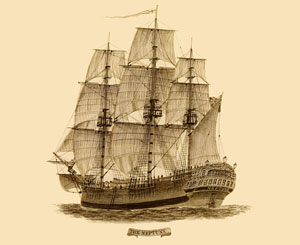
Image is of The First Fleet in Sydney Cove, January 27, 1788 by John Allcott (1938). Painting held by the National Library of Australia.


← Older posts
Newer posts →

Enter your email address to follow this blog

Categories

Archives

Recent Comments

A.O.'s avatarwaltzingmorethanmati… on Zarah Zaynab and Wolfgang…
Madelyn's avatarMadelyn on Zarah Zaynab and Wolfgang…
JD's avatardrperegrine on Can Phoebe Complete This …
A.O.'s avatarwaltzingmorethanmati… on Rua and Rhoa
redrover23's avatarredrover23 on Rua and Rhoa

Blogroll

  • Appellation Mountain
  • Baby Name Pondering
  • Babynamelover's Blog
  • British Baby Names
  • Clare's Name News
  • For Real Baby Names
  • Geek Baby Names
  • Name Candy
  • Nameberry
  • Nancy's Baby Names
  • Ren's Baby Name Blog
  • Sancta Nomina
  • Swistle: Baby Names
  • The Art of Naming
  • The Baby Name Wizard
  • The Beauty of Names
  • Tulip By Any Name

RSS Feed

  • RSS - Posts

RSS Posts

  • Celebrity Baby News: Melanie Vallejo and Matt Kingston
  • Names from the TV Show “Cleverman”
  • Can Phoebe Complete This Sibset?
  • Zarah Zaynab and Wolfgang Winter
  • Baby, How Did You Get That Name?
  • Celebrity Baby News: Media Babies
  • Celebrity Baby News: Adelaide Crows Babies
  • Celebrity Baby News: Chris and Rebecca Judd
  • Names at Work: Name News From the World of Business and Employment
  • Celebrity Baby News: Sporting Round Up

Currently Popular

  • Girls Names From Stars and Constellations
  • Celebrity Baby News: Elly-May Barnes and Liam Conboy
  • Girls Names of Australian Aboriginal Origin
  • Celebrity Baby News: Mary Coustas and George Betsis
  • Rare Girls Names From the 1940s

Tags

celebrity baby names celebrity sibsets english names famous namesakes fictional namesakes honouring locational names middle names name combinations name history name meaning name popularity name trends nicknames popular names saints names sibsets surname names twin sets unisex names

Blog at WordPress.com.

Privacy & Cookies: This site uses cookies. By continuing to use this website, you agree to their use.
To find out more, including how to control cookies, see here: Cookie Policy
  • Subscribe Subscribed
    • Waltzing More Than Matilda
    • Join 517 other subscribers
    • Already have a WordPress.com account? Log in now.
    • Waltzing More Than Matilda
    • Subscribe Subscribed
    • Sign up
    • Log in
    • Report this content
    • View site in Reader
    • Manage subscriptions
    • Collapse this bar

Loading Comments...