• About
  • Best Baby Names
  • Celebrity Baby Names
  • Celebrity Baby Names – Current
  • Celebrity Baby Names – Past
  • Featured Boys Names
  • Featured Girls Names
  • Featured Unisex Names
  • Links to Name Data
  • Waltzing on the Web

Waltzing More Than Matilda

~ Names with an Australian Bias of Democratic Temper

Waltzing More Than Matilda

Tag Archives: virtue names

Famous Name: Beyoncé

21 Saturday Jan 2012

Posted by A.O. in Famous Names

≈ 1 Comment

Tags

American names, celebrity baby names, created names, Creole names, French names, honouring, Louisiana names, popular culture, surname names, UK name popularity, unique names, US name popularity, virtue names

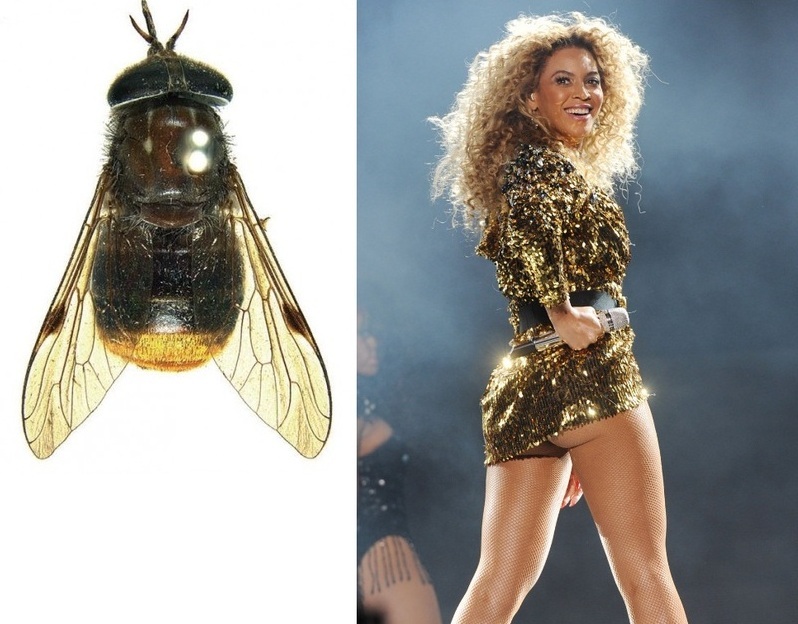
Pop diva Beyoncé has been in the news a lot recently, since the birth of her first child, Blue Ivy Carter. However, her name has hit the headlines for a different reason, after inspiring an Australian taxonomist to name a horse fly after her.

Bryan Lessard, from the CSIRO’s Australian National Insect Collection in Canberra, named the fly Scaptia (Plinthina) beyonceae because it has a prominent golden lower abdomen. To Bryan, who admits to being something of a fan, the unique dense gold hairs on the fly reminded him of Beyoncé’s flashy golden stage outfits.

The rare fly was collected in 1981, the same year Beyoncé was born, from eucalypt forests in the Atherton Tablelands of Queensland.

I’m not sure whether this is the most flattering thing that’s ever happened to Beyoncé, but I love that it shows scientists are just normal people who listen to R&B in their labs while they work, and find themselves as captivated by a gold frock as the next person. And perhaps are human enough to want to see their names in the gossip magazines, and maybe even get a personal response from their idol (she hasn’t made one).

BEYONCE

Beyoncé’s name is as unique as the horse fly, being created especially for her. Her mother Tina’s maiden name is Beyincé, a Creole surname from Louisiana. When she discovered that the Beyincé name was dying out, Tina decided to call her daughter Beyoncé, her own version of the surname. Apparently Tina’s parents were not impressed at first, because “that’s a last name”.

Beyincé is a form of the French surname Boyancé, related to the Old French word for “wood”. It’s an equivalent of English surnames such as Woodward or Forrester.

While the names of celebrities often become popular baby names (think Scarlett and Ashton, for example), Beyoncé’s name remains in very rare use. It belongs so completely to herself, and no other.

DESTINY

Destiny’s Child was the successful girl group of which Beyoncé was a founding member, prior to her embarking on her solo career.

The English word destiny comes from French, and ultimately from the Latin destino, the source of the word destination, meaning “appoint, establish”. It comes from an ancient root meaning “to stand, to place” (also the source of the word obstinate). Destiny is used as a synonym for the word fate, although technically fate is the divine agency or power which brings about the predetermined future events which are our destiny.

Destiny has been used as a girl’s name since the 19th century, and originated in the United States. It has been on the US Top 1000 since 1975, and reached the Top 100 in 1994, leaving it in 2012. It is currently #203.

In the UK, Destiny peaked in 2001 at #211 , and is currently #412. It is also in use in The Netherlands, and is a fairly uncommon name in Australia, although certainly not unknown.

Apart from Destiny’s Child, the name may remind you of Destiny Cyrus, the birth name of actress and singer Miley Cyrus (born just after the name reached the Top 100). It’s a slightly dated virtue name which still has a spiritual or philosophical feel to it, but also suggests the strength to forge your own path in life, to make your own destiny.

POLL RESULTS

Beyoncé gained an approval rating of 15% from the public. Only one person liked the name Beyoncé, while 68% thought it was terrible.

Destiny did rather better, with an approval rating of 32%. However, once again only one person liked the name, and 48% thought it was terrible.


The Nativity Play Baby

19 Monday Dec 2011

Posted by A.O. in Babies in the News

≈ 4 Comments

Tags

Biblical names, english names, hebrew names, name combinations, virtue names, vocabulary names

Last Saturday, the Christmas in the Park celebrations were held in Coolum, on the Sunshine Coast. They had a real live baby playing baby Jesus in the nativity play, with the baby’s real life parents, Luke and Sarah Quinn, playing the roles of Joseph and Mary, and his grandfather Gary Quinn providing music in the band.

The baby’s name is Hosea Courage Quinn. Hosea is from a Hebrew name meaning “salvation”; it is the name of one of the Biblical prophets. The Quinns chose it for its meaning.

The middle name Courage was chosen by Hosea’s father, because “it’s good to have something to live up to”. Virtue names are very much back in vogue, and this one sounds strong and quite masculine.

I think Hosea Courage Quinn is a very striking name, with a neo-Puritan ring to it. It’s one that sticks in my mind.

(Story and photo from Coolum and North Shore News, December 16 2011)

Unique Girls Names from Tasmania, 2010

02 Sunday Oct 2011

Posted by A.O. in Name Themes and Lists

≈ 18 Comments

Tags

astronomical names, Australian Aboriginal names, english names, famous namesakes, fictional namesakes, Flemish names, Greek names, Irish names, Latin names, locational names, musical names, mythological names, name history, name meaning, name popularity, nature names, Nook of Names, Old Norse names, popular culture, royal names, Sanskrit names, surname names, unique names, virtue names, vocabulary names

Many parents say that they are looking for a “unique” name, but what they mean by that seems to differ from person to person. Some say it’s a name you don’t see every day; others define it as any name not in the Top 100; and still others refuse to say what it means to them, but will “know it when they see it”. According to the dictionary, “unique” means that only one person possesses it, and names of which the world holds but one example are few and far between. However, names do not have to be particularly strange or rare to be unique in a certain context. For example, the name Savannah is unique within the British royal family. Here are some names from baby girls born in Tasmania last year; in each case, only one child was given these names. For their state, and in the year they were born, these girls possess unique names. I usually do ten names per list, but this time there was so much choice I did twelve; I’ve also listed other unique names from the same state and year that are similar in some way to the main entry.

Bird

Not only referring to our feathered friends, a “bird” is English slang for a woman, although in the 19th century it was slang for a man, which makes it seem unisex. Another slang term is to “give someone the bird”, meaning to raise the middle finger in an obscene gesture; this has been a favoured way of insulting others since the time of the Ancient Greeks, at least. Being a bird-lover, I find this name simple and homely, and it does remind me of birdsong.

Other nature names: Acacia, Autumn, Clover, Fern, Honey, Maple, Misty, Opal, Pearl, Rosemary, Sage, Storm

Capri

This is the name of an island off the coast off Naples, famous for its stunning natural beauty. Inhabited since prehistoric times, it was a pleasure resort during the days of the Roman Empire, but the first modern tourist didn’t arrive until the 17th century. It was a popular place for artists and writers in the 19th century, and also a haven for gay men and women who formed a community where they could feel more open. A popular 1930s romantic song was The Isle of Capri, which was covered by The Gaylords, aptly enough. Capri pants were all in the rage in the 1950s as cool beachwear suitable for this resort island. No doubt the Ford Capri was also meant to suggest insouciant summer fun. The name of the island may mean either “wild boar” (from Greek) or “goats” (from Latin); there’s even a tiny possibility it means “rocky” (from Etruscan). But clearly it’s the history and associations of the name that are more important than the meaning. It’s a name that spells beauty, romance, art, fashion and freedom.

Other place names: Arizona, Baltimore, Bethany, Cheyenne, Florence, Ireland, Israel, Italia, London, Olympia, Petra, Sierra

Faithful

The virtue name Faith is familiar, but the adjective Faithful is one new to me as a name for a real person. Faithful is a (male) character in John Bunyan’s classic work, The Pilgrim’s Progress. He’s a friend of the protagonist who is executed as a martyr. He is meant to be represent those Christians who remain faithful to their beliefs, even should that lead to death. The Latin for “I am faithful” is Fido, traditionally given to dogs – apparently after Abraham Lincoln gave this name to his canine companion. As a child, I read the YA novel, Cinnamon and Nutmeg, by Anne de Roo, about a young girl growing up on a farm. The heroine wrote a story for school called “Old Faithful” about the touching death of her beloved dog. Unfortunately, she spelled “Faithful” as Fatful, and the teacher read her story mockingly to the class, with every “faithful” replaced by fatful, so that the children screamed with laughter at the tale of her dog dying. As a youngster, this struck me as the epitome of cruelty, and today makes me hope that nobody mis-spells little Faithful’s name.

Other adjective name: Innocent

Fritha

This is an Old Norse name often translated as “love, peace”, but more accurately it refers to the harmonious social order which leads to peace. It was a rare name during the Viking era, and only seems to have become commonly used in Scandinavia after the coming of Christianity – which suggests that it was connected to Christian ideals of peace and brotherhood. Fritha is a main character in the novella, The Snow Goose, by American author Paul Gallico; a sentimental tale of friendship blooming against the backdrop of World War II which was very popular in England. There was a British actress called Fritha Goodey who you may have caught a glimpse of in the movie About a Boy, starring Hugh Grant. Sadly, she died a few years ago in tragic circumstances while still quite young. There’s also a musician, Fritha Jenkins, who played with UK pagan heavy metal band, Skyclad. Because of these associations, Fritha seems like a very “English” name, despite its origins, and also quite artsy.

Other Scandinavian name: Inka

Halle

This is famous for being the name of gorgeous award-winning Hollywood actress, Halle Berry. Ms Berry’s birth name was Maria Halle Berry, but legally switched around to Halle Maria Berry when she was five. Her parents chose the name Halle from Halle Brother’s department store, a local landmark at that time in her home town of Cleveland, Ohio. Founded in the 19th century by Samuel and Salmon Halle, it became an upmarket emporium, but was liquidated in the 1980s. The brothers’ surname is originally Flemish, and is after the village of Halle in Belgium. Of Old Norse origin, Halle means “manorial hall”, and is the equivalent of the English surname Hall. Pronounced HAL-ee, it sounds the same as the girl’s name Hallie, a short form of Harriet.

Other celebrity names: Angelina, Gwyneth, Jolie, Shakira

Justice

This can either be seen as an occupational surname meaning “judge”, or an English vocabulary word. Some people see this name as a Christian virtue name, referring to God’s righteousness; others connect it with social justice; others see it as simply describing the person as fair-minded and honourable. I remember Kay at Nook of Names got rather alarmed at Australian naming laws and thought the name Justice wouldn’t be permitted here, so I wanted to reassure her that it definitely is, even though not a common name.

Other virtue names: Constance, Honor, Prudence, Temperance, Verity

Namaha

This is a Sanskrit word which is an element of sacred Vedic mantras. It means “to surrender with love”, and literally, “to bow (in a gesture of homage and respect)”. It is a negation of one’s ego, and an affirmation of the greater Self becoming one with the Cosmic Soul. It is pronounced nah-ma-hah, with unstressed syllables.

Other Asian names: Jaya, Megumi, Mika, Nilu, Palpasa, Sakura

Nerida

This Australian Aboriginal name means “waterlily”, and features in a legend from Victoria. Nerida and Berwain are two young lovers, about to marry. Wahwee, the spirit of thunder who lives in the mud pool where the couple meet to gather mussels, develops an overpowering desire for Nerida. Because she will not give herself to him, he transforms her into a waterlily, and her lover Berwain into rushes. A superstition is that if you pick a waterlily, you must also pick the rushes growing nearby so that Nerida and Berwain never be divided in death. The waterlily is used as a food source by Aborigines as a traditional bush food; the roots can be roasted, and the stem and seeds eaten raw. Nerida was used as a female name by Aborigines, and also by Europeans, who may have been charmed by the fact it is so similar to Nereida, the name of a nymph in Greek mythology (the scientific name for waterlily is Nymphaea, another pleasing coincidence). Pronounced NEHR-uh-duh, it’s a bit old-fashioned now, but clearly still in use.

Pallas

The epithet of the Greek goddess Athena, this may mean “maiden”. The original Pallas was the daughter of sea-god Triton, and foster-sister to Athena. During a friendly fight between the two goddesses, Athena received divine protection from her father Zeus, but she mortally wounded Pallas. Out of her deep sadness, she created the palladium, a statue made in the likeness of Pallas, which was given to the city of Troy to act as its protector and guardian. This sacred statue was stolen by the Greeks during the Trojan War, otherwise they could never have conquered it. Some stories say that the palladium became the property of Rome, and there are rumours that it was transferred to Constantinople. Pallas is also one of the largest asteroids, and the name of one of the Moon’s craters. Sailor Pallas is a character in the Sailor Moon manga who is named after the asteroid as well the Greek goddess, so it is an astronomical name and one from popular culture.

Other classical names: Athena, Camilla, Cassandra, Lucia, Melanie, Melissa, Octavia, Olympia, Penelope, Sylvia, Valentine, Veronica, Xanthe, Zephyr

Saoirse

This modern Irish name means “freedom”, and came into use in Northern Ireland during the 1920s as a Republican political slogan. Depending on your accent, you can pronounce it SEER-sha, SAIR-sha or SOR-sha, with SEER-sha being the Northern Irish way of saying it, and therefore (some would argue) the “correct” one. Although spelling and pronunciation may be an issue for some, the name sounds enough like names such as Sasha and Sarah to not seem out of place. Its recent use probably owes a lot to young actress Saoirse Ronan, who has impressed critics with her sensitive performances in movies such as Atonement and The Lovely Bones. Saoirse Ronan pronounces her name SUR-sha, just to confuse things further. I suspect the political and religious implications of this name have not been considered much outside Ireland.

Other Irish and British names: Arwen, Ciara, Cordelia, Fiona, Maeve, Sabrina, Shona, Sian, Una

Satanica

This is the Latinised feminine form of the word “satanic”, which can either literally mean giving veneration to Satan, or more generally, suggestive of being diabolical in nature. Satan is from the Hebrew, meaning “the adversary, the opposer, the obstructor”, and in the Hebrew portion of the Bible, Satan is an agent of God whose thankless task it is to tempt humankind and then accuse it before Heaven. In Christianity, he is seen as the Devil, the personification of all evil. Satanica is often used in black metal music as a title, and there is band with this name. There is also a manga series called La Satanica, so it can be seen as a name from popular culture. Satanica cannot help but be controversial as a baby name, and I think it is a heavy burden to place on a child; this name even made me feel depressed just thinking about it, which almost never happens.

Other Latinate names: Amanda, Clementine, Felicia, Mirabella

Tango

This is a dance which arose in the working class neighbourhoods of Buenos Aires, Argentina, in the mid-19th century. It is claimed that the tango is a mixture of South American popular dances influenced by the African community, and by European immigrants. Although the word tango could be Spanish in origin, it may very well come from Nigeria, where temgu means “to dance” in the Ibibio language. The tango arrived in Paris early in the twentieth century, and soon spread to other world capitals, where it was thought to be shockingly intimate (as nearly all new dances seem to be thought). Another tango reference is the scandalously erotic film, Last Tango in Paris, starring Marlon Brando. Even though tango, as a dance form, is dark and sensual, the name Tango isn’t – it sounds chipper and bouncy, and I’m sure has been given as a name to more animals than humans.

Other musical names: Allegra, Aria, Melody Other verb names: Cherish, Treasure Other O-enders: Indigo, Marlo

NOTE: I didn’t count variant spellings of more common names as unique, and I also disqualified double names, as well as names that had also been given to boys.

Celebrity Baby News: Felicity Urquhart and Glen Hannah

20 Saturday Aug 2011

Posted by A.O. in Celebrity Baby News

≈ 5 Comments

Tags

celebrity baby names, virtue names, vocabulary names

Country music singer, Felicity Urquhart, and her husband, musician and producer Glen Hannah, welcomed their first child recently – a baby girl named Tia Joy.

Felicity and Glen interpret her name to mean “princess of joy”, and Felicity notes that names referring to happiness run in her family.

“Joy was my dad’s mum’s name. I have an Aunty Gay, and my name means happiness. Joy is also a significant name in Australian country music with the late, great Slim Dusty’s wife Joy McKean – she’s an amazing talent and a beautiful woman.”

Felicity has been an award-winning country singer for 15 years, and hosts a country music show on ABC radio. She and Glen married in Vanuatu in 2009.

(Story from Digital Spy, August 18 2011; photo from countryragepage.com)

Girls Names from the Top 100 of the 1930s

19 Sunday Jun 2011

Posted by A.O. in Name Themes and Lists

≈ 37 Comments

Tags

Anglo-Saxon names, Biblical names, celebrity baby names, Christmas names, classic names, english names, European name popularity, famous namesakes, fictional namesakes, flower names, French names, Greek names, honouring, Italian names, Latin names, locational names, middle names, military events, mythological names, name history, name meaning, name popularity, name trends, names from movies, names from songs, nature names, nicknames, plant names, popular names, retro names, Roman names, royal names, saints names, Scottish names, Shakespearean names, Tatar names, unisex names, virtue names, vocabulary names

This blog post was first published on June 19 2011, and revised and updated on June 12 2015.

Alma
May be derived from the Latin almus, meaning “nourishing” – an epithet given to several Roman goddesses, including Ceres. Alma mater, meaning “nurturing mother”, is a Latin term often used to refer to one’s college or university: it was originally a title given to mother goddesses, and later to the Virgin Mary. The obscure 4th century Romano-British saint Alma Pompea, married to the semi-legendary King Hoel of Brittany, is an early example of the name. The name was given a boost after being used in Sir Edmund Spenser’s 1590 poem, The Faerie Queen; he seems to have been influenced by the Renaissance Italian word alma, meaning “soul”. The name became popular in the 19th century, after the Crimean War began with the Battle of Alma, when Anglo-French forces defeated the Russians near the River Alma – the river’s name is from a Tatar word meaning “wild apple”. After this date, babies of both sexes (but mostly girls) were named Alma in honour of the military victory. Alma was #24 in the 1900s, and #97 in the 1930s, leaving the Top 100 the following decade, and the charts in the 1960s. Alma made a mild comeback in 2011, and seems very contemporary, as it has been used in Brokeback Mountain and The Hunger Games. Already popular in Europe, Alma would make an interesting alternative to names such as Amelia, Anna, or Emma.

Audrey
Pet form of the Anglo-Saxon name Etheldreda, meaning “noble strength”; it was the name of a 7th century English princess and saint whose feast day is June 23. It became less common after the Middle Ages, because St Audrey Day Fairs sold low-quality necklaces that were disparagingly called tawdries – which is where we get the word for something cheap and tacky from. Audrey was revived in the 19th century when the Victorians rediscovered many Anglo-Saxon names. The name was already familiar, as Audrey is the simple but honest country girl in Shakespeare’s As You Like It. The Victorians were also in the middle of a Shakespeare revival, so Audrey was a dead cert for a comeback. Audrey was #156 in the 1900s, and peaked in the 1920s at #32. The name was #36 in the 1930s, but plummeted so that it was off the Top 100 by the following decade. It fell to a low of 0 in the 1980s, but climbed after the death of Audrey Hepburn until it reached the Top 100 again in 2008. Once tawdry Audrey now seems charming and stylish, and is currently #44 and climbing.

Elsie
Often said to be a pet form of Elizabeth, but technically a pet form of Elspeth, the Scottish form of the name, and was originally Elspie. The name Elsie can be found in songs and poems dating to the 17th century, and became a 19th century favourite. Elsie was #7 in the 1900s, #59 in the 1930s, and left the Top 100 in the 1940s. Elsie left the charts in the 1970s, but returned in the early 2000s at #731. It joined the Top 100 in 2013 at #91, and last year rose 26 places to #65 – an impressive performance. Sweet and unpretentious, Elsie is very much back in the game.

Hazel
Named for the hedgerow tree or shrub which produces edible nuts; the Celts equated hazelnuts with wisdom and poetic inspiration, and the Druids made staffs from hazel branches. It was considered to be one of the trees belonging to the fairies, and folk tales tell of its ability to protect from evil. Hazel has been used as a personal name since the 17th century, mostly for girls, and became popular in the 19th century when plant names were fashionable. Hazel was #45 in the 1900s, and peaked in the 1910s at #18; by the 1930s it was #55. Hazel left the Top 100 in the 1940s, and the charts by the 1970s, making a return in the late 2000s at #477, after Julia Roberts named her daughter Hazel. Last year Hazel had an outstanding debut as the fastest-rising name of 2014, rising #63 places to #88. One factor must surely be the romantic film The Fault in Our Stars, with its heartbreaking heroine Hazel Lancaster, although there have also been Hazels in the Heroes of Olympus series, and Gossip Girl.

Iris
Greek personification of the rainbow who served as messenger to the gods, and linked them to humanity. The name literally means “rainbow”, which is where the colourful iris flower got its name from – and the colourful irises in our eyes. Irises were used in the Middle Ages as a symbol of monarchy, as the fleur-de-lis pattern depicts. Religious pictures from the medieval period show the Virgin Mary holding an iris to symbolise purity and chastity. Filled with meaning and associations, the name was used by the 19th century British aristocracy for both females and males (because the Greeks called the iris flower a “hyacinth”, and Hyacinth was a male name), but quickly became used by all classes, and nearly always for girls. Iris was #62 in the 1900s, and peaked in the 1910s at #31; it was #72 by the 1930s. Iris left the Top 100 in the 1940s, and left the charts in the 1970s, although it returned in the 1980s at #748. Off the charts in the 1990s, Iris came back in the early 2000s at #551, and is now around the mid-200s and apparently stable. Almost always on the charts, Iris manages to be a “normal” name that is still underused. Hip and artistic, it has slightly dark or even punk undertones. It’s a floral name with a bit of bite.

Josephine
Anglicised form of Joséphine, a pet form of Joséphe, a French feminine form of Joseph; by the 19th century Joséphine had become the standard form of the name. It has been used by several of the royal houses of Europe, and is famous as the first wife of Napoleon Bonaparte, and thus the first Empress of the French. Joséphine was born Marie Joséphe, so it was the pet form of her middle name. Classic Josephine has always been on the charts. It was #86 in the 1900s, peaked in the 1910s at #76, and by the 1930s was #78. It left the Top 100 in the 1940s, and sunk to its lowest level in 2011 at #199, so it has never been out of the 200s. In 2012 it made an appearance again in the Top 100 at #93 after the birth of Princess Josephine, the daughter of Australian-born Princess Mary of Denmark, but has since stabilised into its usual place around the mid-100s. Josephine is a solid stayer with royal blood whose nicknames range from the sensible Jo to the cute Josie to the tomboy Joey to the froufrou Fifi to the cool Joss.

Joy
Refers to the emotion of extreme happiness and gladness. It was originally a Puritan virtue name dating from the 16th century, referring to rejoicing for the salvation of God – perhaps most famous from the hymn, Joy to the World, now often used as a Christmas carol. In fact, joy and Christmas have become so entwined that you could even see Joy as a name suitable for a baby born around late December. However, the name Joy has become secularised, and often linked to the joyful experience of welcoming a child into the world: babies have even been called “bundles of joy”. Joy entered the charts in the 1910s at #205, and was in the Top 100 by the following decade. It peaked in the 1930s and ’40s at #60, and left the Top 100 in the 1960s. Joy reached its lowest point in the 1990s at #802, but then increased slightly in popularity, and was stable in the 500s for some time. Its current position is not known for sure, but is in at least occasional use. Quite common in the middle position, Joy is a strong, simple name with a beautiful meaning, and the current trend for virtue names mean that it would be refreshing to see it up front.

Lillian
Most likely a pet form of Elizabeth dating to the Middle Ages: there is a medieval Scottish ballad about a lady named Lillian. The name became greatly more popular in the 19th century, to the point where it could be seen as another Victorian revival of a medieval name, and may have been understood as an elaboration of Lily, which also became fashionable in the 19th century as a flower name. Lillian is a classic name which has never left the charts. It was #35 in the 1900s, reached #86 by the 1930s, and left the Top 100 in the 1940s. It reached its lowest point in the 1970s at #562, and then climbed steeply, following in the footsteps of Lily, until it reached the Top 100 again in 2008 at #81. It is currently #86, so its position is stable. However, the high number of Lilys and Lillys (not to mention the Laylas and Lolas) mean that lovely Lillian may feel almost too on trend for some.

Marie
French form of Maria: in France it has sometimes used for males, especially as a middle name, but in English-speaking countries is almost always feminine. The name often reminds people of Queen Marie Antoinette, whose first two baptismal names were Maria Antonia – she was Austrian by birth. In the Middle Ages, Marie was commonly used in England, and predates the use of Mary. The medieval poet Marie de France lived and worked in England, possibly at the court of King Henry II – it is even thought that she may have been Henry’s own half-sister. The traditional English pronunciation of the name was MAH-ree (still used in the 20th century), but it is now usually said muh-REE. A name never out of common use for centuries, Marie was #71 in the 1900s, and peaked in the 1930s at #11 – perhaps Irving Berling’s hit song Marie, sung by Rudy Vallee, was an influence on its success at this time. Marie left the Top 100 in the 1960s, and fell off the charts in 2011. It is now only in occasional use, although a common middle name. Marie is still popular in Europe, and this is a pretty, traditional name that still seems very wearable.

Olive
English form of the Roman name Oliva, which refers to both the olive tree and its fruit. There is a legendary Italian martyr called Saint Oliva, known as Blessed Olive. The Crusaders introduced the name Olive to England in the 12th century; returning from the Holy Land, they often gave their children names of Biblical import in honour of their religious duty. Olives play a major role in the Bible, from the dove bringing an olive branch to Noah after the Flood, to Christ ascending to Heaven from the Mount of Olives. It was a name used for both males and females, and in fact I have seen a baby boy named Olive in the past few years – but overall Olive has been more common for girls. Olive became popular in the 19th century, along with other plant names. Olive was #26 in the 1900s, and was #73 by the 1930s. It left the Top 100 in the 1940s, and was off the charts by the 1960s. It returned in the late 2000s, after Australian actress Isla Fisher chose the name Olive for her eldest daughter. After a smooth rise, Olive joined the Top 100 in 2012, debuting at #94. It is currently #76, so rising sedately rather than steeply. Buoyed by the success of Olivia and Oliver, and with a V in the middle like other popular names, Olive should continue to do well.

POLL RESULTS
People’s favourite names were Hazel, Iris and Josephine, and their least favourites were Joy, Marie and Alma.

(Painting is Moira Madden, later Moira Hallenstein by Arthur Challen (1937); from the State Library of Victoria.

Faith Margaret Kidman Urban: A Daughter for Nicole Kidman and Keith Urban, a Sister for Sunday Rose

03 Sunday Apr 2011

Posted by A.O. in Celebrity Baby Names

≈ 3 Comments

Tags

celebrity baby names, english names, Greek names, honouring, virtue names, vocabulary names

Faith Urban is the most surprising celebrity baby of 2011, because until she had actually arrived, we didn’t know of her existence.

Her mother, red-haired Hollywood actress Nicole Kidman, has a well-known history of medical problems related to fertility and childbirth. Married to high-profile American actor Tom Cruise for ten years, Nicole suffered an ectopic pregnancy early in her marriage, and then miscarried soon after her separation from Tom in 2001. During Nicole and Tom’s marriage, they adopted two children – Isabella Jane and Connor Anthony – who still live with their father.

Nicole married New Zealand-born country singer Keith Urban in 2006, after meeting him at a G’day LA event the previous year. (G’day LA is an event where Australian celebrities are honoured in Los Angeles around Australia Day).

In July 2008, Nicole gave birth to their daughter, Sunday Rose, at the age of 41. According to an interview in The Australian Women’s Weekly magazine, she never expected to become pregnant or have a baby, and described Sunday’s birth as a “miracle”. She attributed her pregnancy to the mystical properties of the waters at Kunnunurra in far-north Western Australia, where she swam while making the Baz Luhrman film, Australia. Apparently seven women working on the movie conceived after swimming in the waterfalls, and of the babies subsequently born, six were girls. Sceptics pointed out that Sunday’s birth might have had a little to do with the IVF programme the Urbans were reportedly using, although that doesn’t explain the other six pregnancies.

They chose Sunday Rose’s name with care. Sunday is the day of the week that Nicole and Keith were married on, and Sunday is also the day the week that they consider their “special” day, when they spend time as a couple away from their busy work schedules. Rose is the name of Keith Urban’s late grandmother.

While the public may have assumed that the Urbans’ family was now complete, Keith and Nicole had other plans, but kept them a secret from outsiders. Keith may have dropped a tiny hint when he released his latest album, Get Closer, in November last year.

In the dedication, he wrote: “I continue to be brought to my knees by this love of ours … I am in awe of how this blessed family we are creating stretches and fearlessly opens my vulnerable heart … and I just want to be a better man, for you, and father for our heavenly Sunday Rose and have you go to sleep every night knowing that no one has ever, or will ever, love you as much as I do … and all we need is faith.” (my italics).

If this dedication was intended as a private allusion to their soon-to-be-born baby between he and his wife, it probably indicates that they had already chosen Faith’s name at least six weeks before her birth.

Faith Margaret was born on December 28 2010 at Centennial Women’s Hospital in Nashville, Tennessee. On January 17 2011, her birth was announced on Keith Urban’s website:

“Our family is truly blessed, and just so thankful, to have been given the gift of baby Faith Margaret. No words can adequately convey the incredible gratitude that we feel for everyone who was so supportive throughout this process, in particular our gestational carrier”.

When Sunday Rose was born, the media was intrigued by her name and why her parents had chosen it. However, at the news of Faith Margaret’s birth, all anyone could talk about was the method by which she had been born.

They wondered what genetic relation she was to Keith and Nicole (she is their biological child, but carried and delivered by a third party). They wondered who organised the baby’s conception and birth (The Center for Surrogate Parenting, in Los Angeles). They wondered what Faith Margaret had cost them ($150 000, with 20% going to the woman who gave birth to her). They wondered who the surrogate had been (strictly confidential). They wondered why the Urbans used the term “gestational carrier” rather than the usual “surrogate mother” (probably because it’s a term common in the US, where the surrogacy and birth were arranged).

Australia has a long and not-very-proud tradition of criticising Nicole Kidman. Everything from her appearance (too thin, too pale, hair too difficult) to her lifestyle choices (too American, too much Botox, married a Scientologist with a reputation for weirdness). For the past few years, criticism had died down to a low rumble, but Faith Margaret’s birth reignited it as a storm of controversy raged over the method of her birth.

In general, there has been a lot of disapproval directed at the Urbans. Much of it is because paid surrogacy is illegal in Australia. Altruistic surrogacy is permitted in most states, but only medical expenses can be paid to the surrogate. In Nicole Kidman’s home state of New South Wales, recent legislation has been passed that also makes it illegal for residents to procure paid surrogacy overseas. The penalty for breaking the law will be a $100 000 fine and up to two years in prison. The law will not be retrospective, so the Urban family do not need to worry about being charged over Faith’s birth.

Many people have also expressed shock, outrage or even horror at the term “gestational carrier”, which to them seems degrading, too much like legalese, or just plain creepy. Others think it distasteful and unethical for a wealthy movie star to rent another woman’s uterus for her own convenience, and some believe the whole process to be unnatural, and reminiscent of Brave New World. However, there are also many people sympathetic to her desire for another child who feel it is her right to have one by whatever means she chooses, and a few who believe that our surrogacy laws are too strict.

Although Faith’s birth has re-opened the surrogacy debate in Australia, thankfully those issues are outside the scope of this blog, so I don’t need to offer any opinions or suggest any solutions, and can get back to discussing her name.

Nicole Kidman gave a brief interview to E! News Online at the 17th Screen Actors Guild Awards on January 30 2011, where she explained how Faith’s name was chosen.

Her name is Faith because Keith and Nicole needed to maintain their faith throughout the entire pregnancy, and because they never gave up faith that they would have another child together, even though that seemed unlikely because of Nicole’s age and medical history. After Sunday’s birth, Nicole told People magazine that they would have more children if it was part of God’s plan. So Faith’s name refers not only to their personal confidence that they could have another child, but also to the trust they placed in God as part of that process.

The middle name Margaret honours Nicole’s grandmother, who gave birth to her last child at the age of 49. “She’s my inspiration,” says Nicole at the end of the interview. (Keith used the SAG Awards as an opportunity to proudly show off pictures of baby Faith on his mobile phone).

You can see that Faith Margaret’s parents used the same naming formula they used for her sister: vocabulary name with personal meaning + name of relative.

From polling and suveying people online, most baby name enthusiasts thought that Faith was a nice name, and Margaret a lovely classic one. There was less enthusiasm for the combination of the two, with respondents almost evenly divided between people who thought it was a good sensible name, and those who thought it dull and plain. However, almost nobody really disliked it.

I don’t think that Faith Margaret is the prettiest name in the world; to my mind there is something slightly frumpy about it. But I think it is a good name, because it was chosen with a personal meaning in mind, and connected to the name of a beloved or even “inspirational” relative. Both Sunday Rose and Faith Margaret have names with a story attached to them, and that makes them more special than just picking a name that is “cute” or “sounds nice”.

Because of that, I’m giving Faith Margaret Urban thumbs up, and congratulations to her parents, who always knew that you’ve got to have faith.

ACKNOWLEDGEMENTS

Information on how the surrogacy was arranged from Adelaide Now 23/1/11

http://www.adelaidenow.com.au/ipad/nics-150000-bundle-of-joy/story-fn6bqphm-1225992969053

Information on current surrogacy laws in Australia from The Australian 19/1/11

http://www.theaustralian.com.au/news/nation/nic-and-keiths-baby-news-sparks-surrogacy-debate/story-e6frg6nf-1225990575722

Suggestion that Faith was secretly mentioned on Keith Urban’s latest album from Herald Sun 8/3/11

http://www.heraldsun.com.au/ipad/first-pictures-of-keith-urban-and-nicole-kidmans-surrogate-baby-faith/story-fn6bn80a-1226017890670

Interview from E! Online 31/1/11

http://au.eonline.com/uberblog/b223446_Nicole_Kidman_Spills_on__quot_Secret_quot__Baby_No__2.html

Newer posts →

Enter your email address to follow this blog

Categories

Archives

Recent Comments

A.O.'s avatarwaltzingmorethanmati… on Zarah Zaynab and Wolfgang…
Madelyn's avatarMadelyn on Zarah Zaynab and Wolfgang…
JD's avatardrperegrine on Can Phoebe Complete This …
A.O.'s avatarwaltzingmorethanmati… on Rua and Rhoa
redrover23's avatarredrover23 on Rua and Rhoa

Blogroll

  • Appellation Mountain
  • Baby Name Pondering
  • Babynamelover's Blog
  • British Baby Names
  • Clare's Name News
  • For Real Baby Names
  • Geek Baby Names
  • Name Candy
  • Nameberry
  • Nancy's Baby Names
  • Ren's Baby Name Blog
  • Sancta Nomina
  • Swistle: Baby Names
  • The Art of Naming
  • The Baby Name Wizard
  • The Beauty of Names
  • Tulip By Any Name

RSS Feed

  • RSS - Posts

RSS Posts

  • Celebrity Baby News: Melanie Vallejo and Matt Kingston
  • Names from the TV Show “Cleverman”
  • Can Phoebe Complete This Sibset?
  • Zarah Zaynab and Wolfgang Winter
  • Baby, How Did You Get That Name?
  • Celebrity Baby News: Media Babies
  • Celebrity Baby News: Adelaide Crows Babies
  • Celebrity Baby News: Chris and Rebecca Judd
  • Names at Work: Name News From the World of Business and Employment
  • Celebrity Baby News: Sporting Round Up

Currently Popular

  • Celebrity Baby News: Jacinta Allan and Yorick Piper
  • Celebrity Baby News: Jacinta Allan and Yorick Piper
  • The Top 100 Names of the 1940s in New South Wales
  • Celebrity Baby News: Craig Thomson and Zoe Arnold
  • Celebrity Baby News: Ed Husic and Bridget Tilley

Tags

celebrity baby names celebrity sibsets english names famous namesakes fictional namesakes honouring locational names middle names name combinations name history name meaning name popularity name trends nicknames popular names saints names sibsets surname names twin sets unisex names

Create a free website or blog at WordPress.com.

Privacy & Cookies: This site uses cookies. By continuing to use this website, you agree to their use.
To find out more, including how to control cookies, see here: Cookie Policy
  • Subscribe Subscribed
    • Waltzing More Than Matilda
    • Join 517 other subscribers
    • Already have a WordPress.com account? Log in now.
    • Waltzing More Than Matilda
    • Subscribe Subscribed
    • Sign up
    • Log in
    • Report this content
    • View site in Reader
    • Manage subscriptions
    • Collapse this bar
 

Loading Comments...