Celebrity Baby News: Aaron and Laura Payne

Tags

, , ,

NRL star Aaron Payne, and his wife Laura, welcomed their first child on January 25. Their daughter Naida was born at 2.20 pm weighing 2.5 kg (5 pounds 6 ounces).

Aaron is the hooker and vice-captain for the North Queensland Cowboys, and has played with them for the ten years of his career. He has been named their Player of the Year twice. Shortly after the birth of his daughter, he received the call-up to join the NRL All Stars, which plays the pre-season All Stars Match against the Indigenous All Stars. Players for both squads are chosen largely by votes from the public.

Aaron and Laura were married in December 2005, and shortly after her marriage, Laura apparently told an interviewer she was not planning on having children as she wanted the walls in her new house to stay white and clean! However, they did buy a house with four bedrooms ….

At the time of their marriage, Laura Payne (nee Richardson) was an occupational therapy student at James Cook University.

Naida is apparently related to the word naiad, meaning “water nymph”, from Greek mythology. It’s a popular name in Slavic countries, but seems to be fairly well used in Australia, especially Queensland (for example, the mother of Queenslander Governor-General Quentin Bryce has Naida as her middle name). It’s pronounced NY-dah.

(Photo from the North Queensland Cowboys website).

Noah Casanova: Birth Announcements from the “Illawarra Mercury” (December)

Tags

, ,

Twins

Amelia and Brooklyn (g/g)


Girls

Addison Ann Shirley

Alexandra Cailin (Madeline)

Amelie Khees (Aalliah)

Claudia Nicola (Daniella)

Ellie Rose Nicole (Ava, Tyler)

Katie Rose (Jasmin, Brody, Chelsea, Aaron, Matthew)

Lilly Anne

Neve Lacey (Isla)

Olivia Ruby (Emma)

Summer Rose (Chase, Cameron)


Boys

Archer George (Finn)

Bailey Jose (Jaidyn)

Cruze Jaxon

Flynn Ryan

Hayden Clarke

Hugo William John (Archie)

Levi Stiven

Loki William (Karani)

Martino Zlojutro Quade (Velvet, Xavier, Sequoia)

Noah Casanova

Xander Verity: Birth Announcements from “The Newcastle Herald” (December)

Tags

,

Girls

Audrey Rose (Millie, Joe)

Brynlee Jo (Kristy, Makenzie, Jye, Hudson)

Charlie Jane

Eva Theresa Kay (Anna)

Ivy Anne Margaret

Kyeema Jean (Alkira)

Madison Sophia Elizabeth (Lucas, Amelia)

Marina Iris (William, Elise)

Molly Ann Ellen (Grace, Charlie)

Ruby Violet

Sienna Juleen (Max, Archie)

Xander Verity


Boys

Caleb Joseph Kim (Sienna, Matilda)

Emmett Douglas (Amelia, Eliana)

Hamish Robert (Isabelle, Euan)

Hunter Magnus (Gisele, Allira, Bianca)

Jet James

Jonah Lachlan (Cooper)

Lawson Michael

Liam Charles Russell

Max Reg

Rafferty James

Ryley Joe

William Malcolm (Hugh, Mabel)

Famous Name: Australia

Tags

, , , , , , ,

FAMOUS PLACE
Today is Australia Day, which commemorates the landing of the First Fleet in Sydney Cove on January 26 1788. The date was first celebrated by emancipated convicts and their families, who had grown to love their new land, and identified themselves as Australian rather than British. It was the popular Governor Lachlan Macquarie who first declared it an official holiday in New South Wales.

When you think about it, it’s a funny date to choose for our national public holiday, because the landing of the First Fleet wasn’t the foundation of Australia, or even the foundation of Sydney or New South Wales (which took place on February 7 1788). It would be more logical to celebrate Federation Day, the day in 1901 when all the colonies were united, and we were given the right to self-govern – our Independence Day, in fact.

Unfortunately, the worthy bureaucrats who helped forge us into one nation chose the most bureaucratically sensible day to begin our independence – January 1. Apparently they never thought we might have something else to celebrate on that date: a little thing called New Year’s Day.

Despite other days being suggested, in the end we stuck with January 26, and by 1935, it had been called Australia Day. It wasn’t until 1994 that it was accepted by all state and been made a national public holiday.

It’s the biggest celebration in Australia, but is also a controversial one, as it is a celebration of European arrival in Australia – a narrative which ignores our Indigenous history and culture. Let’s hope we can find a way to make Australia Day a holiday to bring us all together and include all Australians.

NAME INFORMATION
Even before anyone knew Australia existed, there was Terra Australis Incognita (Latin for “unknown southern land”). The ancients hypothesised that there must be a land mass in the south to balance all the land in the north.

This idea persisted into the Renaissance, and it began showing up on maps as Terra Australis or Australia, even though it was fictitious. Travellers’ tales of actually reaching this land, or at least seeing it in the distance or hearing about it down the pub, resulted in the British government ordering Captain James Cook to investigate.

It was discovered that this mammoth land-mass, envisaged as stretching from South America and including Antarctica, just didn’t exist. There were lots of small countries and islands, and there was Australia, which is biggish, but by no means a great super-continent covering most of the southern hemisphere. Being the biggest thing they managed to find, it was decided the place we live now must be Terra Australis, or at least be given the name of that legendary land.

It was explorer Matthew Flinders who pushed for the name Australia as early as 1804, and in his charts, notes that the sound of Australia “is more agreeable to the ear”. The term gradually caught on, and once again the enlightened Lachlan Macquarie stepped in, and recommended that the name be formally adopted, which the British Admiralty agreed to in 1824. (You can see why the name Lachlan has prospered).

Australia has been occasionally used as a personal name since the 19th century, and has been nearly always given to girls – as a middle name it is more gender-flexible. It is very rarely given to babies today, even in the middle.

In Australia the name would have been bestowed for patriotic reasons, while in other nations it is not possible to be certain that the name had anything to do with the country at all. In Latin America, for example, the name could have been given simply from the Spanish or Portuguese for “southern”, while in the US it could have at least sometimes been from the Latin for “south”.

Australia is probably the most patriotic name you could choose, and it certainly makes a statement. It’s a part of history – not just our history, but world history and ancient history. It was chosen by Lachlan Macquarie and judged aurally pleasing by Matthew Flinders. It has classical etymology, and it’s a name for a nation that rose out of legend.

Top 31 Names for Girls and Boys in Queensland for 2011

Tags

, ,

GIRLS

  1. Sophie
  2. Ruby
  3. Chloe
  4. Isabella
  5. Mia
  6. Emily
  7. Charlotte
  8. Sienna
  9. Ava
  10. Olivia
  11. Ella
  12. Grace
  13. Amelia
  14. Lily
  15. Sophia
  16. Emma
  17. Lucy
  18. Hannah
  19. Georgia
  20. Zoe
  21. Summer
  22. Matilda
  23. Lilly
  24. Madison
  25. Abigail
  26. Savannah
  27. Chelsea
  28. Maddison
  29. Isla
  30. Isabelle
  31. Jessica

BOYS

  1. Cooper
  2. William
  3. Jack
  4. Ethan
  5. Lachlan
  6. Oliver
  7. Noah
  8. Riley
  9. Thomas
  10. Samuel
  11. Jacob
  12. Joshua
  13. Lucas
  14. Liam
  15. Benjamin
  16. Tyler
  17. James
  18. Charlie
  19. Levi
  20. Max
  21. Alexander
  22. Harrison
  23. Mason
  24. Eli
  25. Ryan
  26. Hunter
  27. Xavier
  28. Nate
  29. Jake
  30. Isaac
  31. Hayden

Source: Queensland Registry of Births, Deaths and Marriages

Celebrity Baby News: Leigh Sales and Phil Willis

Tags

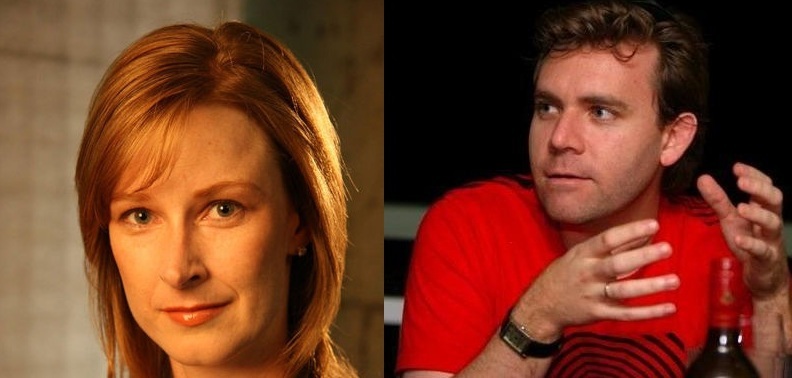
ABC journalist Leigh Sales, and her husband, animator Phil Willis, welcomed their first child on January 20. Their son Daniel Oscar was born in Sydney at 12.50 am, weighing 4 kg (nearly 9 pounds), and 55 cm long.

Leigh joined the ABC in 1995, and became foreign correspondent to the United States in 2001, arriving in Washington shortly after 9/11. She covered stories such as the Iraq War, the 2004 presidential election, and Hurricane Katrina. She won a Walkley Award for her report on Guantanamo Bay, and wrote a book about Guantanamo Bay detainee David Hicks, Detainee 002. It won the George Munster Award for Independent Journalism. In 2008 she became the presenter of late night current affairs show, Lateline, and last year was chosen as co-host of the ABC’s flagship news and current events programme, the 7.30 Report. She has a blog called Well Redhead, where she recommends interesting articles.

Phil was a software engineer for fourteen years before a career change in 2010 saw him become an animator. He worked on the film Happy Feet 2. Phil also has his own blog.

Leigh and Phil met at Queensland University of Technology, where they were both students. They have been married more than 15 years.

Names of Convicts on the Second Fleet

Tags

, , , , , , , , , , , , , , , , , , , , , , ,

The Second Fleet arrived in Sydney in June 1790, and proved something of a disaster. The colony founded by the First Fleet was already struggling and in the grip of starvation, and the Second Fleet was sent partly to aid them with further supplies. The first ship to arrive was the Lady Juliana, which contained female convicts. It took such a leisurely route that although it left months before the other ships, it arrived only a couple of weeks before them.

The convicts on the Lady Juliana provided Australia with its first sex scandal, because the women and ship’s crew consorted freely together, some of the women sold themselves for money or alcohol, and whenever the ship made a port of call, the women entertained men from other ships. Several gave birth on the ship, and many were pregnant by the time they reached Australia.

The women were well treated on board, but on arriving in Sydney, the Lady Juliana was called “a floating brothel”, and its female occupants “damned whores”. A cargo of more than 200 women when provisions were wanted, the ladies couldn’t have been more unwelcome.

Worse was to follow. While the First Fleet had been an effort of the British government, and generally well-organised, the Second had been handed over to private contractors. They had little concern for the convicts’ welfare, and although only a small number died on the first voyage (the unfortunate Ishmael Colman being the exception rather than the rule), the mortality rate on the second was 40%. The ship carrying the majority of the supplies, such as livestock, hit an iceberg en route and was wrecked.

When the remaining convicts reached Sydney, the colonists were horrified to see that the new batch was in terrible condition – starved, filthy, sick with scurvy, covered in lice, and bearing the marks of cruelty on their emaciated bodies. Instead of being the saviours of the colony, the people of the Second Fleet were instead a great drain on its resources. A Third Fleet had to be sent (amazingly, they chose to use the same private contractors again).

More than 165 000 convicts were sent to Australia over eighty years. This is a tiny number compared to the number of free settlers. For many years, convict ancestry was something of which people were deeply ashamed, and it was hidden from the family histories. These days, people are proud of their convict ancestors, and there’s a wealth of information available to them.

WOMEN

Dorcas (Talbot)

At the age of 39, Dorcas was convicted at the Old Bailey of stealing sixty yards of material from a shop, and sentenced to seven years transportation. Dorcas was sent to the penal colony on Norfolk Island, a place of untold horror and abject misery. In 1804 she married John Hatcher, who had arrived on the First Fleet. She died on Norfolk Island in 1811. The name Dorcas is a Greek translation of the Aramaic name Tabitha, meaning “gazelle”. In the New Testament, Dorcas (or Tabitha) was one of the disciples of Jesus; the Bible makes her seem important, and she may have been a leader in the early church. It is said that she was a widow who did charitable works, and Dorcas Aid International is an organisation which raises money for the poor and needy. Dorcas is regarded as a saint in some denominations. Often used in fiction, Dorcas is a shepherdess in Shakespeare’s The Winter’s Tale. She has also given her name to a species of gazelle – the dorcas gazelle, meaning “gazelle gazelle”.

Isabella (Manson, aka Isabella Smith)

At the age of 28, Isabella was convicted at the Old Bailey for stealing clothes and sentenced to 7 years transportation; she seemed to have a male partner, but took full responsibility for the crime. She married John Rowe in Sydney in 1790. John had arrived on the First Fleet, and there was a scheme of marrying off the “best” Second Fleet convict women to the “best” remaining First Fleet men and giving them farmland to work. John and Isabella ran a farm together without much success, and had three children named John, Joseph and Sarah, and possibly another named Mary. They have many living descendants. Isabella died a widow in Gosford in 1847. The name Isabella is the Latinate form of Isabel, a medieval Provencal form of Elizabeth. It was commonly used by royalty, and is the name of Princess Mary of Denmark’s eldest daughter. Isabella has been on the charts since 1900, dropping from it in the 1950s and ’70s. In 1900 it was #75, and today it is #1; its big jump in popularity occurred in the 1990s, although rising since the 1980s. Nicole Kidman and Tom Cruise naming their daughter Isabella in 1992 may have assisted.

Phoebe (Williams)

At the age of 41, Phoebe was convicted at the Old Bailey of stealing 5 yards of cloth and sentenced to seven years transportation. She married Edward MacLean, a First Fleeter, in 1790, and they ran a farm together in Parramatta. Edward died in 1794 and Phoebe died in Parramatta in 1798. The name Phoebe is from the Greek for “bright, shining”. In mythology, Phoebe is one of the Titans, a moon goddess who was the grandmother of Artemis; her name was given to one of the moons of Saturn. Phoebe was also one of Artemis’ titles, and there are several Phoebes in legend, including an Amazon, and the sister of the beautiful Helen of Troy. In the New Testament, Phoebe was a deacon in the early church regarded as a saint by several denominations. It was used by Shakespeare for another of his shepherdesses in As You Like It. Phoebe was #148 in the 1900s and by the 1930s was off the charts altogether. It made a comeback in the 1960s, and climbed at such a rate that it was in the Top 100 by the 2000s. It is maintaining its position around the #50 mark.

Rosamond (Dale, aka Rosina Dale, aka Mary Woods)

At the age of 22, Rosamond was convicted at the court in Lincoln, and sentenced to seven years transportation. She married James Davis from the First Fleet, and they were sent to the penal colony on Norfolk Island, where she died. The name Rosamond is a variant of Rosamund, a Germanic name meaning “horse protection” which was introduced to England by the Normans. From early on, the name was associated with the Latin phrases rosa munda (“pure rose”) and rosa mundi (“rose of the world”), referring to the Virgin Mary. Rosa mundi was transferred from the cult of the goddess Isis who was worshipped throughout the Roman Empire; roses were sacred to her, as they became for Mary as well. There is a heritage rose called the Rosa Mundi which has existed since the 1500s. One of the old Gallica roses, it has red and white striped petals.

Violetta (Atkins)

Violetta was a servant. She was convicted of stealing from her employer at the Old Bailey and sentenced to seven years transportation. I think Violetta must have either died on the voyage, or soon after her arrival in Sydney. Violetta is the Italian form of Violet. Violetta Valéry is the main character in Verdi’s 1853 opera La Traviata, based on the play adapted from the novel La Dame aux camélias by Alexandre Dumas, fils. It’s a romantic and emotionally wrought tale of a courtesan who finds true love, but tragically dies of tuberculosis.

MEN

Ephraim (Lindsay)

Ephraim was convicted by the court in Northampton and sentenced to seven years transportation. In the Old Testament, Ephraim was a son of Joseph, born during his years in Egypt. Ephraim’s mother was a priest’s daughter named Asenath; their marriage was arranged by the Pharaoh. A Christian story is that she converted from paganism to the worship of Yahweh; it’s a fanciful tale involving an angel and some magical bees. According to Jewish tradition, she was actually Joseph’s half-niece, conceived in rape. How she got to Egypt involves yet another angel who leaves her under a bush wearing a necklace inscribed with an explanation of her origins; the priest finds and adopts her. You can see there is some discomfort with the idea of Joseph’s bloodline being “besmirched” by an Egyptian. Ephraim can be pronounced several ways, including EE-free-im and EE-fruhm. It seems like a good alternative to popular Ethan.

Janus (Everard)

Janus was convicted at the Middlesex Guild Hall and sentenced to transportation for life. Janus was the Roman god of beginnings, and thus all points of transition, such as gates and doors. He is famously depicted as having two faces, to indicate that he looks forward to the future and backward to the past simultaneously – a rather neat visualisation of the flow of time, which Janus oversees. The Latin name for “door”, janua, is named after him, and thus doorkeepers and caretakers of building are sometimes known as janitors. Janus was an important deity, and when the Roman calendar was regulated, the first month of the year was called Januarius in his honour. We still start the year off in January, making Janus suited to this month.

Ormond (Burcham)

Ormond was convicted of stealing five bushels of barley and sentenced to death by the court of Norfolk. This was commuted to seven years transportation. Ormond is an Irish surname named after the ancient Irish kingdom in Munster. It simply means “east Munster”, and was a hereditary title within the Irish aristocracy. It may also have become (perhaps deliberately) confused with the Irish surname O’Ruadh, meaning “son of the red one”. Francis Ormond was a philanthropist who founded the college which later became the Royal Melbourne Institute of Technology, as well as endowing Ormond College at the University of Melbourne. There is a 6th century French abbot named Saint Ormond, however, this is an Anglicisation of Armand, the French form of Herman.

Traverse (Spileye)

Traverse was convicted of attempting to steal five dozen tallow candles by the court in Nottingham and sentenced to seven years transportation. This may be a Puritan virtue name, very interesting if so, because they are rarely found in Australia compared to the United States. As the word traverse means to travel, it could refer to pilgrimage, or the soul’s journey through life, or perhaps even the Israelites traversing the desert for forty years. However, I can’t help wondering if it is just a variant of the surname Travers, coming from the French for “to cross”; it was an occupational name for someone who collected tolls at crossing places such as city gates and river fords. There is a Puritan connection with this surname, because Walter Travers was an English Puritan theologian.

Uriel (Barrah, aka Uziel Baruch)

Uriel was a Jewish butcher with a long history of being convicted for debt and theft, although he had also been a constable. His wife’s name was Judith. He was convicted of theft by the Old Bailey and sentenced to seven years transportation. He was originally going to be sent to a penal colony in Africa, an idea the British tried which didn’t work out, so he was sent to Australia instead. When he completed his sentence he returned to England; a relative seems to have taken over his butcher shop during his absence. Uriel is one of the archangels in Jewish and Christian tradition; he isn’t mentioned in the scriptures. He is given several interesting roles, one of which is to guard the gates of Eden with a flaming sword so that none living may enter; he is said to have buried Adam and Abel there. In Jewish mystical tradition, he is called the Angel of Poetry. Uriel appears several times in literature, including Milton’s Paradise Lost. His name means “light of God”.

Famous Name: Beyoncé

Tags

, , , , , , , , , , , ,

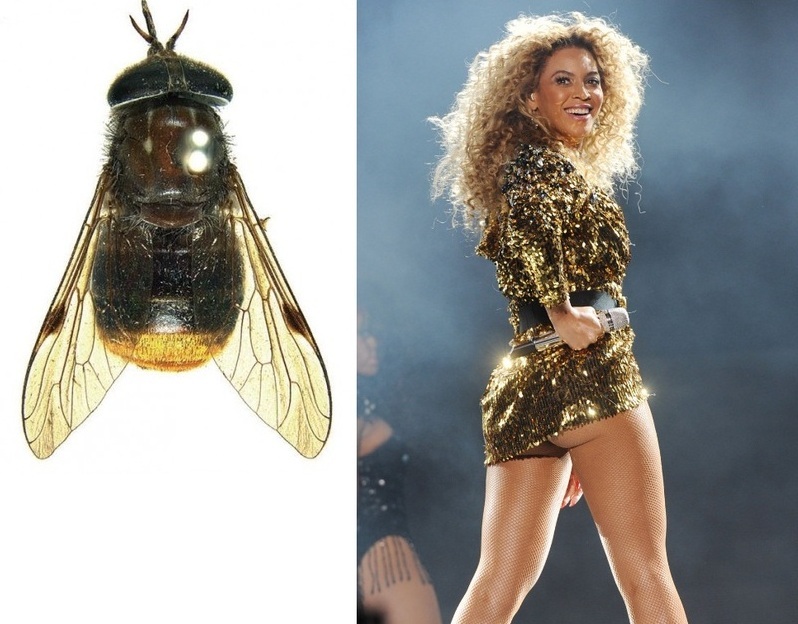
Pop diva Beyoncé has been in the news a lot recently, since the birth of her first child, Blue Ivy Carter. However, her name has hit the headlines for a different reason, after inspiring an Australian taxonomist to name a horse fly after her.

Bryan Lessard, from the CSIRO’s Australian National Insect Collection in Canberra, named the fly Scaptia (Plinthina) beyonceae because it has a prominent golden lower abdomen. To Bryan, who admits to being something of a fan, the unique dense gold hairs on the fly reminded him of Beyoncé’s flashy golden stage outfits.

The rare fly was collected in 1981, the same year Beyoncé was born, from eucalypt forests in the Atherton Tablelands of Queensland.

I’m not sure whether this is the most flattering thing that’s ever happened to Beyoncé, but I love that it shows scientists are just normal people who listen to R&B in their labs while they work, and find themselves as captivated by a gold frock as the next person. And perhaps are human enough to want to see their names in the gossip magazines, and maybe even get a personal response from their idol (she hasn’t made one).

BEYONCE

Beyoncé’s name is as unique as the horse fly, being created especially for her. Her mother Tina’s maiden name is Beyincé, a Creole surname from Louisiana. When she discovered that the Beyincé name was dying out, Tina decided to call her daughter Beyoncé, her own version of the surname. Apparently Tina’s parents were not impressed at first, because “that’s a last name”.

Beyincé is a form of the French surname Boyancé, related to the Old French word for “wood”. It’s an equivalent of English surnames such as Woodward or Forrester.

While the names of celebrities often become popular baby names (think Scarlett and Ashton, for example), Beyoncé’s name remains in very rare use. It belongs so completely to herself, and no other.

DESTINY

Destiny’s Child was the successful girl group of which Beyoncé was a founding member, prior to her embarking on her solo career.

The English word destiny comes from French, and ultimately from the Latin destino, the source of the word destination, meaning “appoint, establish”. It comes from an ancient root meaning “to stand, to place” (also the source of the word obstinate). Destiny is used as a synonym for the word fate, although technically fate is the divine agency or power which brings about the predetermined future events which are our destiny.

Destiny has been used as a girl’s name since the 19th century, and originated in the United States. It has been on the US Top 1000 since 1975, and reached the Top 100 in 1994, leaving it in 2012. It is currently #203.

In the UK, Destiny peaked in 2001 at #211 , and is currently #412. It is also in use in The Netherlands, and is a fairly uncommon name in Australia, although certainly not unknown.

Apart from Destiny’s Child, the name may remind you of Destiny Cyrus, the birth name of actress and singer Miley Cyrus (born just after the name reached the Top 100). It’s a slightly dated virtue name which still has a spiritual or philosophical feel to it, but also suggests the strength to forge your own path in life, to make your own destiny.

POLL RESULTS

Beyoncé gained an approval rating of 15% from the public. Only one person liked the name Beyoncé, while 68% thought it was terrible.

Destiny did rather better, with an approval rating of 32%. However, once again only one person liked the name, and 48% thought it was terrible.


Cedar Kate and Bon Zeev: Birth Announcements from the “Adelaide Advertiser” (December)

Tags

, ,

Victoria-Square-Fountain-Adelaide-australia-23340375-1600-1200Twins

Adam Jack and Amelia Anna

Alexander Xen and Nicholas Luka

Andy and Riley

Emma Rose and Sam Henry

Jacob Thomas and Grace Isabella

Jaxon and Blake

Kristian and Alex (Thomas, Joachim)

Olivia Lenore and Elsie Brooke

Rachael Elizabeth Ann and Sarah Adelaide Jane


Girls

Aaliyah Elizabeth

Amity Em Dora (Indi)

April Dawn

Cedar Kate (Thiele)

Chloe Jade Bird (Amy, Lachlan)

Ebony Elva

Edel Ebony

Elizabeth Anne Jennifer (Adam, Janelle, Sarah)

Ella May McKenzie (James)

Hazel Anne (Mia, Zoe)

Ivy Malin (Saffron, Homer)

Kari Phynix

Mercedes Judeen (Xander, Jeidan)

Olivia Summer Jane

Peyton Aida

Pippa Jane (Max, Sadie)

Poppy Eliza (Lu Lu, Zali)

Scarlet Bonny (Rhett, Elyse)

Silvie Mai (Kai, Finn)

Sofia Mae Rita (Charlie)


Boys

Alexander Gerald Jack (Stephanie, Lucy)

Ashton James Oakley (Kayla, Ella, Brayden)

Bon Zeev

Cooper Harry

Ezekial Roy (Maddy)

Felix Zane

Harley Jake (Campbell, Will)

Harrison Brien Westley (Theodore)

Hudson Joc (Georgia, Jackson)

Jaxon Albert Shane (Isabella)

Jethro Tait (India, Sapphire, Sage)

Louie Axel

Nate Angelo (Zak)

Robert James Lee (Rachel, Madeline)

Rowan Douglas (Hamish)

Sione Valentino (Tapinisi, Eleanora)

Sunni Michael Jeffery (Nara)

Willoughby Strong (Sterling, Crawford)

Wyatt Christian Tyler (Calin)

Zachary William John (Alicia, Isabella)

Harriet and Gus: Birth Announcements from the Melbourne “Age” (December)

Tags

,

Girls

Alexandra Poppy (Gus)

Alice Raphaelle

Amelie Rose

Eleanor Jennifer

Ella Bailey

Emily Violet (Ben)

Harriet Joy (Flynn)

Imogen Felicity (Ryan, Aidan)

Mia Isabelle

Nina Joan (Ruby)

Sophie Grace LePoer (Anabel)

Summer Mae (Imogen, Andrew)


Boys

Alfred Peter “Alfie”

Angus Gordon

Connor James Morgan (Samuel, Olivia, Aidan)

Edward James “Ted” (Hollie)

Felix Stanley (Cordelia)

Frederick Albert

Gus Tano (Maggie)

Jack George Simon

Oliver Jack “Ollie”

Robert Darcy (Niamh)

Theodore Henry (Elliot, Linton, Claire)

William Richard (Sam, Nicholas)