• About
  • Best Baby Names
  • Celebrity Baby Names
  • Celebrity Baby Names – Current
  • Celebrity Baby Names – Past
  • Featured Boys Names
  • Featured Girls Names
  • Featured Unisex Names
  • Links to Name Data
  • Waltzing on the Web

Waltzing More Than Matilda

~ Names with an Australian Bias of Democratic Temper

Waltzing More Than Matilda

Category Archives: Requested Names

Girls Names from Australian Children’s Literature

17 Sunday Aug 2014

Posted by A.O. in Name Themes and Lists, Requested Names

≈ 10 Comments

Tags

astronomical names, Babylonian names, Biblical names, classic names, english names, Etruscan names, fictional namesakes, flower names, French names, Greek names, hebrew names, Irish names, Italian names, Latin names, Median names, middle names, month names, mythological names, name history, name meaning, name popularity, name trends, names from television, nature names, nicknames, plant names, popular names, retro names, Roman names, royal names, Semitic names, Shakespearean names, underused classics, underused names, unisex names

HarrietYoullDriveMeWild01

This week it is Children’s Book Week, which is run by the Children’s Book Council of Australia. Librarians and teachers everywhere will be thinking up exciting new ways to encourage children to read, while the CBC has awarded prizes to the best new Australian children’s books. I thought it would be fun to join in the celebrations, and many of the books chosen are classics and award winners.

Amaryllis
I know two characters with this name. One is Amaryllis “Ryl” Mereweather, from H.F. Brinsmead’s Pastures of the Blue Crane (1964), about a teenage girl who inherits an old shack in northern New South Wales. (Name nerd bonus info: H.F. Brinsmead stands for Hesba Fay – Hesba is derived from the Greek hesperus, meaning “western”). The other is in Sally Odger’s fantasy Amy Amaryllis (1992), about an ordinary Australian girl named Amy Day who switches identities with a girl named Amaryllis Loveday, from a magical world named Ankoor. Amaryllis is a Greek name meaning “to sparkle”, perhaps to suggest sparkling eyes. In Virgil’s pastoral poems, The Eclogues, Amaryllis is a beautiful shepherdess, and the poet makes a play on words to suggest that her name comes from Latin amor, “love”. The amaryllis flower is often known as “Easter lily” in Australia; it is named after the literary character, so this is not just a simple flower name. Unusual and lovely, Amaryllis comes with a host of possible nicknames, including Amy, Ryl, Rylla, Lily, Lissy, and Mary.

Beatrice
In Playing Beatie Bow (1980) by Ruth Park, Beatie Bow is a local legend, a game that children play to frighten each other. But when teenage loner Abigail watches the game, she is brought to the Sydney of one hundred years earlier by a strange girl named Beatrice “Beatie” Bow. This classic is a YA time-travel historical mystery adventure with a dash of romance, and so firmly grounded in The Rocks area of Sydney that you can follow every step of Abigail’s journey. (Name nerd bonus info: Abigail’s parents named her Lynette, but when her parents separate, she chooses Abigail for herself, because it’s an “old witch” name). Beatrice is the Italian form of Beatrix, very famous because of the beautiful muse in Dante’s Divine Comedy. The name has been used in England since the Middle Ages, including by royalty; Princess Beatrice of York was named after a daughter of Queen Victoria, but itwas used in the royal family long before. It’s also a Shakespearean name, because in the comedy Much Ado About Nothing, Beatrice is the witty heroine. Beatrice was #50 in the 1900s, and left the Top 100 in the 1930s; by the 1960s it had left the charts. It made a modest comeback in the 1990s, after the birth of Princess Beatrice, and has remained around the 500-600 level. This is an elegant retro name which has long remained underused. Bea is the usual nickname, although Beatrice Prior from the Divergent series goes by Tris.

Blossom
Little Ragged Blossom is one of the main characters in May Gibbs‘ Snugglepot and Cuddlepie series (1918-40), featuring her plump “gum nut babies”. Blossom is a poor little gum-blossom girl, alone in the world until she gains the friendship and protection of gum-nut boys Snugglepot and Cuddlepie. From then on, she is part and parcel of their adventures, and not infrequently plays the role of damsel in distress, such as when she needs rescuing from the wicked Banskia Men. Even now, I cannot see a gum tree in bloom without imagining the flowers as little blossom girls … The word blossom is used for flowers that grow in masses and clusters, especially on trees, and evokes spring and freshness. Blossom has been used as a girl’s name since the 18th century, and is probably more common as a nickname, such as aviation engineer Maxine “Blossom” Miles, or a middle name, such as jazz singer (Margrethe) Blossom Dearie. On television, Blossom was one of the Powerpuff Girls, and Blossom Rosso the floppy-hatted heroine of sitcom Blossom. Ultra-feminine, quirky and cool, could Blossom be the ultimate flower name?

Celia
Feeling Sorry for Celia (2000) is Jaclyn Moriarty’s side-splittingly comic début epistolary YA novel. Private school girl Elizabeth spends most of her time fretting over her best friend Celia, whose life is one self-caused drama after another. However, a pen-pal programme with the local public school teaches Elizabeth how real friendship works. Celia is the feminine form of Caelius, a Roman family name traditionally derived from caelum, Latin for “heaven”. However, the Caelii traced their ancestry to the Etruscan hero Caeles Vibenna, so the name probably isn’t Latin in origin. It may come from Cel, the Etruscan earth goddess who is the equivalent of Gaia; her name means “honoured”, and the Etruscans named the month of Celi (September) after her. I like the idea of an earthy goddess becoming connected with heaven. Shakespeare used the name for an attractive, serious character in As You Like It, and Ben Jonson wrote the poem Song to Celia, which became Drink To Me Only With Thine Eyes. These writers sparked interest in Celia as an English name in the 17th century. This literary name is both rare and traditional, and doesn’t seem out of place next to popular names like Olivia and Sienna.

Dot
Ethel C. Pedley’s posthumous novel Dot and the Kangaroo (1899) is about a five-year-old girl named Dot who wanders off into the bush and gets lost. She is befriended by a kangaroo who has lost her joey, and gives Dot some magic berries that allow her to understand the speech of animals. It has a strong conservationist message in regard to our native flora and fauna, which is still very much needed. The book was the first to show Australian animals in a genuine Australian setting, and became an immediate favourite. Dot is a short form of Dorothy which dates to medieval times, and has been used as an independent name at least since the 17th century. This adorably pert little name could honour a Dorothy, and also works well in the middle.

Esther
Ethel Turner’s Seven Little Australians (1894) is the only Australian book to be continuously in print for more than a century. Featuring a family of mischievous, lovable army brats who live in Sydney’s outer suburbs, it is surprising how little it has dated. Blended families, teen rebellion, obsession with body image, schoolgirl crushes, and discipline problems … all topics of interest more than a hundred years ago too. The seven little Australians are Meg, Pip, Judy, Nell, Bunty, Baby, and The General; their father is stern Captain Woolcot and stepmother (The General’s mother) is Esther. Esther is beautiful and sweet, but barely older than her eldest step-children, and incapable of really mothering them. Hilarious, heart-warming, and tragic, this is one of Australia’s best-loved children’s books. In the Bible, Esther was a Jewish queen of a Persian king; her story is the basis for the Jewish holiday of Purim. The meaning of Esther is much debated. It may be from a Semitic word meaning “star, morning star”, or a Median word meaning “myrtle” (the translation of her Hebrew name, Hadassah). Another theory is that it comes from the Babylonian fertility goddess Ishtar (Ishtar also represents the morning star, Venus). Esther was #73 in the 1900s, and left the charts in the 1920s. It reached its lowest point in the 1950s and ’60s at #379, but has climbed since then, and isn’t far outside the Top 100 in Victoria. This underused classic is very much on trend at present.

Harriet
Harriet, You’ll Drive Me Wild (2000) is a picture book written by kidlit doyenne Mem Fox, illustrated by Marla Frazee. Harriet Harris is a toddler who doesn’t mean to be naughty, but trouble follows in her wake without her even trying. Harriet’s mother is a calm woman who doesn’t like to yell, but Harriet pushes her to breaking point. The book helps explain to littlies why parents lose their cool. (Name nerd bonus info: Mem Fox’s full name is Merrion, but she has always gone by Mem). Harriet is the English form of Henriette, the feminine form of French Henri, and thus a feminine form of Harry. Harriet was #122 in the 1900s, and left the charts in the 1930s. It returned in the 1970s, and has been climbing ever since. Last year it was one of the fastest rising names of 2013, and joined the Top 100 at #89. Cute and spunky, it can be shortened to Hallie or Hattie – Hattie is a hen in Mem Fox’s Hattie and the Fox (1986).

Josie
Josephine Alibrandi, known as Josie to her friends, features in Melina Marchetta’s breakthrough YA novel, Looking for Alibrandi (1992). A coming of age story, its smart-mouth heroine is in her last year of school, dealing with boys, family, exams, mean girls, and her father, who left when she was a baby and has suddenly reappeared in her life. Looking for Alibrandi was an instant success upon publication, and has been called “the most stolen library book”. Josie is a short form of Josephine, used as an independent name since the 16th century. It has sometimes been given to boys, as a short form of Joseph or Josiah. Josie first ranked in the 1920s at #291, and left the charts in the 1940s. It returned in the 1970s, and climbed before peaking in 2009 at #175. This is an underused retro name which doesn’t sound old-fashioned, but sassy and stylish.

Liesel
Liesel Meminger is the young girl in Markus Zusak’s The Book Thief (2005), set in Nazi Germany during World War II, and narrated by Death himself. Liesel is illiterate at the start of the story, but through learning to read, discovers a lifelong love of words, and finds solace in stealing books to share with others. Against a backdrop of fear and horror, the story shows that books can feed the soul even in our darkest hours. The story does end up having an Australian connection, and a specific Australian setting is used in a very unexpected way. Liesel is a German pet form of Elisabeth, pronounced LEE-zel. Although it’s never charted in Australia, this charming name is very familiar because of Liesl from The Sound of Music, and swimmer Leisel Jones.

Norah
Norah Linton is the heroine of Mary Grant Bruce’s Billabong series (1910-42). Making her début in A Little Bush Maid at the age of twelve, Norah lives at Billabong Station in northern Victoria. She’s a hardy, spirited tomboy who loves horse-riding, camping, and fishing, and is a total daddy’s girl. The books haven’t aged too well, but Norah is an ancestor of other feisty, independent Australian heroines, such as Ryl Merewether and Josie Alibrandi. Norah is a variant of Nora, a pet form of names such as Honoria and Eleanor. It’s often thought of as particularly Irish, and records show many Norahs of the 18th century were born in Ireland. Hip and arty, Norah is fast growing in popularity in both the UK and US, and already popular in Europe, but almost unknown in Australia. It deserves serious consideration by those keen to get ahead of the trends.

Thank you to Manday for suggesting the name Liesel be featured on Waltzing More Than Matilda, and for recommending The Book Thief be added to this list.

POLL RESULTS
The public’s favourite names were Beatrice, Harriet and Norah, and their least favourite were Josie, Blossom and Dot.

(Picture shows cover of Harriet, You’ll Drive Me Wild, from Mem Fox’s website)

Requested Famous Name: Annabelle

23 Wednesday Jul 2014

Posted by A.O. in Famous Names, Requested Names

≈ 3 Comments

Tags

aristocratic names, famous namesakes, honouring, Latin names, modern classic names, name history, name meaning, name popularity, name trends, names of boats, popular names, portmanteau names, Scottish names, UK name popularity, US name popularity

Annabelle_Rankin

Famous Namesake
On July 28, it will be the 106th birthday of pioneering stateswoman Dame Annabelle Rankin, who was the first woman from Queensland to sit in the Parliament of Australia, the second female Australian Senator, and second female parliamentarian for the Liberal Party.

Annabelle was the daughter of Colin Rankin, a Scottish-born Queensland politician who served in both the Boer War and First World War; Annabelle was named after her mother. Her father encouraged her to travel, and when she left school, she went to China, Japan, England, Scotland, and continental Europe. With a background in community involvement, she worked in the slums of London, and with refugees from the Spanish Civil War.

Back in Australia, Annabelle was a volunteer during World War II, serving at air raid shelters and hospitals, and organised the YWCA’s welfare efforts for servicewomen. Her responsibilities involved travelling to military bases in Queensland and New South Wales, and she accompanied Eleanor Roosevelt, First Lady of the United States of America, and Lady Gowrie, wife of the governor-general, on their visits to the troops.

After the war, she stood as a candidate for the Liberal-Country Party, and entered the Senate on July 1 1947. Annabelle was the first woman in the British Commonwealth to be appointed as an opposition whip, and was the whip in the Senate from 1951 to 1966.

Dame Annabelle was appointed Minister for Housing in 1966, becoming the first woman in Australia to administer a government department. As minister, she worked to provide housing for old age pensioners, and introduced a housing system for Aboriginal Australians and new migrants. As a newspaper of the time helpfully noted: “She tackles men’s problems too”.

After retiring from parliament in 1971, Dame Annabelle was appointed high commissioner to New Zealand – the first woman in Australian to lead a diplomatic mission. She supported several community organisations, including the Australian Red Cross Society, Country Women’s Association, Girl Guides, Victoria League, and Royal Commonwealth Society.

She was for many years the President of the Queensland branch of the Children’s Book Council of Australia, and the Dame Annabelle Rankin Award for services to children’s literature in Queensland is given in her honour. Another of her namesakes is the Annabelle Rankin, one of the ferries on Sydney Harbour.

Dame Annabelle was easily recognisable from her auburn hair and warm brown eyes, and combined a cheerful, friendly demeanour with a strong, uncompromising will, and apparently tireless energy. She was an excellent orator, and very capable of handling the occasional heckler (by no means were all the hecklers male, either).

While researching the name Annabelle, I noticed quite a few people seemed to think that the name Annabelle sounded “unprofessional”, and predicted that a woman named Annabelle could never be taken seriously in public life. If nothing else, the career of Annabelle Rankin proves this to be completely untrue.

Name Information
Annabelle is a variant of the name Annabel, which originated in Scotland during the Middle Ages. Although it is sometimes treated as a cross between Anna and Belle, this isn’t plausible as it pre-dates the common use of the name Anna in Scotland.

It’s assumed to be a variant of the Latin name Amabel, meaning “lovable” – the long form of Mabel, and close relation to familiar Amy. It may have been influenced by the name Agnes (“pure”), which was said (and often spelled) Annas at that time.

The Annabelle spelling probably has been influenced by Anna and Belle in the modern era, and is often understood as meaning “graceful and beautiful”. Although this isn’t very good etymology, the name is a bit of a hodge-podge, and you might feel free to translate it as you wish.

The names Annabel and Annabelle have long been favourites with the British peerage, both English and Scottish, which gives them a rather aristocratic air. I tend to feel that Annabel is a bit more “posh”, while others may think that the Frenchified Annabelle seems more stylish and “finished”.

Annabelle has charted in Australia since the 1970s, when it debuted at #580. Since the 1980s it has risen steeply, and it entered the Top 100 in 2000, at #92. It entered the Top 50 in 2007, when it reached #46, and although it wobbled a little here and there, it is now at the highest point it has ever been.

Currently it is #44 nationally, #35 in New South Wales, #50 in Victoria, #43 in Queensland, #47 in Western Australia, #61 in Tasmania, and #36 in the Australian Capital Territory.

Annabelle is also Top 100 and climbing in the US and the UK, but is more popular here than anywhere else, making Annabelle one of those unexpectedly Australian names. Annabelle is also Top 100 in New Zealand, but isn’t rising in popularity.

Annabel has charted in Australia since the 1960s, entering the rankings at #420, but while it also rose steeply during the 1980s, hasn’t become popular, and is still in the 100s. Annabel is only just outside the Top 100 in the UK, but is stable rather than rising, which is probably similar to the situation here. In the US, it is rising steeply, but only in the high 400s, so a long way off popularity.

Annabelle is a pretty, elegant, ultra-feminine name that’s well on its way to becoming a modern classic (while Annabel is already there). It fits in so smoothly with the trend for -belle and -bella names that it’s become quite popular, and may become more so.

Although it wasn’t originally linked to the names Anna and Belle, it might be used to honour people with those names, or similar names. Possible short forms abound, but all the the Annabelles I’ve ever met have only used their full name – it strikes me as one of those relatively long names that are somewhat nickname-resistant. There’s plenty to love about adorable Annabelle!

Thank you to Brooke for suggesting the name Annabelle to be featured on Waltzing More Than Matilda

POLL RESULTS
Annabelle received an approval rating of 62%. 20% of people preferred the name Annabel, but 16% thought Annabelle was beautiful and feminine. Only person thought the name Annabelle was too popular. I wonder if Annabel would have done better – perhaps we will feature it another time.

(Photo is of Dame Annabelle Rankin)

Famous Name: Harvey

28 Wednesday May 2014

Posted by A.O. in Famous Names, Requested Names

≈ 7 Comments

Tags

birth notices, Breton names, english names, famous namesakes, French names, Gaelic names, Gallic names, Irish names, mythological names, name history, name meaning, name popularity, Old Breton names, popular names, retro names, saints names, surname names, UK name trends, US name trends


world-no-tobacco-day-rose-graphicFamous Namesake
On May 31 it will be World No Tobacco Day, encouraging smokers to abstain from tobacco for just 24 hours. World No Tobacco Day was started by the UN’s World Health Organization in 1987, and each year there is a new theme: this year it is “Raise taxes on tobacco”. Should you wish to celebrate No Tobacco Day by giving up smoking, information and support can be gained from a number of government and community services.

The number of Australian smokers has dropped dramatically since World War II. In 1945, about three-quarters of men and a quarter of women smoked every day. Today it’s 16% of men and 13% of women, with numbers continuing to fall, making us one of the most successful countries at reducing smoking in the English-speaking world. That can be attributed to vigorous public anti-tobacco campaigns running since the 1980s.

Australia’s campaign against smoking began with William Harvey, a distinguished thoracic physician who devoted his lengthy career to the study and treatment of tuberculosis after his father (also a doctor) contracted the disease. Harvey had the satisfaction of seeing TB become less common, due to better testing and treatment, but over time he became concerned at the growing incidence of lung cancer.

In 1965 he helped found the Australian Council on Smoking and Health as part of his campaign against smoking, and was its president from 1966 to 1975. This didn’t make him popular with some, especially tobacco companies, who continued to deny there was any link between smoking and disease. However, William Harvey had been a POW during World War II who continued caring for his patients even as disease threatened his own life. He didn’t believe in giving up.

He visited schools and sporting bodies, he wrote to the newspapers, and he persuaded other doctors and medical organisations to join him in his campaign against tobacco. One of his achievements was the banning of cigarette vending machines in hospitals. Progress seemed slow, but he persisted, saying that he had great faith in “the inevitability of gradualness”. A devoted family man, Harvey was a keen gardener and surfer into his twilight years, and played golf, tennis and bowls. He passed away suddenly in 1981 at the age of 84 – a good advertisement for a life of healthy non-smoking.

William Harvey didn’t live to see the big government campaigns against smoking of the 1980s, but their existence and determination owe a great debt to his dedication and energy. And if I can reveal my hand, I have friends and family members who have given up smoking, and as a result I have got to spend many more years with them, or seen them live happier, healthier lives. Every one of them was convinced to give up by anti-smoking campaigns, so from the bottom of my heart, I thank you William Harvey.

Name Information
Harvey is an English surname, and one of the earliest recorded. It is derived from the Breton personal name Huiarnuiu derived from the Old Breton name Huiarnviu, meaning “blazing iron”. The Gallic form of the name is Hervé, and St Hervé (or St Harvey) is one of Brittany’s most popular saints.

Hervé was born blind, and was a 6th century hermit and bard known for his humility. According to legend, he had the power to cure animals, and was always accompanied by a wolf. The story goes the wolf had eaten the ox that the saint used for ploughing, and St Hervé made such an eloquent sermon that the wolf volunteered to pull the plough instead, in penitence.

One of the followers of William the Conqueror during the Conquest was named Hereueu, another form of the Breton name. Use of the name as a surname followed almost immediately after the arrival of men with the first name, and is first found in Norfolk, where the Harvey family were granted lands for their services at the Battle of Hastings.

In Ireland, Harvey was used to Anglicise the Gaelic surname O’hAirmheadhaigh, meaning “grandson of Airmed”. Airmed is a goddess from Irish mythology, known for being a healer during a great battle. As she wept over the grave of her brother, who had been slain by her father, all the healing herbs of the world sprang up, watered by her tears. Airmed gathered them into her cloak, but her father scattered the herbs, so that no person can ever know all the secrets of herbalism – only Airmed. Her name is identical to a word meaning “a measure of grain”, although I’m not sure if that is the origin of the name.

Harvey was also used to Anglicise the Gaelic surname Ó hEarchaidh, meaning “son of Earchadh”. Earchadh is an Irish name that I have seen translated as “noble warrior”. By the way, William Harvey was very proud of his Irish Protestant heritage, so his surname was Irish, although most likely of English origin rather than Gaelic.

The name Harvey was #167 in the 1900s, and peaked in the 1940s at #141 – perhaps because of a family of cricketers from Victoria with the surname Harvey who flourished around this time. Harvey disappeared from the charts from the 1960s to the 1980s, but made a comeback in the 1990s when it ranked at #581.

Interestingly, this was the time when retail chain Harvey Norman, co-founded by maverick businessman Gerry Harvey, became a “superstore” business, with massive expansion. The name Harvey zoomed up the charts to make #314 for the early 2000s and #243 for the late 2000s. Harvey peaked in 2010 at #149, and then began dipping the next year – this coincides with Gerry Harvey’s unpopular campaign to make consumers pay Goods and Services Tax on items bought online from overseas websites.

Although Harvey is in the 100s in New South Wales, it is a Top 100 name in Victoria. Harvey entered the Victorian Top 100 in 2010, debuting at #100, and last year made #64. If you are in Victoria you probably think of Harvey as a popular and rising name, while in other states, Harvey may seem fashionable but underused. It is not clear at present if other states will follow Victoria’s lead, but as Harvey is Top 100 in the UK, and rising in the US, international trends suggest Harvey’s popularity here may be increasing.

Harvey is a cute, spunky name for boy, but there’s also something strong and masculine about it. This retro name has been underused for most of its history, and is now making a comeback – in at least one state, it is more popular now than at any other time. This may give some parents the jitters. Although it has only ever charted as a boy’s name, I have seen Harvey on a few girls in birth notices, and the Irish goddess does give this some legitimacy as a name for both genders.

POLL RESULT
Harvey received an excellent approval rating of 75%, making it one of the highest-rated names for 2014. People saw the name Harvey as strong and manly (20%), cute and boyish (16%), and traditional without being stuffy (13%). However, 11% were reminded too strongly of Harvey Norman stores. There was a strong preference for Harvey being reserved for boys only, with 18% saying it was only suitable for boys, and just 2% believing it could be used for both genders.

Thank you to Vanessa for suggesting the name Harvey be featured on Waltzing More Than Matilda.

Requested Name: Eva

02 Wednesday Apr 2014

Posted by A.O. in Requested Names

≈ 9 Comments

Tags

Biblical names, classic names, European name popularity, famous namesakes, fictional namesakes, hebrew names, historical events, honouring, Irish names, Latinate names, name history, name meaning, name popularity, name trends, names of aeroplanes, New Zealand name popularity, nicknames, popular names, saints names, UK name popularity


Front1Eva is the Latinate form of Eve, a Hebrew name translated as “breath, life”. Eve is famous as the first woman in the Bible, and the companion of the first man, Adam. She shared Adam’s fate of being cast out of the Garden of Eden, and is regarded in the Bible as the mother of all humanity. Apart from the biblical figure, there is also a saint named Blessed Eva of Liege, a medieval holy recluse.

Eva is the most usual form of the name Eve in many countries around the world, and in Ireland and Scotland, can be used to Anglicise the Irish name Aoife, meaning “beauty”. In Australia, Eva has historically been often used by European immigrants, particularly amongst Catholics and Jews. This gives it considerable scope as a potential heritage choice.

Amongst English-speakers, the name received a boost of popularity in the 19th century after the publication of Harriet Beecher Stowe’s 1852 anti-slavery novel, Uncle Tom’s Cabin. In the book, Evangeline St. Clare, or “Little Eva” is an angelic little girl who inspires love in even the most heart-hardened, and in her final throes, converts all the slaves to Christianity with some locks of her hair. It is the pure goodness of Little Eva which changes the lives of all around her.

Uncle Tom’s Cabin created a wave of pro-slavery novels to combat its views, and one of them was Little Eva: the Flower of the South, in 1853. Quick to cash in on the Little Eva phenomenon, it features yet another angelic little girl called Little Eva, equally loving and lacking in prejudice – only in this book, Eva is so kind-hearted that when the slaves are set free, they elect to remain with her of their own free will. This idealistic dream of voluntary slavery never came to pass on a large scale.

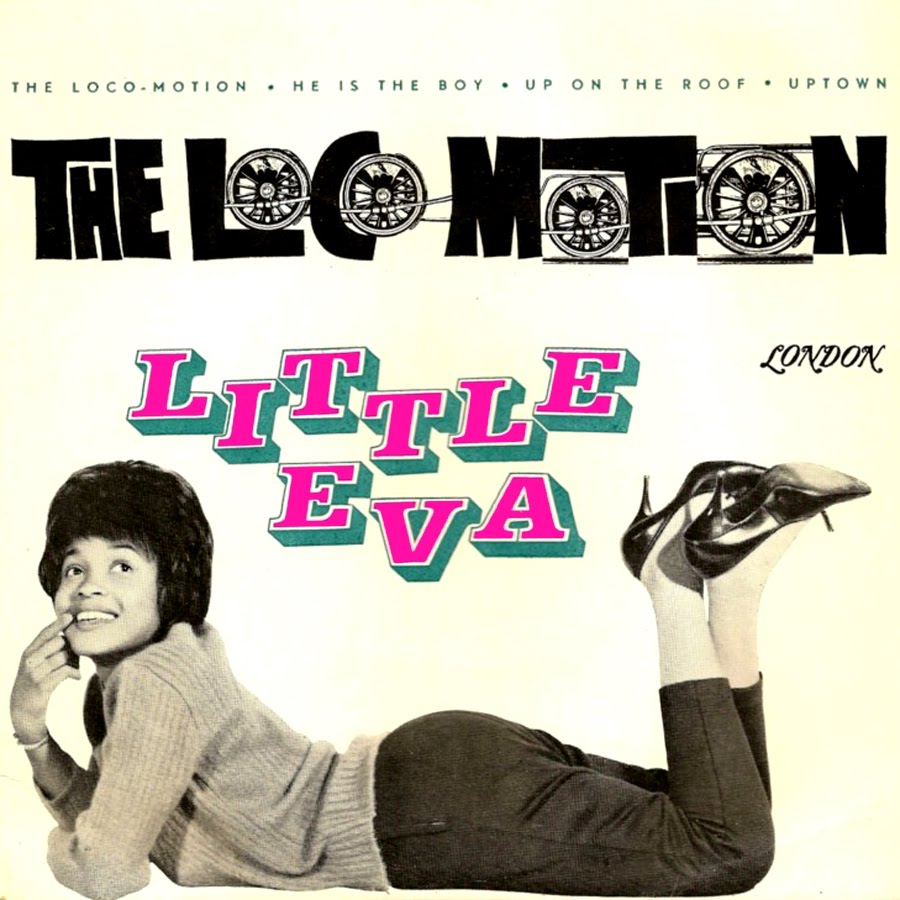
A real life Little Eva was the 1960s pop singer, born Eva Narcissus Boyd. She didn’t receive her moniker from either of these literary characters, but was called Little Eva by her family to distinguish her from her aunt, also named Eva. Little Eva is most famous for singing The Locomotion, later covered by Australian pop star Kylie Minogue. Little Eva apparently wasn’t too impressed by Kylie’s version.

Another Australian connection to Little Eva comes from World War II, when an American Air Force plane named the Little Eva got lost and crashed after a bombing mission in an isolated region of the Gulf of Carpentaria in Queensland. What happened to the survivors of the crash, and their desperate struggle against the dangers of the Australian outback, was made into a documentary called Aeroplane Dance, and is being developed into a feature film scheduled for release this year.

Eva is a classic name in Australia which has never left the charts. It was #37 in the 1900s, sinking until it left the Top 100 in the 1930s. It reached its lowest point in the 1980s at #425, then rose steeply during the 1990s to make the Top 100 for the late 2000s. Currently it is #24 nationally, #26 in New South Wales, #30 in Victoria, #31 in Queensland, #66 in Tasmania, and #27 in the Australian Capital Territory.

Eva is a very international name, being popular in all English-speaking countries, and all over Europe, including Eastern Europe and Scandinavia. It is most popular in Slovenia, at #2, and its popularity in Britain and New Zealand is almost identical to that in Australia.

Eva’s position in the Top 100 is stable, and it is now at its highest level of popularity ever. This makes it a Contemporary Classic – a traditional classic name which manages to feel modern and up-to-date. Because it is still rising, albeit gradually, it is also an Up and Coming Classic, so that it still seems rather fresh and stylish.

This all helps to make Eva an attractive choice. Furthermore, it fits in with the trend for short names ending in -a, such as Isla and Ella, and the V names, such as Ava, Ivy, Evie and Evelyn. This means that while Eva doesn’t stand out amongst its peers, neither does it sound particularly distinctive.

However, for those who care about such things, Eva has the advantage of being a classic, unlike Isla, Ella, Ava, Ivy and Evie, and also began rising before them, so that it cannot be accused of being a copycat. Eva is closest to the name Evelyn, which is also a classic that began rising in the 1990s – although Evelyn has yet to reach the popularity it enjoyed in the 1900s.

Eva is a beautiful classic name that is feminine without being frilly. Eva sounds intelligent as well as pretty, and it’s a name which ages well. It is easy to spell and pronounce, and is popular without being either extremely common or faddish. That makes it a baby name which might tick a lot of boxes on many people’s lists. The usual nicknames are Eve or Evie, but it is so short and simple that it doesn’t really need a nickname.

POLL RESULT
Eva received an excellent approval rating of 83%, making it one of the highest-rated names of 2014. People saw the name Eva as a stylish classic (23%), feminine yet not frilly (19%), beautiful or pretty (18%), and easy to spell and pronounce (17%). However, 6% thought it was too popular. Nobody thought the name Eva sounded too much like the word evil.

Thank you to Brooke for suggesting the name Eva be featured on Waltzing More Than Matilda

Requested Name: Grady

16 Wednesday Oct 2013

Posted by A.O. in Requested Names

≈ 1 Comment

Tags

historical records, Irish names, name history, name meaning, Old Gaelic names, rare names, surname names, unisex names

Cliffs-of-Moher-West-Coast-Co-Clare-small-600x450

Grady is an Anglicised form of the Irish surname O’Grady, from the Old Gaelic O’Gradaigh, or “son of Gradaigh”, with Gradaeigh meaning “the illustrious one”. The O’Gradys are one of Ireland’s noble families, and a recognised Irish clan. The surname is mostly from County Clare and Kilkenny.

I can find Grady in the records from the late 18th century onward, and interestingly, the Gradys who were born in Ireland were all female, while overall the gender balance between male and female at that time was very even. However, the name Grady is overwhelmingly masculine today. In Australian records, Grady is rare as a first name, and mostly given to boys, although not uncommon as a middle name for girls.

Grady does not rank at all in Australia, and never has, although it is in the Top 500 in the United States, and has charted there since the late 19th century. I was a bit surprised to see how rare Grady is here, because it doesn’t sound rare.

It sounds like Brady, Graydon and Grayson, and like traditional Graham. Yet when I think about it, I don’t recall ever meeting a Grady, or seeing a Grady, or even hearing someone mention a Grady, although it wouldn’t have seemed even slightly unusual if I ever had.

It’s one of those handy names that other parents are hardly using, but won’t seem weird to others – and at a time when surname names for boys are booming, and in a country where Irish names are readily accepted, it’s rather strange how little used this name is.

Thank you to Brooke for suggesting the name Grady to be featured on Waltzing More Than Matilda

POLL RESULT: Grady received an approval rating of 62%. People saw the name Grady as cute for a little boy, but handsome and mature on a grown man (22%), strong and masculine (15%), and rare yet familiar-sounding (12%). However, 12% thought it was harsh or ugly-sounding, and a further 12% believed it sounded too trendy, due to its similarity to other names.

(Photo is of the Cliffs of Moher in County Clare)

Requested Name: Susannah

24 Wednesday Jul 2013

Posted by A.O. in Requested Names

≈ 8 Comments

Tags

Biblical names, flower names, Greek names, hebrew names, honouring, name history, name meaning, name popularity, nicknames, underused names

Susanna_merleSusannah is a variant of Susanna, which is from the Greek form of the Hebrew name Shoshannah, meaning “lily”. It may be related to the Egyptian word for “lotus”, and in modern Hebrew it is also understood as “rose”. There is a lot of debate as to which lily the Old Testament means when it says shoshannah – most likely it is the water lily, but others believe it is the flower we call the Madonna lily.

The story of Susanna appears in the Old Testament. According to the story, Susanna was a beautiful Hebrew wife of Babylon, married to a rich man. One day she was secretly watched while bathing in her garden by two lecherous old men. The peeping toms then confronted her, and told her that unless she gave herself to them, they would tell everyone that she has been meeting a young man in her garden.

Despite the two men being elders and judges, Susanna refused to give in to their blackmail, and was soon arrested, to be executed for adultery. At that point, a youth named Daniel sprang forward, and demanded that Susanna receive a fair trial. Intuitively aware the men were lying, Daniel cross-examined the two men separately and found a flaw in their witness testimony – one man claimed that Susanna was meeting her lover under a small tree, while the other said it was a large oak.

Susanna was acquitted, and the two old men put to death in her place for bearing false witness. Although it was a happy result for Susanna, the point of the story is to extol the intelligence and justice of Daniel, the future prophet, who from that moment forth is seen as something out of the ordinary.

In the Bible used by Catholics, Susanna’s story is one of the chapters in The Book of Daniel, but Protestants give it its own (very short) book. They don’t accept it as genuine Bible history, because it doesn’t appear in any Hebrew texts – it was originally written in Greek. However, they leave it in because it’s a nice story; Martin Luther described it as “beautiful religious fiction”. You could even see it as Biblical fan fiction.

There is a Susanna in the New Testament as well, who is mentioned in Luke. She was one of a group of women who were disciples of Jesus, and supported his ministry from their own funds, remaining faithful through his arrest and execution. These women were called The Myrrhbearers, because it was they who prepared Jesus’ body for burial and who bore witness of his empty tomb; they are regarded as apostles to the Apostles.

The name Susanna or Susannah has been used since medieval times, in honour of the Susanna from the Old Testament, but only became common after the Protestant Reformation, probably with the New Testament Susanna in mind. It has many variants, including Susan, Susana, Susanne, Suzanne and Suzette, and is used in many countries in different forms.

Susannah has appeared only sporadically in the charts in Australia, and has never been popular. The highest it’s ever been is #218 in the 1900s, and it also had a resurgence in the 1970s at #389, and in 2009 at #521. Currently it doesn’t chart at all.

Compare that to Susan, which has been almost continually on the charts, and was the #1 name of the 1950s. The 1950s was also the peak for Suzanne, while Susanne peaked in the Top 100 of the 1940s, and Susanna in the 1960s at #376. The other Su- names can all be dated to a particular decade, while Susannah isn’t tied to one specific era.

Susannah commemorates a beautiful Biblical heroine who preferred death to sullying her virtue, and whose story had a happy ending. Despite its pure lily-like meaning, to me it seems a cheerful, sunshiney name – it makes me think of bright yellow daisies more than pale lilies. Susannah is one of those names which seems bright and bubbly for a little girl, but smart and professional for a grown woman.

The fact that it is so familiar (and even similar to popular Savannah), yet so underused, must make it an attractive prospect for parents who are searching for a name which is different, but not too different; a name which has a history, but doesn’t sound dated. It could honour a Susan or a Suzanne, and its nicknames include Sue, Susie, Sukie, Sanna, Sunny, Annie, Zannah and Zuzu.

Thank you to Jamie for suggesting the name Susannah to be featured on Waltzing More Than Matilda

POLL RESULT: Susannah received a highly creditable approval rating of 79%. People saw the name Susannah as sweet and wholesome (21%), familiar yet underused (21%), beautiful or pretty (18%), and a happy, sunshiney name (14%). However, 6% thought it was plain and boring. Only one person thought the name would get confused with Savannah.

(Painting shown is Susanna at Her Bath by Hugues Merle, 19th century)

Requested Name: Penelope

26 Wednesday Jun 2013

Posted by A.O. in Requested Names

≈ 9 Comments

Tags

celebrity baby names, famous namesakes, fictional namesakes, Greek names, mythological names, name history, name meaning, name popularity, US name popularity

penelopePenelope is one of the main characters in Homer’s Odyssey, the epic poem describing the exploits of its hero, Odysseus, the king of Ithaca. After spending ten years at the Trojan War in the Iliad, Odysseus spends another ten years journeying home, as his long-suffering wife Penelope waits for him.

While Odysseus gets to sail around the Mediterranean having loads of adventures, listening to siren song, getting seduced by a fan-girl nymph and having an affair with a sorceress, Penelope has to hold the fort in Ithaca, and raise their son (born just before Odysseus went to war) single-handed. To add to her woes, 108 obnoxious suitors crash at her place, in the belief that she now counts as a widow. They try to win her hand, while simultaneously abusing her hospitality, and even threaten the life of her son.

In order to fend off these unwanted admirers, Penelope pretends to be weaving a burial shroud for her father-in-law, saying that she can’t remarry until it is finished. The old boy was still alive, but you had to be well-prepared in those days. As a delaying tactic, Penelope pulls out a big chunk of the completed threads before she goes to sleep each night. It takes three years for the suitors to twig that something is amiss, and even then a spitefully tattling servant girl has to point it out to them. Unlike brainbox Odysseus, the suitors weren’t exactly bright.

At last Penelope’s patience is rewarded, when Odysseus returns home. He wins an archery contest by which a suitor was finally to be chosen, then slaughters all the horrible suitors, plus twelve maids and a goatherd who had got a little too cosy with the unwelcome visitors. The population of Ithaca now greatly decreased, Penelope and Odysseus settle down for some quality couple time.

Penelope is not only attractive and clever, she is the epitome of the faithful and devoted wife. Even after many year’s absence, she still loves and yearns for Odysseus so much that it hurts, until she longs to die rather than suffer any more from it. Unlike Helen of Troy, who runs off with Paris, Penelope remains true to her man. She is the perfect fantasy wife – so dazzling that she sends her suitors crazy with lust, yet so chaste that they don’t have a hope of winning her.

The meaning of Penelope isn’t clear, and is most likely pre-Greek. Because Penelope is said to have been rescued from drowning by ducks as an infant, the ancient Greeks understood her name to mean “duck”. Today the Eurasian Widgeon has the scientific name Anas penelope.

It’s now usually thought that Penelope means either “weft face” or “weft peel”, to reflect the story about her weaving – “weft face” suggests a face hidden behind her weaving, while “weft peel” suggests her “peeling” away the weaving that she has done. The name is often simply translated as “weaver”. Penelope’s role as a weaver connects her to Athena, the goddess of weaving, and indeed it is Athena who helps Penelope and Odysseus gain their happy ending.

Penelope has charted in Australia since the 1930s, when it debuted at #346. It peaked in the 1950s at #93, and reached its lowest point in the 1990s at #448. Since then it has been steadily climbing, and is currently #190 in New South Wales and #202 in Victoria.

Penelope has been chosen as a baby name by several celebrities, including Taylor Hanson and Tina Fey, but many Penelope-loving parents went into a tailspin when reality TV star Kourtney Kardashian named her daughter Penelope last year.

Why the sudden Penny-Panic? Because Kourtney’s son is named Mason, and although Mason was already popular and a favourite choice for celebrity baby-namers, it was only after Penelope’s big brother was born that the name Mason suddenly rose, and within two years was the #2 name in the United States, where it remains. Now parents fret that the name Penelope may suffer the same fate.

The question is, should Australian parents join in with this general hand-wringing, or even consciously avoid using Penelope, lest they contribute to an unwanted wave of Penny-Popularity?

Reasons Not to Panic About Penelope

  • Penelope isn’t as popular here as it is in the United States. In the US, Penelope is #125 and rising, so it seems likely to be soon in the Top 100 there, even had Kourtney chosen a different name for her daughter. We’re presently quite a way off that point.
  • To put it in perspective, less than 100 babies named Penelope were born last year in New South Wales and Victoria combined. (There may have been as few as 150 in the whole country, probably less). That really doesn’t seem like a big population of Penelopes.
  • As there are around 5300 primary schools in New South Wales and Victoria, that’s an estimated 0.01 Penelopes per school joining Grade 1 in 2018/2019. Almost none, in other words.
  • We may not be quite as influenced by the Kardashians as the United States. While the popularity of Mason suddenly jumped in both the US and Australia after the birth of Kourtney Kardashian’s son, in the US it continued zooming to #2, while here it is rising more sedately and is #17 nationally.
  • The only state or territory where Penelope was in the Top 100 was the tiny ACT – and it dropped out of it last year. Maybe Kourtney spooked them already.

Penelope is gaining in popularity, but it’s been doing so for over a decade, and overall numbers are presently quite low. It’s a pretty, elegant name which was favoured by the English aristocracy for many years, and still has a noble feel to it; it might remind you of Lady Penelope Rich, the inspiration for the name Stella.

Penelope’s mythological namesake is a woman celebrated for her intelligence, skill and character rather than her beauty – a woman of strength and substance. Possible nicknames for Penelope include the cute Penny, popular Poppy, and hip Nell or Nellie.

Thank you to Kathryn for suggesting the name Penelope to be featured on Waltzing More Than Matilda

POLL RESULT: Penelope received an approval rating of 80%, making it one of the most highly regarded names of the year. People saw the name Penelope as beautiful or pretty (20%), intelligent and sophisticated (17%), elaborate but not frilly (13%), and elegant and refined (12%). However, 6% of people believe it is already too popular.

(Painting is of Penelope and the Suitors (1912), by John William Waterhouse)

Requested Name: Genevieve

12 Wednesday Jun 2013

Posted by A.O. in Requested Names

≈ 2 Comments

Tags

Celtic names, famous namesakes, fictional namesakes, French names, Gaulish names, Latinised names, name history, name meaning, name popularity, nicknames, saints names, underused names

T6070702123509

The name Genevieve is in common use because of one woman – Saint Genevieve, one of the patron saints of Paris. Genevieve was born in the 5th century, and embarked on a holy life at an early age, because she was only a little girl when she was consecrated to God. She became a nun while still a teenager, and after the death of her parents, went to live in Paris in a religious community. Genevieve lived an austere and pious life, with frequent visions of heavenly saints and angels, and works of charity.

In 451 Attila and his Huns were sweeping over Gaul, and the inhabitants of Paris prepared to flee in terror. Genevieve encouraged them to trust in God, and urged them to pray, telling them that if they did so, Paris would be spared. Apart from anything else, this was sensible advice, because it restored calm to the city, and of course Paris would have been taken at once if its citizens had evacuated. Attila turned his hordes towards Orléans, leaving Paris untouched. (Fortunately Orléans didn’t come to any major harm, and the Huns were eventually defeated).

Some years later, Paris was taken by the Frankish leader Childeric. During the siege, Genevieve distinguished herself through many acts of self-sacrifice, and because of her diplomatic efforts, Childeric, and his successor, Clovis I, showed unusual clemency towards the citizens of Paris. Clovis I made the city his capital, which was the start of Paris becoming one of the great capital cities of the world.

A hill on the city’s Left Bank where Saint Genevieve prayed is still known as the Montagne Sainte-Geneviève, and on top of it is the Bibliothèque Sainte-Geneviève, the main reference library for students from the nearby Sorbonne, which inherited the writings and collections of a medieval abbey where St Genevieve is said to have been buried. It has been at the heart of French culture and education from the beginning. One of the library’s directors in the 20th century was Geneviève Boisard, so the saint’s name lived on in many ways.

Another famous French namesake is the legendary Genevieve de Brabant, a noblewoman falsely accused of infidelity who lived in a cave with her young son, fed by a helpful deer, until her husband found her after discovering her accuser’s treachery. The story is based on the true story of Marie de Brabant, wife of the Duke of Bavaria, who was suspected of adultery due to a mix-up in the mail, tried, and beheaded in 1256. When it was proved that the verdict had been invalid, the duke had to do penance. The change of name from Marie to Genevieve is almost certainly due to the cult of Saint Genevieve (the deer seems to be borrowed from the legend of Saint Giles).

The meaning of the name Genevieve is obscure. In medieval times the saint’s name was recorded as Genovefa (Latinised as Genoveva), a Gaulish name which may come from the ancient word for “tribe, family”, related to the word for “born”, and thus a distant relative of the word Genesis (which comes from Latin, but from the same ancient roots). Suggestions that Genevieve is a Gaulish form of Guinevere or Jennifer are persistent but most likely fanciful (for a start, Guinevere is already a French form of a name – it doesn’t make much sense a name would two different French forms).

The French spelling of the name is Geneviève, and in English, we remove the accent mark over the name, which also changes the pronunciation to JEN-uh-veev. I won’t attempt to reproduce the French pronunciations, which differ  depending on someone’s accent – a Parisian will say Geneviève differently to a French-speaker from Brussels or Montreal.

Genevieve has charted in Australia since the 1930s, entering the charts at the same time as Jennifer. I suspect that Genevieve was seen as a slightly more exotic version of Jennifer, but while Jennifer went straight into the Top 100 from nowhere, Genevieve debuted at the more modest #306. I think in some ways Genevieve has had the advantage, because while Jennifer peaked in the 1950s and enjoyed a lengthy afterglow of popularity lasting many decades, Genevieve has never been higher than #214. Currently Genevieve is #279 in New South Wales, where it is still out-performed by Jennifer at #260. In Victoria, Genevieve is #179, and Jennifer #206.

Genevieve is an elegant French name, which has remained in constant use here for many decades, without ever becoming popular. It’s pretty and feminine, but not in the least frilly – in fact, it sounds quite intellectual because of its importance to French culture. Its saintly namesake was a woman of brains and courage, and its legendary namesake part of a romantic fairytale which corrects the cruel injustice of real life.

In the past, the most common nicknames for Genevieve were Gen, Genna or Genny (still influenced by Jennifer), but you could also use Ginny, Genie, Gigi, Neve, Eva, Eve, Evie, Viv, Viva or Vivi.

Thank you to Brooke for suggesting the name Genevieve to be featured on Waltzing More Than Matilda

POLL RESULT: Genevieve received an approval rating of 83%, making it one of the most admired names of the year. People saw Genevieve as intelligent and sophisticated (21%), beautiful and romantic (20%), pretty and elegant (18%), and not overused (10%). However, 9% preferred the French spelling and pronunciation of the name. Nobody thought that Genevieve was “too French”.

(The photo shows a view of the Montagne Sainte-Geneviève in Paris, which is
in one of the oldest parts of the city. In the distance you can see the dome of the Panthéon,which was built over a church dedicated to Saint Genevieve, and according to legend, where her relics were kept)

Requested Name: Fia

05 Wednesday Jun 2013

Posted by A.O. in Requested Names

≈ 4 Comments

Tags

famous namesakes, Gaelic names, historical records, Italian names, name history, name meaning, name popularity, nicknames, Old Irish names, Old Irish words, rare names, Samoan names, Scottish names, unisex names

12Dec14-2934

Fia is one of those names whose origin is difficult to ascertain, or which may have multiple origins. This isn’t uncommon with names that are exceptionally short and simple, but it does make it difficult to research, and my findings are going to involve a certain amount of supposition.

The earliest I can find Fia in historical records is around the 18th century, across central and eastern Europe, later moving north to Scandinavia. The most likely explanation is that Fia was used as a short form of a longer name, and, considering names common to all the countries involved, my guess would be that it is short for Sofia (in fact I have seen quite a few Europeans online named Sofia with Fia as their user name).

Fia isn’t often found in the English-speaking world until the late 19th century, and  turns up in the United States amongst immigrants from the aforesaid European countries.

In Australian records, Fia is found very rarely, and associated with both Italian and Samoan immigrants. The Italian is interesting, because the most common explanation of Fia is that it is short for the medieval Italian name Fiammetta, which comes from the Italian word for “fire”. From the records of Italian immigrants to the US, I see Fia used as an abbreviation of Fiorella, meaning “little flower”, although Fia could still be short for Sofia in Italy (it is currently #1 there).

In Samoa, Fia is a common unisex short form of any name beginning or ending with fia. An example is AFL footballer Fia Tootoo, whose entire name is Fiatupu To’oto’o. A Samoan girls name that ends with -fia is Tausa’afia, which means “pleasant, lovable”; Fia can be used as the nickname.

There are two other theories I have read about the origin of Fia that are worth mentioning. One is that it is Scottish Gaelic, and originates from the medieval name Duibhshíth, which has been translated as “black fairy”. The other is that it is short for the medieval Irish name Fiachna, meaning “raven”, or related to fiadh, the Old Irish word for “deer” (originally any game animal).

I don’t find these theories very convincing, mostly because Duibhshíth and Fiachna are male names, and fiadh is also a masculine noun. I wasn’t able to find many women named Fia in Scotland or Ireland in historical records, and the very few I found may have been transcription errors, or abbreviations for longer names, such as Fionnuala. It would be strange for a genuinely Gaelic name to be so absent from Scotland or Ireland.

It would seem that in the English-speaking world, Fia is a modern name, and most likely began as a short form of Sofia. We may have lost touch with its origins due to the vagaries of immigration, and the name’s rarity.

If you are wondering how rare Fia is: there were 28 baby girls named Fia in the United States in 2012, 10 baby girls with the name born in the UK in 2010, and Fia doesn’t show up in Australian data at all. That’s very rare.

Fia is a neat, simple little name which would make a great alternative to popular Sofia and Mia, is a handy nickname for anything from Safiyah to Fiorella to Fiona to Seraphina, and which seems very multicultural. Its dearth of history and namesakes mean that it’s a baggage-free name, with few issues attached, and its rarity ensures that people don’t have a ready image to attach to its bearers.

However, if you are looking for an authentic Gaelic name to honour your Scottish or Irish heritage, I suggest you keep looking. I don’t think this is it.

Thank you to Celia for suggesting the name Fia to be featured on Waltzing More Than Matilda.

POLL RESULT: Fia received an approval rating of 68%. 19% of people thought the name Fia was pretty and unusual, but 15% preferred it as a nickname for a longer name only.

(Photo shows Swedish model Fia Ljungstrom)

Requested Famous Name: Shaun

08 Wednesday May 2013

Posted by A.O. in Famous Names, Requested Names

≈ Comments Off on Requested Famous Name: Shaun

Tags

famous namesakes, fictional namesakes, historical records, Irish Gaelic words, Irish names, name history, name popularity, Norman-French names

223011-shaun-micallef

Famous Namesake
If you are a fan of comedian Shaun Micallef you must be very happy (at least on Wednesdays), because he is in two TV shows on two different channels on the same night. On the ABC at 8 pm, he hosts his own satirical news programme, Shaun Micallef’s Mad as Hell, and on Channel Ten at 8.30 pm, he co-stars with Kat Stewart in the comedy-crime-mystery series, Mr and Mrs Murder. Unfortunately, your happiness will end soon, as one series wraps up tonight, and the other next week.

Like Rebel Wilson, Shaun is trained in law, although unlike Rebel he actually got to the practising part of it, and worked as a solicitor in insurance. Somehow this failed to keep him entertained, and he did a bit of comedy on the side. Eventually Shaun’s wife got sick of him banging on about how he’d much rather work full-time in comedy; she circled a day on the calendar and told him that he had to quit his job and become a comedian by that date, or shut up about it forever. He opted not to shut up, and went into TV comedy as a writer and performer.

Shaun’s style of comedy is cerebral and surreal in a Pythonesque sort of way, and he seems like a cross between George Clooney and John Cleese, veering an erratic silver-haired path between charm and rudeness. Now that his early audiences have grown up, got mortgages and become TV executives, his style of humour has moved further into the mainstream, and he has won several awards. I think his best work was on the short-lived Micallef Tonight, his absurdist chat show which was unfortunately cancelled on flimsy pretexts.

Shaun is of Irish and Maltese heritage, which explains why he has an Irish first name and a Maltese surname. He went on genealogy show Who Do You Think You Are? in order to learn more about both sides of his ancestry, which was a surprisingly emotional experience for this aloof performer.

Name Information
The name Shaun is a variant of the Irish name Seán. When the Normans conquered England in 1066, they brought the name Jehan or Johan with them, pronounced something like DZUH-an – the DZ is like that in the word adze. In English, this was spelled Jean, and pronounced John.

When the Norman English conquered Ireland a century later, the Irish nobility were replaced by Norman aristocrats, many of whom were named Jehan or the Anglicised John. In Ireland, the name became Seán, said SHAWN, which is closer to the modern French pronunciation of Jean than it is to the English pronunciation of John. Once Anglicised, Seán dropped the accent mark to become Sean, which was further Anglicised to Shawn and Shaun.

Now, some people will object that there is no need to further Anglicise Sean – we all know the proper way to pronounce it, which is SHAWN, and Sean is the only correct English form of Irish Seán. However, it’s not quite that simple.

The little mark over the letter a in the name Seán is called a síneadh fada (or just plain fada), and it indicates that the vowel sound has lengthened into an AW sound, so that the name is pronounced SHAWN. However, in Northern Ireland the name is Séan, with the fada over the e to indicate that it has lengthened into an AY sound, and is pronounced SHAYN.

So when you see an Anglicised Sean, how do you know which way to say it – like Seán, or like Séan? We turn it into two different names, Sean and Shane, for the two different Irish pronunciations.

But this is just a useful convention, for without any fada, Sean would be pronounced neither SHAWN nor SHANE, but more like SHAN (by coincidence, shan is the Irish Gaelic word for “old”). We agree to overlook this, for the sake of convenience, but convenience isn’t exactly correctness.

In fact, depending upon their regional accent, people in Ireland may say Sean as SHAWN, SHAYN, SHON, SHEN or SHAHN, so you can see that we are not being entirely accurate when we insist that Sean is always said SHAWN.

The phonetic spellings Shawn and Shaun make things clear, and both were used in Ireland from around the 18th century, with Shawn the older form. Shaun is much more commonly found in historical records than Shawn, both worldwide and in Australia, although both are far outstripped by Sean.

Sean and Shaun began charting in Australia in the 1950s, when Irish names became fashionable, with Shawn following in the 1960s. Shaun debuted higher in the 1950s at #195, to Sean’s #209. Shawn’s debut was at #203 the following decade.

Sean and Shawn peaked in the 1970s at #44 and #144 respectively, and Shaun in the 1980s at #48. Currently Sean is #145, Shaun is #521, and Shawn #586 in New South South Wales. In Victoria, Sean is #183, Shawn is #639, and Shaun doesn’t rank at all.

Apart from Shaun Micallef, Shaun is a name well used in humour, for Shaun the Sheep is a funny animated kid’s show, and Shaun of the Dead a zombie comedy movie. Meanwhile, skater Shaun White and Australian motorcycle racer Shaun Geronimi help give this name a laid back, sporty feel.

Despite debuting higher and peaking later, Shaun hasn’t had the staying power of Sean, but it’s still a cute Irish boy’s name that won’t seem unusual in a class of Liams and Connors.

Thank you to Sarah for suggesting her son’s name to be featured on the blog.

POLL RESULT: Shaun received a decent approval rating of 70%. People saw Shaun as an Irish name well suited to Australia (21%), relaxed and friendly (14%), and easy to pronounce (14%). However, spelling was an issue, for 12% worried that it might get confused with Sean or Shawn, and a further 12% only liked the name spelled Sean. Only one person thought the name was dated.

(Photo of Shaun Micallef from Adelaide Now)

← Older posts
Newer posts →

Enter your email address to follow this blog

Categories

Archives

Recent Comments

A.O.'s avatarwaltzingmorethanmati… on Zarah Zaynab and Wolfgang…
Madelyn's avatarMadelyn on Zarah Zaynab and Wolfgang…
JD's avatardrperegrine on Can Phoebe Complete This …
A.O.'s avatarwaltzingmorethanmati… on Rua and Rhoa
redrover23's avatarredrover23 on Rua and Rhoa

Blogroll

  • Appellation Mountain
  • Baby Name Pondering
  • Babynamelover's Blog
  • British Baby Names
  • Clare's Name News
  • For Real Baby Names
  • Geek Baby Names
  • Name Candy
  • Nameberry
  • Nancy's Baby Names
  • Ren's Baby Name Blog
  • Sancta Nomina
  • Swistle: Baby Names
  • The Art of Naming
  • The Baby Name Wizard
  • The Beauty of Names
  • Tulip By Any Name

RSS Feed

  • RSS - Posts

RSS Posts

  • Celebrity Baby News: Melanie Vallejo and Matt Kingston
  • Names from the TV Show “Cleverman”
  • Can Phoebe Complete This Sibset?
  • Zarah Zaynab and Wolfgang Winter
  • Baby, How Did You Get That Name?
  • Celebrity Baby News: Media Babies
  • Celebrity Baby News: Adelaide Crows Babies
  • Celebrity Baby News: Chris and Rebecca Judd
  • Names at Work: Name News From the World of Business and Employment
  • Celebrity Baby News: Sporting Round Up

Currently Popular

  • Celebrity Baby News: Jacinta Allan and Yorick Piper
  • Celebrity Baby News: Jacinta Allan and Yorick Piper
  • The Top 100 Names of the 1940s in New South Wales
  • Celebrity Baby News: Craig Thomson and Zoe Arnold
  • Celebrity Baby News: Ed Husic and Bridget Tilley

Tags

celebrity baby names celebrity sibsets english names famous namesakes fictional namesakes honouring locational names middle names name combinations name history name meaning name popularity name trends nicknames popular names saints names sibsets surname names twin sets unisex names

Blog at WordPress.com.

Privacy & Cookies: This site uses cookies. By continuing to use this website, you agree to their use.
To find out more, including how to control cookies, see here: Cookie Policy
  • Subscribe Subscribed
    • Waltzing More Than Matilda
    • Join 517 other subscribers
    • Already have a WordPress.com account? Log in now.
    • Waltzing More Than Matilda
    • Subscribe Subscribed
    • Sign up
    • Log in
    • Report this content
    • View site in Reader
    • Manage subscriptions
    • Collapse this bar
 

Loading Comments...