• About
  • Best Baby Names
  • Celebrity Baby Names
  • Celebrity Baby Names – Current
  • Celebrity Baby Names – Past
  • Featured Boys Names
  • Featured Girls Names
  • Featured Unisex Names
  • Links to Name Data
  • Waltzing on the Web

Waltzing More Than Matilda

~ Names with an Australian Bias of Democratic Temper

Waltzing More Than Matilda

Tag Archives: name data

Baby Center Australia Releases Its Name List for 2011

10 Saturday Dec 2011

Posted by A.O. in Name Data

≈ 6 Comments

Tags

Baby Center Australia, Biblical names, famous namesakes, fictional namesakes, name data, name popularity, name trends, nature names, nicknames, popular culture, popular names, royal names, unique names, unisex names

There have been several stories in the press about how babycenter.au has revealed the top names of 2011. What they don’t say is that this isn’t based on birth data from registries, but just on names chosen and made public by the members of the website.

Baby Center also combines spelling of names, which in some ways gives a more accurate impression of the most popular names; on the other hand, it won’t necessarily gel with what the official data says. So yes, take notice of these trends (especially as they are the closest thing we have to a national survey) but they are not the final word on the subject by any means.

Most Popular Girls’ Names

  1. Chloe
  2. Sophie
  3. Ruby
  4. Charlotte
  5. Olivia
  6. Lily
  7. Ava
  8. Ella
  9. Emily
  10. Mia
  11. Sienna
  12. Amelia
  13. Isabella
  14. Lucy
  15. Zoe
  16. Grace
  17. Isabelle
  18. Maddison
  19. Emma
  20. Charlie (tied with Hannah)

Most Popular Boys’ Names

  1. Oliver
  2. Noah
  3. William
  4. Lachlan
  5. Ethan
  6. Jack
  7. Lucas
  8. Charlie
  9. Joshua
  10. Thomas
  11. Max
  12. Riley
  13. Jacob
  14. Aiden
  15. Liam
  16. Jackson
  17. Cooper
  18. Alexander
  19. Xavier
  20. Benjamin

Trends in Boys Names

Jack declines in popularity, and loses his position at #1 to Oliver. Old Testament names for boys continue to increase in popularity; big risers include Jacob, Noah and Joshua. William went to #3, which they attribute to the Royal Wedding, although William has been extremely popular for many years.

Dropping from the list are James, Samuel and Ryan, to be replaced by Alexander, Xavier and Benjamin. If Ryan really does drop significantly it will be interesting, as it has remained stable for around two decades.

Trends in Girls Names

Chloe moves into the #1 spot, while Lily declines in popularity. Isabella falls further down the charts, which Baby Center assures us is due to the Twilight series coming to an end. I’m not sure how they make this tally with the fact that Isabella was popular in the 1990s, while the first Twilight novel wasn’t published until 2005. Nor does this explain the increasing popularity of Jacob, which is also a name from Twilight.

Baby Center places Charlie for girls in the Top 20, because they combine it with the spellings for Charli. Although I think Charlie will be in the Girls Top 100 for 2011, I don’t think it will be Top Twenty. Baby Center also assures us most girls named Charlotte (#4) will be called Charlie in everyday life. I’m not sure where they have gained this information from.

Matilda and Georgia have dropped off the list altogether.

Unique Names

So if these are the popular names, what about the names that were given to only one baby on the website?

Boys: Audi, Brisbane, Fonzie, Harlem, Hawk, Haze, Hendrix, Hercules, Matisse, Rocky, Rome, Spirit, Toohey, Voltaire, Westin

Girls: Breeze, Clover, Deep, Halo, Justice, Lake, Oceana, Rain, Rainbow, Sailor, Serenity, Spring, Star, Storm, Vanilla, Zen

I somehow think that more than one baby received at least some of these names this year, although I expect all of them will be rare.

Baby Name Explorer: 110 Years of Name Data from New South Wales

03 Monday Oct 2011

Posted by A.O. in Name Resources

≈ 1 Comment

Tags

name data, name popularity

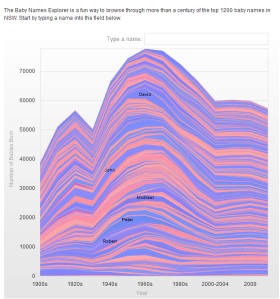
The Baby Name Explorer provides a way to browse through 110 years of the Top 1200 names in the state of New South Wales.

There’s two ways you can use it. The first way is just to scroll through the coloured graph on the website; the pink lines are girl names, the blue ones are boy names and the grey ones are unisex names. Aaron is at the top, and Zoe at the bottom. You can either find a name somewhere between Aaron and Zoe, and follow its fortunes through the years by moving across from left to right, or you can pick a period and move downwards to see what names were popular at a certain period.

For example, in the 1900s, William was the #1 name for boys, with 761 born each year, and Mary was the #1 name for girls, with 1150 born each year. (Leslie was the #1 unisex name). Some names from the 1900s are back in the charts, such as Ruby and Alexander, while Bessie and Clarence aren’t heard of so much these days.

The second way you can use it is to search for a particular name by typing it into the search bar. Once you do that, the name you ask for will come up alone on the chart in bright red and you see its popularity at various times.

For example, when I type in my own name, I can see that it wasn’t even in the Top 100 at the beginning of Federation, and didn’t become Top 100 until the 1950s. It was #55 in the 1970s, peaked in the 1980s, when it got to #39, and since then has declined until it is #71 today. Even though I wasn’t born in New South Wales, it’s still interesting information.

It’s obviously a great historical name resource, so thank you very much to the NSW Registry of Births, Deaths and Marriages, and to the Powerhouse Museum for supplying us with this database.

Boys Names That Only Chart in Australia

31 Sunday Jul 2011

Posted by A.O. in Name Themes and Lists

≈ 28 Comments

Tags

Arabic names, Biblical names, celebrity baby names, english names, famous namesakes, Gaelic names, hebrew names, honouring, Irish names, literary namesakes, locational names, name data, name history, name meaning, name popularity, nicknames, popular names, Scottish names, surname names

Campbell

This is a Scottish surname, which was originally a Gaelic nickname, Caimbeul, meaning “wry, twisted or crooked mouth”. A p was later added to the spelling in the belief the name was from the French for “beautiful field”. I suppose that meaning seemed a lot more appealing. The Clan Campbell was one of the largest and most powerful of the Highland clans, and the chief of the clan became Duke of Argyll. There are many prominent Australians with this surname. Campbell is #60 in Tasmania, which is very proud of its Scottish heritage, and has a historic town called Campbell. Campbell is on the US Top Top 1000, but only as a girl’s name. As a boy’s name, it has appeared only sporadically, peaked in 1885 at #700, and hasn’t been seen there since 2005.

Darcy

An English surname, from a French place name meaning “town of the bear”, which was introduced by the Normans as the surname of one of William the Conqueror’s barons. It can also be interpreted as an anglicised form of a Gaelic surname meaning “son of the dark one”, and this is a more likely origin in Australia. Although romantics cannot help connecting this to Mr Fitzwilliam Darcy from Jane Austen’s Pride and Prejudice, the most famous Australian with this surname is probably Les Darcy, the folk hero boxer. There are a number of notable Australian men called Darcy, including D’Arcy Niland, the roving novelist, Darcy Ward, the motorcyclist, Darcy Lussick, the rugby league player, and Darcy Dugan, the notorious bank robber. As you can see, although Darcy is unisex, it’s a very manly name here, and only Top 100 for boys. It’s #94 in New South Wales, #57 in Victoria, #97 in South Australia, #75 in Tasmania and #54 in the ACT. Darcy as a male name hasn’t been on the US Top 1000 since 1970, and it peaked in 1968 at #868.

Eamon

The Irish form of Edmund, this is pronounced AY-muhn. It’s use today is probably influenced by the sprint swimmer Eamon Sullivan (pictured). An Olympic athlete, Eamon is not only a good-looking underwear model, he also proved he was a fantastic cook by winning Celebrity Master Chef. Little wonder that he then went on to claim Cleo‘s Bachelor of the Year Contest. It’s #71 in the ACT, and has never charted in another country.

Flynn

An Irish surname meaning “son of Flann”; the name Flann means “red” and was the name of a 9th century Irish king. In Australia, it’s most strongly associated with the Tasmanian-born Hollywood film legend, Erroll Flynn. His name was bestowed upon Disney prince Flynn Rider in honour of Erroll Flynn, as the character has much in common with the actor. As this name has been given to Miranda Kerr and Orlando’s Bloom’s son, Flynn Christopher Bloom, I can see it gaining further in popularity. It’s #94 in Victoria, #79 in Tasmania and #80 in the ACT. It’s never charted in another country.

Hamish

This is the anglicised form of Seumas, which is the Scottish form of James; it’s pronounced HAY-mish. Its current popularity is almost certainly due to a well-known comedian who stars on both radio and television, called Hamish Blake. Multi-award winning, he was recently voted the most recognisable celebrity, and will be included in this year’s issue of Who’s Who. The name is #60 in New South Wales, #49 in Victoria, #45 in South Australia, #28 in Tasmania and #34 in the ACT. Hamish only just made it onto the list – it’s only recently left the Top 100 for Scotland.

Jai

A Hindi name which means “victory”, it can apparently be pronounced either JAY or JY. Jai has been in use in Australia since the 1970s. Jai Abberton is a former pro surfer who is a member of the notorious Bra Boys Gang. Jai Koutrae is an actor who’s appeared in several popular soap operas. Jai Ayoub plays rugby for Western Harbour. Jai Larkan is the lead singer of folk-rock band, The Wishing Well. Jai Taurima is a retired athlete who won silver at the 1998 Commonwealth Games. Lots of guys called Jai! It’s currently #98 in Victoria and #95 in South Australia. It only ever seems to have charted in Australia.

Jed

The short form of the Hebrew name Jedidiah, which means “beloved of Yahweh”. In the Bible, this was a term of endearment given to King Solomon by the prophet Nathan. In use in Australia since the 1980s, there are a number of athletes with this name, including AFL player Jed Adcock (who this year welcomed a daughter named Lily Rose). There’s also some rock singers with the name Jed, including Jed Kurzel, who did the music for the film Snowtown. It’s #99 in Tasmania, whose rural population seems suited to the rustic charms of this name. Jed was on the US Top 1000 from 1947-1989; it peaked in 1978 at #481.

Lachlan

This is a Highland Scottish name from the Gaelic Lochlann, which was used as a nickname for someone from Norway – “the land of the lochs (lakes)”. It’s pronounced LOHK-luhn. There was a strong relationship between the neighbouring lands of Norway and Scotland during the Middle Ages, as both battled for control of the Western Isles of Scotland. There were diplomatic missions between the two nations, and even intermarriage between the royal houses. The name Lachlan has a long history in Australia, owing much to Lachlan Macquarie, a British military officer from the Hebrides who served as Governor of New South Wales from 1810-21, in the period when it was transitioning from a penal colony to a free settlement. He therefore played a major role in the shaping of Australian society, and his liberal views toward ex-convicts and lavish expenditure on public works had a great impact on New South Wales. There are 30 places in Australia named after him, and 6 named after his wife, Elizabeth; on his tomb in Scotland he is called “The Father of Australia”. (American readers may be interested to know that he fought very successfully during the American War of Independence – on the British side of course). When media magnate Rupert Murdoch chose Lachlan as his eldest son’s name, he was perhaps drawing on his own Scottish heritage and honouring a great man from Australian history. Forty years later, this name is still going strong, and there is another generation of well-known Lachlans giving it new impetus, such as soap actor Lachlan Buchanan, and fullback for the Penrith panthers, Lachlan Coote. The name is #6 in New South Wales, #13 in Victoria, #5 in South Australia, #5 in Queensland, #12 in Tasmania and #3 in the ACT. It’s never charted in any other country.

Nate

A short form of Nathan, which is a Hebrew name from the verb “to give”; it can be interpreted as “given”, in the sense that God has given a child. Less persnickety baby name sites often interpret it as meaning “gift”, or “gift from God”, which is a more user-friendly way of putting it. The short form has proved very popular here recently, and I can’t help wondering if that’s partly because Australian baby name sites sometimes list Nate as meaning “little gift”, which I think is taking looseness of interpretation a bit far! Nate has a similar level of popularity to Nathan, and if you’re wondering why I don’t mention Nathaniel as a source of Nate, that’s because it’s not well enough known here to have a nickname yet. A famous Nate is Nate Myles, who plays for the Sydney Roosters in the NRL. It’s #60 in Victoria, #52 in South Australia, #44 in Western Australia, #58 in Tasmania and #50 in the ACT. It’s never charted in any other country.

Taj

An Arabic name meaning “crown”, it’s probably best known from the Taj Mahal in India, the name meaning “crown of buildings”. Taj Burrow is an Australian surfer, and as he’s from Western Australia, it’s not surprising that the name is #42 in that state. Taj has only been on the US Top 1000 twice, in 1976 and 1998, and never got higher than #951.

Zac

The short form of Zachary, the English form of Hebrew name Zechariah, meaning “Yahweh remembers”. In the New Testament, Zechariah is the father of John the Baptist. This seems to have done particularly well as a full name here. It’s been around long enough to have some famous Zacs already, such as Zac Dawson, who plays for St Kilda in the AFL, and Zac Drayson, an actor on the popular soap opera, Home and Away. American actor Zac Efron probably isn’t doing it any harm either. Early this year, V8 ute racer Craig Dontas named his second son Zac Michael. It’s #76 in New South Wales, #52 in Victoria, #77 in South Australia and #80 in Tasmania. It hasn’t charted in any other country.

Close But No Cigar

These names don’t make the top 1000 in the United States, but do chart in countries besides Australia

Angus – #75 in Scotland

Archie – #24 in England/Wales, #43 in Scotland

Reuben – #67 in N. Ireland, #71 in England/Wales

Tom – #10 in France, #18 in Belgium, #38 in Netherlands, #62 in Ireland, #93 in N Ireland

Harvey – #47 in England/Wales

NOTE

Please also read Girls Names That Only Chart in Australia, as it contains information relevant to this blog entry. Since then, the 2010 list for England/Wales has been released.

Girls Names That Only Chart in Australia

24 Sunday Jul 2011

Posted by A.O. in Name Themes and Lists

≈ 29 Comments

Tags

African names, Arabic names, Australian Aboriginal names, celebrity baby names, colour names, created names, english names, famous namesakes, fictional namesakes, Greek names, hebrew names, holiday names, Indian names, Irish names, Latin names, locational names, Mer de Noms, mythological names, name data, name history, name meaning, name popularity, nature names, nicknames, plant names, popular culture, popular names, saints names, Sanskrit names, surname names, Swahili names, unisex names, vocabulary names

Recently, Lou at Mer de Noms has had a couple of articles on names that are in the UK Top 150, but fail to make the US Top 500. It’s an interesting look at differences in name popularity between the two countries. I thought about doing the same thing from an Australian perspective, but found the list became too long for my purposes. So I made my conditions a bit tighter – these are names that are on a Top 100 list in Australia, but don’t make the Top 100 in any other country, and aren’t on the US Top 1000.

Asha

Asha has two different origins and meanings. It can be seen as an Indian name from the Sanskrit for “hope, wish, desire”, or an East African name from the Swahili word for “life”. Either way it has a beautiful meaning, and both Indian and Swahili names are becoming fashionable in Australia. It fits in well with other popular Ash- names, such as Ashley, Ash, Asher and Ashton. There’s an attractive TV presenter in Australia called Asha Kuerten (pictured), which has probably helped it gain momentum here. Asha is currently #89 in Victoria, #77 in South Australia, and #68 in the ACT. It’s never been higher than #794 on the US Top 1000 (in 1989), and hasn’t charted there since 2003.

Bridie

This is a pet form of the Irish name Brighid or its anglicised form, Bridget, which means “exalted one”. In Irish mythology, Brighid was the goddess of fire, poetry and wisdom. There was a 5th century Irish saint called Brigid, who is the patron saint of Ireland, and whose feast day on February 1 coincides with the pagan festival of Imbolc (possibly this day was sacred to the goddess of the same name). As around 30% of Australians claim Irish heritage, the name Bridie isn’t too unusual here, and there are several well-known women with this name, including Bridie Carter, a popular soap actress. Bridie is #70 in Tasmania, which has a particularly strong Irish community. It doesn’t chart in any other country.

Ebony

This is from the English word for the valuable black wood which comes from the ebony tree; different species are native to India, Sri Lanka, Indonesia, Mauritius, and West Africa. Although Ebony is often said to be used mostly by African-Americans in the United States, in Australia it is not connected to a person’s skin tone and is just seen as another colour name, like Ruby, Jade or Amber, or a plant name, like Rose or Holly. The exoticism of this name seems to have possessed a strange fascination for Australian parents, and it has been a Top 100 name since the early 1980s. Perhaps popular songs from that decade, such as Ebony Eyes and Ebony and Ivory, helped give it a boost. It’s #63 in South Australia and #55 in Tasmania. In the United States, Ebony got as high as #132 in 1982, and hasn’t been on the Top 1000 since 2005.

Indiana

The name of an American state, it means “land of the Indians”, because of the high Native American population in the area at the beginning of the 19th century (unfortunately, not to last). Indiana was used as a girl’s name (at least in fiction) before the American state was founded: Fanny Burney’s 1795 classic novel, Camilla, features a beautiful but shallow character called Indiana Lynmere. Possibly the name was intended as an elaboration of India, then part of the British Empire. French author George Sand also gave a character this name in her first novel, Indiana (1832). In this book, Indiana is a beautiful, romantic Creole from Reunion, of part-Indian descent. Here, there is a young TV actress called Indiana Rose Evans, and early this year, former NRL player Glenn Hall had a daughter named Indiana Maree. This name has only been Top 100 since last year, and it’s #98 in Victoria. Indiana has not been on the US Top 1000 since the late 19th century.

Jorja

The name Georgia, also an American state name (the state is named after King George II), is more popular in Australia than anywhere else in the world, hovering around the #20 mark on most lists, and Top 100 since the early 1980s. The phonetic spelling Jorja has also proved popular here. It’s currently #88 in Tasmania. Jorja has only been on the US Top 1000 once, in 2006, when it was at #976.

Lucinda

This is an elaboration of the Latin name Lucia, meaning “light”. Always a rather literary name, it was created by Miguel de Cervantes for his 1605 novel, Don Quixote for a character in a farcical romantic subplot. The 17th century Spanish poet Lope de Vega wrote love sonnets to a woman he called “Lucinda” to protect her identity. In more recent fiction, Lucinda is the rather silly fairy godmother in the children’s novel Ella Enchanted, later made into a movie. Australian novelist Peter Carey’s Oscar and Lucinda won the 1988 Booker Prize, and was made into a film directed by Gillian Anderson. Another Australian connection is that Lucinda is the name of a small coastal town in Queensland. As Lucy is so popular, Lucinda seems like a pretty alternative which will allow Lucy/Lucie as a nickname. It was chosen for the name of lifesaver and reality TV star Dean Gladstone’s daughter Lucinda May. It’s # 67 in Tasmania. Lucinda hasn’t been on the US Top 1000 since 1987, and peaked in 1881 at #153.

Tahlia

The name Talia can come from a range of origins. It’s a variant of the Hebrew name Talya, which means “dew from God”; it’s the Italian form of Greek Thalia, which means “to blossom” (Thalia was one of the nine Muses); and it can also be a short form of Natalia, a Latin name which means “Christmas Day”. However, In Australia, Talia is often taken as coming from an Aboriginal word meaning “near water”. Talia has become hugely popular in many parts of Australia; it has a certain patriotic flavour, and is pleasingly multicultural, suiting a variety of backgrounds. Yet it is not found consistently on the Top 100 because it has so many variant spellings. Tahlia is the most common of these variants, and is beginning to overtake Talia because it makes the favoured pronunciation more clear. It’s #47 in New South Wales, #41 in Victoria, #39 in South Australia, #35 in Western Australia, #84 in Tasmania, and #52 in the ACT. Tahlia has never charted in any other country.

Tayla

A specifically feminine form of the popular unisex name Taylor, this may have been coined in imitation of Kayla and related names. However, I can’t help thinking it’s taking off in Australia partly because it looks similar to Talia and Tahlia. It’s #68 in South Australia, #40 in Western Australia, and #94 in Tasmania. Tayla has only been on the US Top 1000 twice – in 1998 and 2006, and was never higher than #924.

Zahra

This is an Arabic name usually translated as “radiance”. The meaning is gorgeous, and Arabic names are becoming increasingly fashionable here with our growing Islamic population. However, almost certainly the reason for its popularity in Australia is due to its similarity to the name Zara. Zara has been used in Britain since the 18th century, where it is the English form of the French name Zaïre, created by the author Voltaire in 1732 for his hugely successful play of the same name, and possibly based on the name Zahra. The drama was soon translated as Zara: A Tragedy, and proved a big hit with English audiences too, being staged well into the 19th century. For some reason, Zara has been a favourite in Australia for over a century, and there are several famous women from Australian history called Zara, including the glamorous wife of former Prime Minister Harold Holt. Zara is more popular in Australia than in any other country, and Zahra is rising on the basis of its success. It’s #82 in the ACT. Zahra has never charted in the United States.

Also Qualifying

Bronte and Lara, which were covered on earlier Name Lists – Bronte in Sydney Suburbs That Can Be Used as Girls Names, and Lara in Girls Names from Video Games. Bronte is #68 in Tasmania. Lara is #43 in New South Wales, #80 in Victoria, #79 in Tasmania and #52 in the ACT. Neither has ever charted in another country.

Close But No Cigar

These names don’t make the top 1000 in the United States, but do chart in countries besides Australia

Freya – #19 in Scotland, #21 in England/Wales, #68 in Ireland, #70 in N. Ireland

Harriet – #89 in England/Wales

Imogen – #32 in England/Wales, #77 in Scotland

Maisie – #34 in England/Wales, #36 in Scotland

Milla – #48 in Norway

Poppy – #22 in England/Wales, #47 in Scotland, #60 in N. Ireland

NOTE

There are some serious statistical issues facing anyone doing comparisons between countries. Australia doesn’t produce a national Top 100, states and territories have different population sizes, not all states and territories provide their Top 100, and one has refused to divulge any of its name data. Countries don’t all release their popularity charts for the year at the same time, so we are still waiting for the ones from England/Wales, for example, and I had to use the one for 2009. I used popularity charts from Behind the Name, and sometimes they are slow in updating their data as well. Not only that, but there is no data available for many countries.

So rather than getting into a mathematical tangle, this is only intended to be of general interest and show a few broad trends.

Midweek Sibset: Sunshine Coast Sibsets

13 Wednesday Jul 2011

Posted by A.O. in Sibsets in the News

≈ 5 Comments

Tags

celebrity baby names, name changes, name data, name popularity, popular names, sibsets

This week in the news is some name information from family history website Genes Reunited. By examing their database, they found there were only 1000 unique names in the public records (meaning first name and surname combinations).

It also looked at a few celebrity baby names to see how common they were.

The name Apple (as in Martin) has appeared on censuses in 1861, 1871 and 1911. The name Sunday (as in Kidman Urban) has been used 305 times between 1837 and 2005. Suri (as in Cruise) has been found 67 times between 1891 and 2005.

I found the story rather frustrating, as it didn’t say what records Genes Reunited had access to, or how far they went back, or even which countries they were in. Is this just Australian records? If so, why are they using the names of American and British celebrities to test their “uniqueness”? If there were 1000 unique names, why couldn’t they have listed at least a few of the more interesting ones for us?

It got even more frustrating when it told us that Bob Geldof’s daughter Fifi Trixiebelle was the only “unique” celebrity baby name. Obviously Fifi is not unique at all, and if they were counting first name-middle name combinations, why didn’t they do that with Apple Martin, Sunday Kidman Urban and Suri Cruise?

Even more silly was when it implied Fifi Trixiebelle’s sisters, Peaches and Pixie, also had “unique” names. For a start, Pixie is Little Pixie’s middle name, and Pixie is so far from being unique that I know three people with that name.

They also listed the “top 10 names of all time”, without telling us how far back they were counting from (surely not literally from the beginning of time), or from which countries they were getting data from (I can tell it’s not worldwide). However, this is the list:

Male: John, William, Thomas, James, George, Robert, Charles, Joseph, Henry, David

Female: Mary, Elizabeth, Sarah, Ann, Margaret, Jane, Alice, Hannah, Emma, Ellen

I couldn’t help feeling there were an awful lot of information missing and a heap of “apples to oranges” comparisons being made. We so rarely get news relating to baby name data, and when we do get some, it’s so garbled as to be almost useless. Grrr.

Apparently feeling the story was lacking some local colour, the article mentioned two sibsets from the Sunshine Coast area.

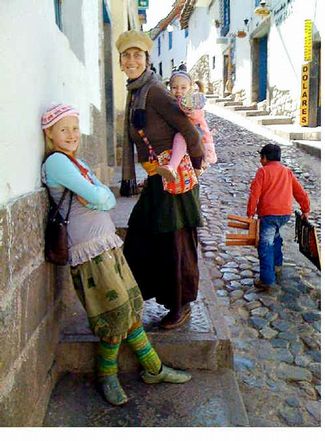
The first one is a family from Maleny, who this year decided to change their surname from Crossman to the more positive Love. They then gave themselves groovy extra middle names to suit their new surname. Dad Ben and mum Shumbi became Benjamin Funky Love and Shumbi Arka Real Love. Their 13-year-old daughter Sabiah is now Sabiah O’Hara Faery Love, and 5-year old Lola-Jae has become Lola-Jae Lucy Juicy Love. The exuberantly-named Love family are currently on a two-year trip around the world.

They were contrasted with a more sedate Twin Waters couple, Darren and Yokoh Geitz, who chose Asher and Austin for their sons, aged 4 and 2 months respectively.

(Story from The Sunshine Coast Daily, July 10 2011; picture of Shumbi Love and children from The Sunshine Coast Daily, January 25 2011)

Newer posts →

Enter your email address to follow this blog

Categories

Archives

Recent Comments

A.O.'s avatarwaltzingmorethanmati… on Zarah Zaynab and Wolfgang…
Madelyn's avatarMadelyn on Zarah Zaynab and Wolfgang…
JD's avatardrperegrine on Can Phoebe Complete This …
A.O.'s avatarwaltzingmorethanmati… on Rua and Rhoa
redrover23's avatarredrover23 on Rua and Rhoa

Blogroll

  • Appellation Mountain
  • Baby Name Pondering
  • Babynamelover's Blog
  • British Baby Names
  • Clare's Name News
  • For Real Baby Names
  • Geek Baby Names
  • Name Candy
  • Nameberry
  • Nancy's Baby Names
  • Ren's Baby Name Blog
  • Sancta Nomina
  • Swistle: Baby Names
  • The Art of Naming
  • The Baby Name Wizard
  • The Beauty of Names
  • Tulip By Any Name

RSS Feed

  • RSS - Posts

RSS Posts

  • Celebrity Baby News: Melanie Vallejo and Matt Kingston
  • Names from the TV Show “Cleverman”
  • Can Phoebe Complete This Sibset?
  • Zarah Zaynab and Wolfgang Winter
  • Baby, How Did You Get That Name?
  • Celebrity Baby News: Media Babies
  • Celebrity Baby News: Adelaide Crows Babies
  • Celebrity Baby News: Chris and Rebecca Judd
  • Names at Work: Name News From the World of Business and Employment
  • Celebrity Baby News: Sporting Round Up

Currently Popular

  • Celebrity Baby News: Jacinta Allan and Yorick Piper
  • Celebrity Baby News: Jacinta Allan and Yorick Piper
  • Celebrity Baby News: Craig Thomson and Zoe Arnold
  • The Top 100 Names of the 1940s in New South Wales
  • Celebrity Baby News: Ed Husic and Bridget Tilley

Tags

celebrity baby names celebrity sibsets english names famous namesakes fictional namesakes honouring locational names middle names name combinations name history name meaning name popularity name trends nicknames popular names saints names sibsets surname names twin sets unisex names

Create a free website or blog at WordPress.com.

Privacy & Cookies: This site uses cookies. By continuing to use this website, you agree to their use.
To find out more, including how to control cookies, see here: Cookie Policy
  • Subscribe Subscribed
    • Waltzing More Than Matilda
    • Join 517 other subscribers
    • Already have a WordPress.com account? Log in now.
    • Waltzing More Than Matilda
    • Subscribe Subscribed
    • Sign up
    • Log in
    • Report this content
    • View site in Reader
    • Manage subscriptions
    • Collapse this bar
 

Loading Comments...