 Bruno (Moretti)
Bruno Moretti won silver in table-tennis at the 1960 Paralympics, and a gold and two silvers in athletics at the 1964 Paralympics. Bruno is a Germanic name meaning “brown”. The name was used by the nobility in medieval Europe, and there are several saints named Bruno. One of them is Saint Bruno of Cologne, who was the son of Saint Matilda. He was Duke of Lotharingia and Archbishop of Cologne, and his court in Cologne was an intellectual and artistic centre. Bruno was also the given name of two popes – Gregory V and Leo IX. Bruno has a long history of use in Europe, and today is Top 100 in Croatia, Catalonia, Spain, and Chile. It’s also a common surname in Italy, and Giardano Bruno was a Dominican friar, philosopher, mathematician and astronomer, who suggested that the Sun was a star, and the universe had infinite worlds, populated by intelligent beings. He went down very badly with the Spanish Inquisition, who had him burned him at the stake. Today he is regarded as a martyr to science. Bruno is a warm cuddly-sounding name, and seems to be a popular choice for bears, both real and fictional.
Cody (Meakin)
Cody Meakin grew up playing both rugby union and Australian rules football; he broke his back in a rugby scrum, and while still in high school, became quadriplegic after a car accident. He took up wheelchair rugby in 2010, where he became an international champion. He won gold at the London Games this year. Cody is derived from the Gaelic surname Ó Cuidighthigh, meaning “son of Cuidightheach”. Cuidightheach is an Old Irish epithet meaning “helpful”. The most famous person with the surname must be “Buffalo Bill” Cody, an American frontiersman who became a celebrity for his Wild West touring shows; these introduced the concept of the American West to Britain and Europe. Buffalo Bill was a supporter of Native American rights, women’s rights and conservation, making him a very modern namesake, as well as giving the name Cody an “American West” feel. In the 1990 Disney film, The Rescuers Down Under, the boy from the Australian outback is named Cody. Cody first charted in the 1970s, and was top 100 by the 1990s. It peaked in the early 2000s at #59, and only left the Top 100 last year, when it dropped to #124.
Dylan (Alcott)
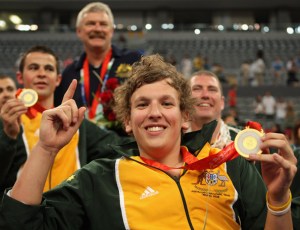
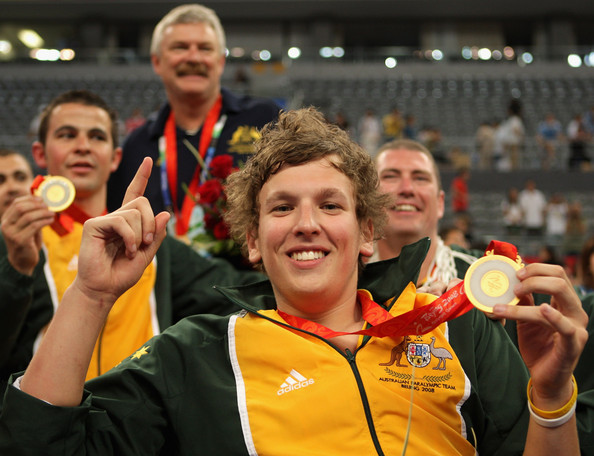
Dylan Alcott has been paraplegic from birth due to a spinal tumour, and began playing wheelchair basketball in 2003. He won gold at the 2008 Paralympics, and silver at this year’s London Games. Dylan is a Welsh name which is difficult to translate exactly, but very roughly means “flood, wave, tide”. In Welsh mythology, Dylan Ail Don was a blond god of the sea, and his epithets were “son of the wave” and “son of the sea”. In the legends, he is killed, and it’s said that the sound of the waves is the sea lamenting his death. The name became well known outside Britain due to the Welsh poet Dylan Thomas, who was named after the god. In Welsh, his name is pronounced DUL-uhn, but Thomas himself preferred the Anglicised pronunciation of DIL-uhn. Thomas’ emotionally powerful yet tightly controlled verse was admired by a young American named Robert Zimmerman, who promptly changed his name to Bob Dylan. As Dylan went on to become a folk balladeer, protest singer and counter-cultural icon, the name Dylan ended up with a double helping of street cred. Dylan first charted in the 1960s and reached the Top 100 in the 1980s. It peaked in the early 2000s at #17, and is currently #41.
Erik (Horrie)
Erik Horrie was left paraplegic after a car accident in 2001, and became involved in wheelchair basketball, but last year switched to canoeing. He won a silver medal at the 2012 London Games, and also welcomed his son Lewis. Erik is derived from Old Norse, and interpreted as “only ruler, eternal ruler, eternal power”. It has been heavily used in the royal houses of Denmark, Norway and Sweden, the most famous to us being Erik the Red, who explored a little-known country, called it Greenland, and became its head chieftain. King Erik IX of Sweden is considered to be a saint, and according to legend was martyred while attending a church service. The name Erik was used in England by the Anglo-Saxons, and settlers from Scandinavia but only became popular in the form Eric in the 19th century, thanks to an earnestly moralising book called Eric, or Little by Little. Other fictional Eriks include the Phantom of the Opera and Erik the Viking from the Monty Python film.
Fabian (Blattman)
Fabian Blattman became paraplegic after a motorcycle accident, and took up wheelchair athletics to improve fitness. One of our most successful Paralympians, he has set several world records. He won a silver and bronze in 1992, a gold and a silver in 1996, and a gold, silver and bronze in 2000. The name Fabian is derived from the Roman family name Fabius, one of the most ancient noble houses of Rome. According to legend, the Fabii claimed descent from Hercules, and were shepherds who followed founding father Remus. Their name is said to be from the Latin word for “broad bean”, a vegetable that the Fabii were supposedly the first to cultivate. The surname Fabianus was given to freed slaves who had been owned by the Fabii, and Fabian is from this name. It was introduced to England by the Normans, but never became as popular there as its equivalents in Continental Europe. There is a 3rd century Saint Fabian, who was elected pope by a dove; despite this unorthodox beginning, he was highly-regarded and worked hard for the early church. The Fabian Society gives this name a left-wing edge; the socialist organisation took its name from the Roman general Fabius Maximus, who wore Hannibal down by attrition rather than engaging in head-on battle.
Jago (Mikulic)
Jago Mikulic was a blind athlete who competed at the 1976 Paralympics, and won a silver in javelin and a bronze in the pentathlon. Jago is a Croatian form of James or Jacob, and is said YAH-go. It can also be a Cornish form of those names, but is pronounced JAY-go in this case. However, the Welsh form Iago is very old and predates the common use of Biblical names in Britain; K.M. Sheard suggests that it may be from the Celtic word for “ice”. If so, this would give Cornish Jago another possible origin.
Kerrod (McGregor)
Kerrod McGregor was a track and field Paralympian who won two golds, three silvers and two bronzes at the 1984 Paralympic Games, one gold in 1988, and one silver in 1996. Kerrod is an English surname that can be derived from the village of Curridge in Berkshire, with the village’s name meaning “Cusa’s ridge”. Cusa was a common Anglo-Saxon name, but what it meant I have been unable to discover. Another possible origin is the hamlet of Kerridge in Cheshire, which means “key ridge” – Kerridge Ridge is one of the foothills of the Pennines. The surname seems to have been most common in Yorkshire. The name Kerrod is well known in Queensland from former NRL star Kerrod Walters, who had a twin brother named Kevin.
Nazim (Erdem)
Nazim Erdem was born in Turkey and came to Australia early in life. As a kid, he practised holding his breath under water as a little game with himself. At the age of 20 he dived into shallow water in an effort to impress some girls; he was underwater for two and a half minutes before being rescued, and his technique of holding his breath saved his life. After the accident, he was quadriplegic. He began playing wheelchair rugby in 1992, and won silver medals at the 200 and 2008 Paralympics, and a gold at the London Games. Nazim is an Arabic boy’s name which means “organiser, convenor”, and as a title, loosely corresponds to the word “mayor” in English. The name isn’t uncommon in Turkey, and Nâzım Hikmet was a charismatic Turkish writer, a leader of the literary avant-garde who was often arrested for his revolutionary political beliefs, and spent much of life in prison or exile. His poetry and his struggles for peace are widely admired in Turkey and outside it; some of his poems have been turned into songs by folk singers such as Joan Baez and Pete Seeger. The name is pronounced NAH-zim.
Rene (Ahrens)
Rene Ahrens won a bronze in discus in 1980 and 1988. René is the French form of the Latin Renatus, meaning “born again, reborn”, referring to the act of baptism, and a popular choice for early Christians. René was a name used by the French aristocracy, and the name is known to us through the philosopher René Descartes (“I think therefore I am”). There is a Saint René Goupil, a French missionary to Canada who is one of the rare North American martyrs. The name is pronounced reh-NAY. Although the feminine form Renee has been popular in Australia, masculine Rene remains very rare here – no doubt partly because it could easily be confused with the girl’s name.
Tristan (Knowles)
Tristan Knowles lost his leg at the age of 9 as a result of cancer, and also lost a lung at the age of 11. He has been playing wheelchair basketball since 1999, and in 2002 was named the NSW Wheelchair Basketballer of the Year. He won silver in 2004, gold in 2008, and a silver at this year’s Paralympic Games in London. Tristan is a Cornish hero of Celtic folklore who is also one of King Arthur’s knights of the Round Table. He is best known as the lover of the beautiful Irish princess Iseult (or Isolde). Iseult was to marry Tristan’s uncle, King Mark of Cornwall, but she and Tristan accidentally drank a love potion that had been prepared for Mark and his bride to share. The two became hopelessly infatuated with each other and embarked on a passionate affair, until Tristan was banished from Cornwall by an understandably irate Uncle Mark. The story was enormously popular in the Middle Ages, and is one of the forerunners to the story of adulterous lovers Lancelot and Guinevere. The name Tristan was yet another revived in the Victorian era, thanks to Tennyson, and the poems he wrote based on Arthurian legends. In the story, Tristan’s name is supposed to be linked with triste, the French word for “sad”, to fit in with his tragic love life. However, it is a form of the Pictish name Drust, which means “riot, tumult”. Drust was a traditional name amongst the royalty of Scotland, and it’s quite a puzzler as to how a Cornish story ended up with a hero with a Scottish name. Some claim that Tristan was a real person, pointing to a 5th century stone in Cornwall, which is supposed to be the grave marker for someone named Drustanus, the son of Cunomorus. Titillatingly, Cunomorus is said to be King Mark himself, suggesting that Tristan and Iseult’s step-incest was even closer and creepier (although his uncle was also his adoptive father anyway). Tristan and Iseult are two literary characters I’ve never been able to warm to, as their actions are so selfish; perhaps the story is trying to tell us that nobody does very well out of an infatuated love affair, not even the lovers themselves. Tristan first charted in the 1960s, and has managed to reach #100 twice, in the 1980s and late 2000s. It’s currently #123.
(Photo of Dylan Alcott celebrating victory from Zimbio)

 Jason Bright from Brad Jones Racing, and his fiancee Lucy Peacock, welcomed their first child on October 22, and have named their son Lennox Jay, to be nicknamed L-Jay or Lenny. The middle name is in honour of a family friend. Lucy is originally from England, and is the Media Manager for Brad Jones Racing.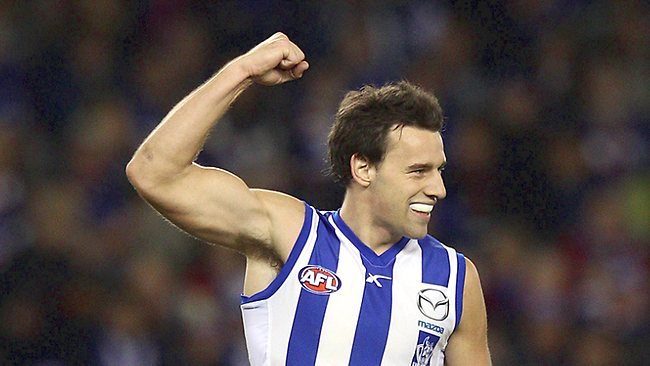





 Waltzing More Than Matilda