• About
  • Best Baby Names
  • Celebrity Baby Names
  • Celebrity Baby Names – Current
  • Celebrity Baby Names – Past
  • Featured Boys Names
  • Featured Girls Names
  • Featured Unisex Names
  • Links to Name Data
  • Waltzing on the Web

Waltzing More Than Matilda

~ Names with an Australian Bias of Democratic Temper

Waltzing More Than Matilda

Category Archives: Famous Names

Famous Name: Beyoncé

21 Saturday Jan 2012

Posted by A.O. in Famous Names

≈ 1 Comment

Tags

American names, celebrity baby names, created names, Creole names, French names, honouring, Louisiana names, popular culture, surname names, UK name popularity, unique names, US name popularity, virtue names

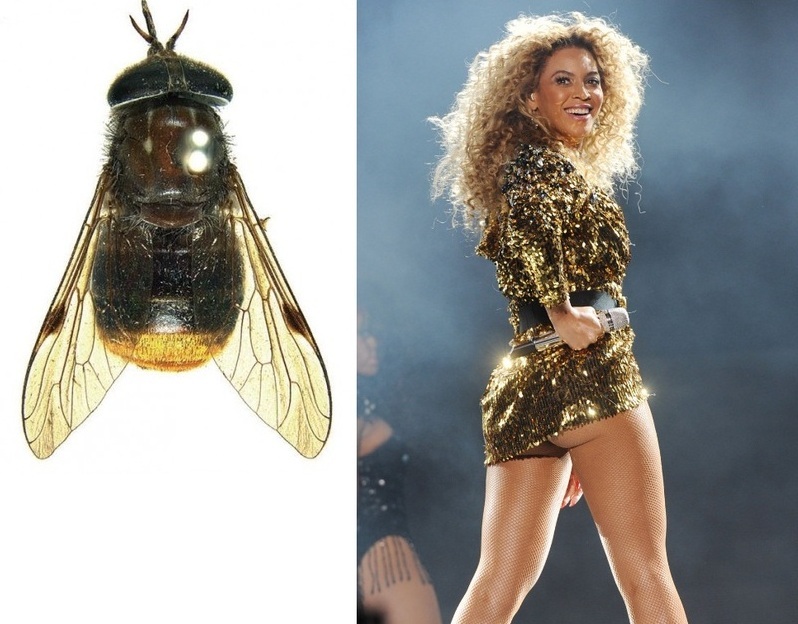
Pop diva Beyoncé has been in the news a lot recently, since the birth of her first child, Blue Ivy Carter. However, her name has hit the headlines for a different reason, after inspiring an Australian taxonomist to name a horse fly after her.

Bryan Lessard, from the CSIRO’s Australian National Insect Collection in Canberra, named the fly Scaptia (Plinthina) beyonceae because it has a prominent golden lower abdomen. To Bryan, who admits to being something of a fan, the unique dense gold hairs on the fly reminded him of Beyoncé’s flashy golden stage outfits.

The rare fly was collected in 1981, the same year Beyoncé was born, from eucalypt forests in the Atherton Tablelands of Queensland.

I’m not sure whether this is the most flattering thing that’s ever happened to Beyoncé, but I love that it shows scientists are just normal people who listen to R&B in their labs while they work, and find themselves as captivated by a gold frock as the next person. And perhaps are human enough to want to see their names in the gossip magazines, and maybe even get a personal response from their idol (she hasn’t made one).

BEYONCE

Beyoncé’s name is as unique as the horse fly, being created especially for her. Her mother Tina’s maiden name is Beyincé, a Creole surname from Louisiana. When she discovered that the Beyincé name was dying out, Tina decided to call her daughter Beyoncé, her own version of the surname. Apparently Tina’s parents were not impressed at first, because “that’s a last name”.

Beyincé is a form of the French surname Boyancé, related to the Old French word for “wood”. It’s an equivalent of English surnames such as Woodward or Forrester.

While the names of celebrities often become popular baby names (think Scarlett and Ashton, for example), Beyoncé’s name remains in very rare use. It belongs so completely to herself, and no other.

DESTINY

Destiny’s Child was the successful girl group of which Beyoncé was a founding member, prior to her embarking on her solo career.

The English word destiny comes from French, and ultimately from the Latin destino, the source of the word destination, meaning “appoint, establish”. It comes from an ancient root meaning “to stand, to place” (also the source of the word obstinate). Destiny is used as a synonym for the word fate, although technically fate is the divine agency or power which brings about the predetermined future events which are our destiny.

Destiny has been used as a girl’s name since the 19th century, and originated in the United States. It has been on the US Top 1000 since 1975, and reached the Top 100 in 1994, leaving it in 2012. It is currently #203.

In the UK, Destiny peaked in 2001 at #211 , and is currently #412. It is also in use in The Netherlands, and is a fairly uncommon name in Australia, although certainly not unknown.

Apart from Destiny’s Child, the name may remind you of Destiny Cyrus, the birth name of actress and singer Miley Cyrus (born just after the name reached the Top 100). It’s a slightly dated virtue name which still has a spiritual or philosophical feel to it, but also suggests the strength to forge your own path in life, to make your own destiny.

POLL RESULTS

Beyoncé gained an approval rating of 15% from the public. Only one person liked the name Beyoncé, while 68% thought it was terrible.

Destiny did rather better, with an approval rating of 32%. However, once again only one person liked the name, and 48% thought it was terrible.


Famous Name: Elvis

14 Saturday Jan 2012

Posted by A.O. in Famous Names

≈ 12 Comments

Tags

famous namesakes, honouring, Irish names, Latin names, mythological names, name history, name meaning, saints names, surname names, UK name popularity, unisex names, US name popularity

This article was first published on January 14 2012, and substantially revised and re-posted on September 14 2016.

Famous Festival
On January 11, the 20th annual Elvis Festival kicked off in the country town of Parkes, west of Sydney – an annual celebration of Elvis Presley’s life and music. For five days in the second week of January, the population of Parkes is swelled by Elvis impersonators, women with big hair, and people wearing blue suede shoes. There are parades, contests, dancing, singing, hip swivelling, and a mass renewal of wedding vows performed by a celebrant in an Elvis costume.

The festival began in 1992, when a small group of local Elvis fans decided to hold a festival on the day of the star’s birthday, January 8.  The next year the festival attracted 200 people from around the country; by 2005 they came in their thousands, by 2007 it had been extended to five days, and now there are more than a hundred events, and the town’s population of 10 000 more than doubles during the Elvis Festival.

The townspeople were originally lukewarm on the Elvis Festival idea. Parkes is the proud owner of an observatory, which has at times assisted NASA on space missions (as fictionalised in the movie The Dish), and had always seen itself as devoted to science and research. An Elvis Festival seemed a bit frivolous.

However by now Parkes has fully embraced the festival, and the whole town gets into the fun by dressing up and decorating the buildings. It’s one of the mayor’s roles to dress as an Elvis impersonator and meet the train from Sydney, where all the similarly-attired fans have travelled together.

People flock here from all over the globe to come to the self-proclaimed Elvis Capital of the World. It injects millions into the economy of the town, and in 2007 they set a record for the most number of Elvis impersonators in one place.

In 2017 the Festival will celebrate its 25th birthday and the theme will be Viva Las Vegas.

Name Information
Elvis Presley was one of those performers lucky enough to have been given such a distinctive name that he had no need to choose a stage name. He was named for his father Vernon, whose middle name was Elvis.

Elvis is an Anglicisation of the Irish name Ailbhe, said like Alva: the meaning is not known for sure, but may derive from the Gaelic albho, meaning “white” – it is also Anglicised as Albus, the Latin for “white”. The name Ailbhe could be given to either sex, and in Irish legend there is a female warrior and follower of Finn McCool named Ailbhe.

A male example of the name is Saint Ailbhe, nearly always known as Saint Elvis. He was a 6th century bishop venerated as one of the four great patron saints of Ireland. Saint Ailbe’s legend is quite fairy-tale – cast out by his royal father (like Oedipus), he was raised by a she-wolf (like Romulus and Remus), and at the end of his life voyaged by ship to the Otherworld (like King Arthur going to Avalon). There is a Welsh village named St Elvis in the saint’s honour, as he is said to have baptised Saint David, the patron of Wales, in this area.

The English surname Elvis does not seem to be derived from the Irish name, and is probably a variant of the surname Elwes, which comes from the female name Heloise or Eloise.

Elvis has been used as a name since perhaps the 18th century, and in Ireland seems to have been used as a female name, although it wasn’t common (today Ailbhe is a popular name for girls in Ireland). However in England the name was mostly masculine, suggesting that there the surname was the primary influence.

The name Elvis went on to become most commonly used in the United States, and was usually a boy’s name. Despite the feminine origin of the surname, it probably sounded like male names such as Alvis and Alvin, giving it a masculine feel.

In Australian records Elvis was nearly always given to girls in the late 19th and early 20th centuries which makes sense considering our strong Irish heritage. It also fit in with turn-of-the-century name trends for girls, such as Alva and Elva. Once Elvis Presley became famous in the 1950s, the name virtually disappeared from records as a girl’s name.

In the US, the name Elvis has charted on and off in the Top 1000 for boys since the late 19th century, becoming more established there around 1910. Before Elvis Presley became famous, its highest peak was #584 in 1919, and it was #900 in 1935, the year Elvis Presley was born.

The name Elvis went off the charts around the time Elvis Presley began his career in 1954, but returned in 1955, so the star did affect the name’s popularity. Elvis peaked in 1957 at #312, the year after Presley released number one hits such as Heartbreak Hotel and made his film debut in Love Me Tender – female fans screamed with excitement non-stop during the movie, even though it had quite a serious plot and a sad ending.

The name Elvis last charted in the US Top 1000 in 2011. Last year in the US there were 180 baby boys given the name Elvis, and numbers are fairly stable.

In the UK, the name Elvis has charted since the 1990s, and the name made the Top 1000 in the early 2000s, peaking at #761 in 2003, and again in 2008 when it made #943. It rose steeply last year, and was back on the Top 1000 at #873.

In Australia, Elvis is not a common name, but I generally see two or three examples of it as a baby name per year – enough to convince me it isn’t a rare name either, and probably has a similar popularity to the UK. A famous Australian with the name is former mixed martial artist Elvis Sinosic.

Elvis has two other musical namesakes. One is British star Elvis Costello, who was born Declan MacManus, and the other is American folk singer Elvis Perkins, the son of actor Anthony Perkins (Elvis Perkins was born the year before Elvis Presley died). Costello’s manager chose the stage name Elvis in reference to Presley, while Anthony Perkins was an Elvis fan.

Elvis, if you forget about its most famous namesake for a moment, sounds like a vintage name ready for revival, complete with fashionable V. And yet it never can be separated from Mr Elvis Aaron Presley. The name will always conjure images of white satin bodysuits covered in rhinestones, brilliantined dark hair, and a heart-stopping smile.

Even though Elvis is not a rare or unusual name, it’s still something of a bold choice as it’s likely to elicit some strong opinions. But you’ll have to tell the naysayers you’d like a little less conversation about it, because you can’t help falling in love with the name Elvis. It’s a truly royal name because it belongs to the one and only king, baby!

POLL RESULTS
Elvis received an approval rating of 42%. 35% of people thought the name was too closely associated with Elvis Presley, although 9% thought it was either handsome or cute. Only one person thought the name Elvis sounded redneck.

(Picture shows Elvis impersonators at the Parkes Elvis Festival, with the Observatory in the background)

Famous Names: Tully and Yasi

07 Saturday Jan 2012

Posted by A.O. in Famous Names

≈ 8 Comments

Tags

Australian name trends, created names, cyclone names, famous namesakes, Fijian names, Game of Thrones names, Irish names, locational names, name history, name meaning, names of rivers, nature names, pen names, rare names, Roman names, surname names, tree names, UK name popularity, unisex names, US name popularity

This blog entry was first posted on January 7 2012, and revised and republished on August 31 2016.

TULLY
On January 3, the town of Tully in Queensland celebrated the upgrade of its famous Golden Gumboot, which was damaged by Cyclone Yasi nearly a year ago. The tourist attraction is a 7.9 metre (26 feet) high gumboot, painted gold, built to commemorate the town’s 1950 highest recorded annual rainfall level of 7.9 metres (310 inches), earning Tully the distinction of being Australia’s wettest town.

When the Golden Gumboot was re-opened, it had received a fresh coat of paint and a new viewing platform. Fittingly, it rained heavily throughout the ceremony.

The town of Tully is named after the nearby Tully River, which received its name from Surveyor-General William Alcock Tully. William Tully was originally from Dublin, and arrived in Hobart as religious instructor on a convict ship in 1850 before embarking on a career of conscientious public service.

Tully is an Anglicised form of an Irish surname, originally MacTully, and having a host of variants, which is often derived from tuile, the Gaelic word for “flood”. Another theory is that it has been mistranslated from toile, meaning “will” (as in the will to keep going). However, some Tullys are so convinced of the first interpretation that they have hyper-Anglicised their surname to Flood.

The meaning of “flood” is very appropriate for the name of a river, and a town famous for its sogginess. In Game of Thrones, the Tully family is one of the Great Houses and as it is the principal house in the Riverlands and their ancestral home is Riverrun, perhaps George R.R. Martin also had the Irish surname and meaning in mind.

Tully has been used as a personal name since the late 18th century. Although the name can be found in early records from Ireland, it seems to have been more frequently used in the United States.

One inspiration for it may have been the Founding Father Alexander Hamilton, who wrote patriotic pamphlets under the pen name Tully – in his case, a reference to the Roman philosopher Marcus Tullius Cicero, whose name was occasionally Anglicised to Tully. The Tullia took their surname from the legendary Roman king Servius Tullius; the name is so ancient we do not know its meaning.

Tully has never been a common name. Last year in the US there were 8 boys named Tully with no girls listed with the name since 2013. In the UK the name has been in sporadic use, and in 2014 there were 4 baby boys named Tully. No girls are listed as having been given the name since 2009.

In Australia I have seen a roughly equal number of boys and girls with this name, and the name may be more evenly unisex here than elsewhere. One boost to the name for girls is women’s basketball champion Tully Bevilaqua, and after the attractive but controversial Tully Smyth competed on Big Brother in 2013, I heard many Australian parents refer to Tully as a “girl’s name”. Perhaps more importantly, it fits with the Australian trend for female names with a T-L pattern, such as Talia, Tilly, and Tallina.

YASI
The town of Tully was one of the worst affected by Cyclone Yasi, which hit the coast of northern Queensland early in the morning on February 3 2011. The town suffered extensive damage to its main street, and the area’s banana crops were completely flattened. Because Cyclone Yasi originated in Fiji, it was a Fijian cyclone forecaster called Misaeli Funaki who chose its name.

If you think naming a baby is difficult, spare a thought for the meteorologists who name cyclones. The cyclone had to start with Y, and nobody could think of an appropriate name for either gender.

So Mr Funaki suggested Yasi, which is the Fijian word for “sandalwood”. It didn’t have a history as a personal name in Fiji, but with no other candidates, his nomination was accepted by the ruling UN body. And so a new name was created.

Sandalwood is a tree with fragrant wood native to Asia and the Pacific. Australia has a sandalwood industry; the tree’s oil is used to make incense, soaps and cosmetics. Its antibacterial properties make it excellent as a skin cleanser, and Australian Aborigines eat its fruit as a bush food. Sandalwood is also used in the rituals of several eastern religions.

Yasi is neither used for boys or girls in Fiji. The cyclone forecasters were looking for a male name when they chose it, but they often resort to unisex names, and probably meant Yasi to be one. It’s commonly said to rhyme with Darcy, but seems to be more correctly pronounced YAH-zee.

During Cyclone Yasi, one doctor was apparently very keen for all babies born during the cyclone to be named Yasi, but there is no record of anyone following his advice. However you can find people around the world with the name Yasi, mostly female – perhaps a short form of names such Yasmin.

These are two short unisex names important to Australia’s history, especially connected with Queensland, rain, and storms. Tully is uncommon, but not unheard of, while Yasi is a true rarity, but not unusable.

POLL RESULTS
Tully received a very good approval rating of 70%. 46% of people thought it was a good name, while not one person hated it. Yasi was far less popular, with an approval rating of 22%. 53% of people weren’t keen on the name, and only one person loved it.

(Photo shows the Golden Gumboot in Tully, Queensland)


Famous Name: Douglas

03 Saturday Dec 2011

Posted by A.O. in Famous Names

≈ 22 Comments

Tags

aristocratic surnames, famous namesakes, locational names, name history, name meaning, name popularity, name trends, names of rivers, nicknames, Scottish names, surname names, UK name popularity, unisex names, US name popularity

doulass

This blog post was first published on December 3 2011, and substantially revised and reposted on December 10 2015.

Famous Namesake
Yesterday marked one hundred years since the Australasian Antarctic Expedition set sail from Hobart in the SY Aurora on December 2, 1911. It arrived at an unexplored region of Antarctica on January 8, 1912, and set up base camp. The site proved to be unrelentingly windy, with constant blizzards that made things hellish for the intrepid explorers.

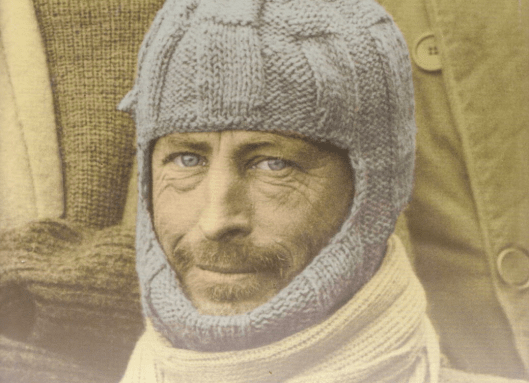
Douglas Mawson was one of the leaders on the expedition. A geologist and lecturer from the University of Adelaide, he had been asked to join Robert Scott’s British expedition to find the South Pole (Scott was famously beaten to the punch by Norwegian Roald Amundsen). Mawson turned him down, as he thought it would be better to take his own team, and lead an expedition to the unexplored bits of Antarctica, which was most of it.

Douglas was part of a three-man sledging team called the Far-Eastern Party, which included Belgrave Ninnis, the son of a British arctic explorer, and Swiss mountaineer Xavier Mertz.

The group was making excellent progress when Ninnis fell into a snow-covered crevasse that the other two men crossed without incident; he took with him six huskies, a tent, most of the food and other essential supplies, and was never seen again. The glacier they were traversing is now called Ninnis Glacier in his honour.

Mawson and Mertz continued their frozen nightmare, forced to eat their huskies to supplement their scant rations. Although both men were unwell, Mertz became seriously ill and died in less than a week. It is thought that he may have died of an overdose of Vitamin A from eating husky liver, which Mawson solicitously fed him, in the fond belief that he was giving Mertz the best of the provisions.

Other theories are that Mertz died from hypothermia, from the shock of eating meat after being a vegetarian, or from the psychological stresses of the journey – especially the death of Ninnis, as the two men had been exceptionally good friends.

In the days before he died, Mertz became weak, exhausted, dizzy and delirious, even biting off the tip of one of his own fingers. He had dysentery, nausea, and stomach pain; his skin peeled away and his hair fell out – not surprisingly, another of his symptoms was depression. Whatever he died from, his demise caused him terrible suffering.

Douglas Mawson sledged the last 100 miles alone, falling into a crevasse on the way and having to climb out using the harness, only to see the boat he was to have returned on disappearing over the horizon. He had to spend another year in Antarctica.

Douglas was knighted in 1914 and The American Geographical Society awarded him a medal in 1916. The work he did was ground-breaking, and led to Australia getting its own portion of Antarctica, from where we still do important research.

For decades Sir Douglas Mawson was regarded unquestioningly as a hero, and his image is on the snow-white Australian $100 note. More recently his part in the expedition has been scrutinised, and attracted criticism. However there is no doubting his strength, courage, and determination to survive against all odds. He is remembered as an enthusiastic and kind man who never boasted of his remarkable exploits.

Name Information
Douglas is an Anglicisation of Scottish surname Dubhghlas meaning “dark river”. It originally belonged to the Douglas Water, which is a river in South Lanarkshire in southern Scotland. On its shores is a village named Douglas after the river, and the Douglas family took the village’s name as their surname when they moved here in the 12th century.

The Clan Douglas was one of the most powerful families of Scotland in the Middle Ages, often holding the real power behind the throne. The heads of the House of Douglas held the titles of the Earl of Douglas and the Earl of Angus, sometimes known as the Black Douglas and the Red Douglas. Their family estate was Castle Douglas, which Sir Walter Scott fictionalised as Castle Dangerous in his novel of the same name.

The Douglases are said to be descended from a Flemish knight, and fought with William Wallace and Rober the Bruce in the Wars of Independence. Sir James Douglas was the first to be labelled the Black Douglas by the English for what they considered his dark deeds: it was a title taken up with pride. The Douglases intermarried with the House of Stuart, gaining a royal connection.

The Douglases became so powerful they were seen as a threat. In 1440 the teenaged William Douglas, the 16th Earl of Douglas, and his younger brother were invited to dine with the ten-year-old King James I of Scotland. While they ate, a black bull’s head – symbol of death – was placed before the young earl. The Douglas boys were then dragged outside, given a mock trial and beheaded, so Clan Douglas lay siege to Edinburgh Castle. Called the Black Dinner, it is the inspiration for the Red Wedding in Game of Thrones.

Douglas has been used as a personal name at least since the 16th century, and seemingly originates in England rather than Scotland. It was originally a unisex name, given equally to boys and girls, and by the 17th century was primarily a female name. A famous example is Douglas Sheffield, Baroness Sheffield, who had an affair with Robert Dudley, the favourite of Queen Elizabeth I, and had a son by him. In the 18th century Douglas became more common for males than females, so this is an example of a name that went from the girls to the boys.

The name is a traditional one in the Hamilton family, which married into the Douglases in the 17th century; although the Hamiltons’ surname is now Hamilton-Douglas, they are actually Douglases by descent. The head of Clan Douglas today is the Duke of Hamilton, Alexander Douglas Douglas-Hamilton.

Douglas was #59 in the 1900s, and peaked in the 1920s at #28, during the career peak of actor Douglas Fairbanks, known as The King of Hollywood in that era. It remained on the Top 100 until the 1970s, and disappeared from the charts in 2010, although returning the following year. It is apparently now in rare use.

In the US Douglas has always been on the Top 1000. It was on the Top 100 from the end of the 1920s to the end of the 1980s. It peaked in 1942 at #23 – two wartime namesakes are General Douglas Macarthur, and Douglas Fairbanks son, Douglas Fairbanks Jr, who became a highly decorated naval officer. It is currently #598 and falling.

In the UK, Douglas was on the Top 100 from the 1880s to the 1970s, peaking in the 1920s. Although it got as low as 508 in 2008, it has been climbing ever since, and is now #276. A current famous namesake is the handsome British actor Douglas Booth.

Douglas is a strong and rugged sounding classic name that is no longer in fashion, but still in use. British trends suggest that it is due for a comeback, and thanks to Douglas Booth, perhaps we can once again see Douglas as a romantic, dashing name, as it was in the 1920s because of Douglas Fairbanks. The nickname Doug seems very dated, but Dougie is cute, and even Gus seems possible.

POLL RESULTS
Douglas received an approval rating of 49%. 22% of people thought it wasn’t ready for a comeback, and 15% saw it as dorky and nerdy, although 17% saw it as strong and rugged. In contrast, 10% of people thought it was ready for a comeback, and saw it as a hip choice most parents weren’t clued into yet.
Famous Names: Barack

19 Saturday Nov 2011

Posted by A.O. in Famous Names

≈ 11 Comments

Tags

African names, Arabic names, Australian Aboriginal names, famous namesakes, hebrew names, name history, name meaning, name popularity, names of horses, rare names, surname names, Swahili names, UK name popularity, US name popularity


3675434-3x2-940x627

This blog post was first published on November 19 2011, and substantially rewritten and re-posted on November 19 2015.

Famous Namesake
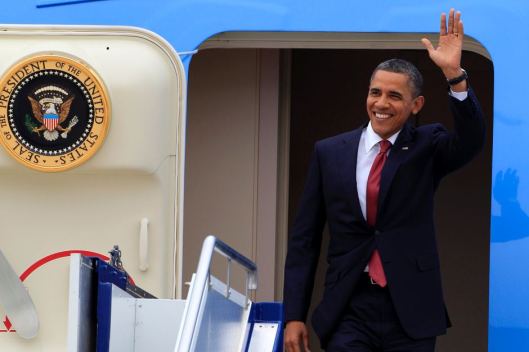
This year is the sixtieth anniversary of the ANZUS Treaty, the military alliance which binds Australia to the United States. Partly to commemorate this occasion, the President of the United States, Mr Barack Obama, made a brief two-day stopover trip to Australia on his way to Bali. He is the fifth American president to visit Australia since Lyndon Johnson arrived in 1966.

Spending two days in Canberra and Darwin, capital cities of our two Territories, he made an address to Parliament, laid a wreath on the Tomb of the Unknown Soldier and paid his respects to the 89 US sailors who perished aboard the USS Peary after being bombed by the Japanese in Darwin Harbour in 1942. It was also announced that a US military base would be stationed in Darwin.

Handsome and charismatic, with a constant friendly smile, the President could not help but make himself popular. Mr Obama has the charm and good manners that we tend to think of as very American, and he made lots of pleasant jokes about Australian slang and the Australian accent, while expressing his fondness for the nation and its people (and no fondness at all for Vegemite, which is an acquired taste).

While in Canberra, he made a visit to a high school and hugged an excited young girl. “He’s so kind … and warm,” she exclaimed. That’s how Barack Obama came across – kind, warm, genuine, funny, and very charming.

Note: President Obama made another visit to Australia in 2014, when he attended the G-20 summit in Brisbane. He gave a speech to students at the University of Queensland, which received thunderous applause from a young audience unused to hearing political leaders talk about climate change and gender equality.

Name Information
Barack is a Swahili variant of the Arabic word barak meaning “blessed”. The name comes from a Semitic root meaning “to kneel down”, with connotations of someone receiving a benediction while on bended knee. In Islam, the related term barakah (“blessing”) means a continuous spiritual presence and revelation providing a flow of blessings and grace to those close to God, such as saints and holy people.

The name is sometimes confused with the Hebrew name Barak, meaning “shining, lightning”. In the Old Testament, Barak was a military commander. In Arabic the equivalent word for “lightning” is buraq – you can see it in the name Al-Buraq, the mystical horse who took the prophet Muhammad on his Night Journey to the heavens on a journey between Jerusalem and Mecca and back.

The Hebrew equivalent of Barack is Baruch, meaning “blessed”. It is related to the Hebrew word berakhah, meaning “benediction, blessing”. In Judaism, berakhah is a blessing or thanksgiving given before enjoying or performing certain acts; for example, before eating: it acknowledges God as the source of all blessings. Baruch can be Latinised as the name Benedict, which is why the Dutch philosopher Baruch Spinoza, who was Jewish, is often known to us as Benedict Spinoza.

As both Arabic and Hebrew are Semitic languages, it is easy to see how such confusion arises over similar or even identical-looking names.

By coincidence, Barak is also an Australian name. The famous Aboriginal spokesman William Barak (sometimes known as King Billy) took his surname from his tribal name of Beruk, meaning “white grub in gum tree”.

President Obama was named after his father, Barack Obama Sr, who was a senior economist in the Kenyan government during the 1960s. Mr Obama Sr was raised in a Muslim family, but was converted to Christianity at the age of six while attending a missionary school.

Apparently his original name was Baraka (from the Islamic term for spiritual blessings and grace), but he changed his name to Barack to avoid the overtly religious connotations of his name. I’m not sure how valid a conversion is in such a young child (it sounds almost coerced), but in any case it didn’t take, and Mr Obama became an atheist. His son did become a Christian, however.

The name Barack has never charted in the United States. Last year 11 babies were named Barack, a number which has decreased since 69 being born in 2009 – the year that Barack Obama Jr became President of the United States. In the year before President Obama’s presidential campaign, just 5 babies were named Barack.

Barack can only be found in British data between 2008 and 2010, peaking in 2009 at 17 births. I haven’t found any Baracks in Australian data, but based on international trends, it may have had a small spike in 2009.

Barack must be the most interesting of the American presidents’ names, and has at least busted the myth that you need a “presidential-style” name to become president of the United States (something like Ulysses or Grover, I presume).

One of its biggest issues as a baby name must be that it is so closely tied to the current US president, and may feel like a “one person name” – especially considering the name’s unique family history.

It could also be confused with similar names, and the pronunciation is something of an issue: although I understand it as buh-RAHK, I have heard it said it in a variety of ways by overseas commentators, including Burrock and Barrack. However, this is a strong handsome name with a nice meaning that will certainly stand out from the crowd.

NAME POLL RESULTS: Barack received an approval rating of 60%. 25% of people thought it was too closely tied to the American president, making it a one person name. However, 14% saw it as strong and commanding, and a further 14% thought it was a name unusual enough to stand out from the crowd. Only one person thought it was too rare, while 3% of people were put off the name because of President Obama.

(Picture shows President Obama arriving in Canberra in 2011; photo from the ABC)

Famous Name: Nancy

06 Tuesday Sep 2011

Posted by A.O. in Famous Names

≈ 9 Comments

Tags

celebrity baby names, classic names, english names, famous namesakes, fictional namesakes, name history, name popularity, name trends, nicknames, UK name popularity, US name popularity

2829044-3x4-700x933

This blog post was first published on September 6 2011, and revised and updated on September 24 2015.

Famous Namesake
On August 7 2011, Australia’s most decorated servicewoman of World War II died. Nancy Wake was born in New Zealand in 1912, and her family moved to Australia when she was a baby. Not long after, her father abandoned the family and went back to New Zealand, selling their house in the process, thus leaving his wife and six children homeless and destitute.

Life must have been tough for young Nancy, but she was clearly a born survivor. A girl of spirit, she ran away from home at the age of 16 and worked as a nurse. When an aunt left her a £200 inheritance, she travelled to New York, and then London, where she became a journalist.

During the 1930s, she settled in Paris, and worked for the Hearst newspapers as European correspondent. One of her first assignments was to interview Adolf Hitler. She also witnessed first-hand the brutal persecution of Jews by the Nazis in Vienna, and vowed that if she could ever do something about it, she would.

In 1939 Nancy married Henri Fiocca, a handsome and wealthy French industrialist who she described as the love of her life. Six months later, Germany invaded France, and Henri and Nancy both joined the French Resistance. Nancy worked as a courier, smuggling food and messages to Resistance agents in Spain, and was able to assist more than a thousand escaped prisoners of war and Allied fliers out of France.

By 1942, the Gestapo had become aware of a significant Resistance agent who was proving a thorn in their side, and code-named her The White Mouse. She was #1 on the Gestapo’s “Most Wanted” list, and had a 5 million franc bounty on her head. Nancy escaped to England, where she trained as a spy in the French section of the British Special Operations Executive, who worked with local resistance groups in German-occupied territories.

She parachuted back into France in 1944 to help with D-Day preparations, and after D-Day was in charge of an army involved in combat against German troops. Never one to back down from a hard task, she once cycled 500 km in three days, crossing several German checkpoints, to find an operator to radio Britain and request new radio codes.

Attractive, vivacious and feisty, she drew admiration for being an “Australian bombshell” who was a crack shot with a cheerfully never-say-die attitude. One of her comrades, Henri Tardivat, said of her: She is the most feminine woman I know, until the fighting starts. Then she is like five men.

At the end of the war, Nancy discovered that her beloved husband Henri had been captured, tortured and executed by the Gestapo in 1943 for refusing to disclose her location. She never ceased to regret leaving France, and blamed herself for his death, believing that if she had stayed with him, he would have survived.

After the war, she was showered in international honours, including the George Medal, the Croix de Guerre, the Medaille de la Resistance, the Chevalier de Legion d’Honneur, and the US Medal of Freedom. Further honours came to her throughout her life, but none from Australia for many years. At first she refused all Australian recognition, then there was some bureaucratic tangles because technically Nancy was still a citizen of New Zealand.

Nancy probably didn’t help the process by getting unsuccessfully involved in Australian politics, and by telling them to stick their medals somewhere unmentionable. Rather belatedly, she was awarded the Companion Order of Australia in 2004; by that time she had left Australia permanently to live in London, after being widowed once more (this time after 40 years of marriage).

Nancy died three weeks away from her 99th birthday. On March 10 2013, her ashes were taken to the village of Verneix near Montluçon, in central France – the region she had used as her base while a Resistance fighter. Here the ashes were scattered in a private ceremony attended by close friends, in accordance with her wishes.

She said of herself: I hate wars and violence, but if they come, I don’t see why we women should just wave our men a proud goodbye and then knit them balaclavas.

Name Information
Nancy was originally a short form of Annis, the medieval English form of Agnes, and in use since the Middle Ages. However, by the time Nancy became commonly used as an independent name in the 18th century, it was derived from Nan, a short form of Ann or Anne.

There are many famous namesakes for this name. Anne “Nancy” Regan, former US First Lady; Nancy Astor, the first female MP in the British Parliament; boot-stomping singer Nancy Sinatra; witty author Nancy Mitford; voice actress of Bart Simpson, Nancy Cartright; punk lover Nancy Spungen; nobbled skater Nancy Kerrigan. It’s interesting how often famous Nancys end up being controversial in some way.

Fictional Nancys are just as strong characters as their real world counterparts. Smart girl detective Nancy Drew, an inspiration to powerful women such as Hilary Clinton. Piratical tomboy Nancy Blackett from Swallows and Amazons; her real name is Ruth, but pirates must be ruthless! Dreamworld heroine Nancy Thompson, who takes on the nightmarish Freddy Kruger. Poor degraded Nancy from Oliver Twist, who performs a noble act to save another, though it risks her own life.

Nancy is a classic name which has been almost continuously on the charts. It was #114 in the 1900s, joined the Top 100 the following decade, and peaked in the 1920s at #26. It left the Top 100 in the 1950s and has fallen gradually; currently it is around the 500s.

In the United States, Nancy was a Top 100 name in the late 19th century, and then again from the 1920s to the end of the 1970s – a very good run. It is has fallen steadily since then and is now #752. In the UK, Nancy was on the top 100 from the mid-19th century until World War II. In 1996 it was #251, and generally making upward progress. It joined the Top 100 again last year, and is currently #90. UK Prime Minister David Cameron has a daughter named Nancy, born in 2004.

Nancy is a wholesome yet spunky name which faded too quickly in Australia compared to other countries. It fits in perfectly with the current trend for cute short form names such as Maggie and Kitty, while having a clean classic feel. This is a spirited choice, suitable for those who want their daughters to be in the thick of the fight, not just waving and knitting on the sidelines.

POLL RESULT
Nancy received an approval rating of 56%. 30% of people thought the name was too dated and old-fashioned, but 16% said it was sweet and wholesome. Nobody was affected by the “nasty Nancy” label given to Nancy Spungen, but 6% were concerned about the phrase “negative Nancy”, and 4% were really bothered that “nancy” is slang for a homosexual or effeminate man.

(Image of Nancy Wake c 1945  from The Australian War Memorial, which houses the collection of all her war medals)

Famous Name: Cadel

25 Monday Jul 2011

Posted by A.O. in Famous Names

≈ 15 Comments

Tags

famous namesakes, fictional namesakes, name history, name meaning, name popularity, rare names, Roman names, surname names, UK name popularity, US name popularity, Welsh names

This blog post was first published on July 25 2011, and revised and updated on July 23 2015.

Famous Namesake
On July 25 2011, Cadel Evans became the first Australian to win the Tour de France in the race’s 108-year history, only the second non-European to officially win it, and at 34, the oldest winner since World War II.

This gruelling 3 600 km (2 200 miles) cycle race lasts for three weeks, and finishes in Paris, with the climax of the final stage along the Avenue des Champs-Élysées. Traditionally the overall winner wears a ceremonial yellow jersey.

This was a great moment in our sporting history, and in Cadel’s home state of Victoria, everyone was urged to wear yellow to work as a show of support. When Cadel returned to Australia in August, there was a huge homecoming parade for him in Melbourne’s Federation Square, with tens of thousands of people dressed in yellow or waving yellow flags. He was also honoured with a state reception.

Cadel was made a Member of the Order of Australia in 2013, and has also been featured on the blog as a celebrity dad. In February 2015, he took part in the inaugural Cadel Evans Great Ocean Road Race and finished fifth, announcing his retirement as soon as the race finished. He is currently Global Ambassador for the BMC Racing Team.

Name Information
As you can probably tell from Cadel’s surname, he is of Welsh ancestry – his great-grandfather was from Wales. Cadel is a variant of the Welsh name Cadell, which is based on cad, the Welsh word for “battle”; there are several related names, such as Cadwalader, meaning “battle leader”. There is a recent fancy that the name is a Welsh form of the Roman name Catallus, although there doesn’t seem to be much evidence to support it.

There were several medieval Welsh kings and princes called Cadell. Cadell Ddyrnllwg was driven from his father’s kingdom by Irish pirates during the chaos of the 5th century. He lived amongst the peasants until a visit from Saint Germanus changed his fortunes. Saint Germanus laid siege to the capital, as it was held by Irish pagans, and Cadell offered the saint his humble hospitality. Saint Germanus had a premonition of disaster, and warned Cadell and his friends to get out of the city. That night the palace was struck by lightning and the resulting fire burned everyone alive, so without any annoying questions from insurance investigators, Cadell was able to regain his throne.

There is a famous explorer in Australian history with the surname Cadell – a Scotsman called Francis Cadell who was the first to explore and navigate the Murray River by steamship. A man who lived a life of adventure, he took part in the New Zealand land wars, where he staged a mutiny against his captain, and also was one of the first to explore the Northern Territory (where Cadel Evans was born), where the Cadell Strait bears his name. Later in life, he took up whaling, pearling, and trading in the East Indies, and was murdered near New Guinea; a fittingly violent end to an exciting life.

A fictional namesake is Cadel Piggot, the protagonist of the Evil Genius series of young adult books by Australian author Catherine Jinks. It’s about a boy who is very small with curly blonde hair and baby blue eyes, and an evil genius with a passion for IT. The series follows his exploits from the ages of 7 to 15 as he gradually develops a sense of right and wrong.

Since Cadel Evans’ historic win at the Tour de France, I have seen quite a few baby boys named Cadel, although the name is still rare in Australia. In the UK, there were 4 baby boys named Cadel in 2013, the name apparently rising slightly after Cadel Evans’ victory. In the US, there were 10 baby boys named Cadel in the US in 2014, down from 19 in 2012 and 17 in 2011. It seems that Cadel Evans did give the name a boost in the US after the 2011 Tour de France, but it has faded, as the name Cadel is now less used than it was in 2010, when there were 12 boys named Cadel.

Cadel fits in quite well with current trends in boy names, looking similar to Caden and Cade. Although at the start of his career, Cadel Evans had his name mispronounced as KAY-del, to sound like cradle without the R, I think by now everyone knows he says his name kuh-DEL (like Adele with a K at the front). This isn’t the British pronunciation, which is more like KAD-el. However, now that Evans has retired, it is unclear whether the name Cadel will continue gathering steam, or run out of puff.

POLL RESULTS
Cadel received an approval rating of 60%. 16% of people thought it was handsome or attractive, but an equal number believed it was too closely associated with Cadel Evans, and felt like a “one person name”. Few were willing to predict the name’s fortunes – 2% thought the name Cadel would continue growing in popularity, while 5% were fairly sure the name was a flash in the pan that would soon be forgotten.

Newer posts →

Enter your email address to follow this blog

Categories

Archives

Recent Comments

A.O.'s avatarwaltzingmorethanmati… on Zarah Zaynab and Wolfgang…
Madelyn's avatarMadelyn on Zarah Zaynab and Wolfgang…
JD's avatardrperegrine on Can Phoebe Complete This …
A.O.'s avatarwaltzingmorethanmati… on Rua and Rhoa
redrover23's avatarredrover23 on Rua and Rhoa

Blogroll

  • Appellation Mountain
  • Baby Name Pondering
  • Babynamelover's Blog
  • British Baby Names
  • Clare's Name News
  • For Real Baby Names
  • Geek Baby Names
  • Name Candy
  • Nameberry
  • Nancy's Baby Names
  • Ren's Baby Name Blog
  • Sancta Nomina
  • Swistle: Baby Names
  • The Art of Naming
  • The Baby Name Wizard
  • The Beauty of Names
  • Tulip By Any Name

RSS Feed

  • RSS - Posts

RSS Posts

  • Celebrity Baby News: Melanie Vallejo and Matt Kingston
  • Names from the TV Show “Cleverman”
  • Can Phoebe Complete This Sibset?
  • Zarah Zaynab and Wolfgang Winter
  • Baby, How Did You Get That Name?
  • Celebrity Baby News: Media Babies
  • Celebrity Baby News: Adelaide Crows Babies
  • Celebrity Baby News: Chris and Rebecca Judd
  • Names at Work: Name News From the World of Business and Employment
  • Celebrity Baby News: Sporting Round Up

Currently Popular

  • Rare Boys Names From the 1950s
  • The Top 100 Names of the 1940s in New South Wales
  • Girls Names From Stars and Constellations
  • Celebrity Baby News: Jacinta Allan and Yorick Piper
  • Celebrity Baby News: Livinia Nixon and Alistair Jack

Tags

celebrity baby names celebrity sibsets english names famous namesakes fictional namesakes honouring locational names middle names name combinations name history name meaning name popularity name trends nicknames popular names saints names sibsets surname names twin sets unisex names

Blog at WordPress.com.

Privacy & Cookies: This site uses cookies. By continuing to use this website, you agree to their use.
To find out more, including how to control cookies, see here: Cookie Policy
  • Subscribe Subscribed
    • Waltzing More Than Matilda
    • Join 517 other subscribers
    • Already have a WordPress.com account? Log in now.
    • Waltzing More Than Matilda
    • Subscribe Subscribed
    • Sign up
    • Log in
    • Report this content
    • View site in Reader
    • Manage subscriptions
    • Collapse this bar
 

Loading Comments...