• About
  • Best Baby Names
  • Celebrity Baby Names
  • Celebrity Baby Names – Current
  • Celebrity Baby Names – Past
  • Featured Boys Names
  • Featured Girls Names
  • Featured Unisex Names
  • Links to Name Data
  • Waltzing on the Web

Waltzing More Than Matilda

~ Names with an Australian Bias of Democratic Temper

Waltzing More Than Matilda

Tag Archives: Slavic names

Girls Names From Stars and Constellations

11 Sunday Dec 2011

Posted by A.O. in Name Themes and Lists

≈ 32 Comments

Tags

Arabic names, Aramaic names, astronomical names, Biblical names, British Baby Names, celebrity baby names, famous namesakes, flower names, Greek names, Latin names, literary namesakes, locational names, mythological names, name history, name meaning, nature names, popular culture, popular names, Sanskrit names, Slavic names, Spanish names, surname names

Christmas is a time for stars – we put stars on our Christmas trees, sing about stars in carols, send cards with glittering stars on them, and cut gingerbread in the shape of stars. Elea at British Baby Names has a post on starry names up on her lovely Advent calendar; she also had a post on astronomical names back in October, which contains many star names. If you name your child after a star, you will want to show them “their” star when they get older, so I’ve given a few hints as to the best time to view the star from Australia; to learn more, two great resources are the Skynotes newsletter from the Melbourne Planetarium (includes video), and the Beginner’s Guide to the Night Sky at ABC Science. I normally do ten names per list, but because it’s the last set for the year I’ve done twelve – besides, stars naturally seem to go in groups of twelve, don’t they?

Alya

Alya is a common name for the yellow binary star Theta Serpentis in the constellation Serpens (“The Serpent”). Its name comes from the Arabic word alyah, meaning “fat tail of the sheep”. Arab astronomers saw this part of the sky as a pasture, with Alya representing a sheep’s tail. The Arabs have cooked with the rich fat from a sheep’s tail for centuries, and it is still considered a delicious comfort food. It might seem like calling your daughter Lard, but it fits in with the popular Aaliyah variants, while being simpler to pronounce and spell. You can always tell people the baby is named after a star that represents a sheep gambolling in a field; however vegetarians may not be able to get past the fact that the Arabs were looking up at the star and thinking, “Yum yum yum”. Serpens is visible in Australia in the middle of winter, and its stars are not easy to see.

Andromeda

Andromeda is a constellation named after a character from Greek mythology. This princess was chained naked to a rock for a sea monster to gobble, thanks to her rather stupid mother’s boasting of her beauty. The hero Perseus, on his way home from other heroic deeds, saw her in distress, and did the traditional hero’s rescue-and-marry-damsel manoeuvre. An awkward detail was that Andromeda was already engaged to her uncle, but Perseus turned him into stone, which got rid of him nicely. The name is pronounced an-DROHM-eh-da, and is said to mean “to think as a man” in Greek, interpreted as meaning to be as intelligent or brave as a man – which sounds a bit sexist, but the story isn’t exactly a feminist fairytale, and it’s clearly meant to be complimentary. Andromeda is a stunning name which can easily be shortened to Andie, Annie, Meda, Mia or Romy; it will remind people of the Andromeda Galaxy, which you can see best in November from Australia, along with the constellation.

Capella

Capella is a common name for the yellow star Alpha Aurigae, the brightest in the constellation Auriga (“The Charioteer”). It means “little she-goat” in Latin, and represents the divine goat Amalthea from Roman mythology. Amalthea was the foster-mother of the god Jupiter, and provided him with milk. When Jupiter broke off one of her horns, it became the ‘”horn of plenty”, which provided its owner with whatever food they desired. For the Boorong people of Victoria, this star was Purra, a kangaroo who is chased and killed by the twins in the constellation of Gemini; the tracks of Purra form the bed of the Wimmera River. Capella is a small town in central Queensland named after the star, so it’s a surprisingly Australian choice as a star name. It’s a fresh twist on Capri or Caprice, with the popular -ella ending. You can see Capella on the northern horizon during summer in Australia, and it’s bright enough to be clearly visible.

Carina

Carina is a constellation of the southern hemisphere; its name is Latin for “keel”, and it represents part of the ship, the Argo, sailed by Jason and the Argonauts in Greek legend. The most prominent star in the constellation is Canopus, the brightest star of southern skies, clearly visible and high in the sky. If you live in the far south of Australia, Canopus will never set. The Bibbulum people of south-western Australia saw Canopus as their ancestor Waa Wahn, the trickster crow. The Maoris called it Atutahi, or “Stand Alone”, because of its brightness. Carina also has meteor showers which peak around Australia Day, and contains the Diamond Cross, sister to the Southern Cross. Considering that the winged keel on Australia II is said to have won us the America’s Cup in 1983, Carina adds up to being a patriotic star name (and suitable for boaties). As Carina is also a name related to either Cara or Katherine, it has the added advantage of sounding like a “regular name”.

Gemma

Gemma is a common name for the binary star Alpha Coronae Borealis, the brightest in the constellation Corona Borealis (“The Northern Crown”). In Greek mythology, Corona Borealis represents a crown worn by Ariadne when she married the wine god Dionysus; Gemma is Latin for “jewel”, so it’s “the jewel in the crown”. Australian Aborigines called this constellation The Boomerang, because of its shape (being in the southern hemisphere, we see the constellation upside-down). Gemma is a popular name in Australia, and the star association helps give it another layer of meaning, while also showing that you don’t need to have a strange or rare name to be named after a star. The constellation is best viewed in winter from Australia, and its difficult to see without practice.

Lucy

In the constellation Centaurus (“The Centaur”) is a tiny white dwarf star, smaller than the Earth, with the boring name of BPM 37093. Its carbon atoms are believed to have formed a crystalline structure, and because diamonds are also carbon arranged in crystalline formation, astronomers have nicknamed this star Lucy – as in Lucy in the Sky with Diamonds. It’s a fun star and song reference for a very popular name, and as you probably know, Lucy means “light”, which seems apt for a star. Because of its size, you can only see Lucy with a telescope; however the constellation Centaurus is the most magnificent in the southern hemisphere, with two of the brightest stars, Alpha and Beta Centauri. You can see a great portion of the Milky Way in Centaurus, and on a moonless autumn night, it will be easy enough to point at Lucy’s general location. Does it matter if it cannot be seen? The Little Prince told us that what is essential is invisible to the eye …

Lyra

Lyra is a small constellation whose name is Greek for “lyre”. It is associated with the myth of Orpheus, a legendary musician, poet and prophet who is best known for his descent into the Underworld in search of his wife, Eurydice. According to some accounts, he died being ripped apart by savage Bacchantes, the female worshippers of the god Dionysus; the Muses gave him a proper burial, and he was finally reunited with his beloved. The Muses took his lyre to heaven and placed it amongst the stars in his honour. In Australia, you can see Lyra low in the northern sky during winter. The name has become well known since Lyra Belacqua is the young heroine of Philip Pullman’s His Dark Materials Trilogy. English model Sophie Dahl named her daughter Lyra in May this year.

Maia

Maia is the common name for 20 Tauri, a blue giant in the constellation Taurus, and the fourth-brightest star in the Pleiades cluster. In Greek mythology, the Pleiades were seven beautiful nymphs who were sisters. They were pursued by the hunter Orion, and Zeus changed them first into doves, and then into stars – where they are still chased by the constellation Orion. The Pleiades are often called the Seven Sisters, and you can see them clearly in summer from Australia. The Aborigines have several legends about the Pleiades, and one involves seven sisters being pursued by a man, just like the Greek myth. Maia was the eldest of the Pleiades, and the mother of the god Hermes. The meaning of the name is uncertain; it may be a respectful title for a mature lady. Maia the star appears as a character in Mary Poppins by P.L. Travers – an Australian writer who clearly loved stars, because the Mary Poppins books are filled with them. Maia is said like the popular Maya (MY-ah), but seems more elegant and literary.

Mimosa

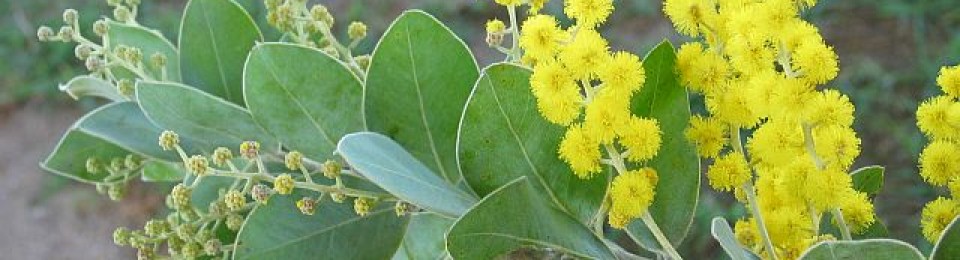
Mimosa is a common name for the yellow binary star Beta Crucis, the second-brightest in the constellation Crux (“Cross”). Crux is the smallest of the constellations, but very significant in Australia, as it is our dear Southern Cross, represented on the national flag as well as the Eureka flag (Mimosa is the left-hand arm of the Cross). Various Aboriginal peoples saw the Cross as an eagle’s footprint, a stingray, a possum in a tree, or two brothers cooking a fish on their campfire. The Aborigines of Eastern Australia called it Mirrabooka; Mirrabooka was a kind and clever man who was placed in the sky by the creator Biami so he could watch over the earth. Because the Southern Cross is always visible here, Mirrabooka never leaves us. The Maoris call it The Anchor; it anchors the Milky Way. The star Mimosa received its name because of its colour; the mimosa is another name for the silver wattle. The name is from the Greek for “mimic”. It’s an extravagant name that’s very patriotic; you could use Mim, Mimi, Mia or Mo as nicknames.

Mira

Mira is the common name for Omicron Ceti, the most notable star in the constellation Cetus. It’s a binary star consisting of a red giant and a white dwarf; the closest symbiotic pair of stars to the Sun. Mira is a variable star; like other red giants, its surface oscillates so that its brightness increases and decreases. Mira was the first variable star ever observed in modern times, and so it gained its name, for Mira means “wonderful, astonishing” in Latin, and is said MEE-rah. The constellation Cetus depicts the sea monster that was going to eat Andromeda: for some reason it has also been immortalised in the stars, and placed worrying close to its intended victim. It’s a large constellation, but not very bright or easy to see; it’s best viewed in Australia in November. At its brightest, you can see Mira with the naked eye; at its dimmest, you will need powerful binoculars to view it. Mira is also a Sanskrit name meaning “ocean”, and a Slavic name possibly meaning “peace”.

Talitha

Talitha is one of the common names for Iota Ursae Majoris, a yellow and purple star system in the constellation Ursa Major consisting of two binary stars orbiting around each other. The name is Arabic, and means “the third leap”, referring to a gazelle jumping about, which is how Arab astronomers saw this portion of the sky. Talitha is also the Aramaic for “little girl”, and is taken from the New Testament when Jesus raises a child from the dead by saying Talitha cumi (“Little girl, get up”). Talitha is pretty, and fits in with popular names like Talia and Taia; it’s pronounced TAH-lith-ah. Ursa Major, or the Great Bear, is one of the best known and loved constellations of the northern hemisphere, but in Australia it can only be viewed in April/May, and is so low on the northern horizon we see only part of it; we cannot see Talitha at all.

Vega

Vega is the common name for Alpha Lyrae, the brightest star in the constellation Lyra, and fifth-brightest star in the sky. The name is from Arabic, and means “falling” or “landing”, referring to the constellation Arab astronomers called The Alighting Vulture. Lyra was seen as a descending vulture; an idea dating back to ancient Egypt and ancient India. Even when the Greeks said it was a lyre, it was still often pictured as a vulture or eagle holding the instrument in its talons. The Boorong people saw Vega as a Mallee Fowl, and knew that once the star disappeared in October, it was time to collect that bird’s eggs. Vega is also a Spanish surname meaning “meadow-dweller”; it’s familiar from the Spanish playwright Lope de Vega, and folk singer Suzanne Vega. Vega is a glamorous-sounding name that’s strongly associated with its star. Once you learn to find Lyra, it will be easy to spot Vega because of its luminosity.

Saturday Sibset: The De-Stressed Family

27 Saturday Aug 2011

Posted by A.O. in Sibsets in the News

≈ 5 Comments

Tags

honouring, Maori names, mythological names, Native American names, sibsets, Slavic names, Tewa names, tribal names

Prevention magazine recently had a story about people who had successfully made their lives less stressful, and more fulfilling. One of them was Julija McDowell, who is originally from Canada, and married to an Australian man named Nicholas.

Julija and Nicholas used to live in San Francisco, where they both worked as animators for George Lucas’ company, Industrial Light and Magic. Highly-paid and highly-stressed, they worked 60-100 hours a week.

When Julija became pregnant with their first child in 2004, she decided to leave her job to concentrate entirely on motherhood. Enjoying the less stressful world of parenting, she kept an online diary of what her children did every day, and from this started an online company to give parents ideas for play and interaction with their children.

A year ago, the McDowell family moved to Sydney, and found relocating to Australia a wonderful opportunity to make their lives less stressful. Now both of them are self-employed and work from home, and because the family is always together, has formed a much closer bond.

They have got rid of their television set to give themselves more quality time, and Julija finds simple family pleasures such as eating dinner each evening, or walking her son to school through Sydney Harbour National Park every morning, very relaxing.

These are the names of the McDowell children:

Dragan is aged six. The name Dragon is one in their extended family, and the similar-sounding Dragan is a Slavic name that means “precious”. (For some reason, Julija thinks it also means “traveller”; something which I haven’t been able to figure out). Dragan seems like a way to honour extended family, Julija’s Slavic background, and also choose a name with a very lovely meaning.

Avanyu is aged four. They chose her name before she was even conceived! The McDowells wanted another “monster” name for their next child to match their “dragon” son. They decided on a monster from Native American culture. Avanyu is a Tewa deity, a feathered sea-serpent who is the guardian of water amongst the tribes of the American South-West.

Taikaro is aged 2. They looked for another “monster” name so that they could continue their name theme, but found it harder than they imagined, as none seemed to suit their son. In the end, Nicholas’ mother showed them a list of old family names from the McDowells, and they chose Taikaro from the list. Nicholas’ great-great-great grandfather married a Maori princess from the Taikaro tribe; the name apparently means “the lost coast”, and if so, the tribal name would have been locational. I checked the Maori dictionary, and according to that, the phrase can mean something like “the elusive coast”, perhaps suggesting it was a good place to hide or hard to find, or even “the scooped-out coastline”, which would refer to its appearance.

The McDowells have chosen unusual and creative names for their children from a variety of cultures, and from their family histories. It also shows one of the perils of choosing a “theme” for your family – you might successfully come up with two names that go together perfectly, but that third name that fits the theme, suits the child, and is also loved by the parents can prove elusive!

(Story from Yahoo Lifestyle; photo from socialmoms.net)

Boys Names from the Top 100 of the 1930s

26 Sunday Jun 2011

Posted by A.O. in Name Themes and Lists

≈ 18 Comments

Tags

Anglo-Saxon names, animal names, aristocratic names, Arthurian names, Celtic names, classic names, english names, epithets, European name popularity, famous namesakes, fictional namesakes, Gaelic names, German names, germanic names, Greek names, Irish name popularity, Irish names, Latin names, mythological names, name history, name meaning, name popularity, name trends, names from films, names from television, nicknames, Old English names, Old Norse names, retro names, royal names, royal titles, saints names, Scottish names, Slavic names, Spanish names, UK name trends, US name trends, Welsh names

This post was first published on June 26 2011, and substantially revised and updated on June 25 2015.

Alfred
Anglo-Saxon name meaning “elf counsel”. The name became famous due to Alfred the Great, 9th century king of Wessex, who defended England against the Vikings, and was the first to call himself King of the Anglo-Saxons. Renowned for his love of learning, he encouraged education and reformed the legal system. Although not officially a saint, he is regarded as a Christian hero, and has a feast day in the Anglican Church. The name Alfred continued to be used even after the Norman Conquest, when many Anglo-Saxon names were discarded. It dwindled after the Middle Ages, but had a revival in the 19th century, and was chosen as the name of one of Queen Victoria’s sons – an earlier Prince Alfred was the son of King George III, and the current British family trace their ancestry back to Alfred the Great. Alfred is a classic name which has never left the charts. It was #14 in the 1900s, and #50 by the 1930s. Alfred left the Top 100 in the 1950s, and is currently around the 300s, its position apparently fairly stable. Popular in Scandinavia, Alfie, Fred, and Freddie give this venerable classic several cute nickname options.

Brian
Irish name, possibly from the Celtic bre, meaning “hill”, to suggest “high, great, exalted”. In Irish mythology, Brian is one of three brothers who are sent on a worldwide magical quest. In some versions, Brian is the clever one of the three, while his brothers are bumbling and easily pushed around. A famous namesake is Brian Boru, the first High King of Ireland, and founder of the O’Brien dynasty; he made the name common in Ireland. The name Brian was also used in Brittany, and became quite popular in East Anglia, where it was spread by Breton immigrants, and in the north of England, brought over by Scandinavian settlers who had lived in Ireland. It experienced a revival in the early 20th century. Brian is a classic name which has never left the charts. It was #169 in the 1900s, and joined the Top 100 in the 1920s. Peaking in the 1930s and ’40s at #7, Brian didn’t leave the Top 100 until the 1980s – Monty Python’s Life of Brian having turned it into a “joke name” didn’t help its fortunes. However, it’s been reasonably stable for about a decade, and is around the 300s. Brian remains a popular name in Ireland. This is a strong-sounding Irish classic still getting reasonable use.

Colin
Anglicised form of the Scottish name Cailean, meaning “whelp, pup, young dog” in Gaelic. It is also a medieval pet form of Col, short for Nicholas, so it’s an English name as well. Cuilén mac Ildulb was a 10th century King of the Scots, while Sir Colin Campbell (“Colin the Great”) was a 13th century cousin of Robert the Bruce, and one of the earliest known members of the Clan Campbell, ancestor of the Earls of Argyll. The name became traditional in the Campbell family because of him. Colin was #51 in the 1900s, and peaked in the 1930s at #14. It left the Top 100 in the 1980s, and although it stayed in use for many years afterwards, now seems to be quite rare. Colin is a traditional name which has a gentle and slightly poetic feel, and works well in the middle.

Edwin
Modern form of the Anglo-Saxon name Eadwine, meaning “rich friend”. The name was traditional amongst Anglo-Saxon royalty and nobility, with the most famous Edwin being a 7th century king of Northumbria who converted to Christianity; it was said that during his reign, the land was so peaceful that a woman with a new baby could walk across the country without being harmed (it tells you something that this was considered remarkable). He was canonised as a saint after his death. The name Edwin sunk in popularity after the Norman Conquest, but was revived in the 19th century during the Victorian enthusiasm for early English names. Edwin is a classic name which has never left the charts. It was #52 in the 1900s, and #88 by the 1930s. It left the Top 100 in the 1940s, and is currently around the 400s. A good alternative to popular Edward, while still having Eddie, Ed, Ned, and Ted as nicknames.

Frederick
English form of the Germanic name Friduric, translated as “peaceful ruler”; the modern German version is Friedrich. A favourite amongst European royalty, the name was traditional amongst the Holy Roman Emperors, with Frederick I also known as Frederick Barbarossa, meaning “red bearded” in Italian. Descended from two of Germany’s leading royal houses, he is regarded as the greatest of the medieval Holy Roman Emperors. Handsome, charismatic, and courtly, he was ambitious and skilful, greatly increasing Germany’s power base, and bringing back the Roman rule of law. According to medieval legend, he is not dead, but sleeps in a cave, waiting to return Germany to its former greatness. There are also a couple of medieval German saints named Frederick. The name was brought to England by the Normans after the Conquest, but it didn’t catch on. It was revived in the 18th century when the German House of Hanover inherited the British throne; Prince Frederick was the eldest son of King George II. Frederick is a classic name which has never left the charts. It was #8 in the 1900s, and #26 by the 1930s. It left the Top 100 in the 1960s, and sunk to its lowest level in the 1990s, at #459. Since then it has gradually increased in popularity, and is now around the low 200s. A distinguished name with friendly nicknames like Fred and Freddie, Frederick is already popular in the UK.

Ivan
Slavic form of John. A traditional Slavic name, there have been many famous Ivans in history, including six tsars of Russia, and many Croatian and Ukrainian leaders. St Ivan is a legendary hermit from Bohemia, while St Ivan of Rila is the patron saint of Bulgaria. Ivan continues to be a popular name in Eastern Europe, while the Spanish form Iván is popular in Spain and Latin America. Its long-term use in the English-speaking world may come from its similarity to the Welsh form of John, Ifan, so it can be seen as an Anglicised form of the Welsh name. Ivan is a classic name which has never left the charts. It was #117 in the 1900s, peaked in the 1910s at #97, and was #100 in the 1930s. It left the Top 100 in the 1940s and is currently around the low 300s, having been reasonably stable since the 1990s. That makes it a great cross-cultural choice which has remained both familiar and underused.

Lawrence
Variant of Laurence, and the usual surname form of the name. St Lawrence of Rome was a 3rd century Spanish saint who was archdeacon of Rome during a time of Christian persecution. There are many stories and legends about him. One is that he spirited the Holy Grail to Spain, where it remains in Valencia. Another is that the Emperor demanded that Lawrence hand over all the church’s goods. Lawrence hastily distributed everything the poor, then presented the city’s suffering, saying that these were the true treasures of the church. For this act of defiance, he was supposedly martyred by being roasted over a gridiron; after hours of pain, he remarked cheerfully: I’m well done. Turn me over! He is one of the most widely venerated saints, and his tomb a favourite pilgrimage site since the 4th century. Lawrence is a classic name which has never left the charts. It was #67 in the 1900s, peaked at #55 in the 1910s and ’20s, and was #61 in the 1930s. It left the Top 100 in the 1960s, and reached its lowest point in 2010 at #466. Since then it has risen again, and is now in the 200s, outstripping Laurence in popularity. This rugged-sounding classic comes with the nicknames Lawrie and Larry.

Lionel
Medieval pet form of Leon, a Greek name meaning “lion”; it could also be directly from Lion, which was used as a nickname in the Middle Ages. According to Arthurian legend, Sir Lionel was a Breton king, and knight of the Round Table. He features in the Grail Quest, where he is shown to be unworthy of the Grail, and more interested in fighting than the spiritual life. Lionel of Antwerp was a son of King Edward III, and reputedly a giant of a man, almost seven feet tall and of athletic build. It is through him that the House of York claimed the throne of England, and the name was a common one amongst the aristocracy. Lionel was #68 in the 1900s, peaked in the 1910s at #66, and was #73 by the 1930s. It left the Top 100 in the 1950s, and hasn’t charted since the 1980s. The name is rising in both the the UK and US, fitting in well with both popular Leo, and the trend for animal names. Definitely a worthy choice that has too often been overlooked!

Rex
The Latin word for “king”, and the title of the ancient kings of Rome (“Rex Romae“) – according to legend, the first king of Rome was Romulus. The Roman monarchs did not inherit kingship, but were elected to the role, and held absolute power. The word rex is ultimately from an ancient root meaning “to rule”, and it is related to the Sanskrit term Raja, the German word reich, and the English words rich, right, regal, royal, reign, and realm. Rex has been used as a personal name since the 17th century, but only came into common use in the 19th century. Rex was #138 in the 1900s, and entered the Top 100 in the 1920s. Peaking in the 1930s at #74, Rex left the Top 100 in the 1950s. It left the charts in the 1980s, but returned the following decade at #635. It has continued climbing, and is now around the 300s. No wonder Rex is making a comeback – it’s short and snappy, ends in the fashionable X (like Max), and sounds very masculine and confident.

Walter
English form of the ancient Germanic name Walthari, meaning “ruler of the army”. It was brought to England by the Normans and soon replaced its Old English version, Wealdhere. Mythologist Jacob Grimm theorised that the name may have originally been an epithet of one of the Germanic war gods, and be linked to the Norse god Tyr. The name was especially famous in the Middle Ages because of Walter of Aquitaine, a legendary king of the Visigoths; medieval poems tell of his military exploits, fighting one-handed against his foes. He may be based on a 5th century king of Aquitaine, Wallia – his name is probably from the Old Norse for “slaughter”. There is a 12th century English saint called Walter. Walter was #15 in the 1900s, and #46 by the 1930s. It left the Top 100 in the 1950s, and dropped off the charts in the 1990s. However, it made a comeback in 2011 after the hit TV show Breaking Bad aired in Australia, with ailing chemistry teacher turned criminal Walter White played by Bryan Cranston. His name was inspired by the American poet, Walt Whitman, and he is also often known as Walt. His teenage son is Walter White Jr, giving the name a younger image to match Walter Snr’s villainous smarts. Walter is currently around the 500s, and it is yet to be seen whether it continues rising now the show has finished. I hope so, because this retro name now seems fresh and unconventional.

POLL RESULTS
People’s favourite names were Walter, Frederick and Alfred, and their least favourites were Lionel, Ivan and Brian.

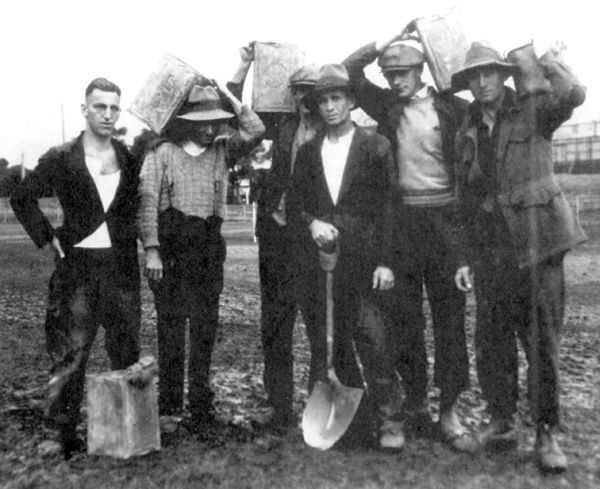
(Photo of men doing relief work during the Great Depression in 1933 from the National Library of Australia)

Newer posts →

Enter your email address to follow this blog

Categories

Archives

Recent Comments

A.O.'s avatarwaltzingmorethanmati… on Zarah Zaynab and Wolfgang…
Madelyn's avatarMadelyn on Zarah Zaynab and Wolfgang…
JD's avatardrperegrine on Can Phoebe Complete This …
A.O.'s avatarwaltzingmorethanmati… on Rua and Rhoa
redrover23's avatarredrover23 on Rua and Rhoa

Blogroll

  • Appellation Mountain
  • Baby Name Pondering
  • Babynamelover's Blog
  • British Baby Names
  • Clare's Name News
  • For Real Baby Names
  • Geek Baby Names
  • Name Candy
  • Nameberry
  • Nancy's Baby Names
  • Ren's Baby Name Blog
  • Sancta Nomina
  • Swistle: Baby Names
  • The Art of Naming
  • The Baby Name Wizard
  • The Beauty of Names
  • Tulip By Any Name

RSS Feed

  • RSS - Posts

RSS Posts

  • Celebrity Baby News: Melanie Vallejo and Matt Kingston
  • Names from the TV Show “Cleverman”
  • Can Phoebe Complete This Sibset?
  • Zarah Zaynab and Wolfgang Winter
  • Baby, How Did You Get That Name?
  • Celebrity Baby News: Media Babies
  • Celebrity Baby News: Adelaide Crows Babies
  • Celebrity Baby News: Chris and Rebecca Judd
  • Names at Work: Name News From the World of Business and Employment
  • Celebrity Baby News: Sporting Round Up

Currently Popular

  • Rare Boys Names From the 1950s
  • The Top 100 Names of the 1920s in New South Wales
  • Celebrity Baby News: Ross Stevenson and Sarah Fallshaw
  • The Top 100 Names of the 1940s in New South Wales
  • Arlo Robert Galafassi: A Son for Toni Collette and Dave Galafassi, a Brother for Sage Florence

Tags

celebrity baby names celebrity sibsets english names famous namesakes fictional namesakes honouring locational names middle names name combinations name history name meaning name popularity name trends nicknames popular names saints names sibsets surname names twin sets unisex names

Blog at WordPress.com.

Privacy & Cookies: This site uses cookies. By continuing to use this website, you agree to their use.
To find out more, including how to control cookies, see here: Cookie Policy
  • Subscribe Subscribed
    • Waltzing More Than Matilda
    • Join 517 other subscribers
    • Already have a WordPress.com account? Log in now.
    • Waltzing More Than Matilda
    • Subscribe Subscribed
    • Sign up
    • Log in
    • Report this content
    • View site in Reader
    • Manage subscriptions
    • Collapse this bar
 

Loading Comments...