Interview with Ebony from Babynameobsessed

Tags

, , , , , , , , ,

downloadToday we are looking at another Australian blogger; Ebony is still in high school, and has been working on Babynameobsessed for over a year. She covers names from popular culture, names from literature, has birth notices from Western Australia (her home state), puts a spotlight on featured names, recalls names from her childhood, and considers coming name trends.

She also makes baby name predictions that sometimes turn out to be spookily accurate: she wondered back in June if Buttercup would make a great middle name, and Friday’s Birth Announcements did indeed feature a baby girl named Eve Buttercup. So for a glimpse into the future of baby names, visit Babynameobsessed (and be honest, you’re feeling a bit jealous now that you didn’t have a name blog when you were thirteen, aren’t you?)

What is your name?

Ebony Anne Smith.

Have you ever wished you had a different name?

When I found out the meaning [black], aged five, I wanted to become the exotic Yasmine or Zoe-Yasmine. For years I imagined myself with another name, though now I can’t see myself as a Yasmine or a Zoe. I do love my name, just not the racist and stripper tones my name has in America. I actually prefer my nickname that I have been called since I was little –  Ebs – to my actual name, but otherwise I am very happy as an Ebony.

How old were you when you first got interested in names?

I was around six or seven. I found a name book that had one page of boys names and one page of girls names, and I made lists of names in a notebook, which sadly I have lost. I remember liking the name Murdoch (!!!) and of course Yasmine. I think it could have been inspired by my hatred of my name as a little girl, and I’ve just stayed in love with names.

What inspired you to begin a name blog?

I was bored one day and decided I might as well make a name blog. I never expected to keep it up for a year, and for it to get as many views as it has.  Not a very interesting story but I would be lying if I said something else.

Do your family and friends know that you are interested in names, and that you have a blog?

My mum and dad and my siblings know, as do my friends. I annoy them so much with my name obsessions.

Do you have a web presence in the baby name world? 

I’m on Nameberry as ebenezer.scrouge and am thinking of starting a Facebook page, but I’m not too sure yet.

Do you have a favourite blog post on babynameobsessed?

I love the “names from my childhood” posts, and the “baby name rant” posts.

Where do you get ideas for your blog posts from?

Life and daydreams pretty much. I tend to get distracted easily and sometimes names get into my daydreams. As for life, I mean pop culture and name sightings.

What differences, if any, do you see between your naming style and older name nerds? Do you think “teenberries” have their own style/s of naming?

Teenagers seem to be more in touch with name trends, and realise that it is a lot rarer than adults seem to think to share your name with someone in a class – and most the time, if they do, name trends have nothing to do with it. With style, I don’t think so; the names that are popular today seem to be accessible to everyone.

What do you think will be the name trends of the future?

Nicknames as full names, especially in Australia, and I can see hyphenated names crossing over [from the UK] as well.

Do you have any pet naming peeves?

Old lady names (Agnes and Agatha and Beatrice), over the top names (Rosamund and Persephone), and creative spellings, especially those of Georgia.

What are some of your favourite names? 

Girls: Isobel, Matilda, Eloise, Alice, Eleanor, and Amelia

Boys: Eamon, Tiago, Cooper, Jack, Jago, Flynn, Archer, Lincoln, and Asher

What names do you dislike?

Lachlan: Overused and it just annoys me.

Jayden: It’s not a very nice name.

Jessica and Sarah: Overused for my generation.

Renesmee: It isn’t a name – its a half-human, half-vampire baby MADE UP for the book [Stephenie Meyer’s Breaking Dawn].

Are there any names you love, but could never use? 

Alice: My mum finds it an old lady name.

Ottilie: My family will think of it as a trying-too-hard Matilda.

Wilhelmina and Eulalia: Too old lady, and my family hates them.

Guilty pleasures are Artemis for either gender, Jamesina, Illyria nn Lily, and Eilidh.

What are your favourite names in the Australian Top 100?

Girls: Matilda (#21) and Eloise (#86) Boys: Jack (#1) and Cooper (#7)

What are your favourite names that have never charted in Australia?

Eulalia and Tiago.

Do you have names picked out for your future children?

Isobel Jamesie Rose and Eamon James Harold. I also have decided that Anne and Grace need to be in a future child’s name.

What is something we don’t know about you?

I am highly clumsy and manage to fall up stairs, and in Coles [supermarket]. And a random fact is my family is of Scottish and English ancestry, and the Smith side is actually Scottish. I often wish I had a more Scottish last name.

What advice would you give to someone who was choosing a name for their baby?

Imagine the name on a baby and an adult. Sure, Honey or Pixie might be cute now, but I’m fourteen and would hate to be named Pixie.

(Photo of Ebony from her blog; used with permission)

Eve Buttercup and Vogue Scarlett

Tags

, ,

Ranunculus_lapaceus


Twins

Jennifer and Jacqueline

Theo and Emilio (Kristina, Ethan)


Girls

Adelie Jayne (Charlotte)

Amelia Jadis

Annabell Charlotte May (Bono)

Carla Margaret (Louise)

Daphne Ellen

Edith Patricia Milne

Edwina Honor Louise

Eve Buttercup (Cody, Sonny)

Jacinta Renee

Joni Kae (Tanner)

Lucia Esther (Savannah, Alexis)

Mary Elizabeth Frances (Julian, Ruby, Sophie, Emily, Xavier, Belle)

Tara Malati Gayle

Vogue Scarlett

Wallis Gertrude Anne


Boys

Ajay Patrick (Nevaya, Frankie)

Albert Percy

Antonio Vito (Tahlia)

Archer Gilbert (Lainie)

Connor John (Odin)

Dwight Harry Thorpe

Eamonn Lucas

Henley Willem

Knox Joe (Jax)

Lenny Robin (Kobe, Ashton)

Remy Peter Joseph (Ambrose, Florence, Theodore)

Rocco Maxwell

Stellan Eli Finn (Skylar)

Sully James

Theo Adam (Jazz)


Most popular names this week

Girls: Amelia

Boys: Isaac

(Photo shows some Common Buttercups, native wildflowers which bloom in spring)

Old Names Are New … And New Names Are Old News

Tags

, , , , , , , , , , , , , , , , , , , , ,

Old Fashioned Names

When it comes to baby names, the newspapers generally run with one of two stories. Either they tell us that “normal” baby names are “back in fashion” (what a relief!), or else they give us dire warnings of “bizarre” baby names which are definitely the sign of the apocalypse, or can at least make us feel all smug and superior for five minutes.

It’s not often they run with both these at once, but in a journalistic triumph, they brought forth two opposing baby name stories within two days of each other. I’m not sure whether they didn’t bother co-ordinating, or hoped nobody would notice the obvious incongruity.

The Daily Telegraph told us that in the future, baby names will no longer be odd hyphenations or spelling variants, because when they looked through the New South Wales data, most of the names popular during the 1940s and ’50s, which had almost disappeared by the early 2000s, have had a resurgence in the past decade.

Henry has almost tripled from 106 in 2002, to 276 in 2012; Evelyn is up from 17 to 112; and Matilda has skyrocketed from 68 to 265. Of the twenty traditional names they chose to look at, only Samuel and Beatrice had suffered a slight decline.

This trend, we are told, reflects a desire for individuality, substance, and “a bit of class”. It has been spearheaded by the young royals, William and Catherine, although they weren’t even engaged at the turn of the century, so I’m not sure how they managed to influence an entire decade of baby names.

Furthermore, we can be assured this signals a return to conservative values, discipline being back in vogue, school uniforms, and clearly defined gender roles (which apparently means girls wearing pink and boys wearing blue).

Generation X parents get the gong for doing their research and picking out good solid names that you can yell from the soccer match sidelines without embarrassment, and which will, it seems, affect their children’s entire destinies and even give them a good Twitter handle. Goodness. Who would thought calling your kid Mabel was so significant?

Meanwhile, over the border, the Courier Mail interviewed an anonymous schoolteacher from Logan (love the old anonymous schoolteacher as a source – can’t be proved they exist, can’t be proved they don’t), and she says names have become increasingly bizarre over the past 20 years, and now spellcheck software can’t even recognise them. I find most names aren’t recognised by spellcheck – where is this spellcheck software which can recognise all the names in the world?

Then comes a long list of names of children who we are told are enrolled at Logan schools, and are meant to be horrified by.

One of them is Romaine – a French name, the feminine of Roman. Another is Cassius, a Roman name and also a saints’s name; it’s gaining in popularity in both the US and the UK. I say thumbs up to Romaine and Cassius’ parents! Felicitas is another Roman saint’s name, with the meaning “fortunate” in Latin. How does a schoolteacher not recognise these as names? That to me is the scary part.

There are names from other cultures, such as Alareal, a Spanish surname derived from the word for “royal”; Jadzia, a Polish form of HedwigSantiana, a Spanish surname which means “St. Anna”; Thiery, a French form of Theodoric. Qaira is Arabic, and Zenen is Spanish, but I don’t know anything more than that.

There’s quite a few vocabulary names, including Beautiful, Bravado, Brilliance, Cherish, De Ja Vu, Freedom, Gorgeous, Heritage, Miracle, Precious, Sapphire, Styles, and Twinkle. A spellchecker will recognise them, and they’re all words with positive meanings. When you think of it, most names start out as vocabulary words anyway.

There’s two titles as names: Caesar and Marquis. I’m mentioning these since it’s said Australians can’t use titles as names, but clearly we can in some cases.

There’s real place names: Australasia, which is patriotic; Avantika, the ancient name for a city in India; Jetiis, a village in Indonesia. And a fictional place name: Ataria, an island in Star Wars.

There’s names of celebrities, such as Beyonce, and Kahu, which is a tribute to Brisbane Broncos NRL star Jordan Kahu, and Kovee, after the musician.

There’s Caylis, who is one of the Neopets, Darian, derived from Darius, Hawke, a surname, and Jezzer, a short form of Jeremy.

There’s some variant spellings, such as Bayleigh, Emmerson, Izack, Kaelani, Khaileb, Khynan, and Psalmz, which I don’t find too outrageous.

There’s some “tweaking” of names such as Leilesha, Mikaiah, Shaylani, Tanyce and Taylay, which don’t offend me. I notice there is a Congresswoman in the US named Tanyce, so it doesn’t seem to impede your progress in life.

There’s some names I don’t recognise, although that doesn’t necessarily make them “bad” names, and I can see that they are in use elsewhere: Kalaize, Millieka, Narvasha, and Shizia.

Finally, we end with Sambo, which I agree seems a bit unfortunate, but does have a number of origins, and L-Car, pronounced Ledashcar (although wouldn’t it be Eldashcar???). Anyway I have already made my views known on this subject, and won’t repeat them here.

So there you go – either names are becoming more and more conservative, or they are becoming ever more strange and confusing. You can decide for yourself which one is correct, if either is.

POLL RESULTS
29% believed that names were not becoming either more conservative or more bizarre, but were staying much the same
24% thought that names were becoming both more conservative, and more bizarre
20% thought they were becoming more conservative for the middle classes, but more diverse for the lower classes
12% didn’t know, and felt confused
7% felt that names were in fact all becoming more bizarre across the board
The remaining 8% (representing three people) chose options where they were the only person to have that opinion

Famous Name: Thorn

Tags

, , , , , , , , , , , , , ,

4978915726_62d35a67eb_o

October 2 will be the 96th birthday of Rosaleen Norton. She was originally from New Zealand, born into a middle-class English family; the Norton family emigrated to Sydney when Rosaleen was eight. She was an unconventional child who disliked other children and all authority figures, including her mother; she slept in a tent in the garden, and preferred the company of her many pets, which included a spider named Horatius. Later in life, she claimed that she had been born a witch, and bore physical proofs of this, including pointed ears and blue markings on her left knee.

From early in life, her favourite time was the night, and while still very young, she began to experience strange fantasies of mystical ghouls and spirits. She liked to draw, and the pictures she drew were inspired by her nightly fantasies. This got her into trouble, because teachers and classmates alike were disturbed by her drawings of demons and vampires, and when she was 14, she was expelled from her private Church of England girl’s school in the belief that she was a corrupting influence. It was not the last time she was to be condemned for her art.

Rosaleen went to art college, where her talent for drawing was more appreciated, and gained work here and there as a writer and illustrator. She lived at the Ship and Mermaid Inn in The Rocks, a run-down pub that attracted artistic types – Joseph Conrad and Jack London both stayed there while visiting Sydney (not together, I presume). It was here that she began reading books on Greek mythology, psychology, magic, occultism, demonology, and the Quabalah.

Rosaleen began experimenting with self-hypnosis and automatic writing as techniques to heighten her artistic perception; these methods were popular with surrealist artists like Salvador Dali and Andrew Breton. During her experiments, she received visions of supernatural figures, and from her occult studies, believed she had not merely accessed her subconscious, but an “astral plane”. She came to see the spiritual entities as having an independent reality of their own, and was able to communicate with them.

Rosaleen turned her symbolic visions into art, but attempts to exhibit or publish her work led to court cases where she was charged with obscenity, and attempting to corrupt public morals. It turned out the adult world still thought like the headmistress of a girl’s school. Rosaleen defended her work as pagan archetypes based on Greek mythology, but even when she won her case, the result was that the exhibition was cancelled, or the book censored. If you think Australia was peculiarly backward in the 1950s, her treatment was even more severe in America, where her book was banned entirely, and copies burned.

Already a notorious figure, Rosaleen settled in King’s Cross, the red light district of Sydney, which attracted many bohemians, artists, writers and poets. She became well known in the area and some of her artwork was displayed in local cafes. Curious visitors came to see the “Witch of King Cross”, who had decorated her house with occult murals, and put up a placard on the door which read: Welcome to the house of ghosts, goblins, werewolves, vampires, witches, wizards and poltergeists.

The police had her arrested for “vagrancy”, which in those days could be used against anyone not in steady employment, and a mentally ill homeless woman claimed that her life had fallen apart after taking part in a Satanic “black mass” with Rosaleen. Being a pagan, Rosaleen didn’t believe in Satan, and eventually the woman admitted she had made the whole thing up. However the tabloids went crazy and she was accused in their pages of doing everything from drinking blood to animal sacrifice – a practice she found abhorrent, for she had a very strong bond with animals.

Rosaleen had her own style of pantheistic witchcraft, based on worshipping Pan as the embodiment of natural forces, and rituals inspired by the works of Aleister Crowley. She was a practitioner of sex magic, and due to a couple of high-profile court cases where this led to further charges of obscenity by her coven, there is a public record of her religious beliefs and practices, given by herself, which make for fascinating reading for the student of comparative religion. You get the distinct impression that the courts were just slightly more interested in the sexual aspects of her magic rituals than strictly necessary.

Interestingly, Rosaleen herself said that her style of magic, called The Goat Fold Path, was not of her own devising, but what she thought was an old Welsh tradition which had existed in inner Sydney from the city’s earliest days, brought here by convicts. There is no way of proving or disproving this, but if correct, it means that European pagans have been in Australia from the beginning, along with Christians, Jews, and atheists.

Rosaleen estimated that she was in personal contact with hundreds of witches, which means that even in the socially repressive 1940s and ’50s, witchcraft was alive and well in Australia before the arrival of contemporary Wicca in the late 1960s. Witchcraft was illegal in Australia until 1971; one of the few religions to be banned in Australia. On the 2011 census, about 32 000 Australians identified themselves as Neopagan, and of those, over 8 000 identified their religion as either Wicca or Witchcraft.

Rosaleen Norton’s craft name was Thorn, perhaps a counterpoint to the Rose suggested by her birth name. The sharp name suited her, because she found spiritual energy in a dark approach to her religion, apparent in her artwork. By no means was she a “fluffy bunny” witch, and was keen on hexing people, and selling curses. She asserted the need to explore the dark parts of her psyche, and embrace them, rather than denying their power.

I think that by taking the name Thorn, she was indicating a willingness to face the pain of life unflinchingly. Even while dying from colon cancer, she said to a friend: I came into the world bravely; I’ll go out bravely.

Thorn is a nature nature which is seldom used, but one which I find very strong and attractive. In botany, a thorn is a branch or stem which ends in a sharp point; their function seems to be to protect a plant from being eaten, and also to provide shade or insulation. The English word thorn may be from an ancient root meaning “stiff”.

In Genesis, thorns are said to be one of Adam and Eve’s punishments, with the earth producing thorns and thistles in order to make food gathering more difficult, and generally ruin their day. In the New Testament, Christ was forced to wear a crown of thorns as a mocking punishment, seemingly a parody of the crown worn by the Roman emperor. In Christian tradition a crown of thorns is a symbol of great humility.

Thorn or thorn tree is also one of the many names by which hawthorn is known (see May). Hawthorn bushes are often used as hedging plants, so that their spiny thorns may protect livestock. The English surname Thorn probably denoted someone who lived near a prominent hawthorn.

Thorn is also a rune letter; despite the way it sounds, it is from the Old Norse for “giants”. However, the Anglo-Saxons do seem to have connected it to thorns, and it is often seen as a rune of warning or even misfortune, although others say that the power it represents can serve as protection – if you dare to grasp the thorn.

In the records, most people named Thorn are male, but I can imagine a girl named Thorn as well – the flipside of Rose (although strictly speaking roses don’t have thorns but prickles). I only found a couple of people named Thorn in Australian records, and they were both male, but as a middle name it was well used by both sexes.

The many associations of this name are double-edged, and some may think of pain and punishment, while others reminded of its protection and power. After all, from a plant’s point of view, thorns are healthy and necessary. It’s a glass half-full situation. Do you weep because roses have thorns, or rejoice that thorn bushes are laden with flowers?

POLL RESULT: Thorn received an approval rating of 44%. 20% of people couldn’t see the name Thorn on a real person, while 16% were reminded of the word prick, or the phrase thorn in my side. However, 15% thought it was an attractive and original nature name, and 11% saw it as strong and protective.

(Photo of thorn from Flickr)

Celebrity Baby News: Football Babies

Tags

, , , , , ,

Riijkaard-20130921213405652201-620x349

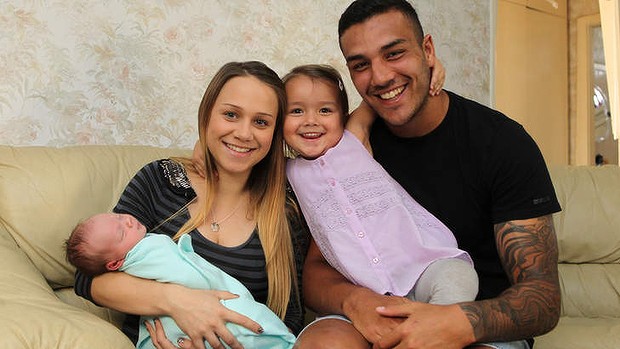
NRL player Dylan Farrell, and his partner Hayley Mundy [pictured], welcomed their son Derain about a week ago. Derain Farrell joins big sister Leilani, aged 3. Derain is a place in New South Wales, whose name is said to come from an Aboriginal language meaning “of the mountains”; Dylan grew up on an Aboriginal mission on the South Coast. Dylan has played for South Sydney Rabbitohs since 2010, and has been signed with the St. George Illawarra Dragons for next season. Souths will face Manly in the finals on Friday.

Soccer star Mark Milligan, and his wife Rhia, welcomed their daughter Audrey earlier this year. Audrey Milligan joins big sister Maya. Mark has been playing professionally since 2002, and is currently signed with Melbourne Victory; he is also a member of the national team, the Socceroos.

Local rugby league player Chris Thompson, and his wife Chrystal, welcomed their son Chandon early in the year. Chandon Thompson joins big sister Alaqua, aged 4, and big brother Mataeo, aged 2. Chris plays for CYMS in Dubbo. Chandon is a French surname, taken from a common place name in France; it is most associated with the champagne Moët & Chandon.

Celebrity Baby News: Brooke Harman and Jeffrey Walker

Tags

BLW_1433_2

Actress Brooke Harman, and her husband, director Jeffrey Walker, welcomed their first child on June 24, and have named their son Boston Scott. Boston Walker was born at 10.38 pm, and weighed 3.6 kg (7lb 15oz); Brooke announced his birth on her blog.

Brooke was born in the United States, and came to Australia as a young child, growing up in Queensland. Her first television role was at the age of 11, on the children’s series, The Wayne Manifesto. She has guest starred on shows such as Home and Away and All Saints, and been in a few films, including the 2003 version of Ned Kelly. Brooke had the lead role in children’s drama series, Pirate Island, and recently had a recurring role on teen drama series, Dance Academy.

Jeffrey started out as a child actor, with his first role at the age of 6, on House Rules. He had major roles in Round the Twist, Ocean Girl, and Mirror, Mirror, and was the star of The Wayne Manifesto, for which he received a Young Actor’s Award from the Australian Film Institute. He and Brooke first met on the set of The Wayne Manifesto. Jeffrey is now a television director who has worked on soaps such as Neighbours and Home and Away, as well as children’s series such as Wicked Science, H2O, The Elephant Princess, and Blue Water High. Jeffrey also plays guitar for the indie rock band, Ballet Imperial.

(Photo of Brooke and Boston from Hello Sailor)

Thank you to Nicole for sending in this celebrity baby tip! All celebrity baby news is gratefully received.


Why Your Child Will Hate Their Name

Tags

, , , , , , , , , , , , , ,

I-HATE-MY-NAME-815x1024

How can I pick a name my child won’t hate?

That’s the question somebody typed into a search bar, and Google knows how, ended up on my blog. Here’s the kicker: you can’t. There’s no name, no matter how tastefully chosen, that comes with a guarantee that your child won’t one day hate it to bits.

I know people with what I see as very nice names (nicer than mine, in my opinion) who hate them with a bewildering passion, while people who have what I consider very boring or even ugly names are deeply grateful to their parents for choosing them. We all have different tastes.

I do know quite a few people who hate their names, and if you hang out on name forums, you don’t have to look hard to find others who have become disgruntled with their names. While everyone has their own personal quirks, over the years I have noticed a few things they tended to have in common.

These are often not the things that baby name articles warn you about. For example, a popular belief is that a “weird name” is sure to be hated by the bearer, who will be teased in the playground and come to loathe their name, their parents, and probably the whole world.

I haven’t noticed this to be the case, with most owners of unusual names enjoying, or at least coming to terms with them. I have never met anyone with an unusual name who legally changed it to something more mundane, even those who professed to find it a bit of a pain sometimes. At most, they adopted a pseudonym when booking restaurants.

Another piece of advice often handed out is that a “bizarre” name spelling will be such a nuisance that the bearer will undoubtedly wish that their parents had gone with something more traditional. Again, I don’t find that to be generally true. Some people with unusually spelled names loathe them, while others are delighted by them.

I know someone with a very unintuitive name spelling (think Veeruyniiikkarh for Veronica), and she loves that every letter in her name was individually chosen by her mum, with each one having a specific personal meaning. I thought it would be the most tremendous nuisance to have to spell out every time, but she assures me that she doesn’t mind at all. “It makes me feel special that my name gets so much attention”. For her, holding up queues is an ego-massage.

As I can’t tell you how to pick a name your child won’t hate, I thought I would least explain why they may end up hating it.

They hate themselves

Research has shown that people with high self-esteem tend to like their own name, and the higher their sense of self-worth, the more they liked their name. That suggests that people who dislike their own name may suffer from self-esteem issues.

You might assume that someone who dislikes their name would arrogantly think it not good enough for them, but sometimes it seems to be the other way around – they don’t think they are good enough for their names.

“It’s a popular girl name, it’s just not me”; “It’s too pretty for me carry it off”; or the most tragic I heard, “It sounds like the name of a happy normal person”.

To give your child the best chance of liking their name, make sure that they have high self-esteem. Convince them that they are pretty, popular, happy and normal enough for their name.

Their name is going downhill

A lot of parents worry about popularity; nearly always that the name is “too popular” to use, or is going to be too popular in the future.

However, I’ve noticed that the majority of people who dislike their names were given names that were either falling in popularity when they were born, or hitting their peak, so that they had begun falling by the time they started school.

Not only that, but the level of dislike appears to correlate with how steeply the name rose and fell. Names with a very obvious peak and trough, dating them to a particular era, seem to be the most disliked.

It doesn’t necessarily seem to be the most popular names that are disliked so much as those which display this pattern. For example, Sarah was the #1 name of the 1980s, yet I rarely hear Sarahs complain bitterly about their name. Could that be because Sarah is a classic which is still in the Top 40, so we don’t think of it as a “typical 1980s name”?

I don’t often hear anyone identify the trajectory of their name’s popularity as the reason for their dissatisfaction. They all have what appear to be good reasons for their dislike: it’s unattractive, it’s boring, it doesn’t suit them. Yet somehow it seems to be names falling in popularity which are perceived as ugly, boring, and not suiting their owners.

People given names that were already dated and out of style at the time of their birth (“old people” names) usually say that they hated their name as a child, but now they’re grown up, they appreciate it’s different from the usual names of their generation.

That may because such names sometimes begin to come back into fashion when they are adults. For example, someone born in the 1980s named Florence would have had a dated name, as it peaked in the 1900s. But now it is fashionable and rising in popularity – suddenly Florence has a cool name.

I do think popularity is worth considering – but not to cross off a name because it’s hit a particular point in the charts. Of course, you can’t know how a name will perform in the future, but you can at least see how it’s doing now. Has it maintained its position over several decades? Has it suddenly “come out of nowhere”? Is it already falling steeply? This information might help you choose between different names.

They hate the reason you chose their name

If someone really loves their name, I don’t think a bad name story will seriously ruin it for them, but if someone is already lukewarm, a bad one can add insult to injury. The factors that seem to get people’s goats are a perceived randomness, casualness, or lack of thought in the way their name was selected.

When you tell your child how you chose their name, stress how important it was to you and how much you love their name. If you chose their name from a baby name book, or a TV show, for example, make sure they understand that it wasn’t just by chance you chose their name. Whatever it was that made you fall in love with the name, express it. And don’t wait until they’re a moody teen or resentful adult to share the good news – they should know from an early age how special you think their name is.

I know a lot of people who disliked their names, and were even thinking of changing them, until their parents explained how much love and care had gone into choosing it. Teenagers who thought their parents had unimaginatively picked a popular name found that they had been named after a much-loved relative. A “made up” name that seemed “random” was the result of putting together the initials of their parents’ best friends who introduced them. And sometimes just knowing it was a name their parents loved above all others was enough to reconcile someone to a name they had thought ordinary.

The bottom line: everyone wants their name to be meaningful. Show your child that theirs is.

You hate your name

In some cases, disliking names seems to run in the family. Quite a number of women I know who dislike their names tell me that their mother was also unhappy with her own name. This may be from parental modelling. Just as mothers who constantly moan about their flabby thighs tend to have daughters with body image problems, it could be that mothers who dislike their name unconsciously send the message to their children to focus on anything about their name that fails to please.

If you hate your own name, make peace with it. Don’t try to work out your own issues when choosing your child’s name. So many parents seem to think that because they hated being one of a dozen in their class their child’s name must be rare, or because they hated their nickname their child needs a “nickname proof” name.

It’s well intentioned, but the trouble is that you’ve made your child’s name story all about you. When you tell your child how you chose their name, the story shouldn’t include information about how you felt about your name. Don’t use your child’s name as an opportunity to fix the mistakes of the past.

They hate you

In rare but distressing cases, people reject their names because their relationship with their parents irretrievably breaks down. It’s not uncommon for them to change their names in order to signal a complete break from their family background, and it can also be so their parents can’t easily locate them.

I don’t think this is worth worrying about, because if it occurs, their name isn’t really the issue, and is the least of your problems.

POSTSCRIPT: I should add that most of my observations in regard to name dislike relate to women. It isn’t that I don’t know any men who dislike their names – I know a fair few who hated their name enough to legally change it, and I’ve read a lot of articles written by men on how much they dislike their name.

However, women and girls do seem to more openly express their feelings about their names, and it’s possible that they have subtler emotions toward their name, or are more likely to be analytical about them. Perhaps women are more likely to be “fussy” about their names than men. Whatever the reason, it seems to be easier to gather information about their feelings towards their names (at least for me).

POLL RESULTS
79% of people responding to the poll were generally satisfied with their name. 33% liked their name, 19% loved their name, 18% weren’t mad about their name, but could live with it, and 9% said that they used to dislike their name, but had changed their mind and now felt positive towards it.

However, 12% of people did hate their name, while 9% thought that hate was too strong a word to use, but they didn’t really like their names either.

The good news is, most of us have names that we are content with, and around 10% of people who don’t like their name will change their minds.

(Picture from Naver)

Celebrity Baby News: Australian Rules Football Babies

Tags

,

899131-lewis-jetta

It’s football finals season, so here are two baby daughters of Australian rules footballers. Both have a connection to the West, and both have pretty floral names.

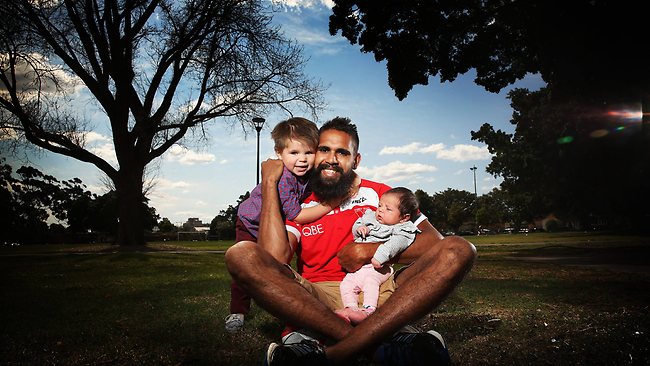
Lewis Jetta, who plays for the Sydney Swans in the AFL, and his partner Jess, welcomed their daughter Daisy last month. Daisy Jetta joins big brother Lewis aged 2 – Lewis is known as Junior.

Lewis is originally from Western Australia, and has been playing for the Sydney Swans since 2010. He is a director with the National Aboriginal Sporting Chance Academy, which works with Indigenous youth, and has been involved with the Australian Literacy and Numeracy Foundation’s Wall of Hands campaign, and the Learn Earn Legend initiative. He is keen to provide a good role model for Indigenous youth, and he and his cousin Neville, who plays for Melbourne, both returned to school to complete Year 12 as an encouragement to their younger cousins. Tonight Lewis will be back in his home state for the preliminary finals against Fremantle Dockers.

Lewis chose Lewis Junior’s name, and under a prearranged agreement, Jess got naming rights for a girl. Lewis jokes that he suggested Louise, but the idea was vetoed.

Rory O’Brien, who plays for the East Fremantle Sharks in the WAFL, and his partner Ebony Lawler, welcomed their daughter Ivy Mae last year.

This year, Rory won the Sandover Medal, awarded to the fairest and best player in the West Australia Football League. Rory is the first person from his club to win it for fifteen years, and he gained the second highest number of votes in history.

(Photo shows Lewis Jetta with his children Junior and Daisy)

Leopold and Maximilian

Tags

, ,

02890MTwins

Gus and Max (Jack)

Perri Belle and Jaegar Flynn (Halle)

Phoebe Aimee Diana and Amelia Nicole Christine


Girls

Annalise Evelyn Ivy-May

Ayla Loren (Keelen)

Emmy Cate (Stella, Ollie)

Eva Jules

Harvi June (Daxon)

Jean Anne

Mia Bella (Ava)

Monica Charli (Gretel)

Pailin “Gemma”

Sanchia Ruby Robin

Shalilah Ida Rose (Tahneesha, Kaden, Tyler)

Summer Donna

Taleisha Jaide

Tilda Ellen (Pippa)

Victoria Lillian (Eliza)

Zarina Zae Claire


Boys

Antanas Jacob

Arion Kon (Zahlia, Malitah)

Duke David (Charlize)

Edward Horace

Finley Rex (Jacob, Lacey, Ruby)

Flynn Fortune

Henry Arthur (Thomas)

Jack William (Gidget)

Leopold Stefan

Lewis Reeve (Nate, Ruby)

Maximilian James (Thomas, Emma, Samuel, Charlotte, Lily, Sarah, Lucy)

Oscar Maxwell “Ozzie” (Tilly)

Ralph Harrison

Stefan Gabriel (Freddie)

Trey Edward

Xavier Albert (Luke, Liana)


Most popular names this week

Girls: Madison

Boys: Xavier

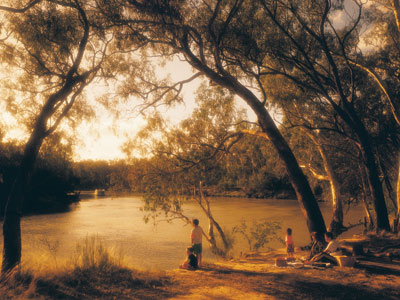
(Picture shows a family picnic by the Murray River, near Mildura in Victoria)

Celebrity Baby News: Daisy Turnbull-Brown and Captain James Brown

Tags

,

-0584_MG_5790

Daisy Turnbull-Brown, and her husband Captain James Brown welcomed their first child on September 19, and have named their son Jack Alexander. Jack Turnbull-Brown was born in the morning, weighing 3.8 kg (8 lb 3 oz) and 55 cm long. Alexander is the name of Daisy’s brother.

Daisy is a history teacher, and James served as an officer in the Australian Army before becoming a Military Fellow at the Lowy Institute, researching military issues and defence policy. Daisy and James were married in 2010.

Daisy is the daughter of Liberal MP Malcolm Turnbull, member for the seat of Wentworth, and recently made Minister for Communications. Daisy’s mother Lucy Turnbull is a prominent businesswoman and former Mayor of Sydney.

Jack is the first grand-child for Malcolm and Lucy.

(Photo shows Daisy and James’ wedding day, with the bride and groom accompanied by their parents, and Daisy’s brother Alex)