Babies Who Made Unexpected Arrivals – Autumn Edition (Part 2)

Tags

, , ,

There was unusually high number of babies who arrived unexpectedly in May, so I made this is a two-parter. Links to full stories and photos.

Megan and Bryant Platt, from the country town of Gin Gin in Queensland, were on their way to hospital in May when their son Liam was born by the side of the road, under a street light in the tiny town of Sharon on the outskirts of Bundaberg. He was delivered by his dad with the help of a Triple 0 operator; Bryant described it as a “scary” and “slippery” situation. Liam has a big sister named Amelia, aged 5.

Chantal Burrows, from Shepparton in Victoria, had practised hypnobirthing in preparation for her labour, and decided to relax and go with the flow no matter what happened. She listened to music, took a little walk, then had a bath to help things along. Her tradie husband Grant was also relaxing, by watching the footy on TV. However, he became slightly less relaxed when he realised that he was going to have to deliver the baby himself in the bath. Chantal stuck to her birth plan by not getting stressed and trusting her husband completely. Their new baby boy is named Nash, and he has a big brother named Jasper, aged 2.

Sue Hopkins from Geelong in Victoria was better prepared than most as she headed off to hospital – she had her birthing partner Kellie Whiskin with her, and was being driven by her husband Rob, who is a doctor. When it became apparent they weren’t going to make it in time, her team sprung into action and placed Sue by the side of the road, where she gave birth lying amongst the gravel. Baby Carrie was born into her father’s arms, although Rob hadn’t delivered a baby since his medical school days. A passing handyman named Gary Boyd also helped out. Carrie has a big brother named William, aged 2.

Karissa Marich from Port Augusta in South Australia gave birth to her son Izaiah Marich-Warren by the side of the road, with assistance from her mum, Karina Welsh.

Simone and Will Buckle from Warrnambool in Victoria welcomed their daughter Saige Violet just six minutes after Simone first felt a mild contraction. The couple soon realised they couldn’t wait for an ambulance when Simone felt the baby crowning while she was in the shower. Will, a carpenter, says it was “nerve-wracking”, but there was literally no time to worry as he covered the bathroom floor in blankets and towels and delivered his daughter. Saige has a big brother Angus, aged 2, who was born after just 40 minutes labour. Simone does not want another home birth, although Will can see the benefits and is prepared to do it again if necessary.

Felicity and Michael Weeks from Toowoomba in Queensland were on their way to hospital when their daughter Tia was born in the back of the car, delivered by her father with the help of a Triple 0 operator.

Umi Dowell from Brisbane felt contractions the day she gave birth, but didn’t worry about it as she’d been feeling them for more than a month. She saw her husband Mark off to work, and attended a check-up with her doctor, who said she wouldn’t need to come in for another week. Umi was eating lunch at home when she went into labour. She didn’t think of calling for an ambulance, as that seemed “a little bit too dramatic”. At the last minute, she did phone Triple 0, and was told to begin preparing for the baby’s birth. Umi panicked as she realised she might have to deliver her own baby, but paramedics Nick Bleckmann and Benjamin Gray did make it just in time, assisted by student paramedic Aynslee Ryan. Umi’s neighbour Louise also came over to help. Baby Josh was born on the kitchen floor after a 15 minute labour. Josh has a big brother named Ethan.

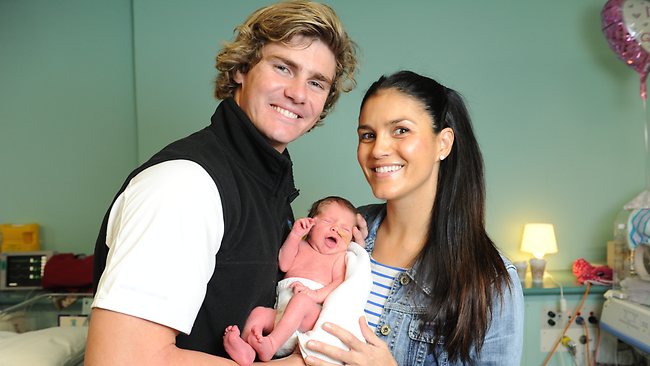
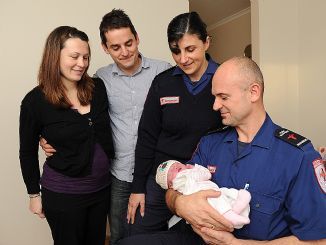
Kirrily and Tim Anderson-Bonsar of Melbourne were warned that they might have a difficult birth with their second baby, because their eldest child, Acacia, born two and a half years previously, had needed a caesarean delivery. When Tim urgently phoned for an ambulance for his wife late one night, paramedics Steve Mati and Michela Clarke squeezed into the couple’s tiny partly-renovated ensuite bathroom to deliver the baby. Steve said there were a few tense moments, but Meadow Akiko arrived in just 16 minutes. Meadow’s middle name Akiko is a common Japanese name which can mean, aptly enough, “autumn child”. Anyone else finding Acacia and Meadow a rather delightful sibset? [Photo of Meadow with her parents and the paramedics].

Nick O’Malley is the US correspondent for the Sydney Morning Herald, and last week he got to contribute a personal story in the Opinion column about the recent birth of his second child. His wife Kathleen woke in the night with mild contractions, and phoned the Royal Prince Alfred Hospital in Melbourne for advice. They told her not to come in until her waters broke, to take two Panadol and try to get some sleep. A couple of hours later, Kathleen’s waters did break, and Nick bundled his now bellowing wife into the back of the car. During the drive to the hospital, Kathleen gave birth to their son, Clyde Johnston O’Malley. Newspaper articles about babies born in cars tend to be coy about the details, but Nick gives a blow-by-blow description, including all the swearing, screaming, biting, traffic violations, and having to spend $150 to get the blood cleaned off the car (he paid  $30 less than usual because it was from a baby being born). The man who cleaned the car was named Sam.
Famous Name: Azaria

Tags

, , , , , , , , ,

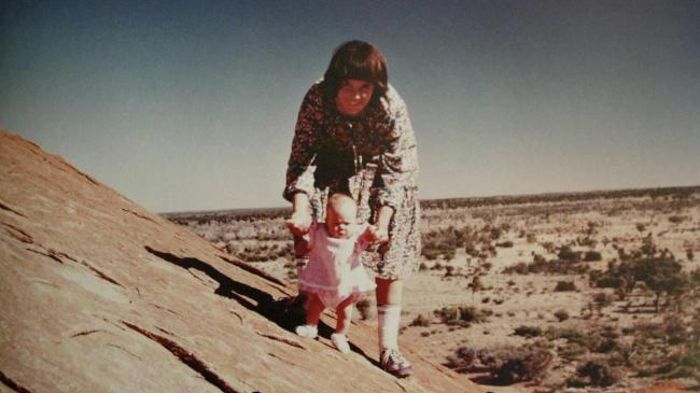
On June 12 this year, a very long legal case finally came to an end, when coroner Elizabeth Morris ruled that Azaria Chantel Loren Chamberlain had been taken by a dingo on August 17 1980. Azaria was nine weeks old when she died, and June 12 was the day after what would have been Azaria’s thirty-second birthday, had she lived.

The disappearance and death of baby Azaria in the Northern Territory was a case which generated mass hysteria, divided the nation, and led to a cruel media-driven witch hunt against Azaria’s grieving parents, Lindy and Michael. It remains an ugly stain on our national psyche, and a lesson in not being too ready to believe the worst about the latest media “villain”. A lesson we unfortunately never seem to learn.

The Chamberlains had been on a camping holiday at Uluru (Ayers Rock) with their three young children when Lindy screamed that a dingo had taken her baby from their tent. Witnesses at the time believed her implicitly; there were warning signs everywhere about the dangers of dingoes, and six weeks earlier, a three year old named Amanda Cranwell had been dragged from her parents’ car by a dingo and had to be driven off. Azaria’s brother Aidan said that he heard a dingo in the tent with them, and Aboriginal trackers reported that she had been dragged by an animal.

A coronial inquest found that Azaria had been taken by a dingo, but her missing body disposed of by unknown human means. That should have been the end of this family’s tragedy, but instead it had just begun. For reasons unclear to me, the Northern Territory police refused to accept the findings, and charged the Chamberlains with murder.

Michael was a pastor in the Seventh Day Adventist Church. People didn’t know much about this minority religion, and mistrusted the Chamberlains as somehow “different”. Lindy maintained the calm dignity of someone who knew she was innocent and believed that God was on her side. This was taken as unnatural – why didn’t she shriek and cry hysterically like a proper woman? Why did she never squeeze out at least a few tears? Why did she seem so assured when she was only a housewife?

Wild rumours began to circulate, and the media gleefully reported each one. One was that the Chamberlains’ religion demanded a child sacrifice, and they had gone into the outback with the express purpose of murdering their baby daughter. Another was that they weren’t Christians at all – they were Satanists, devil worshippers or into black magic; being religious was just a front. Another notion was that perhaps their religion forbade medical assistance (it doesn’t), and that they had killed a terminally ill Azaria rather than let her suffer a slow death. One of the sickest was that Azaria’s brothers Aidan and Reagan, then aged six and four, had killed her and her parents covered it up.

It is shocking and heartbreaking that people in modern times could be so ignorant, gullible and superstitious; it beggars belief that anyone could think a mother would kill her daughter in front her other children, and have the audacity to do so in broad daylight surrounded by witnesses, washing off all blood and disposing of all evidence within ten minutes. However, so convincing was this view of the evil, unnatural Lindy that she was found guilty and sentenced to prison in 1982. Four years later, some of Azaria’s missing clothing was found in a dingo’s lair, and Lindy was released.

The Chamberlains’ marriage did not survive and both remarried. The fate of Azaria was still listed as “unknown”, and her story became urban legend; she was part of the horrors of the outback, she was our nightmare and our collective guilt. She was a meme, a joke, a rumour, a punchline, a subject of gossip, a tee-shirt slogan, an industry which brought out books, tea towels, movies, TV shows and even an opera.

Last week Azaria’s extraordinary story ended, and she was at last declared officially dead and given a death certificate. The coroner offered her heartfelt sympathies to the Chamberlains for the loss of their daughter and sister, however the Northern Territory government refuses to apologise for the events which followed that loss.

Azaria is a variant of the Hebrew name Azariah, which means “Yahweh has helped”; however Azariah is pronounced az-uh-RY-uh, and most people say Azaria a-ZAHR-ree-uh. Despite Azariah being a male name in the Old Testament, Azaria is more commonly used as a girl’s name.

During the hysteria surrounding the Chamberlain case, it was falsely claimed that the name Azaria meant “sacrifice in the wilderness”, with the obvious conclusion  that the Chamberlains had marked their daughter from birth for ritual infanticide. (I would have thought that if you actually were planning to do that to your baby, you’d choose a name that drew less attention to your nefarious scheme).

The original coroner made a finding that Azaria did not in fact mean “sacrifice in the wilderness”, making it one of the few times in legal history when a court has made a ruling on the meaning of a name. Lindy found the name in 1001 Unusual Baby Names, where it was identified with standard baby name book laxness as the feminine form of Azariah, meaning “blessed by God”. The current edition of the book is called The Complete Book of Baby Names, now boasts over 100 000 entries, and has updated Azaria to mean “helped by God”.

Azaria’s name was an unusual name when she was born, and it is still uncommon. I have seen the name a few times in birth announcements, using both the Azaria and Azariah spellings, and given to both girls and boys. Azaria has been on the US Top 1000 since the mid-2000s, suggesting that the name is on the rise internationally rather than being an Australian phenomenon.

The first time I saw the name given to a new baby I gave an unconscious start of shock, but then rationality kicked in and I could see that the name deserves to be used again, and it would be ridiculous to avoid it. Until I saw Azaria with the middle name Chamberlain. Maybe it was a family name, maybe it was honouring an unfortunate victim, but even 32 years later, for me it was too soon.

Celebrity Baby News: Karmichael Hunt and Emma Harding

Tags

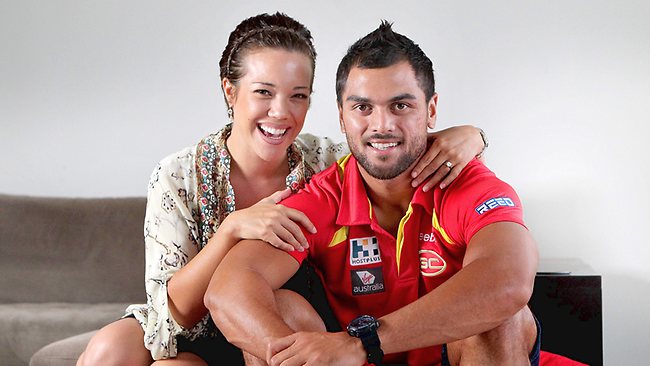
AFL player Karmichael Hunt, and his fiancée Emma Harding, welcomed their first child this week, and have named their daughter Halo Amelia.

Karmichael is originally from New Zealand, and moved to Australia as a child. He began his sporting career playing rugby league, debuting for the Brisbane Broncos in 2004, winning the Dally M Rookie of the Year Award and the Brisbane Broncos Rookie of the Year Award. Despite being eligible to play for New Zealand, the Cook Islands and Samoa, he only ever played national rugby league for the Australian side. In 2009 he switched to rugby union, and played for the French team, Biarritz Olympique. Last year, he changed codes again, and began playing in the Australian Football League with the Gold Coast Suns. Although he has come under a lot of criticism over his decision to swap codes, he won his team’s Most Improved Player Award for 2011.

Emma is the sister of former AFL footballer Scott Harding, who now plays American football in Hawaii. Scott and Karmichael attended the same school together, the Anglican Church Grammar School. Emma’s brother Justin plays for Labrador in the North East Australian Football League. Her mother is from the Polynesian island of Tuvalu.

Celebrity Baby News: Berrick and Bec Barnes

Tags

Rugby union player Berrick Barnes, and his wife Bec, welcomed their first child on June 16, and have named their son Archie. Archie Barnes was born six weeks premature, and weighed just 1.92 kg (about 4 pounds 4 ounces). Berrick and Bec knew that he would be early, but the fact that all their baby stuff is still in its wrappings tells you that Archie came even earlier than expected.

Berrick began his sporting career straight out of school, when he joined the Brisbane Broncos in the National Rugby League in 2005. He then switched codes the next year, and began playing for the Queensland Reds; he has been with the NSW Waratahs since 2010. He made his debut for the national team, the Wallabies, in 2007.

Rebekah (nee Spratt) and Berrick were married in the regional New South Wales city of Orange, shortly before Christmas last year.

June 16 was a very memorable day for Berrick. He had been in Melbourne the day before preparing for a Test match when he was unexpectedly called back to Sydney for the birth of his son. Archie was born around midnight, and then Berrick had to fly back to Melbourne for the match. It was a case of planes, trams and taxis to get him to the ground, but in the end Australia beat Wales 27-19, and Berrick was declared man of the match.

Archie Barnes is the third celebrity baby named Archie this year – the other two are Archie Whitely and Archie Johnson.

Waltzing With … Lawson

Tags

, , , , , , , , , ,

This blog entry was first posted on June 17 2012, and revised and re-published on April 6 2012.

Today is the birthday of the Australian poet Henry Lawson, who was born June 17 1867. Public celebrations to mark this event were held last weekend, to coincide with the Queen’s Birthday long weekend.

There are two festivals in his honour in the Western Plains region of New South Wales. The town of Grenfell has one because that’s where Henry Lawson was born, and so does the town of Gulgong because Henry’s parents moved there when he was just six weeks old, and spent his first five or six years there.

Willoughby council in Sydney holds a bush poetry reading every two years at Henry Lawson’s Cave, and this year it fell on Henry Lawson’s actual birthday. Henry Lawson’s Cave is a small cavern which the author used as an occasional refuge, and perhaps wrote some of his work there. Another site for Lawson-lovers to visit in Sydney is the statue of Henry Lawson near the Domain, an area that Lawson enjoyed walking in, and perhaps sometimes slept out in.

Henry Lawson is said to one of our three national poets, the other two being Banjo Paterson and C.J. Dennis, yet it is as a writer of short fiction that he really shone. His style is quite modern, being spare and unflinching, with plot being less important than powerful imagery. He has sometimes been compared to Hemingway and Chekhov in terms of a lean, raw writing style. His mother was the feminist Louisa Lawson, and the political bent of his work was greatly influenced by her and her radical friends.

His importance as an Australian bush writer is that he wrote of the realities of the Australian bush, rather than the romanticised version you get from Banjo Paterson. Henry Lawson was born to a struggling family on the goldfields, and his parents’ marriage broke up; as a man who greatly admired his mother, he had a deep appreciation of how hard bush life could be for women, and how strong they needed to be just to survive, let alone thrive. The outback frequently appalled Lawson, and he saw it as a place of suffering.

Yet his perceptions of the bush have helped to shape our identity, and he had a gift for capturing and evoking the national character in just a few words. He stressed the egalitarianism and mateship of the Australian psyche, and championed the underdog and the urban poor. He understood the laconic Australian sense of humour, with its sharp sense of irony.

Lawson’s life was a sad one; he was bullied as a child and never felt that he fit in, his little sister died, his parents split up, he went deaf early in life which increased his sense of isolation, he struggled to gain recognition and find steady work, his marriage was unhappy and mirrored his parents’ by ending in separation, and he drank to ease his sadness which made things worse. He spent time in gaols, convalescent homes, and mental asylums.

It’s tempting to think that he inherited a strain of Nordic gloom from his Scandinavian father, and that depression was at the back of many of his misfortunes. Because of this, last year two men did the Henry Lawson Walk, which re-enacted a walk Lawson took with a friend from Bourke in outback New South Wales to Hungerford in outback Queensland – a trip of around 450 km (280 miles).

They did it to raise awareness and funds for Beyond Blue, the national depression initiative. Beyond Blue has programs which focus on men’s health, alcoholism, and those facing isolation in rural areas – in fact many of the problems suffered by Lawson in the late 19th and early 20th centuries are still being battled today. He is truly one of the moderns, both in life and art.

Name Information
Lawson is an English surname meaning “son of Law”, with Law a popular medieval nickname for the name Lawrence. The name was especially associated with Yorkshire, as the Lawson family was prominent during the War of the Roses. Lawson has been used as a personal name since the 17th century, with use concentrated in the north of England – an apparent legacy of its Yorkshire origins.

It should be noted that Henry Lawson’s father Anglicised his surname from the Norwegian form of the name, Larsen. There is a suburb of Canberra named after Henry Lawson – not to be confused with the town of Lawson in the Blue Mountains. Although Henry Lawson did live in the Blue Mountains at one point, the town is named after the explorer, William Lawson.

In the US, Lawson was especially associated with the southern states: John Lawson explored North Carolina in the 18th century, and Gaines Lawson was a Confederate captain in the American Civil War. Alfred Lawson was a popular philosopher in the Midwest, promoting vegetarianism, the end of banking, and racially integrated baseball; an aviation pioneer, he is cited as the inventor of the airliner, although it immediately crashed.

The name Lawson charted in the US Top 1000 from the late 19th century until World War II, then had a long break from 1950 to 2000. Since then, the name has been steadily going up the charts and is now #485 – the highest the name has been since the early 20th century.

In the UK, the name Lawson has been in the Top 1000 since 2003, and has been climbing since 2010, when the British band Lawson formed. Since their first album came out in 2012, the name has gone up even more steeply, and is now #409.

In Australia, Lawson is in steady use, and perhaps also around the 400s here. It’s a name which pays tribute to the first Australian writer to be given a state funeral, and is less popular and more modern-sounding than his first name, Henry, and fits in with popular names such as Lincoln and Logan.

Historian Manning Clark wrote that Australia was “Lawson writ large”, and this patriotic name honours the man who who been called “the people’s poet”, “our poet-prophet”, and “the real voice of Australia”. It’s a voice that is not always comfortable to hear, but this is a great name for anyone who loves the real Australia, and not an idyllic vision of it.

POLL RESULTS
Lawson received an approval rating of 89%, making it one of the highest rated names of 2012. 39% of people loved the name Lawson, and nobody hated it.

Pollyanna and Banjo: Birth Announcements from Hobart (May)

Tags

, ,

Twins

Archie Jack and Flynn Monty

Indianah Tika and Jaidah Anahera

Spencer Simon and Milla Sarah


Girls

Arya Isabel

Charlotte Elizabeth

Ivy Florence (Eliza, Izaak, Alex)

Letaya-Kirra Rose (Bailey, Jackson)

Millie Belle

Olive May (Alice)

Pollyanna Rose (Louie)

Poppy Cecelia

Quinn Georgia (Halle, Archer)

Sonya Rosalie (Ben, Amanda)


Boys

Atticus Sebastian (Stella, Scarlett, Archie, Avalon)

Banjo Charles

Benjamin Joseph George (Oliver)

Flynn Matthew (Jack, Ned)

Heath Griffin (Laella, Romney)

Hudson Leo (Willow)

Jimmy Benjamin (Madelyn, Archie)

Miles Henry Richard (Jack)

Walter Frank (Georgina, Victoria, Rosabella, Wilhelmina)

William Tasman (Oliver)

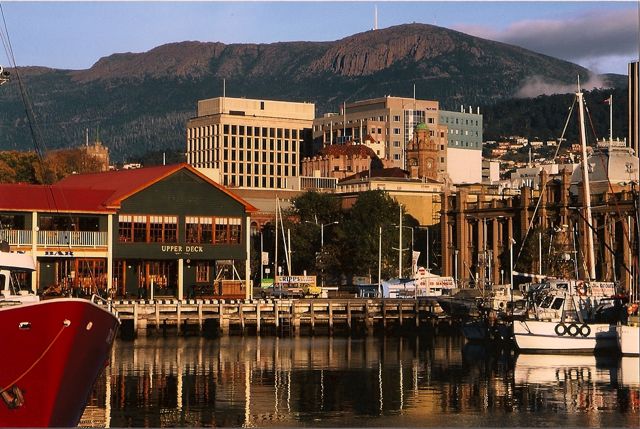
(Photo shows view of Mt Wellington across Hobart docks in autumn)

Twins Memphis Harlow and Indii Takira: Birth Announcements from Canberra (May)

Tags

, ,

Twins

Mason and Jay

Memphis Harlow and Indii Takira (Noah)


Girls

Cate Penelope Beverley

Ella Kate Margaret

Hazel Vuokko

Isla Mary Elizabeth

Lilly Irene Patricia

Meg Michelle (Molly)

Ruby Elsie-Diane (Jackson, Lochie)

Tessa Connie

Xanthe Sabine (Astrid)

Zoe Maria Margaret


Boys

Bassilio Anthony

Braxton Brady

Dimitri George (Savannah)

James Reneti

Jasper Hilton (Clara, Hamish)

Lewis Ian (Charlie)

Maxwell Leonard (Emerson)

Micah Jarod (Jasmine, Kai)

Samson Brian (Evie, Enzo)

Trent Joseph

(Picture shows rowers through morning mist in sub-zero temperatures on Canberra’s Lake Burley Griffin, May 2012; photo from ABC News)

Celebrity Baby News: Jeremy and Jody Smith

Tags

, ,

NRL player Jeremy Smith, and his wife Jody, welcomed their third child and first son on June 9; their son is named Jeremy after his dad. Jeremy Smith Junior joins big sisters Marly, aged 6, and Evie, aged 1.

Jeremy is originally from New Zealand, and is a cousin of Kalifa Faifai Loa, who plays rugby league for the North Queensland Cowboys. Jeremy has been playing professionally since 2004, and began his career with the Melbourne Storm. He has played for the Cronulla Sharks since last season, and also represented the New Zealand Kiwis in last year’s ANZAC Test.

Jody went into labour unexpectedly on the preceding Friday, giving birth to baby Jeremy in the early hours of Saturday morning. When he got home from hospital, he had two children to care for, including his baby daughter, so there was little rest for him. Despite 36 hours without sleep, Jeremy scored the first try of the game in the 17th minute, and Cronulla beat the Gold Coast Titans 22-10.

Famous Name: Venus

Tags

, , , , , , , , , , , , , ,

Last Wednesday was the transit of Venus, the planet taking about six and a half hours to cross the face of the Sun. Most of Australia was in a prime position to view this astronomical event (with special protective glasses, or else streamed live on the Internet so as not to damage our eyes).

Transits of Venus occur in pairs 8 years apart, separated by gaps of 121.5 years and 105.5 years. So the one before this one was in June 2004, and the next one will be in December 2117. I don’t want to be a pessimist, but if you missed this last one, I think you’ve lost your chance to see another.

The transit of Venus is not only a rare and lovely astronomical event, it is also an essential part of Australian history. It was in 1766 that the Royal Society sent Captain James Cook to observe the transit of Venus from the Pacific region. The reason scientists were so keen to get accurate observations was because astronomer Edmond Halley (of Halley’s Comet fame) had suggested that if you measured one of the transits, you could then use the data to figure out the distance from the Earth to the Sun, and thence to work out the distances to all the other bodies in the solar system.

For a variety of reasons, nearly all the scientists sent around the world ran into technical problems, and it was up to Captain Cook to take the observations, which he did in Tahiti in 1769. He then opened his sealed orders from the British Admiralty to find he had been sent on a secret mission to discover the mythical Terra Australis. There was no such place, and discovering New Zealand was a massive disappointment, as it was nowhere near the size the expedition had been hoping for.

Now some men would have gone home, feeling that observing the transit of Venus and discovering New Zealand was enough for one trip. But Captain Cook was made of sterner stuff, and he took it upon himself to become the first European to explore the east coast of Australia, and also to claim it as British territory. His reward was to be given a promotion, and sent back again to look just a bit harder for Terra Australis.

By sailing around diligently discovering places and claiming them for Britain, he was at last able to establish that Terra Australis didn’t exist, although Britain now owned a reasonable sized country it could send convicts to. The maps Cook made in the process were so good that they were still being used in the twentieth century, and the observations he took of the transit of Venus were used to calculate the distance between the Earth and the Sun with reasonable accuracy.

The planet Venus has an ancient connection to Australia as well, because the Yolngu people of Arnhem Land believe she is an important creator spirit called Banumbirr. Through dawn ceremonies performed with beautifully decorated Morning Star poles, they communicate with their dead ancestors through a rope of light which Banumbirr trails behind her. The ceremony means the ancient Yolngu people must have had enough astronomical knowledge to track the complex motion of Venus, as it rises before dawn only at certain times of the year.

I love stars, and although Venus is a planet, I, like almost everyone else, know it as both the Morning Star and the Evening Star. The brightest object in the night sky after the Moon, Venus is the first light to appear at dusk, and the last to disappear at dawn. In fact, I have often wished on Venus, with that little rhyme which begins, Star light, star bright, first star I see tonight …. Sometimes my wishes came true, sometimes they didn’t! Fickle Venus.

The Babylonians may have been the first to understand that the morning and evening stars were the same object, and called it Ishtar, after their goddess of love, sex, fertility and war. Other cultures followed the tradition, and to the Romans she was Venus; her morning aspect was called Lucifer (“light-bringer”), and her evening one Vesper.

Venus was a Roman goddess of love, beauty, sex, fertility, luck and war; her name is from the Latin word venus, meaning “sexual love, sexual desire”. The word is closely related to venenum, meaning “poison, venom”, which probably demonstrates a certain ambivalence towards passionate love we share today. The word venenum also meant charm, as in a love potion. Falling madly in love with someone can feel as if we have been given some sort of magic potion, and if it all goes wrong, we do indeed feel as awful as if we had swallowed poison instead!

The Romans said that Venus was the mother of Aeneas, the Trojan ancestor of Rome’s founder, Romulus, and therefore the mythological ancestor of the Roman people. The month of April was sacred to her, and she was associated with springtime flowering and the fecundity of nature. Her earliest festivals were ones that celebrated gardens and wine-drinking, and many of her attributes seem to be taken from more ancient goddesses of water and purity. Later on, Venus was identified with the Greek goddess Aphrodite and the Phoenician goddess Astarte.

The beauty of Venus has made her a popular subject in art, especially as it was acceptable (and practically mandatory) to show her nude or semi-nude. Two of the most famous are probably the classical statue, the Venus de Milo, which has the arms missing, and Bottichelli’s painting, The Birth of Venus. To call a woman “a Venus” means that she is beautiful and desirable in a very erotic way.

As well as being a female first name, Venus can be an English surname. It’s not related to the goddess, but is from the Norman-French place name of Venoix, near the city of Caen.

Venus is also a place name; there are two towns in Australia called Venus Bay – one in South Australia and the other in Victoria. Both these fishing villages are named after ships called Venus, which brings us to another intriguing Australian connection to Venus.

It is said that the drinking song, The Good Ship Venus, may have been influenced by actual events, when convicts travelling on the brigantine Venus mutinied and took the ship to New Zealand, becoming Australia’s first pirates. Two of the convicts were female, and there were reports of great immorality aboard ship – a possible inspiration for the song’s bawdy lyrics.

Venus is a rarely used name, but one which evokes both feminine beauty and the twinkle of a lovely “star” which can grant wishes …. sometimes. It’s one which has several connections with Australia, and is deeply woven into our nation’s history and culture. That makes Venus a surprisingly patriotic name choice, although I do feel on this one, we have waltzed far, far beyond Matilda!

(Photo of the transit of Venus from NASA)

Celebrity Baby News: Samantha Jolly and Christian Wenck

Tags

News presenter Samantha Jolly, and her husband, Christian Wenck, welcomed their first child on May 25, and have named their son Harrison James. Harrison Wenck was born at St John of God Hospital in Subiaco.

Samantha is a reporter and presenter for Channel Seven News in Perth. Her husband Christian works in the north of Western Australia on a fly-in fly-out basis. Samantha will be taking a year’s maternity leave, and Christian has seven weeks leave.