Celebrity Baby News: Dean and Brooke Young

Tags

,

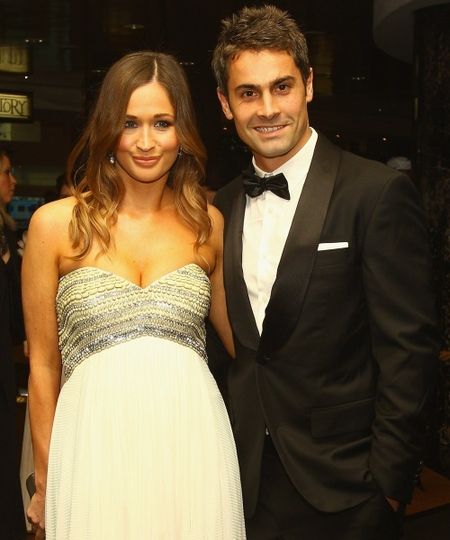
NRL player Dean Young, and his wife Brooke, welcomed a son named Roman Craig Young this week. Roman Craig joins big sisters Elli Grace and Sienna Bel, who are identical twins and aged 3.

Dean has played with the St George Illawarra Dragons all his career, and is the son of former St George Dragons captain and coach, Craig Young. This helps explain Roman’s middle name.

Dean and Brooke have been together since high school, and were married in 2007.

Roman Young is the second celebrity baby born in the past fortnight called Roman; the first one was Roman Paul Shepherd.

(Photo from The Daily Telegraph, January 19 2007)

Celebrity Baby News: Matt and Kirsten King

Tags

NRL player Matt King, and his wife, Kirsten, welcomed their first child on June 16 – a daughter named Charlie June. I’m guessing that her middle name is after her month of birth.

Matt has been in England since 2008, playing for the Warrington Wolves in the Super League. Matt became a favourite at the Wolves, but this season ended in disappointment after the team were knocked out of the semi-finals. However, next week he will be attending a reception with the Queen at Buckingham Palace, for Australians who have succeeded in their chosen fields in the United Kingdom. He will be returning to Australia in order to take up a three year contract with the South Sydney Rabbitohs, beginning next season.

I apologise for the lateness of this entry, as Charlie King’s birth was only announced in the British papers at the time.

(Story and photo from the Warrington Guardian, June 19 2011; extra information from Noosa News, October 5 2011)

Baby Name Explorer: 110 Years of Name Data from New South Wales

Tags

,

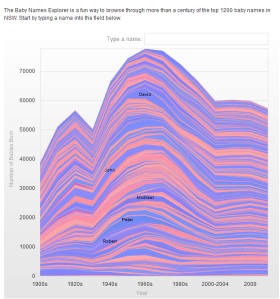
The Baby Name Explorer provides a way to browse through 110 years of the Top 1200 names in the state of New South Wales.

There’s two ways you can use it. The first way is just to scroll through the coloured graph on the website; the pink lines are girl names, the blue ones are boy names and the grey ones are unisex names. Aaron is at the top, and Zoe at the bottom. You can either find a name somewhere between Aaron and Zoe, and follow its fortunes through the years by moving across from left to right, or you can pick a period and move downwards to see what names were popular at a certain period.

For example, in the 1900s, William was the #1 name for boys, with 761 born each year, and Mary was the #1 name for girls, with 1150 born each year. (Leslie was the #1 unisex name). Some names from the 1900s are back in the charts, such as Ruby and Alexander, while Bessie and Clarence aren’t heard of so much these days.

The second way you can use it is to search for a particular name by typing it into the search bar. Once you do that, the name you ask for will come up alone on the chart in bright red and you see its popularity at various times.

For example, when I type in my own name, I can see that it wasn’t even in the Top 100 at the beginning of Federation, and didn’t become Top 100 until the 1950s. It was #55 in the 1970s, peaked in the 1980s, when it got to #39, and since then has declined until it is #71 today. Even though I wasn’t born in New South Wales, it’s still interesting information.

It’s obviously a great historical name resource, so thank you very much to the NSW Registry of Births, Deaths and Marriages, and to the Powerhouse Museum for supplying us with this database.

Unique Girls Names from Tasmania, 2010

Tags

, , , , , , , , , , , , , , , , , , , , , , , ,

Many parents say that they are looking for a “unique” name, but what they mean by that seems to differ from person to person. Some say it’s a name you don’t see every day; others define it as any name not in the Top 100; and still others refuse to say what it means to them, but will “know it when they see it”. According to the dictionary, “unique” means that only one person possesses it, and names of which the world holds but one example are few and far between. However, names do not have to be particularly strange or rare to be unique in a certain context. For example, the name Savannah is unique within the British royal family. Here are some names from baby girls born in Tasmania last year; in each case, only one child was given these names. For their state, and in the year they were born, these girls possess unique names. I usually do ten names per list, but this time there was so much choice I did twelve; I’ve also listed other unique names from the same state and year that are similar in some way to the main entry.

Bird

Not only referring to our feathered friends, a “bird” is English slang for a woman, although in the 19th century it was slang for a man, which makes it seem unisex. Another slang term is to “give someone the bird”, meaning to raise the middle finger in an obscene gesture; this has been a favoured way of insulting others since the time of the Ancient Greeks, at least. Being a bird-lover, I find this name simple and homely, and it does remind me of birdsong.

Other nature names: Acacia, Autumn, Clover, Fern, Honey, Maple, Misty, Opal, Pearl, Rosemary, Sage, Storm

Capri

This is the name of an island off the coast off Naples, famous for its stunning natural beauty. Inhabited since prehistoric times, it was a pleasure resort during the days of the Roman Empire, but the first modern tourist didn’t arrive until the 17th century. It was a popular place for artists and writers in the 19th century, and also a haven for gay men and women who formed a community where they could feel more open. A popular 1930s romantic song was The Isle of Capri, which was covered by The Gaylords, aptly enough. Capri pants were all in the rage in the 1950s as cool beachwear suitable for this resort island. No doubt the Ford Capri was also meant to suggest insouciant summer fun. The name of the island may mean either “wild boar” (from Greek) or “goats” (from Latin); there’s even a tiny possibility it means “rocky” (from Etruscan). But clearly it’s the history and associations of the name that are more important than the meaning. It’s a name that spells beauty, romance, art, fashion and freedom.

Other place names: Arizona, Baltimore, Bethany, Cheyenne, Florence, Ireland, Israel, Italia, London, Olympia, Petra, Sierra

Faithful

The virtue name Faith is familiar, but the adjective Faithful is one new to me as a name for a real person. Faithful is a (male) character in John Bunyan’s classic work, The Pilgrim’s Progress. He’s a friend of the protagonist who is executed as a martyr. He is meant to be represent those Christians who remain faithful to their beliefs, even should that lead to death. The Latin for “I am faithful” is Fido, traditionally given to dogs – apparently after Abraham Lincoln gave this name to his canine companion. As a child, I read the YA novel, Cinnamon and Nutmeg, by Anne de Roo, about a young girl growing up on a farm. The heroine wrote a story for school called “Old Faithful” about the touching death of her beloved dog. Unfortunately, she spelled “Faithful” as Fatful, and the teacher read her story mockingly to the class, with every “faithful” replaced by fatful, so that the children screamed with laughter at the tale of her dog dying. As a youngster, this struck me as the epitome of cruelty, and today makes me hope that nobody mis-spells little Faithful’s name.

Other adjective name: Innocent

Fritha

This is an Old Norse name often translated as “love, peace”, but more accurately it refers to the harmonious social order which leads to peace. It was a rare name during the Viking era, and only seems to have become commonly used in Scandinavia after the coming of Christianity – which suggests that it was connected to Christian ideals of peace and brotherhood. Fritha is a main character in the novella, The Snow Goose, by American author Paul Gallico; a sentimental tale of friendship blooming against the backdrop of World War II which was very popular in England. There was a British actress called Fritha Goodey who you may have caught a glimpse of in the movie About a Boy, starring Hugh Grant. Sadly, she died a few years ago in tragic circumstances while still quite young. There’s also a musician, Fritha Jenkins, who played with UK pagan heavy metal band, Skyclad. Because of these associations, Fritha seems like a very “English” name, despite its origins, and also quite artsy.

Other Scandinavian name: Inka

Halle

This is famous for being the name of gorgeous award-winning Hollywood actress, Halle Berry. Ms Berry’s birth name was Maria Halle Berry, but legally switched around to Halle Maria Berry when she was five. Her parents chose the name Halle from Halle Brother’s department store, a local landmark at that time in her home town of Cleveland, Ohio. Founded in the 19th century by Samuel and Salmon Halle, it became an upmarket emporium, but was liquidated in the 1980s. The brothers’ surname is originally Flemish, and is after the village of Halle in Belgium. Of Old Norse origin, Halle means “manorial hall”, and is the equivalent of the English surname Hall. Pronounced HAL-ee, it sounds the same as the girl’s name Hallie, a short form of Harriet.

Other celebrity names: Angelina, Gwyneth, Jolie, Shakira

Justice

This can either be seen as an occupational surname meaning “judge”, or an English vocabulary word. Some people see this name as a Christian virtue name, referring to God’s righteousness; others connect it with social justice; others see it as simply describing the person as fair-minded and honourable. I remember Kay at Nook of Names got rather alarmed at Australian naming laws and thought the name Justice wouldn’t be permitted here, so I wanted to reassure her that it definitely is, even though not a common name.

Other virtue names: Constance, Honor, Prudence, Temperance, Verity

Namaha

This is a Sanskrit word which is an element of sacred Vedic mantras. It means “to surrender with love”, and literally, “to bow (in a gesture of homage and respect)”. It is a negation of one’s ego, and an affirmation of the greater Self becoming one with the Cosmic Soul. It is pronounced nah-ma-hah, with unstressed syllables.

Other Asian names: Jaya, Megumi, Mika, Nilu, Palpasa, Sakura

Nerida

This Australian Aboriginal name means “waterlily”, and features in a legend from Victoria. Nerida and Berwain are two young lovers, about to marry. Wahwee, the spirit of thunder who lives in the mud pool where the couple meet to gather mussels, develops an overpowering desire for Nerida. Because she will not give herself to him, he transforms her into a waterlily, and her lover Berwain into rushes. A superstition is that if you pick a waterlily, you must also pick the rushes growing nearby so that Nerida and Berwain never be divided in death. The waterlily is used as a food source by Aborigines as a traditional bush food; the roots can be roasted, and the stem and seeds eaten raw. Nerida was used as a female name by Aborigines, and also by Europeans, who may have been charmed by the fact it is so similar to Nereida, the name of a nymph in Greek mythology (the scientific name for waterlily is Nymphaea, another pleasing coincidence). Pronounced NEHR-uh-duh, it’s a bit old-fashioned now, but clearly still in use.

Pallas

The epithet of the Greek goddess Athena, this may mean “maiden”. The original Pallas was the daughter of sea-god Triton, and foster-sister to Athena. During a friendly fight between the two goddesses, Athena received divine protection from her father Zeus, but she mortally wounded Pallas. Out of her deep sadness, she created the palladium, a statue made in the likeness of Pallas, which was given to the city of Troy to act as its protector and guardian. This sacred statue was stolen by the Greeks during the Trojan War, otherwise they could never have conquered it. Some stories say that the palladium became the property of Rome, and there are rumours that it was transferred to Constantinople. Pallas is also one of the largest asteroids, and the name of one of the Moon’s craters. Sailor Pallas is a character in the Sailor Moon manga who is named after the asteroid as well the Greek goddess, so it is an astronomical name and one from popular culture.

Other classical names: Athena, Camilla, Cassandra, Lucia, Melanie, Melissa, Octavia, Olympia, Penelope, Sylvia, Valentine, Veronica, Xanthe, Zephyr

Saoirse

This modern Irish name means “freedom”, and came into use in Northern Ireland during the 1920s as a Republican political slogan. Depending on your accent, you can pronounce it SEER-sha, SAIR-sha or SOR-sha, with SEER-sha being the Northern Irish way of saying it, and therefore (some would argue) the “correct” one. Although spelling and pronunciation may be an issue for some, the name sounds enough like names such as Sasha and Sarah to not seem out of place. Its recent use probably owes a lot to young actress Saoirse Ronan, who has impressed critics with her sensitive performances in movies such as Atonement and The Lovely Bones. Saoirse Ronan pronounces her name SUR-sha, just to confuse things further. I suspect the political and religious implications of this name have not been considered much outside Ireland.

Other Irish and British names: Arwen, Ciara, Cordelia, Fiona, Maeve, Sabrina, Shona, Sian, Una

Satanica

This is the Latinised feminine form of the word “satanic”, which can either literally mean giving veneration to Satan, or more generally, suggestive of being diabolical in nature. Satan is from the Hebrew, meaning “the adversary, the opposer, the obstructor”, and in the Hebrew portion of the Bible, Satan is an agent of God whose thankless task it is to tempt humankind and then accuse it before Heaven. In Christianity, he is seen as the Devil, the personification of all evil. Satanica is often used in black metal music as a title, and there is band with this name. There is also a manga series called La Satanica, so it can be seen as a name from popular culture. Satanica cannot help but be controversial as a baby name, and I think it is a heavy burden to place on a child; this name even made me feel depressed just thinking about it, which almost never happens.

Other Latinate names: Amanda, Clementine, Felicia, Mirabella

Tango

This is a dance which arose in the working class neighbourhoods of Buenos Aires, Argentina, in the mid-19th century. It is claimed that the tango is a mixture of South American popular dances influenced by the African community, and by European immigrants. Although the word tango could be Spanish in origin, it may very well come from Nigeria, where temgu means “to dance” in the Ibibio language. The tango arrived in Paris early in the twentieth century, and soon spread to other world capitals, where it was thought to be shockingly intimate (as nearly all new dances seem to be thought). Another tango reference is the scandalously erotic film, Last Tango in Paris, starring Marlon Brando. Even though tango, as a dance form, is dark and sensual, the name Tango isn’t – it sounds chipper and bouncy, and I’m sure has been given as a name to more animals than humans.

Other musical names: Allegra, Aria, Melody Other verb names: Cherish, Treasure Other O-enders: Indigo, Marlo

NOTE: I didn’t count variant spellings of more common names as unique, and I also disqualified double names, as well as names that had also been given to boys.
Saturday Sibset: Brodie Holland’s Twin Boys

Tags

, , , , , , ,

This week twins appeared to be in. Elisabeth at You Can’t Call It “It”! asked people to help name twin girls; should the parents choose the names they love most, or go for something less popular, and how could they honour family members in the process? Lou at Mer de Noms pondered why parents of boy-girl twin sets so often give a more mainstream name to the male twin. My midweek sibsets featured families with twins, including a woman who had given birth to three sets of twins during her life.

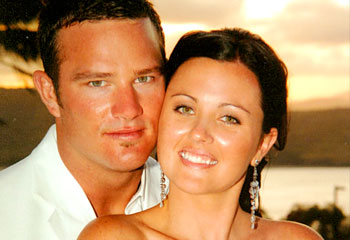
So it makes sense that today’s sibset should also be a family with twins, and as I’ve been a bit slack with the celebrity sibsets, it’s time to feature another famous Australian and their family.

Brodie Holland is a former AFL footballer who is best known for playing with the Collingwood Magpies. He retired in 2008, and now plays suburban football. He has taken part on Dancing with the Stars, where he made the final four, has appeared in advertisements, been a panellist on the AFL Footy Show, and made the obligatory cameo appearance in soap opera, Neighbours.

Brodie married Sarita Stella, a former model from game show, The Price is Right, in 2008, and in 2010 they had a daughter named Stevie.

In March, Sarita gave birth to their identical twin boys, Kip and Bowie, who were 10 weeks premature. Since that time, the boys have been in and out of hospital.

Kip was born with anaemia, and required open-heart surgery, and Bowie was at risk because he received too many red-blood cells while in the womb; this condition is called twin anaemia-polycythemia sequence (TAPS), and affects one-in-twenty identical twins who share the same placenta.

After a long stay in ICU, Kip had to be rushed back to hospital when he stopped breathing due to severe reflux. Later, both babies were admitted to hospital with bronchitis.

Clearly, it’s been a testing time for the Holland family; Brodie says he and Sarita are both positive thinkers by nature, but they couldn’t help but consider the possibility their sons might not make it. Their daughter Stevie was less than 11 months old when the twins were born, so they had three children under the age of one to take care of – just like Sam and Lyndall Mitchell, who also had twins in March with health complications, and a baby less than one year old.

Kip and Bowie are now doing well, putting on weight, and only require monthly check-ups. Brodie says that they feel very lucky, and even though the feeding and changing seems never-ending, he loves every minute of it.

Kip is a short form of Christopher, or any name beginning with Kip-, such as Kipling. Although the word kip is used to identify moves in sports such as dancing, gymnastics and trampolining, it’s most familiar as British slang meaning to have a little sleep (like nap, it is both a noun and a verb).

Bowie seems to be in honour of influential British pop star David Bowie, whose real name is David Jones. He chose his stage name from the 19th American frontiersman, Jim Bowie; Jim Bowie died at the Alamo, and gave his name to the Bowie hunting knife. You could also see Bowie as short for names such as Bowen, or a variant of Beau.

I think Kip and Bowie Holland is a very sprightly twin set – the cute perkiness of Kip makes a nice contrast to the star power of Bowie. I like the way each of the Holland children has a different vowel-sound in their name: short I in Kip, round O in Bowie, and long E in Stevie.

As Bowie is connected with singer David Bowie, and Stevie with singer Stevie Nicks, it does make you wonder if Kip is named after a popular singer from that era as well. I can only think of heavy metal vocalist, Kip Winger, or Kip Herring from punk band, The Vibrators, who don’t have quite the stature of either Bowie or Nicks.

(Story and photo from the Herald Sun, September 5 2011)

Celebrity Baby News: Kelly Landry and Anthony Bell

Tags

Model and TV reporter, Kelly Landry, and her husband, accountant Anthony Bell, welcomed their first child on Tuesday September 27; a girl named Charlize Grace.

Kelly is a reporter on Channel Nine’s travel show, Getaway, and Anthony is on the BRW Young Rich List; his accountancy firm has been listed as the most productive for eight years running.

Kelly and Anthony fell in love on their first date, which was set up by a mutual friend, and were married secretly in New Zealand last February, after only six months of dating. They held an “engagement party” at Rose Bay restaurant, Catalina, with most of the guests only realising it was actually a wedding party when video footage of the nuptials was shown.

Celebrity Baby News: Cam Shepherd and Sam Bonar

Tags

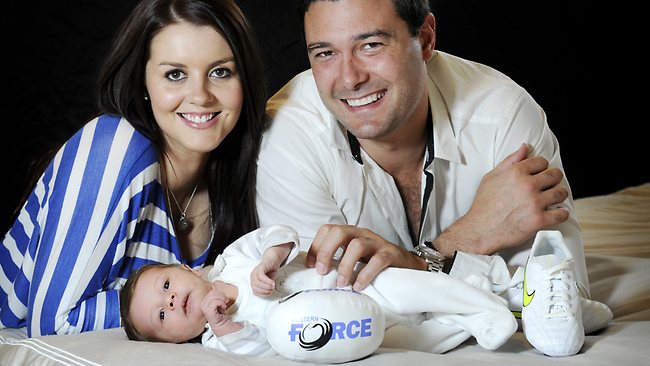
Rugby union footballer, Cam Shepherd, and his fiancee Sam Bonar, welcomed their first child yesterday – a boy named Roman Paul. Roman Shepherd weighed 3.5 kg (7 pounds 13 ounces), and was 51 cm long. His birth was announced on Twitter.

Cam Shepherd plays for Perth team Western Force in the international Super 14 competition.

UPDATE October 16

Roman spent a short period in the neonatal unit of St John of God Hospital after picking up an infection, but is now home with his parents.

Cam says that they picked the name Roman for him because it sounded strong; it was the number 1 name on Sam’s name list, and number 3 on Cam’s. After seeing Sam go through 13 hours of labour, Cam decided that Sam’s first pick was their only option. They both love the name.

Cam and Sam’s wedding is planned for December 2012.

(Story and photo from The Sunday Times, October 15 2011).

Celebrity Baby News: Daniel and Kelly Giansiracusa

Tags

, ,

AFL player, Daniel Giansiracusa, and his wife, Kelly, welcomed their son Otis, on September 8. Otis joins big sister Ruby Iris, who is nearly 3, and his birth was announced on Twitter.

Intriguingly, Otis Giansiracusa was born the day before Otis Redding’s birthday, but I don’t know if that was a factor in the choice of his name.

Daniel plays for the Western Bulldogs, and he and Kelly were married in December 2007.

Ruby Anne Susie Murch: A Daughter for Cathy Freeman and James Murch

Tags

, , , , , , , ,

Cathy Freeman’s daughter was one of the most anticipated babies to be born this year, because Cathy is not only one of our greatest athletes, but also one of our most loved. Australia has been blessed with more than its fair share of fast runners, but Cathy did more than run fast – she has that charisma that draws people to her, and a smile that can light up, not just a room, but an entire stadium.

Her sporting achievements are well-known and add up to a stellar career. She began running aged five, won her first gold medal at the age of eight in Brisbane, and was encouraged by her family to pursue her dream of becoming an Olympic athlete. She won her first international gold medal for the women’s relay at the Commonwealth Games in Auckland, 1990; this made her not only the first Aboriginal gold medal winner at a Commonwealth Games, but also the youngest, as she was only 16. To commemorate her achievement, she was awarded Young Australian of the Year in 1990. In her acceptance speech, she said that she ran for all Australians, but particularly for Aboriginal Australians, whom she hoped to inspire to reach their own goals.

Cathy’s childhood dream came true in 1992, when she became the first Aboriginal Australian to compete at an Olympics Games, in Barcelona. She won double gold at the 1994 Commonwealth Games, and in 1996 received her first Olympic medal when she won silver in the 400 metres in Atlanta. Three subsequent Grand Prix victories and her taking first place at the 1997 World Track and Field Championships in Athens confirmed her status as world champion over 400 metres. In 1998, she received the Australian of the Year Award for her athletic achievements. To date, she is the only person who has ever been awarded both Young Australian of the Year and Australian of the Year.

The 2000 Olympics in Sydney were expected to be the jewel in her crown, and she was chosen to light the Olympic flame at the opening ceremony. Cathy didn’t disappoint, as she won her first Olympic gold medal for the 400 metres, and after the race, did her victory lap carrying both the Australian and Aboriginal flags as a symbol of national reconciliation. This had to gain the special permission of the International Olympic Committee, because although the Aboriginal flag is officially recognised in Australia, it isn’t a national flag, and isn’t recognised by the IOC. Cathy later explained that the carrying of both flags was the culmination of a promise that she had made to herself when she was 16, and just beginning her international career.

Further honours came her way: she received the Olympic Order, the Arthur Ashe Courage Award, the Laureus Sportswoman of the Year Award, and the Order of Australia Medal all in the same year, 2001. After her retirement, she devoted herself to many charitable causes, most notably the Cathy Freeman Foundation, which encourages indigenous children to stay in school and succeed academically.

Catherine Astrid Salome Freeman had become not just an athlete, not just an Olympian, not just a gold medallist, but also a spokesperson, a community leader, a role model, an icon, an inspiration, a star. Her success was beyond the wildest dreams of the little girl who had won primary school sports day races in Queensland.

A couple of years ago I watched an episode of genealogy show, Who Do You Think You Are?, featuring Cathy Freeman. She already knew that her grandfather, Frank Fisher, was a famous rugby league player from an Aboriginal mission, known for being a fast sprinter and a fierce competitor on the field, but was surprised to find her great-grandfather, Frank Fisher senior, served in World War I as a member of the Light Horse. She discovered that she had both English and Chinese ancestry on her mother’s side, and that her mother’s family had been sent to a Palm Island penal settlement for being too independent. They were to remain there for four generations – a place so strictly controlled that Cathy’s mother Cecelia was not allowed to visit family members for Christmas; this was in 1963.

As Cathy read the documents connected with her family history, she shed tears of rage and frustration on behalf of her ancestors. She said that if she had known all this when she was an athlete, she would have run even faster, and her running would have been fuelled by anger. Cathy has a tattoo on one bicep that reads Cos I’m Free, and she realised that her freedom was a historically recent thing.

Despite her magnificent public success, her private life was filled with drama, turmoil and even scandal. But as Cathy explained in an interview: “I might be a champion athlete but that doesn’t make me a champion person. Why shouldn’t my personal life be just as difficult and troublesome as any other woman’s? God, the mistakes I have made and the tears I’ve shed . . . Apart from a certain God-given talent I firmly believe the reason I achieved so much is that running was my escape from a chaotic personal life. Athletics was my refuge, something I could lose myself in.”

Fortunately, her chaotic love life got a lot happier and more stable when she met fund manager James Murch at a charity ball – a man that Cathy describes as “fantastic, fabulous, sexy, beautiful, gorgeous”, and also her best friend. In April 2009, Cathy and James were married in a Ba’hai wedding ceremony that included traditional indigenous elements. They were very open about wanting children as soon as possible, and said they were willing to adopt if necessary.

Cathy dropped a hint that she might be pregnant in September last year, during a ceremony to mark the tenth anniversary of the Sydney Olympic Games. She made a comment about her memory living on through her “unborn children and their children”. After she was questioned what she meant by that, her thought was, “Oh dear, what have I said?”. Pictures of her looking plumper, and a suddenly cancelled charity run across Sydney Harbour Bridge only fuelled speculation.

The pregnancy was officially announced in February, and it was also revealed that pregnancy had triggered gestational diabetes, which is said to run in Cathy’s family, and which Aboriginal women have a higher risk of getting. She had to inject herself with insulin four times a day, and after always being so fit and healthy, it was hard for her to adjust to the idea of her body failing her. In fact, in photos taken during the last few months of her pregnancy, Cathy looks noticeably tired and unwell, although she was able to continue going to the gym.

Her daughter Ruby Anne Susie was born on July 8, and we are told that the delivery went smoothly and both mother and baby were healthy. On July 11, she posted photos of Ruby on her website, and said on Twitter that she was recovering well and loving being a new mum. By the end of July, she was back at work promoting children’s sport.

Ruby was the #1 name last year in Victoria, where the Murch family live, and Cathy and James may well have picked it simply because they love it. However, this pretty gemstone has historically been often used as a name in the indigenous community, and there are several famous Aboriginal women called Ruby, including singer-songwriter, Ruby Hunter; political activist Ruby Langford Ginibi; and Ruby Hammond, the first Aboriginal woman political candidate in South Australia.

I think the middle name Anne may be in tribute to Cathy’s older sister, Anne-Marie, who was born with severe cerebral palsy and spent most of her life in a home for the disabled. Cathy always said that she had to run so fast because Anne-Marie couldn’t move her hands and feet at all, and that Anne-Marie has been a constant inspiration in her life – not just the wind beneath her wings, but a tornado. Anne-Marie died when Cathy was sixteen. The second middle name, Susie, is after James’ mother, who sadly passed away before she could ever meet Cathy.

I must confess that I admire Cathy Freeman a great deal, and basically I would have loved any name she chose for her daughter. I think Ruby Anne Susie is a bright, smiley, sunshiney name that’s cute as a button and also honours loved ones – two completely biased thumbs up!

(Photo from Cathy’s Freeman’s website)

Ludwig Mateo and Zion Wellington – Boys Name Combinations from The Gap Casting Call

Tags

Arthur Dylan

Arthur Raphael

Cooper Jackson

Enrique John

Indiana Luke

Isaac Emmanuel

Jack Leopold

Jag Michael

Jake George

Jan Waldo

Jaydrian Sierre David

Jeremiah Tyler

Jesse Jayden

Joshua Tyler

Julian Jethro

Kristopher Vincent

Levi Jagger

Levi Marc

Lourds Angelo

Lowel Jacob

Ludwig Mateo

Nicholas Charles

Noah Bonifacio

Nyak Adrian

Oliver Bruce

Roman Preston

Thomas John

Trey Jasper

Tristan James

Yuan Lorenzo

Zion Wellington