• About
  • Best Baby Names
  • Celebrity Baby Names
  • Celebrity Baby Names – Current
  • Celebrity Baby Names – Past
  • Featured Boys Names
  • Featured Girls Names
  • Featured Unisex Names
  • Links to Name Data
  • Waltzing on the Web

Waltzing More Than Matilda

~ Names with an Australian Bias of Democratic Temper

Waltzing More Than Matilda

Category Archives: Famous Names

Famous Name: Orpheus

12 Wednesday Feb 2014

Posted by A.O. in Famous Names

≈ 3 Comments

Tags

famous nameksakes, Greek names, mythological names, name history, name meaning

(c) Lady Lever Art Gallery; Supplied by The Public Catalogue Foundation

The big news this week was the release of Australian convicted drug smuggler Schapelle Corby, who has spent the last nine years in a Balinese prison, but is now out on parole, with the proviso that she continue living in Bali where she can be supervised.

To coincide with this event, Channel Nine put on the television movie Schapelle. There’s a lot of interesting names connected with the movie – Schapelle for starters – but the one I was drawn to was Orpheus, because Orpheus Pledger plays Schapelle’s half-brother James. If the name Orpheus Pledger sounds familiar, you may have seen him on Neighbours.

Orpheus was a musician and poet in ancient Greek mythology. He was venerated as the greatest of all poets and musicians and called “the father of song” – according to one tale, it was the god Apollo himself who gave Orpheus his golden lyre and taught him to play it. Poets told how Orpheus’ music could charm the birds, wild beasts and fish, make trees and rocks dance, and change the course of rivers.

The most famous story about Orpheus involves his wife Eurydice, a tree nymph. At their wedding, Eurydice was attacked by a lustful satyr, and in her efforts to escape, she fell into a nest of vipers and suffered a fatal bite on the foot. Orpheus was the one who discovered her body, and in his grief, he played such sad songs that all the nymphs and gods wept for him. They were moved to such pity that the gods advised him to try to get his wife back by travelling to the Underworld.

Once he was in the Underworld, Orpheus sang before the god Hades and his wife Persephone. For the first and only time, their hearts went out to him in his plight, and they agreed that Eurydice would be allowed to return with him. There was just one condition: Orpheus must walk ahead of her, and never look back until they reached the upper world.

Orpheus did what they asked, but once he was in our world, in his desperate anxiety he looked behind to see if Eurydice was still following. Eurydice disappeared, this time forever, and Orpheus’ heart broke all over again.

This descent to the Underworld connects Orpheus to a myriad of mythological figures from different cultures, including Egyptian, Japanese, Sumerian, Hindu, Christian, Norse, Mayan and Celtic, who travel to the land of the dead. The figure who makes this journey returns with some “gift” from the Underworld, marking them as more than mortal, and suggesting the possibility of overcoming death.

The story of Orpheus has inspired many works of art. Creators as diverse as Neil Gaiman, Stravinsky, Jean Cocteau, Franz Liszt, Tennessee William, Poul Anderson, and Andy Partridge have drawn on his myth. Nick Cave and the Bad Seeds have a satirical retelling of the legend called The Lyre of Orpheus, and Baz Lurhmann’s film Moulin Rouge is partly inspired by the story, using music from Jacques Offenbach’s Orpheus in the Underworld.

Towards the end of his life Orpheus turned away from worshipping any but Apollo. Previously, he had been a devotee of the god Dionysus, deity of wine, madness and ecstasy, but now he gave his allegiance to the god of poetry. While venerating the sun god at dawn, Orpheus was killed by Maenads, the frenzied female worshippers of Dionysus, to punish him for his apostasy. It is said that the women began by throwing sticks and stones at him, but the trees and rocks refused to hurt Orpheus, so that the enraged women tore him to pieces with their bare hands.

Orpheus’ head continued to sing mournfully, and his lyre still played; they floated down a river until they reached the sea, and the winds and waves carried them to the Island of Lesbos. Here the head was buried and a shrine built to Orpheus, where people could consult an oracle. The Muses, the nine goddesses of the arts, pieced Orpheus together, and gave him a burial near Mount Olympus, where nightingales sang over his grave. The Muses placed his golden lyre in the sky, where we can still see it as the constellation Lyra. At last his soul was free to join his bride Eurydice in the Underworld.

The name Orpheus is believed to be derived from an ancient root meaning “to put asunder, to separate”. It could be translated as “darkness”, “fatherless, orphaned”, and “to lament, to sing wildly, to cast a spell” – all these come from the same root word. Putting them together, they sum up Orpheus’ story rather well, because his wildly tragic songs enchanted all who heard them, and he continued to sing as he descended into darkness.

Orpheus is an unusual name with a great deal of power. The story of Orpheus is that of a great artist whose powers were magical – one who defied death itself in his quest for love, and who suffered a cruel fate when he turned towards the light. It is a name which has weight, and even a certain amount of heaviness, but it has everything: Art, Magic, Love, Death, Suffering, Light. It doesn’t seem too strange, as it fits in with currently fashionable names such as Orlando and Orson.

POLL RESULT
Orpheus received a fairly good approval rating of 65%. People saw the name Orpheus as haunting and poetic (20%), beautiful and unusual (17%), and usable, as it fits in with current trends (15%). However, 14% thought the story of Orpheus was too heavy, violent, or depressing.

(Picture shows Orpheus by John Macallan Swan)
Famous Name: Boris

05 Wednesday Feb 2014

Posted by A.O. in Famous Names

≈ 2 Comments

Tags

Bulgar names, Bulgarian names, famous namesakes, fictional namesakes, name history, name meaning, nicknames, royal names, Russian names, saints names, Slavic names, Turkic names, UK name popularity, US name popularity

604458-23038244-860c-11e3-8f28-96b14e4a5093

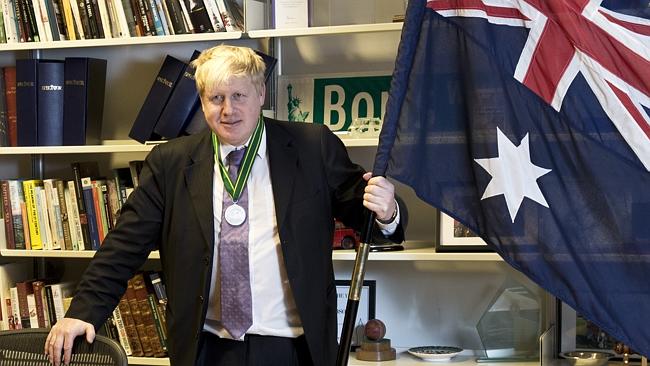
Last week we covered the name of the Australian of the Year for 2014, and here we have another name associated with the Australia Day Foundation awards. At an Australia Day dinner in London, Boris Johnson, the Mayor of London, was declared Honorary Australian of the Year for 2014.

The flamboyant mayor confessed to being a “bit baffled” by his unexpected award, which he received for promoting Australian interests, and campaigning to create visa-free labour and migration between Australia and the United Kingdom. You’ve probably heard on the news that the numbers of Antipodeans in the UK has dropped significantly, partly because of new restrictions on Australians in gaining visas and employment. It’s hard to believe that Londoners want more Australians, but Mayor Johnson will endeavour to get them more anyway.

In case you are dubious about Boris Johnson’s qualifications for being an Australian (even an honorary one), he spent a working holiday in Australia as a teenager, and seems to have had a pretty good time, and he has relatives here. He also points out that as there are more than 200 000 Australians living in London, he can be counted as mayor of the 12th largest Australian city.

Boris is a Bulgar name derived from the Turkic nickname Bogoris, usually interpreted as “short, small”, although other suggestions are “wolf” and “snow leopard, lynx, tiger”. Another theory is that the name ultimately comes from an Iranian source, and may mean “god-like”. Boris can also be used as a short form of the Slavic name Borislav, meaning “one who fights for glory”.

The first person known to history with this name is Prince Boris I, a 9th century ruler of the First Bulgarian Empire who converted to Christianity and adopted the name Mikhail. Boris seems to have converted chiefly for diplomatic and political reasons, for as a Christian ruler he could make more alliances and expand his personal power. However, his conversion also appears to be have been sincere, and at the end of his reign he abdicated to become a monk: he kept having to come out of monkish retirement to quash pagan rebellion and help out with major crises. After his death, he became known as the first Bulgarian saint.

The name Boris became particularly associated with Russia, because Boris II, the great-grandson of Boris I, formed an alliance with the Rus’ Slav prince, Sviatoslav I of Kiev. Sviatoslav’s son Vladimir the Great had a son named Boris – it is conjectured that his mother may have been Bulgarian, possibly even Boris II’s sister. The Kievan Rus’ converted to Christianity, and Boris (son of Vladimir) was later martyred and canonised, becoming one of the Russian Orthodox Church’s most revered saints. The name Boris became used in surrounding countries, and was a traditional name amongst royalty and nobility.

Boris is often seen by English-speakers as an almost comically stereotypical Russian name, and is a favourite choice for fictional villains. This may be a hangover from the Cold War, when Russians were generally portrayed as menacing “baddies”, or it may be because of the English movie star Boris Karloff (real name William Pratt), best known for playing sinister roles in Hollywood horror films such as Frankenstein and The Mummy.

Despite the name being familiar due to high profile Borises such as German former tennis champ Boris Becker, Russian author Boris Pasternak who wrote Dr Zhivago, former Russian President Boris Yeltsin, and Boris Johnson himself, Boris continues to sound rather exotic.

Boris is one of my early name loves, and I think this is because of the novels for young people by Mary Rodgers called Freaky Friday and A Billion For Boris (there’s another book in the series, but my school library didn’t have it). I liked A Billion For Boris better than Freaky Friday, probably because the idea of a psychic television which can make you rich was more appealing to me than swapping lives with my mother (an incredibly selfless workaholic whose life would be daunting for me to take on even as an adult).

Boris is (as you may remember) the tomboyish Annabel’s neighbour, childhood playmate and proto-boyfriend, and as you may also recall, during the course of Freaky Friday, it transpires that Boris’ name is actually Morris – he just has a nasally voice and says his Ms as Bs. Perhaps Mary Rodgers intended this to be a Oh thank goodness – he has a totally normal name! moment, but I was horrified.

To me, Morris was a hideous old man name, reeking of mothballs and uncoolness. Maybe in America in the early 1970s, Morris was considered an okayish name for a nerdy teenager (it only left the US Top 1000 in the 1990s), but by the time I got to read the books, it was nausea-invoking. Luckily, everyone continues to call Morris Boris for the rest of the books.

I thought then, and still tend to think now, that Boris is an awesomely hip yet huggable name, with a lot going for it. Interestingly, the name Boris has risen in popularity in the UK since the 1990s, and last year it made the Top 1000 again at #901 – it debuted there in 2004 at #999.

Political figures are not usually helpful to the popularity of their own names, yet Boris Johnson does not seem to have negatively affected the name Boris. Its rise in the UK may have more to do with the growing number of emigrants to Britain from Russia and Slavic countries though. Indeed, Boris Johnson has Russian ancestry, and describes himself as a “one man melting pot”, so melting a bit of Australian into the pot won’t be any great stretch for him.

POLL RESULT
Boris received an approval rating of 21%. 40% of people saw it as ugly and lumpy, 17% thought it was only suitable for people with Russian or Slavic heritage, and 12% preferred the name Morris. Only 5% of people thought the name Boris was handsome and exotic. 7% were put off the name by Boris Johnson.

Famous Name: Adam

29 Wednesday Jan 2014

Posted by A.O. in Famous Names

≈ 4 Comments

Tags

Akkadian names, Arabic names, Assyrian names, Babylonian names, Biblical names, hebrew names, Irish names, modern classics, name history, name meaning, name popularity, popular names, royal names, Scottish names, Semitic names

14Goodes2501_Hero

On Australia Day, the Australian of the Year for 2014 was announced, and it was AFL footballer Adam Goodes, who plays for the Sydney Swans.

Adam is a distinguished player who has experienced a great deal of success in his field, and is very active in the Sydney Indigenous community, providing leadership and guidance to troubled Indigenous youth, including those in youth detention. He has also started an Indigenous football academy, and he and his cousin Michael O’Loughlin founded the Goodes O’Loughlin Foundation which focuses on education, employment and healthy life choices. Adam plans to use his profile as Australian of the Year to help raise awareness of the push for constitutional recognition of Indigenous Australians.

Adam is well known to almost everyone, even those with no religious background, as the first human mentioned in the Bible. He was created by God out of earth, and placed in the paradisical Garden of Eden with his companion Eve. However, they were expelled from the Garden after disobeying God’s commands, and went on to become founders of the human race. Adam is also seen as the first human in Islam, which regards Adam as a prophet, and the first Muslim.

In Hebrew, āḏām is the word for “human”, and the creation story in Genesis uses this word for “mankind”, “humanity”, “a man”, and the person named Adam, in an ambiguous and complex play of meaning. The word comes from a Semitic root meaning “red, fair, handsome”, and is also the masculine form of the Hebrew word adamah, meaning “ground, earth”, related both to the word for “red”, and the word for “blood”. In Arabic, Adam means “made from the earth”.

Putting this all together, the impression one gets from the name is that Adam is a signifier for all men, and all humans, a handsome man created from the red earth, the colour suggesting that of life-giving blood (the clay become flesh), and perhaps even implying that his skin tone was meant to be a coppery, reddish-brown – which seems reasonable given the story’s Middle Eastern origins.

Genesis emphasises Adam’s connection to the earth, for God set Adam to work on the land, to get his hands dirty, scratched by thorns in order to eat and survive. God’s curse was From dust you were made and to dust you will return, meaning that humans were condemned to mortality (still echoed in the funeral service, ashes to ashes, dust to dust). Adam is separated from nature by his humanity, yet inextricably part of nature and still tied to the earth and his earthy instincts – a succinct précis of the human condition.

The first historical person named Adam we know of is an Assyrian king named Adamu, who lived more than 4000 years ago (it is probably worth mentioning that the Babylonian creation story, many centuries older than Genesis, has the same main features, and there the first man is named Lullu, meaning “man, human being”; when the Assyrians copied the story, they called the first man Adami, possibly from the Akkadian for “to make”).

The name Adam came into common use in Britain in the Middle Ages, and became more popular after the Protestant Reformation. It has particularly strong ties to Scotland, perhaps because it was used to Anglicise the Irish name Áedán (an older form of Aidan), traditional amongst the royal houses and nobility of medieval Scotland.

Although in rare use early in the twentieth century, Adam only began charting in Australia in the 1940s. It raced up the charts during the 1950s to make #51 for the 1960s. It peaked in the 1980s at #10, and is still in the Top 100. It is #66 nationally, #55 in New South Wales, #57 in Victoria, #99 in Queensland, #44 in Western Australia, #84 in Tasmania, and #60 in the Australian Capital Territory.

Adam is a modern classic, yet it is an ancient name – the oldest name in the Book! Brief, strong and primal, it is earth and blood, flesh and bone, birth and death, innocence and guilt: the most human of all names, with its hands buried in the soil and its soul yearning for paradise. Adam is all man and all men; we are all Adam and the children of Adam; and yet Adam is still too archetypal to ever become an Everyman name.

It will always remind us of the first man in one of the oldest stories we know. A man whose descendants have continued to live and die and toil and survive – and remember paradise.

POLL RESULT
Adam received an approval rating of 64%. 30% of people saw it as strong and handsome, but 14% thought it was too common.

Famous Names: Rhonda and Ketut

15 Wednesday Jan 2014

Posted by A.O. in Famous Names

≈ 4 Comments

Tags

Balinese names, dated names, fictional namesakes, locational names, name history, name meaning, name popularity, names from songs, names of rivers, unisex names, Welsh names

aami-remix-642-380

For months, Australia has been avidly following the unfolding romance between a redheaded Australian woman who meets a flirtatious local on a Balinese beach, a younger man working as a waiter. Sparks fly, there is unmistakable chemistry … and something surely happens between them. Or has Rhonda read too much into the situation, her brain fevered from multiple viewings of Eat, Pray, Love?

It sounds like the plot of a soap opera, but we’ve actually been watching a clever series of car insurance commercials from AAMI. Rhonda saved so much money on car insurance that she was able to take a holiday, and it was here that the handsome Ketut pressed exotic drinks on her, and who knows what else. Back home, she found herself gaining the attentions of smooth Trent Toogood at her high school reunion, leaving us wondering if her destiny was Trent or Ketut … or if Ketut was nothing more than a fantasy.

The advertisements have captured the public’s imagination, with several fan pages on Facebook to Rhonda and Ketut’s relationship, and tribute tee-shirts being sold in Bali, reading Rhonda is Mine, and Kiss Me Ketut. Lines such as “beautiful brake foot” and “hot like a sunrise” have entered the popular consciousness, and according to Twitter denizens, if you’re australian and rhonda and ketut aren’t your otp there is something v wrong with u.

The public were invited to vote on whether Rhonda should find eternal bliss with either Trent or Ketu (happy singledom not an option). There wasn’t much doubt that there was nothing v wrong with us and that Team Ketu would win, and Rhonda finally found the happy ever after to her unexpected holiday romance.

AAMI have sensibly said they aren’t going to continue Rhonda and Ketut’s story in case people get sick of it, so the loved-up couple won’t be buying home insurance together or honeymooning in Fiji with all the money they saved on life insurance. AAMI increased its sales by almost 22% during the Rhonda-Ketut story line, so it’s a happy ending for them as well.

Rhonda is a modern Welsh name taken from the Rhondda Valley, once a coal mining area with strong community ties. It has been used since the 19th century, and Rhondda seems to be the older spelling in Wales. Rhondda may be from the Welsh for “recite, recount”, related to the Old Irish for “speech”, with the suggestion that the River Rhondda is speaking aloud (in the sense that we say a river is “babbling”). The meaning is usually glossed as “noisy”.

Rhonda first charted in the 1920s, debuting at #371. It soared in popularity during the 1930s, and made the Top 100 by the 1940s. It peaked in the 1950s at #29, then declined; even the Beach Boys song Help Me Rhonda doesn’t seem to have aided it in the 1960s (it may have possibly damaged the name’s popularity). It was out of the Top 100 by the 1970s, and hasn’t charted since the 1990s.

Rhonda is a dated name, with even the Rhonda in the AAMI commercials given the name when it was already out of fashion (the character is 39). Yet there’s something rather appealing about Rhonda – it’s not glamorous, but seems honest, friendly and good-hearted. I don’t think the advertising campaign is likely to boost Rhonda, but it’s a likeable 1950s name with plenty of warmth.

Ketut (keh-TOOT) is a common Balinese name meaning “fourth-born”; like all Balinese names, it is unisex. It’s a suitably humble name for Rhonda’s hunky waiter, but both characters have names which reference cars – Ketut sounds like the toot of a horn, while Rhonda has Honda in it.

We fell in love with Rhonda and Ketut – but do we love their names?

POLL RESULTS
Rhonda received an approval rating of 44%, and Ketut was further behind with 34%.

Famous Names: Mitchell and Mervyn

08 Wednesday Jan 2014

Posted by A.O. in Famous Names

≈ 8 Comments

Tags

english names, famous namesakes, historical records, Irish names, locational names, modern classic names, name history, name meaning, name popularity, nicknames, popular names, Scottish names, surname names, Welsh names

Mitchell Johnson Media Session

It is a glorious summer: beautiful weather, cloudless blue skies, golden sunshine, and best of all – victory in that ancient international cricketing rivalry, the Ashes. Having lost to England during the northern summer of 2013, Australia was itching to get revenge back on home soil, and we did.

For whatever reason, England failed to perform in Australia and had already lost the Ashes 3-0 by Christmas. The series finished 5-0 to Australia, only the third time in history such a whitewash has been achieved, and England lost all 10 wickets in every innings of the Test series – the first time either side has forfeited 100 wickets in Ashes history. Little wonder we celebrated wildly at the Fan Day at the Opera House yesterday, having taken down the team which was ranked #1 in the world and were favourites to win.

Mitchell Johnson was awarded Man of the Series, the fast bowler having taken 37 wickets – the most in an Ashes series in Australia since the late 1970s. Even more remarkably, this was a comeback with a vengeance, because not so long ago, Mitchell was battling injury, his self-confidence destroyed by the jeering of England’s fan base, the Barmy Army (a jingle about Mitchell Johnson is still their most popular song, and I use the word “song” extremely loosely).

Quite apart from his Barmy Army-silencing performance (and I use the word “silencing” with great poetic licence), Mitchell’s value during the Ashes was as a psychological weapon, because he seemed to strike fear into the English batsman. His secret? Maybe it was his training, the confidence brought about by fatherhood, or a pep talk by a war hero, but nearly everyone was convinced it was his moustache. No, seriously.

Mitchell grew a moustache for Movember to raise money for men’s health, but was urged not to shave it off at the end of the month by selector Mervyn “Merv” Hughes, who sports an impressive moustache himself. A public campaign and $10 000 donation from Gillette convinced Mitchell to keep the mo, and it seemed to work.

I was following the Ashes on the BBC, and was interested to see how much that moustache affected the English: it was the “menacing mo”, “the terrifying tash”, “the malicious moustache”, “the fearsome face-fuzz”, or the “horrid horseshoe”, and Mitchell became the “pantomime villain”. Add one moustache, and suddenly this shy, quiet man had become a bowling nightmare to the English.

Unfortunately, Mitchell says the magic mo must go for now, but confirms he will be growing it back when we take on South Africa later in the summer. I just hope it hasn’t lost its mystique by then.

Mitchell is an English surname of several origins. It is said that the first people with this surname came from Mitcham in Surrey (now in the outer suburbs of London), with Mitcham meaning “big town, large settlement”. Mitchell can also be derived from the male name Michel, a Middle English nickname for a large person, meaning “big”. The Normans had the name Michel, but in their case it was a form of the name Michael.

The surname Mitchell must have moved north during the medieval period, as it became particularly associated with Scotland. The Gaelic form of the name is based on the name Michael. In Ireland, Mitchell is used to Anglicise the Irish surname Ó Maoilmhichil, from the clan name Uí Mhaoilmhichil, meaning “devotees of the Archangel Michael”.

The surname Mitchell is one very well known in Australia, for Sir Thomas Livingstone Mitchell was a 19th explorer of Australia. Originally from Scotland, he joined the British army, where he distinguished himself during the Napoleonic Wars, then became a surveyor in New South Wales. He explored New South Wales, Victoria and Queensland, and published two books which included close and sympathetic observations of the Aboriginal people he encountered.

He is also remembered for the invention of the boomerang propeller, and being the last man in Australia to challenge anyone to a duel (both marksmen missed, so nobody was hurt). Many things are named after him, including the town of Mitchell and the Mitchell River in Queensland, the Mitchell Highway between Queensland and New South Wales, and Major Mitchell’s Cockatoo, a very beautiful bird with soft pink and grey markings, much admired by Sir Thomas Mitchell.

Mitchell has been used as a boys name since at least the 16th century, and turns up early in Scotland. There are many men named Mitchell in Australian records, and lots of them emigrated from Scotland or have Scottish surnames.

The name Mitchell has charted in Australia since the 1940s. It climbed gently until the 1980s (the decade when Mitchell Johnson was born), when it suddenly shot into the Top 25 from virtually nowhere. It peaked in the 1990s at #12, and is still stable in the Top 100. Currently it is #45 nationally, #77 in New South Wales, #53 in Victoria, #51 in Queensland, #41 in South Australia, #37 in Western Australia, and #91 in Tasmania.

Australia is the only country in the world where the name Mitchell is still in the Top 100, and with the success of Mitchell Johnson, I don’t see it going anywhere soon. It’s an Australian modern classic with a lot of history, and a name we hold dear.

Mervyn is derived from the Welsh name Merfyn, of uncertain meaning. It is sometimes said to be a variation of the Welsh name Myrddin (“sea fortress”), from whence we get Merlin, but it may mean “big”, and is often translated as meaning something along the lines of “famous to the marrow”. There was a medieval Welsh king named Merfyn.

The name Mervyn was #66 in Australia in the 1900s, and peaked in the 1920s at #44 before declining and leaving the Top 100 in the 1950s. It hasn’t charted since the 1970s. It may be dated, but it is a uniquely Australian name, because in no other country (not even Wales) did it ever become popular.

Two names more Australian than you might have thought – but which one do you prefer?

POLL RESULTS
Mitchell received a respectable approval rating of 68%, while people were less enthusiastic about Mervyn, with an approval rating of 22% – not one person loved the name Mervyn.


Famous Name: Chaxiraxi

18 Wednesday Dec 2013

Posted by A.O. in Famous Names

≈ 6 Comments

Tags

Canarian names, Caribbean names, epithets and titles, Guanche names, Hispanic names, Latin American names, mythological names, name history, name meaning, saints names, Spanish names

Our-Lady-of-Candelaria-fp

The weather is getting hot now (super hot in some areas), and we are drawing close to the Summer Solstice, which is on Saturday. That means Christmas holidays are just about to start, or have started already! It seems like a good time of year to look at a name connected with both sunshine and Christmas.

I only learned about this name a few months ago, when I saw a Tasmanian chef called Chaxiraxi Afonso Higuera on television. Her first name absolutely fascinated me, and I had to look it up. I don’t know quite what I was expecting, but it wasn’t this.

Chaxiraxi is a goddess known as the Sun Mother in the Guanche religion – the Guanches are the indigenous people of the Canary Islands. The Canaries belong to Spain, but are situated just off the coast of north-west Africa, and the Guanches are Berbers, who have been in the Canary Islands for perhaps as long as three thousand years. The Guanches are not considered to exist in the Canaries as a distinct ethnic group, but traces of their language and culture can still be found there, and DNA tests show a high proportion of the Canarian population have Guanche ancestry from their female lineage.

Not much is known of the Guanche religion, but their gods lived in the mountains, descending to hear the prayers of the people. The Guanche worshipped outdoors, under trees, in caves, or near mountains, with particularly fervent prayers during times of drought. Chaxiraxi was their mother goddess, who had a special festival on August 15 to celebrate the end of the harvest season, and at that time food such as milk, flour made from roasted grains, and sheep and goat’s meat was shared.

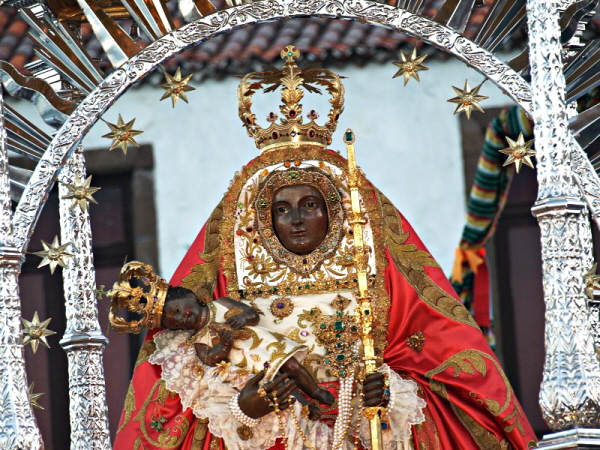
The worship of Chaxiraxi continued in the Canaries in a very surprising way. According to legends told by early Spanish settlers, a statue of the Virgin Mary, holding a child in one hand, and a green candle in the other, was discovered on a beach on the island of Tenerife by two Guanche goatherds. This was in 1392, before the islands were conquered by Spain.

One of the goatherds tried to throw a stone at the statue, but his arm became paralysed; the other tried to stab it with a knife, but ended up stabbing himself. The goatherds took the strangely self-protecting statue to their king, who recognised it as a sacred artefact, and kept it in his cave-palace, where it was venerated as an image of Chaxiraxi. Holding a baby it was easy to see it as a mother goddess, and holding a source of light made it easy to associate with a goddess who gave birth the sun.

Later, a Guanche who had been enslaved by the Spanish and converted to Christianity recognised the statue as the Virgin Mary. The Guanche then took it to another cave, where it was venerated as the Virgin. Archaeologists tell us this cave was a holy site long before Mary was worshipped there, and many of the Guanche continued to see the statue as Chaxiraxi, or saw no difference between the mother goddess and the mother of God. When the islands were conquered, the Spanish believed that the Guanche were already Christians because of the statue.

In 1497 the first mass was performed at the holy shrine, and a hermitage built there in 1526, in the name of Our Lady of the Candelaria – the name coming from the candle the statue held. The Virgin of Candelaria was named as the patron saint of the Canary Islands in 1559, and prayers to the Virgin have been offered against epidemics, plagues, droughts, and volcanic eruptions. Her feast day is August 15 – the same day as Chaxiraxi’s festival, which coincides with the Assumption of the Virgin Mary.

The original statue was lost in 1826 when a tsunami carried it out to the sea from which it emerged; the present statue is a copy, always dressed in rich robes and jewels (it’s possible the one lost at sea was a copy of the original).

The cult of Our Lady of Candelaria swept through the Americas when the Spanish conquered there; Canarians emigrating to America took the veneration of the Virgin with them, in the same way Irish emigrants would later bring Saint Patrick. She is venerated in South America and the Caribbean, where she is the patron saint of cities in Bolivia, Colombia and Puerto Rico, and there is an image of her in San Antonio, Texas. The oldest Catholic cathedral in the United States is in San Fernando, Texas, and here you may see a replica of the statue of the Virgin of Candelaria.

As the veneration of the Virgin of Candelaria spread through different countries, she came to be identified with other goddesses. In the Caribbean religion of Santeria, with the Yoruba storm goddess Oya; in the Brazilian Canomble, with the love goddess Oshun; in Hinduism with the goddess Kali, who rules over Time; and in the indigenous religion of the Andes, with Pachamama, the mother goddess of earth, time, fertility and the harvest – the closest one to Chaxiraxi.

The original statue is believed to have been a medieval Gothic image of the Virgin Mary, perhaps from the prow of a wrecked ship. Because it had dark skin and held a baby, it was one of the so-called Black Madonnas which were created in medieval Europe.

Their significance is not understood, but one theory is that they were an attempt to convert images of ancient earth goddesses to Christian use. Many goddesses such as Isis and Demeter were depicted with black skin, because black is the colour of rich soil, and thus a sign of fertility. The Black Madonnas appear around the time of the Crusades, when Europeans travelled to the Middle East and Africa, and possibly saw such images.

If so, it would seem that the Virgin of Candelaria is a pagan mother goddess become Christian icon become multiple pagan goddesses merged with a Christian symbol of womanhood and motherhood.

I have seen the meaning of Chaxiraxi given, by scholars of the Guanche language, either “she who holds up the heavens”, or “bearer of he who possesses the world”. It is often translated as “sun mother” or “mother of the sun” but that is the goddess’ title rather than the meaning of her name.

Because Chaxiraxi is so strongly associated with the Virgin Mary (and could even be seen as her forerunner, paving the way for easier acceptance of Christianity), the name was acceptable for use by Catholics. It isn’t that rare in the Canary Islands, although more common as a middle name. The name is also used in the Caribbean and Latin America, in areas where the veneration of the Virgin of Candelaria, and Canarian culture, has spread.

I’m not completely sure on how Chaxiraxi is pronounced. In some South American countries it seems to be something like hahk-see-rahk-see, but the lady I saw, who is originally from the Canary Islands, only used the first half of her name, and pronounced it SHAH-see, which sounds much softer and prettier.

This is a genuinely unusual name, very ancient and redolent of a mysterious power. Chaxiraxi has managed to not only survive, but flourish, and attract followers from a range of religions and cultures around the world. So much of her history is myth and legend, but the mother of the sun who has become merged with the mother of the Son, while not being submerged by her, continues to captivate me.

POLL RESULT: Chaxiraxi received an approval rating of 58%. People saw the name Chaxiraxi as being an interesting part of African-Spanish culture (22%), and fascinating and mysterious (19%). However, people also thought it was too difficult to spell and/or pronounce (17%), and too strange and complex (13%). Only one person considered Chaxiraxi too pagan for Christians, but too Catholic for pagans. 

(Picture shows the statue of the Virgin of Candelaria in her shrine at Tenerife)

Famous Name: Orry

11 Wednesday Dec 2013

Posted by A.O. in Famous Names

≈ 2 Comments

Tags

famous namesakes, Manx names, Old Norse names

Annex-Kelly-Gene-An-American-in-Paris_02

Lots of movies get released just before Christmas – are you looking forward to seeing any? This puts me in mind of one of Australia’s Hollywood success stories, who was born on New Year’s Eve 116 years ago.

Orry Kelly (known as Jack) was from Kiama, in the Illawarra region of New South Wales, the son of a gentleman’s tailor. After studying art in Sydney, he worked as a tailor’s apprentice and window dresser before sailing to New York. Kelly got his start painting murals in nightclubs, which led to a job illustrating titles for Twentieth Century Fox, and designing costumes and sets for Broadway shows, but at times he ran speakeasies, designed bathrooms, and sold hand-painted ties to make a buck.

He also fell in love with a young British vaudeville actor named Archie Leach. Jack and Archie lived together in a Manhattan apartment for about five years, and they both moved to Los Angeles at the start of the 1930s to further their careers. Things went well for each of them. Archie changed his name to something more debonair, and became one of Hollywood’s leading men, while Jack worked for all the major Hollwood studios as a designer, under the professional name Orry-Kelly.

Orry-Kelly designed costumes for famous actresses such as Bette Davis, Rosalind Russell, Katharine Hepburn, Marilyn Monroe, and Ava Gardner. He worked on almost 300 films during the Golden Age of Hollywood, with classic movies like 42nd Street, The Maltese Falcon, Casablanca, and Oklahoma! on his CV. He won three Academy Awards for Best Costume Design – for An American in Paris, Cole Porter’s Les Girls, and Some Like It Hot. That makes him our biggest Oscar winner ever.

Kelly was a great wit, very outspoken, and had little respect for authority. Unlike many in Hollywood at the time, he made no secret of his homosexuality. It’s said that people either loved or hated Jack Kelly: a lot of the hate was because he was an alcoholic, and a mean drunk. The drinking eventually killed him, and the pallbearers at his funeral included Tony Curtis, Billy Wilder, and Cary Grant – otherwise known as his old flat-mate Archie.

Intriguingly, Kelly wrote a memoir towards the end of his life, titled Women I’ve Undressed. While publishers apparently loved the book, it never reached print – allegedly because of legal issues. Rumour has it that Cary Grant’s estate put a stop to it. The whereabouts of this book is now unknown, and just one chapter survives, filled with amusing anecdotes and sharp observations about the famous ladies he worked with.

Earlier this year, Orry-Kelly featured as part of the Australian Centre for the Moving Image (ACMI) Hollywood Costume exhibition in Melbourne, together with a programme of classic films featuring his costumes. Director Gillian Armstrong, who has made films based on famous Australians such as Florence Broadhurst and Nancy Wake, is planning a cinema documentary about his life. It won’t be out for Christmas, but I’m very much looking forward to it.

Orry Kelly’s father, William, was originally from the Isle of Man, and he gave his son a name from the island’s history.

Godred Crovan was a medieval Norse-Gaelic ruler of Dublin, and King of the Isles. He invaded the Isle of Man three times before he took it, and the last time used a certain amount of trickery. He hid 300 men in the woods overnight, and when the men of Man rose at dawn, ready to do battle against Godred’s forces, 300 men charged out of the woods and ambushed them. Godred later took Dublin as well, but was driven out at some medievally vague date, and the next year died of a medievally vague ailment – pestilence.

Godred is derived from Old Norse names which combine the word for either god or good with the word for peace, so that the name can be understood as “god’s peace” or “good peace”. The modern English form of the name is Godfrey. In Manx, the name is Goree or Gorry, and then became Orry.

The legend of King Orry survives in Manx folk songs, and they call the Milky Way “the great track of King Orry” in his honour. A Stone Age barrow is known locally as King Orry’s grave, although Godred was apparently buried on the island of Islay, in Scotland. According to legend, King Orry was the founder of the Tynwald, the ancient Norse-based Parliament of the Isle of Man, which has existed for over a thousand years, and thus claims to be the oldest continuous parliament in Europe.

Just to confuse things, the name Godred was traditional amongst Norse nobility, and the “King Orry” of Manx legend may very well be a much earlier Godred, although traditionally Godred Crovan is considered to be the “real” King Orry. If you are starting to get the impression that King Orry’s existence is more in the realm of fiction than of fact, mentally hand yourself a kewpie doll and a stuffed animal.

The name Orry commemorates a fascinating character from Manx folklore, and has a nicknamey feel that doesn’t seem out of step with current trends. If you squint a little, it doesn’t seem too different from familiar names like Harry and Ollie. There’s something about it I can’t help liking – it seems cheerful and rugged, and even rather cuddly. And if your son doesn’t like being called Orry, he can always go by Jack.

POLL RESULT: Orry received a surprisingly high approval rating of 75%. People saw the name Orry as cute (29%), an interesting part of Manx history and culture (20%), and not much different to familiar nicknames like Ollie (17%). However, 9% thought the name was ugly, and a further 9% considered it weird. Only one person preferred either Godred or Godfrey.

(Photo shows Gene Kelly and Leslie Caron wearing Orry-Kelly’s Oscar-winning costumes in An American in Paris)

Famous Name: Diamantina

04 Wednesday Dec 2013

Posted by A.O. in Famous Names

≈ 2 Comments

Tags

famous namesakes, gemstone names, Greek names, honouring, Italian names, locational names, middle names, nicknames

Ancher-Mortlock-Woolley-joins-Conrad-Gargett-Riddel-415086-xl

On December 10, it will mark 154 years since Lady Diamantina Bowen arrived in Queensland. Lady Bowen was the wife of Queensland’s first governor, Sir George Bowen, whose history and surname we looked at in Brisbane Suburbs That Could Be Used as Boys Names.

Lady Bowen was born in the beautiful Ionian Islands of Greece as the Contessa Diamantina di Roma, one of a large aristocratic family descended from Venetians who had occupied the Ionian Islands for centuries as part of the Republic of Venice. Diamantina’s father was President of the Ionian Senate, and had been appointed Poet Laureate of the islands by Queen Victoria, as the Ionian Islands were then a British Protectorate.

Diamantina grew up in a privileged world, was well-educated, and familiar with government, politics and diplomacy. She was described as pretty, slender and graceful, with an attractiveness which came from her expression rather than her features. She was softly-spoken, and had a slight accent when speaking in English; in private, she spoke Italian. Despite their Italian origins, the di Roma family were members of the Greek Orthodox faith.

Diamantina married Sir George Bowen, government secretary to the islands, in 1856, and came to Brisbane three years later with her husband and baby daughter. The Bowens were met by a crowd of 4000 people, waving both the Union Jack and the Greek flag in welcome. Brisbane was enormously excited by their arrival, and there was a 21-gun salute, triumphal arch, fireworks, and days and days of speeches, proclamations, and general celebrations in their honour.

One of the ladies who presented Diamantina with a bouquet described her as a “beautiful Greek fairy princess … stepped out of a poetry book”. The poor fairy princess had endured agonising sea sickness to get there, and being pregnant, possibly morning sickness as well; it must have been an ordeal for her to stand there in the heat and humidity through all the official events.

Brisbane itself must have been something of a culture shock to Diamantina, because although it was a prosperous and thriving community, it was also a pioneering one, and would have seemed rough and dusty, with lumpy roads, and an unreliable water supply.

However, Lady Bowen fulfilled her duties as Queensland’s first lady admirably. She became a celebrated hostess,  and her balls and dinner parties were the highlight of the social scene. She held a weekly salon, and her graciousness is credited with raising the general tone of Brisbane society.

Diamantina was an accomplished pianist and singer, and her interest in music led to her to become a patroness of the arts. When their official residence was ready, the Bowens had an elegant and spacious sandstone mansion to entertain in. Diamantina personally supervised the layout of the grounds, and assisted with the development of the surrounding Royal Botanic Gardens.

Diamantina was also a tireless worker for charity. She started the first Sunday School for children, and helped found the Lady Bowen Lying-In Hospital, Brisbane’s first maternity hospital, and forerunner to the Royal Brisbane Women’s Hospital. She was also a patron of an orphanage, and of a hospital for the incurably ill. At a time marked by religious bias, Lady Bowen befriended the Sisters of Mercy, and became a patroness of their fund-raising efforts.

Diamantina was greatly admired in Brisbane, and became a great favourite. She was dignified without being aloof, and reserved without being cold, but most of all kind-hearted and compassionate, with a genuine desire to be accessible. I suspect it was because of his wife that Sir George was asked to stay on a further two years after his term of office ended.

When the Bowens finally left after eight years, 120 of Brisbane’s married women presented Diamantina with a diamond necklace, and 120 of its single women gave her a gold bracelet studded with emeralds. Diamantina must have made several close personal connections in Brisbane, because we are told that she wept bitterly as she left, becoming so distraught that she had to be carried to the ship to New Zealand, where Sir George had been appointed governor-general.

Diamantina had many namesakes in Queensland – not only Roma Street and Lady Bowen Park in Brisbane, but the town of Roma, the Diamantina River, and Diamantina Island are just a few that come to mind.

Diamantina returned to Australia when Sir George became governor of Victoria. Now in her mid-life, Diamantina’s manner had become impressively regal, and she was seen as exotic, fascinating, and elegant. A Melbourne gossip columnist noted her dazzling black eyes, flawless creamy complexion, and lovely figure. She inspired awe and respect, but never again did she seem quite so loved as she had been in Queensland, where she was a figure of poetry and romance.  

Diamantina is a variation of the Greek name Diamanto, meaning “diamond”. The name is used in both Greece and Italy, and can be pronounced dee-uh-man-TEE-nuh or dy-uh-man-TEE-nuh. The obvious nicknames are Di, Dee and Tina, although Diamond, Mandy and Monti seem possible as well. Lady Bowen’s eldest daughter had Diamantina as her middle name, and she went by Nina, which appeals to me most of all.

Diamantina is a pretty and elaborate girl’s name which belonged to one of the most charming ladies to grace our shores. Diamantina was a heroine to the Greek community in Queensland, and this could be a Greek heritage choice, or a Queensland heritage choice. If the name Diamond seems too hard or crude, Diamantina may seem softer and more elegant.

POLL RESULT: Diamantina received an approval rating of 42%. 36% of people thought it was too fussy and frilly, although 21% saw it as romantic and fairytale.

(Picture shows the governor’s official residence, now Old Government House, in the grounds of Queensland University of Technology, where it is used for functions)

Famous Names: Narcissus and Echo

27 Wednesday Nov 2013

Posted by A.O. in Famous Names

≈ 6 Comments

Tags

car names, english names, famous namesakes, fictional namesakes, flower names, Greek names, locational names, Metamorpheses, mythological names, name history, name meaning, nature names, Ovid, plant names, saints names, unisex names, vocabulary names

EchoandnarcissusAs you probably know, a selfie is a photo that someone has taken of themselves, usually with a phone or webcam, for the purpose of being uploaded to social media. Last week, the Oxford English Dictionary named selfie as the Word of the Year for 2013, noting that use of the word has increased by 17 000% in the past 12 months.

Research from the OED has shown that the word selfie is of Australian origin, with the first recorded use of it in an ABC Online forum in 2002. A user named Hopey posted a photo of his bottom lip, which had been injured when he fell over while drunk, apologising for the photo’s poor quality, as it was only “a selfie”.

Judy Pearsall from the OED explains: “In early examples, the word was often spelled with a -y, but the -ie form is more common today and has become the accepted spelling. The use of the diminutive -ie suffix is notable, as it helps to turn an essentially narcissistic enterprise into something rather more endearing. Australian English has something of a penchant for -ie words –barbie for barbecue, firie for firefighter, tinnie for a can of beer – so this helps to support the evidence for selfie having originated in Australia.”

To celebrate this Australian word being so warmly embraced by the rest of the world, there were just two names that came to mind, suggested by Judy’s appraisal of a selfie as “essentially narcissistic”, and because a photograph is a visual echo of its subject.

In Greek mythology, Narcissus was a stunningly handsome young hunter, the son of a river-god and a nymph. Many admired him, but he proudly spurned them all, even driving his suitors to suicide – Narcissus is said to have cruelly placed a sword in the hands of one despairing fellow, with the obvious suggestion of what he was to do with it.

The best known version of his story is given by the Roman poet Ovid in his Metamorpheses. He tells of a talkative mountain nymph named Echo, whose chattering tongue annoyed the goddess Juno one too many times.

Echo had a habit of waylaying Juno with one of her long-winded stories while Juno’s hubby Jupiter enjoyed himself with some nymph or other, giving the nymph plenty of time to escape Juno’s wrath. Juno cursed Echo’s voice, so that she could never speak until someone else did, and when they did, Echo could only repeat what they said, or even just the last few words of their speech.

The luckless Echo happened to see Narcissus wandering in the woods, and fell madly in love with his beauty. She longed to eloquently tell him of her passion, but could only repeat his own phrases back to him, which just annoyed Narcissus. She embraced him, and he angrily told her to get her hands off – he would rather die than be caressed by such a thing.

The rejected Echo was so ashamed and unhappy that she ran into the mountains and hid herself in the wilderness, until she wasted away with unrequited passion. Only her voice was left, which you can still hear in the hills sometimes – a voice which repeats your own phrases back to you, called an echo.

Meanwhile the gorgeous Narcissus continued to reject many nymphs and youths, always in the nastiest way possible, until one of his victims lifted their hands to heaven and implored the gods that one day Narcissus might fall in love, and his love be denied, so that he could know the pain of rejection in his turn. The prayer was answered by Nemesis, the goddess of divine retribution, who punishes arrogance.

One day, hot and tired from hunting in the heat of midday, Narcissus stopped by a pool in the forest to get a drink. Seeing his own reflection in the pool, he became entranced by its beauty – those starry eyes! Those flowing golden locks! That ivory skin and rose-leaf complexion! Those sweet pouting lips! Yep, the vain Narcissus had fallen head over heels at last – with his own image.

He tried to embrace the stranger in the water, and to kiss him, but although the reflection seemed as eager as he, smiling whenever he did, and offering his lips in return, Narcissus just ended up with his face in the pool, wet and ridiculous. Tortured by his love, he longed to die, and wasted away by the pool, consumed by hopeless desire for himself.

The nymph Echo, now a mere disembodied voice, still loved Narcissus, even as his beauty withered away with neglect. She watched over him, and pitied him in his plight, managing to whisper a sad “Farewell!” to him as Narcissus died and said goodbye to his reflection. Death brought him no relief, for in the afterlife he continued to miserably roam, gazing at his reflection in the underworld River Styx.

When Narcissus’ grieving sisters came to collect him for his funeral, they found his body had disappeared, and in its place was a beautiful narcissus flower, its drooping head still looking into the pool at its own reflection. Narcissus is a genus of spring bulbs native to the woodlands of Europe, West Asia and North Africa. Coming in a range of colours from white through the yellows to dark orange, we call some varieties daffodil or jonquil.

The meaning of Narcissus is not known – the Greeks understood it as meaning “I grow numb”, as if it was related to the words narcotic and narcolepsy. However, this isn’t accepted by scholars, who believe it is more likely an attempt to understand a word originally from another language, most likely one from the Near East. Although legend says the flower’s name came from the mythological character, it is almost certainly the other way around, with Narcissus named after the flower.

The name Narcissus wasn’t uncommon in ancient Greece. Narcissus was a wrestler who assassinated the Emperor Commodus, and is one of the inspirations for the movie Gladiator starring Russell Crowe, while another Narcissus was the slave of the Emperor Claudius, became his personal secretary, and had a lot of influence over him. There are several saints named Narcissus – Narcissus of Athens is mentioned in the New Testament as one of the Seventy Disciples of Christ, and an assistant to Saint Andrew.

In modern times, men named Narcissus were more likely named after one of the saints than the mythological character. However, Narcissus is actually far more common as a female name, because of the flower. One of its many issues is that it has given rise to the term narcissism, to describe inflated self-regard – although some degree of narcissism is probably normal and healthy, when it goes overboard it is seen as a psychological disorder.

The word Echo is from the Greek and means “sound”. Just as with Narcissus, the mythological nymph is named after the word, and not the other way around. There is a Marvel superheroine named Echo (she’s deaf), and Echo is the lead character in the television drama series, Dollhouse. An Australian connection is Echo Point in the Blue Mountains, a wonderful place to hear echoes. Because an echo is a vocabulary word as well as a character, it has sometimes been given as a name to boys, and OH- ending names are fashionable for both sexes. One of the issues with the name Echo is that there is a car called the Toyota Echo.

Can you imagine ever using one of these names from Greek mythology?

POLL RESULT: Narcissus received an approval rating of 13%, making it the lowest-rated boys name of the year, and the lowest-rated name overall. Echo did much better, with an approval rating of 58%.

(Picture shows the 1903 painting Echo and Narcissus by John William Waterhouse, illustrating the story by Ovid )

Famous Name: Clive

20 Wednesday Nov 2013

Posted by A.O. in Famous Names

≈ 3 Comments

Tags

english names, famous namesakes, locational names, name history, name meaning, name popularity, surname names

SiegeOfCuddalore1783

It’s time for another name from the recent election, and yet another case where voting went down to the wire in a safe seat. This time it was the Division of Fairfax, which is a rural seat on Queensland’s Sunshine Coast, comfortably in Liberal hands since 1990.

The reason it received so much attention is because of Queensland multi-millionaire Clive Palmer, who contested the seat for the Palmer United Party, a new political party. Well, newish – the United Australia Party was the precursor to the Liberal party, and this reboot had the Palmer tacked onto it to avoid conflict with the Uniting Australia Party (all I know of them is from their Facebook page, where they vaguely promise to get real people into politics, and make common sense decisions once elected – which they never were).

Clive Palmer is the sort of larger-than-life multi-millionaire who tends the hog the headlines and is almost certain to end up being described as a “colourful character” or even an “eccentric”. A couple of his recent ideas have been to construct a life size replica of the RMS Titanic, to be named Titanic II, and to create a simulation of Jurassic Park filled with animatronic dinosaurs. He has also courted controversy by sharing some of his conspiracy theories, such as Rupert Murdoch’s ex-wife being a spy, and Greenpeace being funded by the CIA.

Clive won the seat of Fairfax by a mere 7 votes; as this was less than 100 votes, it automatically triggered a full re-count. After this second count, Clive won by 53 votes, making Cathy McGowan’s win in Indi by over 400 votes look like a landslide victory. He holds the seat by a margin of 0.03%, making it one of the closest results in Australian political history.

Some hope we are in for an entertaining time from our new MP, while others fear he will make our Parliament a laughing stock. However, eager followers of Australian baby name news may be more interested that Clive and his wife are expecting a baby, and will be welcoming their second child together before Christmas. Stay tuned!

Clive is an English surname derived from clif, the Old English for “cliff”. In Old English, the word didn’t just mean cliffs as we think of them, but was also applied to gentler slopes and riverbanks. The surname can also be through association with any of the several English places named Cliff or Cliffe.

Clive has been used as a boy’s name since the 16th century, and during the 18th it began to be given in honour of Major-General Robert Clive, otherwise known as Clive of India. Sir Robert Clive was a British officer who established the military and political supremacy East India Company in Bengal; although he had no military training, his bravery during the Siege of Arcot made him a hero in Britain by the age of 25.

Clive was one of the key figures who helped secure India, and all its vast wealth, for the British crown. As that wealth and power was consolidated during the 19th century, it is little wonder that the name Clive continued to be associated with the might of the British Empire. Even today, you may have a container of Clive of India curry powder in the pantry, bearing Robert Clive’s likeness.

The name Clive was #80 in the 1900s, and peaked in the 1910s at #73. It left the Top 100 in the 1950s, and hasn’t ranked since the 1970s. It doesn’t seem like a coincidence that British rule ended in India after World War II, and that by the 1970s, our view of India as a nation had radically changed, while we now felt much more uneasy about British imperialism in general.

Clive is a solid, masculine name which still has an air of authority to it. It also possesses quite a number of attractive namesakes, such as charming broadcaster Clive James, hunky actor Clive Owen, horror writer Clive Barker, witty comedian Clive Anderson, comedy actor Clive Dunn, art critic Clive Bell, rugby league star Clive Churchill (after whom the Clive Churchill Medal is named), and Clive Staples Lewis, who wrote The Chronicles of Narnia.

As Clive peaked a century ago, it has more of a vintage feel than a dated feel. It’s not fashionable, but it doesn’t seem unusable. However, it is a truth universally acknowledged (by name nerds) that politics almost never does a name any favours, and whatever else he does in Parliament, Clive Palmer most likely won’t help the fortunes of the name Clive. The sun has set on the British Empire – but has the name Clive also disappeared into the sunset? Only time will tell.

POLL RESULT: Clive received an approval rating of 46%. 22% of people saw the name Clive as horribly dated, and an “old man” name, while 16% thought it sounded intelligent and practical. 14% were put off the name because of Clive Palmer. Nobody thought the name Clive sounded snooty or stuck-up.

(Picture shows the Siege of Cuddalore, in which Robert Clive also distinguished himself; drawing by Richard Simkin, 1890)

← Older posts
Newer posts →

Enter your email address to follow this blog

Categories

Archives

Recent Comments

A.O.'s avatarwaltzingmorethanmati… on Zarah Zaynab and Wolfgang…
Madelyn's avatarMadelyn on Zarah Zaynab and Wolfgang…
JD's avatardrperegrine on Can Phoebe Complete This …
A.O.'s avatarwaltzingmorethanmati… on Rua and Rhoa
redrover23's avatarredrover23 on Rua and Rhoa

Blogroll

  • Appellation Mountain
  • Baby Name Pondering
  • Babynamelover's Blog
  • British Baby Names
  • Clare's Name News
  • For Real Baby Names
  • Geek Baby Names
  • Name Candy
  • Nameberry
  • Nancy's Baby Names
  • Ren's Baby Name Blog
  • Sancta Nomina
  • Swistle: Baby Names
  • The Art of Naming
  • The Baby Name Wizard
  • The Beauty of Names
  • Tulip By Any Name

RSS Feed

  • RSS - Posts

RSS Posts

  • Celebrity Baby News: Melanie Vallejo and Matt Kingston
  • Names from the TV Show “Cleverman”
  • Can Phoebe Complete This Sibset?
  • Zarah Zaynab and Wolfgang Winter
  • Baby, How Did You Get That Name?
  • Celebrity Baby News: Media Babies
  • Celebrity Baby News: Adelaide Crows Babies
  • Celebrity Baby News: Chris and Rebecca Judd
  • Names at Work: Name News From the World of Business and Employment
  • Celebrity Baby News: Sporting Round Up

Currently Popular

  • Rare Boys Names From the 1950s
  • The Top 100 Names of the 1940s in New South Wales
  • Girls Names From Stars and Constellations
  • Celebrity Baby News: Livinia Nixon and Alistair Jack
  • Celebrity Baby News: Jacinta Allan and Yorick Piper

Tags

celebrity baby names celebrity sibsets english names famous namesakes fictional namesakes honouring locational names middle names name combinations name history name meaning name popularity name trends nicknames popular names saints names sibsets surname names twin sets unisex names

Create a free website or blog at WordPress.com.

Privacy & Cookies: This site uses cookies. By continuing to use this website, you agree to their use.
To find out more, including how to control cookies, see here: Cookie Policy
  • Subscribe Subscribed
    • Waltzing More Than Matilda
    • Join 517 other subscribers
    • Already have a WordPress.com account? Log in now.
    • Waltzing More Than Matilda
    • Subscribe Subscribed
    • Sign up
    • Log in
    • Report this content
    • View site in Reader
    • Manage subscriptions
    • Collapse this bar
 

Loading Comments...